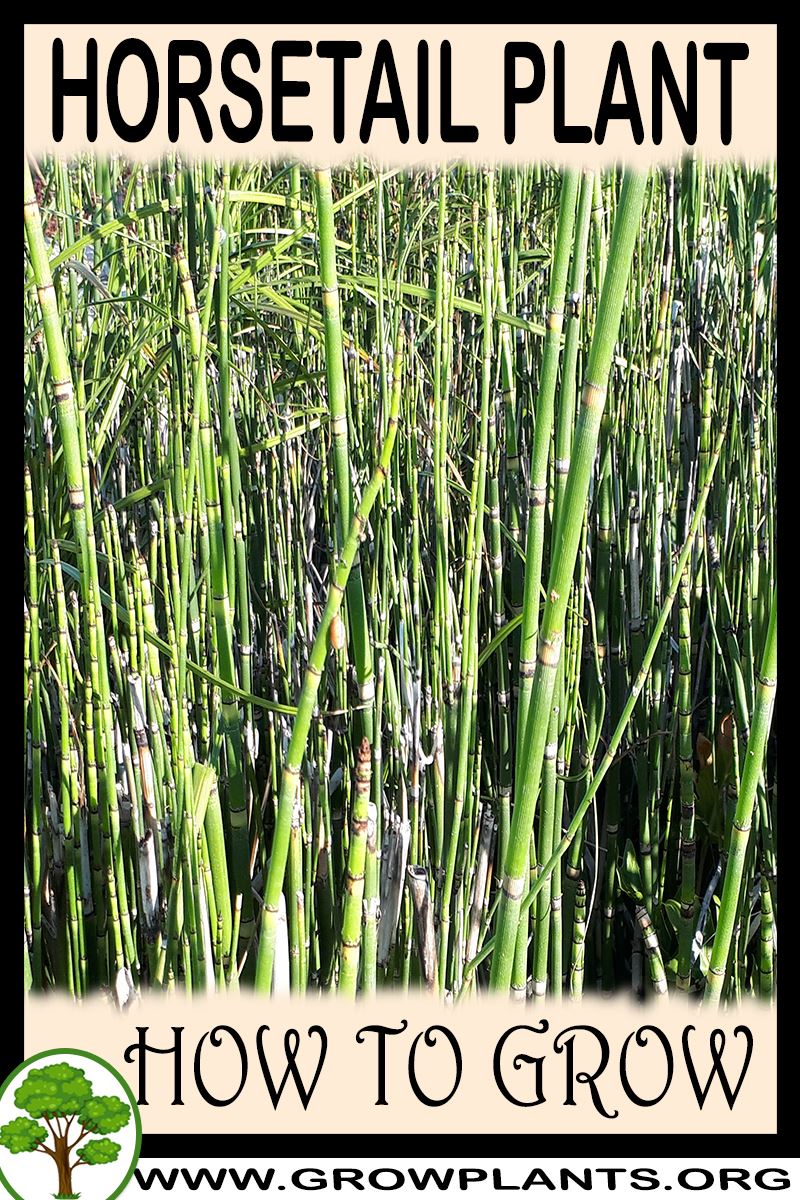
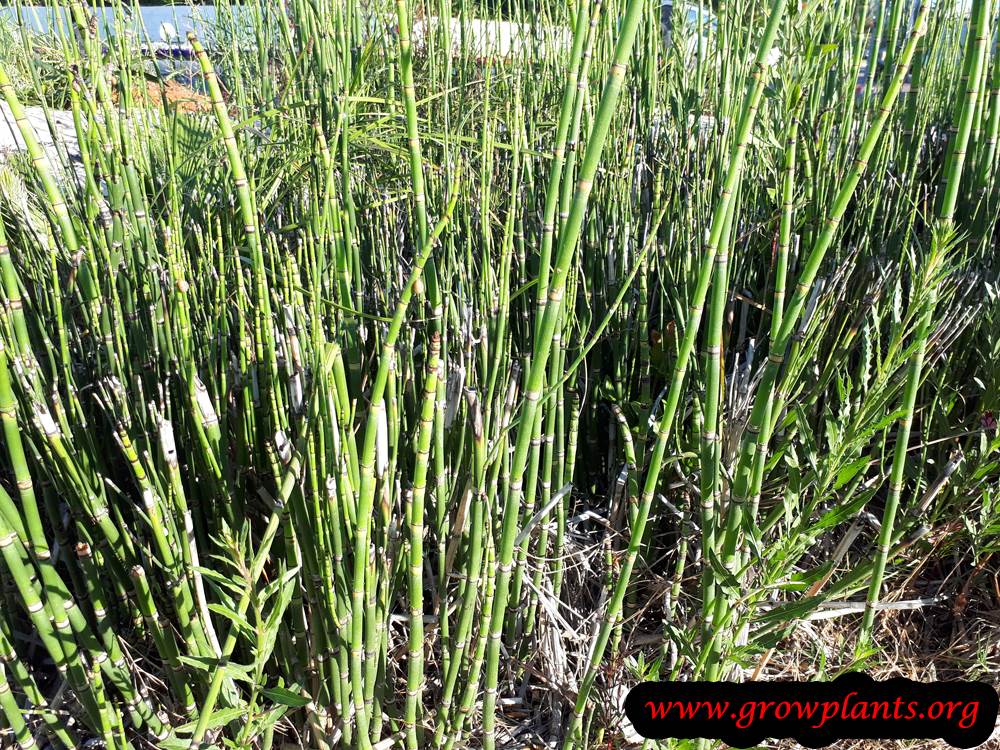
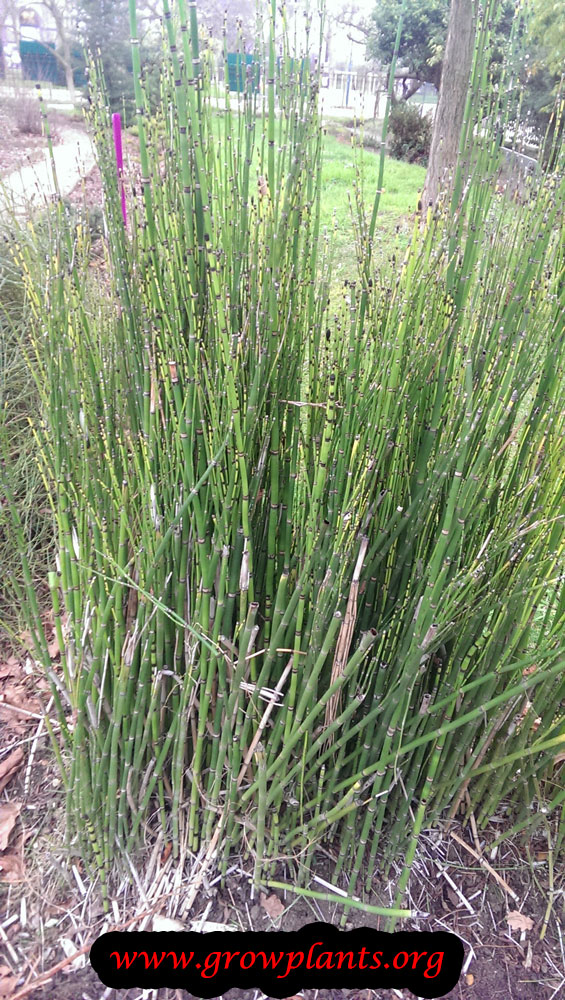
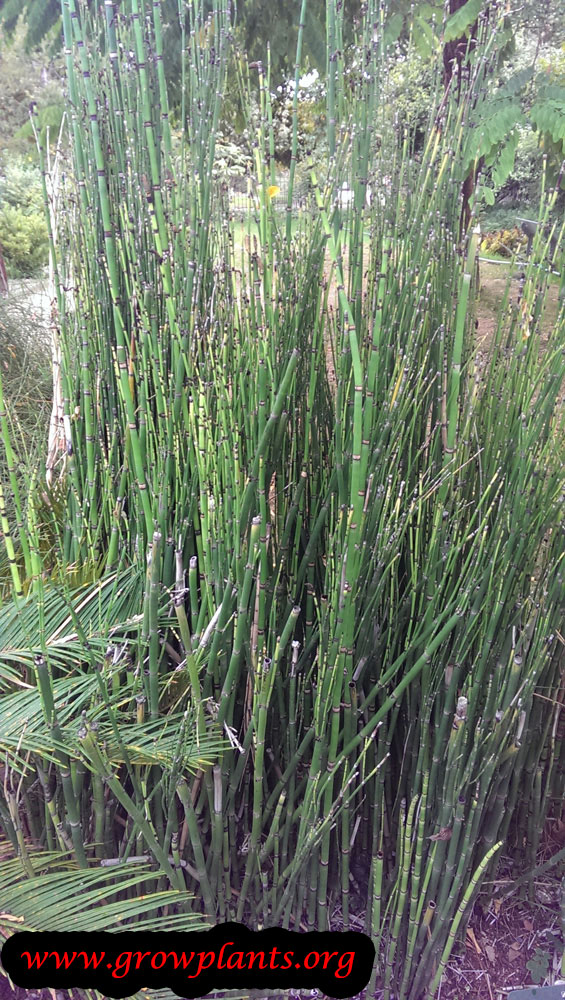
Plant Profile & Key Characteristics
Overview: Horsetail plant (Equisetum) (Snake grass) is a primitive evergreen or deciduous perennial 30-90 cm (12-36 in) tall, with hollow, jointed green stems and no true leaves. A fast-spreading marginal/wetland plant, it is grown as an architectural ornamental and used medicinally, but is aggressively invasive.
Quick Specifications
| Specification | Attribute |
|---|---|
| Plant Type / Life Cycle | Perennial (spore-bearing fern ally) |
| Foliage Type | Evergreen or deciduous |
| Mature Size | 30-90 cm (12-36 in) tall |
| Growth Rate | Fast |
| Root System | Rhizomatous (deep, aggressively spreading) |
| Toxicity | Toxic if ingested – contains thiaminase, poisonous to livestock |
| Hardiness | USDA zone 3+ |
Growth Form & Structure
- Height & Spread: 30-90 cm (12-36 in) tall, spreading indefinitely by rhizomes – best contained in pots or with root barriers.
- Growth Habit & Form: Upright hollow jointed green stems forming dense colonies; no true leaves.
- Lifespan & Maturity: Long-lived perennial.
Anatomy & Physical Features
- Leaves & Foliage: Reduced to tiny scales at the stem joints; the hollow green jointed stems photosynthesise.
- Flower Characteristics: Non-flowering – reproduces by spores from brown cone-like tips (strobili), not true flowers.
Primary Uses & Landscape Value
- Functional & Ornamental Roles: Grown as a striking architectural plant for ponds, bog gardens and containers; has traditional medicinal and scouring uses.
Care Guide: Planting, Soil & Watering
Overview: Horsetail is a fast-spreading, moisture-loving perennial that thrives in wet ground and even shallow water in full sun. It tolerates most soils as long as they stay consistently wet, and spreads aggressively, so containment is wise.
Quick Care Requirements
| Requirement | Ideal Condition |
|---|---|
| Planting Season | Warm season (spring through autumn) |
| Growth Rate | Fast |
| Soil Type | Wet, boggy soil (tolerates poor drainage) |
| Water Need | High – keep the soil wet at all times |
Planting & Establishment
- Best Planting Season: Plant from spring through autumn into wet ground or at a pond margin.
- How to Plant:
- Hole Preparation: Dig a hole matching the root ball; because it spreads by rhizomes, plant into a sunken pot or lined bed to keep it contained.
- Soil Amendments: No special enrichment is needed – it grows in most soils, and a heavy, water-retentive medium actually suits it.
- Planting Depth: Set the crown at soil level or just below; it also grows happily with its base standing in shallow water.
- Growth Speed & Expectations: Growth is fast and vigorous – expect rapid spread, so site it where the running rhizomes can be controlled.
Soil, Watering & Drainage Care
- Soil Mix & Drainage Needs: Unlike most plants, horsetail wants moisture-retentive soil and tolerates standing water; sharp drainage is not required.
- Watering Schedule & Technique:
- Young / Newly Planted: Keep the soil saturated from the start and never let a newly planted clump dry out.
- Established: Water generously and often to keep the ground wet; in containers, stand the pot in a saucer of water.
- Seasonal Adjustments: Reduce watering in cool dormancy but keep the soil damp, and increase in summer heat.
Climate, Light & Hardiness
Horsetail is an ancient, cold-hardy wetland perennial, evergreen in mild climates and deciduous where winters are colder, suited to Mediterranean, desert, subtropical, temperate, and tropical conditions. It grows best in full sun in consistently wet ground.
Quick Climate Specifications
| Climate Zones | Mediterranean, desert, subtropics, temperate, tropics |
|---|---|
| USDA Hardiness Zones | 3+ |
| Frost Tolerance | High |
| Light Conditions | Full Sun |
Sunlight & Light Exposure
Optimal Light Setup
Full sun is preferred for the strongest, most upright growth of the jointed stems.
Shade & Heat Management
Its broad climate range, including desert and tropical zones, reflects good tolerance of hot, sunny conditions where its roots stay consistently wet.
Temperature Extremes & Hardiness
USDA Hardiness & Regional Limits
Horsetail is rated from USDA zone 3 upward, an unusually wide and cold-hardy range for a wetland plant.
Cold Damage & Winter Protection
In colder parts of its range the stems die back over winter while the spreading rhizome survives underground to resprout in spring; in milder climates it can remain evergreen.
Frost Sensitivity
Overall frost tolerance is high given the plant's persistence from USDA zone 3 upward, though visible stems are lost to hard frost where it behaves as deciduous.
Wind, Humidity & Microclimate
Humidity Preferences
Horsetail needs consistently wet ground or shallow water and does not tolerate drying out.
Microclimate Recommendations
Because its spreading rhizomes are aggressive and invasive, plant it in a contained bed or sunken container to keep its spread in check.
Growing in Pots, Balconies & Indoors
Horsetail (Equisetum) is a spreading, water-loving perennial (30-90 cm) that the grower does not recommend as a houseplant. It grows well in containers – and a pot is actually the safest way to grow it, because its running rhizomes are highly invasive in open ground.
Quick Details
- Container Size: A solid pot with no drainage into the soil below, or one stood in a water tray; it likes wet feet.
- Indoor Suitability: Not a houseplant – keep it outdoors.
- Best Spot: Full sun.
- Soil & Drainage: Moisture-retentive; happy standing in water.
- Watering: Keep constantly wet.
Indoors & On the Windowsill
- Houseplant reality: The grower says no – it is an outdoor bog and water-margin plant, not a room plant.
- Safety: Horsetail is toxic if eaten (especially to grazing animals) – keep it away from children and pets, and never use it as food or forage.
On a Balcony or Patio
- Contain it: Excellent in a sealed water feature or a sturdy pot on a sunny balcony; because it spreads aggressively by rhizome, always keep it in a closed container and never let it escape into beds or waterways.
Choosing the Pot, Soil & Long-Term Care
- Upkeep: Divide when congested and top up the water; it needs little feeding. Keep it contained at all times.
Fertilizing & Feeding
A very light feeder – this adaptable, spreading foliage plant thrives even in average wet soil, and heavy feeding mostly just fuels its already aggressive spread rather than improving its appearance.
Quick Fertilizing Specs
| Feeding Level | Light |
|---|---|
| Main Nutrient Priority | Minimal, balanced feeding – this plant rarely needs deliberate fertilizing |
| Best Feeding Period | Establishment and early active growth, if fed at all |
| Soil pH | Tolerates a wide range of soil conditions |
| Reduce/Stop Feeding | Skip feeding once established; ease off entirely as growth slows in cooler weather |
| Organic Options | A little organic matter worked into wet soil at planting is usually all that’s needed |
Feeding by Growth Stage
Establishment after planting
Help newly planted rhizomes settle into consistently wet soil before spreading.
| Nutrient direction | A single light, balanced feeding at planting is plenty – this plant does not need rich feeding to establish. |
|---|---|
| Timing | At planting, in a contained pot or bed with reliably moist to wet soil. |
| Frequency | One light feeding at planting is usually enough; skip additional feeding while it settles in. |
| Fertilizer types | A little well-rotted organic matter worked into the soil at planting, A light balanced fertilizer only if the planting soil is genuinely poor |
| Precautions | Keep feeding light and contained – richer feeding mainly accelerates an already vigorous, spreading rhizome system. |
Active growth
Maintain healthy, upright stems through the main growing season without encouraging excess spread.
| Nutrient direction | Minimal feeding – steady moisture matters far more than added nutrients for this plant. |
|---|---|
| Timing | Spring through summer while stems are actively growing. |
| Frequency | Feed sparingly if the planting looks genuinely weak; otherwise consistently wet soil is enough on its own. |
| Fertilizer types | No dedicated feeding in most reliably wet, organically rich soil, A light balanced feed only if growth looks notably weak or thin for the setting |
| Precautions | Avoid regular feeding in contained pond or bog pots, since this plant spreads aggressively and rich feeding only adds to the maintenance burden. |
Winter dormancy or slowdown
Let growth rest through cold weather without pushing new stems.
| Nutrient direction | None – withhold fertilizer while growth is dormant or has slowed for the season. |
|---|---|
| Timing | Winter months, or whenever top growth dies back or clearly slows. |
| Frequency | No feeding at this stage. |
| Fertilizer types | No feeding at this stage; resume light feeding, if any, only once active growth clearly restarts. |
| Precautions | Do not fertilize while growth is dormant or minimal; wait for clear new stems before feeding again. |
Nutrient Deficiency Signs & Corrections
Thin, sparse, or stunted stems despite reliably wet soil
| Possible causes | Soil that dries out between waterings rather than staying consistently wet, Genuinely poor, nutrient-depleted soil, Rhizomes overcrowded or root-bound in a container |
|---|---|
| Appears first on | New stems emerging from the rhizome |
| What to check | Whether soil moisture is actually staying consistent, How long it has been since the container or bed soil was refreshed, How crowded the rhizome mass has become |
| Possible correction | Fix moisture consistency first; only add a light balanced feed if the soil is confirmed genuinely poor. |
Stems yellowing or fading rather than staying deep green
| Possible causes | Insufficient nitrogen in depleted or very sandy soil, Too much shade for the planting location, Waterlogged, oxygen-poor soil stressing the roots |
|---|---|
| Appears first on | Lower and older stems first |
| What to check | Light levels reaching the planting, How waterlogged versus simply moist the soil is, General nutrient richness of the soil |
| Possible correction | Address light and drainage-versus-waterlogging balance first; a light balanced feed can help only if soil is confirmed nutrient-poor. |
Pruning, Training & Seasonal Maintenance
Horsetail is a rush-like perennial with hollow, jointed stems and no true leaves or persistent woody structure, so there is no structural pruning system to train – each stem is a single unbranched cane that will not re-branch if headed back. Maintenance is essentially sanitary (cutting spent or browning stems at the base) plus, more importantly, ongoing control of its notoriously aggressive, deep rhizome spread, which can be cut back at almost any time of year without affecting a bloom or crop, since the plant reproduces from spore-bearing cones rather than true flowers.
Quick Pruning & Maintenance Specs
| Pruning Tolerance | High for sanitary cutting; the rhizome itself is very hard to remove by cutting alone |
| Primary Maintenance Window | Year-round for old/damaged stems |
| Typical Frequency | Ongoing sanitary removal; rhizome containment checked at least yearly |
| Main Objective | Remove old/browning stems; prevent rhizome escape beyond its intended bed |
| Best Tool Type | Precision snips/bypass secateurs for stems; barrier/spade work for rhizome containment |
| Avoid Heavy Pruning During | No strong seasonal restriction on stem removal – the caution is about spread, not timing |
Special Growth to Remove
- Old, browning or damaged stems – cut individually at the base at ground level; new stems emerge from the rhizome, not from the cut cane.
- Rhizome growth escaping its intended area – the species is noted as aggressive/invasive with an extensive spreading rootstock; any stems appearing outside the planting zone should be removed and the rhizome barrier checked, since chopping rhizome pieces with a tiller or spade tends to multiply the infestation rather than control it – each severed segment can root as a new plant.
Container & Small-Space Pruning
Horsetail is commonly grown in a bottomless or rimmed container sunk into the ground – this is primarily a containment strategy against its aggressive rhizome, not a size-control measure, since it will fill whatever space its roots can reach. It is not suited to growing indoors as a houseplant; keep any container’s rim above soil level so rhizomes cannot escape over the top.
Tools
Precision snips or bypass secateurs for individual stem removal at the base. Loppers, saws and hedge shears are not relevant – the stems are hollow and non-woody, and there is no canopy to shear.
Tool Hygiene & Disease Risk
Routine for disease (none specific is noted), but the stems’ naturally high silica content – the reason this plant is historically called "scouring rush" – can dull cutting edges faster than typical soft-stemmed perennials, so blades may need sharpening more often. Rinse tools of rhizome/soil debris before using them elsewhere, since fragments readily re-root.
Cut Placement & Technique
Cut individual stems at ground level rather than partway up – because the plant does not branch from a headed cut, there is no benefit to cutting higher on the stem.
Heavy Pruning & Rejuvenation
Cutting all top growth to the ground is well tolerated and simply prompts fresh stems from the rhizome; it does not, however, function as rejuvenation of an overgrown planting the way it would on a shrub – the underlying rhizome, not the stems, is what determines the plant’s spread, so cutting stems alone will not control size.
Post-Pruning Care
Keep the wetland/moist soil conditions this plant needs; no extra feeding is required after cutting back stems.
Common Pruning Mistakes
- Trying to control spread by tilling or chopping the rhizome, which multiplies rather than removes the infestation.
- Expecting a headed-back stem to branch – it will not; only the rhizome produces new stems.
- Growing it in an open bed without a containment barrier, given its documented aggressive/invasive habit.
When NOT to Prune
There is no flowering or fruiting display to protect and no strong seasonal restriction; the only real caution is mechanical – avoid rhizome-disturbing cuts (tilling, chopping) when the goal is to control rather than propagate the plant.
Recommended Tools (by task)
- precision_snips – removing individual old/browning stems at the base.
- sharpener – the stems’ natural silica content dulls blades faster than typical soft perennials.
Propagation Guide
Horsetail is propagated vegetatively, matching the site’s own guidance that vegetative reproduction is necessary; dividing its spreading rhizome is by far the most practical way to start new plants. This makes it an Easy plant to propagate, since the alternative — growing from spores — is a slow, specialist technique rarely used outside cultivation of ferns and their relatives.
Quick Propagation Specs
| Best Propagation Method | Rhizome division |
| Alternative Methods | Spores (specialist, rarely used for home propagation) |
| Propagation Difficulty | Easy (division) |
| Vegetative True-to-Type | Yes |
| Best Propagation Season | Spring through autumn, per the site’s planting season |
Division, Offsets, Pups & Suckers
Dig up sections of the spreading, jointed rhizome, keeping healthy roots and at least one node with a growth point on each piece. Because the site notes this plant is aggressive and invasive, plan divisions with containment in mind (e.g., a buried barrier or planted basket) so the rhizome does not spread beyond the intended area. Replant divisions promptly at a similar depth in consistently wet soil.
Spores
Like other Equisetum species, this plant technically reproduces by spores released from the cone-like fertile stem tips rather than by seed. Spore propagation needs very fresh spores sown onto a sterile, constantly moist surface with good light, and establishment is slow; this is a specialist method and division remains the practical choice for most growers.
Bloom & Flower Guide
Quick Details
- Bloom Season: Spring into summer, when the fertile cones appear
- Flower Appearance: No true flower – a yellow-brown, cone-shaped spore head (strobilus) forms at the stem tips
- Edibility: Not edible – grown as an ornamental; the cone is a spore structure, not a flower
Detailed Blooming Overview
Horsetail is an ancient, non-flowering plant that reproduces by spores rather than seed, so despite appearances it does not truly bloom. What looks like a flower is a firm, yellow-brown cone (a strobilus) carried at the tip of the stem, which releases spores. It appears in the warmer part of the year on this upright, fast-spreading plant.
Flower Characteristics
- Yellow-brown, cone-shaped spore head at the stem tips.
- No petals or nectar – the cone releases spores rather than setting seed.
Bloom Care & Thinning
- Managing the plant: Equisetum spreads vigorously and can be invasive; cut back old and spent stems to keep the stand tidy.
Fruit & Uses
Safety note first: horsetails contain an enzyme (thiaminase) that destroys vitamin B1, and one common species, Marsh horsetail (Equisetum palustre), also contains toxic alkaloids – correct species identification is essential before eating any part. Where a genuine food use exists, it is limited to the young, soft fertile shoots that emerge in early spring, always cooked, and only in small quantities.
Quick Edible Specs
| Edible Parts | Young fertile spring shoots (of edible species only, e.g. common/great horsetail) |
|---|---|
| Main Use(s) | Minor traditional spring vegetable, eaten in some cultures in small quantity |
| Eaten Raw or Cooked | Cooked only – not recommended raw |
| Preparation Required | Cook thoroughly (heat destroys the thiaminase enzyme); dried stems can also be used for tea once thoroughly dried |
| Harvest Season | Early spring, when the pale fertile shoots first emerge (see Blooming for the cone-like fertile tips) |
| Time to First Harvest | Only from an established, correctly identified stand |
| Storage | Use fresh and cooked promptly, or dry thoroughly for tea |
| Safety/Toxicity Caveat | Contains thiaminase (vitamin B1-depleting enzyme) – destroyed by cooking/drying, not by eating raw; Marsh horsetail (E. palustre) contains toxic alkaloids and should not be eaten at all; not recommended as a regular or bulk food, and not advised for pregnant women or anyone with thiamine deficiency risk |
Shoots & Stems
The hollow, jointed green or brown stems (see fid 3574-p04) produce pale, unbranched fertile shoots topped with a brownish cone in early spring, before the green sterile stems appear. It is only these very young fertile shoots that have a traditional food use, and only after cooking; the mature green sterile stems are tough, silica-rich, and not eaten.
Harvesting
Cut only the youngest fertile shoots as they emerge in spring, before they harden; this is a brief, single seasonal window rather than a repeat harvest like the sterile stems used for pruning/maintenance.
Preparation, Uses & Safety
Always cook the shoots (boiling or sautéing) before eating – this destroys the thiaminase enzyme that otherwise depletes vitamin B1 with repeated raw consumption. Eat only in small, occasional amounts, never as a staple. Confirm the exact species before harvesting, since Marsh horsetail (Equisetum palustre) is toxic due to additional alkaloids and can grow alongside edible species. Horsetail has a long history of traditional/medicinal use, but no health claims are made here.
Pests, Diseases & Troubleshooting
Overview: Horsetail is a primitive ‘living fossil’ rush that is virtually free of pests and diseases – its tough, silica-rich, chemically defended stems are avoided by almost everything, and it is itself often a weed. Realistically the only ‘troubleshooting’ it needs is containing its aggressively spreading rhizomes; keep it in water or a barrier and it looks after itself.
Quick Troubleshooting Overview
| Issue / Pest | Main Symptom | Primary Solution |
|---|---|---|
| Invasive spread | Rhizomes/runners escaping into surrounding ground | Grow in a pot or lined bed; barrier the roots |
| Chlorosis (rare) | Occasional yellowing if grown too dry | Keep consistently moist; it likes wet feet |
| Aphids (very rare) | Odd colony on soft new shoots | Water jet; usually needs nothing |
| Root rot (uncommon) | Decline only in stagnant, anaerobic containers | Refresh water; ensure some oxygen at roots |
| Flopping/legginess | Weak stems in deep shade | Give more light for stiff upright stems |
Common Pests & Management
- Aphids (rare) (Aphididae):
- Symptoms: Very occasionally a small colony appears on the softest young shoots; damage is negligible and the plant’s tough, gritty tissue deters most feeding.
- Prevention & Control: Simply hose them off; horsetail rarely if ever needs insecticidal treatment.
- Slugs & snails (minor) (Gastropoda):
- Symptoms: Slugs may rasp very young emerging shoots in spring, but the silica-hardened mature stems are left alone.
- Prevention & Control: No action is usually needed; hand-pick if young shoots are being grazed in a display planting.
Diseases & Fungal Issues
- Root / rhizome rot (uncommon) (Anaerobic decay):
- Symptoms: Decline only occurs in stagnant, oxygen-starved container water or badly compacted, permanently anaerobic mud; stems yellow and soften.
- Treatment & Management: Refresh standing water periodically and use an aquatic-suitable substrate; horsetail thrives in wet ground but benefits from some water movement or oxygen. Genuine disease is very rare.
- Foliar issues (negligible):
- Symptoms: Horsetail is remarkably disease-resistant; no significant fungal or bacterial diseases affect it in cultivation. (Notably, an extract of horsetail is even used traditionally as a plant fungicide/tonic.)
- Treatment & Management: No treatment required – this is one of the healthiest plants you can grow. Simply provide the wet, sunny-to-part-shaded conditions it enjoys.
Growing Difficulties & Abiotic Problems
- Invasive spread (the real problem):
- Cause & Symptoms: Horsetail’s deep, brittle, fast-running rhizomes are extremely difficult to eradicate once loose in a garden – the main reason it needs ‘management’. Broken root fragments regrow.
- Correction Strategy: Never plant it free in open ground. Grow it in a sealed container, a pond basket, or a bed lined with a solid root barrier, standing in or beside water. Remove any escaping shoots promptly and completely; do not rotavate, which chops and multiplies the rhizomes.
- Chlorosis from drought:
- Cause & Symptoms: Grown too dry it can pale and weaken, as it is naturally a plant of wet ground and stream margins.
- Correction Strategy: Keep the soil constantly moist to wet – it happily grows in standing water – and it will stay lush and green.
- Weak, floppy stems:
- Cause & Symptoms: In deep shade stems can grow lax and lean.
- Correction Strategy: Give it full sun to part shade for stiff, upright, architectural stems.
What Helps – Products & Tools
Horsetail essentially needs no pest or disease products at all – it is one of the most trouble-free plants in cultivation. The only ‘tools’ worth having are a stout root-barrier or a watertight container to contain it, and a spade to remove escapees. (Its high silica content even makes horsetail tea a traditional home fungicide for other plants.)