Plant Profile & Key Characteristics
Overview: Dianthus barbatus (Sweet William) is a clump-forming herbaceous plant grown for its fragrant, jagged-edged flowers and neat grey-green foliage. It is an evergreen perennial in mild zones and is often grown as an annual where winters are cold.
Quick Specifications
| Specification | Attribute |
|---|---|
| Plant Type / Life Cycle | Perennial (grown as an annual in cold climates) |
| Foliage Type | Evergreen (or annual) |
| Mature Size | Height 20-60 cm (8-24 in) |
| Growth Rate | Moderate to fast |
| Toxicity | Mildly toxic to cats and dogs (ASPCA) |
| Hardiness | USDA zones 10b-11 as perennial, 3-9 as annual |
Growth Form & Structure
- Height & Spread: Forms a clump 20-60 cm (8-24 in) tall; grows well in 5-10 L containers.
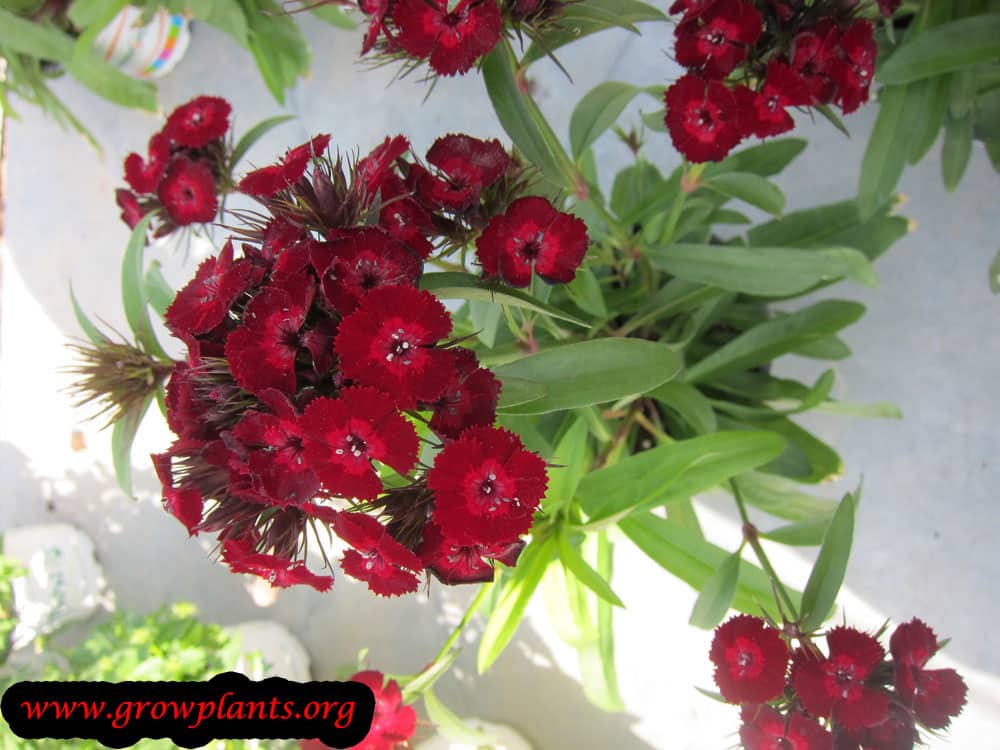
- Growth Habit & Form: Low, clump- to mat-forming herbaceous plant with grassy grey-green foliage and wiry flower stems.
- Lifespan & Maturity: Short-lived evergreen perennial (or annual); fast to reach flowering size.
Anatomy & Physical Features
- Leaves & Foliage: Grey-green, elliptic, grass-like leaves.
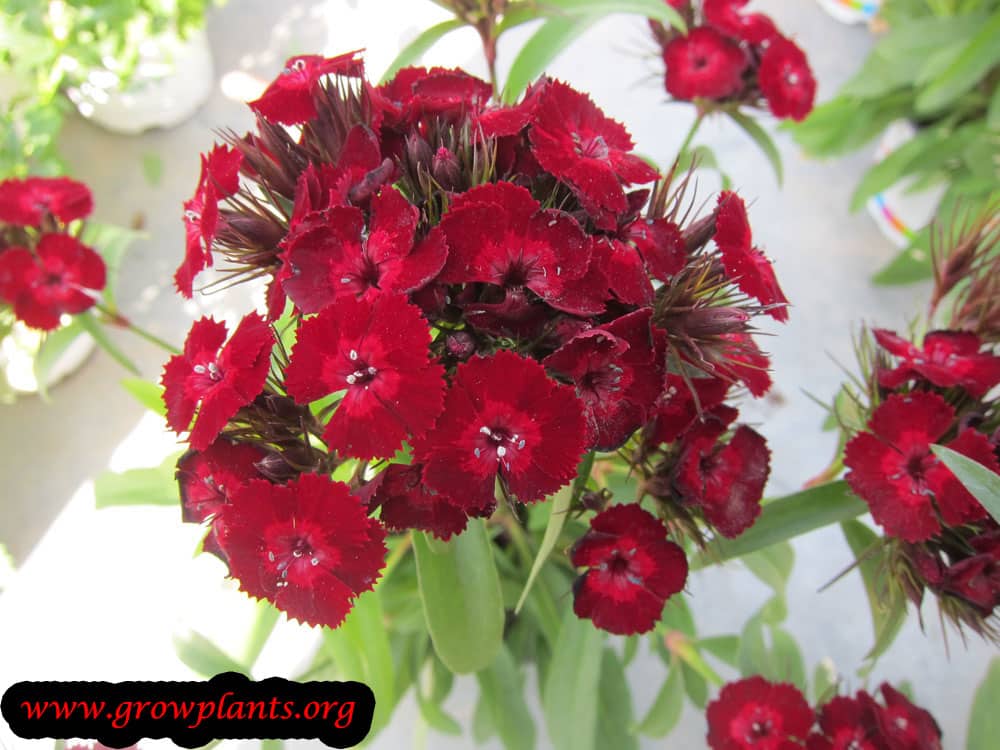
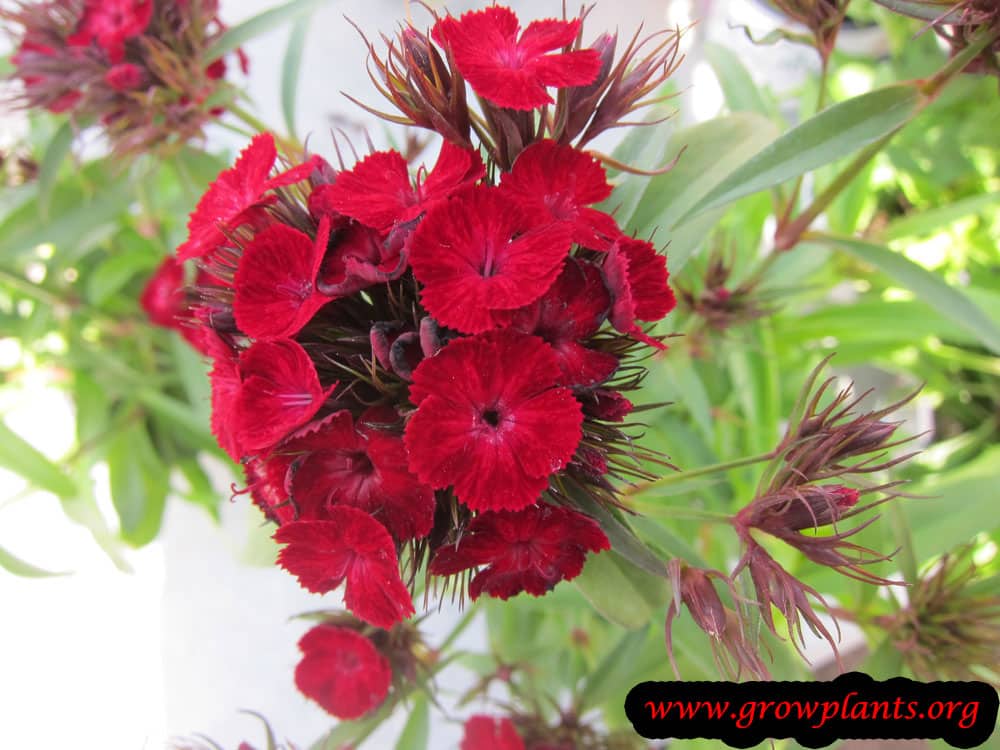
- Flower Characteristics: Five-petalled, jagged-edged flowers in dense heads, in purple, white, magenta, red, lilac or pink (full detail in the Bloom guide).
Primary Uses & Landscape Value
- Functional & Ornamental Roles: Ornamental for borders, edging, rockeries and containers, and a popular fragrant cut flower.
Care Guide: Planting, Soil & Watering
Overview: Sweet william grows best in full sun with well-drained, slightly alkaline soil and even moisture during the blooming season. Good drainage and a light mulch keep the crown healthy while the plant flowers freely.
Quick Care Requirements
| Requirement | Ideal Condition |
|---|---|
| Planting Season | In spring (year-round except winter in frost-free zones 10b-11) |
| Growth Rate | Moderate to Fast |
| Soil Type | Well-draining soil enriched with organic matter |
| Soil pH | Neutral to slightly alkaline |
| Water Need | Moderate to High – keep moist through the flowering season |
Planting & Establishment
- Best Planting Season: Plant in spring where grown as an annual; in frost-free zones 10b-11 plant at any time except winter.
- How to Plant:
- Hole Preparation: Dig a hole larger than the root ball.
- Soil Amendments: Mix in organic matter, chopped dead leaves and humus, and apply a mulch to help retain moisture.
- Planting Depth: Set the plant and cover it lightly – do not bury the crown deeply.
- Growth Speed & Expectations: Moderate to fast.
Soil, Watering & Drainage Care
- Soil Mix & Drainage Needs: Well-draining, organically rich soil; a mulch conserves moisture while good drainage prevents crown rot.
- Watering Schedule & Technique:
- Young / Newly Planted: In the first weeks water daily until the plant establishes.
- Established: Keep evenly moist through the blooming season, letting the surface dry slightly between waterings; adjust to sun exposure.
- Seasonal Adjustments: More during flowering and summer heat; less in winter.
Climate, Light & Hardiness
Dianthus barbatus (Sweet William) thrives in Mediterranean, subtropical, and temperate climates in full sun to half shade, preferring well-drained, slightly alkaline soil. It behaves as a perennial in warm-winter zones and as a cold-season annual where winters freeze hard.
Quick Climate Specifications
| Climate Zones | Mediterranean, subtropical, temperate |
| USDA Hardiness Zones | Approximately 10b–11 as a perennial; commonly grown as an annual in zones 3–9 |
| Approx. Survival Minimum | As a perennial, established plants in zones 10b–11 typically tolerate briefly down to roughly 1.5 to −1°C (30 to 35°F); in colder zones the plant is grown as an annual rather than overwintered |
| Frost Tolerance | Low as a perennial; grown as a frost-season annual in colder climates |
| Light Conditions | Full sun preferred; tolerates half shade, especially useful in hot climates |
Sunlight & Light Exposure
Optimal Light Setup
Full sun gives the strongest flowering and most compact growth.
Direct Sun Requirement
Needs several hours of direct sun daily to flower well.
Shade & Heat Management
In cold climates, half shade reduces flowering; in hot climates, by contrast, half shade is beneficial and the plant grows well there, moderating heat stress.
Best Exposure / Orientation
Open, sunny beds or containers with at least half-day sun suit it best; indoor culture is not recommended for this species.
Temperature Extremes & Hardiness
USDA Hardiness & Regional Limits
Site data lists this species as reliably perennial only in warm-winter zones 10b–11; in zones 3–9 it is commonly grown as an annual because winter freezes prevent it from persisting, not because the plant is inherently unable to survive mild cold for a period.
Cold Damage & Winter Protection
Where grown as a perennial (zone 10b–11), planting is best avoided in winter; in colder zones, treat as a seasonal planting timed to spring, since hard freezes end the plant's growth cycle.
Frost Sensitivity
Frost limits both survival and the length of active growth and flowering; light frost may damage flowers and foliage before killing the plant outright.
Extreme Heat Tolerance
Good in warm and hot climates; flowering continues well into summer, and the plant benefits from half shade where summers are especially hot.
Wind, Humidity & Microclimate
Rainfall & Seasonal Moisture
Adapted to Mediterranean-type climates with a defined dry season, needing only moderate, well-drained moisture rather than constantly wet soil.
Microclimate Recommendations
An open, sunny site with sharp drainage suits this species; in hot regions, light afternoon shade extends the bloom season.
Growing in Pots, Balconies & Indoors
Sweet William are classic, sweetly scented container and border plants but not true houseplants – the grower marks them as no for indoor growing. In a free-draining pot they flower well on a sunny patio or balcony, and a very bright, sunny windowsill can carry them where, as the grower notes, they need at least half shade from fierce sun if kept inside.
Quick Details
- Container Size: 5-10 L (1-2 gal)
- Indoor Suitability: Not a deep-room houseplant; can grow on a very bright, sunny windowsill (indoors give at least half shade from fierce sun)
- Best Spot: Full sun; part shade helps in hot climates (blooms less in cool, shaded spots)
- Soil & Drainage: Well-aerated, free-draining and organic-rich – potting mix or peat with perlite or vermiculite; they like a neutral to slightly limy mix
- Watering in Pots: Keep lightly moist and let excess drain right through – the grower advises no saucer under the pot; outdoors the amount rises with sun exposure
Indoors & On the Windowsill
- Houseplant limits: The grower marks them as not houseplants; deep-room light is too weak for good flowering.
- Windowsill growing: A very sunny sill can work – the grower notes that indoors they need at least half shade from the harshest sun.
- As an annual or perennial: Grown as an annual, start with fresh mix each time; as a perennial, refresh the soil every two years.
On a Balcony or Patio
- Light & wind: Give it the sunniest spot; walls and paving reflect heat so pots dry fast – check moisture often, and outdoors the plant drinks more the more sun it gets.
- Pet safety: Dianthus is mildly toxic to cats and dogs if chewed – keep pots out of reach of curious pets.
Choosing the Pot, Soil & Long-Term Care
- Pot & drainage: A 5-10 L pot with strong drainage holes so water runs straight through – the grower prefers no standing-water saucer, which guards against root rot.
- Potting mix: Aerated and organic-rich – potting mix or peat with perlite or vermiculite.
- Feeding: The grower feeds twice a year – once before flowering and once mid-season; pots leach nutrients faster than open ground.
- Repotting: As a perennial, swap the soil every two years and prune part of the roots and top growth.
Grower’s Container Tip
- Feed and drain the grower’s way: Feed twice a season – just before flowering and again mid-bloom – and skip the saucer so the pot always drains freely.
Fertilizing & Feeding
Sweet William is a moderate feeder, with an early feeding to build the rosette of foliage that supports its dense, clustered flower heads.
Quick Fertilizing Specs
| Feeding Level | Moderate |
|---|---|
| Main Nutrient Priority | Balanced feeding to build sturdy foliage and support dense flower clusters |
| Best Feeding Period | Early spring before the flower clusters form, with a lighter follow-up feeding during the growing season |
| Soil pH | Slightly alkaline soil is preferred; avoid strongly acidic conditions |
| Organic Options | Organic matter such as compost or aged humus worked into the planting hole and topdressed during the season |
| Reduce/Stop Feeding | Taper off feeding as the main flowering period finishes |
Feeding by Growth Stage
Foliage Rosette Establishment
Build a strong low rosette of foliage before the plant sends up its flowering stems.
| Nutrient direction | Balanced feeding to support healthy foliage growth and root establishment |
|---|---|
| Timing | Early in the growing season, while the plant is forming its foliage rosette |
| Frequency | A feeding while the rosette is forming supports strong flower clusters later |
| Fertilizer types | A balanced flowering-plant fertilizer worked into the soil around the base, Compost or aged organic matter mixed into the planting area |
| Precautions | Avoid heavy nitrogen feeding, which can produce lush foliage at the expense of flower cluster development |
Clustered Bloom
Support the dense, rounded clusters of flowers characteristic of this species.
| Nutrient direction | Balanced feeding to sustain the flower clusters through the bloom period |
|---|---|
| Timing | Spring into summer, through the main bloom period |
| Frequency | Light feeding through the bloom period is usually sufficient |
| Fertilizer types | A balanced flowering-plant fertilizer applied lightly around the root zone |
| Precautions | Avoid overfeeding during bloom, which can weaken the stems supporting the flower clusters |
Dormant/Cold-Season Rest
Let the plant rest through cold weather without additional fertility inputs.
| Nutrient direction | None – withhold fertilizer during the dormant/cold season |
|---|---|
| Timing | Late autumn through winter |
| Frequency | No feeding at this stage |
| Fertilizer types | No feeding at this stage; resume feeding the following spring as growth resumes |
| Precautions | Do not fertilize during the dormant/cold season |
Nutrient Deficiency Signs & Corrections
Pale, sparse foliage rosette that is slow to bulk up
| Possible causes | Low soil nitrogen or nutrient-poor soil, Waterlogged or compacted roots limiting uptake, Overcrowding and competition from nearby plants |
|---|---|
| Appears first on | Outer, older leaves of the rosette first |
| What to check | Overall soil fertility, Drainage and root condition, Plant spacing and competition |
| Possible correction | Apply a balanced fertilizer during active growth and improve soil fertility with organic matter |
Full, healthy foliage but small or sparse flower clusters
| Possible causes | Excess nitrogen favoring leafy growth over flowering, Insufficient sunlight, Soil pH that has drifted acidic, outside this plant’s preferred slightly alkaline range |
|---|---|
| Appears first on | Whole-plant flowering pattern |
| What to check | Recent fertilizer history and nitrogen balance, Hours of direct sun the planting receives, Soil pH |
| Possible correction | Rebalance feeding away from high nitrogen, confirm adequate sun, and correct soil pH toward neutral to slightly alkaline |
Flowering stems that bend or break under the weight of the flower clusters
| Possible causes | Nutrient imbalance with nitrogen high relative to overall plant nutrition, Overcrowded planting reducing stem strength, Excess shade or excess water producing soft growth |
|---|---|
| Appears first on | Flowering stems |
| What to check | Fertilizer history and nutrient balance, Plant spacing, Light and water conditions |
| Possible correction | Shift toward more balanced feeding and improve spacing and light exposure |
Pruning, Training & Seasonal Maintenance
Sweet William tolerates only light pruning – deadheading the dense clustered flower heads and an occasional post-bloom cutback. It is usually grown as a biennial or short-lived perennial: plants put on foliage the first season and flower heavily in dense clusters the next, then decline. Because of this, the most consequential pruning decision here is not just when to cut but why – a hard cutback right after the main bloom flush can sometimes coax the plant into a second, shorter season, while leaving a portion of spent heads to set seed lets the planting self-sow and replace itself, which is how Sweet William is traditionally kept going in a border. The plant does not tolerate hard cuts into bare, leafless stems at the base.
Quick Pruning & Maintenance Specs
| Pruning Tolerance | Low–Moderate |
| Primary Pruning Window | Right after the main flower-cluster flush, spring–summer |
| Secondary Maintenance Window | Autumn tidy-back of any remaining top growth |
| Typical Frequency | One or two rounds per bloom season rather than continuous deadheading |
| Main Objective | Extend bloom, decide between trying for a second season or allowing self-seeding succession |
| Young Plant Priority | Pinch the growing tip in the first season to build a bushier clump before it flowers |
| Mature Plant Priority | Cut spent clustered heads promptly on plants being pushed for rebloom; leave some heads on plants left to self-sow |
| Best Tool Type | Fine precision snips or scissors |
| Avoid Heavy Pruning During | Never into bare woody stem bases; avoid removing all seed heads if relying on self-sowing to replace the planting |
Pruning by Plant Age & Size
Newly Established
Remove only damaged foliage in the first season; pinch the growing tip once rooted in to encourage a bushier clump ahead of next season’s flowering.
Young / Formative
No structural training system applies – the plant forms its own upright clustered flowering stems from a basal rosette.
Mature / Established
After the main clustered bloom, either deadhead the whole plant to try to prolong it, or select some stems to leave and set seed for succession, depending on whether the goal is a repeat bloomer or a self-sowing biennial display.
Seasonal Pruning Schedule
Post-Flowering (spring–summer)
Objective: either push for a further flush or allow seed-set for succession. Remove: spent flower clusters on stems being deadheaded, cut to a leaf node or the basal foliage. Do not remove: every seed head if self-sowing is wanted, or healthy foliage. Expected response: possible secondary bloom on deadheaded stems, or seedlings the following season from stems left to ripen. Flowering impact: directly determines whether this planting persists as a repeat bloomer or renews itself by seed.
Ongoing Sanitary (through the season)
Objective: plant health. Remove: any yellowed or diseased foliage. Do not remove: the basal rosette. Expected response: reduced disease pressure, particularly rust.
Structural Pruning & Training
Minimal – Sweet William’s clustered flowering stems rise from a basal foliage rosette with no branches to select; no staking or framework training is generally needed at this plant’s height.
Special Growth to Remove
- Spent flower clusters on stems being deadheaded – cut to a node or the basal foliage.
- Yellowed or matted basal foliage – improves airflow given the plant’s known rust risk.
Container & Small-Space Pruning
In the 5–10 liter pots this plant is grown in, deadhead promptly since container specimens have less room to recover from disease pressure; when repotting a perennial specimen every two years, pair the light top cutback with the root trim the plant’s own care guidance calls for.
Tools
Fine precision snips or scissors only – stems and clustered heads are soft and thin.
Tool Hygiene & Disease Risk
Increased. Rust is a documented disease risk for this plant; wipe or disinfect blades between plants, especially when removing any infected foliage.
Cut Placement & Technique
Cut spent flower clusters down to a leaf node or the basal foliage rather than leaving a bare stub; when choosing stems to leave for self-sowing, select the most vigorous rather than removing them by default.
Heavy Pruning & Rejuvenation
Only a light-to-moderate cutback after the main flush is worth attempting to extend the plant’s season; do not cut into bare, leafless woody stems, which will not resprout. Given the biennial tendency, heavy rejuvenation is often less reliable than simply allowing self-sown replacements.
Post-Pruning Care
Water lightly after a cutback; avoid extra feeding right after – this plant’s own care guidance calls for fertilizer before blooming, not after a trim. Prune in dry conditions to limit rust spread.
Common Pruning Mistakes
- Deadheading every single head, which removes the seed source relied on for self-sowing succession.
- Expecting reliable perennial regrowth from a plant that is naturally biennial-leaning.
- Cutting into bare woody stems expecting regrowth.
When Not to Prune
Avoid cutting wet foliage in humid weather given the known rust risk, and hold off deadheading entirely on any stems being deliberately kept for seed.
Recommended Tools (by task)
- precision_snips – deadheading clustered flower heads and light foliage tidy.
- blade_disinfectant – rust is a known disease here, so wiping blades between plants limits spread.
Propagation Guide
Sweet William (Dianthus barbatus) is most reliably propagated from stem cuttings, which preserve the exact flower color of the parent plant; growing from seed is also easy but seedling flower color can vary. Overall propagation is easy by either method, with cuttings preferred whenever a specific flower color needs to be kept true.
Quick Propagation Specs
| Best Propagation Method | Stem cuttings |
| Alternative Methods | Seed |
| Propagation Difficulty | Easy |
| Seed True-to-Type | Variable – seedlings may not match the parent’s exact flower color |
| Vegetative True-to-Type | Yes – cuttings preserve flower color exactly |
| Best Propagation Season | Cuttings: whenever temperatures can be kept at 20–25°C (68–77°F); Seed: spring or autumn, or even winter indoors if kept warm enough |
| Seed Germination Time | About 7–14 days |
| Cutting Rooting Time | Typically a few weeks under warm, humid conditions |
| Germination Temperature | 16–21°C (61–70°F) |
| Seed Sowing Depth | Surface-sown or barely covered, about 0.5cm (0.25in) deep |
Growing from Seed
Seed Handling & Viability
Store saved seed in a dry, dark location until sowing.
Sowing Season
Sow in spring or autumn – temperature matters more than the calendar date, and seed can germinate even in winter if kept warm enough (e.g. indoors).
Sowing Depth & Orientation
Sow on the soil surface or barely cover, about 0.5cm (0.25in) deep, since seedlings benefit from light. In nursery rows or trays, space seedlings roughly 15 x 20cm (6–8in) apart. Sowing onto a layer of vermiculite helps germination.
Germination Conditions
Keep consistently moist with high humidity, and give the seed exposure to light and sun.
Germination Time
Germination is generally quick, around 7–14 days under suitable conditions.
Seedling Care
Keep the soil moist and grow seedlings on in full sun with average watering.
Stem Cuttings
Cutting Type
Take non-flowering stem tips – choose shoots that have not yet bloomed and carry no flower buds.
Best Timing
Root cuttings whenever temperatures can be kept in the 20–25°C (68–77°F) range.
Cutting Preparation
Cuttings can be started either in water or directly in soil. If rooting in water, use water that isn’t cold and change the water (or switch the rooting medium) every few days; if rooting in soil, insert the stem into moist soil and mist it regularly.
Rooting Setup
Provide high humidity and half-shade rather than direct sun while roots form. Use a moist (not waterlogged) peat-based soil and mist frequently.
Rooting Hormone
A rooting hormone is beneficial and commonly used, though not strictly required for success.
Rooting Time
Roots typically develop within a few weeks under warm, humid conditions.
Bloom & Edible Flower Guide
Quick Details
- Bloom Season: Spring, summer and autumn
- Flower Appearance: Five-petalled flowers with jagged edges in purple, white, magenta, red, lilac or pink, carried in dense flat-topped clusters
- Edibility: Edible – the petals are used in salads and desserts; remove the bitter white heel at the base before eating
Detailed Blooming Overview
Sweet william is loved for the way it gathers its small five-petalled flowers into dense, flat-topped heads, often in rich two-tone patterns. It blooms from spring through summer and into autumn and is a fine, long-lasting cut flower with a light, sweet-spicy scent. Like other pinks, the fringed petals are edible once the bitter base is removed.
Flower Characteristics
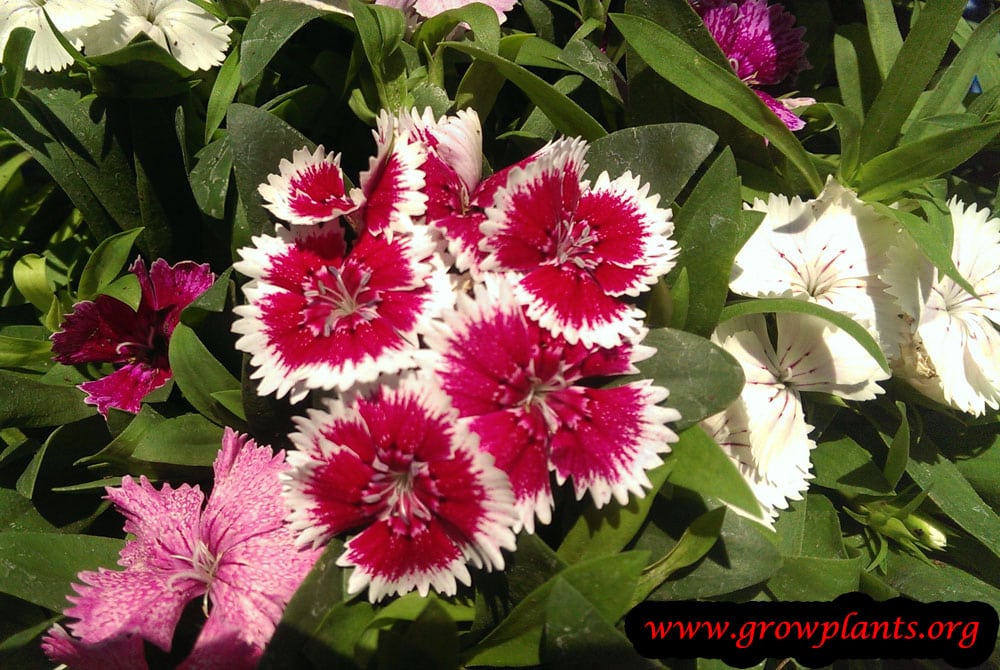
- Five petals with jagged, fringed edges.
- Colours include purple, white, magenta, red, lilac and pink, often with a stronger-coloured rim, held in crowded clusters.
Bloom Care & Thinning
- Deadheading: Remove spent flower heads to prolong the display and tidy the plant.
- For the kitchen: Pick open petals and trim off the bitter white base before use.
- Cut flowers: The clustered heads are excellent and long-lasting in the vase.
Bloom Health & Protection
- Aphids and thrips: Gather on buds and can distort the flowers; insecticidal soap or neem oil usually controls them.
- Grey mould (Botrytis): Damp, still air can spot the blooms; improve airflow and remove faded flowers.
Pests, Diseases & Troubleshooting
Dianthus (pinks, carnations and sweet William) are Caryophyllaceae grown for their fragrant flowers; their main pests are aphids, spider mites and thrips, plus caterpillars in the buds, while their signature diseases are carnation rust, fusarium wilt and botrytis, alongside leaf spots and viruses. The classic weaknesses are stem/crown rot in heavy, wet soil and rust in humid, crowded conditions. Sharp drainage, good airflow and clean, disease-free stock are the foundations of success.
Quick Troubleshooting Overview
| Issue / Pest | Main Symptom | Primary Solution |
|---|---|---|
| Aphids | Sticky curled tips; spreads virus | Rinse off, beneficials, insecticidal soap |
| Spider mites | Fine stippling, bronzing, webbing in hot dry air | Raise humidity, hose foliage, horticultural oil |
| Thrips | Silver flecks, distorted buds and flowers | Sticky traps, sanitation, spinosad |
| Carnation rust | Powdery brown pustules on leaves and stems | Airflow, remove leaves, sulphur/rust fungicide |
| Fusarium wilt | Yellowing, one-sided wilt, stem streaking | Clean stock, resistant kinds, remove/rotate |
| Stem / crown rot | Blackening base, collapse in wet soil | Sharp drainage, dry-side watering |
Common Pests & Management
- Aphids (Myzus persicae / Aphis spp.):
- Symptoms: Soft green or grey insects cluster on shoot tips, buds and leaf undersides; growth curls, honeydew turns leaves sticky and sooty, and aphids spread carnation viruses.
- Prevention & Control: Dislodge with a water jet, encourage ladybirds, lacewings and hoverflies, pinch out badly infested tips, and treat persistent colonies with insecticidal soap in the evening.
- Two-spotted spider mite (Tetranychus urticae):
- Symptoms: In hot, dry conditions the narrow leaves show fine pale stippling, then bronze and dry, with fine webbing on undersides; plants weaken and flowering suffers.
- Prevention & Control: Raise humidity and hose down foliage, keep plants watered and unstressed, introduce predatory mites, and use horticultural oil or insecticidal soap, avoiding broad-spectrum sprays that flare mites.
- Thrips (Frankliniella occidentalis):
- Symptoms: Silvery flecking and streaking on leaves and petals, distorted buds, and browned, speckled or deformed flowers; thrips also spread viruses.
- Prevention & Control: Monitor with blue or yellow sticky traps, remove spent flowers and weeds, keep plants unstressed, and spot-treat with spinosad or insecticidal soap, rotating products, protecting opening buds.
- Carnation tortrix & caterpillars (Cacoecimorpha pronubana / other larvae):
- Symptoms: Caterpillars web together and chew leaves, shoot tips and developing buds, spoiling flowers and leaving frass; tortrix larvae wriggle backwards when disturbed.
- Prevention & Control: Hand-pick and squash rolled leaves and webbed buds, remove affected shoots, encourage birds and parasitic wasps, and use Bacillus thuringiensis (Bt) on young larvae for organic control.
- Cutworms / root-zone larvae (Agrotis spp.):
- Symptoms: Young plants are severed at the base overnight, or wilt as larvae chew stems and roots at soil level.
- Prevention & Control: Search the soil around damaged plants and destroy the grey grubs, use collars around transplants, keep the bed weed-free, and encourage natural predators.
Diseases & Fungal Issues
- Carnation rust (Uromyces dianthi):
- Symptoms: Powdery, reddish-brown pustules erupt on leaves and stems, later turning darker, with yellowing and distortion; worst in humid, crowded, wet conditions.
- Treatment & Management: Space plants and improve airflow, avoid overhead watering and wetting foliage, remove and destroy rusted leaves promptly, and grow resistant kinds; apply sulphur or a suitable rust fungicide if it takes hold.
- Fusarium wilt (Fusarium oxysporum f. sp. dianthi):
- Symptoms: Progressive yellowing and one-sided wilting, with brown streaking inside the stem and eventual collapse; a serious, soil-borne carnation disease.
- Treatment & Management: There is no cure: remove and destroy affected plants, do not compost, and avoid replanting Dianthus in the same soil; start with clean, resistant stock and improve drainage; rotate planting sites.
- Grey mould (botrytis) (Botrytis cinerea):
- Symptoms: Fuzzy grey-brown rot on ageing petals, buds and damaged tissue in cool, damp, still weather; flowers spot and collapse.
- Treatment & Management: Improve airflow, deadhead spent and spotted blooms, clear debris, and avoid wetting the flowers; a protectant fungicide can help in persistent damp, but sanitation is the main control.
- Alternaria & other leaf spots (Alternaria dianthi / Septoria spp.):
- Symptoms: Brown or purple spots with defined margins, sometimes with pale centres, scatter over leaves and stems in wet weather and can girdle shoots.
- Treatment & Management: Remove spotted foliage, improve spacing and airflow, avoid overhead watering, and use clean stock; a copper or general fungicide can help in severe, wet outbreaks.
- Bacterial wilt / slow wilt (Burkholderia (Pseudomonas) caryophylli):
- Symptoms: Sticky, yellowing, wilting shoots with soft, rotting, cracked stems and internal decay; spreads on tools and in water.
- Treatment & Management: There is no cure: destroy affected plants, sanitise tools and hands, use clean cuttings, and avoid waterlogging and splashing; rely on healthy, certified stock.
- Carnation viruses (Carnation mottle / vein-mottle / etch viruses):
- Symptoms: Mottling, streaking, colour-break and distortion of leaves and flowers that never clear, with gradual decline.
- Treatment & Management: There is no cure: rogue out affected plants, control aphids and thrips that spread them, propagate only from clean stock, and sterilise cutting tools between plants.
Growing Difficulties & Abiotic Problems
- Stem and crown rot in wet soil:
- Cause & Symptoms: Heavy, poorly drained or overwatered soil rots the crown and stem base, blackening it and collapsing the plant; a classic Dianthus weakness.
- Correction Strategy: Grow in sharply drained, neutral-to-alkaline soil, plant with the crown at the surface (not buried), water at the base and let it dry between waterings, and avoid winter waterlogging.
- Chlorosis on acid soil:
- Cause & Symptoms: Dianthus prefer neutral to alkaline soil; on acid ground leaves can yellow and growth weakens.
- Correction Strategy: Test the soil and add lime to raise pH where needed, improve drainage, and choose a sunny, open site; correct persistent yellowing with appropriate feeding.
- Flower splitting (calyx split):
- Cause & Symptoms: Wide swings in temperature and moisture, or heavy feeding, cause the calyx to split and flowers to open lopsidedly, mainly in carnations.
- Correction Strategy: Keep watering and feeding even, avoid overfeeding with nitrogen, and protect from extreme temperature swings; support and disbud large-flowered types.
- Legginess / short life:
- Cause & Symptoms: Pinks and carnations become woody, sprawling and short-lived if unpruned and unrenewed.
- Correction Strategy: Trim after flowering to keep plants compact, take cuttings regularly to renew stock, and replace tired plants every few years.
What Helps – Products & Tools
For Dianthus, favour cultural control backed by targeted products: insecticidal soap and horticultural oil for aphids, mites and thrips; Bt for caterpillars; and blue/yellow sticky traps to monitor thrips. Sulphur or a rust fungicide manages carnation rust, and clean, resistant stock plus sharp drainage are the real answer to wilts, viruses and crown rot, which cannot be sprayed away.