Plant Profile & Key Characteristics
Overview: Clematis ‘Nelly Moser’ is a perennial climbing vine, 2–4 m (6–12 ft), evergreen or cold-deciduous, grown as an ornamental hedge/screen for its large striped flowers. It suits subtropical, Mediterranean and temperate climates.
Quick Specifications
| Specification | Attribute |
|---|---|
| Plant Type / Life Cycle | Perennial (woody climbing vine) |
| Foliage Type | Deciduous or evergreen (variety-dependent) |
| Mature Size | 2–4 m tall/long (6–12 ft) |
| Growth Rate | Fast to moderate |
| Toxicity | Toxic if eaten – contains protoanemonin; sap can irritate skin and mucous membranes |
| Hardiness | USDA zone 7–11 |
Growth Form & Structure
- Height & Spread: Climbs 2–4 m (6–12 ft) on a support; also grows in containers with a trellis.
- Growth Habit & Form: Twining/leaf-stalk climbing vine trained on trellis, fence, pergola or through shrubs; can be vigorous.
- Lifespan & Maturity: Long-lived perennial climber that reaches flowering size quickly.
Anatomy & Physical Features
- Leaves & Foliage: Green, elliptic, trifoliate leaves with entire edges.
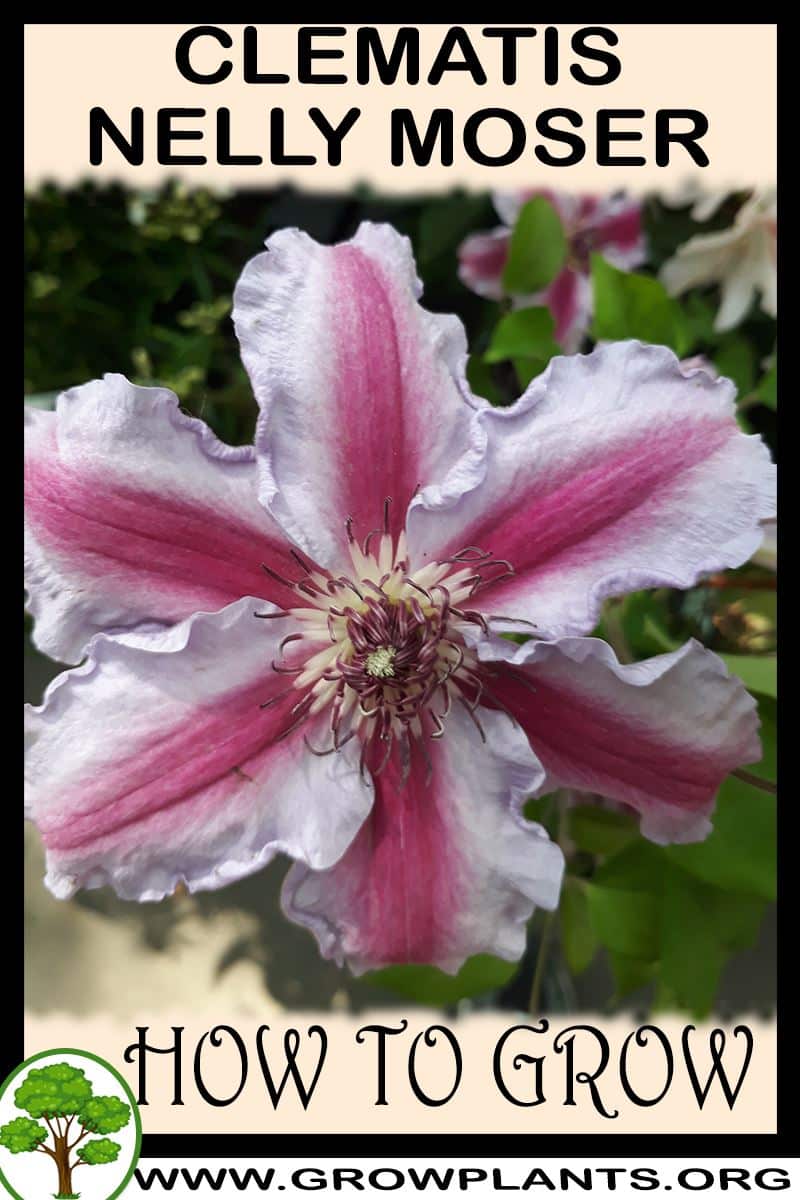
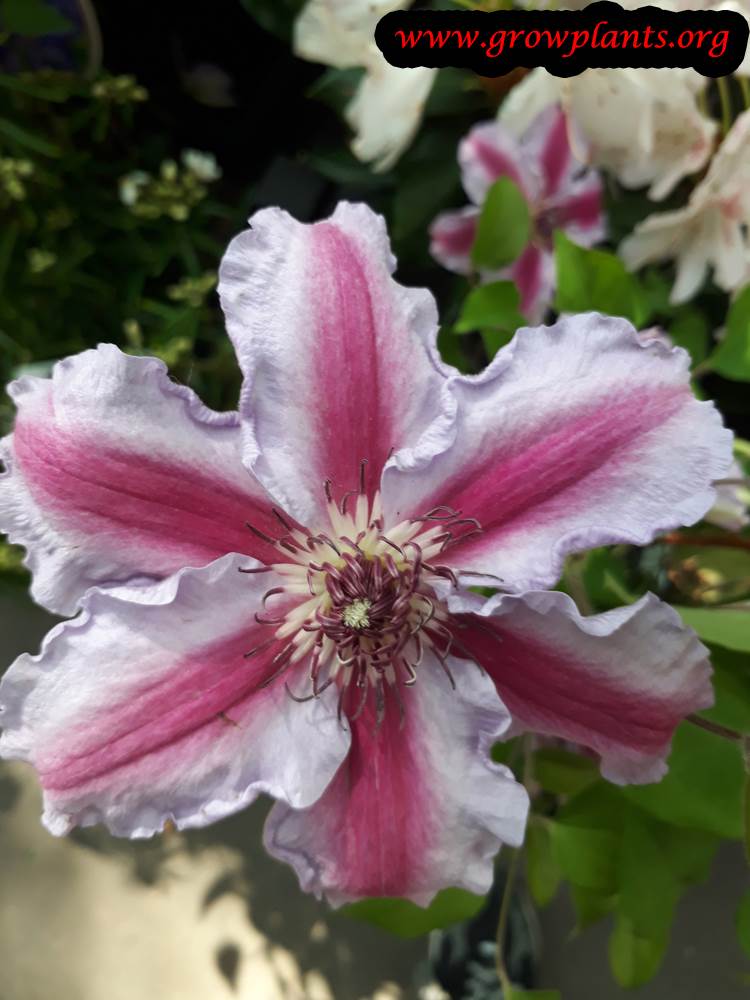
- Flower Characteristics: Large flat flowers with about eight pale mauve-pink tepals, each marked by a deeper pink central bar; followed by feathery seed-heads (see the Bloom guide).
Primary Uses & Landscape Value
- Functional & Ornamental Roles: Ornamental flowering climber for trellises, fences, pergolas and screens; usable as an informal hedge and in large containers.
Care Guide: Planting, Soil & Watering
Overview: The Clematis ‘Nelly Moser’ is a vigorous perennial climbing vine that flowers best with its top in full sun. It likes a fertile, well-drained soil and steady, moderate moisture, with one signature preference: cool, shaded roots – keep the base shaded and mulched while the top climbs into the light.
Quick Care Requirements
| Requirement | Ideal Condition |
|---|---|
| Planting Season | Spring, summer or autumn |
| Growth Rate | Fast to moderate |
| Soil Type | Fertile, well-drained soil; roots kept cool and shaded |
| Water Need | Moderate – keep evenly moist, never waterlogged |
Planting & Establishment
- Best Planting Season: Plant in spring, summer or autumn – avoiding the peak of summer heat – so the roots settle in while conditions are mild.
- How to Plant:
- Hole Preparation: Dig a hole wider and a little deeper than the root ball, and set up a trellis or support at planting time for the vine to climb.
- Soil Amendments: Work plenty of compost and organic matter into the backfill – clematis are hungry plants that reward a rich, well-drained soil.
- Planting Depth: Unusually, set clematis a little deeper than it grew in its pot, with the crown about 5–8 cm below the surface; this encourages strong shoots and helps it recover from clematis wilt. Mulch to keep the roots cool.
- Growth Speed & Expectations: A fast to moderate grower and a vigorous climber that can put on several metres of growth, so give it sturdy support from the outset.
Soil, Watering & Drainage Care
- Soil Mix & Drainage Needs: Clematis want a rich but sharply drained soil, never waterlogged. Follow the classic rule of ‘cool feet, warm head’: shade the root zone with mulch, low planting or a neighbouring plant, while the vine climbs its trellis into the sun.
- Watering Schedule & Technique:
- Young / Newly Planted: Keep the soil evenly moist while the young vine establishes – water deeply and regularly, and don’t let the root zone dry out in its first season.
- Established: Once established, water moderately but deeply, especially in dry spells; a mulched, shaded root run holds moisture and keeps the roots cool.
- Seasonal Adjustments: Water more in hot, dry weather while the vine is in active growth and bloom; reduce in cool or wet periods to avoid soggy roots.
Climate, Light & Hardiness
This large-flowered clematis cultivar grows across subtropical, Mediterranean, and temperate climates, thriving in full sun with a cool, shaded root run, and has good general cold tolerance for the genus.
Quick Climate Specifications
| Climate Zones | Subtropical, Mediterranean, Temperate |
|---|---|
| USDA Hardiness Zones | 7–11 |
| Frost Tolerance | Moderate |
| Light Conditions | Full Sun |
Sunlight & Light Exposure
Optimal Light Setup
The classic clematis rule applies - full sun on the top growth with a cool, shaded root zone gives the best flowering and healthiest plant.
Direct Sun Requirement
Needs several hours of direct sun for strong flowering.
Shade & Heat Management
In hot climates, shading or mulching the base helps keep roots cool even while the vine itself is in full sun.
Best Exposure / Orientation
A trellis or fence facing full sun, with the root zone shaded by low planting or mulch.
Temperature Extremes & Hardiness
USDA Hardiness & Regional Limits
Hardy in zones 7–11; evergreen in the mildest part of that range and cold-deciduous toward its cooler end.
Cold Damage & Winter Protection
In cooler climates it drops its leaves and goes dormant for winter; mulch over the root zone helps protect it through the coldest part of its range.
Frost Sensitivity
New spring growth can be damaged by a late frost.
Extreme Heat Tolerance
Good; tolerates warm subtropical and Mediterranean summers, especially with a cool, moist root run.
Wind, Humidity & Microclimate
Humidity Preferences
Adaptable across subtropical, Mediterranean, and temperate humidity levels.
Dry-Air Tolerance
Moderate; the root zone should stay evenly moist even if the air is dry.
Rainfall & Seasonal Moisture
Prefers consistently moist, well-drained soil through the growing season.
Growing in Pots, Balconies & Indoors
Clematis ‘Nelly Moser’ is a large-flowered climber, not a houseplant, but it is one of the best climbers for a big container on a patio or balcony, trained up a trellis or obelisk.
Quick Details
- Container Size: A large, deep pot for a 2-4 m (6-12 ft) climber, with a support
- Indoor Suitability: Not a houseplant – it needs outdoor light and a frame to climb
- Best Spot: Full sun on top, but keep the roots cool and shaded
- Soil & Drainage: Rich, free-draining, moisture-retentive mix
- Watering in Pots: Average – keep evenly moist; potted clematis must never dry out at the root
Indoors & On the Windowsill
- Houseplant limits: Not an indoor plant; it needs outdoor light, a cool root run and a support to climb. A drip irrigation kit with a timer can take over that watering check automatically.
- Overwintering: Hardy in most climates – a potted plant simply stays outside; in very cold areas move the pot to a sheltered spot to protect the roots.
On a Balcony or Patio
- Sun top, cool roots: Give the top full sun on a trellis or obelisk, but shade the pot itself – group other pots around it or mulch the surface, as clematis roots must stay cool and moist.
- Practicalities: Use a large, deep, stable pot; check moisture daily in summer, as it resents drying out.
Choosing the Pot, Soil & Long-Term Care
- Pot & drainage: A large, deep pot with strong drainage holes and no saucer; keep the root ball cool and never let it dry out.
- Potting mix: A well-aerated, organic-rich mix – peat or coir blended with perlite or vermiculite so it drains freely.
- Feeding: Potted plants need feeding more often than those in open ground, since frequent watering leaches nutrients from the mix – feed regularly through the growing season.
- Repotting: Top-dress each year and pot up every couple of years; prune according to its group to keep flowering strong.
Safety: Clematis sap is toxic if eaten and can irritate skin (protoanemonin) – keep away from children and pets and wash hands after pruning.
Fertilizing & Feeding
A moderate feeder that benefits from balanced nutrition through its vigorous vining growth, then a lighter, bloom-supportive feed as its fragrant flowers develop.
Quick Fertilizing Specs
| Feeding Level | Moderate feeder |
|---|---|
| Main Nutrient Priority | Balanced feeding during vine growth, shifting toward adequate potassium as flowering approaches |
| Best Feeding Period | From spring growth through the summer-to-autumn bloom period |
| Organic Options | Compost or well-rotted organic matter worked around the root zone, kept cool and shaded |
| Micronutrients | Usually supplied by a complete fertilizer; correct specific issues only when diagnosed |
| Soil pH | Prefers fertile, well-drained soil; tolerates a range of conditions |
| Reduce/Stop Feeding | Ease off feeding as the growing season winds down heading into the autumn or winter pruning period |
Feeding by Growth Stage
Spring vining growth and trellis establishment
Support vigorous climbing growth as the vine covers its support.
| Nutrient direction | A balanced complete fertilizer to fuel steady stem and leaf growth. |
|---|---|
| Timing | From the start of spring growth through early summer. |
| Frequency | Regular light feeding through this vigorous growth phase supports steady coverage. |
| Fertilizer types | A balanced complete fertilizer, Compost or well-rotted organic matter |
| Precautions | Keep the root zone cool and shaded, as this vine prefers cool roots even while the top growth is in full sun. |
Summer-to-autumn flowering
Support the striped, fragrant summer-to-autumn blooms.
| Nutrient direction | A balanced fertilizer with adequate potassium to favor flower quality over excess vine growth. |
|---|---|
| Timing | Through the summer-to-autumn bloom period. |
| Frequency | Light, steady feeding through bloom, easing off as flowering slows. |
| Fertilizer types | A balanced, potassium-adequate complete fertilizer |
| Precautions | Avoid heavy nitrogen during bloom, which can favor foliage over flowers. |
Autumn-winter dormancy and pruning period
Let the vine rest through dormancy ahead of its autumn or winter prune.
| Nutrient direction | None – withhold fertilizer while the vine is dormant or being cut back. |
|---|---|
| Timing | Through autumn dieback, winter dormancy, and pruning. |
| Frequency | No feeding at this stage. |
| Fertilizer types | No feeding at this stage – allow the vine to rest undisturbed |
| Precautions | Do not fertilize a dormant or freshly pruned vine; wait for active spring growth to resume before feeding again. |
Nutrient Deficiency Signs & Corrections
Vigorous vine growth with few or no flowers.
| Possible causes | excess nitrogen feeding favoring foliage over flowers, pruning at the wrong time removing flowering wood, insufficient light on the upper vine |
|---|---|
| Appears first on | whole-vine flowering response |
| What to check | recent feeding balance, pruning timing and technique, light exposure on the vine’s upper growth |
| Possible correction | Shift toward a more balanced or potassium-adequate feed, confirm pruning timing matches this variety’s bloom habit, and check light levels. |
New leaves emerge pale yellow while the veins remain green.
| Possible causes | high soil pH limiting iron availability, poorly drained or waterlogged soil around the roots, low soil iron availability |
|---|---|
| Appears first on | newest growth |
| What to check | soil drainage and structure, soil pH conditions, recent watering pattern |
| Possible correction | Improve drainage and soil conditions; apply a chelated iron product per its label if chlorosis persists. |
Chewed or skeletonized leaves and distorted new growth alongside general decline.
| Possible causes | caterpillar feeding damage, aphid infestation stressing new growth, secondary stress from wilt or root issues |
|---|---|
| Appears first on | young leaves and shoot tips |
| What to check | leaves and stems for caterpillars or aphids, overall vine vigor, soil moisture and drainage |
| Possible correction | Address the pest issue directly and hold off on feeding a heavily stressed vine until it recovers. |
Pruning, Training & Seasonal Maintenance
Clematis Nelly Moser is a large-flowered climbing vine that belongs to Pruning Group 2: it produces its main flush of striped pink-and-white flowers in early summer on wood grown the previous year, and often a smaller second flush later in the season on new growth. Pruning tolerance is moderate and timing-sensitive – cutting hard or at the wrong time sacrifices the prized early bloom. The main objectives are removing dead/weak stems, keeping the framework tidy on its support, and encouraging strong new wood without losing next season’s first flush.
Quick Pruning & Maintenance Specs
| Pruning Tolerance | Moderate (light, selective – not hard cutting back) |
| Primary Pruning Window | Late winter / very early spring, as buds begin to swell |
| Secondary Maintenance Window | Deadheading through the growing season |
| Typical Frequency | Once yearly light prune, plus ongoing deadheading |
| Main Objective | Remove dead/weak wood and tidy framework while preserving old-wood flower buds |
| Young Plant Priority | Build a well-spread framework over the support; light initial tip pinching |
| Mature Plant Priority | Selective thinning of old, bare or congested stems; keep flowering wood |
| Best Tool Type | Bypass secateurs |
| Avoid Heavy Pruning During | Autumn and early winter (removes the old wood needed for the early flush) |
Pruning by Plant Age & Size
Newly Established
In the first year, pinch growing tips to encourage branching and multiple stems from the base rather than one long runner; do not prune hard.
Young / Formative
Train stems onto trellising, spreading and tying them to cover the support evenly rather than letting growth bunch at the top – this is a twining vine that needs guidance, not a self-clinging climber.
Mature / Established
Each late winter, remove dead, damaged or very weak stems and cut back to the topmost strong, healthy pair of buds; leave the bulk of the ripened old wood intact for the early flush.
Seasonal Pruning Schedule
Pre-Growth/Early-Spring
Objective: light framework tidy before growth resumes. Remove: dead, damaged or spindly stems, cutting back to a strong bud pair. Do not remove: healthy old wood carrying flower buds. Expected response: vigorous new growth from remaining buds. Flowering impact: preserves the early-summer flush on old wood.
Post-Flowering
Objective: tidy after the first bloom flush and encourage the second. Remove: spent flower stems (deadhead). Expected response: can trigger a lighter second flush on new growth in late summer.
Flowering & Fruiting Wood
Nelly Moser flowers mainly on one-year-old (previous season’s) wood in early summer, with a possible lighter repeat on current-season growth later on. Because the main display comes from old wood, pruning must stay light and be timed for late winter/very early spring – cutting hard, or pruning in autumn, removes the very stems that would have flowered first.
Structural Pruning & Training
- Spread and tie in stems across the support fan-wise to avoid a bare base with growth only at the top.
- Thin out dead or overly congested old wood in the framework to keep air moving and flowers visible.
- Renewal is gradual – replace old unproductive stems a little at a time rather than cutting the whole plant back.
Special Growth to Remove
Deadhead spent flowers regularly through summer to keep the display tidy and to encourage the secondary flush; remove any dead stem tips found at the late-winter prune.
Container & Small-Space Pruning
Grows well in a large container against a trellis or obelisk. Keep the same light, late-winter approach; in a pot, watch that the compact root run doesn’t dry out after any pruning, which can stress a plant that is already relying on stored reserves in old wood.
Tools
- Bypass secateurs – for all routine stem cuts and deadheading.
- Soft ties/stakes – for training and securing stems to trellising.
Tool Hygiene & Disease Risk
Increased risk – clematis wilt and stem dieback pathogens can spread on tools; disinfect blades between plants, and remove and dispose of (don’t compost) any obviously wilted or blackened stem material.
Cut Placement & Technique
Cut just above a healthy, plump bud pair, angled slightly away from the bud. Avoid leaving long stubs, which die back to the next bud anyway.
Heavy Pruning & Rejuvenation
Not recommended as routine practice. If a plant becomes a bare, tangled mass at the top with no growth lower down, a one-off hard cut back to about 1m can be used to force renewal, accepting a lost or much-reduced early flush the following season – use sparingly.
Post-Pruning Care
Water normally; mulch and keep roots cool and shaded (clematis prefer a shaded root run with the top in sun). No extra feeding is needed after a light prune.
Common Pruning Mistakes
- Pruning hard in autumn/winter, which removes the old wood carrying next year’s early flowers.
- Letting growth pile up untied at the top of the support, leaving a bare, leggy base.
- Skipping deadheading, which reduces the chance of a second flush.
When NOT to Prune
Do not prune in autumn or early winter (removes the flower-bearing old wood) and avoid heavy cutting while the plant is in bloom.
Recommended Tools (by task)
- bypass_secateurs – clean cuts on soft-to-semi-woody stems for both the late-winter tidy and season-long deadheading.
- soft_ties_stakes – training the twining growth evenly across a trellis or obelisk.
- blade_disinfectant – wiping secateurs between plants given the increased clematis wilt risk.
Propagation Guide
‘Nelly Moser’ is a named large-flowered hybrid, so the site’s own note to propagate vegetatively ‘to get the same as the mother’ reflects that seedlings will not reliably reproduce this cultivar’s striped flowers; leaf-bud (internodal) semi-ripe cuttings or simple layering are the methods used to keep the exact cultivar. Propagation is Moderate in difficulty – layering is the most forgiving route for home gardeners, while cuttings need consistent humidity to succeed.
Quick Propagation Specs
| Best Propagation Method | Layering (or semi-ripe internodal/leaf-bud stem cuttings) |
| Alternative Methods | Seed (for breeding purposes only, not for keeping this cultivar true) |
| Propagation Difficulty | Moderate |
| Seed True-to-Type | No – hybrid offspring vary and will not reproduce ‘Nelly Moser’s’ striped flowers |
| Vegetative True-to-Type | Yes |
| Best Propagation Season | Layering in spring–summer; cuttings in early summer |
| Seed Germination Time | Often slow and erratic, sometimes taking several months |
| Cutting Rooting Time | Several weeks to a couple of months |
| Germination Temperature | 18–21°C (64–70°F) |
| Seed Sowing Depth | Shallow, just covering the seed |
Growing from Seed
Seed Handling & Viability
This Clematis produces its seed attached to a feathery, beard-like plume, as the site itself describes; these plumed seeds are typically collected once dry.
Dormancy & Pre-Sowing Treatment
Clematis seed often carries dormancy and can benefit from a period of cold, moist stratification before it germinates reliably.
Germination Time
Germination can be slow and uneven, sometimes spread over several months.
Seedling Care
Because this is a hybrid, seedlings will show variable flower color and pattern rather than ‘Nelly Moser’s’ true striping.
Stem Cuttings
Cutting Type
Internodal (leaf-bud) semi-ripe cuttings, the standard method for large-flowered Clematis cultivars – each cutting includes a single node with its leaf pair, trimmed just above and below the node.
Best Timing
Early summer, once new growth has begun to firm up.
Cutting Preparation
Trim leaves back to reduce water loss, leaving a small leaf area; a rooting hormone dip is commonly used.
Rooting Setup
A humid, enclosed propagating environment with a well-drained, moisture-retentive mix; bottom heat can help but is not essential.
Rooting Hormone
Beneficial for this genus, which can otherwise root slowly.
Rooting Time
Several weeks to a couple of months.
Air & Ground Layering
Pin a long, flexible vine stem to the soil at a leaf node, lightly wounding the node, and keep the area consistently moist. Roots typically form over one growing season, after which the new plant can be severed from the parent and potted on – this is the easiest, most reliable way for home gardeners to duplicate this exact cultivar.
Bloom & Flower Guide
Quick Details
- Bloom Season: Summer into autumn.
- Time to First Bloom: Usually within a year or two of planting, once the vine is settled in.
- Flower Appearance: Large, flat, eight-petalled flowers, pale with a pink to purple stripe (bar) down each petal.
- Edibility: Toxic – do not eat; the sap is a skin irritant.
Detailed Blooming Overview
‘Nelly Moser’ is a classic large-flowered clematis, famous for its broad, flat blooms – pale petals each crossed by a distinct rose-pink bar. Trained up a support, the vine studs itself with these showy flowers through summer and into autumn.
Flower Characteristics
- Large, flat flowers with eight petals (tepals).
- Pale ground colour with a pink to purple central stripe.
- Excellent for climbing supports and screens.
Bloom Care & Thinning
- Prolonging bloom: Deadheading spent flowers can encourage a lighter second flush later in the season.
- Safety: Handle with care – clematis sap irritates skin and the plant is not edible.
Bloom Health & Protection
- Earwigs and slugs on the petals: These can chew ragged holes in opening blooms. Removing hiding spots and hand-picking at dusk usually keeps damage to a minimum.
Pests, Diseases & Troubleshooting
Overview: Clematis are generally robust climbers, but the genus is famous for one dramatic disorder – clematis wilt – which strikes large-flowered hybrids like this one hardest, plus sap-suckers on soft new growth and chewing from slugs and earwigs. The best defence is a cool, shaded, well-drained root run, good airflow, and prompt removal of affected stems; most problems are managed culturally rather than with heavy spraying.
Quick Troubleshooting Overview
| Issue / Pest | Main Symptom | Primary Solution |
|---|---|---|
| Clematis wilt | Sudden collapse and blackening of stems/leaves, often near flowering | Cut back to healthy or below-soil growth; improve drainage; plant deep |
| Aphids | Curled, sticky new shoots with clustered green/black insects | Blast off with water; insecticidal soap; encourage ladybirds |
| Slugs & snails | Young spring shoots grazed to stubs | Barriers, hand-pick at night, iron-phosphate bait |
| Earwigs | Ragged holes in petals and young leaves | Trap in rolled cardboard or upturned pots; clear debris |
| Spider mites | Fine stippling and webbing in hot, dry spells | Raise humidity, hose foliage, horticultural oil |
| Powdery mildew | White powdery coating on leaves late in the season | Improve airflow; sulfur or potassium-bicarbonate spray |
Common Pests & Management
- Aphids (Aphis / Myzus spp.):
- Symptoms: Green or black insects clustered on soft shoot tips and buds, leaving sticky honeydew and distorted, curled growth; ants often farm them.
- Prevention & Control: Dislodge with a firm jet of water, repeat as needed; insecticidal soap or horticultural oil on heavy colonies; conserve ladybirds, lacewings and hoverflies.
- Slugs & snails (Deroceras / Cornu spp.):
- Symptoms: Emerging spring shoots grazed to stubs, with silvery slime trails; can wipe out new growth on herbaceous types overnight.
- Prevention & Control: Hand-pick after dark, use copper or grit barriers, remove daytime hiding spots, and scatter iron-phosphate bait around the crown.
- Earwigs (Forficula auricularia):
- Symptoms: Ragged, irregular holes chewed in petals and tender young leaves, worse at night; insects hide in flowers by day.
- Prevention & Control: Trap in rolled damp newspaper or straw-stuffed upturned pots and empty daily; keep the base tidy of debris.
- Two-spotted spider mite (Tetranychus urticae):
- Symptoms: Fine pale stippling and a dull, bronzed look to leaves, with fine webbing on undersides during hot, dry weather.
- Prevention & Control: Raise humidity and hose down foliage; horticultural or neem oil and insecticidal soap; predatory mites in enclosed spaces.
- Vine weevil (Otiorhynchus sulcatus):
- Symptoms: Adults notch leaf margins at night; the far more damaging grubs eat roots of container clematis, causing sudden wilting.
- Prevention & Control: Check rootballs when repotting, remove grubs, use beneficial nematodes as a soil drench, and trap adults at night.
Diseases & Fungal Issues
- Clematis wilt (Calophoma clematidina (syn. Phoma/Ascochyta clematidina)):
- Symptoms: Signature disease: shoots or whole stems suddenly wilt, blacken and die back – often just as buds form – usually from a lesion low on the stem; roots stay alive.
- Treatment & Management: Cut wilted stems right back to healthy tissue or below soil level; plant 5–8 cm deep so buds can regrow from the base; improve drainage and airflow; remove and bin infected material.
- Powdery mildew (Erysiphe / Golovinomyces):
- Symptoms: White powdery coating on leaves and buds, mainly late season in crowded, still conditions.
- Treatment & Management: Improve air movement and spacing; remove affected foliage; sulfur or potassium-bicarbonate sprays; avoid overhead watering.
- Leaf spot & rust (Septoria / Puccinia spp.):
- Symptoms: Brown or reddish spots and blotches on leaves; occasional orange rust pustules underneath.
- Treatment & Management: Remove and destroy affected leaves, rake up fallen debris, and improve airflow; copper or sulfur only if persistent.
Growing Difficulties & Abiotic Problems
- Hot, stressed roots:
- Cause & Symptoms: Clematis want their heads in sun but roots cool; a hot, dry root zone causes weak growth, scorch and poor flowering.
- Correction Strategy: Mulch the root area, shade the base with low plants or a stone/tile, and keep the soil evenly moist but never waterlogged.
- Chlorosis:
- Cause & Symptoms: Yellowing leaves with green veins from poor drainage, waterlogging or very alkaline soil locking up iron/manganese.
- Correction Strategy: Improve drainage, ease off watering, and feed with a balanced feed plus chelated iron if soil is very limey.
- Poor flowering:
- Cause & Symptoms: Few blooms from the wrong pruning at the wrong time, too much shade, or excess nitrogen driving leaf over flower.
- Correction Strategy: Learn the plant’s pruning group and prune accordingly; give at least half-day sun; use a lower-nitrogen, higher-potassium feed.
What Helps – Products & Tools
Reach first for cultural tools – mulch and root-shading, tidy debris, barriers and traps. When needed, insecticidal soap or horticultural/neem oil handles aphids and mites, iron-phosphate bait manages slugs, and sulfur or potassium-bicarbonate sprays check mildew. Beneficial nematodes target vine-weevil grubs in pots.