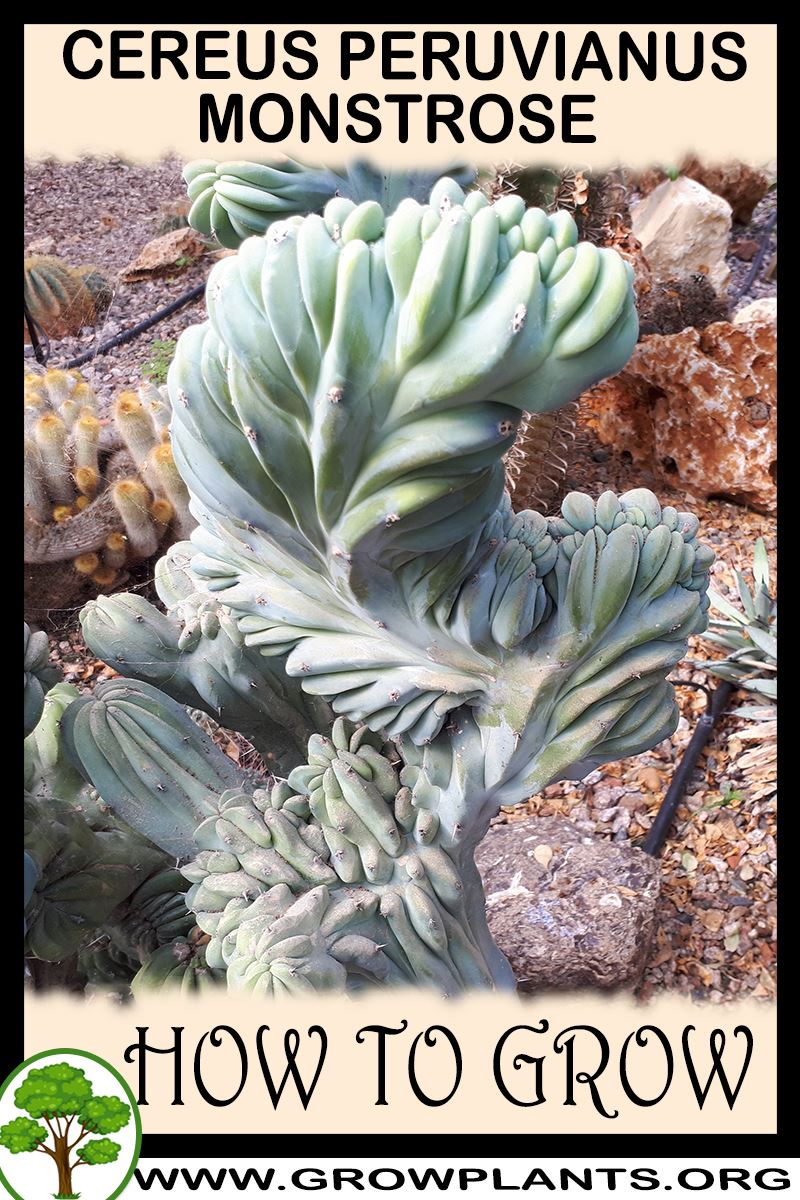
Plant Profile & Key Characteristics
Overview: A monstrose columnar cactus growing 1-10 m (3-30 ft) with distinctive wavy, spiralling or shapeless stems, grown mainly as an ornamental novelty. It is a slow-growing perennial for desert, Mediterranean and subtropical gardens.
Quick Specifications
| Specification | Attribute |
|---|---|
| Plant Type / Life Cycle | Perennial (columnar cactus) |
| Mature Size | 1-10 m (3-30 ft) tall |
| Growth Rate | Slow |
| Root System | Shallow, spreading (typical of columnar cacti) |
| Toxicity | Non-toxic; fruit and seeds edible |
| Hardiness | USDA zone 9-12 |
Growth Form & Structure
- Height & Spread: 1-10 m (3-30 ft) tall; can be grown in containers, staying smaller in a pot.
- Growth Habit & Form: Erect columnar cactus whose stem edges become wavy, spiral or shapeless in the monstrose form.
- Lifespan & Maturity: Slow-growing, long-lived perennial; bears fruit in about 2-5 years.
Anatomy & Physical Features
- Trunk & Bark: Erect green stems with spines and irregular, wavy to spiralled ribs.
- Flower Characteristics: Large white flowers (over 10 cm) with pink-tinged edges, opening at night (full detail in the Bloom section).
- Fruit Profile: Rounded fruit with red to orange skin and white to purple edible flesh and seeds (full detail in the Fruit section).
Primary Uses & Landscape Value
- Edible Uses: Fruit eaten raw, juiced, or made into jams.
- Functional & Ornamental Roles: Sculptural collector’s ornamental and drought-tolerant xeriscape plant.
Care Guide: Planting, Soil & Watering
Overview: This ornamental monstrose form of the Peruvian apple cactus loves full sun and desert heat. It wants a dry, sharply-draining soil and only a small amount of water.
Quick Care Requirements
| Requirement | Ideal Condition |
|---|---|
| Planting Season | Through the warm season, from spring to autumn |
| Growth Rate | Slow |
| Soil Type | Sharply-draining, gritty, sandy cactus mix kept on the dry side |
| Water Need | Low – water sparingly and let the soil dry out fully between waterings |
Planting & Establishment
- Best Planting Season: Through the warm season, from spring to autumn.
- How to Plant:
- Hole Preparation: Plant into a shallow hole in fast-draining, gritty ground, handling the spined stems with folded cardboard or thick gloves.
- Soil Amendments: Blend coarse sand, grit or pumice through the native soil so water drains away fast and never lingers around the base.
- Planting Depth: Set the stem at the depth it grew before, keeping the base slightly proud of the soil to guard against crown rot.
- Growth Speed & Expectations: A slow grower forming a sculptural, wavy-ribbed column that can reach 1-10 m over many years.
Soil, Watering & Drainage Care
- Soil Mix & Drainage Needs: Use a sharply-draining cactus or succulent mix – native soil cut heavily with coarse sand, grit or pumice. Excess moisture is the main killer, so ensure water runs straight through; in pots use a gritty mix with generous drainage holes.
- Watering Schedule & Technique:
- Young / Newly Planted: Water lightly to settle the roots after planting, then only once the soil has dried out, giving just enough to moisten without keeping the base wet.
- Established: Water deeply but infrequently, letting the soil dry almost completely between waterings; once established the plant is markedly drought tolerant.
- Seasonal Adjustments: Give a little extra during prolonged heat, and withhold water over the cool, dormant months to prevent rot.
Climate, Light & Hardiness
The monstrose (crested) form of Cereus repandus shares its species' preference for hot, dry desert, Mediterranean, and subtropical climates in full sun. Cold hardiness is moderate for a columnar cactus, with mature plants tolerating brief light frost but not sustained freezing.
Quick Climate Specifications
| Climate Zones | Desert, Mediterranean, and subtropical climates |
|---|---|
| USDA Hardiness Zones | 9–12 |
| Frost Tolerance | Low – established plants can tolerate brief light frost, but sustained freezing causes damage |
| Light Conditions | Full sun |
Sunlight & Light Exposure
Optimal Light Setup
Grow in full, direct sun; the irregular monstrose stem form still needs strong light to stay compact and healthy.
Direct Sun Requirement
Requires full sun exposure; low light leads to weak, stretched growth.
Temperature Extremes & Hardiness
USDA Hardiness & Regional Limits
Reliable outdoors in zone 9 and warmer, the same range as the species; in marginal areas a warm, sheltered microclimate helps established plants survive occasional cold snaps.
Cold Damage & Winter Protection
Young or recently planted specimens are more cold-sensitive than mature ones; provide a warm, sheltered position and protect from hard freezes at the cooler edge of its range.
Frost Sensitivity
Tolerates brief, light frost once established, but prolonged or hard freezes damage the stem tissue.
Wind, Humidity & Microclimate
Microclimate Recommendations
A warm, dry, sun-exposed spot with sharp soil drainage and good air movement suits this cactus best; avoid cold, damp, low-lying planting spots.
Growing in Pots, Balconies & Indoors
The monstrose apple cactus (a knobbly, sculptural form of Cereus repandus) can reach 1-10 m (3-30 ft). The grower does not treat it as a houseplant, but it grows well in a pot, which keeps its size in check. Slow-growing, a young plant does well on a very sunny windowsill before it eventually wants a large tub in full sun.
Quick Details
- Container Size: Start 20-50% wider than the plant and pot up over the years into a large tub
- Indoor Suitability: Not a houseplant; only a very sunny window suits a young plant
- Best Spot: Full sun – the sunniest sill while young, then a sunny patio or balcony
- Soil & Drainage: Free-draining cactus/succulent mix over a gravel or lava-rock base; strong drainage holes
- Watering in Pots: Water sparingly and let the mix dry out between waterings; cut back further in the cool dormant season – pots must never stay wet
Indoors & On the Windowsill
- Not a houseplant: The grower does not recommend it indoors – it needs full sun and grows into a tall, sculptural column.
- Windowsill growing: A young plant grows slowly enough to enjoy the sunniest sill for a few years.
- Overwintering: Frost-tender – keep it bright, frost-free and nearly dry through winter.
On a Balcony or Patio
- Light & wind: Full sun on a sheltered balcony or patio; as it gains height use a heavy, stable pot and stake against wind. The spines are sharp – keep it clear of paths and seating.
- Bring it in for winter: Move the pot under cover before frost.
Choosing the Pot, Soil & Long-Term Care
- Pot & drainage: Use a pot only 20-50% larger than the plant – it need not be deep, since the roots run shallow. Add a layer of gravel, lava rock or pebbles in the base, give it strong drainage holes, and never leave it standing in water.
- Potting mix: A free-draining cactus and succulent mix – gritty and well aerated so it dries quickly.
- Feeding: Potted cacti need only light feeding, as nutrients leach out with each watering; a dilute low-nitrogen cactus feed through the warm growing season is enough.
- Repotting: Every few years, once the roots fill the pot or the mix has broken down, refresh the soil and move up one size.
Fertilizing & Feeding
A light feeder: this ornamental monstrose cactus is grown mainly for its irregular, sculptural stem form, and needs only occasional, diluted feeding while actively growing.
Quick Fertilizing Specs
| Feeding Level | Light feeder |
|---|---|
| Main Nutrient Priority | Low-nitrogen feeding that keeps growth firm rather than soft |
| Best Feeding Period | Warm active growing season |
| Organic Options | Not typically needed; a well-drained, sandy or cactus-style mix is preferred |
| Reduce/Stop Feeding | Withhold fertilizer through cooler weather when growth slows |
| Micronutrients | Usually unnecessary; correct only a diagnosed deficiency |
| Soil pH | Prefers dry, well-drained soil rather than moisture-retentive conditions |
Feeding by Growth Stage
Warm-season active growth
Support firm, well-formed stem growth without encouraging soft tissue that can spoil the plant’s sculptural, monstrose form.
| Nutrient direction | A diluted, low-nitrogen cactus fertilizer applied sparingly through the growing season. |
|---|---|
| Timing | Through the warm growing season when new growth is visible. |
| Frequency | An occasional light feeding is enough for this slow-growing cactus. |
| Fertilizer types | A diluted, low-nitrogen cactus or succulent fertilizer, A well-drained, sandy or cactus-style soil as the growing medium |
| Precautions | Feed sparingly – excess nitrogen softens the stem tissue and can distort the plant’s naturally irregular, prized growth form. |
Cool-season rest
Let the plant rest through cooler weather without pushing new growth.
| Nutrient direction | None – withhold fertilizer while growth has slowed for the season. |
|---|---|
| Timing | During cooler months when growth naturally slows. |
| Frequency | No feeding at this stage; resume light feeding only once active growth clearly returns. |
| Fertilizer types | No feeding at this stage; hold off fertilizing until active growth resumes. |
| Precautions | Do not fertilize during the cool-season rest – unused nutrients can build up as salts in the dry soil this cactus prefers. |
Nutrient Deficiency Signs & Corrections
Dull, pale green coloring and little visible new growth during the warm season.
| Possible causes | low nitrogen availability in a very lean, sandy soil, old, nutrient-depleted potting soil, root stress limiting nutrient uptake |
|---|---|
| Appears first on | the newest growth points and overall coloring |
| What to check | recent feeding history, soil age and composition, watering consistency and drainage |
| Possible correction | Apply a diluted, low-nitrogen cactus fertilizer during active growth. |
New growth at the tips of the stems looks pale yellow while older tissue lower down stays green.
| Possible causes | high soil pH limiting iron availability, waterlogged or poorly drained soil, root stress from recent transplanting or repotting |
|---|---|
| Appears first on | the newest growth at the stem tips |
| What to check | soil drainage and how quickly it dries, soil or water pH, recent transplanting or root disturbance |
| Possible correction | Correct drainage and watering first, then apply a chelated iron product per its label if the pale color persists. |
Corky, brown scarring or discoloration on the stem surface, often after a change in feeding or potting.
| Possible causes | fertilizer salt buildup from overfeeding a slow-growing plant, mineral buildup from hard water or infrequent flushing, a container or soil that drains poorly and holds salts near the roots |
|---|---|
| Appears first on | the stem surface, especially older, lower tissue |
| What to check | how often and how strong recent feedings have been, container and soil drainage, how long it has been since the mix was flushed or refreshed |
| Possible correction | Ease off feeding, water thoroughly to flush the soil, and repot into fresh, well-drained mix if buildup is heavy. |
Pruning, Training & Seasonal Maintenance
Cereus peruvianus monstrose is grown chiefly for its irregular, contorted, candelabra-like growth form rather than for fruit, though it produces the same edible fruit as the straight species. Pruning tolerance is moderate, but the objective differs from a fruit-focused columnar cactus: the priority is preserving the wavy, spiraling, or shapeless monstrose character of the stems, not maximizing fruit access. The safest window is autumn, matching this plant’s own facts on branches crowding into each other and interfering with harvest.
Quick Pruning & Maintenance Specs
| Pruning Tolerance | Moderate |
| Primary Pruning Window | Autumn, after fruit harvest |
| Typical Frequency | Occasional – mainly to manage crowding or reverted growth |
| Main Objective | Preserve the contorted monstrose form; thin crowded branches |
| Young Plant Priority | Minimal intervention – let the irregular form develop naturally |
| Mature Plant Priority | Remove any reverted normal (non-monstrose) growth if the ornamental form is to be preserved; thin crowding |
| Best Tool Type | Pruning saw for thick stems; loppers for smaller branches |
| Avoid Heavy Pruning During | Spring/summer flowering and fruiting period |
Pruning by Plant Age & Size
Newly Established
Leave unpruned to let its characteristic wavy, spiraling, or irregular stem form develop without interference.
Young / Formative
No formal training system applies – the appeal of this cultivar is its unpredictable natural form, so no shaping toward a standard framework is done.
Mature / Established
Thin branches where crowding blocks access or airflow, and inspect periodically for any growth that has reverted to the normal, non-contorted cylindrical form typical of the straight species.
Seasonal Pruning Schedule
Post-Harvest (Autumn): the main pruning window – thin branches that have grown into each other, once that season’s fruit is picked, giving the plant a full growing season to recover before the next cycle.
Flowering & Fruiting Wood
Like the straight species, fruit forms from areoles along mature stem tissue and takes 2-5 years to first bear. Because fruit is a secondary benefit here rather than the main purpose, pruning decisions should weigh preserving the ornamental form more heavily than maximizing fruit yield – but the same caution applies: removing large sections of mature tissue sets back both form recovery and future fruiting for years.
Structural Pruning & Training
Thin only where branches cross or crowd enough to threaten the plant’s stability or block harvest access. A distinctive task for this cultivar: watch for stem sections that revert to normal, smooth cylindrical growth instead of the wavy monstrose form, and remove that reverted growth at its base if you want to maintain the plant’s ornamental character – left unchecked, vigorous normal growth can eventually dominate the plant.
Container & Small-Space Pruning
Younger specimens are often container-grown for their sculptural form. Size can be controlled with occasional tip removal, but avoid over-shaping – the value of this cultivar is its natural irregularity, not a manicured outline.
Tools
- Pruning saw – for thick stems on a mature plant.
- Loppers – for medium branches and removing reverted growth.
Tool Hygiene & Disease Risk
Increased: cactus stem tissue is prone to bacterial soft rot at cut sites, especially in humid conditions. Disinfect blades between cuts and avoid pruning during wet weather.
Cut Placement & Technique
Remove a branch or reverted section at its point of origin with a clean saw or lopper cut, staging cuts on large limbs to avoid tearing the fleshy stem tissue.
Heavy Pruning & Rejuvenation
Tolerated only in a limited, staged way, as with the straight species – avoid removing a large portion of the plant in one season, both to protect future fruiting and to avoid disfiguring the very growth form the plant is grown for.
Post-Pruning Care
Newly exposed stem tissue can sunburn after a dense area of the plant is opened up. Watch cut surfaces for softening or discoloration in the weeks after pruning, especially if rain follows soon after.
Common Pruning Mistakes
- Trying to “correct” or straighten the monstrose growth, which defeats the ornamental purpose of the cultivar.
- Leaving reverted normal cylindrical growth unchecked until it dominates the plant’s form.
- Pruning during the flowering/fruiting season or in wet weather, raising rot risk and sacrificing fruit.
When NOT to Prune
Avoid pruning during the spring/summer flowering and fruiting period, and during prolonged wet weather when rot spreads fastest from fresh wounds.
Recommended Tools (by task)
- loppers – for medium branches and for removing reverted normal-form growth.
- pruning_saw – for thick, trunk-diameter stems on a mature plant.
- blade_disinfectant – cactus tissue is rot-prone at fresh cuts, especially in humid conditions.
Pruning Troubleshooting
| Problem | Possible Cause | What to Check | Corrective Action |
| Smooth, normal cylindrical stem growth appearing among the contorted growth | Reversion to the straight species’ normal growth form | New growth for loss of the wavy/spiraling character | Remove reverted sections at their base to preserve the monstrose form |
| Branches crowding and blocking fruit access | Dense, unmanaged branching | Branches growing into or over each other | Selectively thin in autumn after harvest |
| Soft, discolored tissue at a cut site | Non-sterile tool or pruning in wet conditions | Texture and color at the cut margin | Excise back into healthy tissue with a sterile blade; avoid pruning in wet weather |
Propagation Guide
Monstrose cactus is best propagated from stem cuttings taken from the deformed, crested growth itself, since this is the most reliable way to keep the wavy, monstrose habit that makes the plant distinctive; seed-grown plants of this mutation often revert wholly or partly to the normal, straight-ribbed columnar form. Cuttings root easily, making this an easy plant to propagate despite its unusual shape.
Quick Propagation Specs
| Best Propagation Method | Stem cuttings taken from monstrose growth |
| Alternative Methods | Seed, mainly for breeding or experimentation rather than keeping the monstrose form |
| Propagation Difficulty | Easy |
| Seed True-to-Type | No — seedlings frequently revert to normal, non-monstrose growth |
| Vegetative True-to-Type | Yes |
| Best Propagation Season | Spring – Autumn |
| Cutting Rooting Time | Typically several weeks to a couple of months |
Stem Cuttings
Cutting Type
Take a section of the wavy, crested (monstrose) stem growth, cutting where a branch joins the main growth if possible.
Best Timing
Take cuttings in the warmer part of the growing season (spring through autumn).
Cutting Preparation
Let the cut surface dry and callus for at least several days to a couple of weeks before planting, since the thick stem holds a lot of moisture and can rot if planted too soon.
Rooting Setup
Insert the callused end a few centimeters into well-drained, sandy soil in full sun; keep it dry at first and only lightly watered until roots form, supporting the cutting so it cannot shift or fall.
Rooting Hormone
Not necessary.
Rooting Time
Usually several weeks to a couple of months to root securely.
Bloom & Flower Guide
Quick Details
- Bloom Season: Spring to summer
- Time to First Bloom: Only on well-established, mature plants; the monstrose form tends to flower less freely than the plain species
- Flower Appearance: Large white funnel-shaped flowers flushed pink at the edges, 10+ cm across, opening at night
- Edibility: Ornamental – the flowers are not eaten
Detailed Blooming Overview
Like most columnar cacti, Cereus repandus is a night bloomer. The big funnel-shaped flowers open after dusk and last only a single night, so the show is brief but striking. Expect blooms only once a plant is mature and well grown – the twisted monstrose form is prized for its stems and flowers a little less predictably.
Flower Characteristics
- White petals with a soft pink flush along the edges.
- Large – 10+ cm across – and funnel-shaped.
- Nocturnal: opens in the evening and closes by the following day.
Bloom Care & Thinning
- Encouraging bloom: Full sun, lean well-drained soil, and a dry, cool winter rest set the plant up to flower once mature.
- Enjoying the flowers: Because they open at night, look for them in the evening – by midday they have usually closed.
- Pollination: Bees work the flowers in the last light before sunset, and moths take over through the night.
Fruit & Uses
Cereus peruvianus monstrose is the same species as Peruvian apple cactus grown in its twisted, crested “monstrose” form, chosen mainly for its unusual stems rather than for fruiting. Where fruit does form, it is the same edible fruit as the straight species, eaten fresh out of hand.
Quick Edible Specs
| Edible Parts | Fruit (flesh and seeds), where produced |
|---|---|
| Main Use(s) | Fresh eating (culinary); juice; jam |
| Eaten Raw or Cooked | Raw; surplus fruit can be juiced or cooked into jam |
| Preparation Required | Peel, or halve and scoop; no other processing needed |
| Harvest Season | Summer to autumn |
| Time to First Harvest | Not in the first year or two, and less predictable than on normal-form plants – see Propagation |
| Storage | Best eaten fresh soon after picking |
| Safety/Toxicity Caveat | None for the ripe fruit itself; the plant’s stems are spiny, so handle harvest with care |
Fruit
Fruit matches the straight species: peel red, pink, purple, or orange; flesh white, yellow, orange, or purple. It ripens as the peel colours fully and softens slightly. Because this cultivar’s mutated, fasciated stems grow irregularly, flowering and fruit set tend to be lighter and less predictable than on a normal columnar plant, so fruit should be treated as a bonus rather than a reliable harvest. Where it does form, it is cut free from the spiny stem, then the flesh and seeds are eaten together exactly as with the straight species.
Harvesting
Any fruit that does set follows the same summer-to-autumn ripening window as ordinary Peruvian apple cactus. Cut it free rather than pulling, to avoid the stem spines.
Preparation, Uses & Safety
No cooking or processing is needed for ripe fruit – peel or scoop and eat fresh, or juice or jam any surplus. The main safety note is mechanical care around the spines during harvest. Because this cultivar is grown and sold primarily as an ornamental oddity, do not expect it to fruit as reliably or as heavily as the straight species; treat any fruit as a secondary bonus, not the reason to grow this plant.
Pests, Diseases & Troubleshooting
Overview: This large columnar cactus is tough and long-lived, and by far its greatest enemy is overwatering, which triggers soft and bacterial rot; the insect pests are the usual succulent sap-suckers. Keep it lean, bright and sharply drained and it needs little else.
Quick Troubleshooting Overview
| Issue / Pest | Main Symptom | Primary Solution |
|---|---|---|
| Overwatering / soft rot | Mushy, blackening, collapsing stem | Cut out rot; dry out; sharp drainage |
| Mealybugs | White cottony tufts in ribs/areoles | Alcohol swab; oil/soap |
| Root mealybugs | Poor growth; white powder on roots | Bare-root, wash, repot |
| Scale | Fixed brown/grey bumps on stems | Scrape; horticultural oil |
| Spider mites | Rusty stippling near growing tip | Rinse; raise humidity; oil |
| Fungal spots | Corky or black spots on ribs | Improve airflow; avoid wetting |
Common Pests & Management
- Mealybugs (Pseudococcus / Planococcus spp.):
- Symptoms: White cottony tufts in growth tips, leaf joints and along stems; sticky honeydew and sooty mould follow. On succulents/cacti check the root zone too, where root mealybugs coat roots in white powder.
- Prevention & Control: Wipe or dab colonies with a cotton swab dipped in dilute alcohol; rinse plants and encourage predators (ladybirds, lacewings). For root mealybug, bare-root, wash the roots and repot in fresh mix. Follow up with horticultural oil or insecticidal soap.
- Root mealybugs (Rhizoecus spp.):
- Symptoms: Stalled growth and a plant that fails to thrive; tip it out and the roots and inner pot wall are dusted with white waxy powder and insects.
- Prevention & Control: Bare-root the plant, wash the roots clean, discard old soil and repot into fresh gritty mix in a clean pot. A soil drench of horticultural oil or a systemic can follow; quarantine new cacti to prevent spread.
- Scale insects (Coccidae / Diaspididae):
- Symptoms: Immobile brown, tan or white bumps on stems and leaf undersides; sticky honeydew and blackish sooty mould on soft scale. Growth slows and leaves yellow.
- Prevention & Control: Scrape off light infestations by hand and prune heavily-encrusted stems. Smother the rest with horticultural or neem oil, covering undersides; repeat to catch mobile crawlers. Conserve parasitic wasps and ladybirds.
- Spider mites (Tetranychus urticae):
- Symptoms: Fine pale stippling on leaves, a dull bronzed look, and fine webbing on undersides in hot, dry conditions. Leaves dry and drop as numbers build.
- Prevention & Control: Raise humidity and hose down foliage to break the cycle; mites thrive on dry, dusty plants. Release predatory mites where practical, and treat with insecticidal soap or horticultural oil, coating leaf undersides over repeat applications.
Diseases & Fungal Issues
- Soft rot / bacterial & fungal rot (Erwinia / Fusarium / Phytophthora spp.):
- Symptoms: Water-soaked mushy patches that turn brown-black and collapse, often starting at the base or a wound and spreading fast; foul smell with bacterial rot. Nearly always follows overwatering, cold-wet soil or an infected wound.
- Treatment & Management: Catch it early: cut out all soft tissue back to firm green flesh with a sterile blade, dust the wound and let it callus dry, and withhold water. Prevention is everything – gritty free-draining mix, careful watering, warmth and avoiding wounds.
- Fungal leaf/stem spot (Fungal (various)):
- Symptoms: Corky, sunken or black spots on the ribs, usually where moisture lingers or after cold damage.
- Treatment & Management: Improve airflow, keep the body dry when watering, and cut away badly affected tissue. Cosmetic scarring is permanent but harmless; systemic spread is the real concern to prevent.
Growing Difficulties & Abiotic Problems
- Overwatering (the number-one killer):
- Cause & Symptoms: Soft, discoloured, collapsing stems and root loss from soil kept too wet, especially in cool or low-light conditions.
- Correction Strategy: Water only when the mix is fully dry, use a gritty cactus medium and a pot with drainage, and cut watering right back in winter and cool weather.
- Etiolation & sunburn:
- Cause & Symptoms: Pale, thin, stretched new growth in low light; or bleached, scorched patches when moved abruptly into fierce sun.
- Correction Strategy: Give bright light for sturdy growth but acclimatise gradually to direct sun to avoid scorch.
- Corky scarring & edema:
- Cause & Symptoms: Rusty or corky patches and, in overwatered plants, blister-like edema on the skin.
- Correction Strategy: Accept old cosmetic scarring; prevent new edema by steadier, leaner watering and good light.
What Helps – Products & Tools
The main ‘tools’ here are a gritty cactus mix, a sharp sterile knife for rot surgery, and restraint with the watering can. For pests use isopropyl alcohol on a swab, insecticidal soap and horticultural/neem oil; sulfur can dust cut surfaces to discourage fungal entry.