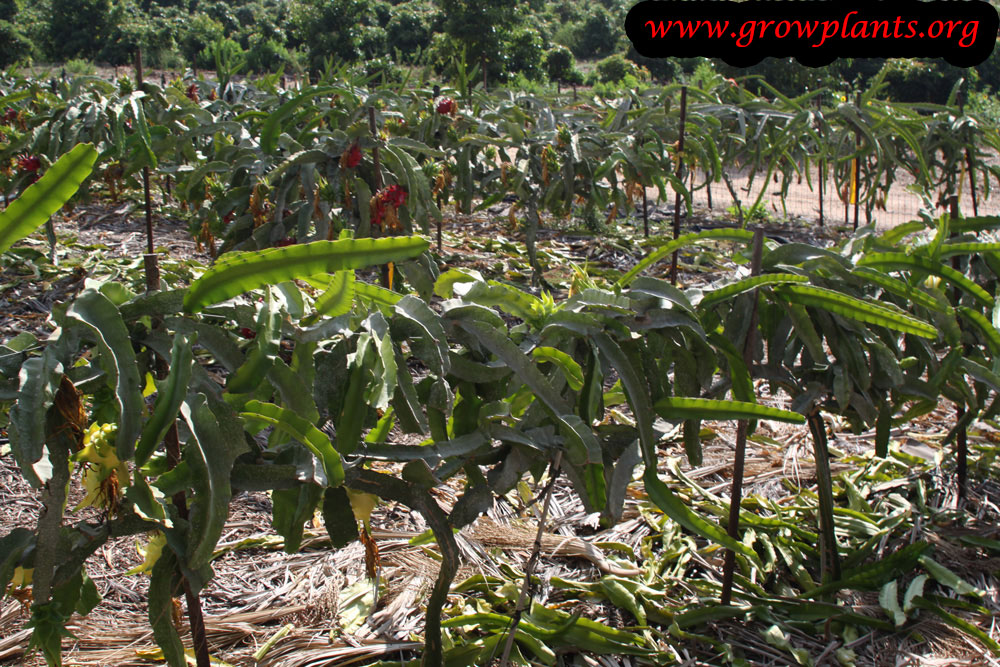
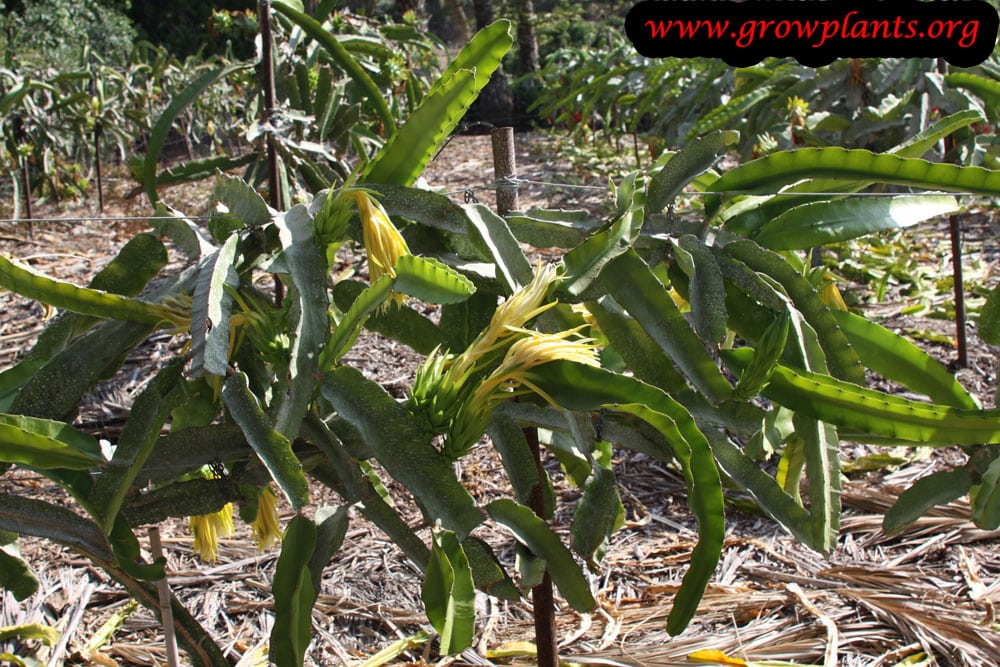
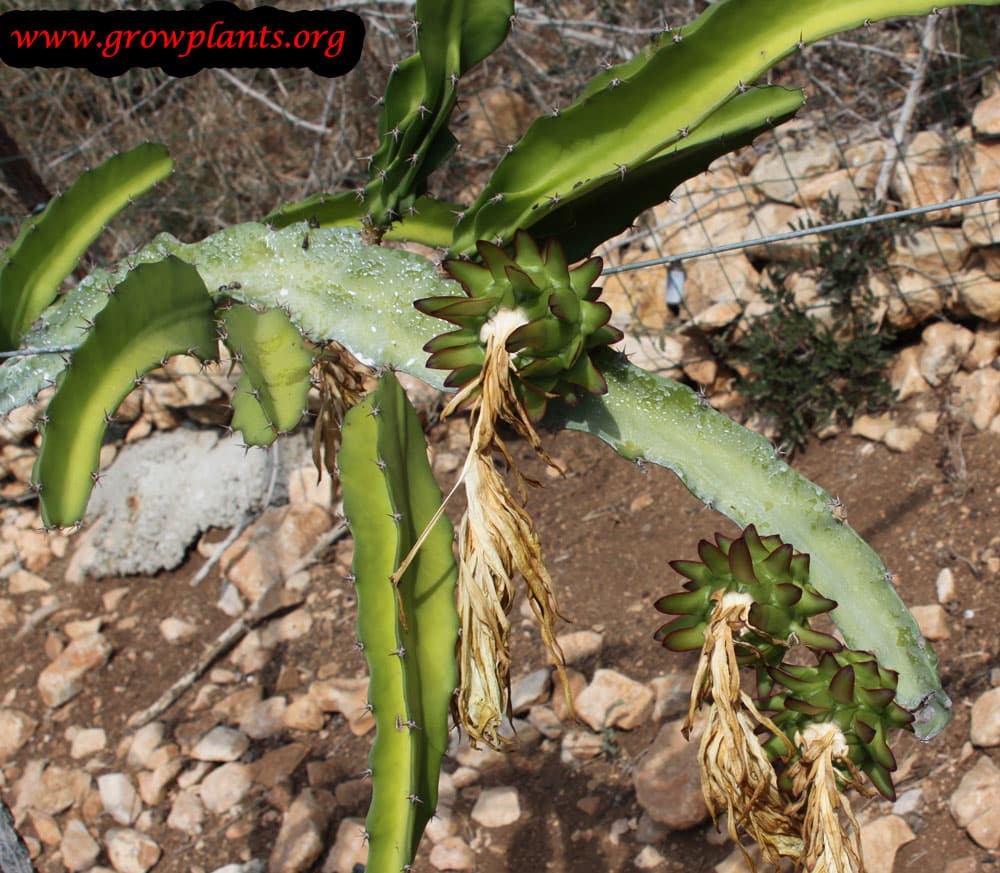
Plant Profile & Key Characteristics
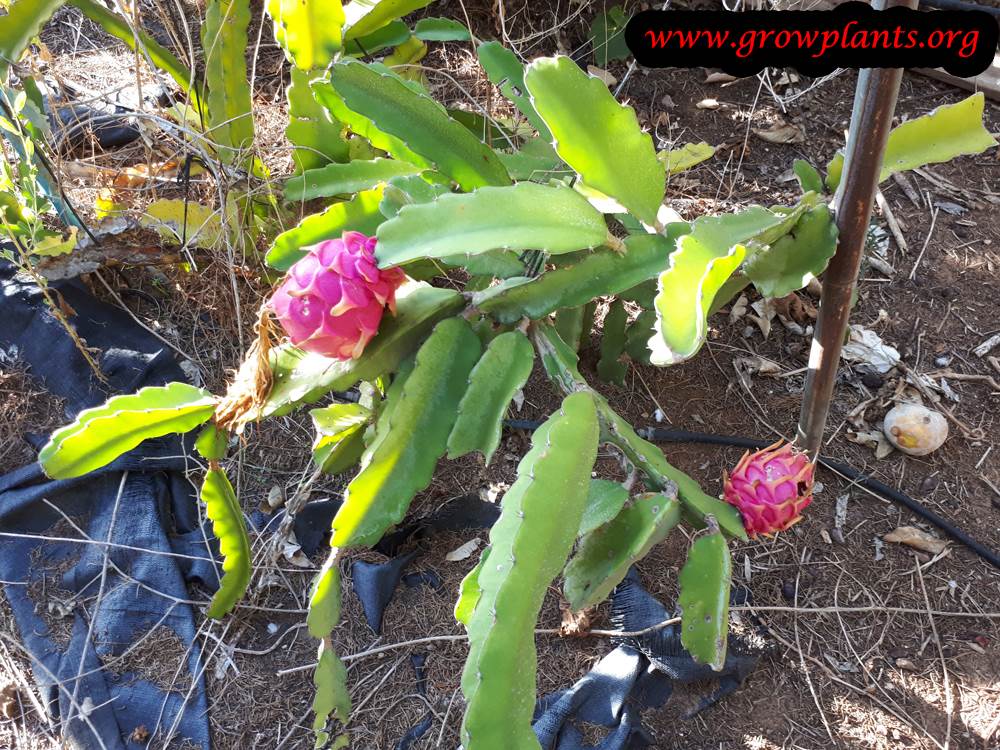
Overview: A vigorous climbing epiphytic cactus grown mainly for its large edible dragon fruit, and also as an ornamental for its wavy green stems, huge night-opening flowers and colourful fruit. A frost-tender perennial best kept trellised and pruned to about 1 m of working height.
Quick Specifications
| Specification | Attribute |
|---|---|
| Plant Type / Life Cycle | Perennial (climbing cactus / vine) |
| Foliage Type | Evergreen (leafless succulent stems) |
| Mature Size | 2-20 m (6-60 ft); usually kept small on a support |
| Growth Rate | Fast once established |
| Root System | Fibrous ground roots plus aerial (adventitious) climbing roots |
| Toxicity | Non-toxic / edible fruit |
| Hardiness | USDA zone 10b+ (10a with winter protection) |
Growth Form & Structure
- Height & Spread: Climbs 2-20 m (6-60 ft) up a support in the ground; in a container (25-50 L / 5-10+ gal) it is trained onto a post and kept compact – larger pots yield more fruit.
- Growth Habit & Form: Sprawling, three-sided succulent vine that clings by aerial roots and needs sturdy trellising.
- Lifespan & Maturity: Long-lived perennial; begins bearing fruit about 2-5 years from planting (see the Fruit guide).
Anatomy & Physical Features
- Leaves & Foliage: No true leaves – green, fleshy, wavy triangular stems bearing short spines along the ribs.
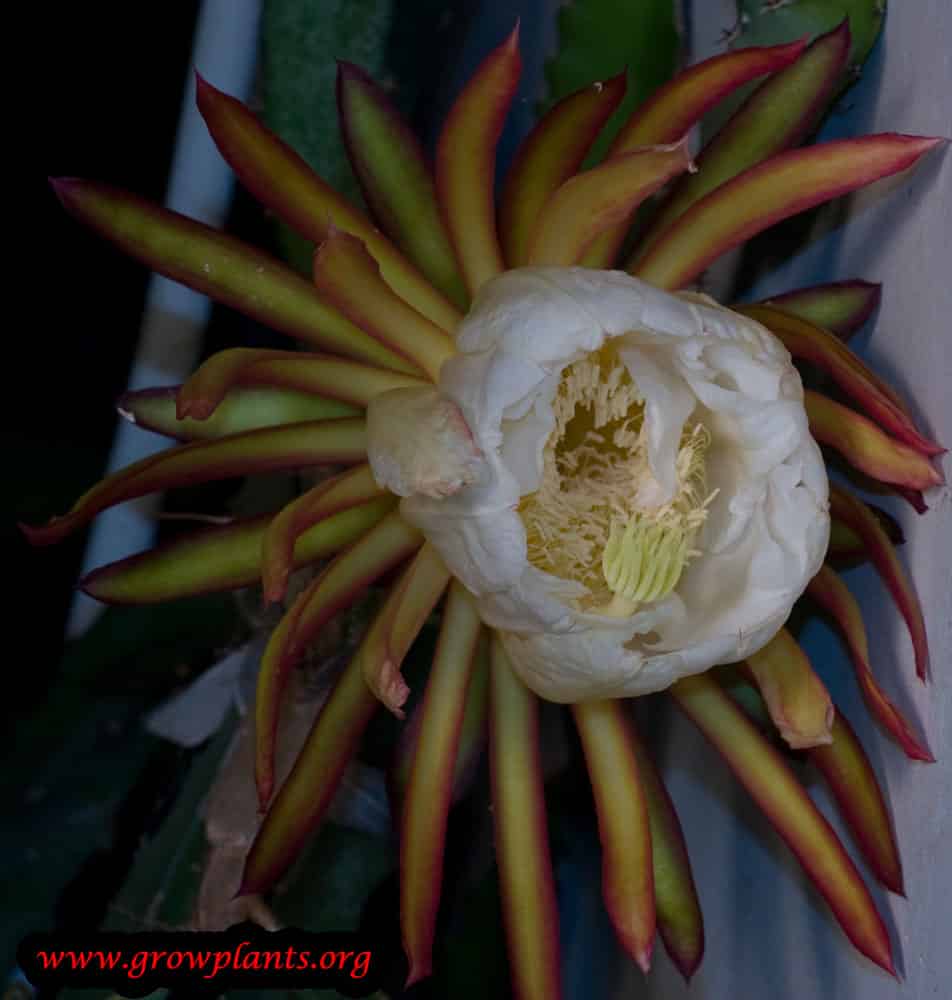
- Flower Characteristics: Very large (5-20 cm) white, yellow-centred flowers that open at night (see the Bloom guide).
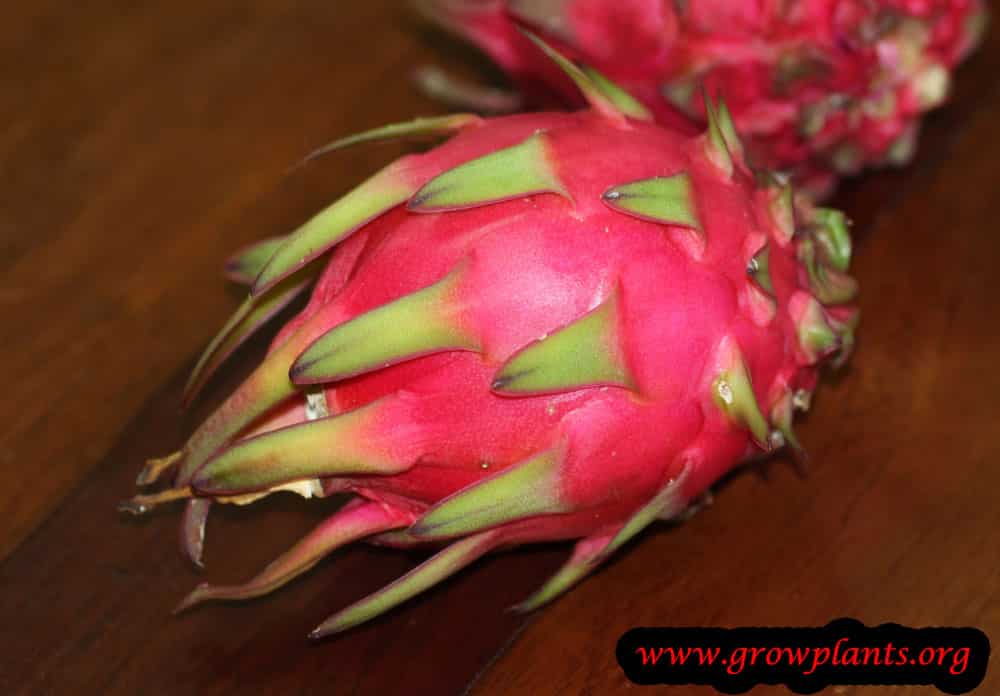
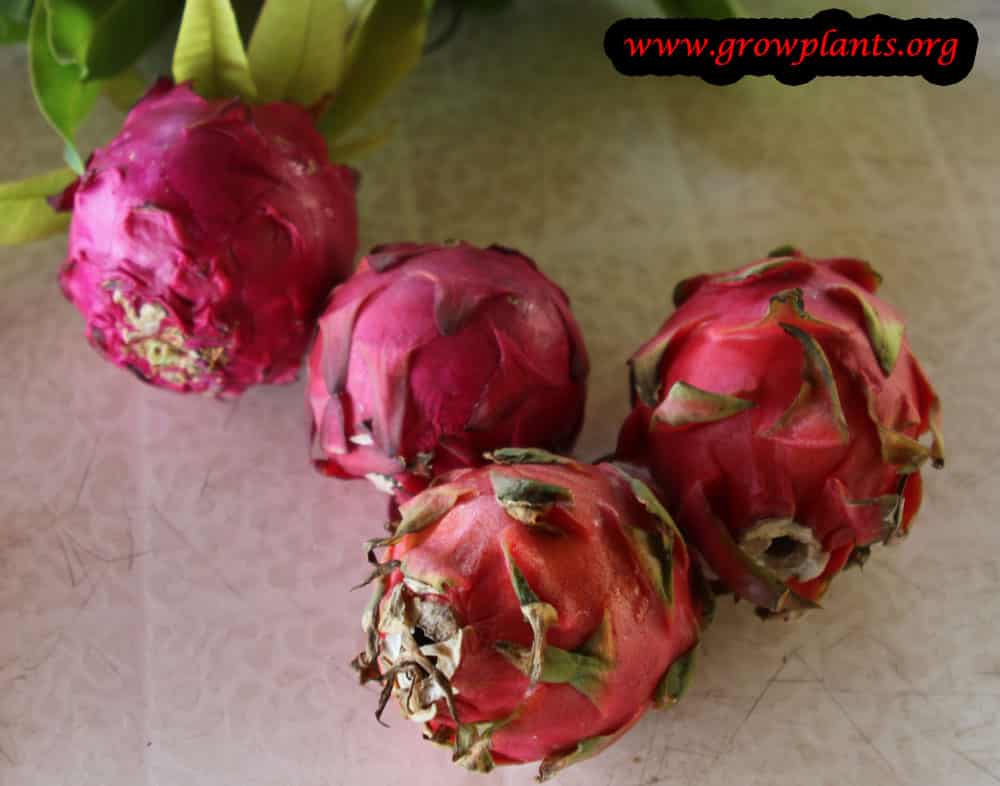
- Fruit Profile: Rounded fruit with white, pink, purple or yellow spiny skin and juicy white/coloured flesh dotted with tiny seeds (see the Fruit guide).
Primary Uses & Landscape Value
- Edible Uses: Fruit eaten fresh, juiced or made into jams.
- Functional & Ornamental Roles: Fruiting vine, ornamental trellis or hedge plant; can be grown in a large container.
Care Guide: Planting, Soil & Watering
Overview: Dragon fruit is a climbing epiphytic cactus that thrives in warm, frost-free climates (zone 10b and up) in full sun to bright half shade. It needs rich, sharply well-draining soil and only modest moisture, resenting any waterlogging around its roots.
Quick Care Requirements
| Requirement | Ideal Condition |
|---|---|
| Planting Season | Spring in zone 10a; spring to summer in 10b; spring to autumn in 11; year-round in 12 |
| Growth Rate | Slow to establish, then moderate to fast |
| Soil Type | Rich but very well-draining soil; as a cactus it must never sit in soggy ground |
| Water Need | Low to Moderate (adjust to soil drainage) – let the soil dry between waterings |
Planting & Establishment
- Best Planting Season: Plant in the warm season – spring in zone 10a, spring to summer in 10b, spring to autumn in 11, and year-round in zone 12.
- How to Plant:
- Hole Preparation: Dig a hole wide enough for the roots and set the cutting or plant against a sturdy trellis or post it can climb.
- Soil Amendments: Work in compost and coarse, gritty material to enrich the soil while keeping it fast-draining.
- Planting Depth: Plant shallowly, setting the base just into the soil; burying stems deeply invites rot, so keep the plant supported instead.
- Growth Speed & Expectations: Slow to establish, but once rooted and given strong light it grows moderately to fast.
Soil, Watering & Drainage Care
- Soil Mix & Drainage Needs: A gritty, free-draining mix is essential; in containers use at least 25–50 L with generous drainage holes, as poor drainage directly stunts the plant.
- Watering Schedule & Technique:
- Young / Newly Planted: Increase watering while a new cutting or plant is establishing, keeping the mix lightly moist but never wet.
- Established: Water sparingly once established, letting the soil dry out between waterings; the amount needed depends on how fast your soil drains.
- Seasonal Adjustments: Water a little more through the warm growing and flowering season and much less in cool weather.
Climate, Light & Hardiness
Dragon fruit is a vining tropical-to-subtropical cactus best suited to Mediterranean, desert, subtropical, and dry tropical climates, growing outdoors year-round only where winters stay essentially frost-free. Unlike many desert cacti it prefers bright light without harsh midday sun, and its cold hardiness is limited.
Quick Climate Specifications
| Climate Zones | Mediterranean, desert, subtropical, or dry tropical climates; also grown indoors as a houseplant |
|---|---|
| USDA Hardiness Zones | 10b and warmer outdoors; possible in zone 10a with attentive winter care |
| Frost Tolerance | Low – None |
| Light Conditions | Half shade, avoiding direct midday sun, or full shade with plenty of ambient light |
Sunlight & Light Exposure
Optimal Light Setup
Bright light is essential for good growth and fruiting, but the strongest midday sun is best avoided, especially in hot climates.
Direct Sun Requirement
Some direct sun outside the harshest midday hours is beneficial; intense all-day noon sun can stress or scorch the fleshy stems.
Shade & Heat Management
Full shade is tolerated provided there is still abundant ambient light; in very hot, intense-sun climates, light dappled shade at midday helps protect the stems.
Temperature Extremes & Hardiness
USDA Hardiness & Regional Limits
Reliable for outdoor, in-ground culture only in zone 10b and warmer; zone 10a is possible with dedicated winter protection, and colder climates require growing it as a container plant that is moved indoors or otherwise protected in winter.
Cold Damage & Winter Protection
The fleshy, water-filled stems are vulnerable to cold injury as temperatures approach freezing; provide a sheltered site or winter protection outside its core hardiness range.
Frost Sensitivity
Frost-sensitive; even light frost can damage stem tissue, so outdoor culture is not recommended where freezes occur.
Wind, Humidity & Microclimate
Microclimate Recommendations
Where grown near its hardiness limit, a warm, sheltered site such as a sunny wall can provide the extra winter protection needed; where grown indoors, a bright spot with at least several hours of light daily is needed, though outdoor culture generally gives better growth and fruiting than indoor growing.
Growing in Pots, Balconies & Indoors
Dragon fruit (Hylocereus) is a vigorous climbing cactus that can reach 2-20 m (6-60 ft) but is best kept small, around 1 m (3 ft). The grower says it can be grown indoors only with a lot of light – at least 8 hours a day, and better with some direct sun – but highly recommends against indoor growing; it does far better in a large container on a bright, sheltered balcony or patio with a trellis.
Quick Details
- Container Size: At least 5-10 gallons (25-50 L), bigger is better for more fruit
- Indoor Suitability: Marginal – only with a lot of light; the grower advises against growing it indoors
- Best Spot: Bright light, ideally with some direct sun, but shaded from the harshest noon sun
- Soil & Drainage: Free-draining mix; good drainage strongly affects growth
- Watering in Pots: Little to moderate water depending on how fast the mix drains; never waterlogged
Indoors & On the Windowsill
- Indoors is marginal (grower): It can be grown indoors only with a lot of light – at least 8 hours a day, better with a few hours of direct sun – but the grower highly recommends not growing it indoors.
- Windowsill growing: The brightest, sunniest window is the minimum; even then it needs a trellis and space, so a balcony or patio is far better.
- Two cultivars for fruit: To set fruit you generally need two cultivars for cross-pollination – hard to manage indoors.
On a Balcony or Patio
- Light & support (grower): Give it a large container (at least 5-10 gal / 25-50 L, bigger yields more fruit) on a bright, sheltered balcony; let it climb a trellis or post and train it to about four arms, like a cross, to keep it compact.
- Two cultivars: Grow two different cultivars together to get fruit; strong drainage in the pot is essential.
- Bring it in for winter: Frost-tender – move it under cover before cold weather.
Choosing the Pot, Soil & Long-Term Care
- Pot & drainage (grower): Use a large container, at least 5-10 gallons (25-50 L) and bigger for more fruit; drainage is important and directly affects the plant’s growth.
- Support (grower): Provide a trellis or post to climb, and train it to about four arms to keep it small and productive.
- Potting mix: A free-draining, lightly organic cactus mix suits this climbing epiphyte.
- Feeding: Feed through the warm growing season, as pot nutrients leach with watering; a balanced feed while it grows and fruits.
Fertilizing & Feeding
A moderate feeder: unlike a desert cactus, this vining, trellised fruiting cactus is grown commercially for its fruit and responds well to regular light feeding through vegetative growth and into flowering and fruit set.
Quick Fertilizing Specs
| Feeding Level | Moderate feeder |
|---|---|
| Main Nutrient Priority | Nitrogen-forward during vegetative stem growth, shifting toward a balanced to potassium-leaning feed as flowering and fruiting begin |
| Best Feeding Period | Warm active growing season through flowering and fruit development |
| Organic Options | Compost or well-rotted organic matter worked into rich, well-drained soil |
| Reduce/Stop Feeding | Ease off feeding as growth slows in cooler weather or reduced light |
| Micronutrients | Usually met by a complete fertilizer; correct iron-related yellowing only if diagnosed |
| Soil pH | Prefers rich, well-drained soil rather than dry, lean desert conditions |
Feeding by Growth Stage
Establishment after planting or rooting a cutting
Help a newly planted specimen or a rooted stem cutting establish roots and begin producing new stem growth.
| Nutrient direction | Light, balanced feeding paired with rich, well-drained soil supports root establishment. |
|---|---|
| Timing | The first months after planting, or once a rooted cutting clearly shows new growth. |
| Frequency | Light feeding started only after new growth confirms the plant has rooted in. |
| Fertilizer types | A balanced complete fertilizer at a light rate, Rich, well-drained soil amended with organic matter |
| Precautions | Avoid heavy feeding right after planting or rooting; unestablished roots are easily stressed by strong fertilizer. |
Vegetative stem growth on the trellis
Build the vining stem structure that will later flower and fruit, filling out the trellis.
| Nutrient direction | A nitrogen-forward feeding supports vigorous new stem growth while the plant fills its support structure. |
|---|---|
| Timing | Through the warm growing season as the plant actively produces new stem segments. |
| Frequency | Regular light feedings through the active growing season. |
| Fertilizer types | A nitrogen-forward complete fertilizer, Compost or well-rotted organic matter around the root zone |
| Precautions | Very lush, soft stem growth from excess nitrogen is more vulnerable to rot and pests – keep feeding moderate rather than heavy. |
Flowering and fruiting
Support the plant’s night-blooming flowers and the fruit that follows through to harvest.
| Nutrient direction | Shift toward a balanced to potassium-leaning feed as flowering begins and fruit develops. |
|---|---|
| Timing | As flower buds appear through fruit development and the harvest season. |
| Frequency | Continued regular light feeding through the flowering and fruiting season. |
| Fertilizer types | A balanced to potassium-leaning complete fertilizer, Organic matter maintained around the root zone |
| Precautions | Flowers and young fruit are sensitive to stress – keep feeding consistent rather than heavy or irregular. |
Nutrient Deficiency Signs & Corrections
Pale green stems and slowed new stem growth during the active growing season.
| Possible causes | low nitrogen availability in the soil, poor, sandy, or leached soil around the roots, insufficient organic matter around the root zone |
|---|---|
| Appears first on | the newest stem segments |
| What to check | recent feeding history, soil organic matter and structure, watering and drainage |
| Possible correction | Apply a nitrogen-forward feeding during active growth and work organic matter into the soil. |
Yellowing of the newest stem growth while older stem segments remain green.
| Possible causes | high soil pH limiting iron availability, waterlogged or poorly drained soil, root stress from a recent transplant or repotting |
|---|---|
| Appears first on | the newest stem growth |
| What to check | soil pH and drainage, recent transplanting or root disturbance, overall watering consistency |
| Possible correction | Improve drainage and watering first, then apply a chelated iron product per its label if yellowing persists. |
Poor flowering or small, underdeveloped fruit despite otherwise healthy stem growth.
| Possible causes | low potassium availability during flowering and fruiting, inconsistent watering during flower and fruit development, insufficient light reducing overall plant vigor |
|---|---|
| Appears first on | the flowers and developing fruit |
| What to check | feeding history through the flowering and fruiting stage, light exposure, watering consistency during fruit set |
| Possible correction | Shift toward a potassium-leaning feed during flowering and fruit development. |
Pruning, Training & Seasonal Maintenance
Dragon fruit is a climbing, trellis-grown cactus vine that tolerates moderate to high pruning, and unlike most cacti in this family it genuinely needs regular structural training. The objectives are training stems onto a support, keeping the canopy open enough for hand-pollination and fruit access, and renewing old unproductive growth. The safest window is after the plant finishes blooming and yielding fruit; pruning during spring-early summer flowering and fruit set sacrifices that season’s crop.
Quick Pruning & Maintenance Specs
| Pruning Tolerance | Moderate to High |
| Primary Pruning Window | Post-harvest, after blooming and fruiting finish |
| Secondary Maintenance Window | Ongoing sanitary removal of dead/infected stems, any time |
| Typical Frequency | Annual structural/renewal pruning, plus ongoing sanitary checks |
| Main Objective | Train onto support; keep canopy open for pollination/harvest access; renew old wood |
| Young Plant Priority | Select and tie the strongest stems to the trellis; remove weak growth |
| Mature Plant Priority | Renew old, shaded, or unproductive segments; maintain airflow and light |
| Best Tool Type | Bypass secateurs for soft growth; loppers for thicker basal stems |
| Avoid Heavy Pruning During | Spring-early summer flowering and fruit set |
Pruning by Plant Age & Size
Newly Established
Select the strongest one or two stems and tie them to the support post; remove thin, weak growth that would otherwise compete for the plant’s limited early energy.
Young / Formative
Train the plant with a trellis/cordon system: stems are tied up a central post and then allowed to branch and cascade outward once they reach the top of the support, commonly trained to spread in several directions from a central point for even coverage.
Mature / Established
Focus shifts to renewal: remove a portion of old, shaded, or declining stem segments each cycle so the plant keeps producing vigorous new fruiting growth, and thin crowded areas so flowers remain reachable for hand-pollination and fruit remains reachable for harvest and netting.
Seasonal Pruning Schedule
Post-Harvest: the main pruning window – remove dead, diseased, or spent stem segments, thin crowded growth, and tie in new growth to the support once that cycle’s flowering and fruiting is finished.
Ongoing Sanitary: rotted or diseased tissue should be removed as soon as it is noticed, at any time of year, since stem rot can spread quickly through the fleshy tissue.
Avoid pruning during spring-early summer, when the plant is flowering and setting fruit – cutting then removes flowers and developing fruit directly.
Flowering & Fruiting Wood
Flowers and fruit form from areoles along mature, well-established stem segments rather than on brand-new soft tip growth, and a young plant typically takes 2-5 years to bear its first fruit. Because of this, removing too much mature stem tissue in a single session sets back near-term fruiting – renew only a portion of the old segments each cycle rather than cutting back hard all at once.
Structural Pruning & Training
The vine needs an ongoing support system (post or trellis) and benefits from being trained to spread outward once it reaches the top, giving open, sunlit access to multiple flowering areas. Thin crowded growth regularly, both to make hand-pollination practical (the flowers open at night and are often hand-pollinated) and to keep the ripening fruit visible and reachable. Because this species can grow 2-20m but is best kept compact, repeated tip pruning/topping is used to control size – commercial and home growers alike typically cap it around 1m of climb before redirecting growth outward.
Special Growth to Remove
- Dead or infected stem segments – this species is prone to stem rot, so remove promptly rather than waiting.
- Excess crowded new shoots competing for light in an already dense area.
- Spent, shriveled segments that have stopped fruiting well, as part of renewal.
Container & Small-Space Pruning
Dragon fruit grows well in large containers (5-10 gallons or more) with a sturdy built-in trellis or stake. The same thinning and renewal logic applies at a smaller scale; because two different cultivars are usually needed for good cross-pollination and fruit set, container growers aiming for fruit should plan support and spacing for more than one plant.
Tools
- Bypass secateurs – for most stem-segment cuts.
- Loppers – for thicker basal growth on an older plant.
- Soft ties/stakes – for training and securing new growth to the trellis.
Tool Hygiene & Disease Risk
Increased: Hylocereus is documented to be susceptible to bacterial and fungal stem rot that can spread through contaminated tools, especially when cutting infected material. Disinfect blades between cuts when removing diseased tissue, and avoid pruning in prolonged wet or humid conditions.
Cut Placement & Technique
Cut at natural segment joints where possible to minimize the exposed wound surface, and avoid crushing the fleshy stem tissue, which slows healing and invites rot.
Heavy Pruning & Rejuvenation
An overgrown or tangled specimen can be cut back significantly to renew it, but it is best staged across one to two post-harvest seasons rather than done all at once, since removing too much mature wood in a single pass sets back near-term fruiting. Expect a vegetative regrowth flush first, with flowering resuming as the new growth matures.
Post-Pruning Care
Watch cut ends closely in humid weather, since this is a rot-prone species. Avoid overhead irrigation directly onto fresh cuts, let the wound surface dry, and retie new growth to the trellis as it extends.
Common Pruning Mistakes
- Pruning during spring-early summer flowering and fruit set, sacrificing the current crop.
- Leaving growth crowded and tangled, which blocks hand-pollination access and shades developing fruit.
- Using dirty tools on this rot-prone tissue.
- Letting the vine outgrow its support without topping, resulting in a heavy, poorly supported tangle.
When NOT to Prune
Avoid pruning during the spring-early summer flowering and fruit-set window, and during prolonged wet or humid weather when rot spreads fastest from fresh cuts.
Recommended Tools (by task)
- bypass_secateurs – for most segment cuts during renewal and sanitary pruning.
- loppers – for thicker basal growth on established plants.
- soft_ties_stakes – essential for training this climbing vine onto its support structure.
Pruning Troubleshooting
| Problem | Possible Cause | What to Check | Corrective Action |
| Poor fruit set | Tangled growth blocking hand-pollination access | Density and airflow around open flowers | Thin and train growth onto an open trellis; hand-pollinate at night when flowers open |
| Soft, discolored stem tissue (rot) | Wet conditions, tool contamination, or overwatering | Texture and color of affected segments | Excise well into healthy tissue with a sterile tool; improve drainage and airflow |
| Reduced fruiting after a hard prune | Too much mature fruiting wood removed at once | Ratio of new versus retained mature growth | Stage renewal pruning across multiple post-harvest seasons |
Propagation Guide
Dragon fruit is propagated almost entirely from stem cuttings, which root easily, grow into a fruiting-size plant much faster than seedlings, and — unlike seed — reliably reproduce the exact fruit and flesh color of the parent plant. Seed is biologically viable and occasionally used for breeding or rootstock trials, but named cultivars are not raised from seed since seedlings are typically hybrid offspring of whatever cultivars were cross-pollinated.
Quick Propagation Specs
| Best Propagation Method | Stem cuttings |
| Alternative Methods | Seed, mainly for breeding rather than keeping a named cultivar true |
| Propagation Difficulty | Easy |
| Seed True-to-Type | Hybrid offspring vary — most plantings grow more than one cultivar together to cross-pollinate for fruit, so seed is not true to the parent |
| Vegetative True-to-Type | Yes |
| Best Propagation Season | Warm months; timing follows the plant’s own planting season, which starts in spring and extends further into the year in warmer hardiness zones |
| Cutting Rooting Time | Typically several weeks under warm, humid conditions |
Stem Cuttings
Cutting Type
Cuttings can be taken from all or part of a stem segment; using a whole segment and cutting at the joint between segments, rather than mid-segment, gives a higher success rate.
Best Timing
Take cuttings during the warm season; success improves with extra warmth and water during rooting.
Cutting Preparation
Let the cut end callus before planting, as with other columnar or climbing cacti, to reduce the risk of rot.
Rooting Setup
Increase watering somewhat above what a fully established plant would get and keep the cutting warm; otherwise treat it much like a mature plant. Large or heavy stem segments should be staked or supported so they cannot shift or fall while rooting, since movement can disturb the forming roots.
Rooting Hormone
Not necessary — dragon fruit cuttings root readily on their own.
Rooting Time
Typically several weeks under warm, humid conditions.
Growing from Seed
Seed can be scooped from ripe fruit pulp and sown shallowly in a warm, evenly moist, well-drained mix; germination is relatively quick for a cactus, typically within a few weeks. Because most dragon fruit plantings grow multiple cultivars together for cross-pollination, seed usually gives a hybrid mix rather than a plant matching either parent, and seedlings take considerably longer than cuttings to reach fruiting size, so seed is mainly of interest for breeding rather than for propagating a specific cultivar.
Bloom & Edible Flower Guide
Quick Details
- Bloom Season: Spring to summer, often in several flushes
- Time to First Bloom: Once the vine is established and well supported, usually within a couple of years
- Flower Appearance: Very large white flowers with yellow stamens, 5-20 cm, opening for a single night; the swelling bud looks much like a small fruit
- Edibility: The flowers and buds are edible – in parts of Asia they are cooked as a vegetable or dried for soups and tea
Detailed Blooming Overview
Dragon fruit is a night-blooming cactus, and the flowers are a spectacle in their own right – huge, fragrant, and open for only one night. Before they open, the plump buds look so much like the fruit that growers can be caught out. Getting a good flush of flowers is the first step toward a crop, so bloom care and fruit set go hand in hand here.
Flower Characteristics
- Pure white petals surrounding a ring of yellow stamens.
- Large – anywhere from 5 to 20 cm – and strongly fragrant.
- Nocturnal: open in the evening and finished by the next day.
Bloom Care & Thinning
- Pollination: In the wild, bats do the work at night. In cultivation, hand pollination gives the most reliable set – move pollen between flowers with a soft brush in the evening.
- Know your variety: There are several flower types – some are self-fertile, some can only be pollinated by another variety, and some are good pollen donors. Whichever you grow, hand pollination improves fruit set.
- Timing: Because each flower lasts a single night, check plants in the evening and pollinate promptly.
Fruit & Uses
Dragon fruit plant is grown chiefly for its large, brightly coloured fruit, eaten fresh as a dessert fruit with the flesh and its many tiny seeds together. In some cuisines the plant’s unopened flower buds are also harvested and cooked as a vegetable.
Quick Edible Specs
| Edible Parts | Fruit (flesh and seeds); flower buds (regional use) |
|---|---|
| Main Use(s) | Fresh eating (culinary); juice; jam; flower buds cooked as a vegetable in some cuisines |
| Eaten Raw or Cooked | Fruit raw; flower buds cooked |
| Preparation Required | Fruit: peel, or halve and scoop, no other processing; flower buds: cook before eating |
| Harvest Season | Spring through autumn |
| Time to First Harvest | Several years after planting, faster once the plant is established – see Propagation |
| Storage | Best eaten fresh; cut fruit has a short shelf life |
| Safety/Toxicity Caveat | None known for the ripe fruit; stems are spiny, so handle harvest with care |
Fruit
Peel colour varies by cultivar – white, pink, purple, or yellow, sometimes with a differently coloured flesh inside – and some types carry spines on the peel. Fruit is ready when the peel has fully coloured and softens slightly. It is cut from the plant rather than pulled, since it grows on the spiny stems; the fruit itself is then halved and the flesh scooped out, with its many small seeds eaten along with it. Surplus fruit is used for juice or jam.
Flowers & Flower Buds
The plant’s large, showy flowers open for a single night only, and before they open the unopened buds resemble small fruit. In some culinary traditions (notably Vietnamese cooking) these buds are picked and cooked – typically stir-fried or added to soups – and eaten as a vegetable. This is a secondary, regional use rather than the main reason the plant is grown, and the buds are not eaten raw.
Harvesting
Fruit forms in repeated flushes from spring through autumn rather than all at once, so plants are picked over several times each season as each fruit colours up. Hand-pollinating the night-blooming flowers generally improves fruit set and size. Wear gloves or use a tool when cutting fruit free, since the stems are spiny.
Preparation, Uses & Safety
Ripe fruit needs no cooking – halve it and scoop out the flesh and seeds to eat fresh, or juice or jam surplus fruit. Flower buds, where used as a vegetable, should be cooked rather than eaten raw. The main safety caution for the fruit itself is mechanical: harvest carefully around the spiny stems.
Pests, Diseases & Troubleshooting
Overview: Dragon fruit is a robust climbing cactus with few chronic pests, but its soft, water-rich stems are prone to fungal and bacterial rots wherever moisture lingers, and to sunscald in extreme heat. Excellent drainage, airflow, and clean tools prevent most trouble; insects are usually secondary.
Quick Troubleshooting Overview
| Issue / Pest | Main Symptom | Primary Solution |
|---|---|---|
| Mealybugs / scale | White cottony or brown bumps in stem grooves, sooty mold | Wipe off, horticultural oil, control ants |
| Ants | Farming mealybugs/scale, tending honeydew | Bait ant trails to break the protection cycle |
| Slugs & snails | Chewed soft new stems and flowers overnight | Iron-phosphate bait, barriers, hand-pick |
| Birds | Pecked, gouged ripening fruit | Netting or fruit bags near ripeness |
| Stem soft rot | Yellow-brown mushy patches, ooze, collapse | Cut to clean tissue, improve drainage/airflow |
| Sunscald | Bleached yellow-white patches on sun-facing stems | Light shade in extreme heat, gradual acclimation |
Common Pests & Management
- Mealybugs (Planococcus / Pseudococcus spp.):
- Symptoms: White cottony masses tucked into stem ribs, areoles, and flower bases; sticky honeydew and black sooty mold follow, weakening growth.
- Prevention & Control: Wipe colonies off with a damp cloth or alcohol swab, blast with water, release predators, and apply horticultural oil or insecticidal soap; always control the ants that shelter them.
- Scale insects (Diaspididae / Coccidae):
- Symptoms: Immobile brown, grey, or waxy bumps clinging to stems, often in the shaded grooves, with yellowing and honeydew.
- Prevention & Control: Scrub off light infestations, prune heavily crusted segments, and smother crawlers with horticultural oil applied in the cool evening.
- Ants (Formicidae):
- Symptoms: Constant ant trails on stems; ants themselves cause little damage but farm and spread mealybugs and scale for their honeydew.
- Prevention & Control: Set ant baits along trails and at the base, keep stems from touching the ground or fences that give access, and the sap-sucker problem usually collapses with them.
- Slugs & snails (Gastropoda):
- Symptoms: Rasped and chewed wounds on tender new stems, buds, and flowers, with slime trails, mostly at night and after watering.
- Prevention & Control: Water in the morning, clear damp debris, ring plants with copper tape or iron-phosphate bait, and hand-pick after dark.
- Fruit-pecking birds ((various)):
- Symptoms: Gouged holes and pecked flesh on ripening fruit, sometimes the whole crop lost near maturity.
- Prevention & Control: Bag individual fruit or net the plant as color develops; this is a harvest-window problem, not a year-round pest.
Diseases & Fungal Issues
- Stem soft rot / bacterial soft rot (Erwinia/Dickeya spp.):
- Symptoms: Soft, yellow-to-brown mushy patches that ooze and collapse, often starting at wounds or where water pools in stem grooves.
- Treatment & Management: Cut back to firm green tissue with a sterilized knife, let the wound callus dry, improve drainage and airflow, and avoid overhead watering; copper can suppress spread.
- Anthracnose & stem canker (Colletotrichum, Neoscytalidium dimidiatum):
- Symptoms: Sunken tan-to-orange lesions with dark margins and concentric rings on stems and fruit, sometimes with reddish spore masses; can girdle stems.
- Treatment & Management: Remove and destroy infected segments, disinfect tools, keep foliage dry, space for airflow, and apply a copper or labelled fungicide preventively in wet weather.
- Stem spot / Bipolaris rot (Bipolaris cactivora):
- Symptoms: Small water-soaked spots that enlarge into brown sunken rotted areas, especially on young shoots and fruit in humid conditions.
- Treatment & Management: Prune affected tissue, reduce humidity and leaf wetness, and use copper-based protectant sprays during prolonged wet spells.
- Cactus Virus X:
- Symptoms: Mottled or mosaic discoloration and mild stem distortion; spread mechanically by tools and handling.
- Treatment & Management: There is no cure — remove severely affected plants, disinfect cutting tools between plants, and propagate only from clean stock.
Growing Difficulties & Abiotic Problems
- Sunscald / sunburn:
- Cause & Symptoms: Bleached yellow-white to corky patches on the sun-facing side of stems during intense heat, especially on plants moved abruptly into full sun.
- Correction Strategy: Acclimate gradually, provide light afternoon shade in extreme climates, and keep plants well-watered to reduce heat stress.
- Root & base rot from overwatering:
- Cause & Symptoms: Yellowing, soft base, and collapse when grown in heavy, poorly drained, or constantly wet soil.
- Correction Strategy: Use a gritty, fast-draining mix, water only when the medium dries, and plant on a mound or in raised beds in wet climates.
- Poor fruit set:
- Cause & Symptoms: Flowers open (often night-blooming) but few fruit form; many selections are self-incompatible and need cross- or hand-pollination.
- Correction Strategy: Hand-pollinate at night or early morning by transferring pollen between compatible plants, and grow more than one clone for cross-pollination.
- Cold / frost damage:
- Cause & Symptoms: Water-soaked, blackened, then collapsing stem tissue after temperatures near or below freezing.
- Correction Strategy: Protect from frost with cover or bring containers under shelter; damaged tips can be cut back to healthy tissue once weather warms.
What Helps — Products & Tools
Start with mechanical and cultural control: wipe or hose off mealybugs and scale, bait ants to break the honeydew cycle, and use iron-phosphate bait for slugs. Horticultural oil and insecticidal soap handle residual sap-suckers. For the rots and anthracnose that matter most here, sanitation and drainage come first, then a copper fungicide. Fruit bags or netting protect ripening fruit from birds.