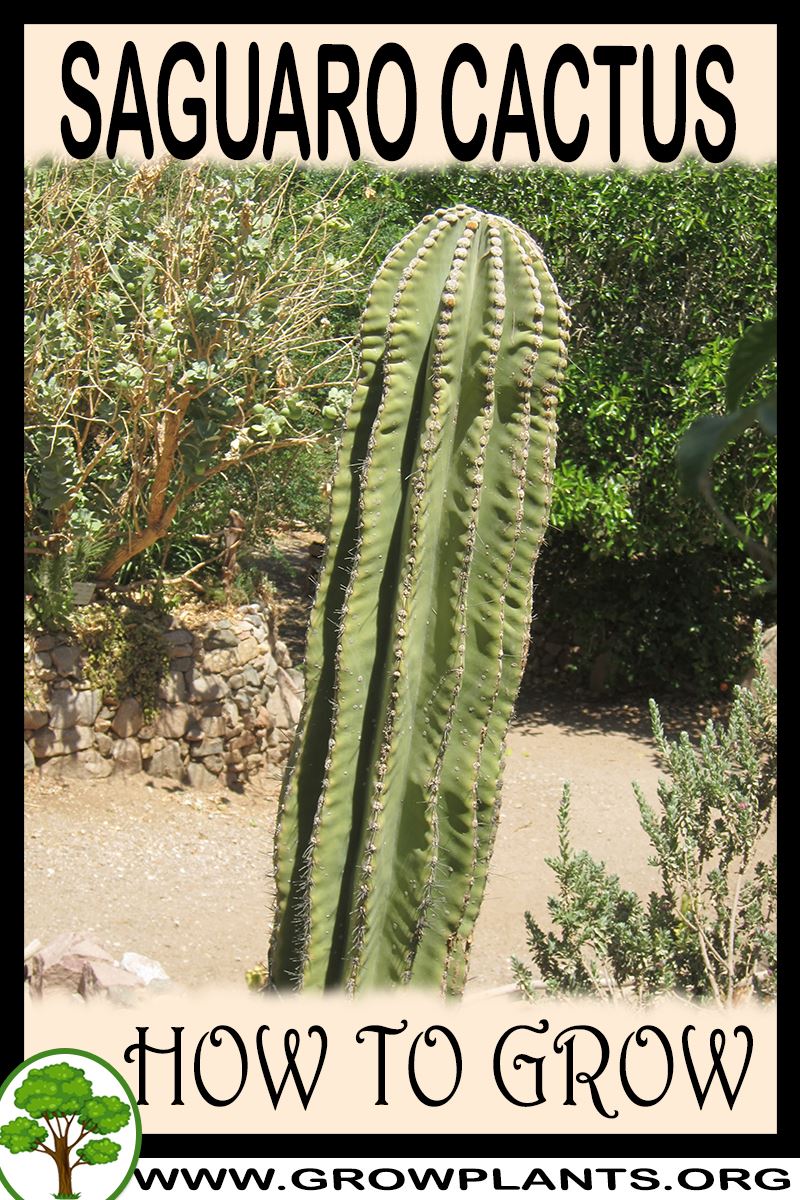
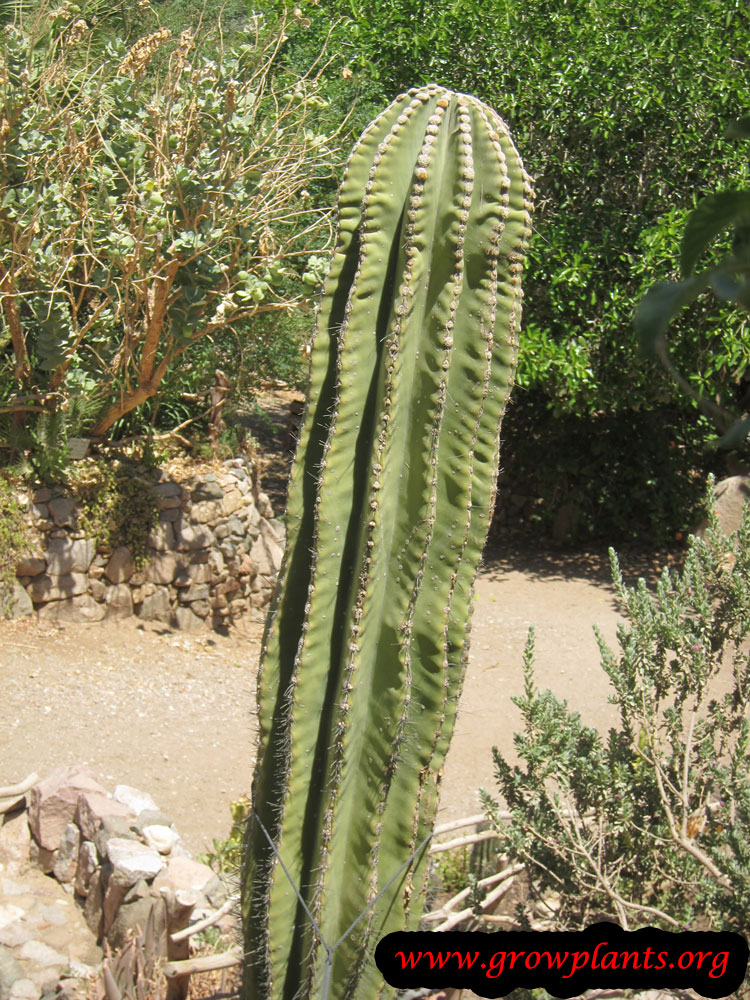
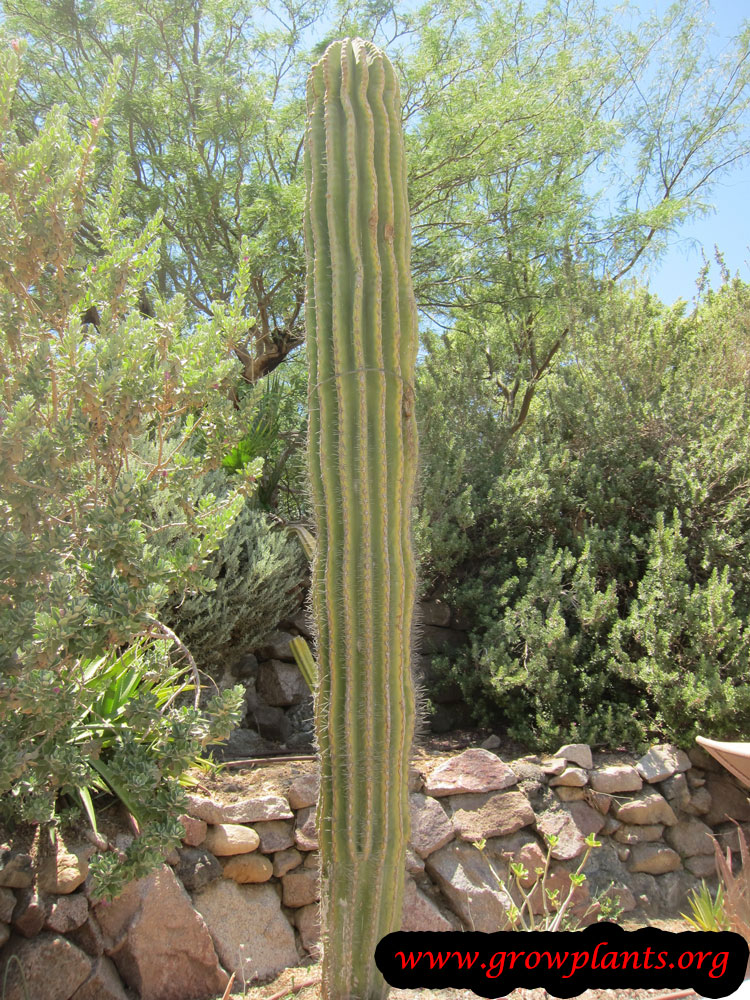
Plant Profile & Key Characteristics
An iconic, slow-growing columnar cactus reaching about 5-20 m (15-60 ft), developing arms with age. A very long-lived, drought-tolerant perennial grown as a desert ornamental, with edible red fruit.
Quick Specifications
| Specification | Attribute |
|---|---|
| Plant Type / Life Cycle | Perennial (very long-lived) |
| Mature Size | 5-20 m tall (15-60 ft) |
| Growth Rate | Slow |
| Root System | Shallow, wide-spreading radial roots with a central taproot |
| Toxicity | Non-toxic; fruit edible |
| Hardiness | USDA zone 8-12 |
Growth Form & Structure
- Height & Spread: 5-20 m (15-60 ft) tall; not suited to pots at maturity
- Growth Habit & Form: Erect, ribbed columnar stem branching into upward-curving arms with age
- Lifespan & Maturity: Extremely long-lived (can exceed 150 years); very slow, first fruiting about Usually several decades; flowering commonly begins at around 35 years under natural conditions. from establishment
Anatomy & Physical Features
- Stems & Spines: Green, pleated (accordion-ribbed) water-storing stem that browns with age and is armed with spines; leaves are reduced to spines
- Flower Characteristics: Large (10+ cm) white flowers; night-opening, bat- and bee-pollinated
- Fruit Profile: Oval red fruit with red pulp; edible
Primary Uses & Landscape Value
- Edible Uses: Fruit eaten raw, juiced or made into jams
- Functional & Ornamental Roles: Landmark desert-garden ornamental and wildlife plant for xeriscaping
Care Guide: Planting, Soil & Watering
Overview: An iconic, very slow-growing desert cactus for full sun and extremely free-draining, gritty soil. It needs very little water and rots in wet or heavy ground.
Quick Care Requirements
| Requirement | Ideal Condition |
|---|---|
| Planting Season | In the warm season (spring through autumn) |
| Growth Rate | Very slow |
| Soil Type | Very free-draining, gritty/sandy and low in organic matter |
| Water Need | Very low |
Planting & Establishment
- Best Planting Season: Plant in the warm season, when the ground is warm and dry.
- How to Plant:
- Hole Preparation: Dig a shallow hole just larger than the roots.
- Soil Amendments: Blend in coarse sand and grit for sharp drainage; avoid rich, moisture-holding soil.
- Planting Depth: Set the base at soil level; do not bury the stem.
- Growth Speed & Expectations: Extremely slow – only a few centimetres a year when young, ultimately a giant of 5–20 m.
Soil, Watering & Drainage Care
- Soil Mix & Drainage Needs: A gritty, mineral, very free-draining mix; perfect drainage is essential. Not suited to long-term container growing.
- Watering Schedule & Technique:
- Young / Newly Planted: Occasional light watering in the warm season while establishing.
- Established: Water rarely; let the soil dry out completely, and withhold water in cold weather.
- Seasonal Adjustments: A little in summer heat; essentially none in winter.
Climate, Light & Hardiness
Saguaro is a slow-growing giant columnar cactus native to hot desert climates and needs full, unfiltered sun to thrive. It is more cold-tolerant than many people expect for a desert cactus, surviving brief winter cold in its native range, though prolonged hard freezes are damaging.
Quick Climate Specifications
| Climate Zones | Desert, Mediterranean, and subtropical climates |
|---|---|
| USDA Hardiness Zones | 8–12 |
| Frost Tolerance | Moderate for a columnar cactus – tolerates brief, light frost, but not prolonged hard freezes |
| Light Conditions | Full sun |
Sunlight & Light Exposure
Optimal Light Setup
Grow in full, all-day direct sun, matching its native open-desert habitat.
Direct Sun Requirement
Requires strong, direct sun; young plants in habitat often establish under a nurse shrub or tree but mature specimens need full sun exposure.
Temperature Extremes & Hardiness
USDA Hardiness & Regional Limits
Reliable outdoors from zone 8 and warmer, reflecting its native Sonoran Desert range, which does experience occasional winter cold snaps.
Cold Damage & Winter Protection
Established saguaros can withstand brief cold periods typical of zone 8–9 winters, but extended hard freezes cause tissue damage; young plants are considerably more cold-sensitive than large, mature specimens and benefit from extra winter protection.
Frost Sensitivity
Tolerates occasional light frost once well established, but is not suited to climates with regular hard or prolonged freezes.
Extreme Heat Tolerance
Highly heat tolerant, well adapted to intense desert summer heat.
Wind, Humidity & Microclimate
Dry-Air Tolerance
Thrives in the low humidity and dry air of desert climates.
Microclimate Recommendations
A hot, sun-baked, sharply drained site that mimics open desert conditions suits saguaro best; avoid humid, shaded, or poorly drained locations.
Growing in Pots, Balconies & Indoors
The saguaro (Carnegiea gigantea) is the giant of the cactus world, reaching 5-20 m (15-60 ft) over a very long life. The grower marks it as neither a houseplant nor a container plant – it is a true landscape cactus for open, sun-baked ground in a hot, dry climate. Although seedlings grow astonishingly slowly, the grower does not recommend pots for it, so long-term it needs to be planted out.
Quick Details
- Container Size: Not recommended by the grower – a landscape cactus for open ground
- Indoor Suitability: Not a houseplant
- Best Spot: Full sun in a hot, dry climate, planted in the open ground
- Soil & Drainage: Extremely free-draining, gritty, mineral soil
- Watering in Pots: Not applicable long-term; a young seedling needs only very sparing water
Indoors & On the Windowsill
- Not a houseplant: The grower marks it as unsuitable indoors – it is a desert giant that needs full sun and open ground.
- Windowsill only while tiny: A seedling can sit on a bright, sunny sill for its first years, but it will eventually far outgrow any indoor spot.
On a Balcony or Patio
- Light & wind: It belongs in the open in full sun; the grower does not recommend keeping it in a container, so a balcony is only ever a very temporary home for a young plant.
Choosing the Pot, Soil & Long-Term Care
- A landscape cactus, not a pot plant: The grower’s guidance is that the saguaro is grown in open, free-draining desert ground rather than in containers.
- Soil & drainage: If starting a seedling, use an extremely gritty, free-draining mineral mix and water very sparingly until it is planted out.
Fertilizing & Feeding
A light feeder: this extremely slow-growing, long-lived desert giant is adapted to lean native soil, so only occasional, diluted feeding is warranted, mainly while it is young.
Quick Fertilizing Specs
| Feeding Level | Light feeder |
|---|---|
| Main Nutrient Priority | Low-nitrogen feeding, mainly to help a young plant establish |
| Best Feeding Period | Warm active growing season |
| Organic Options | Not typically needed; this species is adapted to lean, well-drained desert soil |
| Reduce/Stop Feeding | Withhold fertilizer through cooler weather and once the plant is well established in the ground |
| Micronutrients | Usually unnecessary; correct only a diagnosed deficiency |
| Soil pH | Prefers dry, well-drained soil rather than rich or moisture-retentive conditions |
Feeding by Growth Stage
Warm-season active growth
Help a young, establishing saguaro build root and stem mass; mature, in-ground plants generally coast on native soil.
| Nutrient direction | A diluted, low-nitrogen cactus fertilizer used sparingly, most useful while the plant is young and establishing. |
|---|---|
| Timing | Through the warm growing season, especially in the years after planting. |
| Frequency | Rarely needs feeding beyond an occasional light application while young; well-established plants usually need none at all. |
| Fertilizer types | A diluted, low-nitrogen cactus fertilizer, used mainly while the plant is young, Native, well-drained desert soil as the primary growing medium |
| Precautions | This species is exceptionally slow-growing and adapted to lean soil; overfeeding does far more harm than good. |
Cool-season rest
Let the plant rest through cooler weather without pushing new growth.
| Nutrient direction | None – withhold fertilizer while growth has slowed for the season. |
|---|---|
| Timing | During cooler months when growth naturally slows. |
| Frequency | No feeding at this stage. |
| Fertilizer types | No feeding at this stage; hold off fertilizing until active growth resumes. |
| Precautions | Do not fertilize during the cool-season rest – this desert species has no use for nutrients it cannot actively grow into. |
Nutrient Deficiency Signs & Corrections
Unusually pale or yellow-green coloring and very limited growth even for this slow-growing species.
| Possible causes | very low nitrogen in extremely lean, sandy native soil, young roots not yet established after transplanting, root stress limiting nutrient uptake |
|---|---|
| Appears first on | overall stem coloring, most noticeable on young plants |
| What to check | how recently the plant was transplanted, soil composition and drainage, recent feeding history, if any |
| Possible correction | On a young, establishing plant, a diluted, low-nitrogen cactus fertilizer during active growth can help; mature in-ground plants rarely need this. |
New growth near the growing tip looks pale yellow while older tissue below stays green.
| Possible causes | high soil pH limiting iron availability, waterlogged or poorly drained planting site, root stress from recent transplanting |
|---|---|
| Appears first on | the newest growth near the crown |
| What to check | planting site drainage, soil pH, how recently the plant was transplanted |
| Possible correction | Correct drainage and site conditions first, then apply a chelated iron product per its label if the pale color persists. |
Soft, discolored, or scarred patches on the stem surface following feeding, most likely on a young, in-ground plant.
| Possible causes | fertilizer salt buildup from feeding a species adapted to very lean soil, mineral buildup from irrigation water in a naturally dry site, a planting site that drains poorly and holds salts near the roots |
|---|---|
| Appears first on | the stem surface near the base |
| What to check | whether the plant has been fed more than an occasional light amount, site drainage, irrigation water quality and frequency |
| Possible correction | Stop feeding, water deeply and infrequently to flush salts from the root zone, and avoid further fertilizing unless new growth clearly stalls. |
Pruning, Training & Seasonal Maintenance
Saguaro is a massive, extremely slow-growing columnar cactus (mature height 5-20m) that does not tolerate structural or shaping pruning at any stage of life. Its arms and stem take decades to form and cannot regenerate the way a woody plant’s branches do – a removed arm is gone permanently, and any cut into living tissue is a lasting scar and a real infection risk. The only legitimate maintenance is removing confirmed dead or rotted tissue, and on a plant this size that task is best left to an experienced grower or arborist.
Quick Pruning & Maintenance Specs
| Pruning Tolerance | Very Low to None – no shaping or size-control pruning |
| Primary Pruning Window | As-needed, only when dead or rotted tissue is confirmed |
| Main Objective | Sanitary removal of dead/rotted tissue only |
| Young Plant Priority | No pruning – protect the single growing point of the trunk |
| Mature Plant Priority | Inspect arms and trunk for rot; do not remove healthy arms for shape or size |
| Best Tool Type | Pruning saw, reserved for confirmed dead/rotted material only |
| Avoid Heavy Pruning During | Always – heavy or shaping pruning is never appropriate for this species |
Pruning by Plant Age & Size
Newly Established
No pruning whatsoever. A young saguaro has a single growing point and takes many decades before its first arm even forms; any cut at this stage risks the plant’s survival.
Young / Formative
No structural training applies. Saguaro branches on its own timeline, arm by arm, and is never trained or shaped by pruning.
Mature / Established
Even a large, multi-armed specimen is not pruned for form or size. The only mature-plant task is periodically checking the base and arm joints for soft, dark, or wet tissue that signals rot.
Special Growth to Remove
- Dead or rotted tissue only – anything else, including a healthy but inconveniently placed arm, should be left alone.
Tools
- Pruning saw – for excising confirmed dead or rotted sections only; given the scale of a mature saguaro, large removals should involve an experienced professional.
Tool Hygiene & Disease Risk
High-risk: saguaro and related columnar cacti are documented to develop bacterial soft rot (necrosis) that can spread rapidly from a contaminated wound. Always disinfect tools before and after any cut, and never work on this species right after cutting a different, possibly infected plant.
Cut Placement & Technique
Cut well back into firm, healthy tissue past any softened or discolored margin, and avoid leaving a stub or pocket that could trap water.
Heavy Pruning & Rejuvenation
Not tolerated, under any circumstances. There is no rejuvenation pruning for this species – a removed arm will not regrow, and cutting into living tissue can introduce a fatal infection in a plant that may otherwise live well over a century.
Post-Pruning Care
Keep any wound dry and monitor it for weeks to months afterward for spreading softness, darkening, or odor, which would indicate the rot was not fully removed.
Common Pruning Mistakes
- Attempting to shape, size-control, or “design”-prune a plant whose growth form is essentially fixed by decades of prior growth.
- Cutting into living tissue instead of confirming the material is genuinely dead first.
- Using non-sterile tools, risking the spread of bacterial rot.
When NOT to Prune
Essentially always, except to remove confirmed dead or rotted tissue. Never prune during humid or rainy periods, when bacterial rot spreads fastest through fresh wounds, and never remove a healthy arm for aesthetic or space reasons.
Recommended Tools (by task)
- pruning_saw – the only tool this species should ever need, and only for removing confirmed dead or rotted sections.
- blade_disinfectant – essential given the documented risk of spreading bacterial soft rot on this genus.
Pruning Troubleshooting
| Problem | Possible Cause | What to Check | Corrective Action |
| Soft, dark, wet lesion spreading across stem or arm tissue | Bacterial soft rot (necrosis), often following mechanical injury | Texture, color, and odor at the margin of the affected area | Excise well into firm healthy tissue with a sterile tool; keep the area dry; consult an experienced arborist for large specimens |
Propagation Guide
Saguaro is propagated almost exclusively from seed — the site’s own data confirms grafting or other vegetative reproduction is not necessary, and in practice cuttings from this single-trunked giant are rarely attempted and root very poorly. Propagation itself is not technically hard, but this is one of the slowest-growing cacti there is, so growing a saguaro from seed is a long-term, patience-testing project rather than a quick one.
Quick Propagation Specs
| Best Propagation Method | Seed |
| Alternative Methods | None practical; stem cuttings are rarely used and root poorly on this species |
| Propagation Difficulty | Moderate — straightforward technique, but seedlings are slow and delicate for years |
| Seed True-to-Type | Usually true-to-type |
| Best Propagation Season | Spring – Autumn |
| Seed Germination Time | Typically a couple of weeks under warm, consistently moist conditions |
| Germination Temperature | Around 21–29°C (70–85°F), typical for desert cacti |
| Seed Sowing Depth | Surface-sow or barely cover; the seed is very fine |
Growing from Seed
Seed Handling & Viability
Seed is collected from the ripe, edible red fruit.
Sowing Season
Sow in spring through autumn, in line with the plant’s own recommended planting season.
Sowing Depth & Orientation
Sow on or just under the surface of a well-drained, gritty mix; the seed is tiny.
Germination Conditions
Keep the mix evenly moist (not waterlogged) and warm; light shade at this stage is safer than the full sun mature plants need.
Germination Time
Usually within a couple of weeks under warm, consistently moist conditions.
Seedling Care
Young seedlings are very slow-growing and, in their first years, are far more vulnerable to direct sun, heat and frost than mature plants; light shade or the shelter of a nurse plant or structure through the early years mirrors how seedlings establish in the wild and improves survival.
Bloom & Flower Guide
Quick Details
- Bloom Season: Spring
- Time to First Bloom: Very slow – a saguaro is usually decades old before it flowers for the first time
- Flower Appearance: Waxy white flowers with a yellow center, 10+ cm across, clustered near the stem tips
- Edibility: Ornamental – the flowers are not eaten
Detailed Blooming Overview
The saguaro is famous for a spectacular but patient bloom. Flowers open in the cool of night near the top of the stems and stay open into the following morning before closing. Because the plant grows so slowly, a saguaro may be several decades old before its first flowers appear – which is part of why they are so treasured.
Flower Characteristics
- Creamy white, waxy petals surrounding a dense yellow center.
- Large – 10+ cm across – and borne in a crown near the stem tips.
- Open at night and remain open into the next morning.
Bloom Care & Thinning
- Encouraging bloom: Full desert sun, sharp drainage, and age are what bring flowers – there is no shortcut with this species.
- Pollination: Nectar-feeding bats work the flowers overnight, with bees and birds such as white-winged doves taking over by day.
- A note on protection: The saguaro is a protected species in much of its native range – enjoy the bloom, but never collect wild plants.
Fruit & Uses
Saguaro produces a large, edible red fruit that splits open when ripe, and both the pulp and its many tiny seeds are eaten, traditionally fresh or cooked down into syrup and jam. It has long been a significant food source where it grows wild in the Sonoran Desert.
Quick Edible Specs
| Edible Parts | Fruit (pulp and seeds) |
|---|---|
| Main Use(s) | Fresh eating (culinary); juice; jam; traditionally also dried or made into syrup and wine |
| Eaten Raw or Cooked | Raw, or cooked down into syrup/jam |
| Preparation Required | Split or peel open; no other processing needed to eat fresh |
| Harvest Season | Summer |
| Time to First Harvest | Many years after planting, considerably longer than most fruiting cacti – see Propagation/Growth |
| Storage | Fresh fruit is perishable; pulp is traditionally boiled and reduced into shelf-stable syrup for longer storage |
| Safety/Toxicity Caveat | None for the ripe fruit; the plant is heavily spined, and wild saguaro is protected in parts of its native range, so only harvest fruit from plants you are entitled to pick |
Fruit
The fruit is ovate and red-peeled, forming near the tips of the stems and arms. It ripens over summer and splits open on its own when ready, revealing bright red pulp studded with thousands of tiny black seeds; that split is the clearest ripeness cue. Pulp and seeds are eaten together, either scooped out fresh or traditionally harvested using a long pole to reach fruit on tall plants. Surplus fruit is cooked down into syrup, jam, or traditionally fermented into a ceremonial wine; it can also be sun-dried for later use.
Harvesting
Fruit ripens and splits open in summer, generally in one main flush; birds and other wildlife will also take fruit once it opens, so timely picking matters. Where saguaro grows wild it is often legally protected, so harvesting is normally done only on cultivated garden specimens or with permission.
Preparation, Uses & Safety
Ripe fruit needs no cooking to eat – the pulp and seeds are scooped out and eaten fresh. Larger harvests are traditionally boiled and strained into a thick syrup used for jam, drinks, or fermented into wine for ceremonial use; no health claims are implied by this traditional use. The only safety caution is mechanical: the plant’s stems are heavily spined, so harvest carefully.
Pests, Diseases & Troubleshooting
Overview: The saguaro (Carnegiea gigantea) is a slow, long-lived desert cactus with few insect enemies but one signature threat: bacterial necrosis, the notorious “saguaro rot,” which invades through wounds, frost cracks and sunburn. Its main pests — cactus longhorn beetle, cochineal/scale, mealybugs and mites — matter mostly because their damage opens the way to rot, so management is about preventing wounds, avoiding overwatering and cold-wet stress, and keeping the plant dry and well-drained.
Quick Troubleshooting Overview
| Issue / Pest | Main Symptom | Primary Solution |
|---|---|---|
| Bacterial necrosis (saguaro rot) | Black oozing, foul-smelling sunken rot cavities | Cut to firm tissue, dry and callus; remove severe cases |
| Cactus longhorn beetle | Chewed stems/base, grubs boring into tissue | Hand-pick adults at night, protect base, keep wounds dry |
| Cochineal / cactus scale | White cottony tufts or scale, yellow patches | Water jet, scrape, horticultural oil |
| Mealybugs | White cottony clusters on stem or roots | Alcohol swab, treat root zone, neem/oil |
| Frost / sunburn | Blackened frost scars; bleached sun-scorched patches | Protect tip from frost, acclimate to sun, keep dry |
| Overwatering rot | Soft collapsing base, decline | Gritty mix, sparse warm-season watering, drainage |
Common Pests & Management
- Cactus longhorn beetle (Moneilema gigas):
- Symptoms: Large, flightless glossy-black beetles that chew stems and feed at the base; their grubs bore into the fleshy tissue and roots, creating wounds that invite bacterial rot — the most damaging insect of desert cacti.
- Prevention & Control: Hand-pick the conspicuous adults at night; protect the base of young plants; remove debris where they shelter. Keep wounds clean and dry so secondary rot cannot establish; chemical control is rarely warranted and beetles are best managed physically.
- Cochineal / cactus scale (Dactylopius / Diaspis echinocacti):
- Symptoms: Cottony white tufts (cochineal) or small circular scales encrusting the stem; feeding causes yellow chlorotic patches, and the white masses ooze deep red when crushed.
- Prevention & Control: Blast off with a strong water jet; scrape off scale; remove heavily infested pads/stems. Horticultural oil smothers crawlers; repeat as needed and keep plants unstressed.
- Mealybugs (Pseudococcus spp.):
- Symptoms: White cottony clusters in stem ribs, at the base and on roots; yellowing, honeydew and sooty mold; root mealybugs weaken plants unseen.
- Prevention & Control: Wipe visible clusters with alcohol-dipped swabs; for root mealybug, inspect and treat the root zone. Neem or horticultural oil helps; keep the plant dry between treatments.
- Spider mites (Tetranychus spp.):
- Symptoms: Fine stippling and rusty, corky discoloration on the stem surface (especially near the growing tip) in hot, dry, dusty air; subtle but disfiguring.
- Prevention & Control: Occasional gentle rinsing and dust control deter them; treat outbreaks with horticultural oil or insecticidal soap on affected areas.
Diseases & Fungal Issues
- Bacterial necrosis (saguaro rot) (Erwinia (Pectobacterium) cacticida):
- Symptoms: The classic saguaro killer: dark, water-soaked sunken spots that ooze near-black, foul-smelling liquid, spreading into large rotting cavities; often enters through frost cracks, sunburn, insect wounds or freeze damage.
- Treatment & Management: Prevention centers on avoiding wounds and keeping the plant unstressed and well-drained. For localized rot, cut out all infected tissue back to firm green flesh with a sterilized blade, let the wound dry and callus in open air, and keep it dry; badly rotted plants cannot be saved and should be removed to protect others.
- Soft rot and root rot (Phytophthora / Pythium / Fusarium):
- Symptoms: Mushy, collapsing tissue at the base or roots, yellowing and toppling, driven by overwatering, poor drainage or cold-and-wet soil.
- Treatment & Management: Grow in fast-draining mineral soil; water sparingly and never let the base sit wet, especially in cool weather. Remove rotted tissue and improve drainage; severely affected plants are usually lost.
Growing Difficulties & Abiotic Problems
- Frost and cold damage:
- Cause & Symptoms: Water-soaked then blackened, sunken scars on the stem after frost, particularly on the growing tip and south/west faces; cracks from freezing open the door to bacterial necrosis.
- Correction Strategy: Protect the growing tip from hard frost with a cover or cap during cold snaps; keep plants dry in winter; site in a warm, protected microclimate. Damaged areas should be kept dry to callus over.
- Sunburn and corking:
- Cause & Symptoms: Bleached, yellow or tan scorched patches on tissue suddenly exposed to intense sun (e.g. after transplanting or reorientation); older basal tissue naturally turns brown and corky, which is normal.
- Correction Strategy: Acclimate plants gradually and keep the sun-adapted face oriented as before when moving them; provide temporary shade to newly exposed or transplanted specimens. Distinguish harmless basal corking from active disease.
- Overwatering rot:
- Cause & Symptoms: Soft, discolored, collapsing base and general decline when a desert cactus is watered too often or grown in dense, moisture-retentive soil.
- Correction Strategy: Use a gritty, extremely well-drained mix; water deeply but very infrequently and only in the warm season; withhold water in cool weather. Correct drainage is the single most important safeguard.
What Helps — Products & Tools
For a saguaro, the most important tools are cultural: fast-draining mineral soil, very restrained watering, frost protection for the tip, and a sterilized sharp blade plus sulfur or a dusting fungicide to excise and dry out any rot. For pests, keep horticultural oil and insecticidal soap (scale, cochineal, mealybug, mites); hand-pick longhorn beetles at night. Copper products can be used cautiously on cut rot surfaces, but keeping wounds dry and clean matters more than any spray.