
Plant Profile & Key Characteristics
Overview: A small evergreen bromeliad forming a rosette only 5-20 cm across, grown as an ornamental for its striped foliage and colourful flower bracts. Naturally an epiphyte of tropical forests, it is easily kept as a houseplant in bright, indirect light.
Quick Specifications
| Specification | Attribute |
|---|---|
| Plant Type / Life Cycle | Perennial |
| Foliage Type | Evergreen |
| Mature Size | 5-20 cm (2-8 in) |
| Growth Rate | Slow to moderate |
| Root System | Epiphytic – roots serve mainly for anchorage (can be grown mounted, without soil) |
| Toxicity | Non-toxic (bromeliad) |
| Hardiness | USDA zone 11+ (10b+ with winter protection) |
Growth Form & Structure
- Height & Spread: Forms a compact, water-holding rosette 5-20 cm across; grow it in a small pot or mounted on cork or bark as in the wild.
- Growth Habit & Form: Rosette-forming evergreen epiphyte with a central ‘tank’ (cup) that holds water.
- Lifespan & Maturity: The main rosette flowers once, then produces offsets (‘pups’) that carry the clump on.
Anatomy & Physical Features
- Leaves & Foliage: Linear, sharp-edged leaves in green, purple or near-black, often banded or striped, arranged in a rosette.
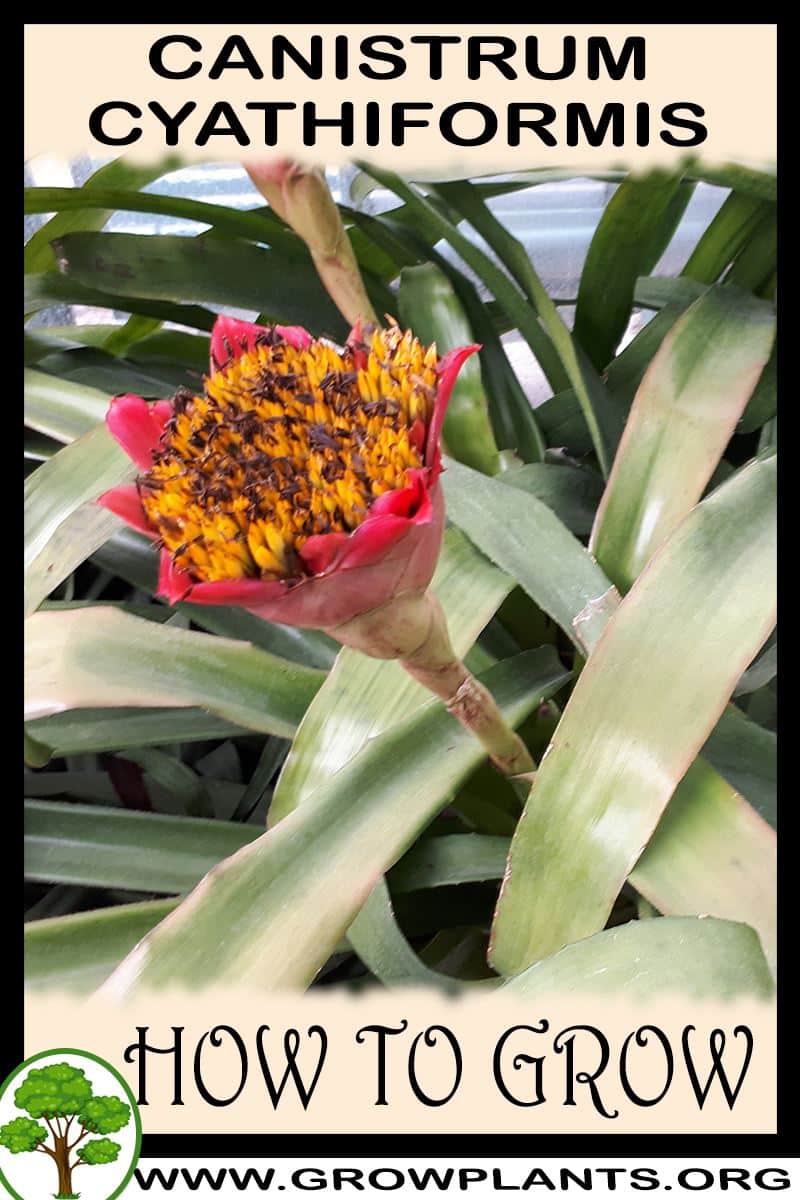
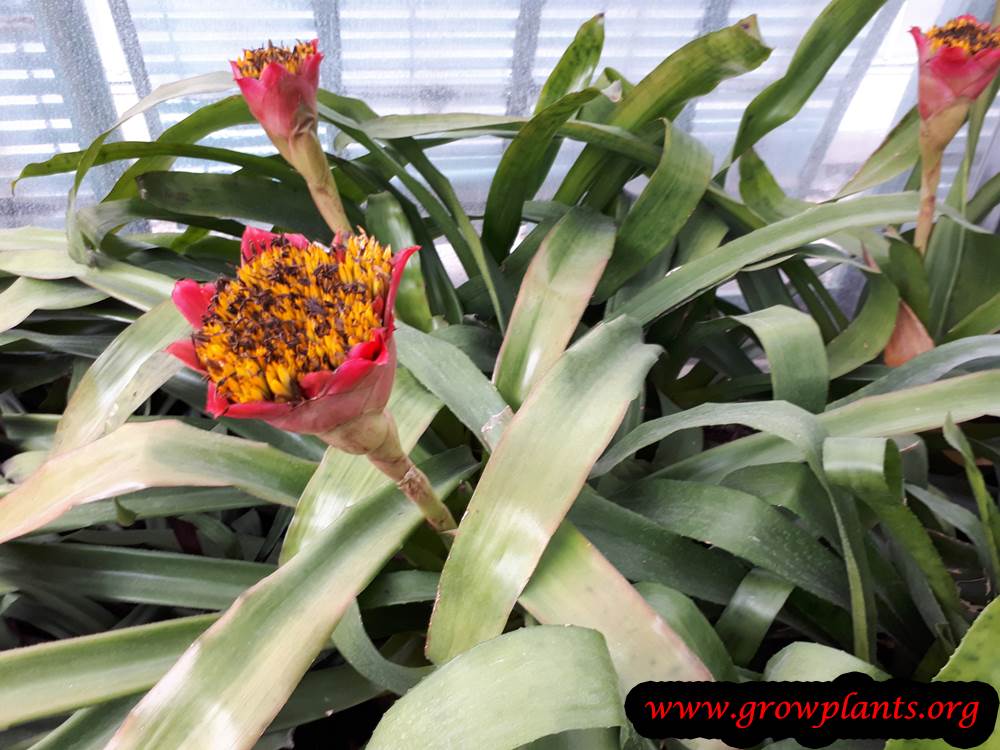
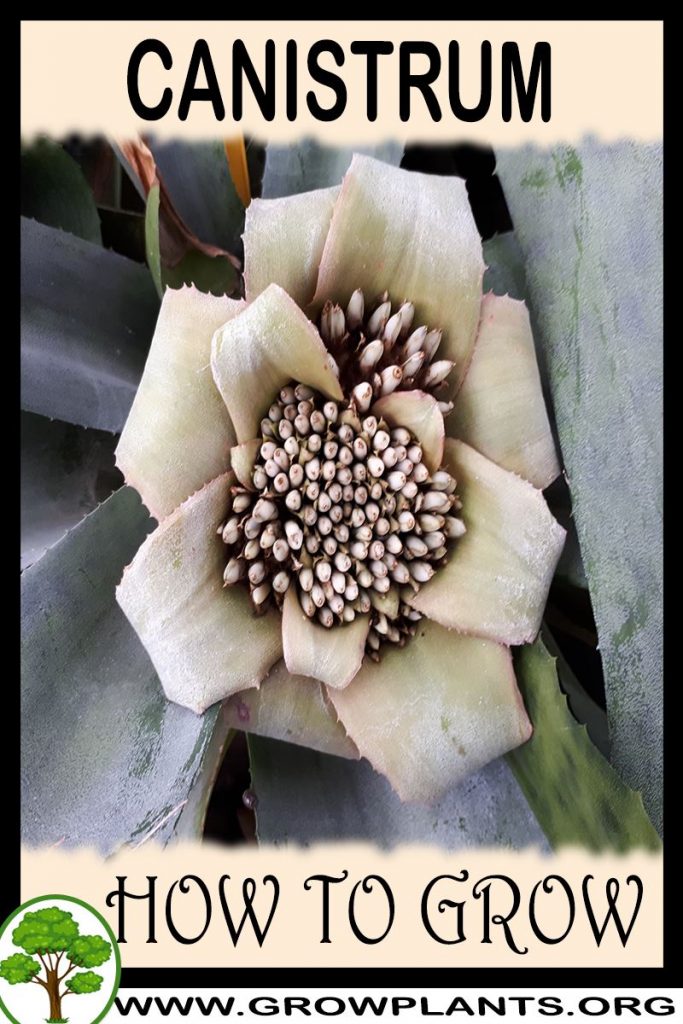
- Flower Characteristics: Bears small white-to-yellow flowers in the central cup, surrounded by red, pink, orange, yellow or purple bracts (see the Bloom guide for detail).
Primary Uses & Landscape Value
- Functional & Ornamental Roles: Ornamental houseplant, container or mounted specimen; a shade and tropical-garden accent.
Care Guide: Planting, Soil & Watering
Overview: Canistrum is an epiphytic bromeliad that in the wild clings to trees and rocks in humid tropical forest, so it wants warmth (above 15°C), high humidity and a light, airy, fast-draining medium rather than heavy soil. It prefers bright shade out of direct sun, slightly acidic conditions, and water applied into the central leaf rosette.
Quick Care Requirements
| Requirement | Ideal Condition |
|---|---|
| Planting Season | Warm season by zone – spring–summer in 10b, spring–autumn in 11, year-round in 12+ |
| Growth Rate | Slow to moderate |
| Soil Type | Light, airy, very free-draining epiphytic mix (bark / sphagnum) – not heavy garden soil |
| Soil pH | Slightly acidic |
| Water Need | Moderate – fill the central rosette with rain or purified water; keep humid but never soggy at the roots |
Planting & Establishment
- Best Planting Season: Plant in the warm season suited to your zone – spring to summer in 10b, spring to autumn in 11, and year-round in zones 12+.
- How to Plant:
- Hole Preparation: Rather than deep soil, seat it in a small pot of open epiphytic mix, or mount it on cork or bark as it grows in the wild.
- Soil Amendments: Use a light, airy medium such as bark or sphagnum that holds humidity around the roots while draining freely.
- Planting Depth: Keep the base of the rosette at the surface – never bury the crown, which rots if kept wet under soil.
- Growth Speed & Expectations: Grows slowly to moderately, forming offsets (pups) around the mother plant over time.
Soil, Watering & Drainage Care
- Soil Mix & Drainage Needs: Because it is an epiphyte, sharp drainage and airflow matter more than soil – grow it in an open mix or on bark, keeping the roots moist and humid but never waterlogged.
- Watering Schedule & Technique:
- Young / Newly Planted: Keep the medium and roots lightly moist and the humidity high while it settles.
- Established: Water into the central rosette cup, preferably with rainwater or purified water, and let the medium stay lightly moist.
- Seasonal Adjustments: Water more in warm weather; reduce in cool conditions and keep above 15°C for best growth.
Climate, Light & Hardiness
Canistrum bromeliads are tropical, largely epiphytic plants that grow naturally in warm, humid forest conditions, so they do best in bright, indirect light rather than direct sun. They need warmth above about 15°C (59°F) to thrive, are reliably outdoors only in USDA zone 11 and warmer, and can extend to about zone 10b with careful winter care.
Quick Climate Specifications
| Climate Zones | Subtropics, Mediterranean, tropic, or grown indoors as a houseplant |
|---|---|
| USDA Hardiness Zones | Approximately 11 and warmer; possible in 10b+ with careful winter protection |
| Optimal Temp Range | Warm, generally above 15°C (59°F) |
| Approx. Survival Minimum | Can briefly survive down to about 3°C (37°F), though this is not recommended and risks damage |
| Frost Tolerance | None |
| Light Conditions | Half shade without direct light, or full shade with good ambient light |
Sunlight & Light Exposure
Optimal Light Setup
Wants plenty of bright, indirect light rather than direct sun, in keeping with its natural role as a shaded forest epiphyte.
Shade & Heat Management
Direct sun will burn the leaves and flowers, leaving scorch marks, so filtered light or full shade with good ambient brightness suits it best.
Best Exposure / Orientation
A bright but sun-sheltered spot, such as under tree canopy outdoors or near, but not directly in, a sunny window indoors.
Temperature Extremes & Hardiness
USDA Hardiness & Regional Limits
Reliable outdoors only in USDA zone 11 and warmer; with attentive winter protection it can be grown down to about zone 10b, and elsewhere it is best kept as a houseplant.
Cold Damage & Winter Protection
Growth suffers well before temperatures approach freezing; the site data notes a preference for conditions above about 15°C (59°F), and while brief survival down to around 3°C (37°F) is possible, it is not advisable and risks lasting damage.
Frost Sensitivity
Not frost tolerant at all.
Wind, Humidity & Microclimate
Humidity Preferences
Needs consistently high humidity, reflecting its native tropical forest, epiphytic habitat where rainfall keeps the air and roots humid year-round.
Microclimate Recommendations
Best treated as an epiphyte-style planting, mounted or grown in an open, airy medium rather than dense soil, in a warm, humid, sheltered microclimate away from direct sun and cold drafts.
Growing in Pots, Balconies & Indoors
Canistrum is an epiphytic bromeliad, and the grower notes it is actually easiest to grow as a houseplant – in the wild it perches on trees rather than in soil, so a pot or a mounted piece of bark suits it well. It brings a lush, tropical look to a shaded indoor corner.
Quick Details
- Container Size: A small pot, or mount it on cork/bark – the roots anchor more than they feed
- Indoor Suitability: A good houseplant; easy in bright, indirect light indoors
- Best Spot: Bright shade with no direct sun – hot sun scorches the leaves and flowers
- Soil & Drainage: Very open, well-ventilated, fast-draining bark-based epiphyte mix
- Watering in Pots: Keep the central leaf rosette topped up with water; keep roots moist but never waterlogged
Indoors & On the Windowsill
- A natural houseplant: As an epiphyte it thrives indoors – pot it in an open bark mix or mount it on cork, and water into the central cup of the rosette.
- Light: Give bright, filtered light away from direct sun; a spot near (but not in) a window is perfect. It also copes with fairly deep shade if there is enough ambient light.
- Humidity: It enjoys moist air – mist it or group it with other plants; a bathroom or kitchen window suits it well.
On a Balcony or Patio
- Sheltered shade: Outdoors it wants a shaded, humid, wind-sheltered spot – direct sun will burn the foliage and flowers. Keep the rosette filled with fresh water.
Choosing the Pot, Soil & Long-Term Care
- Pot or mount: Grow it in a small, very free-draining pot of bark-based epiphyte mix, or tie it to cork/bark. If mounted, wrap the roots in bark or moss to hold moisture.
- Watering: Keep the roots moist and the central cup topped up; empty and refresh the cup water now and then to keep it clean.
- Feeding: Feed sparingly with a dilute balanced feed in the growing season – bromeliads are light feeders.
- Repotting: Only pot on when it outgrows its perch; after flowering it produces offsets you can separate and grow on.
Fertilizing & Feeding
This genus profile covers Canistrum bromeliads generally – as epiphytic rosette plants they are naturally light feeders, and the guidance here applies across the genus’s species and cultivars unless a specific one is known to differ.
Quick Fertilizing Specs
| Feeding Level | Light |
|---|---|
| young_feeding | Hold off on feeding newly potted plants or freshly separated offsets until new growth confirms they have settled in. |
| mature_feeding | Light, diluted feeding through the active growing season only. |
| Main Nutrient Priority | A balanced feed with a mild nitrogen lean to support rosette fullness and leaf coloration. |
| Best Feeding Period | The warm active-growth months. |
| Organic Options | A dilute organic liquid feed works as a gentler alternative for this epiphytic genus. |
| Reduce/Stop Feeding | Reduce feeding as light and temperatures drop for the season and pause it entirely after repotting or dividing. |
Feeding by Growth Stage
Establishment After Repotting or Dividing
Give a newly potted plant or a separated offset time to root into its medium before adding nutrients.
| Nutrient direction | None – withhold fertilizer until the plant shows active new growth in its new medium. |
|---|---|
| Timing | Right after potting, mounting, or dividing an offset from the parent rosette. |
| Frequency | No feeding at this stage until fresh growth confirms the plant has established. |
| Fertilizer types | No feeding at this stage – plain water in the cup and medium is sufficient. |
| Precautions | Do not fertilize a freshly potted or divided plant; wait for clear new growth before starting to feed. |
Active Growth
Support new leaf production and rosette form during the plant’s growing period.
| Nutrient direction | A light, balanced feed with a mild nitrogen lean for full, well-colored foliage. |
|---|---|
| Timing | While the rosette is actively producing new center leaves. |
| Frequency | Feed lightly and only occasionally – as a genus, Canistrum bromeliads are light feeders that do poorly under a heavy routine. |
| Fertilizer types | A diluted balanced liquid houseplant fertilizer applied to the medium, A very dilute foliar feed as an alternative for epiphytically mounted specimens |
| Routine trace nutrients | iron, manganese |
| Precautions | Avoid letting concentrated fertilizer solution pool in the central cup; flush it with plain water on a regular basis. |
Low-Light or Cool-Season Slowdown
Avoid encouraging new growth while reduced light and cooler conditions naturally slow the plant.
| Nutrient direction | None – withhold fertilizer while growth has slowed for the season. |
|---|---|
| Timing | The darker, cooler part of the year when new center-leaf growth visibly slows. |
| Frequency | No feeding at this stage – plain water is enough until active growth resumes. |
| Fertilizer types | No feeding at this stage – maintenance watering only. |
| Precautions | Do not fertilize during the slow season; unused nutrients can accumulate as salts in the medium and cup. |
Nutrient Deficiency Signs & Corrections
Overall leaf color looks faded rather than the normal saturated green, purple, or black patterning typical of the genus.
| Possible causes | Too little nitrogen from a very sparse or absent feeding routine, Insufficient light reducing pigment intensity, Salt buildup in the cup or medium interfering with uptake |
|---|---|
| Appears first on | The newest center leaves of the rosette |
| What to check | Check light exposure before assuming a nutrient cause, Flush the cup and medium with plain water to rule out salt accumulation |
| Possible correction | Flush built-up salts, correct light levels, and resume light balanced feeding once active growth restarts. |
Tips of the leaves turn brown and dry while the rest of the leaf stays green.
| Possible causes | Mineral or salt buildup from over-concentrated fertilizer or hard water, Low ambient humidity drying the thin leaf tips, Root stress limiting the plant’s ability to move water and nutrients |
|---|---|
| Appears first on | The tips of the older, outer leaves |
| What to check | Check whether fertilizer has been used at full strength instead of diluted, Check humidity levels and watering consistency around the plant |
| Possible correction | Dilute feeding further, flush the medium and cup periodically with plain water, and raise humidity where the plant is grown. |
Pruning, Training & Seasonal Maintenance
Plants in the genus Canistrum grow as rosettes of stiff, sharp-edged leaves and carry no woody stems or branches, so there is no structural pruning to speak of — only grooming. Each rosette flowers once, then gradually declines while offsets (pups) form at its base to take over, so the objective is simply to remove spent tissue without disturbing that succession. Because none of this affects a woody framework, grooming can be carried out at any point in the year with no impact on the timing or size of future blooms.
Quick Pruning & Maintenance Specs
| Pruning Tolerance | Low (grooming only, not structural pruning) |
| Primary Pruning Window | Any time of year, as needed |
| Typical Frequency | Occasional – as leaves brown or a rosette finishes flowering |
| Main Objective | Remove dead or damaged leaves and spent rosettes; allow pups to develop |
| Young Plant Priority | Leave alone while the offset is establishing |
| Mature Plant Priority | Groom old leaves; remove the spent rosette once pups are self-sufficient |
| Best Tool Type | Small precision snips |
| Avoid Heavy Pruning During | Always – there is no woody structure to hard-prune |
Pruning by Plant Age & Size
Newly Established
Leave a freshly potted offset untouched; trim only leaf tissue that was torn or bruised when it was separated from the parent plant.
Young / Formative
No training system applies — the rosette habit is fixed, with nothing to stake, pinch or shape.
Mature / Established
After a rosette blooms it begins to fade; leave it in place until its pups are large enough to stand alone, then cut the exhausted parent away at its base to free up light and space.
Special Growth to Remove
- Dead or browned leaves: trim off at their base against the rosette; avoid tearing, which can wound the central cup.
- Spent flower/bract structure: once fully faded, cut the flowering portion back to the rosette.
- Exhausted parent rosette: remove only once its pups no longer depend on it for support.
Container & Small-Space Pruning
Whether potted or mounted as an epiphyte, keep the central cup and leaf axils clear of fallen debris, which traps moisture against the crown and encourages rot or mealybugs. Overall size stays within the plant’s naturally compact 5–20cm rosette, so no height or spread control is needed.
Tools
- Precision snips: the only tool needed, for trimming dead leaves, spent flower structures, and separating pups.
Tool Hygiene & Disease Risk
Routine hygiene – a clean blade between plants is sufficient. Mealybugs are the genus’ main pest issue and travel easily on tools, so wipe the blade before moving to another plant.
Cut Placement & Technique
Cut dead leaves close to the rosette base, angled away from the central cup to avoid nicking healthy tissue or letting water collect in a fresh wound.
Heavy Pruning & Rejuvenation
Not applicable: there is no woody growth to rejuvenate. Renewal is handled entirely by the pups that replace each rosette after it flowers.
Post-Pruning Care
No extra feeding or special aftercare is needed after grooming; keep the plant in its usual humid, shaded spot and the small cuts will heal on their own.
Common Pruning Mistakes
- Cutting into living, green leaf tissue instead of only the dead portion.
- Removing the parent rosette before its pups can support themselves.
- Leaving cut debris in the central cup, inviting rot.
When NOT to Prune
Do not remove a flowered rosette while its pups are still small, and avoid trimming healthy green leaves purely for cosmetic reasons.
Recommended Tools (by task)
- precision_snips: correctly scaled for thin bromeliad leaves and flower stalks — the only cut this genus ever requires.
Propagation Guide
Canistrum is most conveniently propagated by separating the offsets (“pups”) that form at the base of the rosette, which is also the only way to keep a particular cultivar or leaf coloration true. Seed is a well-documented alternative on this site but needs fresh seed and specific warm, humid, bright conditions, and seedlings can vary from the parent; propagation is overall Easy by offsets, more Moderate from seed.
Quick Propagation Specs
| Best Propagation Method | Offsets (pups / daughter plants) |
| Alternative Methods | Seed (requires fresh seed and controlled warm, humid, bright conditions) |
| Propagation Difficulty | Easy by offsets; Moderate from seed |
| Seed True-to-Type | Variable — generally true to the species, but daughter plants (offsets) are needed to keep a specific cultivar |
| Vegetative True-to-Type | Yes |
| Best Propagation Season | End of spring to early autumn for seed; offsets can be separated spring to summer in hardiness zone 10b, spring to autumn in zone 11, and all year in zone 12+ |
| Seed Germination Time | 1–2 months |
| Germination Temperature | 25–30°C (77–86°F) by day, cooler at night |
| Seed Sowing Depth | Surface-sown, on top of the soil |
Growing from Seed
Seed Handling & Viability
Use fresh seed — not more than a few months old, as viability declines with age. Store any seed to be saved in a dry, dark spot at room temperature until sowing.
Sowing Season
End of spring to early autumn.
Sowing Depth & Orientation
Surface-sow onto sphagnum or peat moss without burying the seed, and keep it lightly moist.
Germination Conditions
High humidity and light, moist, well-aerated soil, with warm days of 25–30°C (77–86°F) and cooler nights, plus plenty of light.
Germination Time
Around 1–2 months.
Seedling Care
Seedlings need essentially the same conditions as a mature plant; space seedlings roughly 3x2cm (1.5x1in) apart in trays, and transplant them to a spot free of algae buildup.
Division, Offsets, Pups & Suckers
As with most bromeliads, a rosette eventually stops vegetative growth after flowering and produces offsets (“pups”) around its base. Wait until a pup is at least one-third to one-half the size of the parent rosette and has developed its own roots before separating it with a clean cut close to the parent stem — smaller, rootless pups are unlikely to establish well. Pot the offset into the same light, free-draining, epiphyte-style mix used for mature plants (or mount it on bark or cork), keep it humid and in half to full shade out of direct sun while it establishes, and once rooted resume watering into the central rosette cup as for an adult plant.
Bloom & Flower Guide
Quick Details
- Bloom Season: Summer into autumn
- Flower Appearance: White to yellow flowers in the center of the rosette, ringed by rounded bracts in red, pink, orange, yellow or purple
- Edibility: Not eaten – grown as an ornamental bromeliad
Detailed Blooming Overview
Canistrum is a genus of bromeliads (also known as Mosenia) grown for their striking rosettes and central bloom. The flowers appear in summer and autumn from the heart of the plant, set off by vivid bracts. They grow in subtropical, Mediterranean and tropical gardens, or indoors, in roughly zone 11 and warmer (zone 10b with careful overwintering).
Flower Characteristics
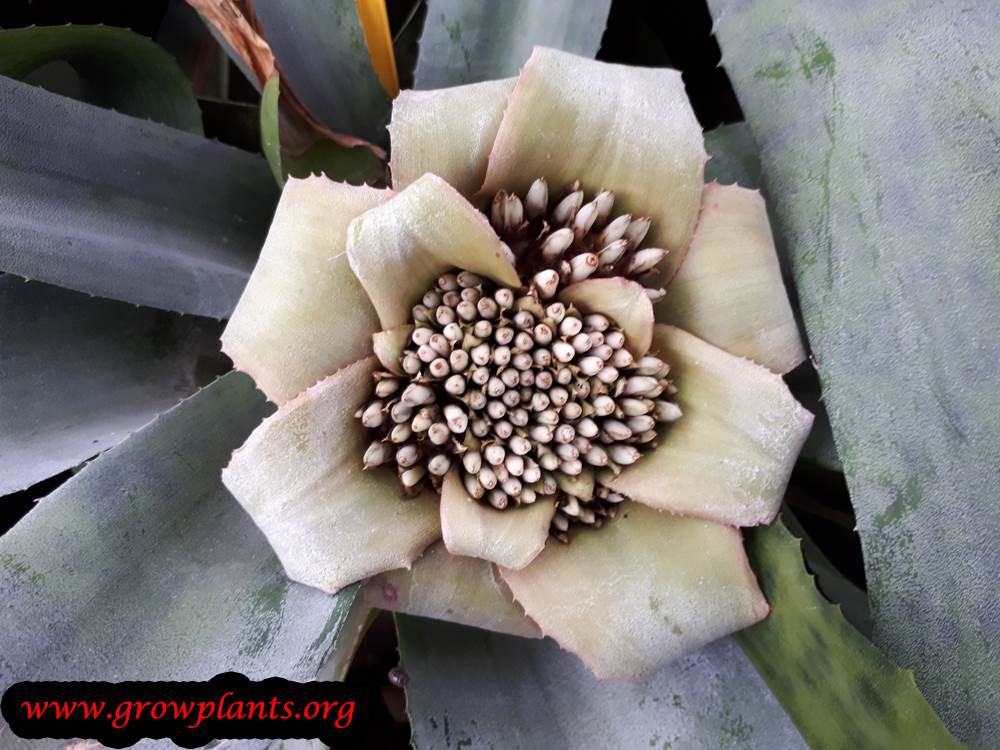
- Small white to yellow flowers clustered in a crown at the center of the rosette.
- Encircled by rounded bracts in red, pink, orange, yellow or purple – the main display.
- Held low within the leaf cup.
Bloom Care & Thinning
- Understanding the cycle: Each rosette flowers a single time and then produces offsets that continue the plant – keep the pups to grow on for future flowering.
- Position: Bright, indirect light with a little water in the central cup gives the best results.
Pests, Diseases & Troubleshooting
Overview: Canistrum is a tank-forming bromeliad, and like its relatives it is troubled mainly by scale and mealybugs on the leaves, with the central water-holding cup being the critical weak point: stagnant, cold or dirty water there invites fatal heart and crown rot. Only the genus is recorded here, so this uses the general Canistrum/bromeliad pattern. Care is overwhelmingly cultural — bright indirect light, warmth, fresh water in the cup and a fast-draining, airy medium — with oils and soaps used sparingly and gently.
Quick Troubleshooting Overview
| Issue / Pest | Main Symptom | Primary Solution |
|---|---|---|
| Bromeliad (Boisduval) scale | White/yellow encrustations on leaves, esp. undersides | Wipe/scrape, light horticultural oil |
| Mealybugs | White cottony masses in leaf axils and central cup | Alcohol swab, insecticidal soap |
| Aphids | Colonies on the inflorescence and soft new growth | Rinse off, insecticidal soap |
| Heart / crown rot | Central rosette loosens, browns and pulls out | Fresh cup water, warmth, avoid cold-wet |
| Leaf spot | Brown/black spots or blotches on leaves | Airflow, sanitation, copper fungicide |
| Sunburn | Bleached or brown scorched leaf patches | Reduce light intensity, acclimatise gradually |
Common Pests & Management
- Bromeliad / Boisduval Scale (Diaspis boisduvalii):
- Symptoms: The classic bromeliad pest — white to pale-yellow, circular armoured scales encrusting leaves, concentrated on the undersides and in sheltered leaf bases, causing yellow blotching and weakening the plant.
- Prevention & Control: Inspect new plants before introducing them, wipe or gently scrape off colonies, and treat with a light horticultural oil or insecticidal soap, testing on one leaf first since some bromeliads are oil-sensitive; repeat to catch crawlers.
- Mealybugs (Pseudococcus, Planococcus spp.):
- Symptoms: White, cottony, waxy masses tucked deep into leaf axils and the central cup, with honeydew and sooty mould; root mealybugs may also infest the medium.
- Prevention & Control: Dab clusters with an alcohol-moistened swab, flush the cup with clean water, treat with insecticidal soap, and repot in fresh medium if roots are infested.
- Aphids (Aphis spp.):
- Symptoms: Soft-bodied colonies on the emerging flower spike and tender new growth, with honeydew.
- Prevention & Control: Rinse them off with water and spot-treat with insecticidal soap; usually a minor, occasional problem.
- Spider Mites (Tetranychus spp.):
- Symptoms: Fine stippling and slight webbing, mostly on plants grown too dry or in low humidity indoors.
- Prevention & Control: Raise humidity, rinse the foliage, and use insecticidal soap if they persist.
Diseases & Fungal Issues
- Heart / Crown Rot (Fusarium, Phytophthora, Erwinia bacterial):
- Symptoms: The most serious threat — the central rosette softens, browns and lifts out with a gentle tug, often smelling foul, after cold, waterlogged or stagnant conditions in the cup or medium.
- Treatment & Management: Prevention is everything: keep it warm, refresh the water in the cup regularly (using rainwater or soft water), never leave it cold and wet, and grow in an open, fast-draining mix; an early, mild case may be halted by draining the cup, drying out and drenching with copper.
- Fungal Leaf Spot (Helminthosporium, Colletotrichum spp.):
- Symptoms: Brown to black spots or water-soaked blotches on the leaves, enlarging in warm, humid, still air.
- Treatment & Management: Improve air movement, avoid wetting foliage late in the day, remove badly spotted leaves, and apply a copper fungicide if it spreads.
- Root Rot (Pythium / Phytophthora spp.):
- Symptoms: Wilting and decline from roots rotting in a soggy, airless medium.
- Treatment & Management: Use a coarse, free-draining epiphyte mix, water the medium sparingly, and repot if the mix has broken down and stays wet.
Growing Difficulties & Abiotic Problems
- Overwatering & Salt Build-up:
- Cause & Symptoms: A constantly soggy medium leads to rot, while hard tap water leaves mineral crusts and brown leaf tips as salts accumulate in the cup.
- Correction Strategy: Keep the medium on the dry side, water mainly into the cup, and flush the cup periodically with rainwater or distilled water to clear salts.
- Sunburn:
- Cause & Symptoms: Bleached, tan or brown scorched patches where the plant is exposed to sudden or excessive direct sun.
- Correction Strategy: Provide bright but filtered/indirect light and acclimatise gradually to any increase in intensity.
- Cold Damage:
- Cause & Symptoms: Brown, mushy or translucent leaf patches and increased rot risk after exposure to cold, especially combined with wet.
- Correction Strategy: Keep it warm and frost-free, and never leave the cup filled going into cold nights.
What Helps — Products & Tools
A soft cloth and cotton buds with rubbing alcohol handle most scale and mealybugs; light horticultural oil or insecticidal soap (patch-tested first) backs them up; and a copper fungicide covers leaf spot and early rot. The most important “tools” are clean rain or soft water for the cup and a coarse, fast-draining epiphyte medium.