

Plant Profile & Key Characteristics
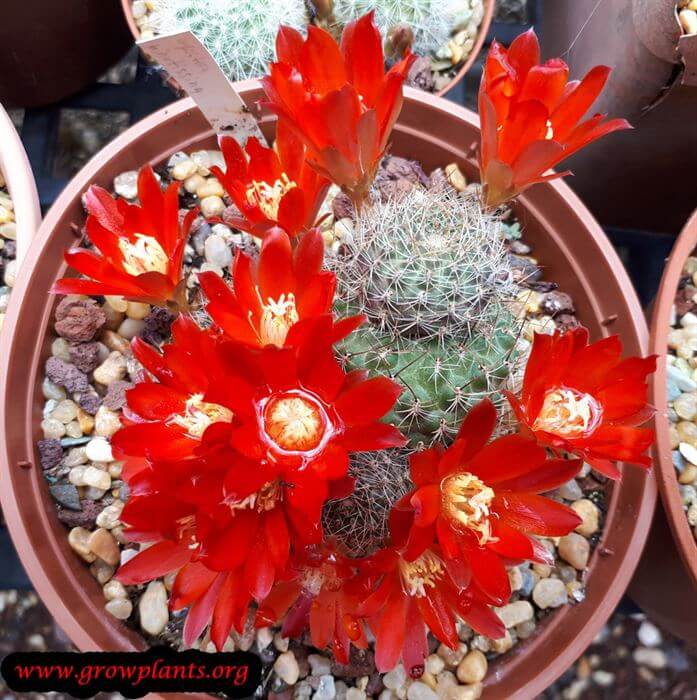
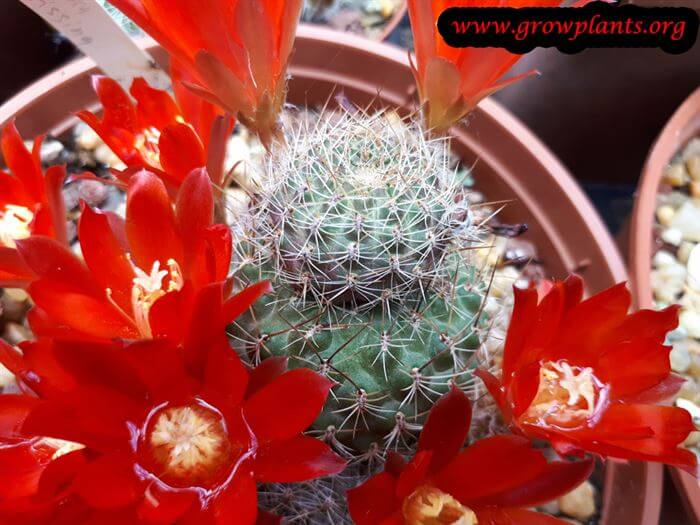
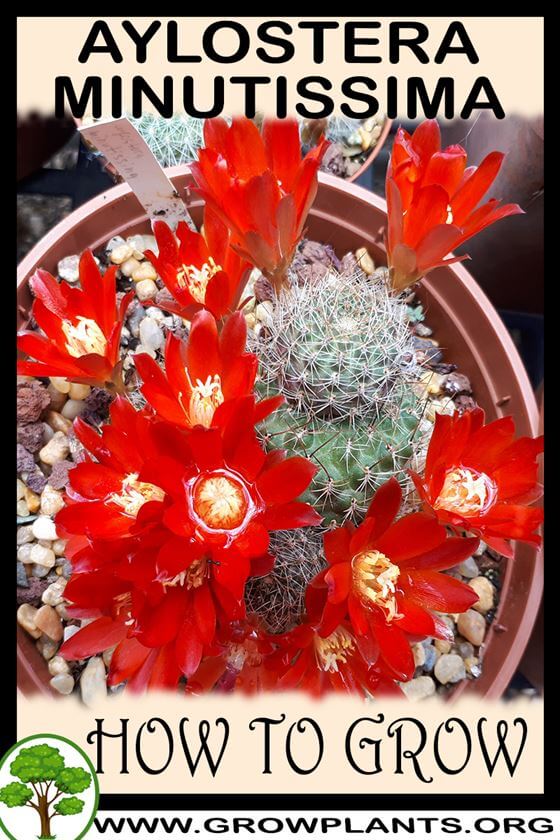
Overview: A tiny, slow-growing, drought-tolerant crown cactus grown as an ornamental, forming small green globular stems just 5–15 cm across clothed in white spines and topped by red trumpet-shaped flowers arranged like a crown.
Quick Specifications
| Specification | Attribute |
|---|---|
| Plant Type / Life Cycle | Perennial (cactus) |
| Foliage Type | Evergreen (leafless succulent stem) |
| Mature Size | 5–15 cm (2–6 in) |
| Growth Rate | Slow |
| Root System | Fibrous, shallow |
| Toxicity | Non-toxic (spines can cause mechanical injury) |
| Hardiness | USDA zones 9b–11 |
Growth Form & Structure
- Height & Spread: 5–15 cm (2–6 in), clustering into clumps; well suited to shallow, well-drained pots.
- Growth Habit & Form: Small, clustering globular cactus that forms offsets.
- Lifespan & Maturity: Long-lived, slow-growing succulent.
Anatomy & Physical Features
- Leaves & Foliage: Leafless; green globular stem covered in white spines.
- Flower Characteristics: Red trumpet-shaped flowers ringing the top of the stem like a crown.
Primary Uses & Landscape Value
- Functional & Ornamental Roles: Ornamental drought-tolerant cactus for containers, rockeries and dry desert-style gardens.
Care Guide: Planting, Soil & Watering
Overview: Aylostera minutissima is a tiny, slow-growing, drought-tolerant globular cactus (a crown cactus) that thrives in full sun and sharply drained, gritty soil. Water sparingly and let the soil dry out fully between waterings — it stores water in its stem and rots easily if kept too wet.
Quick Care Requirements
| Requirement | Ideal Condition |
|---|---|
| Planting Season | Spring to summer, during the warm growing season |
| Growth Rate | Slow |
| Soil Type | Gritty, sandy, sharply well-draining (cactus/succulent mix) |
| Water Need | Low — let the soil dry out between waterings, never overwater |
Planting & Establishment
- Best Planting Season: plant in spring or summer during warm, active growth; it tolerates only light frost (down to about -2 °C), so plant out only where hard freezes are past.
- How to Plant:
- Hole Preparation: set it into loose, gritty, free-draining soil in a shallow hole, never where water pools.
- Soil Amendments: blend in coarse sand, grit or pumice to guarantee fast drainage.
- Planting Depth: set the plant at soil level with the base of the stem resting on the surface — do not bury the body, which invites rot.
- Growth Speed & Expectations: slow-growing and very compact, staying only about 5–15 cm (2–6 in) and clustering into a small crown over time.
Soil, Watering & Drainage Care
- Soil Mix & Drainage Needs: use a gritty, sandy cactus mix. In a pot, choose a free-draining container and add an inert layer of grit or pumice — sharp drainage is essential to prevent root rot.
- Watering Schedule & Technique:
- Young / Newly Planted: water lightly to settle it in, keeping the soil barely moist without soaking it.
- Established: water sparingly and deeply, then let the soil dry out completely before watering again.
- Seasonal Adjustments: water a little more during active growth in spring and summer; keep it nearly dry over winter and shelter it from cold, wet conditions.
Climate, Light & Hardiness
Aylostera minutissima, a small globular "crown cactus," is at home in hot, dry desert, mediterranean, and subtropical climates in full sun. Its frost tolerance is limited - an established, dry plant may briefly survive down to around −2°C (28°F), but it needs winter protection anywhere colder or wetter than that.
Quick Climate Specifications
| Climate Zones | Desert, Mediterranean, Subtropical |
|---|---|
| USDA Hardiness Zones | approximately 9b–11 |
| Cold Damage Begins | as temperatures approach freezing, particularly if the soil is damp |
| Approx. Survival Minimum | approximately −2°C (28°F), briefly, for an established, dry plant |
| Frost Tolerance | Low |
| Light Conditions | Full sun |
| Wind Tolerance | Moderate |
Sunlight & Light Exposure
Optimal Light Setup
Full sun keeps growth compact and encourages the crown of red, trumpet-shaped flowers; indoors, place it at the brightest south-facing window available.
Direct Sun Requirement
Outdoors it wants unfiltered direct sun for most of the day, matching its native open, arid habitat.
Shade & Heat Management
Established plants tolerate intense desert heat when kept dry; very young or recently repotted specimens can benefit from a little midday shade until they harden off.
Best Exposure / Orientation
A south-facing, unshaded position - a rock garden, gravel bed, or sunny windowsill - suits it best.
Temperature Extremes & Hardiness
USDA Hardiness & Regional Limits
Reliably grown outdoors year-round only in roughly zones 9b–11; in colder climates it needs to be grown in a container and brought under cover (indoors or in a greenhouse) for winter.
Cold Damage & Winter Protection
Damage risk rises as temperatures near freezing, especially if the soil is at all damp; keep the plant bone-dry and sheltered through winter in any borderline climate.
Frost Sensitivity
Frost tolerance is low: a dry, established plant may shrug off a brief dip to about −2°C (28°F), but prolonged or wet cold is likely fatal.
Extreme Heat Tolerance
Excellent - it is well adapted to hot, arid desert summers provided the growing medium drains sharply.
Wind, Humidity & Microclimate
Humidity Preferences
Prefers low ambient humidity, in keeping with its native arid habitat.
Dry-Air Tolerance
Thrives in dry air and is not troubled by low indoor or desert-climate humidity.
Wind Tolerance
Moderate - its low, compact habit and native exposure to open terrain make it reasonably tolerant of wind, though it is small enough to also do well in a sheltered spot.
Rainfall & Seasonal Moisture
Adapted to low, seasonal rainfall with a distinct dry period; cold combined with wet soil is far more dangerous to it than drought.
Microclimate Recommendations
Grow on a raised, sharply-draining site (slope, rock garden, or container) that stays dry through winter; a container-grown plant is easy to move under cover during winter rain or cold snaps, though pots also heat, cool, and freeze faster than garden soil.
Growing in Pots, Balconies & Indoors
Aylostera minutissima is a tiny clustering cactus (only 5-15 cm) that thrives in a small pot. The grower doesn’t class it as a general houseplant, but like most cacti it does very well on a hot, sunny windowsill with direct light – give it the brightest position you can.
Quick Details
- Container Size: Small – a shallow pot just larger than the clump; cacti like to be a little snug
- Indoor Suitability: Best on a bright, sunny windowsill rather than deep in a room
- Best Spot: Full sun – the sunniest window or a sheltered sunny patio
- Soil & Drainage: Very free-draining, gritty cactus mix (add extra perlite, pumice or coarse sand); sharp drainage is essential – a ready-made cactus and succulent soil is a reliable shortcut to this mix
- Watering in Pots: Small amounts; let the mix dry out fully between waterings and keep it nearly dry through the cool, low-light season
Indoors & On the Windowsill
- Houseplant note: Not a foliage houseplant for a dim room, but an excellent sunny-windowsill cactus – it needs the strongest direct light.
- Windowsill growing: A hot, sun-facing sill suits it well; turn the pot occasionally for even growth.
- Overwintering: In cold climates keep it indoors over winter – cool, bright and nearly dry, which also helps it flower.
On a Balcony or Patio
- Light & wind: It loves a hot, sunny, sheltered spot; protect it from prolonged wet, as the small pot must never stay soggy. Bring it under cover before frost.
Choosing the Pot, Soil & Long-Term Care
- Pot & drainage: A small pot with strong drainage holes and no standing-water saucer; terracotta suits cacti because it breathes and dries fast.
- Potting mix: Gritty, mineral cactus mix – free draining above all.
- Feeding: A dilute low-nitrogen cactus feed a few times during active growth only.
- Repotting: Every couple of years into fresh gritty mix; handle the spines with care.
Fertilizing & Feeding
A light feeder overall: this small, slow-growing globular cactus needs only occasional, low-nitrogen feeding while actively growing in warm weather, with none through its cooler dormant rest.
Quick Fertilizing Specs
| Feeding Level | Light feeder |
|---|---|
| Main Nutrient Priority | Low-nitrogen and minimal, in keeping with a slow-growing, small-stature cactus |
| Best Feeding Period | The warm active growing season only |
| Organic Options | Not typically needed; a diluted cactus fertilizer is more common than organic amendments |
| Micronutrients | Rarely needed; usually supplied by a complete cactus fertilizer if one is used |
| Soil pH | Tolerates a wide range in fast-draining, gritty soil |
| Reduce/Stop Feeding | Stop feeding through the cooler dormant season |
Feeding by Growth Stage
Warm-season growth and crown flowering
Support gradual growth of the green, spine-covered globular stems and the crown of red, trumpet-shaped flowers that forms at the top.
| Nutrient direction | A light, low-nitrogen feeding suits this slow-growing, small-stature cactus. |
|---|---|
| Timing | During the warm active growing season. |
| Frequency | An occasional light feeding through the growing season is generally enough; this species rarely needs more. |
| Fertilizer types | A diluted balanced fertilizer formulated for cacti or succulents, used sparingly, A slow-release, low-nitrogen product worked lightly into fast-draining, gritty soil |
| Precautions | Let soil dry between waterings before feeding, and handle this spined plant carefully; excess moisture combined with feeding raises the risk of rot in such a small-bodied cactus. |
Cool-season dormant rest
Let the plant rest through its cooler dormant period without encouraging vulnerable new growth.
| Nutrient direction | None – withhold fertilizer while the plant is dormant. |
|---|---|
| Timing | Through the cooler part of the year, when growth slows or stops. |
| Frequency | No feeding at this stage. |
| Fertilizer types | No feeding at this stage – allow the plant to rest through its dormant period |
| Precautions | Do not fertilize during dormancy; feeding combined with cooler, wetter conditions raises the risk of stem and root rot in this small, frost-tender cactus. |
Nutrient Deficiency Signs & Corrections
The base or body of the small globular stem softens, discolors, or smells musty, with the plant losing firmness.
| Possible causes | Overwatering, Poorly drained or overly dense soil, Feeding during the cool, dormant season |
|---|---|
| Appears first on | The base of the stem and the roots |
| What to check | Soil drainage and container drainage holes, Recent watering frequency, Whether feeding happened during dormancy |
| Possible correction | Improve drainage, let soil dry fully between watering, and hold off feeding until active growth is clearly underway again. |
New growth at the crown looks unusually soft, swollen, or stretched rather than firm and compact.
| Possible causes | Too much nitrogen feeding, Insufficient light causing stretched growth, Overwatering encouraging soft tissue |
|---|---|
| Appears first on | The newest growth at the crown |
| What to check | Recent feeding strength and how often it was applied, Light exposure, Watering routine |
| Possible correction | Cut back to a lighter, low-nitrogen feeding and confirm the plant gets plenty of direct light. |
Spine or stem tips brown or look scorched, most noticeably on container-grown plants.
| Possible causes | Mineral salt buildup from fertilizer or hard water, Infrequent flushing of the container soil, Overly strong feeding for such a small plant |
|---|---|
| Appears first on | Stem and spine tips |
| What to check | How long since the container soil was last flushed with water, Feeding strength used, Water source |
| Possible correction | Flush the container soil thoroughly with water and reduce feeding strength going forward. |
Pruning, Training & Seasonal Maintenance
Aylostera minutissima (Crown cactus) is a small clustering globular cactus that needs almost no pruning – treat cuts only as remedial care (removing dead or rotting tissue) or as a way to harvest offsets for propagation, never as routine shaping. The safest time to intervene is during its active growing season (spring–summer), when wounds callus and heal fastest. Pruning does not encourage flowering: the crown of red trumpet flowers forms at each stem’s own growing point, so any cut that damages a stem’s tip stops that stem from flowering again.
Quick Pruning & Maintenance Specs
| Pruning Tolerance | Low |
| Primary Pruning Window | Spring–Summer (active growth, fastest healing) |
| Secondary Maintenance Window | Any time, for dead or rotten tissue only |
| Typical Frequency | Rare – only as needed |
| Main Objective | Remove dead/rotten tissue; harvest offsets |
| Young Plant Priority | Leave untouched to establish |
| Mature Plant Priority | Divide or remove offsets if the clump is overcrowded |
| Best Tool Type | Sterile fine blade |
| Avoid Heavy Pruning During | Winter dormancy / cool, damp weather (slow healing, rot risk) |
Pruning by Plant Age & Size
Newly Established
No pruning; remove only tissue that arrived damaged or rotten from transplant.
Young / Formative
No structural training applies to a globular cactus. Simply monitor the base for early signs of rot.
Mature / Established
Offsets (“pups”) clustering around the base can crowd the pot over time – remove or divide excess offsets at their base if crowding restricts airflow or light to the inner stems.
Seasonal Pruning Schedule
Ongoing Sanitary – Objective: keep the plant free of dead or rotting tissue that could spread rot to healthy stems. Remove: shriveled or blackened stem tissue, spent flower remnants. Do not remove: healthy green stem tissue or offsets you want to keep for a fuller clump. Expected response: none – this is purely preventive. Flowering impact: none, as long as each retained stem’s growing point is untouched.
Special Growth to Remove
- Offsets/pups: this species clusters by producing basal offsets that build its namesake “crown” appearance. Retain them for a fuller display, or remove/divide them at the base with a sterile blade to propagate new plants or relieve overcrowding.
- Dead or rotten stem tissue: cut back into firm, healthy tissue whenever rot appears (usually from overwatering or cold, wet conditions) – this is the only cut this plant genuinely needs.
- Spent flowers: the trumpet flowers wither at the stem tip and can be left to drop naturally or gently removed for tidiness; this does not affect future flowering since new blooms come from new growing points.
Container & Small-Space Pruning
At 5–15 cm mature size this species is grown almost exclusively in pots and rockeries. Keep the clump’s footprint in check by dividing and repotting outward-growing offsets rather than cutting them back, and prioritize excellent drainage over any pruning – drainage, not pruning, is what actually prevents the rot that threatens a potted specimen.
Tools
Grafting knife (sterile, fine blade) – the right size for cutting into rotten tissue or separating offsets cleanly without crushing these small stems. No other tool category is needed; nearly every cut this plant requires is small and precise.
Tool Hygiene & Disease Risk
Increased. Cuts are only ever made into damaged or rotting tissue, so there is a real risk of spreading soft rot or fungal pathogens between plants (or into remaining healthy tissue on the same plant) if the blade is not clean. Disinfect the blade before and after each cut, especially between separate specimens.
Cut Placement & Technique
When removing rot, cut well back into visibly firm, healthy green tissue – any grey, brown, or mushy tissue left behind will keep spreading. Let the cut surface dry and callus for several days in a shaded, airy spot before it touches soil or is watered.
Heavy Pruning & Rejuvenation
Not tolerated. This species has a single growing point per stem; there is no rejuvenation cut that regrows a decapitated stem’s crown the way a shrub resprouts. If a stem is lost to rot beyond saving, remove it at the base and rely on remaining offsets to refill the clump.
Post-Pruning Care
Hold off watering for several days after any cut so the wound can callus – a fresh cut plus wet soil on a stem this small is the fastest route to more rot. Do not feed after cutting; this is remedial care, not growth stimulation. Keep the plant bright and airy while it heals and watch the cut edge for any spread of discoloration.
Common Pruning Mistakes
- Cutting into rot without going far enough into healthy tissue, so the rot returns.
- Watering immediately after a cut.
- Removing offsets purely for tidiness, when leaving them gives the fuller clustered “crown” this species is named for.
- Using a large or dull blade that crushes rather than cleanly slices the small stems.
When NOT to Prune
Avoid any cutting during winter dormancy or cold, damp weather – wounds heal slowly in cool conditions, and the plant is already more rot-prone when cold and wet. Don’t remove offsets you intend to keep just because the clump looks irregular; irregular clustering is this species’ natural habit, not a flaw.
Recommended Tools (by task)
- grafting_knife: sterile, narrow blade for cutting into rot or separating offsets cleanly on very small stems – minimizes crush damage and reduces the risk of carrying contamination into remaining healthy tissue.
Propagation Guide
Also known as Crown cactus for the ring of blooms it produces at the crown, Aylostera minutissima is most easily and truly increased by removing and rooting the offsets ("pups") it clusters around its base; seed is a useful alternative for raising larger numbers or for plants that have not yet offset, and being a true species rather than a hybrid it comes reasonably true from seed. Propagation is generally easy, though seed-raised plants are slow to reach a useful size.
Quick Propagation Specs
| Best Propagation Method | Offsets (pups) |
| Alternative Methods | Seed |
| Propagation Difficulty | Easy (offsets); Moderate (seed, slow) |
| Seed True-to-Type | Usually true-to-type (species, not a hybrid cultivar) |
| Vegetative True-to-Type | Yes |
| Best Propagation Season | Spring / Summer, matching the plant’s own active growing and planting season |
| Seed Germination Time | Often begins within a couple of weeks but can be staggered over several weeks |
| Germination Temperature | Warm, roughly 20–25°C (68–77°F) |
Growing from Seed
Seed Handling & Viability
Cactus seed keeps reasonably well if stored cool and dry, but fresher seed germinates more evenly and reliably.
Sowing Season
Spring or summer, in line with the plant’s own active growing season.
Sowing Depth & Orientation
Sow on the surface of a gritty, free-draining cactus mix and press in lightly – do not bury, as this fine seed benefits from light to germinate.
Germination Conditions
Warm (roughly 20–25°C / 68–77°F), kept evenly moist but never waterlogged, in bright indirect light; covering the tray helps hold humidity until seedlings appear.
Germination Time
Germination can begin within a couple of weeks but is often staggered over a longer period.
Seedling Care
Seedlings are tiny and slow-growing at first; keep humidity a little higher than for mature plants, then ease off gradually, and only pot on once large enough to handle safely.
Division, Offsets, Pups & Suckers
As a "Crown cactus," this species naturally clusters, forming small globular offsets around the base of the parent stem. Offsets can be removed at any time during active growth (spring/summer). Detach with a clean cut and let the wound dry and callus for several days in a dry, shaded spot before setting the offset on or lightly pressing it into a gritty cactus mix to root. Offsets that already carry their own basal roots establish fastest and most reliably; very small, unrooted offsets are viable but take longer and are less certain to take.
Bloom & Flower Guide
Quick Details
- Bloom Season: Summer
- Time to First Bloom: These small crown cacti are free-flowering and often bloom while still young, within a few years of propagation
- Flower Appearance: Red, trumpet-shaped flowers that open around the top of the stem in a crown-like ring
- Edibility: Ornamental – the flowers are not eaten
Detailed Blooming Overview
Like others in its group, this crown cactus flowers from areoles near the top of the plant, so the blooms open in a ring around the crown. The trumpet-shaped flowers open in bright sunshine and close again toward evening, each lasting a few days. A cool, dry winter rest is the key that sets the buds for the coming summer.
Flower Characteristics
- Red, trumpet-shaped flowers.
- They form a crown around the top of the stem, often almost hiding it at peak bloom.
Bloom Care & Thinning
- Rest to flower: Give a cool, dry winter rest (around 10°C / 50°F) with little or no water – this dormancy is what sets the buds.
- Light: Bright light or full sun through the growing season builds the strength to flower well.
- Watering as buds swell: Resume careful watering in spring as buds appear, and avoid turning the plant, since the buds orient to the light.
- No thinning needed: The plant sets and drops its own flowers naturally.
Pests, Diseases & Troubleshooting
Overview: Aylostera minutissima (syn. Rebutia minutissima) is a tiny clustering crown cactus from the high Andes of Bolivia and Argentina, prized for flowering profusely despite its miniature size. These tiny, free-flowering crown cacti are hardy and nearly pest-free, so almost every problem comes from overwatering and poor drainage. The main live pests are mealybugs (especially hidden root mealybugs), scale and spider mites; the real killers are basal and root rot and fungal infection in cold, wet soil. The source content for this plant is unusable machine text, so this profile is built from genuine Rebutia/Aylostera horticulture: keep it dry, gritty and airy, with organic controls first.
Quick Troubleshooting Overview
| Issue / Pest | Main Symptom | Primary Solution |
|---|---|---|
| Root mealybugs | White fluff on roots, stalled growth, no flowers | Bare-root, wash, soak, repot in fresh dry mix |
| Mealybugs (crown) | Cottony tufts between ribs and in the crown | Alcohol swab, insecticidal soap/oil |
| Scale insects | Hard brown bumps on the body, yellow patches | Scrape off, horticultural oil |
| Spider mites | Rusty-bronze stippling near the tip, fine webbing | Rinse, fresh air, miticidal oil |
| Basal / root rot | Soft brown mushy base, collapse | Cut to clean tissue, dry off, gritty mix |
| Overwatering | Swollen, split or rotting body | Water sparingly, sharp drainage, dry winter |
Common Pests & Management
- Root Mealybugs (Rhizoecus spp.):
- Symptoms: White powdery or waxy deposits coating the roots and inner pot wall, with mysteriously stalled growth and shy flowering even when the plant looks clean above soil. A common, easily missed problem in small cacti.
- Prevention & Control: Check roots at repotting; if found, bare-root the plant, wash off all soil, soak the roots in insecticidal soap or a systemic solution, and repot in fresh dry mix in a clean pot. Repot every couple of years to catch them early.
- Mealybugs (Pseudococcus spp.):
- Symptoms: White cottony tufts tucked between the ribs, among the spines and in the woolly crown, with sticky honeydew and slow, weakened growth.
- Prevention & Control: Dab clusters with an alcohol-dipped swab, rinse, and treat with insecticidal soap or horticultural oil; repeat to catch survivors and isolate until clear.
- Scale Insects (Diaspis spp.):
- Symptoms: Hard brown limpet-like bumps fixed to the stem, leaving yellowed sunken patches where they feed.
- Prevention & Control: Scrape off gently with a soft brush, then smother the rest with horticultural oil, repeating to catch mobile crawlers.
- Spider Mites (Tetranychus spp.):
- Symptoms: Rusty-bronze corky scarring and pale stippling around the growing tip, with faint webbing in hot, dry, still air; the marks are permanent on cactus skin.
- Prevention & Control: Provide fresh air and occasional rinsing, avoid a hot bone-dry stagnant spot, and treat active mites with horticultural oil or a miticidal soap over the crown.
Diseases & Fungal Issues
- Basal & Root Rot (Fusarium, Pythium, Phytophthora):
- Symptoms: The base turns soft, brown and mushy and the little plant collapses; the classic result of overwatering or cold, wet soil in winter.
- Treatment & Management: Cut away all rot to firm clean green tissue, dust with sulphur, let it callus and re-root in dry gritty mix. Prevent with a mineral, sharply draining mix, sparse watering and a dry, cool (not cold-wet) winter rest.
- Botrytis & Fungal Spot (Botrytis cinerea, misc. fungi):
- Symptoms: Grey fuzzy mould on damaged areas or spent flowers, or small brown fungal spots on the body in cool, damp, poorly ventilated conditions.
- Treatment & Management: Remove affected tissue and old flowers, improve airflow, cut humidity and avoid overhead watering; a copper or sulphur fungicide checks persistent damp.
- Corky / Cosmetic Scarring:
- Symptoms: Dry brown corky patches from old pest damage, handling or minor infection, usually harmless.
- Treatment & Management: Improve ventilation and keep the body dry; the marks are permanent but not a threat.
Growing Difficulties & Abiotic Problems
- Overwatering & Winter Wet:
- Cause & Symptoms: Standing water or cold-wet soil, especially in the dormant season, causes swelling, splitting and soft basal rot.
- Correction Strategy: Use a gritty free-draining mix, water only when fully dry, and keep almost dry and cool (but frost-free or lightly frost-hardy per species) through winter.
- Etiolation & Poor Flowering:
- Cause & Symptoms: Too little light makes the squat globe stretch pale and soft and suppresses the profuse flowering these cacti are prized for.
- Correction Strategy: Give bright light with direct sun, and a cool dry winter rest to trigger heavy spring blooming.
- Sunburn / Scorch:
- Cause & Symptoms: Sudden strong sun after dull conditions bleaches or scars the skin with permanent pale patches.
- Correction Strategy: Increase sun gradually and shade lightly during the fiercest midday heat.
What Helps – Products & Tools
For these miniature cacti the essentials are a gritty mineral mix and restrained watering, plus isopropyl alcohol swabs and horticultural oil or insecticidal soap for mealybugs, scale and mites, a systemic drench for root mealybug, and sulphur or copper fungicide with a sterile knife for rot. Dry, airy, bright culture prevents nearly every problem.