Plant Profile & Key Characteristics
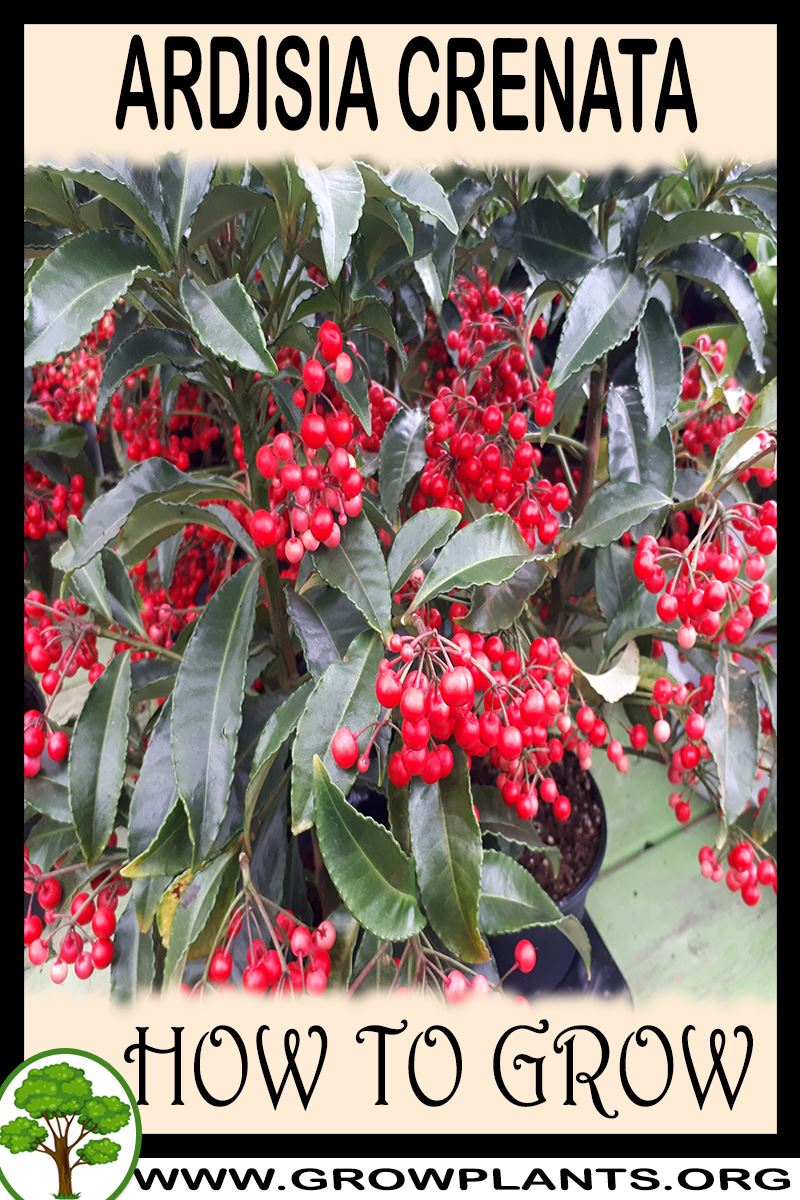
Overview: Christmas berry / coral ardisia (Ardisia crenata) is an evergreen shrub reaching 0.3-1.8 m, grown chiefly for its long-lasting bright red berries. It is a shade-tolerant plant that also makes a good houseplant.
Quick Specifications
| Specification | Attribute |
|---|---|
| Plant Type / Life Cycle | Perennial |
| Foliage Type | Evergreen |
| Mature Size | 0.3-1.8 m tall (12-72 in) |
| Growth Rate | Fast to moderate |
| Hardiness | USDA zones 7-10 |
Growth Form & Structure
- Height & Spread: 30-180 cm (12-72 in) in the ground; readily grown in pots and kept smaller indoors.
- Growth Habit & Form: Upright evergreen shrub with a single or few stems and glossy foliage held in tiers.
- Lifespan & Maturity: Long-lived evergreen perennial; berries persist through autumn and winter.
Anatomy & Physical Features
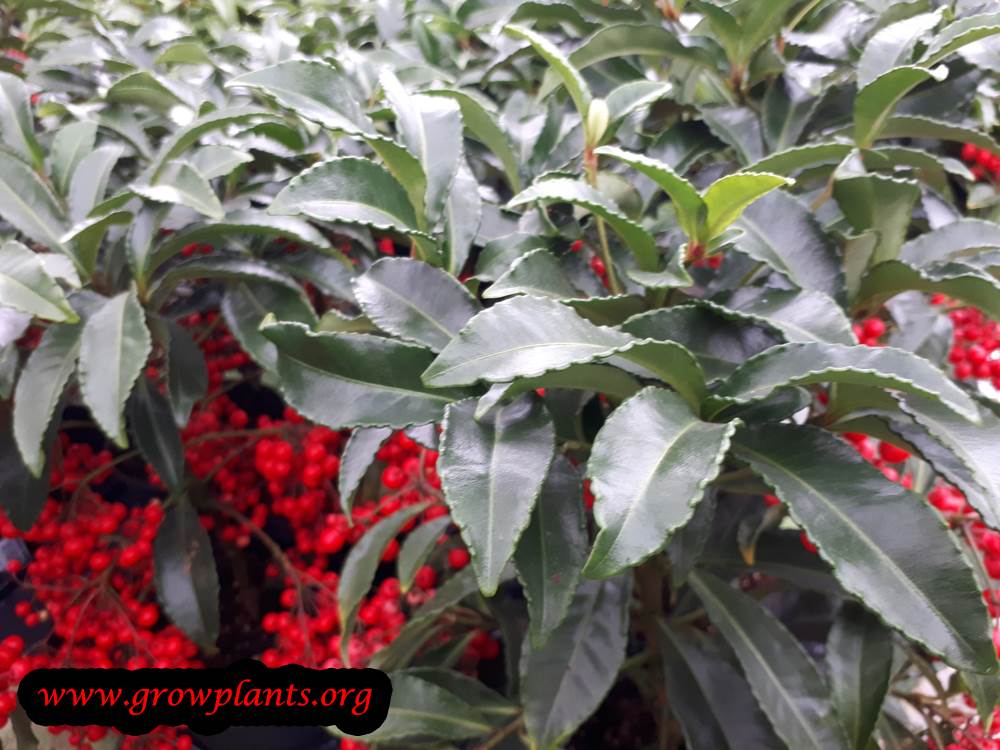
- Leaves & Foliage: Glossy green elliptic leaves with crinkled (scalloped) margins.
- Flower Characteristics: Small white-to-pink star-shaped flowers borne in clusters.
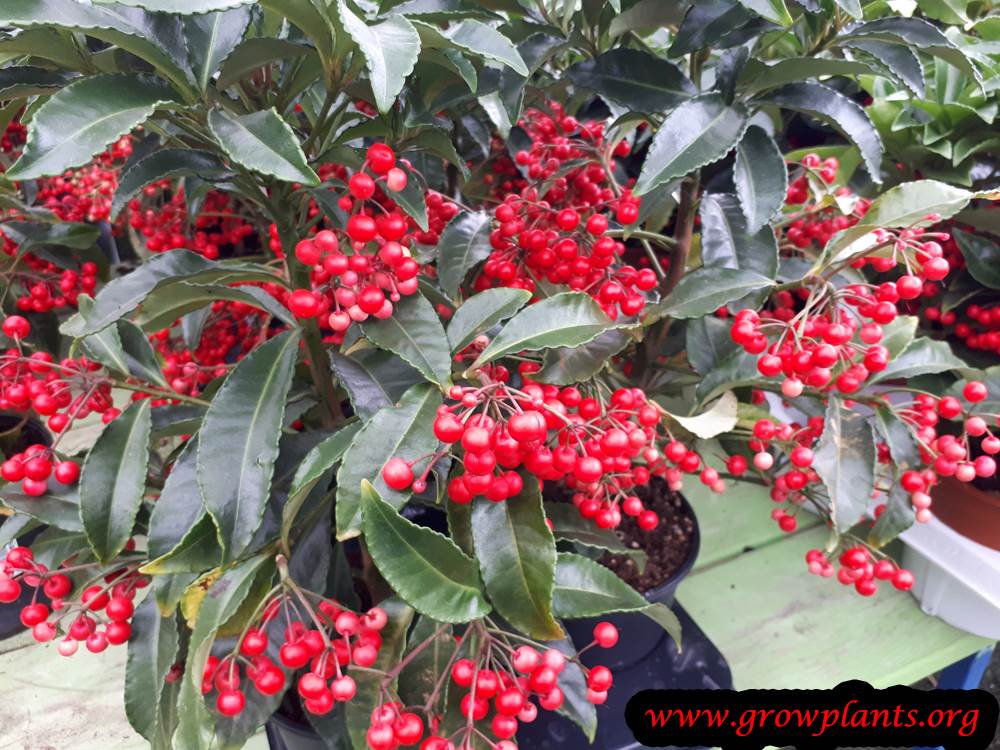
- Fruit Profile: Round, glossy bright-red ornamental berries – decorative rather than for eating.
Primary Uses & Landscape Value
- Functional & Ornamental Roles: Ornamental shade shrub and houseplant grown for its coral-red berries; note that it can be invasive in warm climates.
Care Guide: Planting, Soil & Watering
Overview: Coral ardisia is a shade-loving evergreen shrub that prefers rich, consistently moist but well-drained soil. It grows in half to full shade and likes steady moisture without waterlogging.
Quick Care Requirements
| Requirement | Ideal Condition |
|---|---|
| Planting Season | In spring through autumn during the warm season |
| Growth Rate | Moderate |
| Soil Type | Rich, moist and well-draining |
| Water Need | Moderate; keep evenly moist |
Planting & Establishment
- Best Planting Season: Plant in spring through autumn in a sheltered, shaded spot.
- How to Plant:
- Hole Preparation: Dig a hole about twice as wide as the root ball and as deep, loosening the sides, and choose a spot with moist but free-draining soil.
- Soil Amendments: Work in compost or leaf mould to enrich the soil and help it hold moisture.
- Planting Depth: Set the top of the root ball level with the soil surface and keep the stem base clear.
- Growth Speed & Expectations: A moderate grower reaching 30-180 cm (1-6 ft); note that it self-seeds readily and can become invasive in mild climates.
Soil, Watering & Drainage Care
- Soil Mix & Drainage Needs: Provide rich, moisture-retentive but well-drained soil. It also does well indoors or in containers with a quality potting mix and good drainage.
- Watering Schedule & Technique:
- Young / Newly Planted: Keep the soil evenly moist while the plant establishes.
- Established: Water regularly so the soil does not dry out, but avoid standing water.
- Seasonal Adjustments: Water more in summer heat and reduce in winter when growth slows.
Climate, Light & Hardiness
Ardisia crenata (coralberry / Christmas berry) is a shade-loving evergreen shrub for mediterranean, subtropical, and temperate climates or as a houseplant, prized for its bright red winter fruit. It is hardy outdoors in USDA zone 7–10.
Quick Climate Specifications
| Climate Zones | Mediterranean, subtropical, temperate, or as a houseplant |
|---|---|
| USDA Hardiness Zones | 7–10 |
| Frost Tolerance | Moderate |
| Light Conditions | Half Shade / Full Shade |
Sunlight & Light Exposure
Optimal Light Setup
Half shade to full shade suits it best, mimicking its natural understory habitat.
Direct Sun Requirement
Not needed – and best avoided, since this is a shade-adapted plant rather than a sun-lover.
Shade & Heat Management
Its shade preference naturally helps protect the foliage and ornamental fruit from sun-scorch in warmer parts of its range.
Best Exposure / Orientation
A shaded woodland-edge spot outdoors, or a bright-but-indirect indoor location as a houseplant.
Temperature Extremes & Hardiness
USDA Hardiness & Regional Limits
Reliably hardy outdoors USDA zone 7–10; it is evergreen, keeping its ornamental red fruit through winter within this range.
Cold Damage & Winter Protection
At the cold edge of zone 7, mulch and a sheltered position help protect the root zone and fruit display through winter.
Frost Sensitivity
Moderately frost-tolerant within its zone range; harder freezes beyond zone 7 can damage foliage and fruit.
Extreme Heat Tolerance
Good with average water, provided it has the shade it needs; direct sun combined with heat is more likely to stress it than heat alone.
Wind, Humidity & Microclimate
Rainfall & Seasonal Moisture
Prefers consistently moist soil, typical of the understory conditions it favors.
Microclimate Recommendations
A shaded, humid, sheltered spot – such as under trees or on a shaded patio as a container plant – suits it across its hardiness range.
Growing in Pots, Balconies & Indoors
Ardisia crenata (coral berry) is a neat, glossy-leaved evergreen the grower rates as a houseplant that also grows well in containers. It keeps long-lasting red berries through the cooler months and likes shade and warmth, making it an easy, handsome plant for an indoor pot.
Quick Details
- Container Size: A medium pot it can settle into; pot up as it slowly grows
- Indoor Suitability: A genuine houseplant for a bright to shaded, warm room
- Best Spot: Half to full shade – bright, indirect light, no harsh sun
- Soil & Drainage: Free-draining, organic-rich mix
- Watering in Pots: Average – evenly moist, never waterlogged
Indoors & On the Windowsill
- Houseplant: A true houseplant. Give it bright, indirect light and warmth; it fruits well even in fairly low light and holds its berries for months.
- Safety: The red berries are best treated as mildly toxic – keep them out of reach of children and pets, and don’t eat them.
- A pot tames it: It self-seeds and is listed as invasive where it escapes, so container-growing keeps it in check.
On a Balcony or Patio
- Light, wind & heat: Best on a sheltered, shaded or part-shaded balcony out of harsh midday sun; walls and railings reflect heat and dry pots fast, so check moisture often and shield from strong wind.
- Practicalities: Only in warm weather and shade; bring it in before cold, as it is not frost-hardy.
Choosing the Pot, Soil & Long-Term Care
- Pot & drainage: Use a pot with strong drainage holes and skip a standing saucer of water, which invites root rot; terracotta breathes and dries fast, while glazed or plastic holds moisture longer.
- Potting mix: Well-aerated and organic-rich – a peat- or coir-based mix opened up with perlite or vermiculite and enriched with compost.
- Feeding: Potted plants use up their food faster because frequent watering leaches nutrients away – feed a little more often through the growing season than plants in open ground.
- Repotting: Refresh the mix and pot up roughly every couple of years; for perennials, lightly prune the root ball and top growth at the same time.
Fertilizing & Feeding
A moderate feeder: balanced feeding supports spring growth, then a potassium-forward feed favors flowering and the ornamental berry display this shrub is grown for, with no feeding needed during its slower winter rest.
Quick Fertilizing Specs
| Feeding Level | Moderate feeder |
|---|---|
| Main Nutrient Priority | Balanced in spring, shifting toward potassium-forward feeding to support bloom and berry set |
| Best Feeding Period | Spring growth through bloom and early berry development |
| Organic Options | Compost worked into moist, organic-rich soil |
| Micronutrients | Iron and manganese are usually adequate in organic-rich, well-drained soil; correct specific issues only when diagnosed |
| Soil pH | Prefers moist, organic-rich soil; avoid highly alkaline conditions, which can limit micronutrient uptake |
| Reduce/Stop Feeding | Taper off once berries have set and hold off through the winter rest period |
Feeding by Growth Stage
Spring growth flush
Support fresh leaf and stem growth on this evergreen shrub as active growth resumes in spring.
| Nutrient direction | A balanced complete fertilizer to support steady growth. |
|---|---|
| Timing | Spring, as new growth resumes. |
| Frequency | A light feeding as spring growth begins. |
| Fertilizer types | A balanced complete fertilizer for shrubs, Compost worked into moist, organic-rich soil |
| Precautions | Keep soil consistently moist but not waterlogged; this shade-loving shrub does not tolerate the soil drying out. |
Bloom and ornamental fruit set
Support flowering and the ornamental berry display that follows, which this shrub is primarily grown for.
| Nutrient direction | Continue balanced feeding with adequate potassium to support fruit set and quality. |
|---|---|
| Timing | From spring-to-summer bloom through berry development. |
| Frequency | Light, steady feeding through bloom and early fruit set, easing back once berries are developing. |
| Fertilizer types | A balanced complete fertilizer, shifting toward a more potassium-forward feed as berries form |
| Precautions | Avoid heavy nitrogen once berries are setting; excess leafy growth can come at the expense of the ornamental fruit display. |
Winter rest
Match feeding to this evergreen shrub’s naturally slower pace through the cooler months, while the ornamental berries persist on the plant.
| Nutrient direction | None – withhold fertilizer during the winter rest period. |
|---|---|
| Timing | Winter, while berries are on display and growth is slow. |
| Frequency | No feeding at this stage. |
| Fertilizer types | No feeding at this stage – resume light feeding once spring growth resumes |
| Precautions | Do not fertilize during winter rest; the berry display needs no extra feeding to persist. |
Nutrient Deficiency Signs & Corrections
New leaves emerge pale yellow or blotchy while the veins stay green.
| Possible causes | high soil pH limiting micronutrient availability, waterlogged, poorly aerated soil, low organic matter in poor soil |
|---|---|
| Appears first on | the newest leaves |
| What to check | soil pH and drainage, recent watering, organic matter level |
| Possible correction | Improve drainage and organic matter; correct with a chelated iron or manganese product per its label if chlorosis persists. |
Few or no ornamental berries form despite normal flowering.
| Possible causes | insufficient pollination without a nearby compatible plant, excess nitrogen favoring foliage over fruit set, inadequate light, since this shade-tolerant shrub still needs some light to fruit well |
|---|---|
| Appears first on | berry count following bloom |
| What to check | light levels, recent feeding balance, especially nitrogen, presence of other Ardisia plants nearby for pollination |
| Possible correction | Ease off nitrogen, confirm adequate indirect light, and allow for pollination between multiple plants where possible. |
Wilting and leaf drop with blackened roots despite consistently moist soil.
| Possible causes | waterlogged, poorly drained soil, overwatering, fungal root pathogens favored by constantly wet conditions |
|---|---|
| Appears first on | roots and lower stems |
| What to check | soil drainage, watering frequency, container drainage if grown as a houseplant |
| Possible correction | Improve drainage, let soil dry slightly between waterings, and hold off feeding until the plant recovers. |
Pruning, Training & Seasonal Maintenance
Ardisia crenata is a small evergreen shrub grown mainly for its long-lasting red berry display, so pruning has to work around this ornamental fruiting cycle rather than being purely cosmetic. It flowers and sets berries on the current season’s new growth, tolerates moderate pruning well, and the safest time to shape or renew it is once the current berry display has faded in autumn/winter, leaving a full growing season for new wood to form, flower and re-fruit before the next display.
Quick Pruning & Maintenance Specs
| Pruning Tolerance | Moderate |
| Primary Pruning Window | Autumn/winter, once the berry display has finished |
| Secondary Maintenance Window | Light shaping during the spring growth flush |
| Typical Frequency | Once a year |
| Main Objective | Shape the shrub and remove old fruiting wood without sacrificing next season’s display |
| Young Plant Priority | Light shaping and pinching to build a full, multi-branched habit |
| Mature Plant Priority | Post-display renewal cuts; remove weak or crossing growth |
| Best Tool Type | Bypass secateurs (small-diameter woody stems) |
| Avoid Heavy Pruning During | Spring–summer flowering, and while berries are actively on display |
Pruning by Plant Age & Size
Newly Established
Remove only damaged growth; let the shrub build its framework before any shaping cuts.
Young / Formative
Pinch or lightly tip-prune to encourage a full, multi-stemmed shrub rather than a single leggy stem – relevant since it is grown both as a compact houseplant and as a 30cm–1.8m landscape shrub.
Mature / Established
Open up crowded interior growth after the berry display fades, and shorten any overly long shoots to keep the shrub’s naturally rounded shape.
Seasonal Pruning Schedule
Post-Display (Autumn–Winter)
- Objective: renew shape and remove old wood once the berry display has finished
- Remove: spent fruiting clusters, dead or crossing branches
- Do not remove: current season’s healthy young shoots, which will carry next year’s flowers
- Expected response: fresh growth flush in spring that flowers and re-berries on schedule
- Flowering/fruiting impact: none, since flowers form on new growth produced after this cut
Flowering & Fruiting Wood
Ardisia crenata flowers in spring/summer and fruits on the current season’s new growth, with the red berries then persisting as an ornamental display through autumn and into winter. Pruning right after the berry display fades – not mid-display, and not during spring/summer flowering – removes old fruiting wood without sacrificing the following year’s flowers, since the plant produces fresh flowering wood again the next growing season.
Structural Pruning & Training
Maintain the shrub’s naturally rounded, multi-stemmed shape by removing crossing or inward-growing branches and shortening any single shoot that has outgrown the rest. Height and spread control is easy given its moderate size range and slow-to-moderate growth rate.
Special Growth to Remove
- Spent berry clusters once the display has faded – besides tidiness, this reduces bird-dispersed seed, which matters since this species is recorded as invasive in some regions
- Dead or winter-damaged twigs
Container & Small-Space Pruning
Since it is also grown as a houseplant, container specimens benefit from slightly more assertive pruning for size control – shorten new growth after the berry display to keep the plant in scale with its pot, and prune roots lightly at repotting every couple of years.
Tools
- Bypass secateurs for the small woody stems typical of this shrub
- Precision snips for removing individual spent berry clusters without disturbing nearby growth
Tool Hygiene & Disease Risk
Routine – clean, sharp secateurs are sufficient. No major pruning-transmissible disease is documented for this species beyond general aphid pressure, which is not spread by tools.
Cut Placement & Technique
Make thinning cuts back to a healthy side branch or bud rather than leaving stubs; cut spent berry clusters back to just above a leaf node.
Heavy Pruning & Rejuvenation
Tolerates a moderate rejuvenation cut, up to about a third, if the shrub has become leggy or sparse, best done right after the berry display fades. Expect a season of reduced flowering and fruiting while it regrows a full framework, so avoid rejuvenating more than one older specimen at a time if the berry display matters that season.
Post-Pruning Care
Water normally, and watch for sun exposure on previously shaded interior stems if the canopy has been opened significantly, since this species prefers half to full shade. No extra feeding is required after a light shaping cut.
Common Pruning Mistakes
- Pruning off developing berry clusters mid-display purely for tidiness, losing the plant’s main ornamental feature for the season
- Over-opening the canopy in full sun exposure, which can scorch previously shaded foliage
- Letting spent berries persist and self-seed unchecked into nearby beds, given the species’ recorded invasive tendency
When Not to Prune
Avoid pruning during spring–summer flowering and while the red berries are actively on display; hold off on heavy cuts on a newly planted or newly potted specimen until it is established.
Recommended Tools (by task)
- bypass_secateurs – primary tool for shaping cuts and removing old wood on this small woody shrub
- precision_snips – deadheading spent berry clusters without disturbing nearby growth
Pruning Troubleshooting
| Problem | Possible Cause | What to Check | Corrective Action |
| Sparse or absent berry display | Pruned during or just before flowering, removing flower buds | Timing of the last prune relative to spring bloom | Prune only after the previous berry display fades, in autumn/winter |
| Leggy, open growth | No shaping cuts for several seasons | Time since last renewal prune | Do a moderate rejuvenation cut post-display, then resume light annual shaping |
| Self-sown seedlings appearing nearby | Berries left to fully ripen and disperse (often by birds) | Presence of unwanted seedlings under or near the shrub | Deadhead spent berry clusters before they fully disperse, given the species’ recorded invasive tendency |
Propagation Guide
Ardisia crenata is most easily raised from the seed inside its ornamental red berries, which germinates readily and is in fact part of why this plant is flagged as invasive in some regions – be mindful of that when propagating and dispersing seedlings. Stem cuttings are a practical alternative, particularly useful for keeping a compact or variegated selection true to type. Overall this is an Easy plant to propagate.
Quick Propagation Specs
| Best Propagation Method | Seed (from ripe red berries) |
| Alternative Methods | Semi-hardwood stem cuttings |
| Propagation Difficulty | Easy |
| Seed True-to-Type | Usually true-to-type for the species |
| Vegetative True-to-Type | Yes |
| Best Propagation Season | Spring, summer, or autumn, matching the plant’s own planting season |
| Seed Germination Time | Typically several weeks to a couple of months |
| Cutting Rooting Time | Usually several weeks under warm, humid conditions |
| Germination Temperature | Warm, roughly 21–27°C (70–80°F), suiting this subtropical shrub |
| Seed Sowing Depth | Shallow – just cover the cleaned seed |
Growing from Seed
Seed Handling & Viability
Clean the fleshy red pulp off the seed before sowing, and sow while fresh – like many fleshy-fruited seeds, viability can decline if it is allowed to dry out for long.
Germination Conditions
Warm temperatures and consistently moist, humid conditions suit germination, in line with this plant’s preference for moist soil and shade.
Germination Time
Typically several weeks to a couple of months.
Seedling Care
Grow seedlings on in half to full shade with even moisture until well established.
Stem Cuttings
Cutting Type
Semi-hardwood tip cuttings.
Best Timing
Spring through summer, during active growth.
Rooting Setup
Root in a warm, humid environment in a moist, well-draining mix.
Rooting Hormone
Optional – can be beneficial but is not required.
Rooting Time
Usually several weeks.
Bloom & Flower Guide
Quick Details
- Bloom Season: Spring into summer
- Flower Appearance: Small star-shaped flowers in white to pink, borne in clusters
- Edibility: Not edible – the plant and its berries are toxic if eaten
Detailed Blooming Overview
Ardisia crenata (Christmas berry, coral ardisia or coralberry) is an evergreen shrub grown mainly for the ornamental display that follows flowering. The delicate flowers appear in spring and summer in Mediterranean, subtropical and temperate settings, or indoors, across roughly zones 7-10.
Flower Characteristics
- Small, neat five-pointed star flowers in white to soft pink.
- Carried in loose clusters below the glossy, wavy-edged foliage.
- Also sold as Australian holly, coral bush, coralberry and coralberry tree.
Bloom Care & Thinning
- Position: A sheltered, part-shaded spot with steady moisture gives the best flowering.
- Pollination: The flowers are self-fertile and readily set fruit.
- Safety: All parts, and especially the berries, are toxic if eaten – site it away from children and pets, and note it can self-seed and become invasive in warm climates.
Pests, Diseases & Troubleshooting
Overview: Coralberry is a shade-loving evergreen shrub grown for glossy leaves and long-lasting red berries; indoors and in warm gardens its main enemies are sap-sucking scale, mealybugs and mites, while overwatering brings root rot. It is otherwise quite tough. Steady moisture with excellent drainage, humidity, and inspection of leaf undersides keep it clean; note its natural leaf-margin nodules are a harmless symbiosis, not a disease.
Quick Troubleshooting Overview
| Issue / Pest | Main Symptom | Primary Solution |
|---|---|---|
| Scale insects | Brown bumps on stems/leaves, sticky honeydew | Wipe/prune off, horticultural oil |
| Mealybugs | White cottony tufts in leaf axils | Dab with alcohol, insecticidal soap, oil |
| Aphids | Sticky distorted new growth | Water jet, insecticidal soap |
| Spider mites | Fine speckling, webbing in dry air | Raise humidity, hose foliage, oil |
| Leaf spot / dieback | Brown blotches, twig dieback | Remove leaves, airflow, copper fungicide |
| Root rot | Wilting, yellowing, soft roots in wet soil | Free drainage, cut watering |
Common Pests & Management
- Scale insects (Coccidae / Diaspididae):
- Symptoms: Brown, tan or white waxy bumps clinging to stems, leaf midribs and undersides. Soft scales excrete honeydew that fuels sooty mould; leaves yellow and growth thins under heavy infestation. The commonest pest of coralberry indoors.
- Prevention & Control: Wipe light scale off with a soft cloth or cotton bud, and prune out badly encrusted twigs. Encourage or protect parasitic wasps outdoors. Apply horticultural or neem oil to smother crawlers and adults, repeating every couple of weeks to catch new generations.
- Mealybugs (Pseudococcidae):
- Symptoms: White, cottony, waxy tufts nestled in leaf axils, along veins and on stems, with honeydew and sooty mould and slow, distorted growth. They hide in crevices and around the crown.
- Prevention & Control: Dab colonies with a cotton bud dipped in rubbing alcohol, and rinse the plant. Isolate affected specimens. Follow up with insecticidal soap or horticultural oil, thoroughly wetting axils and undersides; repeat until clear.
- Aphids (Aphis spp.):
- Symptoms: Soft green or black insects clustered on tender new shoots and flower stalks, causing curled tips, honeydew and sooty mould.
- Prevention & Control: Rinse them off with water and encourage ladybirds and lacewings outdoors. Insecticidal soap or neem clears persistent colonies; treat the growing tips where they gather.
- Spider mites (Tetranychus urticae):
- Symptoms: Fine pale stippling and a dull look to the glossy leaves, with fine webbing on undersides in dry indoor air or hot weather; leaves may bronze and drop.
- Prevention & Control: Raise humidity, mist and hose the foliage, and keep the plant out of hot dry drafts. Protect predatory mites outdoors. Horticultural oil or insecticidal soap controls stubborn infestations.
- Thrips (Thysanoptera):
- Symptoms: Silvery flecking and distortion on new leaves with black frass specks, mainly on plants in warm, dry positions.
- Prevention & Control: Use sticky traps to monitor, keep the plant vigorous, and treat serious cases with spinosad or insecticidal soap on the new growth.
Diseases & Fungal Issues
- Leaf spot (Cercospora / Phyllosticta spp.):
- Symptoms: Round to irregular brown or purplish spots, sometimes with darker margins or pale centres, on the leaves, worst in warm humid conditions and on wet foliage.
- Treatment & Management: Remove and bin spotted leaves, improve air circulation, and water at the base to keep foliage dry. Copper fungicide gives preventive control where leaf spot recurs in humid seasons.
- Botryosphaeria dieback / canker (Botryosphaeria / Neofusicoccum spp.):
- Symptoms: Wilting and browning of individual branches, sunken or discoloured bark, and progressive twig dieback, usually entering through wounds or on stressed plants.
- Treatment & Management: Prune out affected wood well below the canker with disinfected tools, and keep the shrub unstressed with steady moisture and light shade. There is no spray cure; vigour and clean pruning are the defence.
- Root & crown rot (Phytophthora / Pythium spp.):
- Symptoms: Wilting and yellowing despite moist soil, poor vigour, and soft, dark, decayed roots and crown in overwatered or poorly drained conditions.
- Treatment & Management: Grow in free-draining, humus-rich soil, let the surface dry between waterings, and never leave the pot standing in water. Remove severely affected plants; improving drainage and watering habits is the real fix.
- Bacterial leaf gall / nodules (note) (Burkholderia symbiont):
- Symptoms: Ardisia crenata naturally carries beneficial bacteria in nodules along the leaf margins, giving the leaf edge a crenulated, bumpy look. This is a normal symbiosis, NOT a disease. True bacterial galls or swellings on stems from other organisms are rare.
- Treatment & Management: No action is needed for the natural leaf-margin nodules — they are part of the plant’s biology. If genuinely galled or swollen stem tissue appears (uncommon), prune it out and destroy it, and keep the plant unstressed.
Growing Difficulties & Abiotic Problems
- Overwatering & root rot:
- Cause & Symptoms: Constantly soggy soil or a saucer of standing water suffocates the roots, yellowing leaves, wilting the plant and inviting Phytophthora — the most common way coralberry is killed.
- Correction Strategy: Use a free-draining, humus-rich mix, water only when the top of the soil dries, and empty saucers. Ensure pots have drainage holes and never let the plant sit wet.
- Leaf scorch & chlorosis:
- Cause & Symptoms: Harsh direct sun bleaches and scorches the leaves of this understorey shrub, while very alkaline or waterlogged soil yellows the foliage between green veins.
- Correction Strategy: Site in bright shade to dappled light out of fierce midday sun, and grow in slightly acidic, well-drained soil; correct chlorosis with chelated iron and better drainage.
- Low humidity & cold damage:
- Cause & Symptoms: Dry indoor air causes leaf-tip browning and invites spider mites, while temperatures near or below freezing damage the foliage of this warm-climate plant.
- Correction Strategy: Raise humidity by grouping plants or using a pebble tray, keep it away from hot drafts and radiators, and protect from frost — move containers indoors in cold spells.
- Berry / leaf drop:
- Cause & Symptoms: Sudden changes in light, temperature or watering can cause leaf yellowing and premature berry drop.
- Correction Strategy: Keep conditions steady — consistent light, warmth and moisture — and avoid moving the plant abruptly between very different environments.
What Helps — Products & Tools
For coralberry, keep to rubbing alcohol spot-treatment and insecticidal soap for mealybugs, horticultural / neem oil for scale and spider mites, a water jet and soap for aphids, and sticky traps for monitoring thrips and whitefly. Copper fungicide covers leaf spot in humid conditions. The single most important ‘tool’, though, is cultural — a free-draining mix and careful watering to prevent root rot. Chelated iron corrects chlorosis.