
Plant Profile & Key Characteristics
Overview: A fast-growing evergreen tropical shrub, vine or small tree reaching 0.5–6 m (2–20 ft) overall — about 2–6 m as a vine, 0.5–3 m as a shrub and 4–6 m as a small tree, prized for its clusters of fragrant, yellow, pink or red trumpet-shaped flowers. Grown as a frost-tender ornamental — a perennial in warm zones and a warm-season annual in cooler areas.
Quick Specifications
| Specification | Attribute |
|---|---|
| Plant Type / Life Cycle | Perennial (grown as an annual in cool climates) |
| Foliage Type | Evergreen |
| Mature Size | 0.5–6 m (2–20 ft) overall — about 2–6 m as a vine, 0.5–3 m as a shrub and 4–6 m as a small tree |
| Growth Rate | Fast (slower while young) |
| Toxicity | Toxic — all parts contain a milky latex that irritates skin and causes digestive upset if eaten (Apocynaceae). |
| Hardiness | USDA zone 9+ (perennial); grown as an annual in zone 7+ |
Growth Form & Structure
- Height & Spread: In the ground about 0.5–6 m (2–20 ft) overall — about 2–6 m as a vine, 0.5–3 m as a shrub and 4–6 m as a small tree; kept smaller and more restrained in a 10–20 L (2.5–5 gal) container.
- Growth Habit & Form: Vigorous evergreen shrub that also scrambles as a woody climber, and can be trained tree-like; needs a trellis or support when grown as a vine.
- Lifespan & Maturity: Long-lived tropical perennial; fast growth brings it to flowering size within a few seasons.
Anatomy & Physical Features
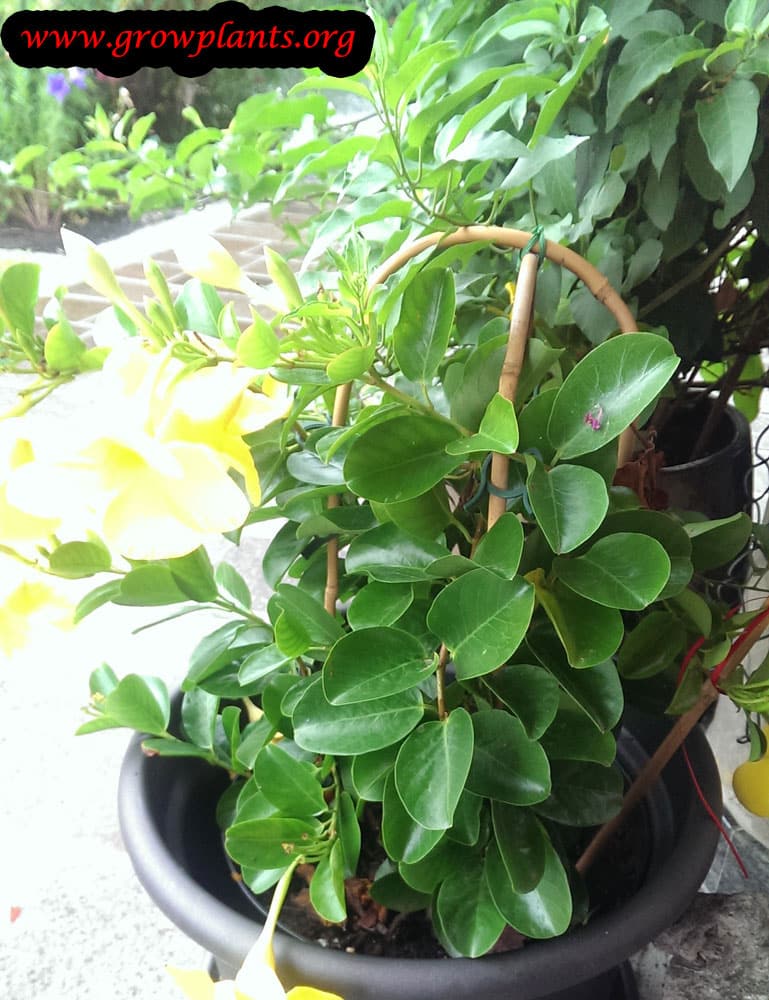
- Leaves & Foliage: Glossy green, elliptic leaves borne in whorls along the stems.
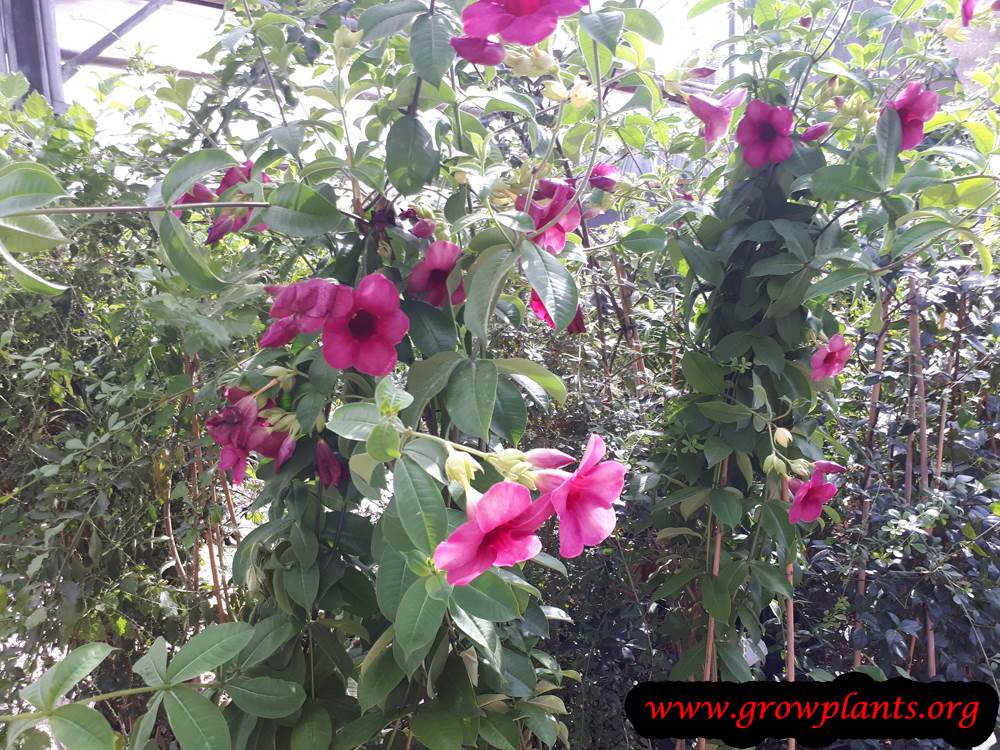
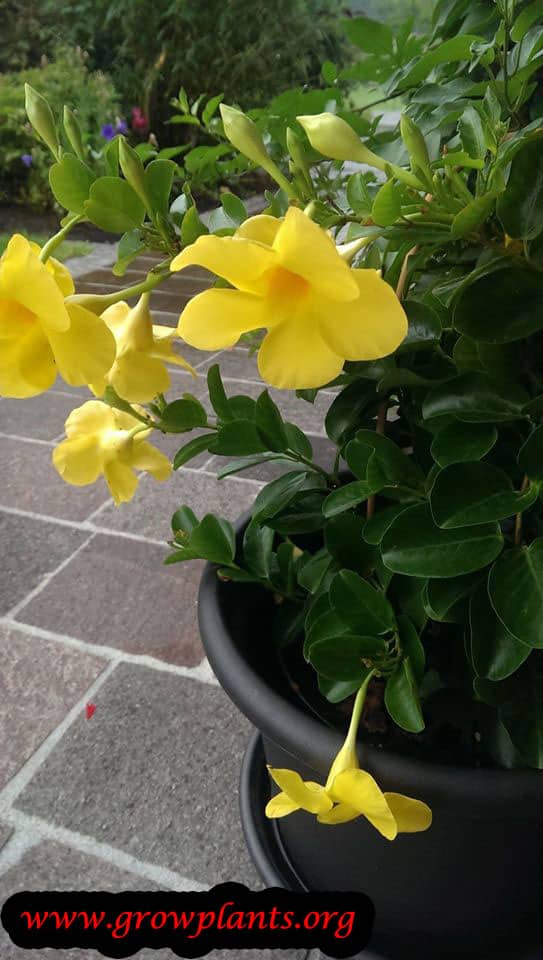
- Flower Characteristics: Fragrant, yellow, pink or red trumpet- to bell-shaped flowers carried in clusters through the warm season (see the Bloom guide for detail).
Primary Uses & Landscape Value
- Functional & Ornamental Roles: Ornamental fragrant flowering climber and shrub for frost-free gardens — trained over trellises, arches, fences and pergolas, used as a flowering screen or grown in large containers on a patio.
Care Guide: Planting, Soil & Watering
Overview: Allamanda is a fast-growing tropical that thrives in warm, frost-free conditions and full sun, in rich, free-draining soil kept steadily moist. It rewards generous organic matter and mulch, and prefers not to dry out fully during the warm growing season.
Quick Care Requirements
| Requirement | Ideal Condition |
|---|---|
| Planting Season | Spring in cooler zones (or as a warm-season annual where frost occurs); spring–summer in zone 10, spring–autumn in zone 11, year-round in zone 12+ |
| Growth Rate | Fast (slower while young) |
| Soil Type | Rich, well-draining soil high in organic matter |
| Water Need | Moderate to High — keep the soil evenly moist |
Planting & Establishment
- Best Planting Season: Plant in spring once frost has passed and the soil has warmed; in frost-free zones (11–12+) planting can extend through the warm season, while in cold-winter areas it is grown as a warm-season annual.
- How to Plant:
- Hole Preparation: Dig a hole noticeably wider than the root ball so the roots can spread into loosened soil.
- Soil Amendments: Mix organic matter, decomposed leaves and humus into the backfill to enrich and open up the soil, then mulch after planting.
- Planting Depth: Set the plant so the root collar sits level with the surrounding soil — do not bury the stem. For vining types, install a trellis or support at planting time.
- Growth Speed & Expectations: Growth is slow while the plant is young, then becomes fast once it is established in warm, bright conditions.
Soil, Watering & Drainage Care
- Soil Mix & Drainage Needs: Allamanda needs rich but sharply draining soil; in containers use a quality potting mix (peat-based is fine) with perlite or vermiculite so excess water drains freely and the roots never sit waterlogged, and mulch to hold moisture between waterings.
- Watering Schedule & Technique:
- Young / Newly Planted: Water twice on planting day, then daily for the first two weeks while the roots establish.
- Established: Water regularly to keep the soil evenly moist — this tropical prefers not to dry out fully during active growth.
- Seasonal Adjustments: Increase watering in heat and during active growth, and reduce noticeably in the cooler months when growth slows.
Note: Best grown in a container where space is limited; if planting in the ground, allow about 3m (10ft) between plants.
Climate, Light & Hardiness
Allamanda plant is a tropical, frost-tender flowering vine or shrub that thrives in full sun in tropical, subtropical, and warm mediterranean climates, with flowering noticeably reduced in half shade. It needs essentially frost-free conditions to persist as a perennial (about zone 9 and warmer) and is grown as a warm-season annual or container plant as far as zone 7, where it is cut back or brought under cover for winter.
Quick Climate Specifications
| Climate Zones | Tropical, subtropical, warm mediterranean, and warm temperate climates; essentially frost-free conditions needed for perennial growth |
|---|---|
| USDA Hardiness Zones | Zone 9+ as a perennial; grown as an annual or container plant as far as zone 7 |
| Optimal Temp Range | Approximately 21–29°C (70–84°F) |
| Cold Damage Begins | Approximately 10°C (50°F); chilling can cause leaf yellowing or drop even before frost |
| Approx. Survival Minimum | Roots and stems are generally killed by hard frost; a brief, light chill near 0°C (32°F) may be survived by an established root system in a mild zone 9 site, though cold tolerance varies by exposure, plant age, and how sheltered the site is |
| Frost Tolerance | Very Low |
| Light Conditions | Full Sun (half shade reduces flowering) |
Sunlight & Light Exposure
Optimal Light Setup
Full sun is essential for a strong flush of its trumpet-shaped flowers; half shade is tolerated for foliage growth but noticeably reduces blooming.
Direct Sun Requirement
Needs several hours of direct sun daily for good flowering; where grown as a vine, training it onto a sunny trellis or support keeps the whole plant well lit, not just the base.
Shade & Heat Management
Handles full tropical sun and heat without difficulty; no special heat shading is needed in its preferred warm climates.
Best Exposure / Orientation
A warm, sunny, wind-sheltered spot - such as a south-facing wall or trellis - both maximizes flowering and buffers the plant from occasional cool snaps.
Temperature Extremes & Hardiness
USDA Hardiness & Regional Limits
Reliable as a perennial only in essentially frost-free zone 9 and warmer; from about zone 7 through zone 8 it is grown as a warm-season annual, a container plant brought indoors for winter, or a plant cut back hard and heavily mulched with no guarantee of regrowth.
Cold Damage & Winter Protection
Cold tolerance varies with plant age, exposure, and how established the root system is - a mature, in-ground plant in a sheltered zone 9 microclimate may take a light chill better than a young or container-grown specimen. Where frost threatens, move container plants under cover, or in marginal ground plantings apply a thick mulch over the root zone before winter.
Frost Sensitivity
Very frost-sensitive; foliage and stems are damaged well above freezing and are killed outright by any hard frost.
Extreme Heat Tolerance
Excellent; as a tropical species it thrives in high heat and humidity provided the soil stays evenly moist and rich, as recommended for this plant.
Wind, Humidity & Microclimate
Humidity Preferences
Prefers the high humidity of its native tropical and subtropical range; propagation guidance for this plant specifically calls for high humidity to root cuttings successfully, reflecting its general preference for humid air.
Dry-Air Tolerance
Limited; dry, low-humidity air is more stressful for this plant than for many landscape shrubs, particularly for young growth.
Wind Tolerance
Moderate; as a twining vine or lax shrub it benefits from a trellis or a wind-sheltered position, since exposed, whippy new growth can be damaged by strong wind.
Rainfall & Seasonal Moisture
Suited to climates with reliable warm-season rainfall or irrigation; consistent with its rich, moisture-retentive soil preference, it does not tolerate a prolonged dry season without supplemental water.
Microclimate Recommendations
In marginal (zone 7–8) climates, plant against a warm, sun-facing wall for extra winter warmth and wind shelter, and mulch the root zone heavily before cold weather.
Growing in Pots, Balconies & Indoors
Allamanda (golden trumpet) is a vigorous tropical climber-shrub grown for its glossy leaves and big trumpet flowers. The grower says it is not a houseplant – it needs strong sun to bloom – but it grows well in a large container on a warm, sunny patio or balcony, and in cold climates a pot lets you move it under cover for the winter.
Quick Details
- Container Size: 10-20 L (2.5-5 gal), per the grower
- Indoor Suitability: Not a true houseplant; too little light indoors to flower – a bright sunroom or the warmest sunny window at best
- Best Spot: Full sun (half shade means fewer flowers)
- Soil & Drainage: Rich, organic potting mix, or peat/coir with perlite or vermiculite; must drain freely
- Watering in Pots: Keep the soil moist with water running freely from the pot; containers dry faster than open ground
Indoors & On the Windowsill
- Not a houseplant: The grower marks it unsuitable indoors – it is a sun-lover that grows leggy and refuses to flower in ordinary room light. At most, try the brightest, warmest sunny window or a heated sunroom.
- Overwintering under cover: This is the real reason to pot it in cold climates. Allamanda is frost-tender, so before the cold arrives bring the container into a bright, frost-free room, conservatory or greenhouse, water sparingly, and move it back out once warmth returns.
- Toxic – keep it away: All parts and the milky sap are poisonous and the sap can irritate skin, so keep plants out of reach of children and pets and wash your hands after pruning. Never let anyone eat any part of it.
On a Balcony or Patio
- Light & warmth: Give it the hottest, sunniest, most sheltered spot; walls and railings that trap and reflect heat suit this tropical well.
- Support & wind: The climbing types need a trellis or obelisk – tie in the shoots and shelter them from strong wind on exposed balconies.
- Drying & runoff: Sun-warmed pots dry quickly, so check moisture often; position the pot so milky-sapped drips and runoff don’t stain paving or reach where children and pets play.
Choosing the Pot, Soil & Long-Term Care
- Pot & drainage: A 10-20 L pot (the grower’s size) with strong drainage holes; skip a standing saucer of water to avoid root rot.
- Potting mix: Rich in organic matter – a good potting mix, or peat/coir with perlite or vermiculite for aeration (the grower’s recipe).
- Feeding: Container plants lose nutrients to leaching, so feed regularly through the growing season to keep the flowers coming.
Grower’s Container Tip
- Repot and rejuvenate every two years: When grown on as a perennial, every couple of years switch out the soil and prune back part of the roots along with some top growth, then return the plant to fresh, organic-rich mix – this keeps a potted Allamanda vigorous and free-flowering.
Growing this plant in a greenhouse
A greenhouse can give allamanda plant frost protection and cold protection. In the right climate it may also be kept growing through winter, depending on how much warmth and light are provided.
Greenhouse at a glance
| Greenhouse suitability | Conditional - depends on your climate |
|---|---|
| Main benefits | frost protection, cold protection |
| Season extension | earlier spring & later autumn |
| Outdoor protection advisable below | about 10°C |
| Maintain greenhouse minimum | around 10°C for active growth |
| Suitable types | heated greenhouse, polycarbonate greenhouse, lean-to |
| Heating | Heating is recommended in cold climates for continuous growth. |
Related greenhouse guides
- Greenhouses: How to Choose the Right Greenhouse
- Best Greenhouse Heaters
- Greenhouse Climate Control: Temperature, Ventilation and Humidity
- Best Lean-To Greenhouses
Fertilizing & Feeding
A fast-growing tropical flowering shrub or vine that blooms heavily through the warm months and responds well to steady, balanced feeding in the growing season, tapering off as growth slows in cool weather.
Quick Fertilizing Specs
| Feeding Level | Moderate – a vigorous tropical bloomer |
|---|---|
| young_feeding | Feed lightly and regularly as young plants establish |
| mature_feeding | Feed regularly through the warm season to sustain vigorous growth and flowering |
| Main Nutrient Priority | Balanced nutrition with steady nitrogen to fuel fast growth and continuous bloom |
| Best Feeding Period | Through the warm growing season, from spring into autumn |
| Reduce/Stop Feeding | Ease off as growth slows in cool weather or winter |
| Soil pH | Slightly acidic to near neutral, rich and well-drained |
| Organic Options | Mulch, humus and well-rotted organic matter |
| Micronutrients | A complete fertilizer usually supplies trace needs |
Feeding by Growth Stage
Spring flush of new growth
Fuel vigorous new shoots as growth resumes in warm weather.
| Nutrient direction | A balanced, nitrogen-inclusive feed to drive strong new growth. |
|---|---|
| Timing | Spring, as growth resumes. |
| Frequency | Regular, light feeding through the flush of new growth. |
| Fertilizer types | A balanced complete fertilizer, Compost or well-rotted organic matter as mulch |
| Precautions | Keep nitrogen moderate – too much drives leafy growth at the expense of flowers. |
Warm-season flowering
Sustain the long summer-into-autumn display of trumpet flowers.
| Nutrient direction | Continue balanced feeding; adequate potassium supports flowering. |
|---|---|
| Timing | Summer into autumn. |
| Frequency | Steady, regular feeding through the blooming months. |
| Fertilizer types | A balanced complete fertilizer |
| Precautions | Avoid high-phosphorus bloom boosters; balanced feeding and full sun give the best flowering. |
Cool-season rest
Growth slows or the plant is cut back by cold and rests.
| Nutrient direction | None – hold off fertilizer while growth is slow. |
|---|---|
| Timing | Winter or cool weather, when growth stalls. |
| Frequency | No feeding at this stage. |
| Fertilizer types | No feeding while the plant is resting or dormant. |
| Precautions | Do not fertilize dormant or cold-checked plants; resume once warm growth returns. |
Nutrient Deficiency Signs & Corrections
Older leaves turn uniformly pale green to yellow and growth slows.
| Possible causes | Nitrogen shortage in poor or leached soil, Frequent watering or heavy rain leaching nutrients from containers, Cold soil limiting nutrient uptake |
|---|---|
| Appears first on | Older, lower leaves. |
| What to check | Recent feeding history, Soil richness and drainage, Soil temperature |
| Possible correction | Resume regular balanced feeding once weather is warm, and enrich the soil with organic matter. |
Yellowing between green veins on the youngest leaves.
| Possible causes | Iron becoming unavailable in alkaline or waterlogged soil, Poorly drained or overly wet roots, Occasionally a manganese shortage |
|---|---|
| Appears first on | The newest leaves. |
| What to check | Soil reaction and drainage, How wet the soil stays, Root health |
| Possible correction | Correct drainage and soil reaction; a chelated iron product applied per its label greens up new growth. |
Brown, scorched leaf edges and tips.
| Possible causes | Fertilizer salt build-up in containers from over-feeding, Salty or hard water, Drying out between waterings |
|---|---|
| Appears first on | Leaf margins and tips. |
| What to check | Feeding strength, Water quality, Watering consistency |
| Possible correction | Flush pots thoroughly with clean water and reduce feeding strength. |
Pruning, Training & Seasonal Maintenance
Allamanda is grown as a twining vine, a free-standing shrub, or trained as a small tree, and pruning needs shift with the form. All forms tolerate moderate to fairly hard pruning; the main objective is size control and opening the canopy to light, since flower clusters form on new growth and shaded interior stems bloom poorly. The safest, most effective window is autumn into winter (or year-round in frost-free zone 10-12 gardens), ahead of the spring flush that carries the summer/autumn flower display.
Quick Pruning & Maintenance Specs
| Pruning Tolerance | Moderate to High – tolerates hard renewal cuts, especially the shrub form |
| Primary Pruning Window | Autumn/Winter (possible year-round in warm zones) |
| Typical Frequency | One major shaping per year, plus light clean-up through the season |
| Main Objective | Size control and canopy light for better flowering |
| Young Plant Priority | Establish the intended form: single trunk (tree), trellis-trained stems (vine), or 3-5 main stems (shrub) |
| Mature Plant Priority | Open the canopy to light and contain size on this fast, aggressive grower |
| Best Tool Type | Varies by form and stem size (see Tools) |
| Avoid Heavy Pruning During | Summer/autumn bloom period |
Pruning by Plant Age & Size
Newly Established
Remove only damaged or dead growth in the first season; let the plant build framework before shaping it.
Young / Formative
Vine form: tie the twining stems onto a trellis or support from the start and pinch tips to force low branching. Tree form: select and stake a single leader, removing competing trunks and low side shoots to build a clear stem. Shrub form: choose 3-5 well-spaced main stems and remove the rest to build an open, multi-stemmed framework.
Mature / Established
Annual thinning of crowded, crossing, or shaded interior stems; height and spread control, since this plant can reach 0.5-6 m unchecked depending on form; periodic renewal of old, unproductive wood.
Seasonal Pruning Schedule
| Dormant / Winter | Objective: structural shaping and size reduction ahead of the spring flush. Remove: dead, damaged, or crossing stems, and cut back overly long shoots. Do not remove: healthy buds needed for spring regrowth. Expected response: a vigorous spring flush that becomes this season’s flowering wood. Flowering impact: positive – more new growth means more bloom. |
| Ongoing Sanitary | Objective: tidiness and plant health through the growing season. Remove: dead stems and spent flower clusters as they appear. Do not remove: healthy new growth carrying developing buds. Expected response: none beyond a neater plant. Flowering impact: none. |
Flowering & Fruiting Wood
Allamanda flowers in clusters at the tips of current-season growth, not on old wood. Pruning in the dormant/cool season before the spring flush maximizes the amount of new flowering wood produced for the coming summer/autumn display; pruning heavily right before or during that bloom period removes the very shoots carrying the season’s flower buds and should be avoided.
Structural Pruning & Training
Vine form: redirect and tie in wayward twining stems, removing growth that pulls away from its support. Shrub/tree forms: thin crossing or rubbing branches and control height/spread on this fast, aggressive grower, favoring thinning cuts over shearing to keep an open, light-filled canopy that flowers well.
Special Growth to Remove
- Dead stems, removed on sight as routine sanitation.
- Any stem growing into deep shade that will not flower well.
- On the vine form, unsupported stems that have flopped off the trellis.
Container & Small-Space Pruning
Container plants are typically repotted roughly every two years; at that point cut back both the root ball and the top growth together to keep the plant in balance with its pot. Between repots, prune mainly for compactness and light penetration rather than size alone.
Tools
- Bypass secateurs for young or soft stems.
- Loppers for older woody stems, especially on shrub/tree forms.
- A pruning saw for thick basal wood on tree-form specimens.
- A pole pruner is worth having only for mature tree-form plants reaching the top of the 4-6 m range.
Tool Hygiene & Disease Risk
Routine – clean, sharp tools are sufficient; no serious transmissible disease is documented, though aphids, mealybug and mites should be watched on fresh cuts. Safety note: Allamanda’s milky sap is a skin and eye irritant, so wear gloves when pruning.
Cut Placement & Technique
Favor thinning cuts (removing a stem back to its point of origin) over heading cuts to keep growth open rather than dense and twiggy. On tree-form trunks, cut just outside the branch collar. On the vine form, cut back to a healthy node so the stem can re-twine.
Heavy Pruning & Rejuvenation
Tolerated well, especially on the shrub form, which is noted as fast-growing and invasive/aggressive. An overgrown plant can be cut back hard in the dormant season to renew its shape; expect a vigorous regrowth flush and a temporary reduction in flowering the following bloom period while the plant rebuilds.
Post-Pruning Care
Water normally; skip extra fertilizer right after a hard prune, since the plant is already primed to push vigorous regrowth on its own. Watch new growth for aphids, mealybug and mites, which favor tender post-prune shoots.
Common Pruning Mistakes
- Shearing the outside of the canopy instead of thinning, which shades the interior and reduces flowering.
- Pruning in summer/autumn and removing the season’s developing flower buds.
- Skipping gloves and getting the irritant sap on skin or in eyes.
- Leaving a vine form untrained until it becomes a tangled mass that is hard to correct later.
When NOT to Prune
Avoid heavy pruning during the summer/autumn bloom period, since it removes developing flower clusters; also avoid hard pruning immediately after transplanting, before the plant is established.
Recommended Tools (by task)
- bypass_secateurs – shaping cuts and dead-stem removal on all forms.
- loppers – thicker stems on shrub/tree forms and renewal cuts.
- pruning_saw – old basal wood on mature tree-form plants.
- soft_ties_stakes – training the vine form onto a trellis or staking a young tree-form leader.
Pruning Troubleshooting
| Problem | Possible Cause | What to Check | Corrective Action |
| Excess leafy regrowth, few flowers | Pruned too hard or too late, into the spring flush | Timing of the last major prune vs. bloom season | Shift structural pruning to the autumn/winter dormant window |
| Poor flowering on an established plant | Dense, shaded interior canopy | Crowded or crossing stems | Thin to an open framework using cuts to point of origin, not shearing |
| Leggy, floppy vine growth | Inadequate support or training | Trellis and tie points | Retie stems and pinch tips to force branching low down |
| Dieback after pruning | Marginal cold (zone 9 edge) or fresh cuts hit by a cold snap | Timing against the last frost date | Delay hard pruning until frost risk has passed in marginal zones |
Propagation Guide
Allamanda is most reliably increased from stem cuttings taken in spring under warm, humid conditions; seed is workable but the site itself notes cuttings are the easier route. Overall difficulty is Moderate – rooting is dependable with hormone, warmth and humidity, but is not a simple stick-in-soil job.
Quick Propagation Specs
| Best Propagation Method | Stem cuttings |
| Alternative Methods | Seed |
| Propagation Difficulty | Moderate |
| Seed True-to-Type | Variable – this entry covers flower colors from yellow through pink to red across the genus |
| Vegetative True-to-Type | Yes |
| Best Propagation Season | Spring (cuttings); spring to summer (seed) |
| Seed Germination Time | 2–6 weeks |
| Cutting Rooting Time | Typically several weeks under the warm, humid conditions described below |
| Germination Temperature | 21–26°C (70–79°F) |
| Seed Sowing Depth | 2–4 cm (1–1.8 in) |
Growing from Seed
Seed Handling & Viability
Store seed in a dry, dark location until sowing.
Sowing Season
Spring to summer.
Sowing Depth & Orientation
Sow at about 2–4 cm depth; start seed in individual pots rather than direct in the ground.
Germination Conditions
Moist soil, high humidity and a sunny position, at roughly 21–26°C (70–79°F).
Germination Time
About 2–6 weeks.
Seedling Care
Water generously at sowing, then reduce to an average amount once seedlings emerge; grow on in full sun.
Stem Cuttings
Cutting Type
Softwood/semi-hardwood tip or node cuttings are standard practice for this genus.
Best Timing
Spring, or whenever warmth of about 24–28°C (75–83°F) can be maintained.
Cutting Preparation
Take cuttings from healthy stems; handle the cut ends with care, as Allamanda’s milky latex sap can irritate skin and eyes.
Rooting Setup
Moist, peaty soil with high humidity; a greenhouse or a covered container (for example a perforated plastic box) is strongly recommended. Rooting in water is also possible, but the water should be refreshed every few days.
Rooting Hormone
Recommended – listed among the site’s core requirements for successful rooting.
Rooting Time
Typically several weeks under warm, humid conditions; no exact figure is given.
Bloom & Flower Guide
Quick Details
- Bloom Season: Summer to autumn
- Flower Appearance: Large yellow (sometimes pink or red) trumpet-to-bell flowers in clusters, lightly fragrant
- Edibility: Toxic – do not eat any part; the milky sap can also irritate skin and eyes
Detailed Blooming Overview
Golden trumpet blooms generously through the warm months, opening its bold trumpet-shaped flowers on new growth. It is a gorgeous, fragrant climber – but every part is poisonous, so it is a plant to admire rather than sample.
Flower Characteristics
- Trumpet-to-bell-shaped flowers in clusters, most often golden yellow but sometimes pink or red.
Bloom Care & Thinning
- Keeping it flowering: It blooms on new wood, so a light prune encourages fresh flowering shoots.
- Safety: All parts are poisonous – keep prunings and fallen flowers away from children and pets, wear gloves, and wash hands after handling the irritant sap.
Pests, Diseases & Troubleshooting
Overview: Allamanda (genus) is a tropical member of the dogbane family (Apocynaceae) whose main trouble comes from sap-sucking insects – mealybugs above all, plus whitefly, scale, spider mites and aphids – and the sooty mould that rides on their honeydew. In wet or poorly drained soil it is prone to root rot and fungal leaf spot, and in alkaline or cold soil to iron chlorosis (yellow leaves). Grow it warm, bright and well-drained and manage pests organically first; the milky sap is toxic, so handle with care.
Quick Troubleshooting Overview
| Issue / Pest | Main Symptom | Primary Solution |
|---|---|---|
| Mealybugs (signature) | White cottony tufts in axils; honeydew & sooty mould | Alcohol swab + horticultural oil; encourage beneficials |
| Whitefly & scale | Sticky honeydew, black mould, yellowing | Sticky traps; oil/soap to undersides; parasitoids |
| Spider mites | Fine stippling, bronzing & webbing (dry air) | Raise humidity; hose foliage; oil/soap; predatory mites |
| Fungal leaf spot | Brown/purple spots, yellow halos | Airflow; remove spotted leaves; copper fungicide |
| Root & stem rot | Wilt in moist soil; black mushy base | Free-draining mix; do not overwater; improve drainage |
| Yellow leaves (chlorosis) | Interveinal yellowing on new leaves | Chelated iron; acidify & drain soil |
Common Pests & Management
- Mealybugs (Planococcus citri):
- Symptoms: Cottony white tufts in leaf axils, stem tips and leaf undersides; sticky honeydew and sooty mould follow, and heavy infestations yellow and stunt growth. A signature Allamanda pest, worst on soft new shoots and on indoor/greenhouse plants.
- Prevention & Control: Wipe off small colonies with an alcohol-dipped swab and blast with water; keep plants uncrowded and inspect new stock before introducing it. Release/encourage ladybirds and lacewings. For persistent infestations spray horticultural oil or insecticidal soap thoroughly (including axils and undersides) in the evening, repeating every 7–10 days; neem also helps.
- Whiteflies (Bemisia / Trialeurodes spp.):
- Symptoms: Clouds of tiny white moth-like insects fly up when the plant is disturbed; nymphs on the leaf undersides suck sap, causing yellow stippling, honeydew and sooty mould, and weakening the plant.
- Prevention & Control: Use yellow sticky traps to monitor and reduce adults; encourage Encarsia parasitoids and other beneficials. Keep plants vigorous but not over-fed on nitrogen. Spray insecticidal soap or horticultural/neem oil to the leaf undersides in the evening, repeating to catch newly hatched nymphs.
- Scale Insects (Coccus / Saissetia spp.):
- Symptoms: Immobile brown, black or waxy bumps along stems, leaf veins and undersides; soft scales exude honeydew and sooty mould, armored scales cause yellow spotting and dieback. Easy to miss until a branch declines.
- Prevention & Control: Scrape or rub off light infestations and prune out badly encrusted stems; support parasitic wasps and predatory beetles. Apply horticultural oil to smother scale and crawlers, with thorough coverage and a repeat spray; treat in the evening to protect pollinators.
- Spider Mites (Tetranychus urticae):
- Symptoms: Fine pale stippling and a dull, bronzed look to the leaves, with fine webbing on undersides and shoot tips in hot, dry conditions; leaves yellow and drop. Worst on stressed or indoor plants in dry air.
- Prevention & Control: Raise humidity and hose down the foliage regularly to disrupt mites; avoid drought stress and dusty conditions. Introduce predatory mites (Phytoseiulus). Spray horticultural oil or insecticidal soap to leaf undersides, repeating at 5–7 day intervals, and rotate products to avoid resistance.
- Aphids (Aphis spp.):
- Symptoms: Clusters of small green, yellow or black soft-bodied insects on tender new shoots, buds and leaf undersides; they distort young growth, secrete honeydew and can spread viruses.
- Prevention & Control: Blast off with water, pinch out heavily infested tips, and avoid lush over-fertilised growth; encourage ladybirds, hoverflies and lacewings. Insecticidal soap or neem oil clears persistent colonies – spray tips and undersides thoroughly.
- Caterpillars ((various Lepidoptera)):
- Symptoms: Ragged, chewed leaf margins and holes, with frass (droppings) on foliage; the culprits are green or striped caterpillars, often feeding at night on the tender foliage of the whole apocynaceous shrub.
- Prevention & Control: Hand-pick and drop into soapy water, and inspect leaf undersides for eggs and young larvae. Encourage birds and parasitic wasps. Bacillus thuringiensis (Bt) sprayed onto small caterpillars is selective and effective; spot-treat only where damage warrants.
Diseases & Fungal Issues
- Fungal Leaf Spot (Cercospora / Colletotrichum (anthracnose)):
- Symptoms: Brown to purplish spots and blotches on leaves, sometimes with yellow halos or tan centres; anthracnose lesions may spread along leaf tips and margins and cause defoliation in warm, wet, crowded conditions.
- Treatment & Management: Improve airflow and avoid wetting the foliage in the evening; remove and destroy spotted leaves and fallen debris, and space plants for quick drying. A copper-based fungicide protects new growth during prolonged warm, humid weather.
- Root & Stem Rot (Phytophthora / Pythium / Rhizoctonia):
- Symptoms: Wilting despite moist soil, yellowing lower leaves, blackened mushy stem base and dark, decayed roots; plants in heavy, waterlogged or poorly drained soil collapse. The most serious Allamanda killer.
- Treatment & Management: Plant in free-draining soil/mix and never let the pot stand in water; water thoroughly then let the surface dry before rewatering. Remove affected plants, improve drainage, and avoid deep planting. A soil drench of a Phytophthora/Pythium-active fungicide can protect valuable plants early.
- Sooty Mould ((Capnodium spp., secondary)):
- Symptoms: A black, soot-like film coating leaves and stems, growing on the honeydew dropped by mealybugs, whitefly, scale and aphids; it blocks light and dulls the plant but does not infect tissue directly.
- Treatment & Management: Control the underlying sap-sucking pests (see above) – that removes the honeydew and the mould stops spreading. Wash or wipe the black film off leaves once the insects are gone.
- Powdery Mildew ((Oidium/Erysiphaceae)):
- Symptoms: A white powdery coating on leaves and shoots, usually in warm days with cool humid nights and poor airflow; heavy infection distorts and yellows leaves.
- Treatment & Management: Space and prune for airflow and sun; avoid dense, shaded, over-fed growth. Remove affected leaves. Sulfur, potassium-bicarbonate or a horticultural-oil spray checks mild outbreaks.
Growing Difficulties & Abiotic Problems
- Iron/Manganese Chlorosis:
- Cause & Symptoms: Younger leaves turn yellow between still-green veins (interveinal chlorosis); Allamanda is notoriously prone to this in alkaline, cold, or waterlogged soil where iron and manganese are locked up.
- Correction Strategy: Keep soil slightly acidic and well-drained; apply chelated iron (and manganese) as a foliar feed or drench for a quick green-up, and mulch. Avoid overwatering and cold, wet roots, which worsen the lock-out.
- Cold Damage & Leaf Drop:
- Cause & Symptoms: Sudden yellowing and dropping of leaves, blackened shoot tips, or overall decline after cold nights; Allamanda is tropical and resents temperatures below about 10–13 °C.
- Correction Strategy: Protect from cold and drafts, bring container plants under cover before cold snaps, and keep it warm and bright. Trim frost-damaged growth in spring once new buds show; do not overwater cold plants.
- Poor Flowering:
- Cause & Symptoms: Vigorous leafy growth but few flowers; caused by too little light, excess nitrogen, or over-vigorous unpruned growth (flowers form on new wood).
- Correction Strategy: Give full sun, feed with a balanced or bloom-type (higher-potassium) fertiliser rather than high nitrogen, and prune in late dormancy to encourage flowering new shoots.
- Oedema (Corky Blisters):
- Cause & Symptoms: Water-soaked bumps that turn corky and tan on leaf undersides, when roots take up water faster than leaves lose it in cool, humid, wet conditions.
- Correction Strategy: Ease off watering in cool, dull, humid spells and improve airflow and light; the plant grows out of it. Do not mistake it for a pest or disease and over-treat.
- Salt / Fertiliser Burn:
- Cause & Symptoms: Scorched brown leaf tips and margins from over-fertilising or salt build-up in containers, or from hard/saline irrigation water.
- Correction Strategy: Flush pots periodically with plenty of clean water to leach salts, feed at moderate rates, and use rain or low-salt water where possible.
What Helps – Products & Tools
Allamanda problems respond well to horticultural/neem oil and insecticidal soap (mealybugs, whitefly, scale, mites, aphids), yellow sticky traps for whitefly monitoring, and Bacillus thuringiensis (Bt) for caterpillars. For disease use a copper fungicide on leaf spot and sulfur or potassium bicarbonate for powdery mildew, and a well-draining mix plus careful watering (with a Phytophthora/Pythium drench for prized plants) against root rot. Correct the common yellowing with chelated iron. Note the milky sap is a skin/eye irritant and toxic if eaten – wear gloves when pruning.
Frequently Asked Questions
When does Allamanda bloom and what do the flowers look like?
Allamanda blooms from summer to autumn, producing large yellow (sometimes pink or red) trumpet-to-bell flowers in clusters that are lightly fragrant. Because it flowers on new wood, a light prune encourages fresh flowering shoots and more blooms.
How do you grow Allamanda from seed?
Sow Allamanda seed in spring to summer at about 2–4 cm depth, starting the seed in individual pots rather than direct in the ground. Keep the soil moist with high humidity in a sunny spot at roughly 21–26°C (70–79°F); germination takes about 2–6 weeks. Water generously at sowing, then reduce to an average amount once seedlings emerge and grow them on in full sun.
Is Allamanda a vine or a shrub?
Allamanda can be grown as a vine, a free-standing shrub, or trained as a small tree — it’s a vigorous evergreen that naturally scrambles as a woody climber and can also be shaped tree-like. As a vine it typically reaches about 2–6 m and needs a trellis or other support; as a shrub it stays more compact at 0.5–3 m, and as a small tree it can reach 4–6 m.
Is the Allamanda plant toxic to people and pets?
Yes — every part of Allamanda is toxic. All parts contain a milky latex that irritates skin and causes digestive upset if eaten, and the sap can also irritate skin. Keep the plant, its prunings and fallen flowers out of reach of children and pets, and wash your hands after handling or pruning it.
What is the most common pest problem with Allamanda, and how do you treat it?
Mealybugs are Allamanda’s signature pest, appearing as cottony white tufts in leaf axils, stem tips and leaf undersides, often followed by sticky honeydew and sooty mould — worst on soft new shoots and on indoor/greenhouse plants. Wipe off small colonies with an alcohol-dipped swab and a blast of water, and for persistent infestations spray horticultural oil or insecticidal soap thoroughly, including axils and undersides, in the evening, repeating every 7–10 days.