
Bonsai never grow in ordinary potting soil – it compacts, holds too much water and suffocates the fine roots. Bonsai soil is a coarse, granular mix that drains fast, holds air, and still retains enough moisture between waterings. Most good mixes are built from a few standard components you can blend to suit your tree and climate. This guide covers those components, typical blends, and how to choose.
As an Amazon Associate GrowPlants earns from qualifying purchases. We recommend product types that genuinely suit the plant; prices and availability are set by Amazon.
Quick recommendations
- Best all-round base: akadama
- Best for drainage/aeration: pumice
- Best for structure: lava rock
- Best for azaleas/ericaceous: kanuma
- Best grab-and-go: a ready-mixed bonsai soil
How we chose
We judged components on drainage, aeration, water retention, how long they hold structure before breaking down, and pH suitability. The goal is a mix that never stays soggy but never bone-dries in minutes. Recommendations are based on bonsai horticulture, not lab testing.
Recommended components & mixes
Akadama
A granular Japanese clay that is the classic bonsai base – good water retention plus air. It softens over a couple of years (a cue to repot). Most mixes are built around it.


Pumice
Light volcanic rock that adds drainage and air and encourages fine roots. Doesn’t break down, so it keeps a mix open over time.
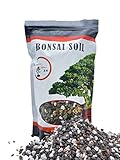


Lava rock
Adds long-lasting structure and drainage and holds a little moisture in its pores. Common as the third part of a classic blend.


Kanuma (for acid-lovers)
An acidic pumice-type soil ideal for azaleas and other ericaceous bonsai that dislike lime.


Ready-mixed bonsai soil
Pre-blended mixes take the guesswork out for beginners; check that they are gritty and free-draining, not a fine peat-based compost.


Typical blends at a glance
| Tree type | Suggested blend | Why |
|---|---|---|
| Deciduous | More akadama (e.g. 2:1:1 akadama/pumice/lava) | Higher water need |
| Conifers / pines | More pumice/lava (e.g. 1:1:1 or grittier) | Prefer sharper drainage |
| Azaleas | Kanuma-based | Acidic, moisture-retentive |
| Beginner (mixed) | Quality ready-mix | Simple, reliable |
How to choose
- Match the tree: more akadama for moisture-loving deciduous trees; more pumice/lava for conifers.
- Match your climate/habits: hot, dry or forgetful? increase water-holding akadama; wet climate or over-waterer? increase grit.
- Acid-lovers (azaleas) get kanuma.
- Sieve to remove dust and keep particles even – dust clogs drainage.
Common mistakes
- Using regular potting soil or compost – it compacts and rots roots.
- Not sieving out fines, so the mix drains poorly.
- Never repotting – old akadama breaks down and suffocates roots (refresh every 1–3 years depending on species).
- One mix for everything, ignoring conifer vs deciduous vs azalea needs.
FAQ
Can I use normal potting soil for bonsai? No – it compacts and holds too much water. Use a gritty, free-draining bonsai mix.
What is akadama? A granular Japanese clay that balances water retention and aeration; it’s the traditional base of most bonsai soils.
How often should I replace bonsai soil? At repotting, typically every 1–3 years depending on species and how fast the soil breaks down.
Do all bonsai use the same soil? No – deciduous trees like more moisture (more akadama), conifers like sharper drainage, and azaleas prefer acidic kanuma.
Final recommendation
A classic akadama / pumice / lava blend suits most bonsai – tilt toward akadama for deciduous trees and toward pumice/lava for conifers. Use kanuma for azaleas, and a quality ready-mix if you’d rather not blend your own. Always sieve out dust and refresh the soil at repotting.
As an Amazon Associate GrowPlants earns from qualifying purchases. GrowPlants does not sell these products.
See also: best bonsai pots · best bonsai tools · all bonsai supplies.