Leek, Allium ampeloprasum, is one of the most forgiving vegetables in the garden and one of the easiest to grow badly. It will survive almost anything; producing the long, thick, tender white shank that makes it worth growing takes a little more thought. Nearly all of it comes down to the soil you plant it into and how you handle the plant as it grows.
What a leek actually is
Leek is a herbaceous member of the genus Allium – the same genus as onions and garlic, which is why you will see it sold as leek onion or onion leek. Those are not different vegetables or different varieties; they are just alternative names for the same plant, used because of the shared genus.
Its life cycle is worth understanding, because it explains how the plant is grown. The bulb itself is biennial – it grows in one year and flowers in the next – but the plant is treated as an annual in the vegetable garden, harvested before it ever flowers. It is nonetheless classed as a perennial, because it reproduces vegetatively from its bulbs and so a planting can carry on indefinitely if you let it.
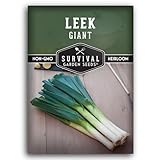
 Organo Republic Onion Leek Seeds Pack 1G - Over 375 Non-GMO Heirloom Onion Seeds
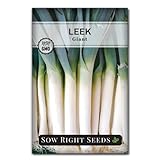 Sow Right Seeds - Giant Leek Seed for Planting Outdoor Vegetable Garden
A few reliable leek varieties to start from seed: As an Amazon Associate we earn from qualifying purchases.
The leaves grow in a radial arrangement, with new young leaves emerging from the centre and older leaves pushed outward. This is exactly why a leek is a cylinder of tightly wrapped layers rather than a rosette, and why soil that works its way between those layers is so hard to wash out later.
Leeks grow in Mediterranean, subtropical and temperate climates, in hardiness zones 6-11, and they want a cool winter.
Soil: the part that decides your crop
Leeks want soil that is rich, well drained, free of rocks, and supplied with nitrogen. Each of those is doing real work.
- Free of rocks matters more here than for most vegetables. A leek grows downward as a long straight shaft, and a stone in its path deflects it – you get a bent, forked or stunted shank instead of a straight one, and lifting it whole becomes a struggle. Dig the bed over and remove stones before planting, not after.
- Well drained because the base of the plant sits in the soil for months. Waterlogged ground around a packed cylinder of leaf bases is an invitation to rot.
- Rich and nitrogen-fed because the part you eat is leaf. Unlike a root crop, where too much nitrogen gives you foliage instead of a harvest, with leeks the foliage is the harvest. Nitrogen drives leaf growth, and leaf growth is thickness in the shank.
- Mulch keeps moisture even and suppresses the weeds that are awkward to remove from around an established row.
Water is straightforward: an average amount, applied regularly. Steady moisture matters more than volume – a plant growing for months on end without checks makes better texture than one that alternates between dry and drenched.
Light: full sun to half shade. Full sun gives the fastest growth, but leeks tolerate part shade better than most vegetables, which makes them useful for a bed that only gets half a day of sun.
The white part, and how to get more of it
The leaves are green at the top and white at the bottom, and the white section is the part most cooks reach for. That colour difference is not a separate tissue: it is simply leaf that has grown without light. Anything shielded from the sun stays pale and stays tender.
That is the whole principle behind blanching. Planting into a deeper hole, or drawing soil up around the stems as the plants grow, keeps more of the shaft in the dark and gives you a longer white section. It is also the second reason stone-free soil pays off – you cannot mound gritty, rocky soil around a leek without grit ending up between the leaf layers.
If you do this, mound gradually as the plant grows rather than burying a young plant all at once, and keep the soil below the point where the leaves separate.
Seed or seedlings?
You can start leeks from seed, from seedlings, or from bulbs. Vegetative propagation works but is not necessary.
For most gardeners, seedlings are the better choice, and the reason is a genuine quirk of the plant: leek seedlings transplant extremely freely. They can be lifted, moved and replanted with far less setback than most vegetables tolerate, which is why nurseries raise them under glass and sell them in bundles. If the price is reasonable, starting from seedlings is the easier and more reliable route.
That same tolerance is why leeks are traditionally sown in a nursery bed and moved to their final spacing later – you can raise a lot of plants in a small area and then set them out exactly where you want them.
Sowing leek seed
Seed is entirely doable if you want a specific cultivar or a large number of plants:
- Prepare rich, well-drained, stone-free soil with nitrogen available.
- Sow and cover the seed lightly, about 0.5 cm deep.
- Keep the soil moist and water regularly – even moisture is what gets an even stand of seedlings.
- Give full sun to half shade.
When to plant
Leeks can be planted all year, but the best timing depends on your climate:
- Warm climates – plant in autumn, so the plant does its growing through the cool season rather than into summer heat.
- Cooler climates – plant in spring, giving the crop the full growing season before winter.
Both point at the same principle: leeks are a cool-season crop that want a long, steady stretch of moderate weather. Season the planting to land the bulk of the growing period there.
Growth is medium to fast, and a mature plant reaches 0.5-2 m (20-80 in) including the leaves. Leeks also grow well in a planter, pot or container – choose a deep one, since depth is what gives you shank length. They are not suited to growing indoors as a houseplant; they need real sun.
Flowering, and why you should usually prevent it
Leeks bloom in summer, occasionally as early as spring. The flowers are small, white to pink-purple, carried on a stem in a rounded umbel – the classic Allium flower head – and pollinated by bees and flies.
Attractive as they are, you should normally remove them. It is recommended to thin out the flower stem unless you specifically want seed. Once a leek commits to flowering, it pushes a hard, woody stalk up through the centre of the shank and diverts its resources into seed rather than leaf – and that central core stays tough no matter how you cook it. You can prune all year, and the flower stem is the main thing you are pruning for.
Harvest
Leaves can be harvested all year. The recommended method is to lift the whole plant out of the ground once it is fully grown, rather than stripping leaves from a standing plant – you get the full white shank that way, and picking individual leaves off a growing leek just weakens it.
The bulb is small and white, made of layers in a radial, oblong arrangement, and runs 2-5 cm across. Flavour depends entirely on the cultivar: some are distinctly spicy and some sweet, so it is worth reading the variety description rather than assuming all leeks taste alike.
Bulbs can be pulled all year, with one exception – in genuinely cold areas, leave them in the ground rather than trying to lift through the cold season.
Using the whole leek
The entire leek is edible, though most people use only the white part. The green tops – often sold as leek greens, which is just another name for the leaves – are perfectly usable and go into almost all the same dishes.
The one distinction worth knowing in the kitchen: if a dish needs the firmer part that holds its structure through cooking, use the white. The greens are softer and better in anything long-cooked or blended, so use them for stock, soup and braises rather than throwing them away.
Standard uses: soup, baked dishes, casserole, quiche, meatballs and vegetable balls, and leek can also be eaten raw. Both leaves and bulb are usually cooked.
Japanese leek – is it different?
Japanese leek is smaller than a regular leek, and the flavour is the same. It is used in exactly the same way – soups, baked dishes, casseroles, quiches, meatballs, or raw. Choose it for the size that suits your garden and your cooking, not because you expect a different taste.
Pests: onion fly and onion thrips
Two pests account for most leek trouble, and both are shared with the rest of the Allium family.
- Onion fly. The adult lays at the base of the plant and the larvae tunnel into the stem and roots. Damage happens out of sight, and the first sign above ground is usually yellowing, wilting or a plant that simply topples. Because the damage is internal, prevention beats cure – keep plants covered where the fly is a known problem, and lift and destroy affected plants rather than leaving them in the bed.
- Onion thrips. Tiny insects that rasp the leaf surface and feed on the sap, leaving pale silvery streaks and flecks. They shelter down between the tightly wrapped leaf bases, which is exactly where sprays cannot reach, and they build up fastest in hot, dry spells. Steady watering and mulch, which keep conditions from getting hot and dry at soil level, help more than you would expect.
Both are reasons not to grow leeks in the same spot as onions or garlic year after year – rotating the alliums around the bed breaks the cycle before populations build.
For the full plant profile see our Leek plant growing page.
Related guides
Part of our Vegetable Gardening guides.
For the equipment that makes propagating easier (heat mats, humidity domes, rooting hormone), see our propagation equipment guide.