Plant Profile & Key Characteristics
Overview: Oxalis hirta (trailing oxalis) is a low bulbous perennial geophyte 10-20 cm tall with leaves in a rosette, grown as an ornamental flowering groundcover for its pink-purple blooms.
Quick Specifications
| Specification | Attribute |
|---|---|
| Plant Type / Life Cycle | Perennial (geophyte, summer-dormant) |
| Foliage Type | Deciduous (summer-dormant) |
| Mature Size | 10-20 cm (4-8 in) |
| Growth Rate | Moderate to fast |
| Root System | Bulbous geophyte |
| Toxicity | Contains oxalic acid – edible only in small amounts; large quantities can be harmful (soluble oxalates) |
| Hardiness | USDA zones 9-11 |
Growth Form & Structure
- Height & Spread: 10-20 cm (4-8 in); grows well in pots (start pots at ~3-6 L / 0.8-1.6 gal).
- Growth Habit & Form: Low, spreading and trailing geophyte with rosette foliage, useful as groundcover.
- Lifespan & Maturity: Perennial that returns and multiplies from its bulbs each season.
Anatomy & Physical Features
- Leaves & Foliage: Green oval leaves arranged in a rosette (unlike the clover-shaped leaves of most wood-sorrels).
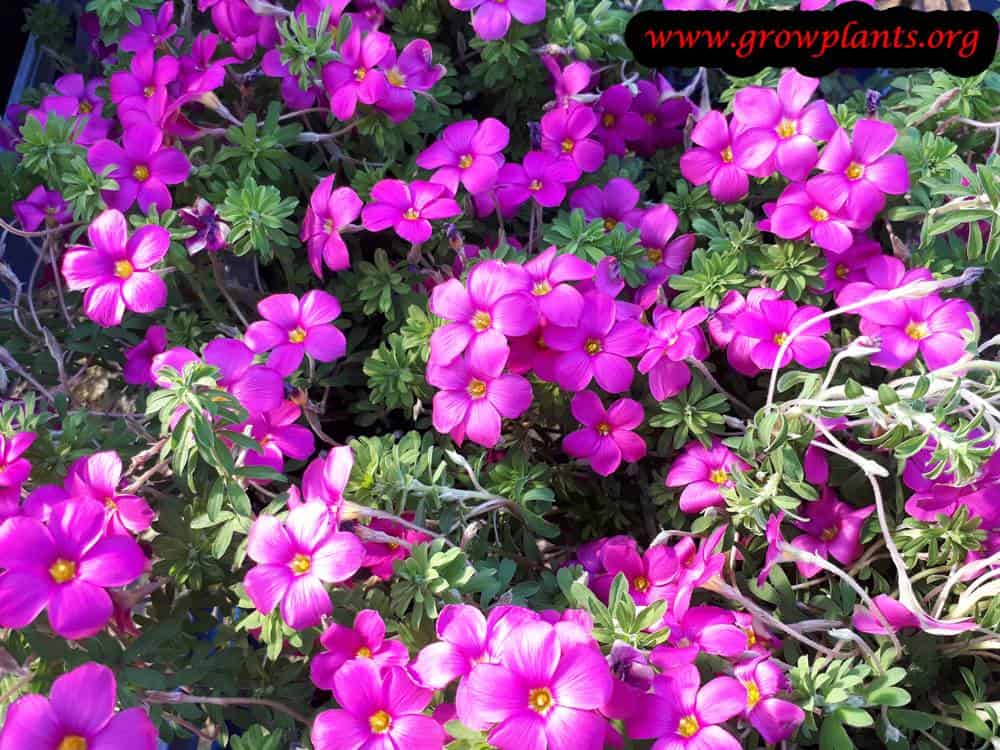
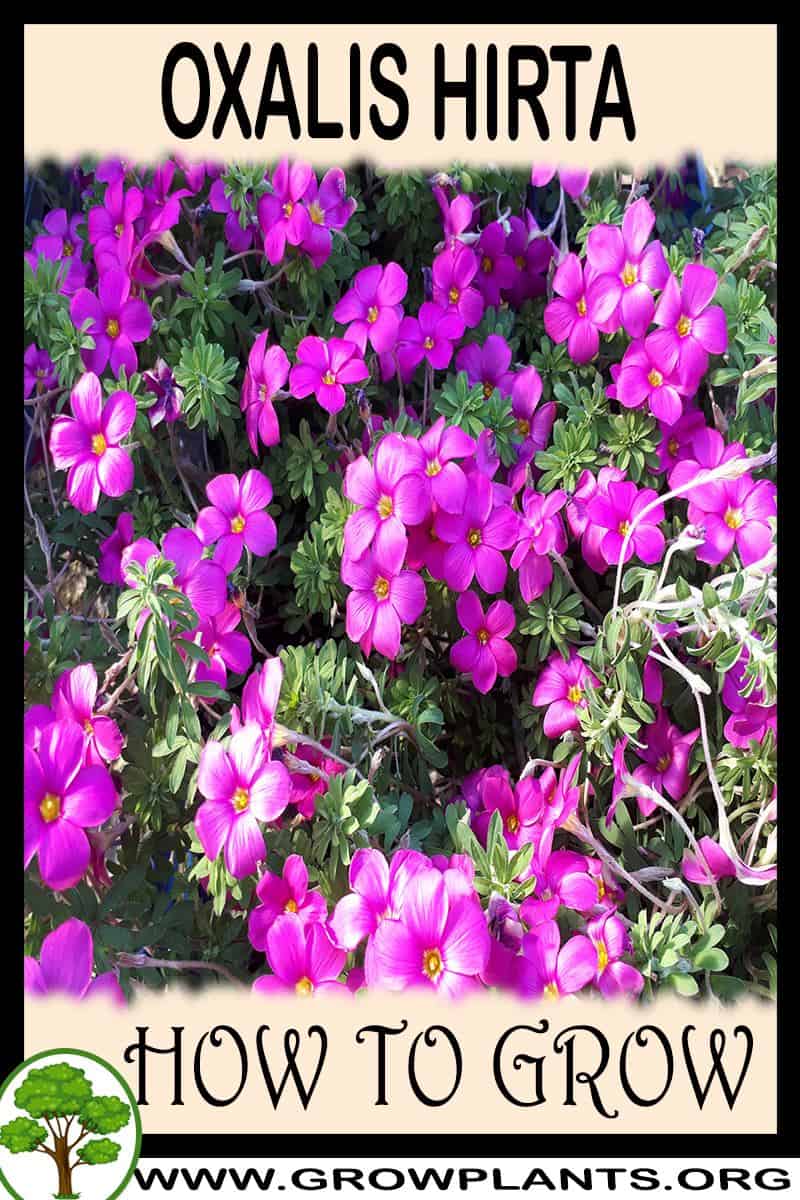
- Flower Characteristics: Pink-purple flat five-petalled flowers (full detail in the Bloom guide).
Primary Uses & Landscape Value
- Functional & Ornamental Roles: Ornamental flowering groundcover and container geophyte.
Care Guide: Planting, Soil & Watering
Overview: Oxalis hirta (Trailing Oxalis) is a bulbous, summer-dormant geophyte that grows from small bulbs in rich, well-draining soil kept evenly moist during its active season. It appreciates regular moisture while in leaf, then rests through its dormancy.
Quick Care Requirements
| Requirement | Ideal Condition |
|---|---|
| Planting Season | Spring to summer in warm zones; autumn to winter where temperatures drop below freezing |
| Growth Rate | Moderate to Fast |
| Soil Type | Rich, well-draining soil that holds some moisture (peat / organic) |
| Water Need | Moderate to High – keep evenly moist during active growth |
Planting & Establishment
- Best Planting Season: Plant at the start of the growing season – spring to summer in mild climates, or autumn to winter where hard frosts occur; set bulbs 2–5 cm (1–2 in) deep.
- How to Plant:
- Hole Preparation: Dig the hole noticeably larger than the root ball – roughly two to three times its size – so the roots settle into loose soil; bulbs go 2–5 cm (1–2 in) deep.
- Soil Amendments: Mix organic matter, humus and dried leaves into the backfill for a rich, moisture-retentive but still free-draining bed, then mulch the surface to hold moisture.
- Planting Depth: Set the root ball at soil level and firm the soil gently – not too hard, but firm enough that the plant does not sink when watered.
- Growth Speed & Expectations: Growth is moderate to fast during the active season; the clump fills out and can be lifted and divided when dormant.
Soil, Watering & Drainage Care
- Soil Mix & Drainage Needs: Use a rich, well-draining mix that still retains some moisture; in containers use rich soil with organic matter and drainage holes, and the bulbs can be lifted and stored during dormancy. It grows in full sun to half shade.
- Watering Schedule & Technique:
- Young / Newly Planted: Water daily for about the first two weeks after planting (preferably in the morning) to settle the plant, keeping the soil consistently moist.
- Established: Keep the soil evenly moist through active growth, watering deeply but never leaving it waterlogged.
- Seasonal Adjustments: Reduce watering as the foliage dies back into dormancy and keep it on the dry side while resting; resume regular watering when new growth appears.
Climate, Light & Hardiness
Oxalis hirta grows in subtropical and Mediterranean climates and is hardy outdoors in USDA zones 9 through 11. It prefers full sun to half shade, and as a summer-dormant bulb it benefits from a defined cool season to trigger proper dormancy and regrowth.
Quick Climate Specifications
| Climate Zones | Subtropical, Mediterranean |
|---|---|
| USDA Hardiness Zones | 9–11 |
| Light Conditions | Full Sun to Half Shade |
Sunlight & Light Exposure
Optimal Light Setup
Grow in full sun to half shade during its autumn-to-spring active growing season.
Temperature Extremes & Hardiness
USDA Hardiness & Regional Limits
Hardy outdoors in USDA zones 9 through 11; some varieties specifically need a period of cool weather to grow and flower well, so an unusually mild, unvarying climate can affect performance.
Chilling Requirement
Benefits from at least about one month of temperatures below 5°C (41°F) to properly trigger its dormancy/regrowth cycle; this is a fairly modest chilling need compared with temperate fruiting plants, but it does distinguish this species from a purely tropical, ever-active grower.
Wind, Humidity & Microclimate
Microclimate Recommendations
A cool, well-ventilated spot that still gets a genuine winter chill supports the plant's natural dormancy cycle better than a uniformly warm, sheltered position.
Growing in Pots, Balconies & Indoors
This compact oxalis (10-20 cm / 4-8 in) is a bulbous plant the grower does not rate as a true houseplant – it wants strong light to bloom, so deep in a room it will stretch and sulk. It is, however, an easy and pretty subject for a sunny windowsill or a small balcony pot, and its bulb makes it simple to store while dormant.
Quick Details
- Container Size: Start at 3-6 L (0.8-1.6 gal) and pot up as it fills the pot
- Indoor Suitability: Not a deep-indoor houseplant; suits a bright, sunny windowsill
- Best Spot: Full sun to light shade – the brightest position you can offer
- Soil & Drainage: Rich soil with organic matter and free drainage; drainage holes essential
- Watering in Pots: Average to generous while in growth; ease off as it goes dormant
Indoors & On the Windowsill
- Houseplant limits: The grower does not treat it as a houseplant – away from a window the light is too weak for good flowering.
- Windowsill growing: A sunny sill with direct light suits it well; keep it turned so growth stays even.
- Dormancy & overwintering: It dies back to the bulb in its rest period; you can lift the bulb from the soil and store it dry, which also makes it easy to protect from cold.
On a Balcony or Patio
- Light & wind: Give it the sunniest spot; small pots dry quickly against warm walls and railings, so check moisture often in hot weather.
- Practicalities: Being small it is easy to move – a good candidate for a bright balcony shelf, brought in or stored dry over winter.
Choosing the Pot, Soil & Long-Term Care
- Pot & drainage: A 3-6 L pot with strong drainage holes; skip a standing water saucer to avoid rot. Terracotta breathes and dries faster than glazed or plastic.
- Potting mix: A rich, free-draining mix with plenty of organic matter.
- Feeding: Potted plants exhaust their food faster as nutrients leach – feed lightly through the growing season only.
- Repotting: Refresh the soil periodically, as potting mix loses structure over time; divide crowded bulbs when you do.
Grower’s Container Tip
- Grow-into-the-pot method: Start in a 3-6 L pot and, each time the plant fills it, move up a size until it reaches the size you want – the grower prefers this because the soil stays fresher and care is more efficient. When it is large, swap out part of the old soil.
- Lift the bulb: In the dormant season you can take the bulb out of the soil to store it – handy for cleaning up the mix or overwintering.
Fertilizing & Feeding
A light feeder: a modest balanced feeding while the rosette is actively producing leaves is enough, with all feeding withheld once the bulb goes dormant.
Quick Fertilizing Specs
| Feeding Level | Light feeder |
|---|---|
| Main Nutrient Priority | Balanced feeding with adequate nitrogen while leaves are actively growing |
| Best Feeding Period | During active leaf growth ahead of and through the bloom period |
| Organic Options | Compost or other organic matter worked into the bed or container mix |
| Reduce/Stop Feeding | Stop feeding once the plant dies back and enters dormancy |
| Micronutrients | Usually met by organic matter; correct only a diagnosed deficiency |
| Soil pH | Tolerates a range of well-drained soils; avoid heavy, waterlogged ground |
Feeding by Growth Stage
Active leaf growth and bloom
Support fresh rosette growth and flowering while this trailing ground cover is actively producing leaves.
| Nutrient direction | A balanced, nitrogen-forward feeding supports leafy rosette growth without pushing this modest ground cover too hard. |
|---|---|
| Timing | While the plant is in active leaf growth ahead of and through its bloom period. |
| Frequency | A light feeding at the start of active growth is usually enough for this small ground cover. |
| Fertilizer types | A diluted balanced complete fertilizer, Compost or other organic matter worked into the bed |
| Precautions | Avoid heavy feeding, which can produce lush, floppy foliage and raises disease pressure in humid weather. |
Dormant season and mulching
Protect the resting bulb through its dormant period without pushing new growth.
| Nutrient direction | None – withhold fertilizer while the plant is dormant and let mulch and residual soil fertility carry it through. |
|---|---|
| Timing | During the dormant season, once foliage dies back. |
| Frequency | No feeding during dormancy; resume only once active leaf growth restarts. |
| Fertilizer types | No feeding at this stage; a layer of mulch over the dormant bulbs is the main input. |
| Precautions | Do not fertilize dormant bulbs – feeding now wastes nutrients and can encourage rot in resting bulb tissue. |
Nutrient Deficiency Signs & Corrections
Older leaves pale to light green or yellow and the rosette produces fewer, smaller new leaves.
| Possible causes | low available soil nitrogen, poor organic matter in the bed, nutrient loss from heavy watering or rain |
|---|---|
| Appears first on | older leaves |
| What to check | recent feeding history, soil organic matter level, watering and drainage |
| Possible correction | Work compost into the bed or apply a diluted balanced fertilizer while the plant is in active leaf growth. |
Leaf margins show scorch or yellowing and flowering is sparse or weak despite otherwise healthy foliage.
| Possible causes | low soil potassium, heavy nitrogen feeding crowding out potassium uptake, leaching in light or sandy soils |
|---|---|
| Appears first on | older leaf margins |
| What to check | recent fertilizer balance, soil texture and drainage, overall flowering vigor |
| Possible correction | Switch to a balanced or potassium-containing fertilizer during active growth and improve soil organic matter. |
New leaves turn pale yellow while the veins stay green.
| Possible causes | high soil pH tying up available iron, waterlogged or poorly drained soil, root stress from recent disturbance or division |
|---|---|
| Appears first on | youngest leaves |
| What to check | soil pH and drainage, recent watering pattern, root health after any recent division |
| Possible correction | Correct soil pH toward the plant’s preferred range and apply a chelated iron product per its label if the deficiency is confirmed. |
Pruning, Training & Seasonal Maintenance
Oxalis hirta is a small trailing, rosette-forming geophyte with no woody growth, so it needs only light seasonal tidying rather than any real pruning. As its foliage dies back going into dormancy, the dead top growth is cut away and the bulb mulched over its rest period; through the growing and bloom season the only other task is deadheading spent flowers, which has no effect on next year’s bloom since it forms fresh from the bulb.
Quick Pruning & Maintenance Specs
| Pruning Tolerance | Low (seasonal tidying only) |
| Primary Pruning Window | As foliage collapses at the start of dormancy |
| Secondary Maintenance Window | Deadhead through the autumn–spring bloom period |
| Typical Frequency | Once per dormancy transition, plus occasional deadheading |
| Main Objective | Tidy collapsed foliage; prevent excess self-seeding; divide congested bulbs |
| Young Plant Priority | None – let a newly planted bulb establish undisturbed |
| Mature Plant Priority | Seasonal foliage cutback; deadhead; divide crowded bulbs at repotting |
| Best Tool Type | Precision snips or fingers |
| Avoid Heavy Pruning During | Active growth flush after dormancy breaks, and full bloom |
Pruning by Plant Age & Size
Newly Established
No pruning; let the bulb root in and put up its first rosette undisturbed.
Young / Formative
No structural training – this is a low trailing rosette geophyte with no framework to build.
Mature / Established
Cut back collapsed foliage as the plant enters dormancy; deadhead spent flowers through bloom; divide congested bulb clusters at repotting, digging gently since the bulbs can sit unusually deep and are easily lost if handled roughly.
Seasonal Pruning Schedule
Dormant/Winter (onset)
Objective: tidy the plant as it goes dormant. Remove: fully collapsed, dying foliage. Do not remove: any leaf that is still green, since it is still feeding the bulb for the next growing cycle. Response: a tidy dormant bulb; mulching at this point (as noted for this species) helps protect it through its rest period.
Special Growth to Remove
- Collapsed or yellowing foliage as dormancy sets in.
- Spent flower stems – deadhead to tidy and limit self-seeding.
Container & Small-Space Pruning
Oxalis hirta is commonly grown in pots; the same light seasonal cutback and deadheading apply, and because its bulbs can be small and unusually deep, lifting them out of the soil during dormancy for storage or repotting needs to be done gently rather than by pulling the plant.
Tools
- Precision snips or fingers – the only cut this soft-leaved geophyte needs.
- A small garden spade for gently dividing bulb clusters at repotting.
Tool Hygiene & Disease Risk
Routine to slightly increased: powdery mildew and other fungal issues are noted for this species, so avoid working the foliage while it is wet and remove any mildew-affected leaves promptly.
Cut Placement & Technique
Cut or pinch collapsed foliage at its base near the bulb; deadhead flower stems down into the remaining foliage.
Heavy Pruning & Rejuvenation
Not applicable in the woody sense – a congested or declining clump is renewed by dividing the bulbs during dormancy, not by cutting back the top growth hard.
Post-Pruning Care
Mulch over the dormant bulb as noted for this species; resume normal watering only once new growth resumes at the start of the next season.
Common Pruning Mistakes
- Cutting back green, still-functional foliage before it has died back on its own, reducing what the bulb has stored for next season.
- Digging up bulbs carelessly during division, since they can sit unusually deep and are easily damaged or lost.
When NOT to Prune
Avoid cutting back foliage while it is still green and growing, and avoid disturbing the plant right as new growth emerges from dormancy.
Recommended Tools (by task)
- Seasonal foliage cutback and deadheading: precision_snips.
- Dividing congested bulb clusters at repotting: garden_spade – used gently, given how deep and delicate the bulbs can be.
Propagation Guide
The most reliable way to start new Oxalis hirta plants is by dividing the bulbs during the plant’s dormant season, though the bulbs are often small, brittle, and can sit surprisingly deep, so lifting them takes patience and a gentle hand. Vegetative propagation isn’t strictly necessary to keep the species true, and starting from bulbs is easier than raising it from seed, but the real risk of damaging or losing bulbs while digging makes overall difficulty moderate.
Quick Propagation Specs
| Best Propagation Method | Bulb Division |
| Alternative Methods | Seed; whole-plant division when the bulb cannot be located |
| Propagation Difficulty | Moderate |
| Seed True-to-Type | Usually true-to-type (species, not a named cultivar) |
| Vegetative True-to-Type | Yes |
| Best Propagation Season | Dormant season for bulb division; spring above 5°C (41°F), or autumn in colder hardiness zones, for sowing seed |
| Seed Germination Time | 3–5 weeks |
| Seed Sowing Depth | About 0.5cm (0.25in), seed needs covering |
Growing from Seed
Seed Handling & Viability
Keep collected seed in a dry, dark place, ideally refrigerated, until it is time to sow.
Dormancy & Pre-Sowing Treatment
The site notes the plant itself needs at least one month under 5°C (41°F) to break dormancy; giving seed a comparable cool spell before sowing helps mimic this natural cycle.
Sowing Season
Sow in spring once temperatures are reliably above 5°C (41°F), or in autumn in hardiness zones where winter temperatures fall below 0°C (32°F).
Sowing Depth & Orientation
Cover seed lightly, about 0.5cm (0.25in) deep. When pricking out, space seedlings roughly 2×3cm (0.8×1.2in) apart.
Germination Conditions
Keep the soil consistently moist with high humidity and never let it dry out; water moderately to heavily.
Germination Time
Typically 3–5 weeks.
Seedling Care
Grow seedlings on in moist soil with high humidity and half shade until well established.
Rhizomes, Tubers, Bulbs & Corms
Bulb Division: Lift and separate bulbs during the dormant season — spring above 5°C (41°F), or autumn where winters drop below 0°C (32°F). The bulbs are frequently small, hard to find, and can be planted quite deep, so dig around them gently and unhurriedly; rough handling or letting them dry out at the wrong moment often kills the plant. If the bulb itself can’t be located, lifting and dividing the whole plant is an acceptable fallback. Replant divisions promptly into moist, rich soil and water them in well.
Bloom & Flower Guide
Quick Details
- Bloom Season: Autumn through winter into spring
- Flower Appearance: Five-petalled, funnel-to-flat flowers in pink-purple, opening in bright light and closing at night or in dull weather
- Edibility: Best treated as ornamental – Oxalis is high in oxalic acid and should not be eaten in any quantity
Detailed Blooming Overview
Oxalis hirta is a small tuberous, trailing plant that comes into its own in the cooler months, flowering through autumn, winter and into spring while much else is resting. The bright pink-purple flowers each have five petals and open with the sun, furling closed again as light fades.
Flower Characteristics
- Five-petalled pink-purple flowers, funnel-shaped opening to nearly flat
- Flowers open in bright light and close at night or under cloud
- A cheerful cool-season display above clover-like foliage
Bloom Care & Thinning
- Managing the bloom: little is needed during flowering; after the display fades the plant naturally dies back to its tubers and rests over the warm, dry season
- Site: full sun to light shade and free-draining soil give the most flowers in the cool season
- Note: water sparingly once foliage yellows and the plant enters dormancy
Pests, Diseases & Troubleshooting
Overview: Hairy wood sorrel (Oxalis hirta) is a bulb/tuber-forming wood sorrel whose signature disease is a bright orange rust, alongside powdery mildew and the sap-sucking insects – aphids, spider mites and whitefly – that trouble soft-leaved plants; underground, bulbs and tubers rot readily if kept wet in dormancy. Airy, evenly-drained culture and prompt removal of rusted leaves keep it healthy.
Quick Troubleshooting Overview
| Issue / Pest | Main Symptom | Primary Solution |
|---|---|---|
| Oxalis rust | Bright orange pustules on leaf undersides | Remove infected leaves, improve airflow |
| Powdery mildew | White powdery coating on leaves | Airflow, avoid wet foliage, sulfur/bicarb spray |
| Aphids | Sticky, curled leaves and stems; honeydew | Water jet, insecticidal soap |
| Spider mites | Fine stippling and webbing in dry heat | Raise humidity, rinse, neem/soap |
| Whitefly & fungus gnats | White flies / gnats around potted plants | Sticky traps, let soil dry, soap/neem |
| Bulb / root rot | Mushy bulbs; failure to sprout | Dry dormancy, gritty mix, discard soft bulbs |
Common Pests & Management
- Aphids (Aphididae):
- Symptoms: Soft green, grey or black insects clustered on tender leaves, stems and flower stalks, causing curling, sticky honeydew and sooty mould, and able to spread viruses.
- Prevention & Control: Rinse off with a firm water spray and encourage ladybirds and lacewings; control ants. Use insecticidal soap or neem oil on stubborn colonies, covering leaf undersides and growing tips.
- Spider mites (Tetranychus urticae):
- Symptoms: Fine pale stippling and a dusty, bronzed look with delicate webbing on leaf undersides in hot, dry, still air – a frequent problem on indoor Oxalis such as the purple shamrock.
- Prevention & Control: Raise humidity and rinse the foliage regularly, then treat with insecticidal soap or neem oil on the undersides, repeating to catch hatchlings; a spell of cooler, more humid air alone often checks them.
- Whitefly (Trialeurodes vaporariorum):
- Symptoms: Tiny white moth-like insects that rise in a cloud when disturbed, feeding on leaf undersides with honeydew and sooty mould, mostly indoors and under glass.
- Prevention & Control: Use yellow sticky traps to monitor and thin adults and spray insecticidal soap or neem oil on the undersides, repeating; good ventilation limits them.
- Fungus gnats (Bradysia spp.):
- Symptoms: Small dark flies drifting around potted plants; their larvae live in constantly moist compost and can nibble fine roots and tubers of seedlings and weak plants.
- Prevention & Control: Let the top of the compost dry between waterings, use yellow sticky traps for adults, and apply a Bacillus thuringiensis israelensis (Bti) or beneficial-nematode drench for larvae in heavy cases.
Diseases & Fungal Issues
- Oxalis rust (Puccinia oxalidis):
- Symptoms: Bright orange to rusty-brown powdery pustules on the undersides of the leaves, with yellow flecking above; heavy infection distorts and drops foliage. The most characteristic disease of the genus.
- Treatment & Management: Pick off and destroy infected leaves at the first pustules, avoid wetting the foliage, and improve air circulation and spacing. Clear fallen debris; where rust is persistent a sulphur fungicide gives protection, but sanitation and airflow are primary.
- Powdery mildew (Erysiphales):
- Symptoms: A white powdery coating on leaves and stems in warm days with humid nights and stagnant air, as flagged in the source, yellowing and weakening affected leaves.
- Treatment & Management: Improve airflow and light, avoid overhead watering and excess nitrogen, and remove affected leaves. A potassium-bicarbonate or sulphur spray helps in stubborn cases.
- Bulb, tuber and root rot (Pythium / Fusarium / Sclerotinia spp.):
- Symptoms: Soft, brown, sometimes foul bulbs and tubers that fail to sprout or rot in growth, plus stem-base collapse, after wet, poorly drained soil or watering through dormancy.
- Treatment & Management: Grow in gritty, free-draining soil, water only in active growth, and keep bulbs and tubers dry during their rest; lift and store dry in wet climates. Discard any soft, rotten storage organs rather than replanting.
- Leaf spot / downy patches (various fungi):
- Symptoms: Brown or purple leaf spots and, in damp weather, downy patches, mostly cosmetic on vigorous plants.
- Treatment & Management: Remove affected leaves, keep foliage dry, and improve airflow; rarely needs more than tidy culture.
Growing Difficulties & Abiotic Problems
- Bulb / tuber rot from overwatering:
- Cause & Symptoms: The main killer: bulbs and tubers left wet – especially during their natural dormancy – rot instead of resting.
- Correction Strategy: Reduce or stop watering as the foliage dies back, use free-draining soil and pots with drainage, and resume watering only when new growth appears.
- Invasiveness / self-seeding spread:
- Cause & Symptoms: Many Oxalis, notably Bermuda buttercup, spread aggressively by bulbils and seed and can become hard-to-eradicate weeds, as the source warns.
- Correction Strategy: Grow contained in pots or confined beds, deadhead before seed sets, and remove stray bulbils carefully; never compost the bulbils of weedy species.
- Dormancy die-back (mistaken for death):
- Cause & Symptoms: Many species naturally collapse and lose their leaves after flowering, which is often mistaken for disease.
- Correction Strategy: Recognise this as normal rest: keep the pot dry and cool through dormancy and growth will return; do not overwater trying to ‘revive’ it.
- Leaf scorch and faded colour:
- Cause & Symptoms: In fierce midday sun tender or coloured forms (e.g. purple shamrock) can scorch, while too little light fades the colour and stretches the plant.
- Correction Strategy: Give bright light but shelter from harsh midday sun for coloured indoor types; for green species, more sun deepens vigour without scorch.
What Helps – Products & Tools
Keep to gentle tools: a water jet, insecticidal soap and neem oil for aphids, mites, whitefly and fungus gnats, yellow sticky traps and a Bti drench for gnats, and a sulphur or potassium-bicarbonate fungicide for the rust and powdery mildew that define this genus. The best preventives are gritty free-draining soil, airflow, dry dormancy and prompt removal of rusted leaves. Note the leaves contain oxalic acid, so keep them from pets and grazing.