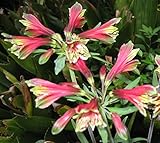
Alstroemeria, the Peruvian lily, is the rare garden plant that is also a professional cut flower, and it is grown the way it is because of that second life. Get the underground part right and the plant does the rest for years.
What you are actually planting
Alstroemeria is a herbaceous geophyte – a perennial that stores its energy underground and sends up fresh top growth each season. The “bulbs” sold for it are fleshy storage roots on a spreading underground crown, not true bulbs, and they are brittle. That explains two planting rules below: they want soil free of stones, and they are moved with care rather than yanked apart.
Above ground it makes linear to oval leaves – green, or in some cultivars white to grey-black – on stems that twist as they grow. The flowers sit at the stem tips, with 4 to 6 petals, in purple, red, pink, white, orange, yellow or green, frequently more than one colour on the same flower, with stripes, dots or irregular markings.
 40+ Alstroemeria Seeds for Planting - Mix Peruvian Llily Seed Heirloom Colorful Ornamental Bouquet
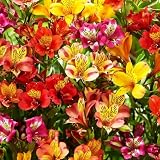 Mixed Color Alstroemeria Seeds 30 PCS Perennial Peruvian Lily Flower Seeds for Outdoor Garden
Alstroemeria is usually planted from bare-root rhizomes rather than seed: As an Amazon Associate we earn from qualifying purchases.
Bloom season is spring to summer. Some species keep their own timing – Alstroemeria aurea, for instance, flowers in summer.
Size and spacing
Most Alstroemeria stands 30–60 cm (12–24 in). Across the whole range, plants run from 20 cm to 1 m, with most garden cultivars settling at 40–80 cm. It establishes quickly once it is in the ground.
Spacing follows size, and it is worth getting right because a crowded planting is what turns a healthy clump into a slug-friendly, mildewy tangle:
- Standard cultivars: 60 cm apart.
- Dwarf cultivars: 30–40 cm apart.
- Keep at least 20 cm between the bulb and any neighbouring plant of another kind, so the alstroemeria’s spreading crown has room to run.
Dwarf Peruvian lily
Dwarf forms exist and reach 20–30 cm. They are grown in exactly the same way as full-sized cultivars – there is no separate care regime. The advantage is purely practical: a dwarf needs less space and fits next to a small window while still getting enough light, which matters if you keep a plant indoors over winter.
When and where to plant
Planting is possible at the end of winter, in spring, or in summer, but spring is clearly the best, and the reasoning decides how the plant’s first year goes.
- Spring gives the plant enough time to establish, flower, and then build up its reserves in preparation for winter. That last part is what a geophyte lives on.
- Summer planting works, but a newly planted bulb with no established root system can simply die in a heat wave.
- Autumn planting runs the mirror risk – a plant that has not settled in can be killed by night frosts.
Choose a sunny position without a lot of wind. Alstroemeria grows in full sun to half shade; half shade is the sensible compromise in a hot climate. Wind matters more than people expect, because the flowering stems are tall, slender and top-heavy, and a snapped stem is a flower lost.
Planting depth and soil
- Prepare well-drained soil. This is the only strict soil requirement, and it is the difference between a clump that thrives and one that rots in a wet winter.
- Clear the stones out to a decent depth. The storage roots are brittle and push outward as the clump expands; stones damage them and physically block that spread.
- Plant the bulbs at least 15 cm deep. Depth insulates them against both frost and summer heat, and anchors the tall stems.
- Space as above, and water in.
From there, Alstroemeria wants an average amount of water – steady moisture, never waterlogged. There are no special difficulties in growing it; this is a forgiving plant once it is sited properly.
Cold hardiness and overwintering
Alstroemeria is grown in hardiness zone 7 and up, and it survives cold the way geophytes do – the top growth goes, the storage roots live. The foliage will take light frost, and some species are hardier still: several tolerate winter temperatures of about −3 °C to −5 °C (27 °F to 23 °F), with Alstroemeria aurea among those that come through frost reliably. Hardiness varies by species and cultivar, so assume the lower figure for an unknown plant.
In a genuinely cold climate, the standard practice is to lift the bulbs in winter and keep them indoors, either way:
- Keep them growing indoors – but only with real light, a bright window at minimum. A dwarf cultivar on a windowsill is the practical version of this.
- Let them sleep. Store the bulbs dormant in a dark place and replant in spring. Far less work, and it matches the plant’s natural cycle.
Propagation by division – the method that actually works
The recommended way to make more Alstroemeria is from bulbs, by division. It is fast, and unlike seed every division is identical to the parent. Timing is the part that matters:
- Let the secondary (daughter) bulbs grow on for a while before you separate anything. A daughter that is still small has no reserves of its own, and cutting it off from the mother simply kills it.
- Wait until the daughter plant is at least 10 cm before separating it. At that size it has enough top growth and enough stored energy to survive on its own.
- Lift the clump carefully, work the soil away rather than pulling, and separate the daughter with as much of its own root as possible.
- Replant immediately at the same depth, water in, and keep the soil evenly moist while it re-establishes.
Divide in the planting season – spring is best, for the same reason spring planting is best.
Growing Alstroemeria from seed (and why not to)
Seed is not difficult, but it is not recommended, for one reason: it is almost impossible to know what colour the flowers will be. Modern Alstroemeria are complex hybrids whose seedlings do not reproduce the parent, so if you chose a plant for its colour, seed is the one method guaranteed not to give it back.
If you want to try anyway:
- Sow in spring, in warm weather.
- Set the seed 1–2 cm deep and cover it with soil.
- Give it almost full sun.
- Keep the soil moist throughout – and raise the humidity if you can, which speeds germination noticeably.
- Grow the seedlings on and treat them as ordinary plants once they are established.
Cutting the flowers – and making them last a month
This is where Alstroemeria earns its keep. It is grown both as a garden flower and as a cut flower, and in good vase conditions the stems last almost a month.
How to cut
- Cut when the flower is just starting to open – as the buds begin to break rather than at full display. A stem cut in bud opens in the vase and gives you the entire flowering life indoors; a fully open stem has already spent much of it in the garden.
- Cut low, from the base of the stem – a few centimetres above the point where the plant divides at ground level. Taking the whole stem out prompts the plant to send up new flowering shoots from the crown. Snipping off just the flowering top leaves a blind stump that produces nothing and blocks the space.
Vase care
- Strip every leaf from the lower stem so that no foliage sits below the waterline. Submerged leaves rot within a day or two, and the bacteria they feed are what block the stem and stop it drinking.
- Add a little chlorine or bleach, plus sugar, to the vase water. The bleach suppresses the bacteria; the sugar supplies the energy the cut stem can no longer make for itself. That combination is essentially what commercial flower food does.
- Change the water every 3–5 days, rinsing the vase and re-trimming the stem ends each time.
Pruning and deadheading
Alstroemeria needs very little pruning, and what it does need is mostly tidying:
- During the season: once a flower has died, cut the end of the stem back – about a centimetre in from the spent flower. Removing faded flowers stops the plant from putting energy into setting seed and keeps it producing.
- End of the season: cut back for shape, tidying the clump once flowering is finished.
- Autumn and winter: the main pruning season. Remove old and dead leaves – not just for tidiness, since damp collapsed foliage over the bulbs is exactly where slugs and rot overwinter.
In a cold climate, that tidy-up plus lifting the bulbs is the whole care routine.
Pests
- Slugs and snails – the main problem, and they do their worst early, grazing off soft new shoots as they emerge in spring before the plant has any size to spare. Clearing dead leaves and damp cover from around the crown removes their daytime shelter.
- Aphids – they cluster on soft stem tips and flower buds, distorting the buds and leaving sticky honeydew. Crowded clumps with poor airflow suffer most, which is another argument for correct spacing.
Containers
Alstroemeria grows well in a planter, flowerpot or container. A pot guarantees the drainage the plant wants, keeps the brittle storage roots out of stony ground, and makes overwintering trivial – move the whole pot somewhere sheltered instead of lifting bulbs. Go well beyond the 15 cm minimum planting depth, since a shallow container will not hold a top-heavy 60 cm plant upright. It is not a true houseplant: a dwarf cultivar will do in a bright window, but in average room light it stretches and stops flowering.
For the full plant profile see our Alstroemeria growing page.
For a quick plant-profile overview of Alstroemeria (Peruvian lily), see our main Alstroemeria growing page.
For the equipment that makes propagating easier (heat mats, humidity domes, rooting hormone), see our propagation equipment guide.