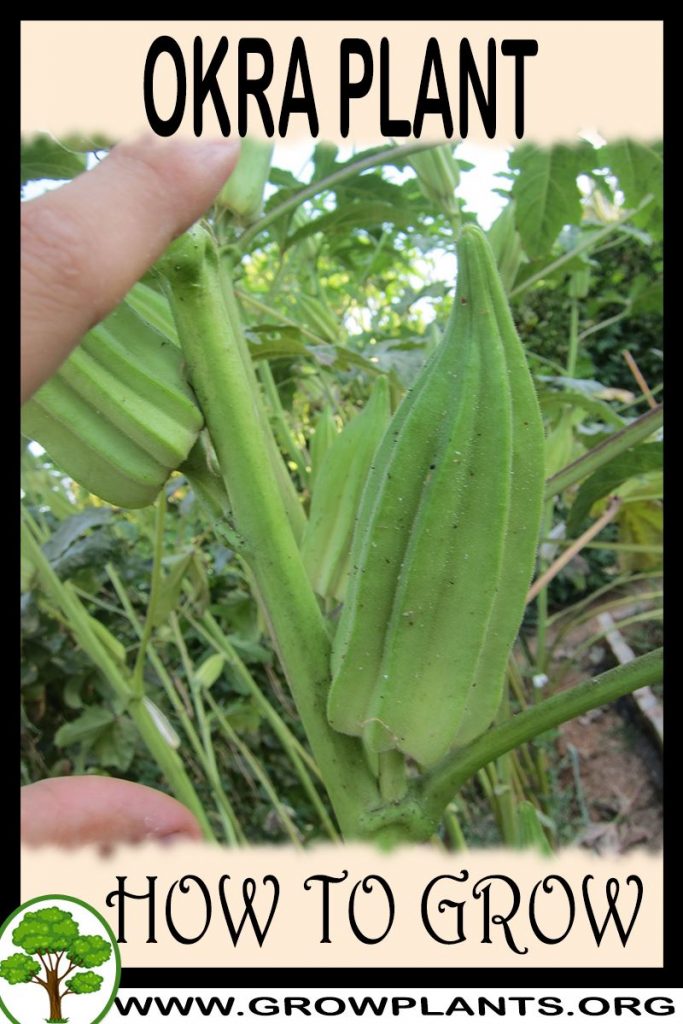
Plant Profile & Key Characteristics
Overview: Okra (Abelmoschus esculentus), also called bamia or gumbo, is a fast-growing tender vegetable, 1–2 m (3–6 ft) tall, usually grown as a warm-season annual and evergreen only in frost-free climates. It is cultivated mainly for its edible seed pods, with edible young leaves and an ornamental hibiscus-like flower.
Quick Specifications
| Specification | Attribute |
|---|---|
| Plant Type / Life Cycle | Perennial in the tropics, usually grown as a warm-season annual |
| Foliage Type | Frost-tender; evergreen in warm climates, deciduous or grown as an annual in cold ones |
| Mature Size | 1–2 m (3–6 ft) tall |
| Growth Rate | Moderate |
| Root System | Taproot |
| Toxicity | Non-toxic / edible |
| Hardiness | USDA zone 11+ as a perennial, 4+ grown as an annual |
Growth Form & Structure
- Height & Spread: Upright plant to 1–2 m (3–6 ft) tall; grows well in large containers where it stays somewhat shorter.
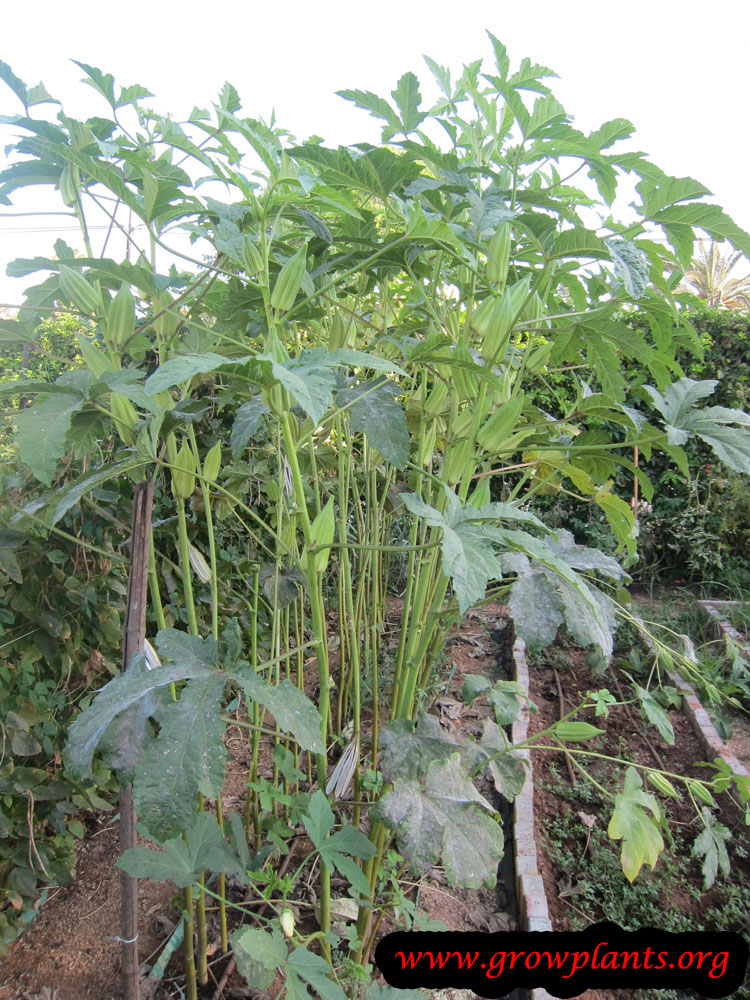
- Growth Habit & Form: Erect, sparsely branched herbaceous shrub with a single main stem.
- Lifespan & Maturity: Fast to mature, bearing its first pods roughly 5–8 months from sowing; short-lived where frost kills it back.
Anatomy & Physical Features
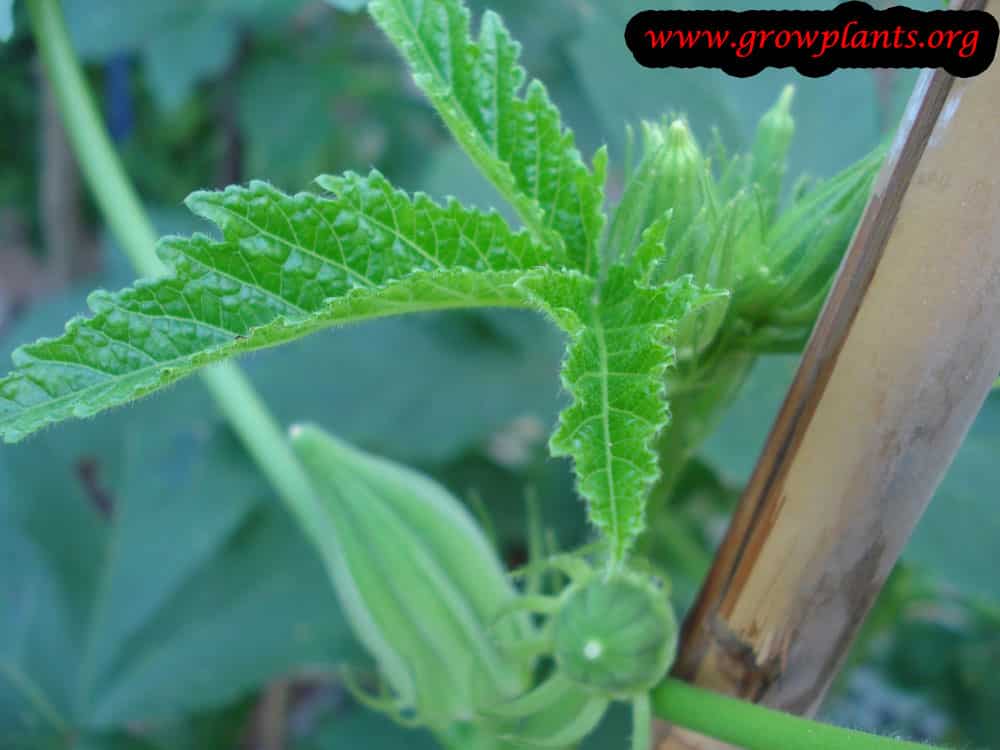
- Leaves & Foliage: Large fleshy palmate leaves with 5–7 lobes (sometimes faint), up to about 15 cm across; young leaves are edible.
- Flower Characteristics: Bright yellow hibiscus-like flowers with a dark purple-brown centre near the stamens.
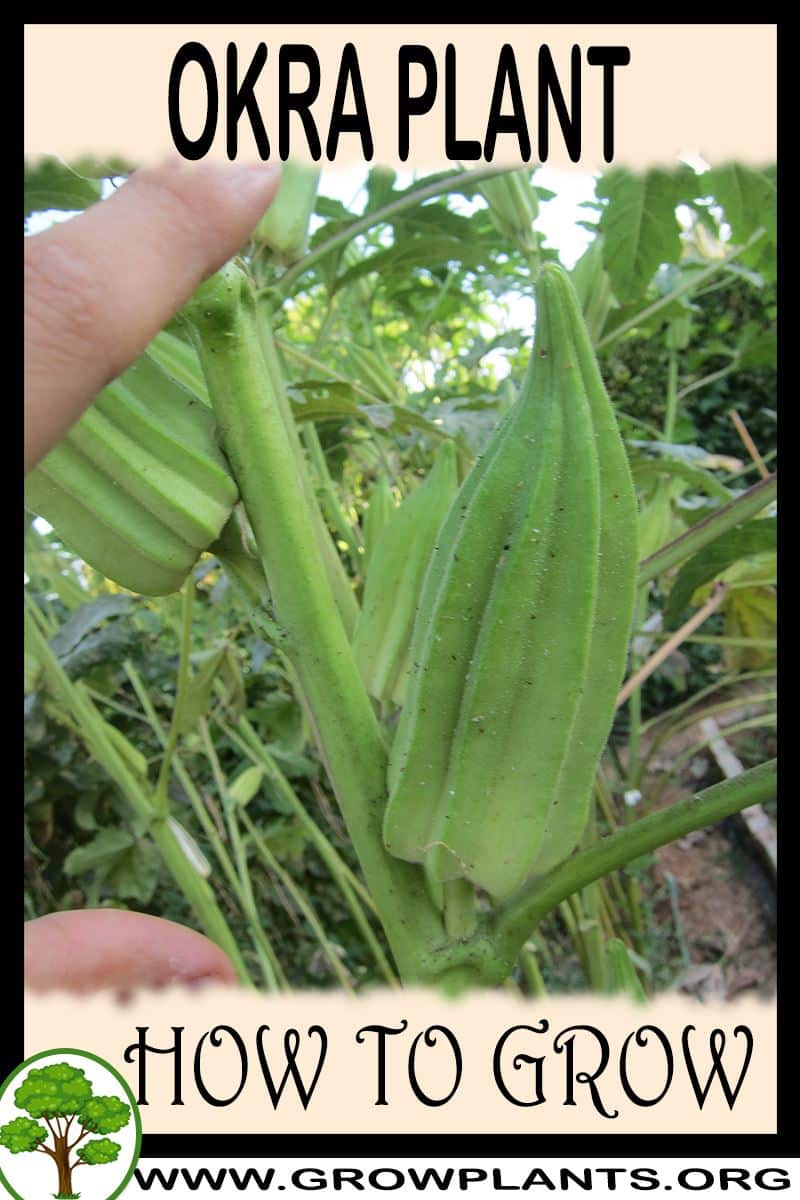
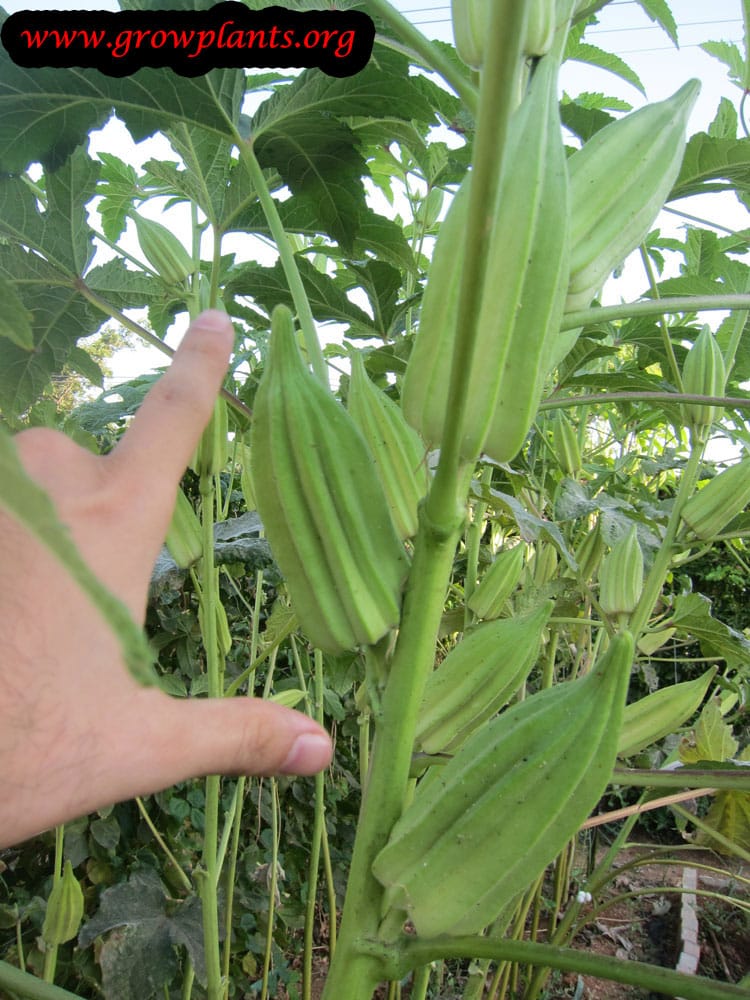
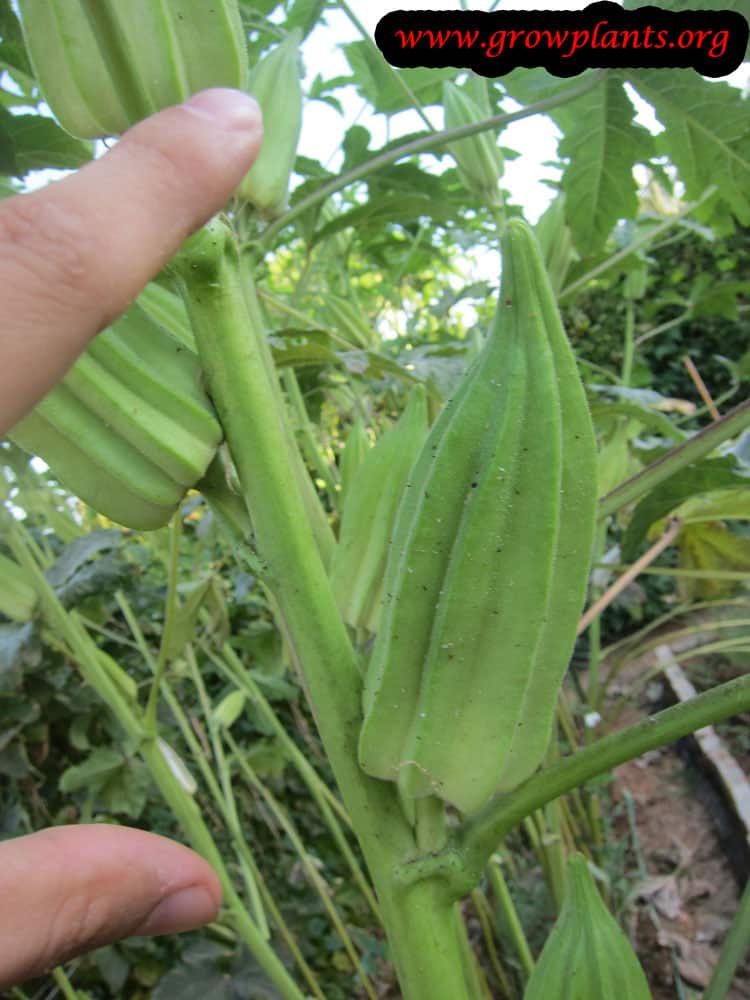
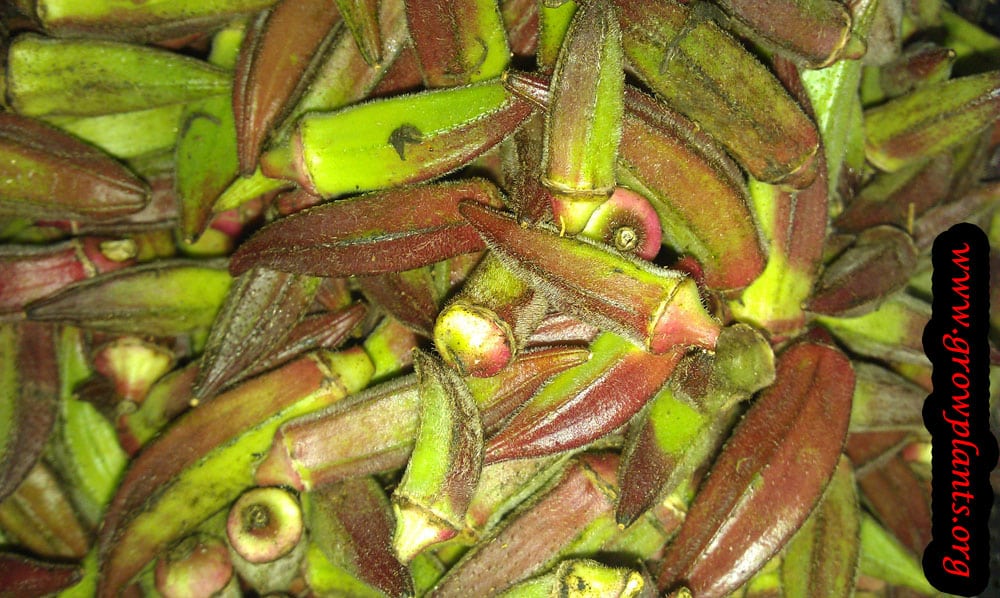
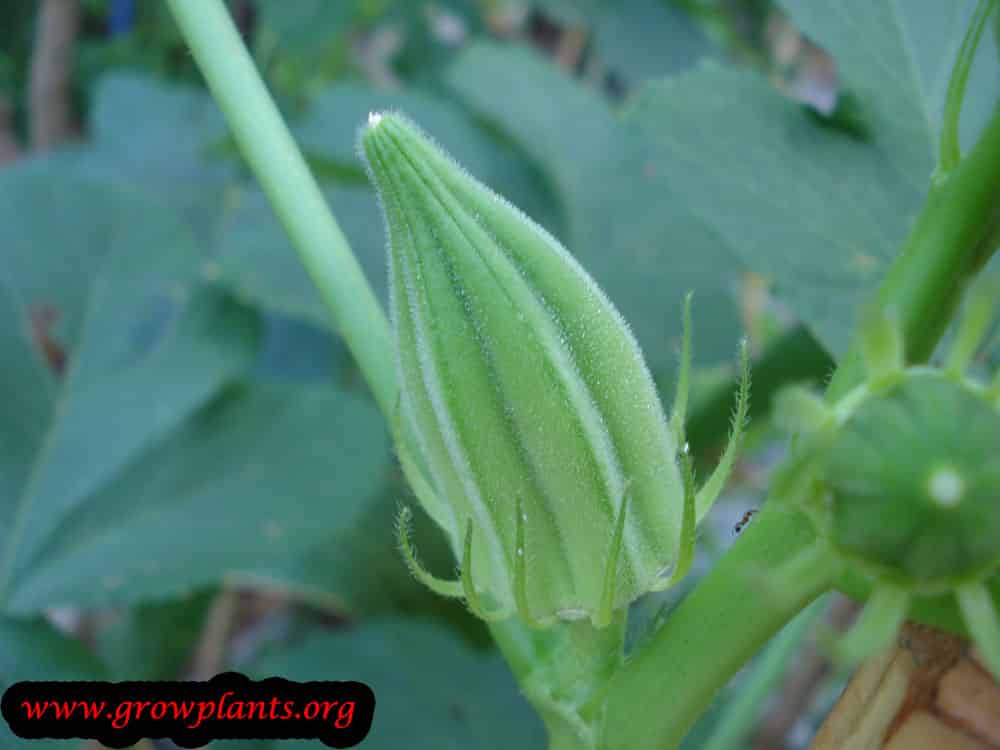
- Fruit Profile: Edible ridged pods, green or red, harvested young and tender.
Primary Uses & Landscape Value
- Edible Uses: Pods eaten cooked, pickled or in stews; young leaves used raw in salad and mature leaves cooked or stuffed; roasted seeds used as a coffee substitute.
- Functional & Ornamental Roles: Primarily a food crop, but the showy flowers also give it ornamental value; suited to vegetable beds and large containers.
Care Guide: Planting, Soil & Watering
Overview: Okra is a warm-season, moderate-growing vegetable for full sun that needs fertile, well-draining soil and steady, even moisture. It is very sensitive to cold, so plant only once the weather is reliably warm and keep the soil lightly moist to keep pods forming.
Quick Care Requirements
| Requirement | Ideal Condition |
|---|---|
| Planting Season | Spring after the last frost (as an annual); spring through autumn where grown as a perennial in frost-free zones |
| Growth Rate | Moderate |
| Soil Type | Fertile, well-draining soil |
| Soil pH | Neutral, roughly 6.0 to 7.0 |
| Water Need | Moderate — keep the soil evenly moist, especially during flowering and pod set |
Planting & Establishment
- Best Planting Season: Okra is very sensitive to cold, so plant in spring only after the last frost, once the soil has warmed. In frost-free climates (zone 11+) it grows as a perennial and can be set out from spring into autumn.
- How to Plant:
- Hole Preparation: Plant into a hole a little wider than the root ball and at the same depth, in a warm, sheltered, sunny spot.
- Soil Amendments: Enrich the soil with compost or well-rotted organic matter; okra is a hungry crop and rewards fertile, free-draining ground.
- Planting Depth: Set transplants at the same depth they grew, keeping the stem base at soil level.
- Growth Speed & Expectations: Moderate — with warmth and full sun it grows steadily into a 1–2 m plant and begins bearing within a few months.
Soil, Watering & Drainage Care
- Soil Mix & Drainage Needs: Needs fertile, well-draining soil; in containers use a rich, free-draining potting mix with good drainage holes.
- Watering Schedule & Technique:
- Young / Newly Planted: Keep the soil consistently moist while seedlings and transplants establish.
- Established: Water regularly and evenly so the soil stays lightly moist through flowering and pod set; avoid letting it dry out completely, which stresses the plant and checks cropping.
- Seasonal Adjustments: Water more often in summer heat; much less in cool weather when growth slows or the plant dies back.
Climate, Light & Hardiness
Okra is a heat-loving, frost-sensitive plant that behaves as a true evergreen (or cold-deciduous) perennial only in USDA zone 11 and warmer, and is grown as a warm-season annual as far north as zone 4. Regardless of climate it needs full sun and is notably sensitive to cold.
Quick Climate Specifications
| Climate Zones | Mediterranean, subtropical, temperate, tropical |
|---|---|
| USDA Hardiness Zones | 11+ as a perennial; 4+ grown as an annual |
| Frost Tolerance | Very Low |
| Light Conditions | Full sun |
Sunlight & Light Exposure
Optimal Light Setup
Requires full sun for vigorous growth, flowering, and pod set.
Temperature Extremes & Hardiness
USDA Hardiness & Regional Limits
The USDA zone 11+ perennial rating reflects a genuinely frost-free, warm year-round climate; the much broader zone 4+ figure describes where it can be grown as a summer annual, planted after the last frost.
Frost Sensitivity
Explicitly noted as cold-sensitive - even a light frost typically ends the growing season, and cool spring soil slows or prevents germination and early growth.
Frost-Free Growing Season
As a warm-season annual crop outside the tropics, okra needs a solidly warm frost-free stretch of the growing season to establish, flower, and produce a worthwhile pod harvest.
Growing in Pots, Balconies & Indoors
Okra (Abelmoschus esculentus, bamia) is a tall, warm-season vegetable that needs full sun and heat to crop. The grower does not rate it as a houseplant – grow it in a large container on a hot, sunny balcony, patio or terrace, much like a tomato.
Quick Details
- Container Size: A large, deep pot for a 1-2 m plant (general guidance – the grower confirms containers suit it, with no set volume)
- Indoor Suitability: Not an indoor plant – it needs full sun and warmth to flower and fruit
- Best Spot: Full sun – the hotter and brighter the better
- Soil & Drainage: Well-drained mix
- Watering in Pots: Keep the mix evenly moist – a large plant in a pot drinks a lot in heat; never waterlogged
Indoors & On the Windowsill
- Houseplant limits: The grower marks it as not a houseplant. Okra needs strong, direct sun and heat to set pods, which a room – or even most windowsills – cannot supply, so it is not an indoor plant.
- Best kept outdoors: Give it the hottest, sunniest outdoor spot in a big container.
On a Balcony or Patio
- Light, wind & heat: A bright, sheltered balcony or patio suits it well. Walls, railings and paving reflect heat so pots dry fast – check moisture often in hot weather, shelter it from strong wind, and allow for the pot’s weight and for drainage runoff.
- Practicalities: Choose a large, deep pot so the 1-2 m plant does not dry out or blow over; stake it on exposed balconies and pick pods young and often.
Choosing the Pot, Soil & Long-Term Care
- Pot & drainage: Use a pot with strong drainage holes and empty any standing saucer so the roots never sit in water and rot; a big pot resists drying and toppling.
- Pot material: Terracotta breathes and dries quickly (handy for sun-loving Mediterranean plants); glazed or plastic pots hold moisture longer.
- Potting mix: Well-aerated, free-draining mix – a good potting mix, or peat/coir blended with perlite or vermiculite and some organic matter.
- Feeding: Potted plants use up nutrients faster because watering leaches them out, so feed a little more often than plants in open ground – a large fruiting plant benefits from steady feeding.
Fertilizing & Feeding
A moderate feeder: this warm-season fruiting vegetable is grown for both its edible pods and its edible young leaves, so steady nitrogen-forward feeding early on, shifting toward a balanced, potassium-aware approach at pod set, supports its full productive cycle. A fertilizer formulated for tomatoes and vegetables supports that feeding pattern through harvest.
Quick Fertilizing Specs
| Feeding Level | Moderate feeder |
|---|---|
| Main Nutrient Priority | Nitrogen-forward feeding supports early leafy growth, shifting toward a balanced, potassium-aware fertilizer once pods begin forming |
| Best Feeding Period | Through the warm growing season, since this plant is sensitive to cold |
| Organic Options | Compost or organic matter worked into well-drained soil at planting |
| Reduce/Stop Feeding | Feeding tapers off as the growing season ends and cooler weather approaches, or, where grown as a perennial, as growth slows in cooler months |
| Micronutrients | Usually adequate from a complete fertilizer and organic matter in well-drained soil |
| Soil pH | Prefers well-drained soil |
Feeding by Growth Stage
Establishment after planting
Help newly planted or transplanted okra establish roots quickly in warm soil before its main growth push.
| Nutrient direction | A balanced fertilizer supports steady root and early leaf establishment. |
|---|---|
| Timing | At planting or transplanting in the spring warm season. |
| Frequency | A light feeding at planting is usually enough while roots establish. |
| Fertilizer types | A balanced complete fertilizer, Compost or organic matter worked into the planting soil |
| Precautions | Wait until the soil is reliably warm before planting, since this plant is sensitive to cold, and keep soil evenly moist while roots establish. |
Vegetative growth
Support okra’s leafy growth and branching structure, including its edible young leaves, before pod production ramps up.
| Nutrient direction | Nitrogen-forward feeding supports vigorous leaf and stem growth during this stage. |
|---|---|
| Timing | Through early-to-mid warm-season growth, before heavy flowering. |
| Frequency | Regular feeding through this stage supports the plant’s leafy growth phase. |
| Fertilizer types | A nitrogen-forward complete fertilizer, Compost or organic matter as a top-dressing |
| Precautions | Watch for aphids on new growth, and harvest young leaves for eating without stripping so much foliage that the plant’s vigor suffers. |
Flowering, pod set, and harvest
Support ongoing flowering and pod production through the harvest period, since regular picking encourages the plant to keep producing.
| Nutrient direction | A balanced fertilizer with attention to potassium supports continued flowering and pod development through the harvest period. |
|---|---|
| Timing | Through flowering and pod set into the harvest period. |
| Frequency | Regular feeding through the harvest period supports continued pod production. |
| Fertilizer types | A balanced complete fertilizer with attention to potassium, Compost or organic matter as a top-dressing |
| Precautions | Harvest pods while still young and tender, since pods left to mature toughen quickly, and picking regularly encourages continued production. |
Nutrient Deficiency Signs & Corrections
Leaves are pale green to yellow and smaller than expected, with slowed growth.
| Possible causes | low available soil nitrogen, leaching from watering or heavy rain, competition from a large fruit or leaf harvest load |
|---|---|
| Appears first on | older, lower leaves |
| What to check | recent feeding history, soil organic matter level, overall plant vigor and pod load |
| Possible correction | Apply a nitrogen-forward fertilizer appropriate for the current growth stage. |
Leaf margins show yellowing or scorch, most visible on older leaves during heavy pod production.
| Possible causes | low soil potassium relative to fruiting demand, sandy or fast-draining soil that leaches potassium, inconsistent watering that limits nutrient uptake |
|---|---|
| Appears first on | older leaves, leaf margins |
| What to check | fertilizer potassium content, soil drainage and texture, watering consistency |
| Possible correction | Shift to a balanced fertilizer with attention to potassium during flowering and pod set. |
Flowers form but drop before setting pods, or pod set is sparse.
| Possible causes | heat or cold stress outside this plant’s warm-season preference, inconsistent watering during flowering, excess nitrogen relative to potassium once pods begin setting |
|---|---|
| Appears first on | flowers and young pod sets |
| What to check | recent temperature extremes, watering consistency during flowering, recent fertilizer balance |
| Possible correction | Keep watering consistent through flowering and avoid excess nitrogen relative to potassium once pods begin setting. |
Pruning, Training & Seasonal Maintenance
Okra needs almost no formal pruning – the main structural intervention it tolerates is a single tip-pinch before flowering to control height and encourage a bushier, more branched plant. Far more important than any cut is the harvest itself: because okra flowers continuously on new growth through summer into autumn, regularly picking pods is what keeps it producing, while leaving pods to over-mature on the plant signals it to slow or stop flowering. In frost-free zones (11+) where it persists as a perennial, an autumn cutback after the main fruiting flush is appropriate; where grown as a cold-sensitive annual, the "autumn" end of the plant’s life is simply removal, not a pruning event.
Quick Pruning & Maintenance Specs
| Pruning Tolerance | Low – minimal cutting needed |
| Primary Pruning Window | One optional tip-pinch before flowering begins, for height/branching control |
| Secondary Maintenance Window | Autumn cutback after the main flush, where grown as a perennial (zone 11+) |
| Typical Frequency | Continuous pod harvest every 2–3 days through the season; at most one topping cut |
| Main Objective | Height/branching control and sustained pod set through consistent harvest |
| Young Plant Priority | Do not pinch until the plant is established; topping too early can stall growth |
| Mature Plant Priority | Keep up with harvest; remove lower leaves once their pods are picked |
| Best Tool Type | Precision snips / bypass secateurs |
| Avoid Heavy Pruning During | Peak flowering/fruiting – there is little to gain and it removes harvestable framework |
Pruning by Plant Age & Size
Newly Established
No pruning is needed while the seedling establishes; remove only damaged growth.
Young / Formative
No formal training system applies to this herbaceous-to-shrubby annual. A single pinch of the growing tip before flowering starts is optional and encourages more lateral branches, each a potential pod-bearing site.
Mature / Established
The operative maintenance is harvest, not pruning: picking pods every 2–3 days before they toughen keeps the plant flowering. Where the plant persists as a perennial in warm zones, an autumn cutback after the main flush tidies the plant ahead of its slower season.
Structural Pruning & Training
Height & spread control: the pre-flowering tip-pinch is the only structural tool used, and only where a bushier, shorter plant is preferred over a single tall stem.
Special Growth to Remove
- Lower leaves, once the pods below them have been picked – improves airflow through the plant, reduces disease pressure and eases access for continued harvest.
- Any missed, over-mature or tough pods – remove promptly even if not used, since leaving them on the plant is what tells it to reduce further flowering.
Container & Small-Space Pruning
Okra can be grown in containers; the confined root zone already limits ultimate size, so the same light approach applies – an optional early tip-pinch for a more compact, bushy habit, plus regular harvest.
Tools
- Precision snips – tip-pinching and lower-leaf removal.
- Bypass secateurs – tougher basal stems on perennial-grown plants in frost-free zones.
Tool Hygiene & Disease Risk
Routine. Aphids, slugs and root-knot nematode are the documented pest/disease pressures, none of which are notably tool-spread – clean, sharp tools are sufficient.
Cut Placement & Technique
Pinch the growing tip just above a leaf node. Remove lower leaves close to the main stem without tearing the stem tissue.
Heavy Pruning & Rejuvenation
Not a relevant practice for this fast-cycling annual/short-lived perennial – there is no woody framework to rejuvenate; a tired perennial specimen is generally better replaced than hard-pruned.
Post-Pruning Care
No special feeding is tied to a pinch or leaf removal; keep up normal, even watering, which also supports steady pod development.
Common Pruning Mistakes
- Letting pods over-mature on the plant, which slows further flowering.
- Pinching the growing tip too early, before the plant is established.
- Stripping too many leaves at once in the name of airflow, reducing the plant’s photosynthetic capacity.
When NOT to Prune
- During peak flowering/fruiting, avoid cutting back stems that are actively setting pods.
- Avoid working the plant while foliage is wet, given its nematode and fungal-adjacent pest pressures.
Pruning Troubleshooting
| Problem | Possible Cause | What to Check | Corrective Action |
| Pod production slowing or stopping | Over-mature pods left on the plant | Lower/older nodes for large, tough, unpicked pods | Harvest every 2–3 days; remove any missed pods immediately |
| Tall, sparse, weak-stemmed plant | No early tip-pinch was done | Plant height and branching pattern | Pinch the growing tip while still young, before flowering begins |
| Lower leaves yellowing or spotting | Poor airflow through a dense lower canopy | Density of old foliage near the base | Remove spent lower leaves once their pods are picked |
Recommended Tools (by task)
- precision_snips – tip-pinching and lower-leaf removal on soft young growth.
- bypass_secateurs – tougher basal stems on perennial-grown, frost-free-zone plants.
Propagation Guide
Okra is most commonly and reliably grown from seed, the standard method for this annual (or short-lived perennial) vegetable; site data confirms vegetative propagation is not required but is possible via stem cuttings. Seed usually comes true-to-type for a given variety, though open-pollinated okra can cross with other varieties growing nearby via bee pollination. Both methods are easy.
Quick Propagation Specs
| Best Propagation Method | Seed |
| Alternative Methods | Stem cuttings |
| Propagation Difficulty | Easy |
| Seed True-to-Type | Usually true-to-type for a given variety (may cross-pollinate with other varieties grown nearby) |
| Vegetative True-to-Type | Yes |
| Best Propagation Season | Spring |
| Seed Germination Time | 2 weeks to 3 months |
| Cutting Rooting Time | 3-7 weeks |
| Seed Sowing Depth | 1-2cm |
Growing from Seed
Seed Handling & Viability
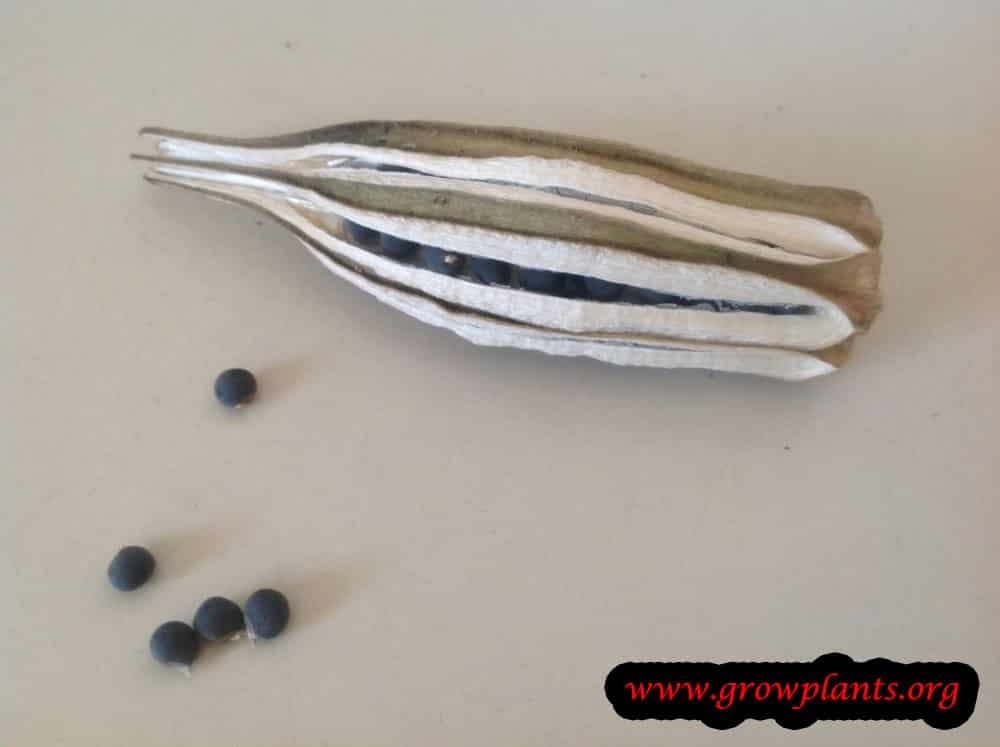
Seeds are small (2-3.5mm), black; store them in a dry, dark place until sowing.
Sowing Season
Spring.
Sowing Depth & Orientation
Sow about 1-2cm deep, spaced roughly 20-30cm apart.
Germination Conditions
Moist but not waterlogged, well-drained soil, watered at an average level.
Germination Time
Quite variable, from about 2 weeks up to roughly 3 months depending on conditions; germination can be irregular, and soaking seed for several hours before sowing is a common way gardeners help speed it up.
Seedling Care
Full sun; keep soil from being overly wet at this stage.
Stem Cuttings
Cutting Type
Stem cuttings.
Best Timing
Spring.
Rooting Setup
Moist, well-drained soil in half shade.
Rooting Hormone
Not indicated as necessary; treat as optional.
Rooting Time
3-7 weeks.
Bloom & Edible Flower Guide
Quick Details
- Bloom Season: Summer into autumn
- Flower Appearance: Large, bright yellow hibiscus-like flowers with a dark purple-brown centre near the stamens
- Edibility: Edible — as a mallow-family plant, the flowers are edible (mild and mucilaginous), alongside the familiar pods
Detailed Blooming Overview
Okra belongs to the mallow family, and it shows: the flowers are big, satiny and bright yellow with a deep maroon eye, unmistakably hibiscus-like. Each bloom is short-lived but they come in succession through the warm months, opening in the morning and drawing in bees. Beautiful enough to earn the plant a place for looks alone, and the flowers are edible in their own right.
Flower Characteristics
- Broad, bright yellow petals.
- A dark purple-brown throat around the central column of stamens.
- Classic hibiscus/mallow form — showy but fleeting.
Bloom Care & Thinning
- Thinning the bloom: none needed — let the flowers come freely.
- Pollination: worked by bees (the flowers are also self-fertile).
- Sun for bloom: full sun and warmth keep the succession of flowers coming.
Fruit & Uses
Okra is grown mainly for its edible seed pods, cooked or pickled as a vegetable, but the leaves are also eaten and the mature seeds can be used as a coffee substitute. Pods are cooked, while young leaves can be eaten raw and older leaves are cooked.
Quick Edible Specs
| Edible Parts | Pods, leaves, seeds |
| Main Use(s) | Culinary – cooked or pickled pods; leaves as salad/cooked green; roasted seeds as a coffee substitute |
| Eaten Raw or Cooked | Pods: cooked or pickled. Young leaves: raw. Mature leaves: cooked. Seeds: roasted |
| Preparation Required | Pods: cook or pickle. Mature leaves: cook. Seeds: roast/grind for coffee substitute |
| Harvest Season | Summer/autumn for pods; leaves through the growing season (all year in tropical climates, spring–autumn in cooler zones) |
| Time to First Harvest | A matter of months from planting, not years |
| Storage | Pods are best used fresh soon after picking, or pickled for longer storage |
| Safety/Toxicity Caveat | None noted; pods are best picked young, as overripe pods turn fibrous and tough rather than unsafe |
Fruit
The edible pods are green or red. They are best picked before fully mature, while still tender – the site notes it’s advisable to harvest before the pod is fully ripe, since older pods become fibrous. Pods form over roughly 5–8 months from planting and are harvested through summer and autumn. Birds and slugs can damage the developing pods.
Leaves & Greens
The fleshy leaves have 5–7 lobes. Young leaves are tender enough to eat raw in salads, while fully grown leaves are tougher and are cooked – stir-fried or used as a wrapping for stuffed-leaf dishes. Leaves are harvested by cutting them off next to the branch, available through the growing season.
Seeds, Pods & Nuts
If pods are left to fully mature and dry rather than being picked young, the seeds inside can be collected (before they drop to the ground), roasted, and ground as a caffeine-free coffee substitute. This is a secondary use compared to the pods.
Preparation, Uses & Safety
Pods are the main crop, eaten cooked or pickled; young leaves are used raw in salads and mature leaves are cooked; dried seeds are roasted for a coffee-substitute beverage. No toxicity is noted for any part; the main quality issue is pods toughening if left too long before harvest.
Pests, Diseases & Troubleshooting
Overview: Okra is a warm-season Malvaceae crop whose main threats are sap-sucking insects, boll/fruit-boring caterpillars, and the whitefly-borne yellow vein mosaic virus that is the crop’s most damaging disease. Vigorous, unstressed plants in warm, sunny, well-drained beds shrug off most trouble; a scouting, cultural, organic-first routine keeps both the sucking pests and the virus vectors in check.
Quick Troubleshooting Overview
| Issue / Pest | Main Symptom | Primary Solution |
|---|---|---|
| Aphids | Curled, sticky leaves with clustered insects; honeydew and sooty mold | Water jet, ladybirds; insecticidal soap or neem if heavy |
| Whiteflies | White flies under leaves; yellowing – and they spread mosaic virus | Sticky traps, reflective mulch, resistant lines; neem/soap |
| Fruit/shoot borer | Bored, frass-filled pods and wilted shoot tips | Remove bored pods, pheromone traps, Bt or spinosad |
| Root-knot nematode | Stunting, root galls, wilting in heat despite watering | Rotate, add organic matter, plant resistant lines, solarize |
| Yellow vein mosaic | Yellow vein-netting, small distorted leaves and pods | Control whiteflies, rogue infected plants, resistant varieties |
| Powdery mildew | White powder on leaves late in the season | Airflow, sulfur or potassium bicarbonate |
Common Pests & Management
- Cotton / melon aphid (Aphis gossypii):
- Symptoms: Clusters of small green-to-black insects on shoot tips and leaf undersides curl and pucker the foliage; sticky honeydew, sooty mold, and ants follow, and the aphids can transmit viruses.
- Prevention & Control: Encourage ladybirds, lacewings, and hoverflies, knock colonies off with water, and avoid excess nitrogen. Reflective/silver mulch deters landing; treat persistent outbreaks with insecticidal soap or neem sprayed under the leaves in the evening.
- Whiteflies (Bemisia tabaci):
- Symptoms: Tiny white flies swarm up from leaf undersides when disturbed; nymphs suck sap, yellow and weaken leaves, coat them in honeydew and sooty mold, and – most seriously – transmit yellow vein mosaic virus.
- Prevention & Control: This is the key vector, so manage it hard: yellow sticky traps, reflective mulch, and prompt removal of virus-infected plants. Support parasitoids and predators, and rotate insecticidal soap, neem, or horticultural oil on leaf undersides; grow tolerant varieties where virus pressure is high.
- Fruit & shoot borer (Earias vittella / Earias insulana):
- Symptoms: Young caterpillars bore into growing shoot tips, causing them to wilt and droop, then tunnel into pods leaving entry holes, frass, and distorted, inedible fruit.
- Prevention & Control: Scout and pinch out wilted ‘dead-heart’ shoot tips and remove bored pods to break the cycle; hang pheromone traps to time control. Encourage Trichogramma egg parasitoids and spray Bt or spinosad against small larvae before they enter the pods.
- Fruit borer / earworm (Helicoverpa armigera):
- Symptoms: Larger caterpillars chew buds, flowers, and bore round holes into pods, feeding inside and fouling them with frass; damage often peaks as pods set.
- Prevention & Control: Handpick larvae, encourage birds and parasitic wasps, and use pheromone traps for monitoring. Treat egg-lay and small larvae with Bt or spinosad, and keep to a resistant-friendly rotation to avoid resistance build-up.
- Spider mites (Tetranychus urticae):
- Symptoms: Fine pale stippling and bronzing of leaves with faint webbing on undersides during hot, dry weather; heavy feeding scorches and drops leaves.
- Prevention & Control: Hose foliage to raise humidity and knock mites off, keep plants watered, and avoid dusty stress. Release predatory mites where available and use horticultural oil or a labelled miticide only for stubborn hot-spell outbreaks.
- Flea beetles (Systena / Phyllotreta spp.):
- Symptoms: Numerous tiny ‘shot-hole’ pits chewed through the leaves, worst on young plants; the small beetles hop away when disturbed.
- Prevention & Control: Protect seedlings with floating row cover until established, keep beds weed-free, and use trap crops. Kaolin clay or spinosad can protect heavily hit young plantings; mature okra usually outgrows the damage.
- Stink bugs (Nezara / Euschistus spp.):
- Symptoms: Shield-shaped bugs pierce developing pods, leaving sunken, warty, or twisted fruit and darkened feeding spots; heavy feeding deforms pods badly.
- Prevention & Control: Keep field margins weed-free, handpick and knock bugs into soapy water in the cool morning, and encourage predators. Spot-treat only heavy pressure, choosing softer products and sparing pollinators.
Diseases & Fungal Issues
- Yellow vein mosaic virus (Bhendi yellow vein mosaic begomovirus):
- Symptoms: A striking network of yellow, chlorotic veins over the leaf, followed by overall yellowing, stunting, and small, pale, distorted pods; spread by whiteflies and the crop’s most damaging disease.
- Treatment & Management: There is no cure once infected, so prevention rules: control whiteflies aggressively, remove and destroy infected plants promptly, manage weed reservoirs, and – most importantly – grow resistant or tolerant varieties where the virus is present.
- Fusarium & Verticillium wilt (Fusarium oxysporum / Verticillium dahliae):
- Symptoms: Yellowing and wilting that often starts on one side or lower leaves, with browning of the internal stem tissue; plants decline and may collapse, worse on infested, poorly drained ground.
- Treatment & Management: Rotate away from Malvaceae and other susceptible crops for several years, plant on well-drained soil, and use resistant varieties and clean seed. Remove and destroy affected plants; the soil-borne fungi cannot be sprayed out once established.
- Powdery mildew (Erysiphe cichoracearum / Podosphaera):
- Symptoms: White powdery patches on leaves, usually later in the season, that yellow and dry the foliage and can reduce yield in a dry, crowded stand.
- Treatment & Management: Space plants for airflow, water at the base, and clear crop debris. Sulfur, potassium bicarbonate, or a horticultural-oil spray checks it if applied early on unstressed plants.
- Cercospora leaf spot & damping-off (Cercospora abelmoschi / Pythium):
- Symptoms: Angular grey-brown leaf spots with premature defoliation in wet weather; at the seedling stage damping-off collapses stems at the soil line.
- Treatment & Management: Use clean, treated seed and a free-draining seedbed, avoid overwatering seedlings, and rotate. Copper fungicide can protect foliage during prolonged wet spells; rogue and destroy heavily spotted debris.
- Root-knot nematode (Meloidogyne spp.):
- Symptoms: Stunting, midday wilting, and yellowing despite adequate water, with characteristic knotty galls swelling the roots when lifted.
- Treatment & Management: Rotate with non-hosts such as cereals and marigold, build soil organic matter to feed antagonists, solarize infested beds in the hot season, and choose resistant lines where available.
Growing Difficulties & Abiotic Problems
- Bud & flower drop:
- Cause & Symptoms: Extreme heat, cold snaps, drought, or erratic watering make okra shed buds and blooms before pods set.
- Correction Strategy: Keep soil evenly moist with deep, regular watering and mulch, and expect set to resume once temperatures moderate; avoid transplant and drought shock during flowering.
- Tough, woody pods:
- Cause & Symptoms: Pods left on the plant past their tender stage turn fibrous and inedible, and slow, cool growth can also toughen them.
- Correction Strategy: Harvest young and often – every day or two in warm weather – to keep pods tender and to keep the plant productive; grow in full warmth for fast, succulent growth.
- Poor germination / cold-set:
- Cause & Symptoms: Okra is a heat lover; cold, wet soil rots seed and stalls seedlings, and cool spells stall pod set.
- Correction Strategy: Sow only into warm soil, pre-soak seed to speed emergence, and avoid overwatering the seedbed; use warmth or protection to get an even, vigorous start.
- Nutrient & edema issues:
- Cause & Symptoms: Yellowing lower leaves signal nitrogen shortage, while sudden swings in soil moisture can cause corky edema spots on pods.
- Correction Strategy: Feed a balanced fertiliser (not excess nitrogen, which delays fruiting), keep watering steady, and correct any chlorosis with organic matter and a balanced feed.
What Helps – Products & Tools
For okra and its kin the practical kit is mostly soft and cultural: neem and horticultural oil and insecticidal soap for aphids, whiteflies, and mites; Bt or spinosad for boring caterpillars; yellow sticky traps and reflective mulch to blunt whitefly virus spread; sulfur or potassium bicarbonate for powdery mildew; a copper fungicide for wet-weather leaf spot; and resistant varieties plus crop rotation as the backbone against wilt, nematodes, and yellow vein mosaic virus.