Plant Profile & Key Characteristics
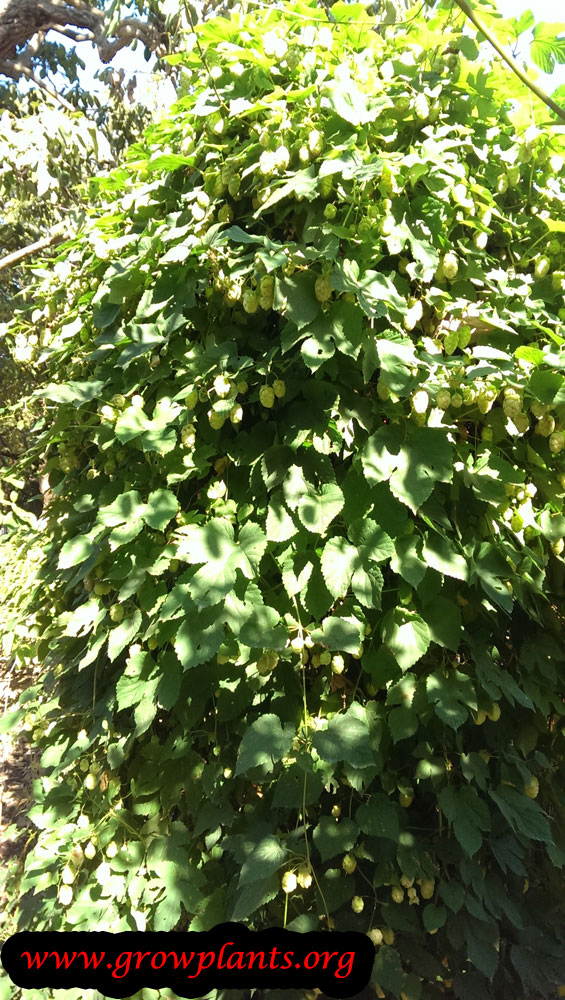
Overview: A fast-growing deciduous perennial climbing vine (bine) reaching about 4-8 m (13-26 ft) each season, grown for its aromatic female flower cones used in brewing as well as for edible young shoots and leaves.
Quick Specifications
| Specification | Attribute |
|---|---|
| Plant Type / Life Cycle | Perennial (herbaceous climbing vine / bine) |
| Foliage Type | Deciduous |
| Mature Size | 4-8 m (13-26 ft) long per season |
| Growth Rate | Fast to moderate |
| Root System | Rhizomatous (spreads and can be aggressive) |
| Toxicity | Leaves and female cones edible for people / used in brewing; hop cones are toxic to dogs |
| Hardiness | USDA zone 3-9 |
Growth Form & Structure
- Height & Spread: Bines twine 4-8 m (13-26 ft) up supports each year, dying back to the rootstock in winter; can be container-grown but not indoors.
- Growth Habit & Form: Vigorous, twining herbaceous climber (dioecious – male and female flowers on separate plants).
- Lifespan & Maturity: Long-lived perennial crown that re-grows fast each spring; can be aggressive.
Anatomy & Physical Features
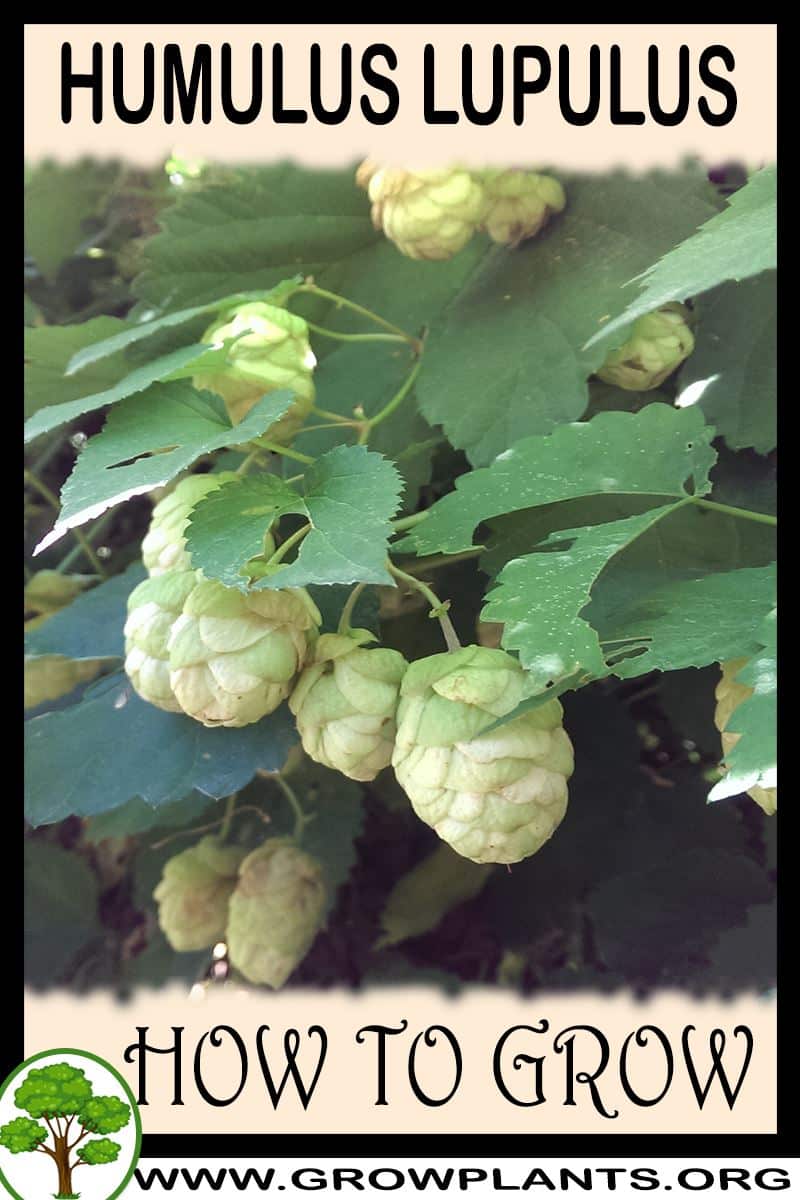
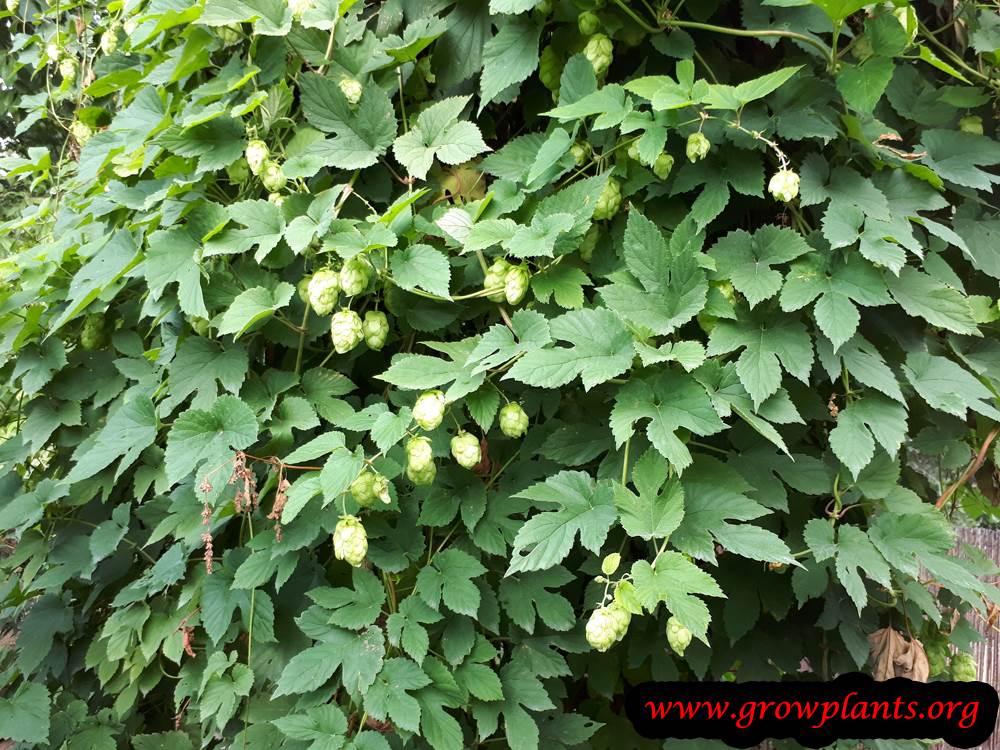
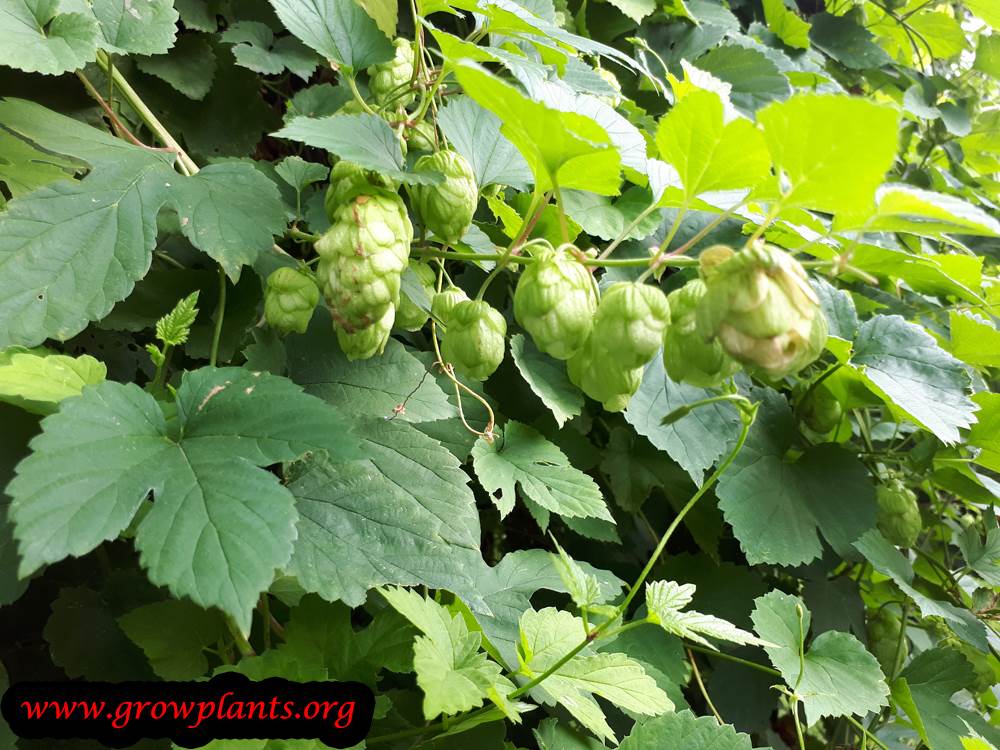
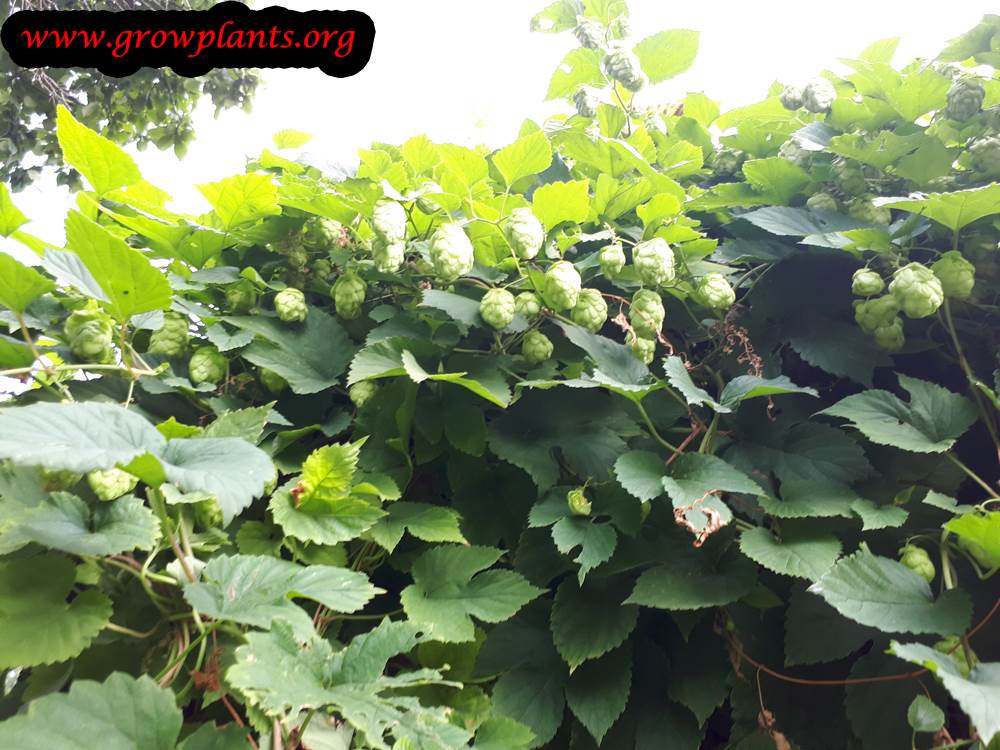
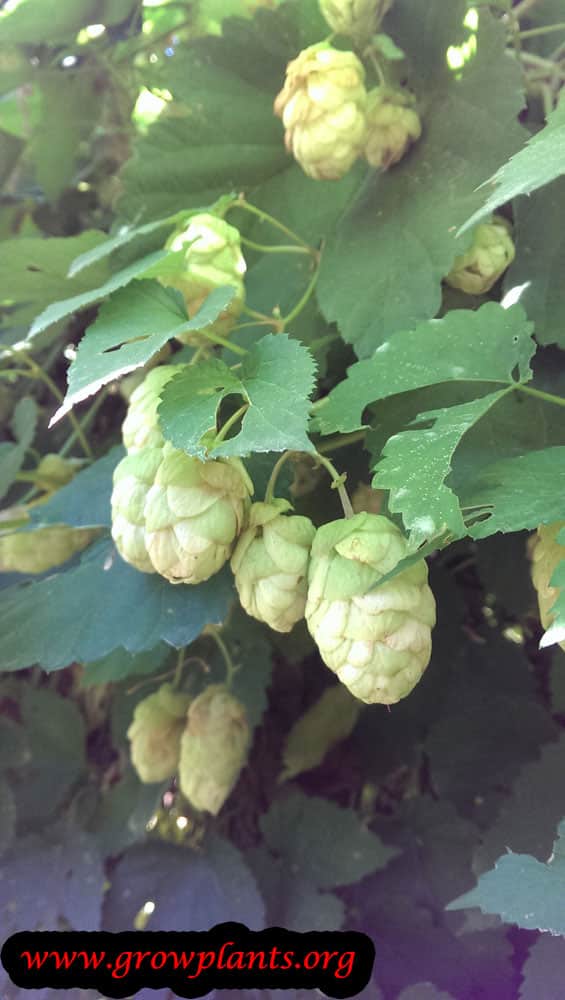
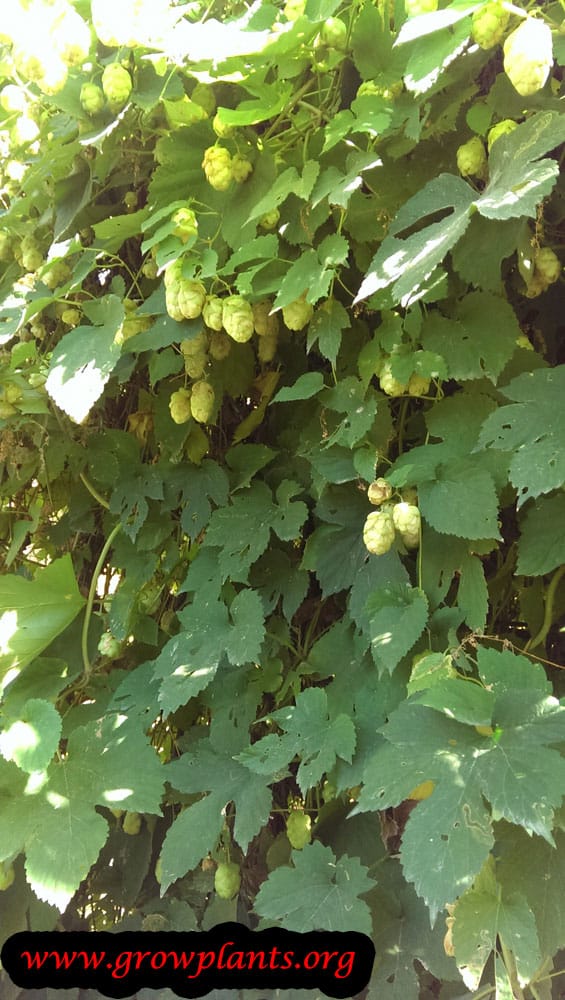
- Leaves & Foliage: Green, heart-shaped to 3-7 lobed leaves with serrated edges.
- Flower Characteristics: Fragrant green female cones (‘hops’) and white male flower clusters on separate plants (full detail in the Bloom section).
Primary Uses & Landscape Value
- Edible Uses: Young leaves and shoots eaten cooked or raw in salads; female flower cones used to flavour beer, and the plant has medicinal uses.
- Functional & Ornamental Roles: Grown as a fragrant ornamental screening vine and as a brewing/medicinal crop.
Care Guide: Planting, Soil & Watering
Overview: Common hop (Humulus lupulus) is a vigorous, fast-growing perennial climber for temperate climates (zones 3–9) that dies back each winter and needs a cold dormancy. It thrives in deep, rich, moist but well-drained soil in full sun, with generous watering and nitrogen-rich feeding through the growing season.
Quick Care Requirements
| Requirement | Ideal Condition |
|---|---|
| Planting Season | Dormant to warm season — winter through spring and summer |
| Growth Rate | Fast to Moderate (vigorous, can be aggressive) |
| Soil Type | Deep, rich, moist but well-drained soil |
| Water Need | Moderate to High — keep the soil consistently moist during active growth |
Planting & Establishment
- Best Planting Season: Plant rhizomes or young plants from late in the dormant season into spring and summer, once the soil is workable, giving the vine a full warm season to climb; a cold winter is needed for the next year’s growth.
- How to Plant:
- Hole Preparation: Dig a hole roughly twice the width of the roots and set up a tall support or trellis at planting, as the bines climb several metres in one season.
- Soil Amendments: Work in plenty of compost or well-rotted manure — hops are hungry feeders that respond to rich, nitrogen-supplied soil.
- Planting Depth: Set young plants at the depth they grew; plant rhizomes a few centimetres deep, keeping the shoots near the surface.
- Growth Speed & Expectations: Expect fast, vigorous growth of several metres in a single season; the plant can be aggressive and spread, so allow room or contain the roots.
Soil, Watering & Drainage Care
- Soil Mix & Drainage Needs: Provide deep, humus-rich, moisture-retentive soil that still drains freely; roots should stay evenly moist but not waterlogged.
- Watering Schedule & Technique:
- Young / Newly Planted: Water frequently to keep the soil consistently moist while the vine establishes and climbs.
- Established: Water generously and deeply during active growth and hot spells; hops use a lot of water when growing fast.
- Seasonal Adjustments: Reduce watering as the vine dies back in autumn and keep it on the dry side through winter dormancy.
Climate, Light & Hardiness
Hops is a cold-hardy herbaceous perennial vine grown in temperate, mediterranean, or subtropical climates, needing full sun to half shade and, notably, a cold winter as part of its normal growth cycle. The site rates it to approximately zone 3–9.
Quick Climate Specifications
| Climate Zones | Temperate, mediterranean, and subtropical climates |
|---|---|
| USDA Hardiness Zones | Approximately 3–9 |
| Frost Tolerance | High – dies back to the root and regrows each year |
| Light Conditions | Full Sun to Half Shade |
Sunlight & Light Exposure
Optimal Light Setup
Full sun supports the most vigorous vine growth and best cone (flower) production; half shade is tolerated but growth is less vigorous.
Temperature Extremes & Hardiness
USDA Hardiness & Regional Limits
Reliable outdoor culture spans approximately zone 3–9, reflecting strong winter cold tolerance as a herbaceous perennial whose top growth dies back to the ground each winter and resprouts from the crown in spring.
Cold Damage & Winter Protection
Unlike most plants in this batch, hops actually needs a genuine cold winter period as part of healthy annual growth - the site specifically lists cold winter conditions among its requirements. Mild, frost-free climates that never deliver this winter chill tend to produce weaker regrowth and vigor the following season.
Wind, Humidity & Microclimate
Wind Tolerance
As a tall climbing vine that can reach considerable height each season, provide sturdy support and a reasonably wind-sheltered site to prevent damage to the long bines.
Microclimate Recommendations
A site with full sun, good air movement, and a genuine winter chill period best matches this plant's natural growth cycle.
Growing in Pots, Balconies & Indoors
Hops are not a houseplant – the grower marks them unsuitable indoors – and this fast, tall herbaceous climber (4-8 m / up to 25 ft in a season) needs full sun and a tall support outdoors. It grows well in a large container that dies back each year and re-sprouts from the rootstock, but it is far too big for a windowsill.
Quick Details
- Container Size: A large, heavy pot of about 30-45 L (8-12 gal) with a tall string or trellis
- Indoor Suitability: Not an indoor plant; grow it outdoors up a tall support
- Best Spot: Full sun to part shade
- Soil & Drainage: Rich, moisture-retentive mix that still drains; hops are hungry and thirsty
- Watering in Pots: Water generously through the growing season – it uses a lot of water in full growth
Indoors & On the Windowsill
- Not a houseplant: It races up several metres in a season – impossible indoors or on a sill.
- Windowsill: Not an option; give it height and full outdoor light.
- Overwintering: Hardy – the top dies back each cold season and re-grows from the crown; simply keep the pot barely moist while it rests. Note the plant is mildly toxic to dogs, so keep pets from chewing it.
On a Balcony or Patio
- Light & wind: Give it a tall, sunny support – a wall of string up to a balcony rail works well; anchor everything firmly as the mature bine is heavy.
- Practicalities: A big, stable pot and rich feeding keep it vigorous; expect to water daily in peak summer. A drip irrigation kit with a timer can take over that watering check automatically.
Choosing the Pot, Soil & Long-Term Care
- Pot & drainage: A large 30-45 L pot with strong drainage holes; skip a standing-water saucer to avoid root rot. Terracotta breathes and dries faster; glazed or plastic holds moisture longer.
- Potting mix: A light, aerated, organic-rich mix – potting compost or peat/coir with added perlite or vermiculite for drainage. Add extra organic matter – hops are heavy feeders and drinkers.
- Feeding: Nutrients wash out of pots faster than open ground, so feed potted hops more often – a balanced liquid feed through the active growing season.
- Repotting: Refresh the top layer of mix each year and renew it or pot up every couple of years; lightly trim the roots and top growth when you do.
Fertilizing & Feeding
A hungry, fast-growing perennial bine that regrows its entire top from the crown each year and benefits from steady, nitrogen-leaning feeding through the growing season, tapering off as the plant heads into winter dormancy.
Quick Fertilizing Specs
| Feeding Level | Moderate feeder |
|---|---|
| Main Nutrient Priority | Nitrogen-forward feeding during rapid vegetative growth, shifting toward potassium as cones develop |
| Best Feeding Period | Spring through summer during rapid climbing growth and cone development |
| Organic Options | Compost or aged manure worked into moist, fertile soil around the crown |
| Reduce/Stop Feeding | Stop feeding as the bine dies back for winter dormancy |
| Micronutrients | Usually met by a complete fertilizer and organic matter; correct only a diagnosed deficiency |
| Soil pH | Slightly acidic to near neutral is generally preferred |
Feeding by Growth Stage
Spring crown emergence
Support strong new shoots as the crown breaks dormancy and begins climbing again.
| Nutrient direction | A balanced fertilizer with available nitrogen gets new bines off to a vigorous start. |
|---|---|
| Timing | Early spring as new shoots emerge from the crown. |
| Frequency | A feeding as growth resumes, with follow-up feeding once shoots are climbing well. |
| Fertilizer types | A balanced complete fertilizer, Compost or aged manure worked around the crown |
| Precautions | Keep fertilizer away from direct contact with the crown to avoid burning emerging shoots. |
Rapid vegetative growth
Fuel the bine’s fast climb up its trellis and build a full canopy of lobed leaves.
| Nutrient direction | A nitrogen-forward fertilizer supports the vigorous stem and leaf growth this plant is known for. |
|---|---|
| Timing | Late spring into early summer during the period of fastest climbing growth. |
| Frequency | Regular feeding through this stretch of rapid growth. |
| Fertilizer types | A nitrogen-forward complete fertilizer, Compost or aged manure as a supplemental feed |
| Precautions | Ease back on nitrogen as cones begin to set, since excess nitrogen late in the season can reduce cone quality. |
Flower and cone development
Support the female flowers and developing cones without pushing more leafy growth.
| Nutrient direction | Shift toward a more balanced, potassium-inclusive fertilizer as cones form. |
|---|---|
| Timing | Mid to late summer as female flowers and cones develop. |
| Frequency | Lighter, less frequent feeding as the plant shifts from vegetative growth to cone production. |
| Fertilizer types | A balanced fertilizer with proportionally more potassium, Compost as a light top-dressing |
| Precautions | Avoid heavy nitrogen feeding at this stage, which favors foliage over cone development. |
Winter dormancy
Let the crown rest through cold winter dormancy after the bine dies back.
| Nutrient direction | None – withhold fertilizer while the crown is dormant over winter. |
|---|---|
| Timing | Autumn through winter after the bine dies back. |
| Frequency | No feeding at this stage; resume once new shoots emerge in spring. |
| Fertilizer types | No feeding at this stage; hold off fertilizing until active growth resumes in spring. |
| Precautions | Do not fertilize a dormant crown; nutrients applied now are wasted and can leach away before spring. |
Nutrient Deficiency Signs & Corrections
Older leaves turn pale green to yellow and bine growth is noticeably slower or thinner than expected.
| Possible causes | low available soil nitrogen for this vigorous grower’s needs, nitrogen leaching in moist, well-watered soil, an undernourished or depleted crown after several seasons |
|---|---|
| Appears first on | older, lower leaves |
| What to check | recent feeding history, soil organic matter around the crown, how many seasons since the bed was last amended |
| Possible correction | Apply a nitrogen-forward fertilizer during vegetative growth and build soil organic matter around the crown. |
Interveinal yellowing appears on older leaves while the veins themselves stay green.
| Possible causes | low soil magnesium, heavy potassium feeding competing with magnesium uptake, leaching in light, sandy soils |
|---|---|
| Appears first on | older, lower leaves |
| What to check | soil magnesium status, how potassium-heavy recent feeding has been, soil texture and drainage |
| Possible correction | Apply a labeled magnesium source such as Epsom salt or a dolomitic amendment and rebalance overall feeding. |
Leaf margins scorch or brown late in the season and cone development is noticeably reduced.
| Possible causes | low soil potassium relative to this heavy-cropping plant’s demand, inconsistent watering during cone development, heavy nitrogen feeding late in the season diluting potassium relative to growth |
|---|---|
| Appears first on | margins of older leaves |
| What to check | watering consistency during cone development, recent fertilizer balance, cone yield and quality compared to prior seasons |
| Possible correction | Shift toward a more balanced or potassium-inclusive fertilizer as cones develop and maintain even watering. |
Pruning, Training & Seasonal Maintenance
Hops is a herbaceous perennial climber (a ‘bine’, gripping its support with stiff stem hairs rather than tendrils or twining woody growth) that dies back completely each winter and regrows from a persistent underground crown. Its pruning is therefore less about shaping wood and more about two things: cutting away the dead top growth once it dies back, and, in spring, selecting which of the many new shoots from the crown are trained up as that year’s bines. Winter is the main cutback window, following the plant’s natural die-back; the crown itself is aggressive and long-lived, so ongoing management is really about controlling which growth it’s allowed to put its energy into.
Quick Pruning & Maintenance Specs
| Pruning Tolerance | High (herbaceous top growth; the crown is what persists) |
| Primary Pruning Window | Winter, once the bines have died back |
| Secondary Maintenance Window | Early spring shoot selection (‘crowning’) |
| Typical Frequency | One full cutback per year, plus spring shoot thinning |
| Main Objective | Remove dead top growth; select and train the strongest new bines |
| Young Plant Priority | Establish the crown and its support before growth accelerates |
| Mature Plant Priority | Thin excess shoots each spring; cut all bines down after die-back |
| Best Tool Type | Bypass secateurs / loppers at the base; precision snips for shoot thinning |
| Avoid Heavy Pruning During | Active summer bine growth and flowering |
Pruning by Plant Age & Size
Newly Established
Let the crown establish for its first season with minimal interference beyond providing a support; avoid disturbing the young root system.
Young / Formative
Each spring, once shoots emerge from the crown, select the 2–3 strongest and train them (by hand, wrapping clockwise, since this species twines in that direction) onto strings or a trellis; this is the only ‘training system’ hops needs – there is no leader/vase framework, since the whole above-ground plant is rebuilt from scratch every year.
Mature / Established
Repeat the same spring shoot-selection each year on an established crown, and in winter cut all dead bines down after they die back. Established crowns also benefit from a light ‘crowning’ – scraping away some of the shallow surface buds and rhizome growth in early spring – to concentrate vigor into fewer, stronger bines and reduce disease carried over in old crown tissue.
Seasonal Pruning Schedule
Winter (Die-Back)
- Objective: clear spent top growth and reduce overwintering disease inoculum.
- Remove: all dead bines, cut down close to the crown.
- Do not remove: the crown itself – it is the perennial part of the plant and regenerates all top growth each year.
- Expected response: a clean base ready for spring shoot emergence.
Early Spring (Crowning / Shoot Selection)
- Objective: concentrate the plant’s vigor into a manageable number of strong bines.
- Remove: excess weak shoots, keeping only the strongest 2–3 per crown to train up.
- Do not remove: the crown’s healthy buds entirely – some are needed for the season’s growth.
- Expected response: fewer, more vigorous bines rather than many thin, competing shoots.
Special Growth to Remove
- Dead bines after winter die-back – the plant’s documented main pruning task.
- Excess weak shoots at the crown each spring, beyond the 2–3 chosen to train.
- Male seedlings/volunteer plants, if any appear – this species is dioecious and growers typically keep only female plants, since pollination is not needed and unpollinated female cones are preferred.
Container & Small-Space Pruning
Possible in a large container, but the crown is a vigorous, spreading structure and the bines still reach several metres in a season, so container plants need a tall, sturdy support and more attentive spring shoot-thinning than an in-ground planting to stay manageable.
Tools
Bypass secateurs or loppers for cutting the thick, fibrous bine bases at winter die-back; precision snips for thinning young shoots in spring.
Tool Hygiene & Disease Risk
Increased risk – hops is prone to downy mildew, which can overwinter in old crown and bine debris, so clearing dead growth fully at the winter cutback and keeping the crown area clean is a genuine disease-control measure, not just tidiness.
Cut Placement & Technique
Cut dead bines close to the crown at the winter cutback; when crowning, scrape or cut shallow surface growth without gouging into the main crown; when hand-training young bines onto strings, wrap them clockwise in the direction they naturally twine.
Heavy Pruning & Rejuvenation
Not applicable in the usual woody-plant sense – the entire top growth is removed and rebuilt every year by nature. The closest equivalent to rejuvenation is crown division: an old, congested crown can be lifted and divided to renew vigor or to propagate new plants.
Post-Pruning Care
After the winter cutback, mulch and top-dress the crown, since this species appreciates moist, nitrogen-rich soil and a period of winter cold to grow well the following year. After spring shoot selection, keep the chosen bines watered as they establish on their strings.
Common Pruning Mistakes
- Leaving all emerging spring shoots to grow, resulting in many thin, weak, competing bines instead of a few strong ones.
- Leaving dead bine debris around the crown over winter, which can harbor downy mildew.
- Letting bines trail on the ground instead of hand-training them onto a support early, when they are easiest to direct.
When Not to Prune
Avoid cutting back bines while they are actively growing and flowering in summer – by then the season’s growth is established and cutting it back only sets the plant back.
Pruning Troubleshooting
| Problem | Possible Cause | What to Check | Corrective Action |
| Many thin, weak bines instead of a few vigorous ones | Too many spring shoots left uncontrolled, competing for resources | Number of shoots retained per crown | Thin to the strongest 2–3 shoots at crowning time next spring |
| Recurring downy mildew early in the season | Disease carried over in old crown or bine debris | Base of the crown for leftover dead material | Clear all dead growth fully at the winter cutback and keep the crown area clean |
Recommended Tools (by task)
- loppers – cutting thick, fibrous bine bases at the winter die-back cutback.
- precision_snips – thinning excess shoots during spring crowning.
- soft_ties_stakes – hand-training young bines onto strings or a trellis.
- garden_spade – dividing an old, congested crown to renew vigor or propagate.
Propagation Guide
Hops is dioecious, and since only female plants produce the cones grown for brewing and other uses, vegetative propagation from a confirmed female plant – as this site’s own facts note is necessary – is the standard, reliable method: dividing the perennial rootstock/rhizome. Seed remains an option mainly for breeding or novel plants, since it does not guarantee a female or true-to-type result. Rhizome division is easy.
Quick Propagation Specs
| Best Propagation Method | Rhizome/rootstock division from a known female plant |
| Alternative Methods | Seed (yields unsexed, non-true-to-type plants; mainly useful for breeding) |
| Propagation Difficulty | Easy |
| Seed True-to-Type | No / hybrid offspring vary – and plant sex is not determined until flowering |
| Vegetative True-to-Type | Yes, and it guarantees the plant’s sex |
| Best Propagation Season | Division: late winter to early spring while dormant; Seed: spring |
| Seed Germination Time | Typically one to a few weeks |
| Germination Temperature | Moderate, roughly 18–21°C (64–70°F) |
| Seed Sowing Depth | Shallow, lightly covered |
Growing from Seed
Seed Handling & Viability
No recalcitrant or short-lived behavior is noted; normal handling is fine.
Dormancy & Pre-Sowing Treatment
Fresh seed generally germinates without special treatment, though a short cold stratification can help even out germination.
Sowing Season
Spring.
Sowing Depth & Orientation
Shallow, lightly covered.
Germination Conditions
Moderate warmth, consistently moist.
Germination Time
Roughly one to three weeks.
Seedling Care
Seedlings will not show their sex until they flower, and only female plants produce usable cones, so growers wanting a guaranteed female should propagate vegetatively from an already-identified female plant rather than relying on seed.
Rhizomes, Tubers, Bulbs & Corms
Rhizome Division: Hops forms a persistent, spreading perennial rootstock (crown/rhizome). Divide it while dormant, in late winter or very early spring before new shoots emerge. Each division should include a healthy section of rhizome with at least one or two visible buds/growth points. Take rhizome cuttings only from a confirmed female plant to keep the resulting plants female and, for named cultivars, true-to-type. Plant divisions promptly at roughly the depth they were growing, in moist, fertile soil; establishment is generally quick and reliable.
Bloom & Edible Flower Guide
Quick Details
- Bloom Season: Summer
- Time to First Bloom: In its first year from a rhizome, with fuller cone crops from the second year on
- Flower Appearance: Male and female flowers on separate plants — the papery green female cones (the hops) are the prized part, while males bear small white flowers in loose sprays
- Edibility: Yes — the female flower cones are edible and are the very flowers used to flavour beer
Detailed Blooming Overview
Hops are grown for their flowers, not their fruit. Plants are either male or female, and it is the female’s cone-like clusters — soft, papery and green — that carry the aromatic resins used in brewing. Growers keep female plants only and leave them unpollinated, which gives cleaner, seedless cones.
Flower Characteristics
- Female flowers form green, cone-like clusters; male flowers are small, white and grouped in sprays. Both are fragrant, on heart-shaped, lobed leaves.
Bloom Care & Thinning
- Growing for cones: Give full sun, rich moist soil and a tall support; the vigorous bines climb several metres each season.
- Pollination and cone quality: Hops are wind-pollinated and dioecious — for the best cones, grow only female plants and keep males away so the flowers stay seedless.
- Managing the bloom: Cut the bines back after the plant dies down in the cool season to renew growth.
Bloom Health & Protection
- Mildews at flowering: Hops are prone to downy and powdery mildew and to aphids at bloom; good airflow and, if needed, a sulphur-based or neem treatment help keep the cones clean.
Fruit & Uses
Hops is grown for its cone-like female flowers (strobiles), its young spring shoots, and its lobed leaves, all of which are edible in different ways. The female flower cones are the classic brewing ingredient, the tender young shoots are eaten as a spring vegetable, and the leaves are used cooked or raw in salads.
Quick Edible Specs
| Edible Parts | Female flower cones, young shoots, leaves |
|---|---|
| Main Use(s) | Brewing (female flower cones); culinary vegetable (shoots, leaves) |
| Eaten Raw or Cooked | Leaves: raw (salad) or cooked; shoots: cooked; flower cones: processed (brewing) or dried for tea |
| Preparation Required | None for young leaves; cook shoots; only grow/harvest female plants for the edible flower cones |
| Harvest Season | Leaves: spring/summer; flower cones: summer bloom season; shoots: early spring as new growth emerges |
| Time to First Harvest | Once the vine is established and actively growing (see Propagation for establishment) |
| Storage | Flower cones are typically dried for storage; leaves and shoots are best used fresh |
| Safety/Toxicity Caveat | Only female plants produce the useful edible flower cones – the site notes it is better to grow only female plants since pollination is not needed. Handling fresh hop bines/leaves can occasionally cause skin irritation in sensitive individuals; wash hands after harvesting. |
Leaves & Greens
The green, heart-shaped leaves (with 3-7 lobes and a serrated edge) can be harvested once the plant is established, in spring and summer, by cutting them free – the site notes it is best not to cut them together with stems. They are eaten either raw in salads or cooked.
Shoots & Stems
In early spring, the young emerging shoots of hops are cut and cooked as a seasonal vegetable, a traditional specialty in parts of Europe, prepared similarly to asparagus. This is a brief, early-season harvest before the shoots lengthen into climbing bines.
Flowers & Flower Buds
Only female plants bear the edible flower structures: pale green, papery cone-like clusters (strobiles) that form in a hop "hive," as described on the site. These are the part used in beer brewing, and are also sometimes dried for a mild herbal tea. Male flowers, which grow separately and are not needed for cropping, are not the edible part.
Preparation, Uses & Safety
Leaves can be used straight from the plant, raw or briefly cooked. Young shoots need cooking before eating. The female flower cones are mainly used industrially/traditionally in brewing, where processing (boiling with the brew) is inherent to their use; they can also be dried for tea. Growing only female plants, as the site recommends, is what allows a useful cone harvest without needing pollination. A brief note: hops have a traditional use for their mildly calming properties, but no health or dosing claims are made here.
Pests, Diseases & Troubleshooting
Overview: Hops are vigorous, fast-climbing perennial bines with a well-known pest trio – the hop aphid, the two-spotted spider mite and the hop looper – and a strong tendency to downy and powdery mildew plus soil-borne Verticillium wilt. Because the plants grow so densely and quickly, airflow, clean planting stock and early scouting are the backbone of management.
Quick Troubleshooting Overview
| Issue / Pest | Main Symptom | Primary Solution |
|---|---|---|
| Hop aphid | Colonies on leaf undersides and cones, sticky honeydew and sooty mould | Encourage predators, water blast, insecticidal soap |
| Two-spotted spider mite | Stippling and bronzing with webbing in hot, dry spells | Avoid drought stress, predatory mites, miticide |
| Hop looper | Chewed leaves and defoliation from looping caterpillars | Bt, hand-pick, encourage natural enemies |
| Downy mildew | Angular yellow leaf spots, greyish downy undersides, stunted ‘spike’ shoots | Remove spikes, improve airflow, copper, resistant varieties |
| Powdery mildew | White powdery coating on leaves and cones | Space and prune, sulfur or bicarbonate, resistant varieties |
| Verticillium wilt | Wilting, one-sided yellowing and brown vascular streaks | Use clean stock, remove plants, avoid infested soil |
Common Pests & Management
- Hop aphid (Phorodon humuli):
- Symptoms: Pale green aphids that colonise the undersides of leaves and, critically, the developing cones, coating them in sticky honeydew and sooty mould and downgrading the crop; populations explode in mild weather.
- Prevention & Control: Encourage and conserve ladybirds, lacewings and hoverflies; blast off light infestations with water and treat with insecticidal soap or neem, keeping the cones clean; avoid excess nitrogen that fuels soft aphid-prone growth; monitor undersides from early in the season.
- Two-spotted spider mite (Tetranychus urticae):
- Symptoms: Fine pale stippling that turns to bronzing and leaf death, with webbing on undersides; damage is worst in hot, dry, dusty conditions and on drought-stressed plants, and mites also spoil the cones.
- Prevention & Control: Keep plants well watered and unstressed, and lay dust; conserve or introduce predatory mites (Phytoseiulus, Neoseiulus); use horticultural oil or a miticide for outbreaks, covering leaf undersides; avoid broad-spectrum sprays that kill mite predators.
- Hop looper (Hypena humuli):
- Symptoms: Green looping caterpillars that chew holes and can defoliate leaves and damage cones in mid to late season.
- Prevention & Control: Hand-pick on small plantings, encourage birds and parasitic wasps, and use Bacillus thuringiensis (Bt) which targets caterpillars without harming beneficials; treat only where damage is significant.
- Japanese beetle (Popillia japonica):
- Symptoms: Adults skeletonise leaves between the veins in warm regions, sometimes in large aggregations on the upper canopy.
- Prevention & Control: Hand-pick or knock beetles into soapy water in the cool of the morning, site pheromone traps well away from the plants, and protect vulnerable growth; healthy, vigorous bines tolerate moderate feeding.
- Stem borers (Hydraecia micacea and allies):
- Symptoms: Caterpillars boring into the base of the bines cause sudden wilting and collapse of individual stems.
- Prevention & Control: Cut out and destroy wilted bored stems, keep the crown area weed-free, and maintain vigorous growth; damage is usually sporadic.
Diseases & Fungal Issues
- Downy mildew (Pseudoperonospora humuli):
- Symptoms: The key hop disease in damp climates: angular yellow blotches limited by the veins with a greyish-purple downy growth on the undersides, plus stunted, brittle, pale ‘spike’ shoots arising from infected crowns; it can rot developing cones brown.
- Treatment & Management: Cut out and destroy spike shoots and crown-infected growth, strip low foliage to improve airflow at the base, train bines up for rapid drying, and grow resistant varieties; protect with copper-based fungicides in wet seasons and avoid overhead irrigation.
- Powdery mildew (Podosphaera macularis):
- Symptoms: White, powdery fungal patches on leaves, shoots and cones, distorting growth and, on cones, causing browning and reddening that ruins quality; it thrives in crowded, humid but not wet canopies.
- Treatment & Management: Grow resistant cultivars, prune and train for airflow, and remove early infected growth; spray sulfur, potassium bicarbonate or a suitable fungicide preventively, rotating modes of action to avoid resistance.
- Verticillium wilt (Verticillium nonalfalfae / V. dahliae):
- Symptoms: A soil-borne vascular disease causing wilting, upward leaf-curl, yellowing (often one-sided) and brown streaking in the stem tissue; virulent strains can kill plants and persist in soil for years.
- Treatment & Management: Plant certified clean stock in uninfested ground, remove and destroy affected plants, avoid moving contaminated soil, keep nitrogen moderate, and do not replant hops on known infected sites; there is no chemical cure.
- Fusarium cone tip blight & canker (Fusarium spp.):
- Symptoms: Reddening and browning of cone tips and, sometimes, cankers and wilting of bines, more troublesome in wet seasons.
- Treatment & Management: Maintain airflow and balanced feeding, remove affected material, and avoid injury and waterlogging; sanitation is the main tool.
Growing Difficulties & Abiotic Problems
- Drought stress:
- Cause & Symptoms: Wilting, scorched leaf margins and a surge in spider-mite damage when the deep-rooted bines run short of water in hot spells.
- Correction Strategy: Water deeply and mulch, especially during rapid summer growth and cone fill; consistent moisture also suppresses mite outbreaks.
- Nutrient deficiency:
- Cause & Symptoms: Pale or yellowing leaves and weak growth (nitrogen), or scorched margins and poor cones (potassium) on such a fast, hungry crop.
- Correction Strategy: Feed with a balanced fertiliser and adequate potassium, avoiding excess nitrogen that invites aphids and soft mildew-prone growth.
- Sun / wind scald on bines:
- Cause & Symptoms: Bleached or damaged young growth exposed to fierce sun and wind on the training strings.
- Correction Strategy: Provide sheltered support, keep plants well watered, and let the dense upper canopy shade lower growth.
- Waterlogging & poor drainage:
- Cause & Symptoms: Yellowing, stunting and root decline where the crown sits in heavy, wet soil.
- Correction Strategy: Plant in deep, well-drained soil, improve heavy ground with organic matter, and avoid low, waterlogged spots.
What Helps – Products & Tools
Lean on cultural tools first: train and thin bines for airflow, grow resistant varieties, and conserve predatory mites and aphid predators. Back these with insecticidal soap and neem for aphids, horticultural oil or a miticide for spider mites, and Bt for caterpillars. For disease, use copper against downy mildew and sulfur or potassium bicarbonate against powdery mildew, plus certified clean stock to keep Verticillium out.