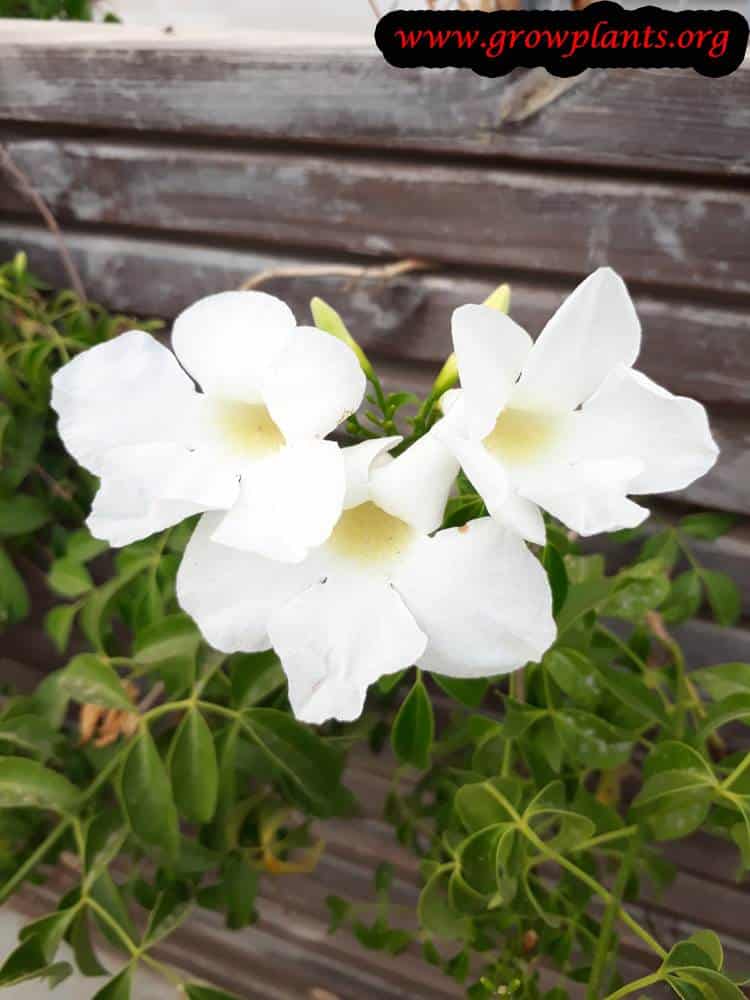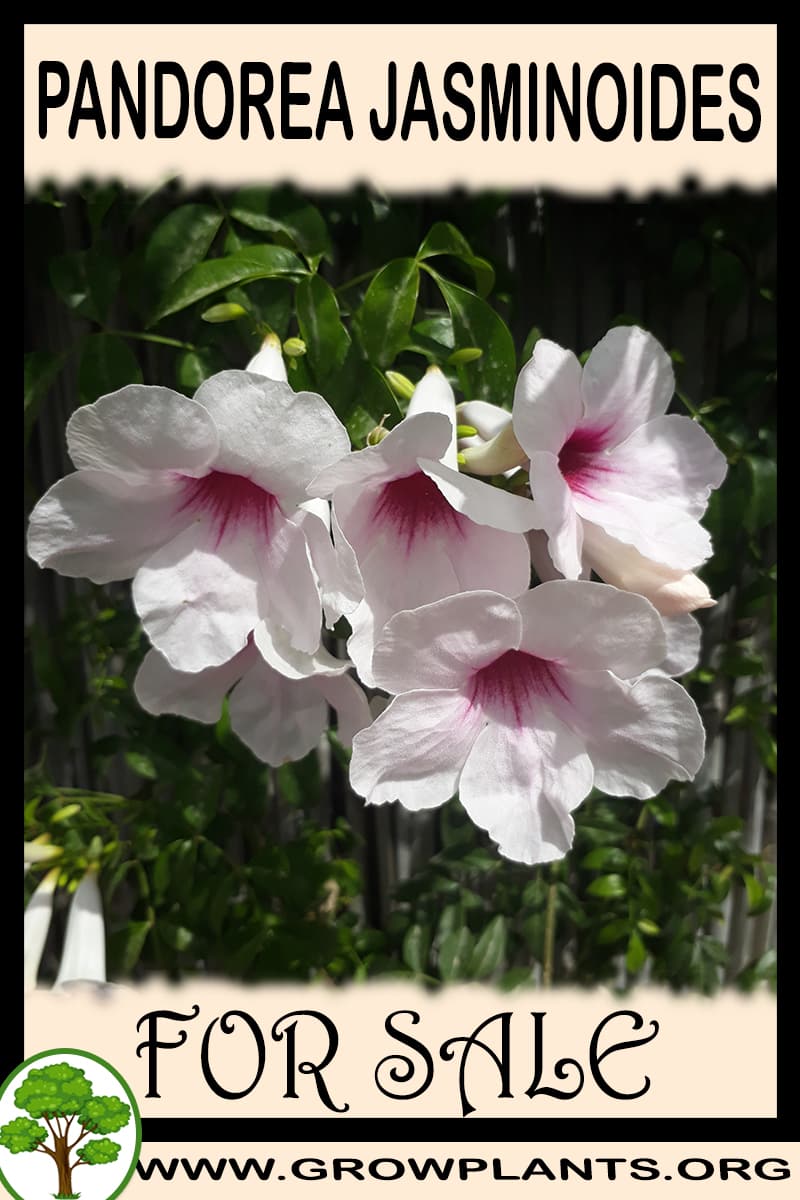

Plant Profile & Key Characteristics
Overview: An evergreen woody climber of the genus Pandorea (bower vine) reaching 2-8 m, grown for its abundant, fragrant trumpet flowers. It is a fast-growing ornamental for covering fences, pergolas and hedges in mild climates.
Quick Specifications
| Specification | Attribute |
|---|---|
| Plant Type / Life Cycle | Perennial (evergreen vine) |
| Foliage Type | Evergreen |
| Mature Size | 2-8 m (6-26 ft) climbing |
| Growth Rate | Fast to moderate |
| Hardiness | USDA zones 9-11 |
Growth Form & Structure
- Height & Spread: Climbs 2-8 m (6-26 ft); can be container-grown with support.
- Growth Habit & Form: Twining evergreen vine with glossy foliage.
- Lifespan & Maturity: Fast-establishing perennial climber.
Anatomy & Physical Features
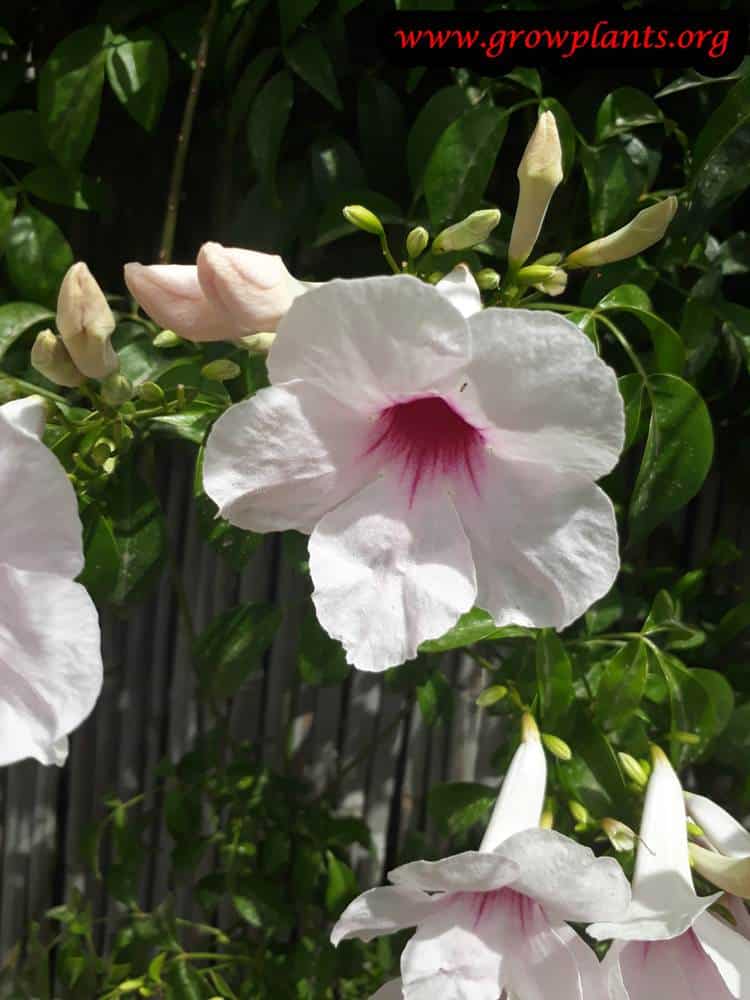
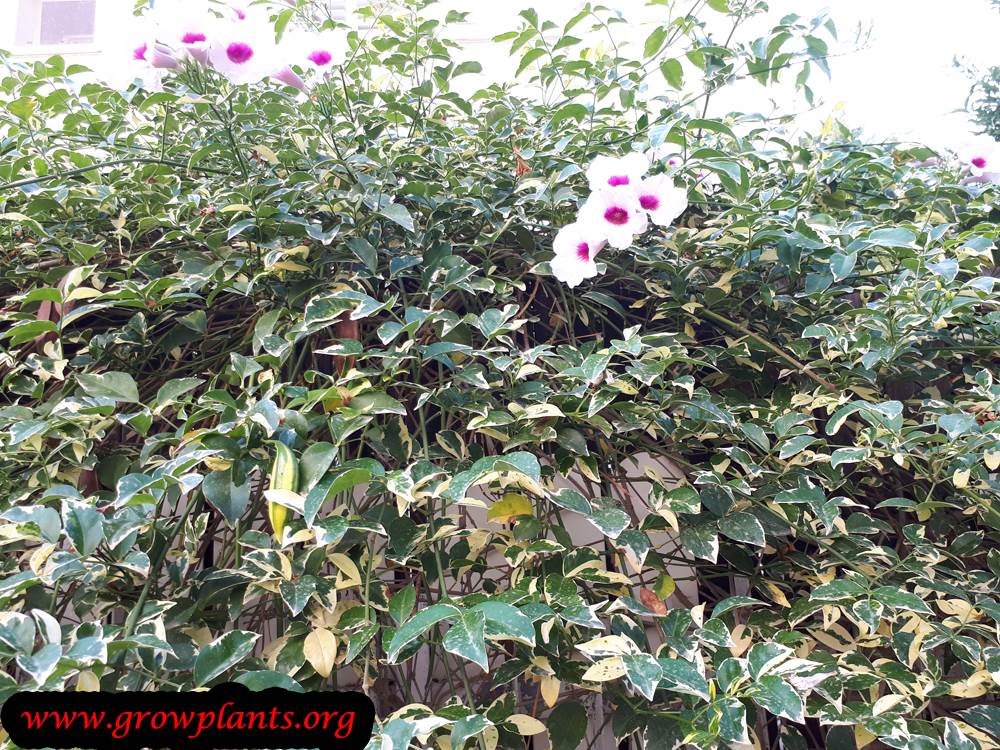
- Leaves & Foliage: Glossy green (or green variegated with white or yellow), elliptic leaflets with a pointed tip.
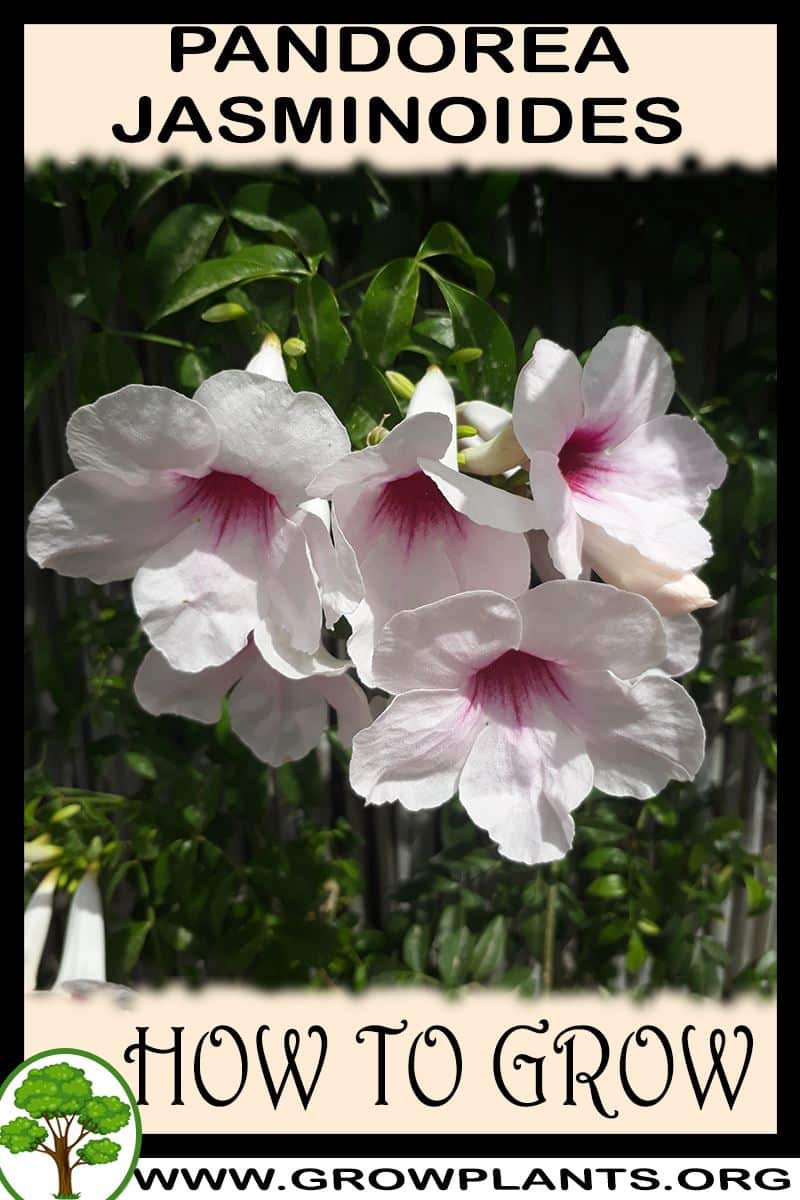
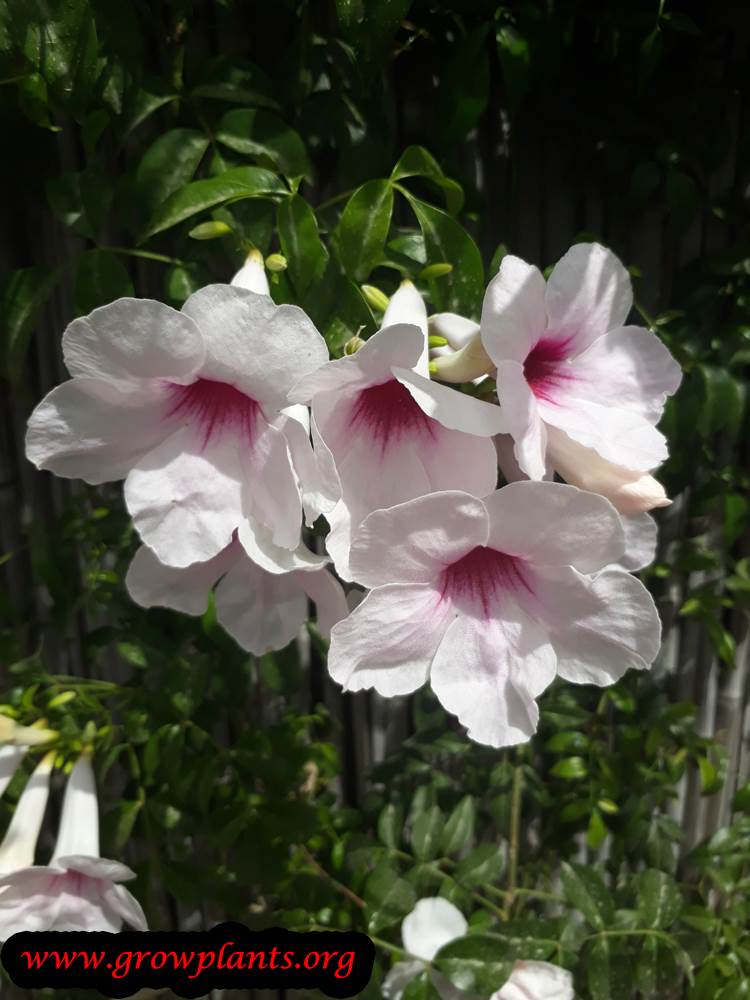
- Flower Characteristics: Fragrant, trumpet-shaped flowers in white, pink or purple with a darker throat.
Primary Uses & Landscape Value
- Functional & Ornamental Roles: Ornamental climber for pergolas, fences and screening hedges.
Care Guide: Planting, Soil & Watering
Overview: The bower vine is a vigorous evergreen climber that flowers best in full sun to part shade in warm conditions, tolerating only light frost. It likes moist, fertile, well-draining soil and moderate, steady watering.
Quick Care Requirements
| Requirement | Ideal Condition |
|---|---|
| Planting Season | In the warm season, spring through autumn |
| Growth Rate | Moderate to fast |
| Soil Type | Moist, fertile, well-draining |
| Water Need | Low to moderate; keep lightly moist |
Planting & Establishment
- Best Planting Season: Plant from spring through autumn in the warm season; hardy to around zone 9, it tolerates only light frost. Provide a trellis or support for the twining stems.
- How to Plant:
- Hole Preparation: Dig a hole a little wider than the root ball near a sturdy support.
- Soil Amendments: Work in compost and organic matter to enrich the soil and help it hold moisture.
- Planting Depth: Set the root ball level with the surrounding soil and firm gently.
- Growth Speed & Expectations: A fast, twining climber reaching 2-8 m; prune after flowering to keep it in bounds.
Soil, Watering & Drainage Care
- Soil Mix & Drainage Needs: Needs fertile, moisture-retentive yet free-draining soil; in pots use quality potting mix with drainage holes and mulch to hold moisture.
- Watering Schedule & Technique:
- Young / Newly Planted: Keep the soil evenly moist while the vine establishes.
- Established: Water regularly so the soil stays lightly moist, letting the top dry slightly between waterings.
- Seasonal Adjustments: More in summer heat and flowering; less in winter.
Climate, Light & Hardiness
Pandorea jasminoides (Bower vine) grows in subtropical or mediterranean climates and prefers full sun to half shade. Cold tolerance is low to moderate, with the site rating it to approximately zone 9–11.
Quick Climate Specifications
| Climate Zones | Subtropical and mediterranean climates |
|---|---|
| USDA Hardiness Zones | Approximately 9–11 |
| Frost Tolerance | Low |
| Light Conditions | Full Sun to Half Shade |
Sunlight & Light Exposure
Optimal Light Setup
Full sun to half shade both work; full sun generally supports the best flowering on this twining vine.
Temperature Extremes & Hardiness
USDA Hardiness & Regional Limits
Reliable outdoor culture is rated to approximately zone 9–11.
Cold Damage & Winter Protection
Protect from frost, especially while young; established vines are somewhat sturdier but still intolerant of hard freezes at the cooler end of their range.
Frost Sensitivity
Site in a warm, sheltered spot - such as against a warm wall - in marginal zone 9 gardens.
Wind, Humidity & Microclimate
Humidity Preferences
Prefers reliably moist, well-drained soil and benefits from moderate humidity typical of subtropical Australian climates.
Microclimate Recommendations
A warm, sheltered, humid microclimate improves both growth and winter survival at the cooler edge of its range.
Growing in Pots, Balconies & Indoors
Bower vine is not a houseplant – the grower marks it unsuitable indoors – and as a vigorous evergreen climber (2-8 m / 6-26 ft) it needs full sun and a strong support outdoors. It grows well in a large container on a sunny balcony or patio, but it is not a windowsill plant.
Quick Details
- Container Size: A large pot of about 30-40 L (8-11 gal) with a trellis
- Indoor Suitability: Not an indoor plant; grow it outdoors against a support
- Best Spot: Full sun to part shade for good flowering
- Soil & Drainage: Free-draining, organic-rich mix
- Watering in Pots: Water moderately; established plants tolerate short dry spells
Indoors & On the Windowsill
- Not a houseplant: Too vigorous and light-hungry for indoors – it needs open air and room to climb.
- Windowsill: Not practical; it soon outgrows any sill and won’t flower without strong light.
- Overwintering: Frost-tender – in cold areas a potted plant can be sheltered under cover for winter.
On a Balcony or Patio
- Light & wind: Give it a sunny wall or railing and a firm support; the mass of foliage catches wind, so anchor it well.
- Practicalities: Prune after flowering to keep a potted plant in bounds; pots dry fast in the sun.
Choosing the Pot, Soil & Long-Term Care
- Pot & drainage: A large 30-40 L pot with strong drainage holes; skip a standing-water saucer to avoid root rot. Terracotta breathes and dries faster; glazed or plastic holds moisture longer.
- Potting mix: A light, aerated, organic-rich mix – potting compost or peat/coir with added perlite or vermiculite for drainage.
- Feeding: Nutrients wash out of pots faster than open ground, so feed potted bower vine more often – a balanced liquid feed through the active growing season.
- Repotting: Refresh the top layer of mix each year and renew it or pot up every couple of years; lightly trim the roots and top growth when you do.
Fertilizing & Feeding
A moderate feeder that blooms best with steady, balanced nutrition in moist, well-drained soil through its main growing and flowering season.
Quick Fertilizing Specs
| Feeding Level | Moderate feeder |
|---|---|
| Main Nutrient Priority | Balanced feeding with adequate nitrogen for foliage and support for a full flush of fragrant flowers |
| Best Feeding Period | Spring through summer while actively growing and blooming |
| Organic Options | Compost or aged manure worked into moist, well-drained soil |
| Reduce/Stop Feeding | Taper off feeding as flowering finishes and growth slows |
| Micronutrients | Usually met by a complete fertilizer; correct only a diagnosed deficiency |
| Soil pH | Tolerates a range, doing best in moist, well-drained soil |
Feeding by Growth Stage
Establishing after planting
Help new roots settle into moist, well-drained soil and start the vine climbing its support.
| Nutrient direction | A balanced fertilizer with adequate nitrogen supports early root and stem development. |
|---|---|
| Timing | The first growing season after planting. |
| Frequency | A light feeding at planting, repeated as new growth establishes. |
| Fertilizer types | A balanced complete fertilizer, Compost worked into the planting area |
| Precautions | Keep soil consistently moist when feeding; fertilizer applied to dry soil can stress establishing roots. |
Active growth ahead of bloom
Build out the glossy, sometimes variegated foliage and climbing framework ahead of flowering.
| Nutrient direction | A balanced, nitrogen-leaning feeding supports steady leafy growth on the twining stems. |
|---|---|
| Timing | Spring as new growth resumes and extends. |
| Frequency | Regular light feedings through this stretch of active growth. |
| Fertilizer types | A balanced complete fertilizer, A nitrogen-forward feed for foliage growth |
| Precautions | Avoid pushing excess nitrogen once buds begin forming, which can favor leaves over flowers. |
Fragrant trumpet-flower bloom
Support a full flush of fragrant white, purple, or pink trumpet-shaped flowers.
| Nutrient direction | A balanced fertilizer with proportionally more potassium supports strong flowering. |
|---|---|
| Timing | Spring into summer as flower buds form and open. |
| Frequency | A light feeding as buds form, easing off once flowering is in full swing. |
| Fertilizer types | A balanced fertilizer formulated for flowering vines, A potassium-inclusive bloom feed |
| Precautions | Avoid heavy nitrogen feeding during bloom, which can reduce flower production in favor of foliage. |
Nutrient Deficiency Signs & Corrections
Older leaves fade to pale green or yellow and new growth is sparse.
| Possible causes | low available soil nitrogen, nitrogen leaching from frequent watering in moisture-retentive soil, thin, low-organic-matter soil |
|---|---|
| Appears first on | older, lower leaves |
| What to check | recent feeding history, soil organic matter, watering and drainage |
| Possible correction | Apply a balanced fertilizer with available nitrogen and build soil organic matter. |
New leaves emerge yellow while the veins remain distinctly green.
| Possible causes | high soil pH limiting iron availability, waterlogged soil restricting root uptake, root stress from recent transplant |
|---|---|
| Appears first on | newest growth at the shoot tips |
| What to check | soil pH, drainage around the root zone, whether nearby plants show the same symptom |
| Possible correction | Correct soil pH toward the plant’s preference and apply a chelated iron product per its label if the pattern persists. |
Flower buds fail to open properly or drop before blooming, and new shoot tips can look distorted.
| Possible causes | low soil boron, drought stress limiting nutrient movement during bud development, very sandy soil prone to leaching |
|---|---|
| Appears first on | flower buds and new shoot tips |
| What to check | watering consistency during bud formation, soil texture and leaching potential, overall bloom performance versus prior seasons |
| Possible correction | Confirm the pattern before acting, since boron has a narrow margin between deficiency and toxicity; apply a labeled boron product only per its instructions if confirmed. |
Pruning, Training & Seasonal Maintenance
Bower vine is a vigorous twining climber that, left unpruned, tends to collapse into a dense, self-shading tangle with progressively fewer visible flowers, since blooms form on new growth toward the outside of the plant. It tolerates hard pruning well, and the main objective is an annual renewal cutback that keeps the canopy open and productive rather than a solid mat of old growth. Autumn–winter, once the spring–summer bloom has finished, is the safest and most effective window – it clears the way for fresh flowering growth the following season.
Quick Pruning & Maintenance Specs
| Pruning Tolerance | High |
| Primary Pruning Window | Autumn – winter (post-flowering) |
| Secondary Maintenance Window | Light tip control during spring–summer growth |
| Typical Frequency | One firm annual renewal cutback |
| Main Objective | Prevent self-shading tangle; renew flowering wood |
| Young Plant Priority | Establish onto a sturdy, permanent support |
| Mature Plant Priority | Annual thinning/cutback to keep the canopy open |
| Best Tool Type | Bypass secateurs / loppers for older base growth |
| Avoid Heavy Pruning During | The spring–summer bloom period |
Pruning by Plant Age & Size
Newly Established
Remove only damaged growth; tie leading stems onto a sturdy, permanent trellis, fence or pergola, since this vine can reach up to around 8m and needs real support in place early.
Young / Formative
No formal leader/vase framework applies to this twining habit – direct stems to fully cover the support while keeping growth spread out rather than bunched, to avoid an early self-shading tangle.
Mature / Established
Give an annual post-flowering cutback, thinning out old, congested growth and shortening overly long stems, so light reaches the interior and next season’s flowers are not confined to a shell of growth at the surface.
Seasonal Pruning Schedule
Autumn / Winter (Post-Flowering)
- Objective: renew flowering wood and prevent canopy self-shading.
- Remove: old, congested growth and overlong stems, cutting back firmly.
- Do not remove: the whole support framework on an established vine at once – renew in stages if the plant is very overgrown.
- Expected response: fresh growth through spring that carries the next bloom.
- Flowering impact: none – this timing follows bloom and precedes the new growth flowers form on.
Structural Pruning & Training
Ongoing thinning of crossing and congested stems is the key structural task; without it, this vigorous twiner readily builds up into a dense mat that shades its own interior and lower growth, reducing the overall flower display even though the plant looks lush.
Special Growth to Remove
- Congested, tangled interior stems that shade out potential flowering growth.
- Overlong stems extending well beyond the support.
- Spent flower clusters, tidied off as they fade.
Container & Small-Space Pruning
Grows well in a large container against a support, but its vigorous size range means container specimens need firmer, more frequent cutback than an in-ground plant to stay in scale – without that, a potted bower vine will still try to reach its full in-ground size and quickly become top-heavy and tangled.
Tools
Bypass secateurs for routine thinning and tip work; loppers for thicker stems at the base of an established plant.
Tool Hygiene & Disease Risk
Routine care – keep tools clean and sharp; no significant transmissible disease is documented for this species.
Cut Placement & Technique
Use thinning cuts to remove whole stems back to their point of origin, opening up the canopy, rather than shearing the surface, which worsens the self-shading tangle over time.
Heavy Pruning & Rejuvenation
Tolerates a hard rejuvenation cutback of an overgrown, tangled plant, cutting back close to the main framework after flowering; regrowth is fast given the species’ documented fast-to-medium growth rate, though a very hard reset may cost part of the following season’s flower display while the plant rebuilds.
Post-Pruning Care
Water normally, keeping soil evenly moist as this species prefers moist, well-drained conditions; no extra feeding is needed for routine renewal cuts. After a hard cutback, retie new leading growth to the support as it develops.
Common Pruning Mistakes
- Leaving the vine unpruned for years, letting it collapse into a dense, self-shading tangle with a declining flower display.
- Shearing the surface instead of thinning, which thickens the outer shell without opening the interior.
- Providing too light a support for a vine that can reach up to around 8m.
When Not to Prune
Avoid firm cutback during the active spring–summer bloom period; wait until flowering has finished.
Pruning Troubleshooting
| Problem | Possible Cause | What to Check | Corrective Action |
| Fewer flowers than in previous seasons despite lush growth | Years without renewal thinning; canopy has become a self-shading tangle | Interior of the plant for dense, congested old growth | Thin firmly after the next bloom to reopen the canopy to light |
| Bare, sparse growth low on the support | All new growth pushed to the outer surface, none renewed from lower down | Base and lower stems for old, unproductive wood | Cut some older stems back harder to force lower branching |
Recommended Tools (by task)
- bypass_secateurs – routine thinning and tip work.
- loppers – thicker base stems on an established vine.
- soft_ties_stakes – securing new leading growth to its support after cutback.
Propagation Guide
Bower vine can be grown from seed, which the species comes fairly true from, but variegated forms like the one noted on this page must be propagated vegetatively by stem cuttings to keep their leaf coloring true. Semi-hardwood cuttings are the standard practical method and root with modest reliability. Overall this is a moderately easy plant to propagate.
Quick Propagation Specs
| Best Propagation Method | Semi-hardwood stem cuttings |
| Alternative Methods | Seed |
| Propagation Difficulty | Moderate |
| Seed True-to-Type | Usually true-to-type for the species, but variegated forms do not come true from seed |
| Vegetative True-to-Type | Yes |
| Best Propagation Season | Cuttings: warm growing season; Seed: spring |
| Seed Germination Time | A few weeks, variable |
| Cutting Rooting Time | Several weeks, can be inconsistent |
| Germination Temperature | Warm, roughly 21–27°C (70–80°F) |
| Seed Sowing Depth | Shallow, lightly covered |
Growing from Seed
Seed Handling & Viability
Seed is carried in flattened pods and is generally not long-lived, so it is best sown reasonably fresh.
Dormancy & Pre-Sowing Treatment
Fresh seed typically needs no special pretreatment.
Sowing Season
Spring once conditions are warm.
Sowing Depth & Orientation
Sow shallow, lightly covered.
Germination Conditions
Warm and consistently moist.
Germination Time
A few weeks, can be variable.
Seedling Care
Variegated leaf coloring, as noted for some plants of this species on this page, is not a stable seed-transmitted trait, so seedlings will not necessarily show it – grow on and select, or propagate variegated individuals by cuttings instead.
Stem Cuttings
Cutting Type
Semi-hardwood tip cuttings.
Best Timing
Warm growing season (spring to summer).
Cutting Preparation
Take a cutting with a couple of nodes and remove the lower leaves.
Rooting Setup
Well-drained, humid mix.
Rooting Hormone
Beneficial – can improve what is otherwise a moderately reliable rooting rate.
Rooting Time
Several weeks.
Bloom & Flower Guide
Quick Details
- Bloom Season: Spring and summer
- Flower Appearance: Fragrant trumpet-shaped flowers in white, pink or purple, usually with a deeper-coloured throat
- Edibility: Ornamental climber — not eaten
Detailed Blooming Overview
The bower vine is prized for its trusses of trumpet flowers, each pale petal set off by a rich rose or maroon throat and often lightly scented. It flowers through the warm months on a well-behaved evergreen frame.
Flower Characteristics
- Trumpet-shaped, five-lobed flowers in white, pink or purple with a darker throat, borne in clusters.
Bloom Care & Thinning
- Encouraging bloom: Full sun to part shade and moist, well-drained soil suit it best; it flowers on new growth.
- Managing the display: Tidy after the main flush and prune lightly in the cool season to shape.
Bloom Health & Protection
- Aphids on buds: Aphids can settle on tender buds; a rinse or insecticidal soap keeps them down.
Pests, Diseases & Troubleshooting
Overview: The bower vine is a vigorous evergreen climber that is fairly trouble-free; its main pests are aphids on soft new growth, plus spider mites, scale, mealybugs, and whiteflies in warm or sheltered conditions. Serious disease is uncommon beyond root rot in wet soil and sooty mould following sap-suckers. Sun, airflow, and free-draining soil keep it healthy and floriferous.
Quick Troubleshooting Overview
| Issue / Pest | Main Symptom | Primary Solution |
|---|---|---|
| Aphids | Sticky, curled new shoots and buds | Rinse off; insecticidal soap; encourage predators |
| Spider mites | Fine stippling and webbing in hot, dry spells | Raise humidity; horticultural oil |
| Scale insects | Brown bumps on stems; sticky honeydew; sooty mould | Scrape off; horticultural oil |
| Mealybugs | White cottony tufts in leaf axils | Alcohol swab; insecticidal soap/oil |
| Root rot | Yellowing, wilting in wet soil | Improve drainage; ease off watering |
| Chlorosis | Yellow leaves, green veins | Chelated iron; correct soil pH |
Common Pests & Management
- Aphids (Aphis / Myzus spp.):
- Symptoms: Clusters of green, black, or yellowish soft insects on the soft new shoots, flower buds, and leaf undersides, leaving stickiness, sooty mould, and curled, distorted young growth.
- Prevention & Control: Blast off with a jet of water and squash survivors; encourage ladybirds, lacewings, and hoverflies. Insecticidal soap or neem/horticultural oil clears heavier colonies – spray the tips and undersides, and control ants that farm them.
- Spider mites (Tetranychus urticae):
- Symptoms: Fine pale stippling that dulls and bronzes the leaves, with delicate webbing on undersides in hot, dry weather; foliage yellows and drops in bad infestations.
- Prevention & Control: Keep the vine well watered and not drought-stressed, and hose down the foliage. Spray horticultural oil or insecticidal soap on undersides, repeating every 5–7 days; predatory mites help under cover.
- Scale insects (Coccus / Saissetia spp.):
- Symptoms: Immobile brown, tan, or blackish bumps along stems and leaf midribs, with sticky honeydew, sooty mould, and yellowing, weakened growth.
- Prevention & Control: Scrape off light infestations and prune out badly encrusted stems. Treat with horticultural oil to smother scale and repeat every 1–2 weeks; encourage parasitic wasps and predators.
- Mealybugs (Planococcus / Pseudococcus spp.):
- Symptoms: White cottony waxy tufts in leaf axils and on stems, with honeydew, sooty mould, and stunted new growth, especially on sheltered or indoor plants.
- Prevention & Control: Dab with a cotton bud of rubbing alcohol and spray insecticidal soap or neem/horticultural oil; persist over several weeks and check for a root form when repotting containers.
- Whiteflies (Trialeurodes vaporariorum):
- Symptoms: Clouds of tiny white flies rising when the plant is disturbed, with yellow-mottled, sticky leaves and sooty mould, mainly under glass or in still, warm sites.
- Prevention & Control: Hang yellow sticky traps and spray insecticidal soap or horticultural oil on leaf undersides in the evening; encourage Encarsia parasitoids and improve air movement.
Diseases & Fungal Issues
- Root and collar rot (Phytophthora / Pythium / Rhizoctonia):
- Symptoms: Yellowing, wilting, and dieback with soft, dark roots and stem base in heavy, waterlogged, or poorly drained soil; the vine declines despite wet ground.
- Treatment & Management: Plant in free-draining soil, improve drainage or use a raised position, and avoid overwatering established plants. Remove and destroy badly affected plants; do not replant into the same wet, infected spot.
- Leaf spot (Cercospora / Alternaria spp.):
- Symptoms: Brown or black spots, sometimes with yellow halos, on leaves kept wet in humid, crowded conditions; spots may merge and cause some leaf drop.
- Treatment & Management: Remove affected leaves, thin crowded growth for airflow, and water at the base to keep foliage dry. A copper-based fungicide helps in persistent cases, though better ventilation usually resolves it.
- Sooty mould (secondary):
- Symptoms: A black film coating leaves and stems wherever aphids, scale, whiteflies, or mealybugs have dripped honeydew; it shades the foliage rather than infecting it.
- Treatment & Management: Control the underlying sap-suckers, then wipe or hose off the black film. Once honeydew stops, the mould weathers away and does not return.
Growing Difficulties & Abiotic Problems
- Poor flowering
- Cause & Symptoms: Lush leafy growth but few flowers in too much shade, with excess nitrogen, or on an over-pruned plant.
- Correction Strategy: Give a warm, sunny position, avoid heavy nitrogen feeding, and prune after flowering rather than removing flowering wood at the wrong time. More sun reliably means more bloom.
- Iron chlorosis
- Cause & Symptoms: Yellowing leaves with green veins, especially on new growth, in alkaline or waterlogged soil that locks out iron.
- Correction Strategy: Correct drainage, mulch with organic matter, and apply chelated iron; where soil is very alkaline, acidify gently or grow in a container with suitable mix. Confirm it is not simply overwatering.
- Frost & cold damage
- Cause & Symptoms: Blackened, wilted new growth and dieback after frost, as this warm-climate vine is only tender to half-hardy.
- Correction Strategy: Site in a sheltered, sunny, frost-protected spot, mulch the roots in cold areas, and grow in containers to move under cover where winters are cold. Prune out frost-damaged growth in spring.
- Vigour / support needs
- Cause & Symptoms: A strong, twining climber that can smother supports and neighbouring plants and become tangled and woody at the base if neglected.
- Correction Strategy: Give a sturdy trellis or frame, guide and tie in new growth, and prune after flowering to keep it within bounds and encourage fresh flowering wood. Renovate leggy plants by cutting back hard.
What Helps – Products & Tools
The core kit is insecticidal soap and neem / horticultural oil for aphids, mites, scale, mealybugs, and whiteflies, plus yellow sticky traps and rubbing alcohol for spot-treating. Against disease, a free-draining site prevents rot, a copper fungicide handles leaf spot, and chelated iron corrects chlorosis. A sturdy trellis and secateurs manage its vigour.