Plant Profile & Key Characteristics
Overview: A vigorous herbaceous perennial reaching 1–3 m (3–10 ft) that dies back to a large fleshy taproot each winter and regrows each spring. It is grown as a drought-tolerant ornamental for its purple stems and dark berry clusters, though it is best treated as a poisonous plant.
Quick Specifications
| Specification | Attribute |
|---|---|
| Plant Type / Life Cycle | Herbaceous perennial (dies back to a taproot each winter) |
| Foliage Type | Deciduous |
| Mature Size | 1–3 m (3–10 ft) tall |
| Growth Rate | Fast to moderate |
| Root System | Large fleshy taproot |
| Toxicity | Toxic — root, mature berries and raw foliage contain phytolaccatoxin and are poisonous to people and pets; keep children away from the berries |
| Hardiness | USDA zones 6–10 |
Growth Form & Structure
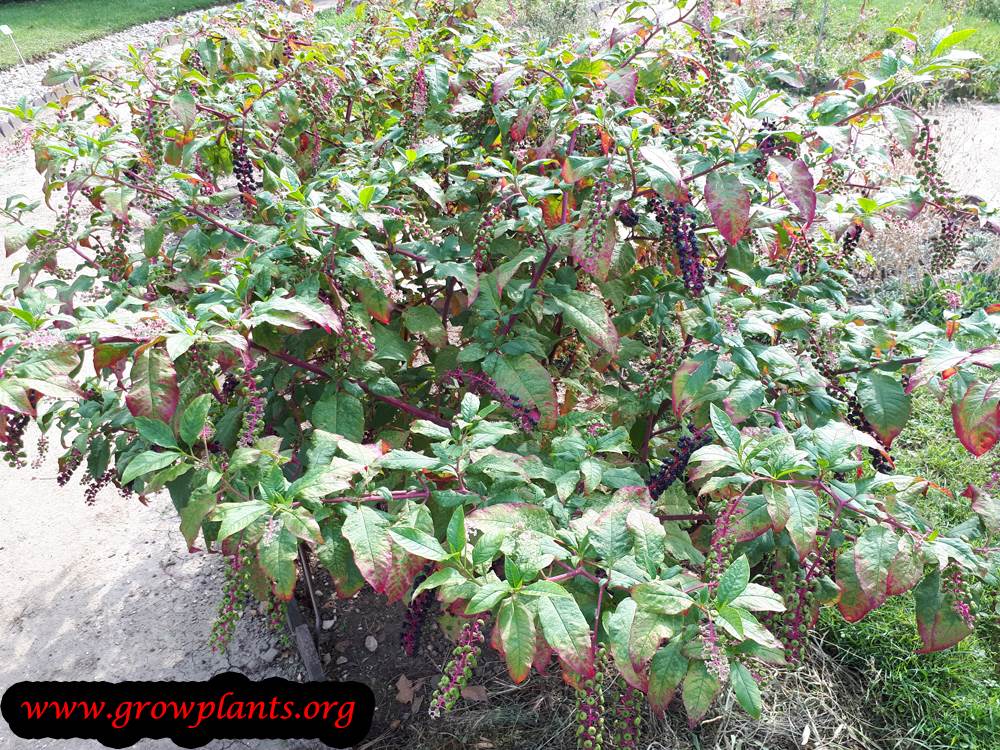
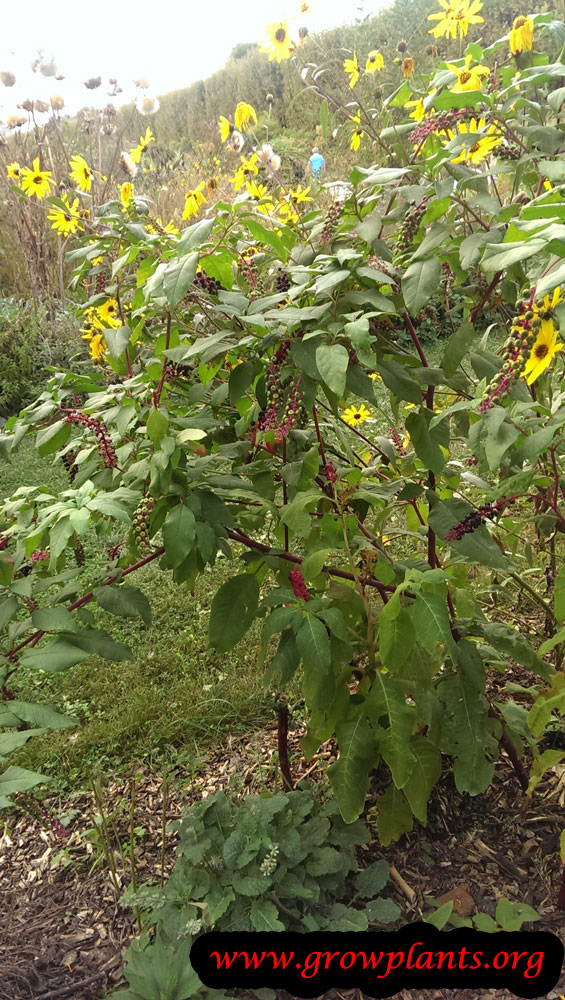
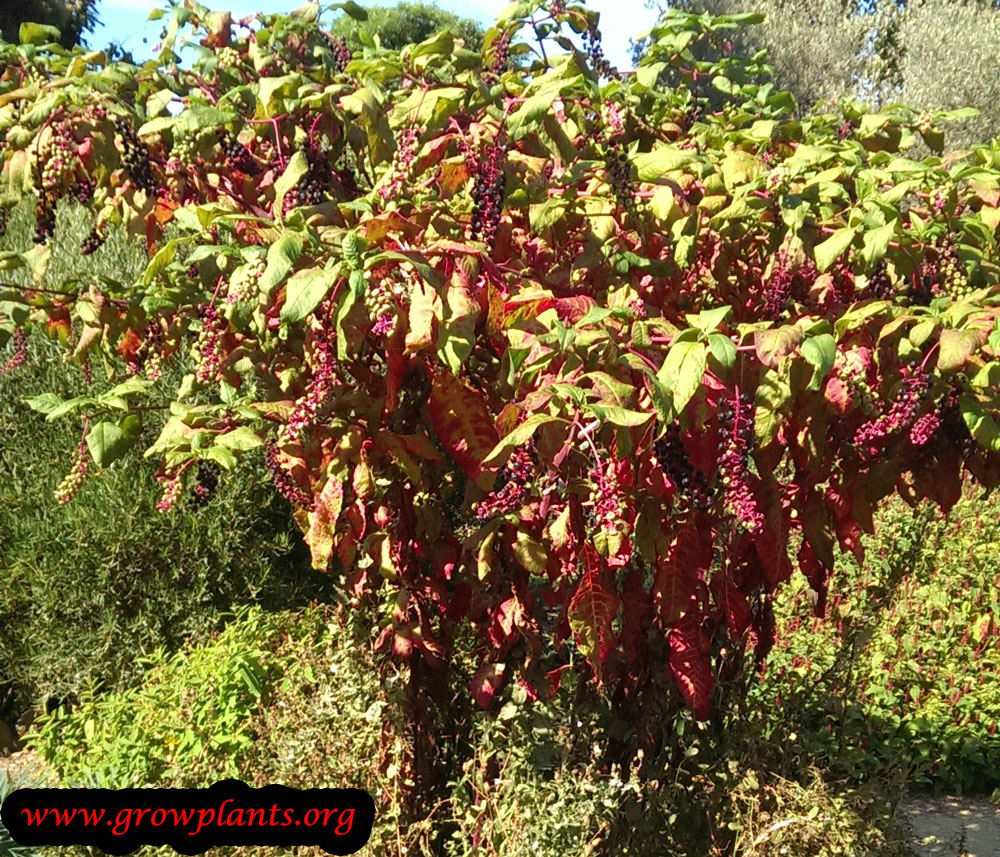
- Height & Spread: In the ground it forms a bushy, multi-stemmed mound 1–3 m (3–10 ft) tall in a single season; it can also be kept in a large container, where its size stays more restrained and the taproot is contained.
- Growth Habit & Form: Upright, branching herbaceous plant; smooth, hollow reddish-purple stems rise from the crown of the taproot and can be cut back in winter to control its spread.
- Lifespan & Maturity: The taproot is long-lived and returns for many years, thickening with age; top growth reaches full size within one growing season.
Anatomy & Physical Features
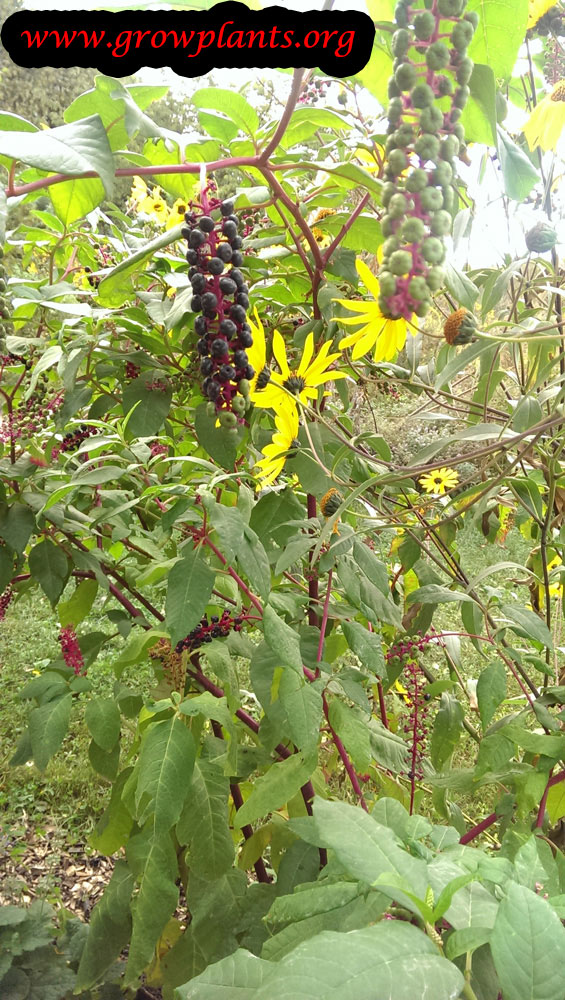
- Leaves & Foliage: Green, elliptic leaves carried on the branching purple-tinged stems.
- Flower Characteristics: Small white flowers (0.3–0.5 cm) borne in slender clusters.
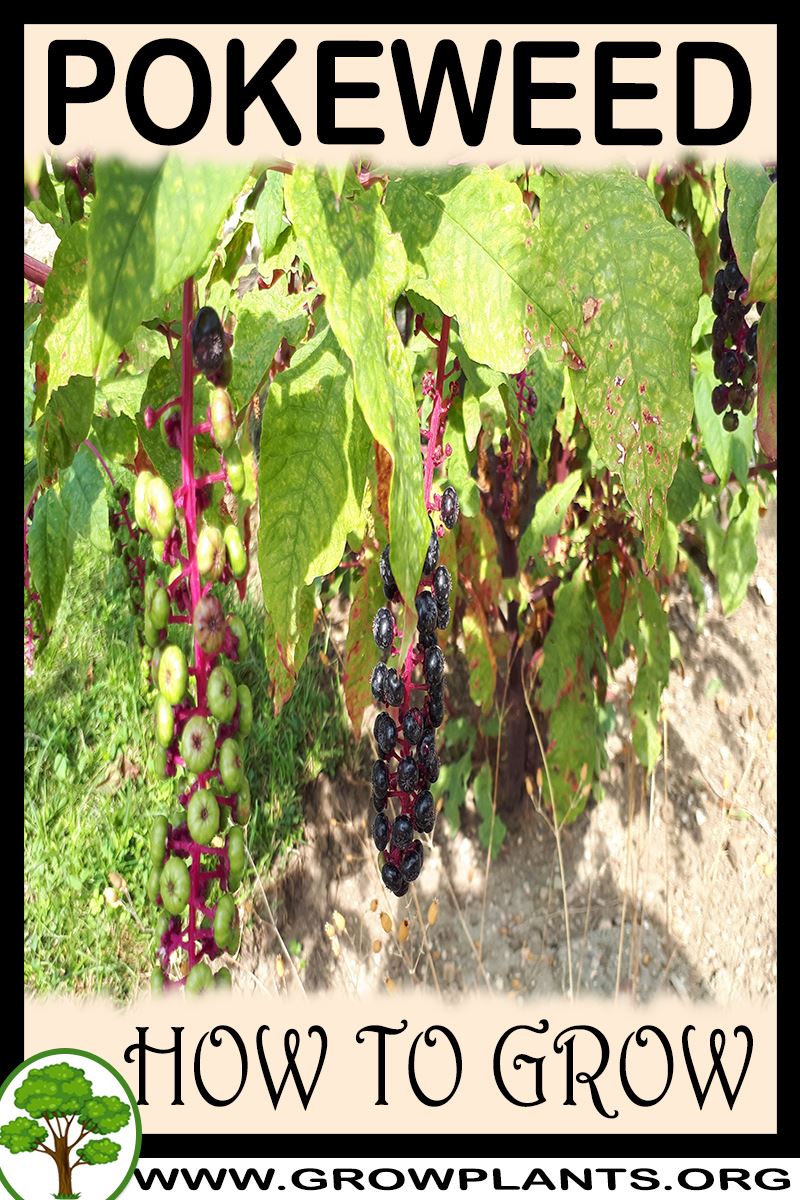
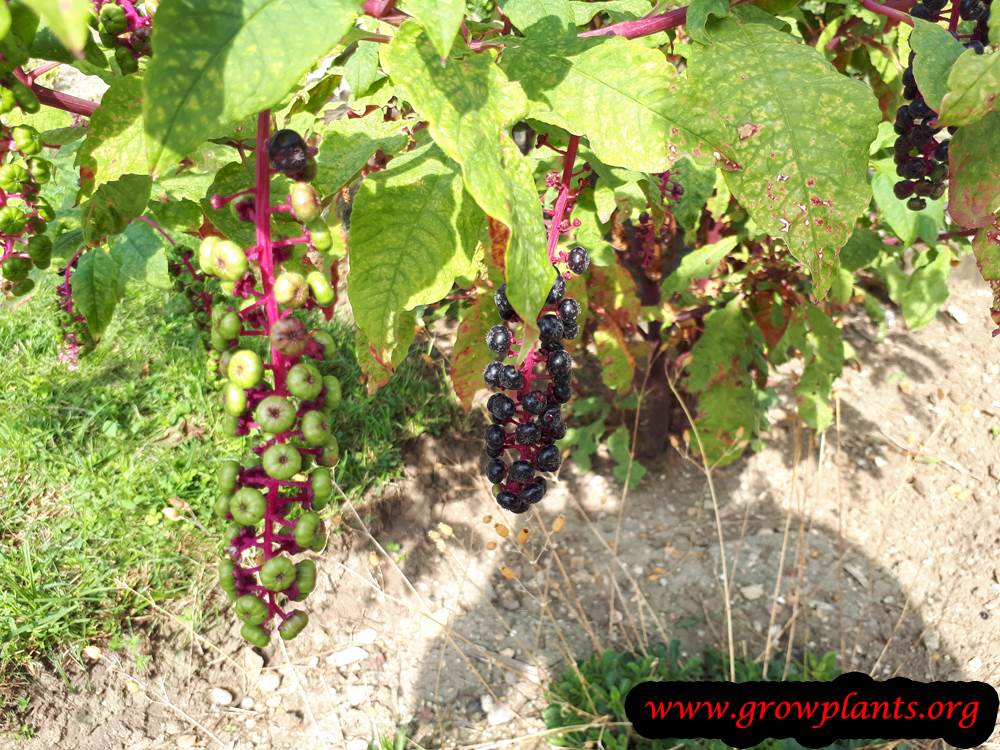
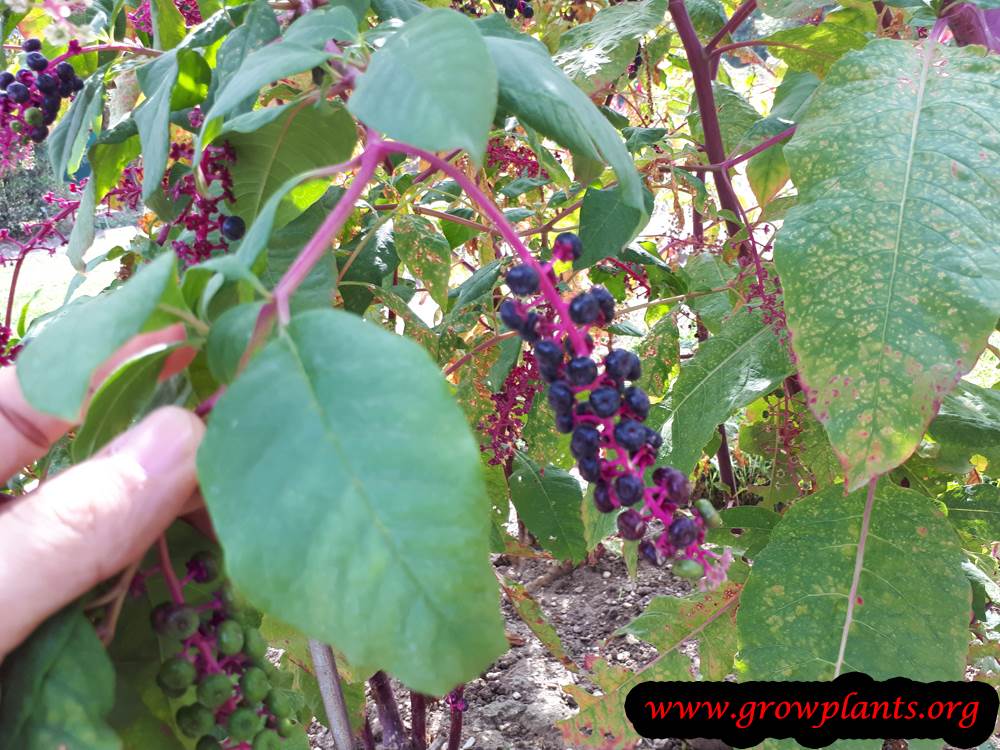
- Fruit Profile: Purple-black berries 0.3–0.6 cm hanging as bunches on a purple stalk — decorative but poisonous.
Primary Uses & Landscape Value
- Functional & Ornamental Roles: Drought-tolerant ornamental for wild, border and naturalistic plantings, valued for its bold foliage, red stems and bird-attracting (but toxic to humans) berries; can be grown indoors or in a large pot. Note its invasive tendency and self-seeding.
Care Guide: Planting, Soil & Watering
Overview: Pokeweed is a fast-growing, highly adaptable perennial that grows in full sun to full shade in almost any frost-free, well-drained soil. It needs only modest water once established but self-seeds freely and can become invasive.
Quick Care Requirements
| Requirement | Ideal Condition |
|---|---|
| Planting Season | Spring, summer or autumn in frost-free conditions |
| Growth Rate | Fast to moderate |
| Soil Type | Adaptable, well-drained; tolerates poor soil |
| Water Need | Low to moderate — let the soil dry between waterings |
Planting & Establishment
- Best Planting Season: Plant in spring, summer or autumn where the ground stays frost-free.
- How to Plant:
- Hole Preparation: Dig a hole as deep as and a little wider than the root ball; to limit spread, deadhead before the berries seed around.
- Soil Amendments: Little is needed — it grows in poor as well as rich soil, so just ensure reasonable drainage.
- Planting Depth: Set the root ball level with the surface, keeping the crown at soil level; it regrows each year from a large taproot.
- Growth Speed & Expectations: Expect fast-to-moderate growth to a bold plant 1–3 m tall in a single season.
Soil, Watering & Drainage Care
- Soil Mix & Drainage Needs: Almost any well-drained soil suits it. In a container use an ordinary free-draining potting mix.
- Watering Schedule & Technique:
- Young / Newly Planted: Water occasionally to establish young plants; they root quickly.
- Established: Water sparingly — it is drought-tolerant once the deep taproot forms and prefers the soil to dry between waterings.
- Seasonal Adjustments: Give a little more water in summer heat and none in cool, wet weather.
Climate, Light & Hardiness
Pokeweed is a versatile herbaceous perennial (evergreen or deciduous depending on climate) that adapts to Mediterranean, desert, subtropical, temperate, and tropical conditions, growing in full sun through full shade. It is moderately cold hardy and grows best where winters stay frost-free or only lightly frosted.
Quick Climate Specifications
| Climate Zones | Mediterranean, Desert, Subtropics, Temperate, Tropics |
|---|---|
| USDA Hardiness Zones | 6–10 |
| Frost Tolerance | Moderate |
| Light Conditions | Full Sun / Half Shade / Full Shade |
Sunlight & Light Exposure
Optimal Light Setup
Highly adaptable, growing well from full sun to full shade.
Temperature Extremes & Hardiness
USDA Hardiness & Regional Limits
Hardy across zones 6–10, with the root generally surviving winter cold within that range even as top growth may die back.
Cold Damage & Winter Protection
The plant's own care overview describes it as doing best where conditions are frost free; in colder parts of its zone 6–10 range, expect the foliage to die back to the root over winter and regrow in spring.
Frost Sensitivity
Top growth is frost sensitive and typically dies back with freezing temperatures, while the perennial rootstock can survive within its hardiness range.
Wind, Humidity & Microclimate
Microclimate Recommendations
Because it tolerates such a wide range of climates and light levels, it is not particular about microclimate beyond avoiding prolonged hard freezes in its coldest zones.
Growing in Pots, Balconies & Indoors
Pokeweed (Phytolacca americana) is a fast, bold-foliage perennial (1-3 m) with dramatic dark-purple berries. The grower marks it as suitable both indoors and in containers, and it does tolerate shade, but note that every part of the plant is highly poisonous – so this is a plant to grow only where children and pets cannot reach it.
Quick Details
- Container Size: A large, deep, sturdy pot – it grows big and fast
- Indoor Suitability: Grower lists it as a houseplant, but it is highly toxic (see safety)
- Best Spot: Full sun to full shade – very adaptable
- Soil & Drainage: Rich, deep, well-draining mix
- Watering in Pots: Small to average amount – it is fairly drought-tolerant once established
Indoors & On the Windowsill
- Grower’s note: He lists it as a houseplant, and its wide light tolerance (sun to full shade) does suit indoor conditions.
- Reality check: It grows large and vigorous, so give it a big pot, good light and room, and cut it back to keep it in bounds.
- Safety first: All parts – especially the berries and roots – are highly poisonous. Keep it well away from children and pets and never treat any part as edible.
On a Balcony or Patio
- Light, wind & heat: Give it the brightest spot it will tolerate; walls and railings reflect heat and dry pots quickly, so check moisture often and shelter or stake exposed growth.
- Room to grow: On a patio it needs a large, stable pot; the berries stain and are toxic, so site it thoughtfully.
Choosing the Pot, Soil & Long-Term Care
- Pot & drainage: A large, deep, sturdy pot with strong drainage holes. Use strong drainage holes and skip a standing-water saucer to avoid root rot. Terracotta breathes and dries faster; glazed or plastic holds moisture longer.
- Potting mix: A well-aerated, organic-rich mix – potting soil or peat/coir with perlite or vermiculite for free drainage.
- Feeding: Potted plants use up their soil faster as nutrients leach out with watering – feed lightly and regularly through the growing season.
- Repotting: Refresh the mix and pot up about every two years; for perennials, lightly root- and top-prune the plant when you do.
- Safety: Every part of pokeweed is toxic if eaten; wear gloves when handling and keep it away from children and pets.
Fertilizing & Feeding
A light feeder overall: this vigorous, drought-tolerant plant establishes well with organic matter and generally needs little supplemental fertilizer, with feeding eased off as it dies back for cool weather.
Quick Fertilizing Specs
| Feeding Level | Light feeder |
|---|---|
| Main Nutrient Priority | Balanced feeding, kept light, while the plant is establishing and in active growth |
| Best Feeding Period | Spring through the warm active growing season |
| Organic Options | Compost or organic matter worked into the soil at planting |
| Reduce/Stop Feeding | Ease off feeding as the plant dies back for cooler weather |
| Micronutrients | Rarely an issue for this vigorous, low-input plant |
| Soil pH | Tolerates a wide range of soil conditions |
Feeding by Growth Stage
Establishment
Help a young Pokeweed plant settle in before its naturally fast growth takes over.
| Nutrient direction | A light balanced fertilizer or worked-in organic matter is enough to get roots established. |
|---|---|
| Timing | The first weeks after planting, indoors or in the garden. |
| Frequency | A single light feeding at planting, or none at all if the soil is already reasonably fertile. |
| Fertilizer types | A light balanced fertilizer or compost worked into the planting site, Container-grown plants benefit from a well-draining potting mix |
| Precautions | Avoid heavy feeding at establishment; this plant is already noted as a fast, aggressive grower and doesn’t need encouragement to spread. |
Active growth through the warm season
Support steady growth and flowering through summer without pushing this already-vigorous, invasive-leaning plant further.
| Nutrient direction | Feeding needs are minimal once established; an occasional light balanced feeding is plenty for both garden and container plants. |
|---|---|
| Timing | Through spring and summer while the plant is actively growing. |
| Frequency | An occasional light feeding at most through the growing season. |
| Fertilizer types | A light balanced fertilizer, used sparingly, Organic matter as a light seasonal top-dressing |
| Precautions | Overfeeding this fast-growing, drought-tolerant plant mainly encourages unwanted spread rather than better health; keep feeding minimal. |
Cool-season dieback
Let the plant die back for cooler weather without pushing tender new growth into cold conditions.
| Nutrient direction | None – dying-back or dormant growth does not need feeding. |
|---|---|
| Timing | Autumn into winter, following the plant’s winter pruning season. |
| Frequency | No feeding through dieback and cool-season rest; resume once new growth returns in spring. |
| Fertilizer types | No feeding at this stage – the plant is dying back or resting for the season. |
| Precautions | Do not fertilize during dieback or winter rest; wait for active new growth before feeding again. |
Nutrient Deficiency Signs & Corrections
Pale green leaves and noticeably slower growth for a plant known to be fast-growing.
| Possible causes | very poor or depleted soil, nitrogen leaching from heavy watering, root competition in a crowded planting |
|---|---|
| Appears first on | older, lower leaves |
| What to check | soil fertility, recent watering and drainage, how crowded the surrounding planting is |
| Possible correction | Apply a light balanced fertilizer once and monitor, since this plant rarely needs repeated feeding. |
New leaves emerge yellow while their veins remain green.
| Possible causes | high soil pH limiting iron availability, waterlogged or compacted soil, container soil that has gone stale |
|---|---|
| Appears first on | newest leaves |
| What to check | soil drainage and pH, container soil age if grown in a pot, recent transplant stress |
| Possible correction | Improve drainage and refresh old container soil, then apply a chelated iron product per its label if needed. |
Wilting or yellowing despite this being a drought-tolerant plant, sometimes with soft, discolored stem bases.
| Possible causes | waterlogged or poorly drained soil, root rot from excess irrigation or a container without drainage, planting site that collects standing water |
|---|---|
| Appears first on | lower stems and older leaves |
| What to check | drainage of the bed or container, recent watering frequency, whether water pools around the roots |
| Possible correction | Improve drainage, reduce watering frequency, and hold off on further fertilizer until active recovery growth appears. |
Pruning, Training & Seasonal Maintenance
Pokeweed is a fast-growing, weedy herbaceous perennial with no persistent woody framework – pruning here is entirely about controlling its size and its noted invasive, bird-dispersed self-seeding, not shaping. All parts of the plant are toxic, most concentrated in the root, so hand and tool safety matters as much as timing. In most of its zone 6–10 range the top growth naturally collapses over winter, so a winter cutback of the dead stems to the crown is the main annual task, with optional in-season control of height and berry clusters if unwanted spread is a concern.
Quick Pruning & Maintenance Specs
| Pruning Tolerance | High |
| Primary Pruning Window | Winter (cut back collapsed/dead top growth to the crown) |
| Secondary Maintenance Window | Summer stem topping and berry-cluster removal to control height and spread |
| Typical Frequency | One winter cutback per year, plus as-needed spread control |
| Main Objective | Control size and limit self-seeding from bird-dispersed berries |
| Young Plant Priority | Watch for and remove unwanted volunteer seedlings near the parent plant |
| Mature Plant Priority | Annual winter cutback; remove berry clusters before they ripen if spread is unwanted |
| Best Tool Type | Loppers for the thick basal stems; secateurs for smaller growth – wear gloves, sap is toxic |
| Avoid Heavy Pruning During | No strong seasonal restriction given its vigor; consider leaving some berry clusters if the display is grown intentionally for birds |
Pruning by Plant Age & Size
Newly Established
No pruning needed beyond removing any damaged growth; watch the surrounding area for volunteer seedlings, since this species self-seeds readily.
Young / Formative
No formal training system – this is a soft-stemmed, multi-stemmed herbaceous clump, not a plant with a trained framework.
Mature / Established
Cut the whole plant back to its crown each winter once top growth has collapsed; through the growing season, top overly tall or sprawling stems and remove berry clusters before they ripen if you want to limit self-seeding.
Seasonal Pruning Schedule
Dormant/Winter
Objective: remove collapsed top growth and reset the plant’s size before spring. Remove: dead or collapsed stems, cut back close to the crown. Do not remove: the crown/rootstock itself – new growth emerges from it each spring. Expected response: vigorous fresh stems the following spring, given the plant’s fast growth rate.
Summer Canopy Management
Objective: keep height and spread in check and, if desired, limit self-seeding. Remove: overly tall or floppy stem tops; purple-black berry clusters before they fully ripen and are taken by birds. Do not remove: all berry clusters if the plant is intentionally kept as a wildlife/ornamental feature – birds use the berries, so this step is a spread-control choice, not a required maintenance task.
Structural Pruning & Training
There is no framework to train – the only structural objective is overall size and spread control. The annual hard winter cutback is effectively the entire “structural” technique for this species.
Special Growth to Remove
Remove berry clusters before they ripen if unwanted self-seeding is a concern, since birds readily disperse the purple-black berries; remove volunteer seedlings around the base for the same reason. Handle all cut material with gloves and dispose of it away from compost destined for garden beds, since the toxic sap (concentrated most in the root) can irritate skin and the seeds can remain viable.
Container & Small-Space Pruning
In a container, root restriction naturally helps limit this otherwise 1–3 m plant’s size, but the same winter cutback still applies to keep it tidy. Keep containers out of reach of children and pets given the plant’s toxicity, and ensure good drainage as with any large, fast-growing perennial in a pot.
Tools
Bypass secateurs for smaller stems and berry-cluster removal; loppers for the thick, pithy basal stems this species produces by late summer. Wear gloves for all cutting and handling, since the sap is toxic.
Tool Hygiene & Disease Risk
Routine for tools – the only recorded pest is aphids, not a pruning-transmitted issue. The real precaution is personal, not tool-related: wear gloves, since the plant’s sap (and especially its root) is toxic to handle bare-handed.
Cut Placement & Technique
For the winter cutback, cut stems close to the crown rather than leaving tall stubs. When topping stems in summer, cut just above a leaf node. When removing berry clusters, cut the whole stem below the cluster to avoid dropping ripe berries into the bed.
Heavy Pruning & Rejuvenation
Well tolerated – cutting the entire plant back to the crown each winter is standard practice, not a special rejuvenation measure, and the plant regrows vigorously from its rootstock the following spring given its fast growth rate.
Post-Pruning Care
Dispose of cut stems and any berry-bearing material away from garden compost if self-seeding is unwanted. No extra feeding is needed after the winter cutback – this species already grows vigorously and additional inputs are unnecessary for a plant often considered a weed.
Common Pruning Mistakes
Letting berry clusters fully ripen and drop or get bird-dispersed when spread is unwanted; allowing the plant to build an extensive perennial rootstock over several seasons before starting any control, making later removal much harder; handling stems, and especially roots, without gloves given the plant’s toxicity.
When NOT to Prune
There is no strong seasonal restriction on cutting this vigorous species back; the main consideration is a deliberate one – hold off removing berry clusters if the plant is being grown intentionally as a food source for birds.
Recommended Tools (by task)
- bypass_secateurs – berry-cluster removal and cutting smaller stems.
- loppers – the thick, pithy basal stems this species produces by late summer.
- garden_spade – dividing or removing unwanted crowns/rootstock when controlling this species’ spread.
Propagation Guide
Pokeweed spreads readily from seed – consistent with the site’s note that it can be invasive – and can also be propagated by dividing its large, fleshy taproot/crown; grafting is not needed. Overall difficulty is Easy, though note that all parts of the plant, including the seed and root, are toxic and should be handled with care.
Quick Propagation Specs
| Best Propagation Method | Seed |
| Alternative Methods | Division of the taproot/crown |
| Propagation Difficulty | Easy |
| Seed True-to-Type | Usually true-to-type (species) |
| Vegetative True-to-Type | Yes |
| Best Propagation Season | Seed sown in autumn after fruiting, or stratified and sown in spring; divide the crown while dormant in early spring |
Growing from Seed
Dormancy & Pre-Sowing Treatment
Seed typically has a dormancy that benefits from a period of cold, moist stratification before it will germinate readily – this mirrors the seed’s natural over-wintering in soil, where it is well known to remain viable for a long time.
Sowing Season
Sow fresh, ripe berries/seed in autumn, or cold-stratify over winter and sow in spring.
Seedling Care
Handle seed with gloves, since the whole plant, including the seed, is toxic if ingested.
Division, Offsets, Pups & Suckers
Pokeweed forms a large, fleshy taproot/crown rather than spreading rhizomes, and resprouts vigorously from root fragments – part of why the site flags it as invasive. Divide the dormant crown in early spring before new growth begins, ensuring each division carries at least one growth bud and a healthy piece of root; replant promptly and keep moist while it re-establishes. Wear gloves when handling the root, as it is toxic.
Bloom & Flower Guide
Quick Details
- Bloom Season: Spring to summer, and into autumn in mild areas
- Time to First Bloom: Typically in its first summer on vigorous plants
- Flower Appearance: Small white to greenish-white flowers about 0.3-0.5 cm across, carried in slender clusters (racemes) on pink-red stems
- Edibility: Poisonous – all parts, including the flowers and the dark berries that follow, contain toxic compounds; do not eat the flowers
Detailed Blooming Overview
Pokeweed is a bold, fast-growing perennial that sends up slender flower spikes through summer. Handsome as it is, the whole plant is toxic, so it is one to enjoy in the garden rather than the kitchen.
Flower Characteristics
- Small white to greenish-white flowers, roughly 0.3-0.5 cm across.
- Borne in upright-then-arching clusters on distinctive pink-red stems.
Bloom Care & Thinning
- Safety: Every part of the plant is toxic to people and pets – keep the flowers and developing berries away from children.
- Managing self-seeding: If you do not want it seeding around, cut the flower spikes before berries form, and wear gloves when handling it.
Fruit & Uses
Safety caveat first: pokeweed is toxic in most of its parts. Only the very youngest spring shoots and leaves have any traditional food use, prepared as “poke sallet,” and only after a specific multi-boil process to remove the plant’s natural toxins – they are never eaten raw. The roots, mature stems and leaves, and the ripe purple-black berries (including their seeds) are toxic and are not eaten.
Quick Edible Specs
| Edible Parts | Young shoots & leaves only (earliest spring growth) |
|---|---|
| Main Use(s) | Traditional cooked green (“poke sallet”) – regional/heritage culinary use |
| Eaten Raw or Cooked | Cooked only – never raw |
| Preparation Required | Multiple-boil method (boil and discard the water at least two to three times) before any further cooking |
| Harvest Season | Spring (earliest new growth only, before stems redden/toughen) |
| Time to First Harvest | Not age-based – determined by growth stage, not plant maturity |
| Storage | Use fresh; harvest only the youngest growth each time |
| Safety/Toxicity Caveat | Whole plant is toxic; roots, mature stems/leaves, seeds and berries must not be eaten; many extension services now advise against eating pokeweed at all due to poisoning risk from improper preparation |
Leaves & Greens
Only the very youngest spring growth – new shoots and leaves picked while still tender and before the stems begin to redden – has any traditional food use, prepared as “poke sallet,” a cooked green from the southeastern United States. Preparation requires boiling the greens and discarding the cooking water at least two to three times before final cooking; this leaching step removes the plant’s natural toxins, and the greens are never eaten raw or after only a single boil. As the plant matures and the stems turn red or purple, the leaves and stems become more toxic and are not eaten.
Preparation, Uses & Safety
Poke sallet is a heritage/regional dish, not a routine vegetable, and should be treated with caution rather than as a casual home-garden green: poisoning symptoms (nausea, vomiting, diarrhea, and in serious cases more severe effects) have been documented from improperly prepared pokeweed, which is why many current extension and poison-control resources recommend avoiding it as food altogether rather than relying on the traditional multi-boil method. The ripe purple-black berries are not a food part of this plant – they, along with the roots and mature stems/leaves, contain toxic compounds, and the seeds inside the berries are especially concentrated in them. Keep pokeweed away from children and pets, who are most at risk from accidental berry or root ingestion.
Pests, Diseases & Troubleshooting
Overview: Pokeweed is a fast, deep-taprooted native perennial that is largely untroubled by pests and diseases — healthy plants shrug off most problems, so management is mostly about siting, containment, and safety rather than spraying. All parts (especially the mature root and berries) are toxic to people and livestock, and its abundant berries spread it aggressively, so the real ‘troubleshooting’ is cultural. Favor tolerance and hand control over chemicals.
Quick Troubleshooting Overview
| Issue / Pest | Main Symptom | Primary Solution |
|---|---|---|
| Aphids | Curled new growth, sticky honeydew, sooty mold | Blast off with water; encourage ladybugs; insecticidal soap only if heavy |
| Flea / leaf beetles | Small shot-hole chewing on leaves | Tolerate on this vigorous plant; row cover on seedlings if desired |
| Caterpillars | Ragged chewed leaf margins | Hand-pick; Bt (Bacillus thuringiensis) if defoliation is severe |
| Pokeweed mosaic virus | Mottled, mosaic-patterned leaves | No cure — control aphid vectors, remove severely affected plants |
| Cercospora leaf spot | Round brown spots in wet, crowded conditions | Improve airflow, remove spotted leaves; rarely needs treatment |
Common Pests & Management
- Aphids (Aphis, Myzus spp.):
- Symptoms: Clusters of soft green or black insects on tender shoots and flower stalks, with sticky honeydew and blackish sooty mold; new leaves may curl.
- Prevention & Control: Tolerate low numbers on this vigorous plant. Knock colonies off with a firm water jet, protect and attract ladybugs and lacewings, and reserve insecticidal soap or a light horticultural-oil spray (applied in the cool of evening) for heavy infestations.
- Flea beetles (Chrysomelidae):
- Symptoms: Tiny beetles that jump when disturbed and pepper leaves with small round ‘shot holes’; worst on young plants.
- Prevention & Control: Established pokeweed easily outgrows this damage. Protect only seedlings with floating row cover, keep the area weeded, and let ground beetles and other predators build up rather than spraying.
- Caterpillars / loopers (Lepidoptera larvae):
- Symptoms: Irregular chewed holes and ragged margins, with green or dark frass on leaves below.
- Prevention & Control: Hand-pick and drop into soapy water. For persistent damage use Bacillus thuringiensis (Bt), which targets caterpillars while sparing bees and beneficial insects.
- Spider mites (Tetranychus urticae):
- Symptoms: Fine pale stippling and faint webbing on hot, dusty, drought-stressed plants; leaves bronze.
- Prevention & Control: Raise humidity and reduce dust and drought stress; rinse foliage undersides. Use insecticidal soap or horticultural oil for outbreaks and preserve predatory mites.
Diseases & Fungal Issues
- Pokeweed mosaic virus (Pokeweed mosaic virus):
- Symptoms: Yellow-green mosaic mottling, distortion and stunting of new growth; symptoms persist and cannot be cured.
- Treatment & Management: There is no chemical cure. Manage aphid vectors, rogue out badly affected plants, and disinfect tools; the species is otherwise a known virus reservoir, so keep it away from susceptible vegetables.
- Cercospora / fungal leaf spot (Cercospora spp.):
- Symptoms: Small round tan-to-brown spots that enlarge in warm, wet, crowded conditions.
- Treatment & Management: Improve air movement, avoid overhead watering late in the day, and remove and destroy spotted leaves. Fungicides are rarely justified on such a vigorous plant.
- Crown / root rot (Phytophthora, Pythium spp.):
- Symptoms: Wilting and collapse where the deep root sits in waterlogged soil.
- Treatment & Management: Plant in free-draining ground and avoid chronically wet sites; there is no rescue once the taproot rots, so prevention through drainage is the only reliable control.
Growing Difficulties & Abiotic Problems
- Extreme toxicity:
- Cause & Symptoms: All parts are poisonous, the mature root and ripe berries most dangerously so; a genuine hazard to children, pets and livestock.
- Correction Strategy: Site away from play areas and pasture, wear gloves when handling, and remove berry clusters before birds spread seed if toxicity is a concern.
- Weediness / self-seeding:
- Cause & Symptoms: Birds eat the berries and scatter viable seed widely, producing many volunteer seedlings and a persistent taproot.
- Correction Strategy: Cut off flower/berry heads before ripening, pull young seedlings while the taproot is small, and dig mature crowns entirely as fragments regrow.
- Sunburn / leaf scorch:
- Cause & Symptoms: Sudden intense sun or drought browns and crisps large leaves.
- Correction Strategy: Provide even moisture in the hottest, driest periods; the plant recovers readily as it is deep-rooted and vigorous.
What Helps — Products & Tools
For the occasional sap-sucker, insecticidal soap, horticultural or neem oil, and simply attracting ladybugs and lacewings are enough; use Bacillus thuringiensis (Bt) for caterpillars and a copper-based product only if leaf spot ever becomes serious. Most ‘products’ here are gloves and a sharp spade for safe removal and containment.