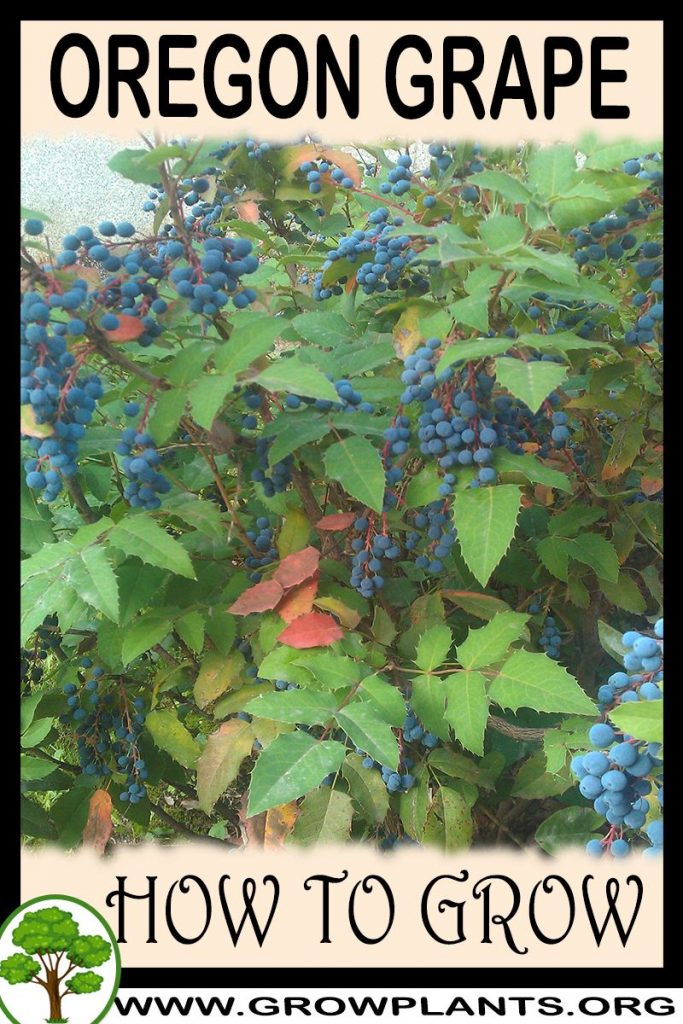
Plant Profile & Key Characteristics
Overview: Evergreen shrub reaching 0.5-2 m with spiny, holly-like foliage, grown as an ornamental and hedge plant. Bears clusters of yellow flowers followed by blue-purple grape-like berries.
Quick Specifications
| Specification | Attribute |
|---|---|
| Plant Type / Life Cycle | Perennial (evergreen shrub) |
| Foliage Type | Evergreen (source ‘deciduous’ corrected – the species is evergreen) |
| Mature Size | 0.5-2 m (2-6.5 ft) |
| Growth Rate | Moderate |
| Root System | Rhizomatous, suckering |
| Toxicity | Berries tart and edible in small amounts; plant contains berberine alkaloids and is best not eaten raw in quantity |
| Hardiness | USDA zones 5-9 |
Growth Form & Structure
- Height & Spread: 0.5-2 m, spreading by suckers to form colonies; grows in containers.
- Growth Habit & Form: Upright, suckering evergreen shrub.
- Lifespan & Maturity: Long-lived, colony-forming shrub.
Anatomy & Physical Features
- Leaves & Foliage: Glossy, green, ovate, holly-like leaflets with spiny margins.
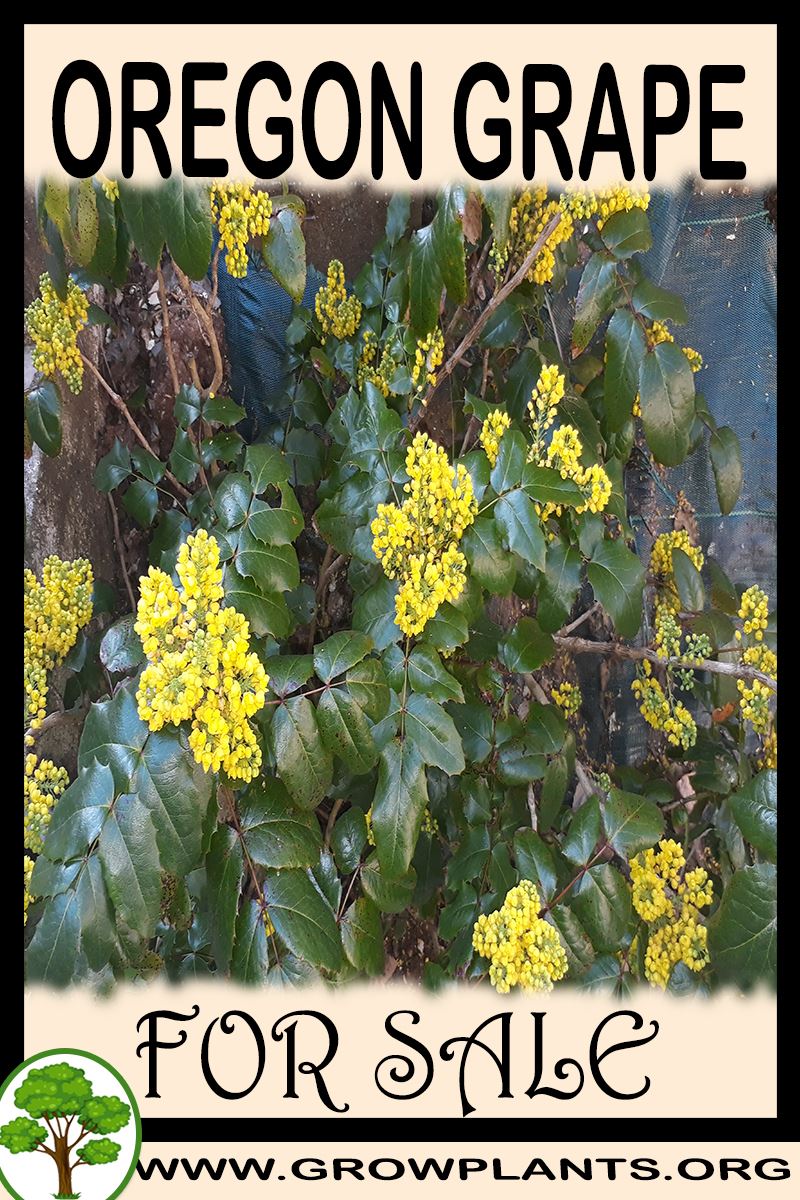
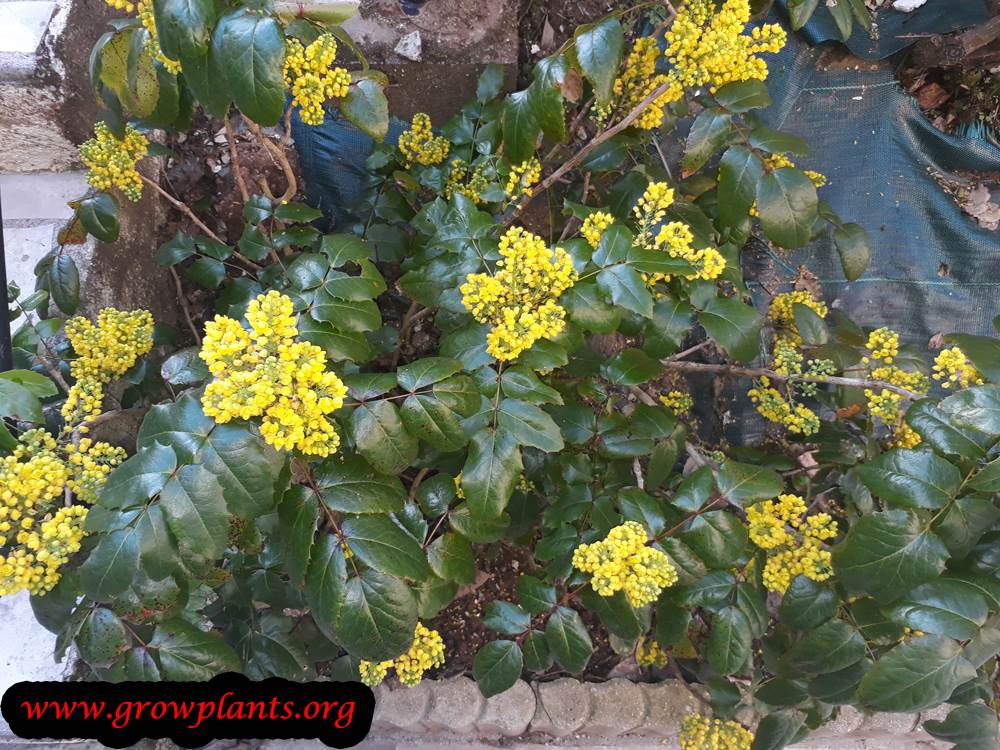
- Flower Characteristics: Fragrant yellow flowers in dense clusters.
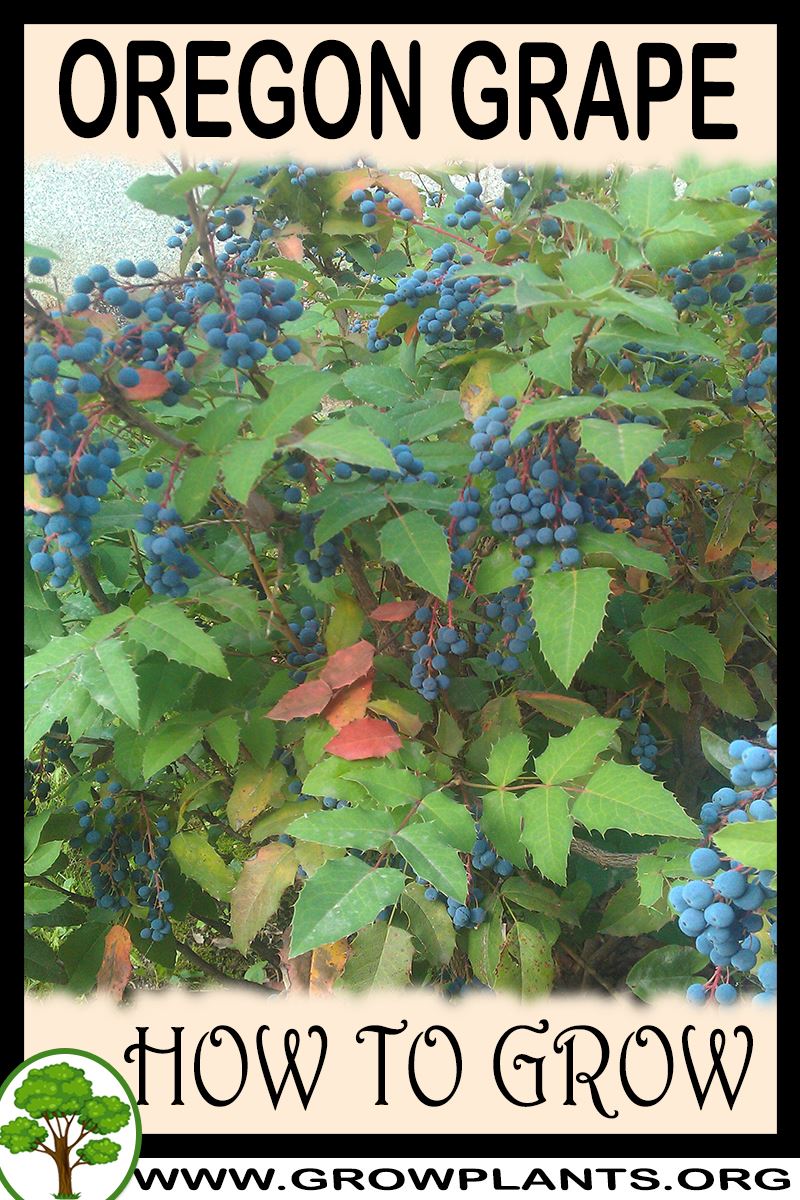
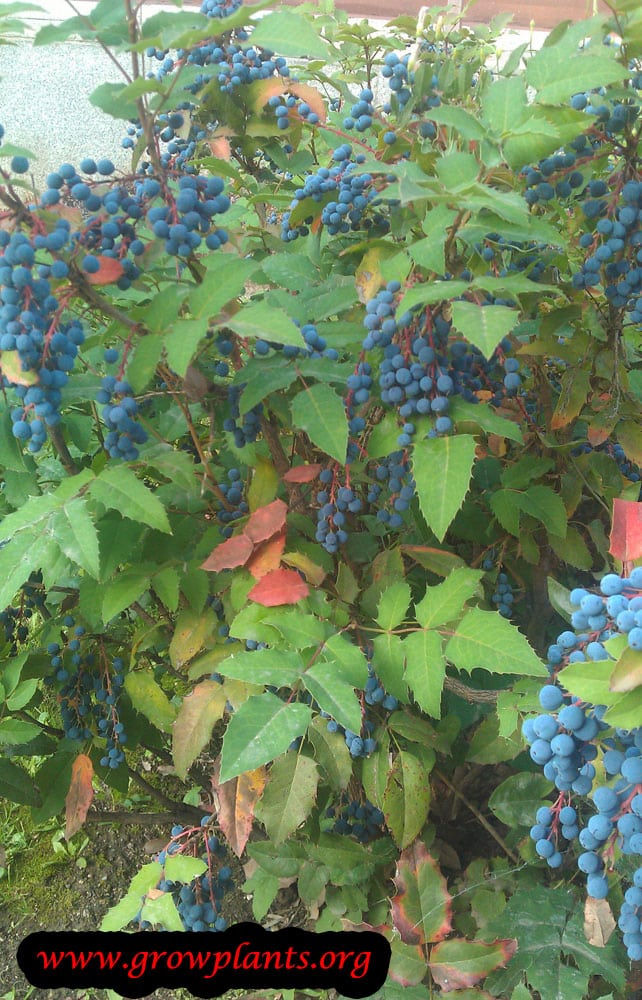
- Fruit Profile: Blue-purple, grape-like berries in clusters, tart.
Primary Uses & Landscape Value
- Edible Uses: Berries used cooked or in preserves – tart, and eaten in moderation.
- Functional & Ornamental Roles: Ornamental evergreen hedge and shade shrub; also used medicinally.
Care Guide: Planting, Soil & Watering
Overview: Oregon grape (Mahonia aquifolium) is a moderate-growing evergreen shrub (zones 5–9) that tolerates full sun to shade. It prefers a rich, moist, well-drained and acidic soil and likes moderate to generous watering.
Quick Care Requirements
| Requirement | Ideal Condition |
|---|---|
| Planting Season | Winter through summer |
| Growth Rate | Moderate |
| Soil Type | Rich, moist, well-drained, acidic |
| Soil pH | Acidic (approx. 5.0–6.0) |
| Water Need | Moderate to high |
Planting & Establishment
- Best Planting Season: From winter through summer.
- How to Plant:
- Hole Preparation: Dig a hole about the depth of the root ball and twice as wide, ideally in a spot sheltered from harsh sun and drying wind.
- Soil Amendments: Mix acidic organic matter such as leaf mould or compost into the backfill to enrich the soil and hold moisture.
- Planting Depth: Set the root collar level with the soil surface; do not bury the stem, and mulch afterwards.
- Growth Speed & Expectations: A moderate grower that spreads slowly into a suckering evergreen shrub, useful for hedging and shady borders.
Soil, Watering & Drainage Care
- Soil Mix & Drainage Needs: A humus-rich, moisture-retentive but free-draining acidic soil is ideal; mulch to keep roots cool. It also grows well in a container with a free-draining, acidic mix and drainage holes.
- Watering Schedule & Technique:
- Young / Newly Planted: Keep the soil consistently moist while the plant establishes, watering whenever the surface begins to dry.
- Established: Water deeply and keep the soil evenly moist; it tolerates some dryness once established but resents prolonged drought.
- Seasonal Adjustments: Reduce watering in winter and increase noticeably through summer heat and fruit set.
Climate, Light & Hardiness
Oregon grape is a temperate and subtropical shrub grown for its spiny hedge foliage and grape-like fruit clusters. It grows in full sun to half shade and is hardy through cold temperate winters.
Quick Climate Specifications
| Climate Zones | Temperate, subtropical |
|---|---|
| USDA Hardiness Zones | 5–9 |
| Frost Tolerance | High |
| Light Conditions | Full Sun to Half Shade |
Sunlight & Light Exposure
Optimal Light Setup
Full sun to half shade; half shade can help protect foliage from harsh summer sun in hotter parts of its range.
Temperature Extremes & Hardiness
USDA Hardiness & Regional Limits
Hardy in USDA zones 5–9, well suited to cold-winter temperate climates as well as milder subtropical areas.
Growing in Pots, Balconies & Indoors
Oregon grape is a hardy evergreen with glossy, holly-like leaves, yellow spring flowers and blue-black berries. The grower rates it for containers but not indoors – it is a tough shrub that actually appreciates a cooler, shadier outdoor spot.
Quick Details
- Container Size: A roomy tub, 20-40 L (5-10 gal), scaled to the shrub
- Indoor Suitability: Not a houseplant (grower); a hardy evergreen for a shaded outdoor pot
- Best Spot: Full sun to partial shade; a bright spot with some direct sun is ideal.
- Soil & Drainage: Aerated, organic-rich mix (quality potting mix, or peat/coir with perlite or vermiculite); it must drain freely.
- Watering in Pots: Keep the mix consistently moist – this one likes water – but make sure it drains freely; never let a potted plant go bone-dry.
Indoors & On the Windowsill
- Not a houseplant: The grower marks it unsuitable indoors; it is a hardy outdoor shrub that needs seasonal cold, and its spiny leaves make it awkward in a room.
- No winter shelter needed: Fully hardy and evergreen – keep it outdoors year-round.
On a Balcony or Patio
- Light & exposure: It tolerates sun but is one of the better shrubs for a shaded or part-shaded balcony; shelter from harsh, drying wind, which can scorch the evergreen leaves.
- Handle with care: The leaves are spiny – site the pot where people won’t brush against it, and wear gloves when pruning.
Choosing the Pot, Soil & Long-Term Care
- Pot & drainage: A roomy tub with strong drainage holes; skip a standing-water saucer. Keep the mix reliably moist but never waterlogged.
- Potting mix: Use a well-aerated, organic-rich mix – quality potting mix, or peat/coir blended with perlite or vermiculite.
- Feeding: As nutrients wash out of pots faster than open ground, feed potted plants regularly through the growing season with a balanced fertiliser.
- Repotting: Refresh the mix and pot up or root-prune every couple of years; remove old, leggy stems to keep it dense.
Fertilizing & Feeding
Oregon grape is grown as an ornamental and medicinal hedge shrub rather than for its grape-like but toxic, not-recommended-for-eating berries, and it does well on acidic soil with only light, moderate feeding.
Quick Fertilizing Specs
| Feeding Level | Light to moderate; a hardy hedge shrub that does not need rich feeding. |
|---|---|
| Main Nutrient Priority | Balanced nutrition with attention to iron and manganese availability, since this shrub prefers acidic soil. |
| Best Feeding Period | Through the spring growth and bloom period. |
| Soil pH | Prefers acidic soil. |
| Reduce/Stop Feeding | Ease off feeding as growth slows heading into autumn and winter. |
Feeding by Growth Stage
Establishment
Help a newly planted Oregon grape root into acidic soil and put out its first spiny-edged, holly-like leaves.
| Nutrient direction | Light, balanced nutrition to support root development. |
|---|---|
| Timing | In the weeks after planting. |
| Frequency | A light feeding at planting is usually enough to help this shrub establish. |
| Fertilizer types | A balanced complete fertilizer suited to acid-loving plants, used lightly, Compost or other organic matter worked into acidic soil |
| Precautions | Keep this shrub’s spiny leaves and toxic berries in mind when handling and siting the plant; this is a safety note rather than a feeding concern. |
Spring growth and bloom
Support new foliage growth and the clusters of yellow spring flowers, which later give way to ornamental (not for eating) purple-blue berries.
| Nutrient direction | Light, balanced nutrition – this hardy shrub grows well without a rich feeding program. |
|---|---|
| Timing | Through the spring growth and flowering period. |
| Frequency | Light feeding through the growing season is usually sufficient for this low-input shrub. |
| Fertilizer types | A balanced complete fertilizer suited to acid-loving plants, used lightly |
| Precautions | On alkaline soil, watch for pale new growth even when feeding is adequate – this points to a pH problem rather than a lack of fertilizer. |
Autumn and winter dormancy
Let growth harden off and the shrub go dormant ahead of winter.
| Nutrient direction | None – withhold fertilizer through dormancy. |
|---|---|
| Timing | From autumn through winter. |
| Frequency | No feeding at this stage. |
| Fertilizer types | No feeding – resume feeding once spring growth resumes |
| Precautions | Do not fertilize during dormancy; late feeding can push tender growth that is more vulnerable to cold. |
Nutrient Deficiency Signs & Corrections
New leaves turn pale yellow between green veins, especially in soil that is not sufficiently acidic.
| Possible causes | Alkaline or neutral soil limiting iron or manganese availability for this acid-preferring shrub, Poorly drained or compacted soil restricting root function, A genuine iron or manganese shortage in the soil |
|---|---|
| Appears first on | New, upper leaves. |
| What to check | Soil pH and whether it matches this shrub’s preference for acidic soil, Drainage and root health, Whether older leaves remain a normal green |
| Possible correction | Work toward acidic, well-drained soil first; if chlorosis persists, apply a chelated iron or manganese product per its label. |
Leaves develop spots, blotches or scattered dieback rather than staying uniformly glossy green.
| Possible causes | Fungal leaf spot disease, which this species can be prone to in humid or crowded conditions, Spider mite feeding, a known pest issue for this shrub, General stress from poor drainage or unsuitable soil pH |
|---|---|
| Appears first on | Scattered leaves across the shrub. |
| What to check | Signs of spider mites, such as fine webbing or stippled leaves, Air circulation and how crowded the planting is, Soil pH and drainage |
| Possible correction | Improve air circulation and manage any pest or fungal issue directly; correct soil pH and drainage rather than relying on extra fertilizer. |
The shrub grows well but produces few of its yellow spring flower clusters.
| Possible causes | Excess nitrogen favoring leafy growth over flower buds, Pruning at the wrong time removing developing flower wood, Insufficient light reaching the shrub |
|---|---|
| Appears first on | Overall flowering across the shrub. |
| What to check | Recent nitrogen-heavy feeding, When and how the shrub was last pruned, Sun exposure at the site |
| Possible correction | Ease back on nitrogen, prune promptly after flowering rather than beforehand, and confirm the site gets adequate sun. |
Pruning, Training & Seasonal Maintenance
Oregon grape (Mahonia aquifolium) is an evergreen shrub with holly-like, spiny foliage, grown for its late-winter/spring flower clusters, tart blue-black berries, and year-round structure. It spreads by root suckers to form colonies and tolerates hard renewal pruning well. The main timing decision is the trade-off around its old-wood bloom: pruning right after flowering preserves that year’s flowers and berries while still renewing the plant for next year, whereas pruning in late winter, before bloom, favors a more compact plant at the cost of that season’s flower and fruit display.
Quick Pruning & Maintenance Specs
| Pruning Tolerance | High |
| Primary Pruning Window | Immediately after flowering (once bloom fades in spring), to preserve that year’s flowers/berries |
| Secondary Maintenance Window | Late winter, before bloom, only if a compact form matters more than that year’s flowers/fruit |
| Typical Frequency | As-needed renewal, not annual |
| Main Objective | Control legginess/height, manage colonizing spread, remove damaged spiny growth |
| Young Plant Priority | Minimal — let it establish and begin naturalizing |
| Mature Plant Priority | Renewal cutback of the oldest/leggiest canes; sucker/spread management |
| Best Tool Type | Bypass secateurs/loppers (thorn-aware gloves) |
| Avoid Heavy Pruning During | Right as flower buds are swelling, if that season’s bloom and berries matter to you |
Pruning by Plant Age & Size
Newly Established
Minimal pruning; let the plant establish and begin naturally suckering.
Young / Formative
No formal training system is needed — it is an informal thicket/mounding shrub.
Mature / Established
Renewal removal of the oldest, leggiest canes at the base; thin or limit root suckers to keep the colony within bounds if it is being kept as a defined specimen rather than allowed to naturalize.
Seasonal Pruning Schedule
Post-Flowering (primary window)
Objective: renew the plant while preserving the current season’s flowers and berries. Remove: the oldest, leggiest canes at the base; unwanted root suckers. Do not remove: flower/fruit clusters still developing. Expected response: vigorous new basal growth that will flower the following season. Flowering impact: none this year; sets up next year’s bloom.
Dormant/Winter (alternative window)
Objective: favor a more compact plant over this year’s bloom. Remove: leggy canes, dead or spine-damaged leaves. Flowering impact: removes flower buds already set on old wood, reducing or eliminating that season’s flowers and berries.
Ongoing Sanitary
Remove dead or spine-damaged leaves at any time.
Flowering & Fruiting Wood
Flowers form in terminal clusters on the previous year’s wood, opening in late winter to spring and followed by tart, grape-like berries. Pruning in late winter, just before bloom, removes flower buds already set — trading this year’s flowers and fruit for a more compact plant — while waiting until right after bloom preserves the current display and still leaves a full season to grow the wood that will flower next year.
Structural Pruning & Training
Renewal removal of the oldest, most leggy canes at ground level. Since it naturally colonizes by root suckers, decide whether to let it spread (naturalized planting, hedge fill) or contain it (defined specimen) and prune suckers accordingly.
Special Growth to Remove
- Root suckers — retain some if naturalizing or filling a hedge row, remove unwanted ones if a contained specimen is preferred.
- Dead or spine-damaged leaves.
- Spent flower clusters, if tidiness is desired (optional, not required for plant health).
Container & Small-Space Pruning
Tolerates container growing; the pot naturally contains its normally colonizing habit, so pruning is mostly about size and shape rather than spread control. A containerized specimen may look sparser than an in-ground one simply because the roots can’t spread to fill in as many new shoots.
Tools
- Bypass secateurs — routine thinning and deadheading; use thorn-aware gloves given the spiny, holly-like leaves.
- Loppers — older basal canes at renewal time.
Tool Hygiene & Disease Risk
Routine — aphids and spider mites are the noted pests, not major transmissible pathogens requiring blade disinfection between cuts.
Cut Placement & Technique
Remove chosen old canes at the base (a thinning cut) rather than heading them mid-cane, to keep the informal thicket form and encourage strong new basal growth.
Heavy Pruning & Rejuvenation
Tolerated well — an overgrown or leggy planting can be cut back hard, even close to the ground, to rejuvenate it. It resprouts vigorously from the base and its rhizomes, though flowering and fruit will be reduced or absent for a season while it rebuilds.
Post-Pruning Care
Water during the regrowth flush; handle prunings and work near the plant with gloves given the spiny foliage. Monitor tender new growth for aphids and spider mites.
Common Pruning Mistakes
- Cutting hard right as flower buds are swelling and unintentionally losing the whole season’s bloom and berries.
- Treating the naturally colonizing sucker habit as a problem to eliminate entirely, rather than a feature to manage.
- Working the spiny foliage without gloves.
When NOT to Prune
Avoid a hard renewal cut in the days right before bloom if that season’s flowers and berries matter to you — shift the cut a few weeks later, to right after flowering, instead.
Recommended Tools (by task)
- bypass_secateurs — routine thinning and deadheading.
- loppers — older basal canes at renewal time.
Pruning Troubleshooting
| Problem | Possible Cause | What to Check | Corrective Action |
| No flowers/berries this year | Renewal-pruned in late winter right before bloom | Timing of the cut versus the bloom window | Next time, prune right after flowering instead |
| Leggy, bare-based planting | No renewal cutback of old canes for years | Proportion of old, woody, unproductive canes | Base-level thinning cutback after flowering |
| Colony spreading beyond the bed | Root suckers left unmanaged | Perimeter for new shoots | Remove unwanted suckers at their point of origin |
Propagation Guide
Oregon grape is most reliably increased by semi-hardwood stem cuttings or by digging rooted rhizome suckers, both of which reproduce the plant true to type; seed also works well but needs cold stratification and is slower. Overall propagation is Easy.
Quick Propagation Specs
| Best Propagation Method | Semi-hardwood stem cuttings |
| Alternative Methods | Division of rhizome suckers; seed |
| Propagation Difficulty | Easy |
| Seed True-to-Type | Usually true-to-type (species) |
| Vegetative True-to-Type | Yes |
| Best Propagation Season | Cuttings: mid to late summer. Division: dormant season (winter, per the plant’s winter/spring/summer planting window). Seed: sow fresh in autumn or after stratification in late winter |
| Cutting Rooting Time | Several weeks to a couple of months under humidity |
| Germination Temperature | Roughly 15–21°C (59–70°F) after stratification |
| Seed Sowing Depth | Shallow, just covering the seed (about 0.5–1cm / 0.2–0.4in) |
| Grafting Required | No |
Growing from Seed
Seed Handling & Viability
Clean berry pulp from the seed before storing or sowing to reduce mould risk; viability is best when seed is used reasonably fresh.
Dormancy & Pre-Sowing Treatment
Seed typically shows dormancy that is broken by a period of cold, moist stratification (roughly 2–3 months of chilling); sowing outdoors in autumn so seed stratifies naturally over winter is a practical option.
Sowing Season
Fresh seed in autumn, or after stratification in late winter to early spring.
Sowing Depth & Orientation
Sow shallowly, just covering the seed.
Germination Conditions
Partial shade with consistently moist, acidic, humus-rich soil (matching this plant’s preference for acidic soil) at roughly 15–21°C (59–70°F).
Germination Time
Variable and can be irregular; allow several weeks to a few months.
Seedling Care
Grow seedlings on in partial shade for their first year or two before moving to their final light exposure.
Stem Cuttings
Cutting Type
Semi-hardwood tip cuttings from the current season’s growth.
Best Timing
Mid to late summer, once new growth has begun to firm up.
Cutting Preparation
Take 10–15cm (4–6in) cuttings, remove the lower leaves, and lightly wound the base if desired.
Rooting Setup
Well-drained propagation mix under a humidity dome or mist, in partial shade.
Rooting Hormone
Beneficial; it generally speeds rooting and improves success for semi-hardwood cuttings of this shrub.
Rooting Time
Several weeks to a couple of months.
Division, Offsets, Pups & Suckers
Oregon grape spreads by underground rhizomes and produces root suckers that can be dug up with roots attached and transplanted as independent plants. Do this in the dormant season, within the plant’s winter to early-spring planting window, and reduce top growth on the division at transplant to ease establishment. Only dig suckers that already have their own root system; unrooted shoots should be left attached to the parent plant.
Bloom & Flower Guide
Quick Details
- Bloom Season: Spring
- Flower Appearance: Bright yellow flowers in dense clusters
- Edibility: Ornamental – the flowers are not grown as a food crop
Detailed Blooming Overview
Oregon grape opens its cheerful yellow flowers in spring, a welcome early splash of colour and one of the season’s first nectar sources. The blooms are held in tight clusters above the glossy, spiny, holly-like foliage.
Flower Characteristics
- Bright yellow, with six outer and six inner tepals, giving a full, layered look.
- Borne in dense clusters that stand out against the dark leaves.
Bloom Care & Thinning
- Pruning for bloom: Prune in winter, before the spring flowers form, removing dead wood and shaping the shrub.
- Pollination: The early flowers are visited by bees as a valuable spring nectar source.
- Light and water: Full sun to half shade with acidic, evenly moist soil suits flowering.
Fruit & Uses
Oregon grape produces small, grape-like berries that the site’s own growing notes describe as “edible (not recommended)” while also flagging the fruit as containing some toxicity, so this is a marginal, traditional-use fruit rather than a reliable food crop. When it is used at all, the ripe berries are almost always cooked into jelly, jam or juice rather than eaten raw in any quantity.
Quick Edible Specs
| Edible Parts | Fruit (ripe berries only) |
| Main Use(s) | Culinary (jelly, jam, juice) in small amounts; root and bark traditionally used medicinally (no health claims made here) |
| Eaten Raw or Cooked | Best cooked into jelly or juice; raw tasting limited to a few fully ripe berries at most |
| Preparation Required | Cook with sugar into jelly/juice; strain out the numerous hard seeds; use only fully ripe (deep purple-blue) fruit |
| Safety/Toxicity Caveat | The site flags the fruit itself as containing toxicity and lists it as “edible (not recommended)” – do not treat it as a raw snack fruit, and never eat the spiny leaves |
Fruit
The berries are purple-blue and shaped like small grapes, ripening in clusters after the yellow spring flowers fade. Per the site’s own care notes, this is a fruit to treat with caution: it is described as edible but “not recommended,” and separately flagged as containing toxicity, so only fully ripe, deep-coloured berries should ever be considered, and only in small amounts. Traditionally the tart, acidic, seedy berries are cooked down with sugar into jelly, jam or juice, which both improves the sharp flavour and reduces any raw-fruit risk; the many small hard seeds are usually strained out in the process.
Preparation, Uses & Safety
Safety first: the plant’s own growing information marks the fruit as “edible (not recommended)” and specifically calls out toxicity in the fruit, so Oregon grape berries should not be eaten freely or in quantity, and should never be relied on as a produce crop. The established use is turning fully ripe berries into cooked jelly, jam or juice. The bright-yellow roots and bark are traditionally used in herbal preparations, but this is a medicinal folk use, not a food use, and no dosing or health claims are made here. The spiny-edged leaves are not an edible part and are not eaten.
Pests, Diseases & Troubleshooting
Overview: Oregon grape is a tough evergreen shrub whose signature disease is mahonia rust, which spots and reddens the leaves, alongside powdery mildew and minor sap-feeders like aphids, whitefly and scale. Its most frequent everyday problem is abiotic winter leaf scorch on exposed leaves. Shade, shelter and airflow keep the foliage clean.
Quick Troubleshooting Overview
| Issue / Pest | Main Symptom | Primary Solution |
|---|---|---|
| Mahonia rust | Rusty spots above, orange pustules beneath; red blotches | Remove infected leaves; airflow; resistant siting; fungicide if severe |
| Powdery mildew | White coating on new leaves | Airflow; base watering; sulfur |
| Aphids | Curled new growth, honeydew | Hose off; predators; insecticidal soap |
| Whitefly / scale | Sticky leaves, brown bumps, sooty mould | Sticky traps; scrape; horticultural oil |
| Spider mites | Stippling in hot dry sites | Hose foliage; horticultural oil |
| Winter leaf scorch | Reddened, browned, dried leaf margins in winter | Shelter from wind/sun; mulch; keep roots moist |
Common Pests & Management
- Aphids (Aphis / Macrosiphum spp.):
- Symptoms: Clusters of soft insects on the tender new shoots and flower spikes cause curling, stunting and sticky honeydew with sooty mould.
- Prevention & Control: Hose off, encourage ladybirds and lacewings, and use insecticidal soap for heavy colonies; avoid excess nitrogen that flushes soft growth.
- Whitefly (Trialeurodes / Bemisia spp.):
- Symptoms: Tiny white flies on leaf undersides suck sap and leave honeydew and sooty mould, mainly in sheltered or greenhouse conditions.
- Prevention & Control: Use yellow sticky traps and insecticidal soap or neem on leaf undersides, and remove heavily infested lower leaves.
- Scale insects (Coccus / Diaspididae spp.):
- Symptoms: Brown or waxy bumps on stems and leaf undersides suck sap, yellowing foliage and producing honeydew.
- Prevention & Control: Scrape off, prune out heavily encrusted wood, and apply horticultural oil to smother crawlers; conserve parasitoid wasps.
- Spider mites (Tetranychus / Oligonychus spp.):
- Symptoms: Fine stippling and bronzing of the leathery leaves in hot, dry, dusty conditions.
- Prevention & Control: Hose foliage to remove dust and mites, keep the shrub watered, and use horticultural oil for persistent colonies.
Diseases & Fungal Issues
- Mahonia rust (Cumminsiella mirabilissima):
- Symptoms: The characteristic disease: dark red to purple blotches on the upper leaf surface with rusty-brown powdery pustules beneath, causing spotting, discolouration and premature leaf drop in damp conditions.
- Treatment & Management: Remove and destroy affected leaves and fallen litter, improve airflow by thinning, avoid overhead watering and damp shade, and site in a more open airy spot; use a suitable fungicide only for severe, recurring infections.
- Powdery mildew (Microsphaera berberidis):
- Symptoms: White powdery coating on new leaves and shoots in warm, humid, still conditions, causing distortion and yellowing.
- Treatment & Management: Prune for airflow, water at the base, remove affected growth, and apply sulfur or potassium-bicarbonate if it spreads.
- Leaf spot (Phyllosticta / Cercospora):
- Symptoms: Brown or purplish spots on leaves in wet weather, sometimes merging; usually cosmetic.
- Treatment & Management: Rake up fallen leaves, avoid wetting foliage, improve airflow, and use a copper fungicide only where severe.
Growing Difficulties & Abiotic Problems
- Winter leaf scorch:
- Cause & Symptoms: Reddening, browning and drying of leaf margins over winter, worst on leaves exposed to cold drying wind and bright sun while the frozen roots cannot replace lost moisture.
- Correction Strategy: Site in sheltered part-shade out of harsh wind and hot winter sun, mulch to protect and insulate roots, keep the root zone from drying, and simply trim scorched leaves in spring – the shrub recovers well.
- Chlorosis / poor colour:
- Cause & Symptoms: Interveinal yellowing and dull leaves on very alkaline or poor soil.
- Correction Strategy: Grow in humus-rich, neutral to slightly acid soil, mulch with leaf-mould, and correct with chelated iron if needed.
- Sun scorch in full exposure:
- Cause & Symptoms: Bleached, reddened foliage and stress when grown in hot full sun rather than its preferred dappled shade.
- Correction Strategy: Plant in part to full shade with moist, well-drained soil; the leaf colour and health are far better out of intense sun.
What Helps – Products & Tools
Sanitation and airflow beat mahonia rust – remove spotted leaves and litter and open up the shrub, with a fungicide only if it recurs. Insecticidal soap and horticultural oil handle aphids, whitefly, scale and mites, sulfur controls mildew, and a sheltered shady site with mulched roots prevents winter scorch.