

Plant Profile & Key Characteristics
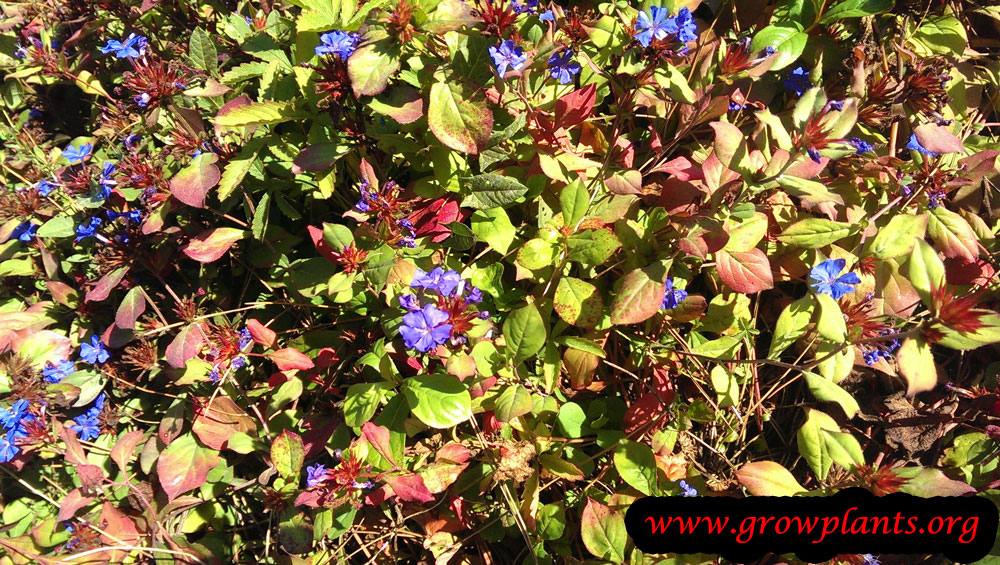
Overview: Ceratostigma plumbaginoides (hardy plumbago) is a spreading perennial subshrub groundcover, 20-90 cm (8-36 in), grown for its intense blue flowers and red-purple autumn foliage. It is evergreen in mild climates and deciduous where cold, is drought tolerant, and can spread aggressively.
Quick Specifications
| Specification | Attribute |
|---|---|
| Plant Type / Life Cycle | Perennial subshrub (annual in cold climates) |
| Foliage Type | Evergreen or cold-deciduous |
| Mature Size | 20-90 cm tall (8-36 in), spreading |
| Growth Rate | Fast to moderate |
| Root System | Rhizomatous, spreading (can be aggressive). |
| Toxicity | Reported poisonous/irritant if ingested. |
| Hardiness | USDA zones 7a+ (zone 6 with winter protection) |
Growth Form & Structure
- Height & Spread: 20-90 cm (8-36 in) tall and spreading into a groundcover mat; also grows in containers of about 5-10 L, kept in check by root pruning.
- Growth Habit & Form: Low, spreading subshrub to shrub forming a dense groundcover.
- Lifespan & Maturity: Fast- to moderate-growing perennial; can be invasive and aggressive.
Anatomy & Physical Features
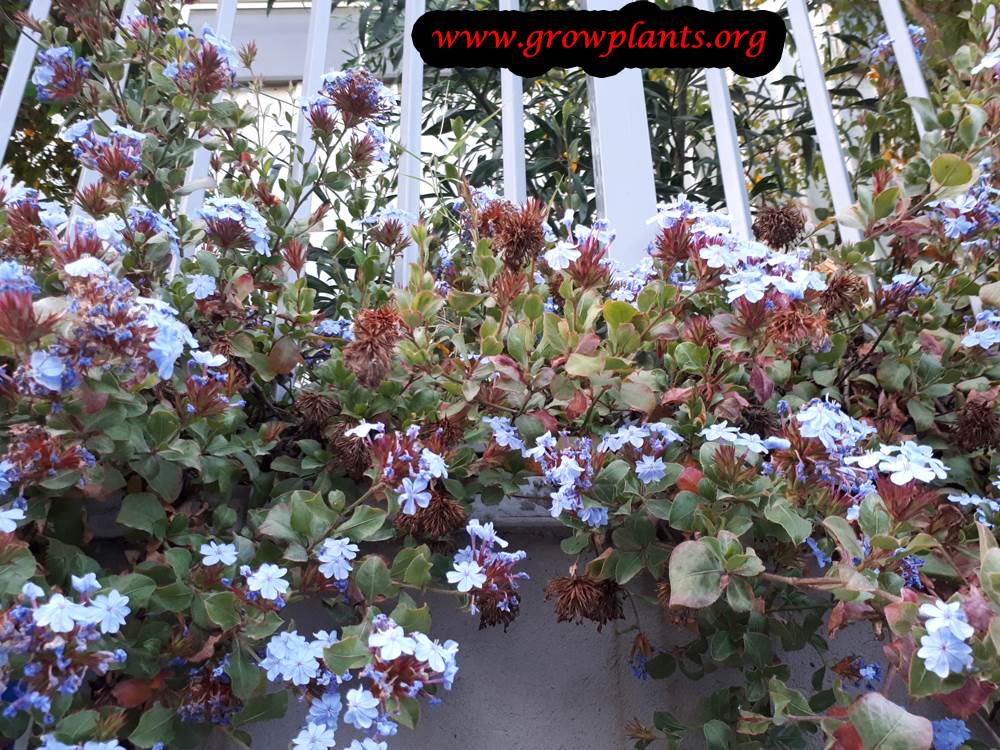
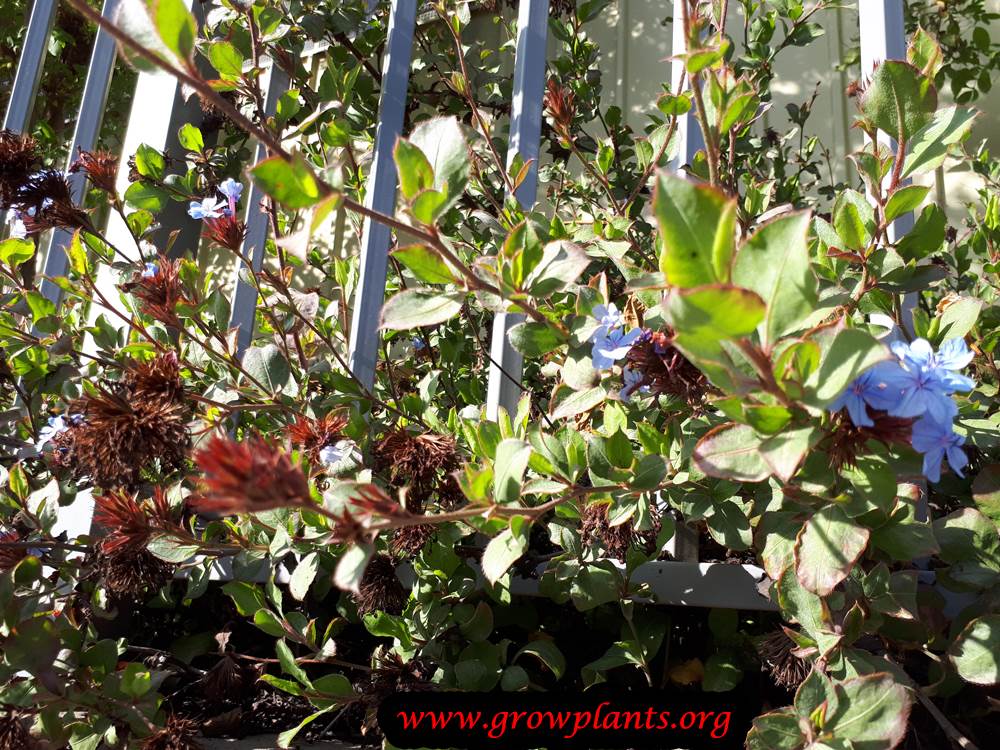
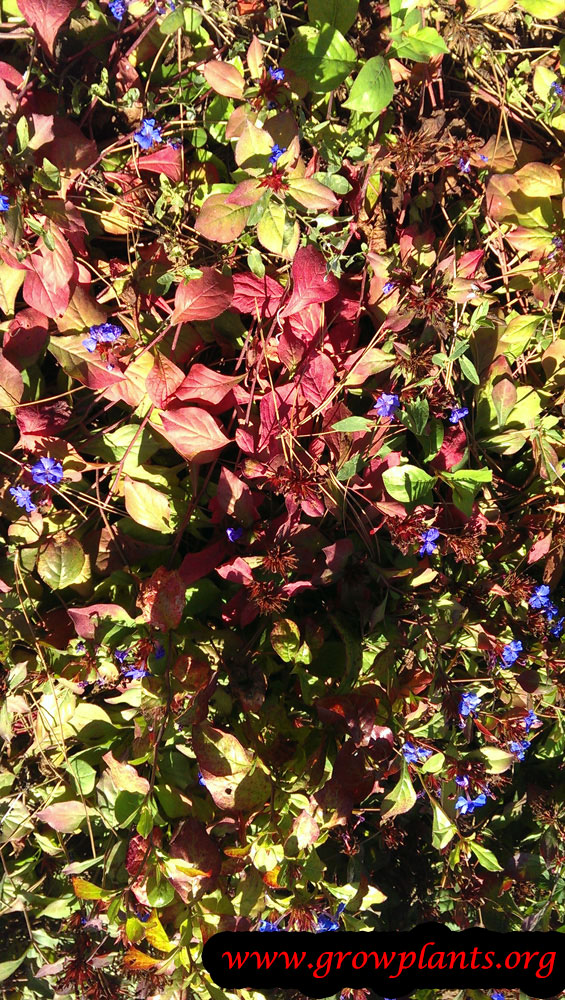
- Leaves & Foliage: Green oval leaves that turn red or purple around flowering time; evergreen in mild climates, deciduous in cold ones.
- Flower Characteristics: Blue or purple five-petalled flowers borne in clusters from spring through autumn.
Primary Uses & Landscape Value
- Functional & Ornamental Roles: Ornamental drought-tolerant groundcover for borders, edging and containers, valued for late-season blue flowers and red autumn foliage; can also be kept as a houseplant.
Care Guide: Planting, Soil & Watering
Overview: Hardy plumbago is a fast-spreading, mat-forming perennial ground cover for a wide climate range (hardiness zone 7a+, and zone 6 with winter protection), growing in full sun to shade. It likes a rich, moisture-retentive but well-drained soil enriched with organic matter and mulch, and moderate watering.
Quick Care Requirements
| Requirement | Ideal Condition |
|---|---|
| Planting Season | In spring; through summer or autumn in warmer zones |
| Growth Rate | Moderate to fast |
| Soil Type | Rich, organic, well-drained soil |
| Water Need | Moderate – keep lightly moist; water when the top of the soil dries |
Planting & Establishment
- Best Planting Season: Plant in spring in colder zones (6-8); from spring to summer in zones 9-10a, and spring to autumn in zones 10b-11a.
- How to Plant:
- Hole Preparation: Dig a hole about twice the size of the root ball (roughly 100% wider).
- Soil Amendments: Mix organic matter, humus and dead leaves into the backfill for fertility and moisture retention; apply a fertiliser in spring.
- Planting Depth: Set the root ball level with the soil surface, then mulch around (not over) the crown.
- Growth Speed & Expectations: A fast, spreading grower reaching 20-90 cm (8-36 in) and forming a dense mat over time.
Soil, Watering & Drainage Care
- Soil Mix & Drainage Needs: Use a rich but free-draining soil; in pots use a peat or potting mix with perlite plus humus, with plenty of drainage holes, and mulch the surface to hold moisture.
- Watering Schedule & Technique:
- Young / Newly Planted: Keep the soil evenly moist while establishing, with high humidity to help new plants settle.
- Established: Water moderately so the soil stays lightly moist; a summer and winter mulch conserves moisture and protects the roots.
- Seasonal Adjustments: More in summer heat; ease off in winter, when it may die back and rest (mulch for protection).
Climate, Light & Hardiness
Ceratostigma plumbaginoides (hardy plumbago) is an adaptable, drought-tolerant groundcover that grows across an unusually wide span of climates - from tropical to temperate - and tolerates full sun through full shade; its comfortable outdoor range is zone 7a and warmer, extending to zone 6 with attentive winter care.
Quick Climate Specifications
| Climate Zones | Subtropics, Mediterranean, desert, temperate, tropics; also grown indoors |
|---|---|
| USDA Hardiness Zones | 7a and warmer; possible in zone 6 with winter protection |
| Frost Tolerance | Moderate (evergreen in mild climates; dies back to the ground and regrows in colder ones) |
| Light Conditions | Full Sun, Half Shade, or Full Shade |
Sunlight & Light Exposure
Optimal Light Setup
Adaptable: full sun gives the densest flowering, while shadier spots still perform acceptably.
Shade & Heat Management
Tolerates full shade, useful under trees or on the shaded side of structures.
Temperature Extremes & Hardiness
USDA Hardiness & Regional Limits
Reliable outdoors from zone 7a up; in zone 6 it typically behaves as cold-deciduous, dying back to the roots each winter and needing protective mulch to return reliably.
Cold Damage & Winter Protection
In the coldest part of its range, treat it as herbaceous - cutting back and mulching in autumn - rather than expecting evergreen winter foliage.
Frost Sensitivity
Top growth is frost-tender and blackens with a hard frost, but the root system is considerably hardier.
Extreme Heat Tolerance
Good; it also thrives in subtropical and desert heat given some water.
Wind, Humidity & Microclimate
Rainfall & Seasonal Moisture
Adaptable across climates from desert to tropical, though it grows best with organic-rich, evenly moist (not waterlogged) soil.
Growing in Pots, Balconies & Indoors
Hardy Plumbago (Ceratostigma plumbaginoides) can be grown as a houseplant and in containers, as the grower confirms – a spreading perennial (20-90 cm) prized for its intense blue late-season flowers and red autumn foliage. The grower gives a detailed potting recipe, kept faithfully below.
Quick Details
- Container Size: From about 5-10 L minimum up to larger; the grower advises starting at least 200% bigger than the plant, and notes the pot size sets the plant size
- Indoor Suitability: Grower rates it as growable indoors; give it the brightest spot for good flower colour
- Best Spot: Full sun to part or full shade
- Soil & Drainage: Potting mix or peat with perlite blended with humus and organic matter; strong drainage with plenty of holes
- Watering in Pots: Average – keep the soil moist (chopped mulch helps); let the pot base drain the same day, never left standing wet
Indoors & On the Windowsill
- Indoors: The grower lists it as growable indoors; give it a bright window for the best blue flower colour and red autumn tints, and keep the mix moist but never waterlogged.
- Winter rest: It dies back and rests in the cold season; keep it cooler and drier while dormant, then it reshoots and flowers again.
- Overwintering: Hardy in many climates, so a pot can also winter outside in a sheltered spot.
On a Balcony or Patio
- Light & wind: On a patio it flowers best in good light; use chopped mulch on the surface to hold moisture, as pots dry fast in heat and sun.
- Practicalities: Ensure the pot drains freely – it tolerates a briefly wet base but not standing water.
Choosing the Pot, Soil & Long-Term Care
- Pot & drainage: Use a 5-10 L or larger pot with strong drainage holes; skip a standing-water saucer to avoid root rot. Terracotta breathes and dries faster, while glazed or plastic pots hold moisture longer, which suits it.
- Potting mix: A rich, well-aerated organic mix – peat or coir with plenty of compost or organic matter, lightened with perlite or vermiculite for drainage.
- Feeding: Potted plants exhaust their soil quickly as nutrients leach out – feed lightly but regularly through the growing season.
- Repotting: Refresh the mix or pot up about every two years; for clumping perennials, lift and divide, trimming the roots and old top growth as you go.
Grower’s Container Tip
- The grower’s potting recipe: In his words: start in a container at least 200% bigger than the plant; use potting mix or peat with perlite, blended with humus and organic matter; top with chopped mulch to keep the soil moist; let the base of the pot fill with water but dry out the same day; drainage matters, so make enough holes. The pot size decides the plant’s size – it grows to about 5-10 L pots and shallow containers. To keep it in a small pot, cut the roots every year or two and let it regrow; if the roots are never pruned and overgrow, the plant stops blooming and growing.
Fertilizing & Feeding
A light feeder: an early feeding in spring is generally all this tough, spreading groundcover needs, since its own vigor and the mulch worked into its bed carry it through the rest of the season.
Quick Fertilizing Specs
| Feeding Level | Light feeder |
|---|---|
| Main Nutrient Priority | Balanced feeding with organic matter; heavy nitrogen isn’t needed for this naturally spreading groundcover |
| Best Feeding Period | Early spring as new growth begins |
| Organic Options | Mulch and organic matter worked into rich soil |
| Reduce/Stop Feeding | Skip further feeding once the season’s growth is underway |
| Micronutrients | Rarely an issue when grown in rich, mulched soil |
| Soil pH | Prefers rich soil; tolerates a range of soil pH |
Feeding by Growth Stage
Spring feeding and new growth
Support fresh growth and glossy foliage as the plant breaks dormancy in spring.
| Nutrient direction | A balanced fertilizer applied once growth begins supports the season’s foliage and flowers. |
|---|---|
| Timing | In spring, as new growth begins. |
| Frequency | A single feeding at the start of spring is generally enough for the season. |
| Fertilizer types | A balanced complete fertilizer, Mulch or organic matter refreshed around the base |
| Precautions | This is a vigorous, spreading plant, so avoid heavy nitrogen that would push it to spread even more aggressively; keep fertilizer off foliage, which is noted as poisonous. |
Extended spring-through-autumn bloom
Sustain the long run of blue to purple flower clusters across the growing season.
| Nutrient direction | Feeding is rarely needed beyond the spring application; this plant blooms reliably on modest nutrition. |
|---|---|
| Timing | Across spring, summer, and into autumn as flowers continue to open. |
| Frequency | Minimal feeding is usually enough through this long bloom window. |
| Fertilizer types | A light balanced feeding only if growth or bloom looks weak |
| Precautions | Avoid extra feeding during the bloom run; this plant’s spreading habit already provides good cover without it. |
Cold-season dieback and rest
Let the plant die back to the ground or slow down through cold weather without pushing new growth.
| Nutrient direction | No supplemental feeding is needed while the plant is dormant or dying back for winter. |
|---|---|
| Timing | Through autumn dieback and the cold, dormant part of the year. |
| Frequency | No feeding during this dormant period. |
| Fertilizer types | No feeding at this stage; a dormant or dying-back planting has no active growth to support. |
| Precautions | Withhold fertilizer until new growth resumes in spring; mulch instead for winter protection. |
Nutrient Deficiency Signs & Corrections
Foliage looks pale and sparse rather than its usual glossy green mat.
| Possible causes | low soil fertility, thin, sandy soil without much organic matter, competition from nearby aggressive plants |
|---|---|
| Appears first on | overall foliage color and density |
| What to check | soil organic matter and fertility, competition from surrounding plants, time since last feeding |
| Possible correction | Apply a light balanced fertilizer in spring and refresh mulch or organic matter. |
New leaves yellow between the veins while older leaves stay green.
| Possible causes | high soil pH limiting iron uptake, waterlogged spots in the bed, compacted soil restricting roots |
|---|---|
| Appears first on | newest leaves |
| What to check | soil pH and drainage, standing water after rain or irrigation, root health in the affected patch |
| Possible correction | Improve drainage and soil pH balance; apply a chelated iron product per its label if the issue persists. |
Leaf edges brown or the planting looks scorched despite adequate rainfall.
| Possible causes | fertilizer salt buildup from repeated feeding, drought stress concentrating soil salts, poor drainage trapping salts near the roots |
|---|---|
| Appears first on | leaf margins |
| What to check | feeding history and amounts, recent rainfall or irrigation, drainage of the planting bed |
| Possible correction | Ease off feeding, water thoroughly to flush salts, and rely on the plant’s natural vigor to recover. |
Pruning, Training & Seasonal Maintenance
Ceratostigma plumbaginoides behaves like a herbaceous perennial groundcover in most climates (dying back in winter at the cooler end of its range, semi-woody where milder), and its single most important pruning event is a hard cutback to near ground level in late winter or very early spring, before new growth emerges. This removes the previous season’s tired stems and consistently produces denser, more floriferous growth, since it blooms on current-season shoots in late summer/autumn. Light deadheading through the season is optional, but the plant’s health and bloom quality depend on that one late-winter cutback rather than pruning "all year."
Quick Pruning & Maintenance Specs
| Pruning Tolerance | High (tolerates being cut to the ground annually) |
| Primary Pruning Window | Late winter/early spring, before new growth starts |
| Secondary Maintenance Window | Light deadheading/tidying through the growing season |
| Typical Frequency | One hard annual cutback, plus occasional light grooming |
| Main Objective | Renew fresh growth and maximize late-season bloom |
| Young Plant Priority | None – let new plantings establish for a season before cutting hard |
| Mature Plant Priority | Annual late-winter cutback to the ground (or to a low framework where semi-woody in mild climates) |
| Best Tool Type | Hedge shears or hand shears for the clump; precision snips for deadheading |
| Avoid Heavy Pruning During | Active late-summer/autumn bloom; note the plant is documented as poisonous – use gloves |
Pruning by Plant Age & Size
Newly Established
No cutback the first season – let the planting root in and spread.
Young / Formative
No structural training needed – it spreads as a low groundcover on its own.
Mature / Established
Annual late-winter/early-spring cutback to near ground level (or to a low woody framework in milder climates) is the main recurring task.
Seasonal Pruning Schedule
Dormant/Winter to Pre-Growth/Early-Spring (primary)
Objective: renew growth and maximize bloom. Remove: cut the whole planting back hard, close to the ground, before new shoots emerge. Expected response: dense fresh growth and better late-season flowering. Flowering impact: positive – this is what produces the bloom.
Ongoing Sanitary
Light deadheading of spent flower clusters through late summer/autumn is optional grooming, not required for rebloom, since flowering is already on fresh growth.
Flowering & Fruiting Wood
Blooms on current-season growth produced after the late-winter cutback, not on old wood, so the hard annual cutback does not sacrifice bloom – it’s what produces it. There is no persistent flowering-wood framework to protect the way there would be on an old-wood-blooming shrub.
Structural Pruning & Training
Essentially a renewal-pruning-only plant – its "structure" is renewed from the base each year rather than built up over multiple seasons. Where it persists as a low subshrub in milder climates, remove any winter-damaged or leggy stems in the same late-winter session.
Special Growth to Remove
- Old, tired stems from the previous season – removed wholesale in the late-winter cutback.
- Spent flower clusters – can be tidied through the bloom season, though not required for rebloom.
Container & Small-Space Pruning
Works well in containers and gets the same annual hard cutback there. Container specimens also need periodic root pruning/root management every year or two, since a root-bound root system in a small pot will stop the plant from blooming and growing well.
Tools
Hedge shears for the annual whole-clump cutback (fast, uniform); precision snips for optional in-season deadheading.
Tool Hygiene & Disease Risk
Routine – clean tools are sufficient; no notable pruning-transmissible disease documented for this species, though gloves are worth using given its documented toxicity.
Cut Placement & Technique
Cut stems uniformly close to the ground (or to a low framework of old wood if kept as a subshrub) – precise bud-facing cuts aren’t necessary for this renewal-style regime.
Heavy Pruning & Rejuvenation
The annual hard cutback to the ground IS the normal maintenance for this species, not a rescue measure – it keeps the planting dense and floriferous rather than sparse and woody.
Post-Pruning Care
Water normally; light spring feeding is reasonable to support the season’s regrowth after a hard cutback, since the whole visible plant is being renewed from the base. Watch for aphids/spider mites on the flush of new growth per the source pest facts.
Common Pruning Mistakes
- Pruning lightly "for design" through the year instead of doing the one decisive late-winter cutback, which leaves old, tired stems in place and reduces bloom density.
- Skipping the cutback and letting the planting become sparse/woody at the base.
- Forgetting gloves given the plant’s documented toxicity.
When NOT to Prune
Avoid the hard cutback once new growth has already started (wastes the season’s growth), and avoid it during active late-summer/autumn bloom.
Recommended Tools (by task)
- hedge_shears – fast, uniform annual cutback of the whole groundcover planting to the ground.
- precision_snips – optional in-season deadheading/tidying.
Propagation Guide
Hardy plumbago (Ceratostigma plumbaginoides) is most easily started from stem cuttings – the site notes this is genuinely easier than starting from seed, even though grafting or vegetative propagation isn’t strictly necessary – while seed offers a true, if slower, alternative once temperatures are reliably warm. Both methods are easy for a home gardener, helped along by the plant’s own vigorous, spreading nature.
Quick Propagation Specs
| Best Propagation Method | Stem cuttings |
| Alternative Methods | Seed; rhizome division |
| Propagation Difficulty | Easy |
| Seed True-to-Type | Yes (species) |
| Vegetative True-to-Type | Yes |
| Best Propagation Season | Spring for both cuttings and seed sowing; seed sowing also possible in summer, and in autumn in hardiness zone 10b+ per the site |
| Seed Germination Time | 2–6 weeks (site data) |
| Cutting Rooting Time | Not specified exactly by the site; typically several weeks under the warm, humid conditions it recommends |
| Germination Temperature | Above 24°C (75°F) for seed (site data); cuttings root as long as temperatures stay above 25°C (77°F) (site data) |
| Seed Sowing Depth | 0.5cm (0.25 inch) (site data) |
Growing from Seed
Seed Handling & Viability
Store harvested seed in a dry, dark location until sowing (site data).
Sowing Season
Spring or summer; possible in autumn in hardiness zone 10b+ (site data).
Sowing Depth & Orientation
Sow about 0.5cm (0.25 inch) deep (site data). For spacing, use roughly 4x5cm (1.8×2 inches) if sowing in trays or nursery rows, or about 40x50cm (16-20 inches) between plants if sowing direct in place (site data).
Germination Conditions
Needs temperatures above 24°C (75°F), consistently moist soil, and full sun to half shade; keep the soil moist until germination, since full sun combined with high humidity helps sprouting (site data). Sow into a moisture-retentive medium such as peat soil mixed with vermiculite or perlite (site data).
Germination Time
2–6 weeks (site data).
Seedling Care
Keep seedlings’ soil consistently moist with an average amount of water, never letting it dry out, until well established (site data).
Stem Cuttings
Cutting Type
Stem cuttings (site data: “start by cutting for stems”).
Best Timing
Better to start cuttings in spring, but possible at other times as long as the temperature stays above 25°C (77°F) (site data).
Cutting Preparation
Take a stem cutting and insert it into the rooting medium; removing the lower leaves first is standard general practice for stem cuttings of this kind.
Rooting Setup
Peat soil is best, though other soil such as potting mix will also work; keep the medium moist and humidity high around the cutting (site data).
Rooting Hormone
Not indicated by the site data; optional and not necessary, though it may modestly speed rooting.
Rooting Time
The site does not give an exact duration; expect roots within a few weeks under the recommended warm (above 25°C/77°F), humid, moist conditions.
Rhizomes, Tubers, Bulbs & Corms
Because hardy plumbago spreads by creeping rhizomes – the same vigorous habit the site flags as invasive and aggressive – established clumps can also be increased by rhizome division in spring. Lift a rooted section with attached shoots and replant it promptly at the same depth, using the site’s own planting method: dig a hole roughly double the size of the root ball and work in organic matter, dead leaves, and humus. Keep the division evenly moist until new growth confirms establishment.
Bloom & Flower Guide
Quick Details
- Bloom Season: Spring through autumn, a long late-season display
- Flower Appearance: Five-petalled flowers in vivid gentian-blue to purple, in small clusters
- Edibility: Not edible – the plant is poisonous if eaten; grown as ornamental ground cover only
Detailed Blooming Overview
Hardy plumbago is prized for its late show of true, gentian-blue flowers – an uncommon, almost pure blue – carried in small clusters from spring right through autumn. As the flowers come, the surrounding leaves flush red and purple, so the plant offers blue and bronze at once. It flowers on new growth, which is why the display runs so late in the season.
Flower Characteristics
- Five-petalled flowers in vivid blue to purple.
- Borne in clusters, with the nearby foliage turning red-purple as they open.
- One of the few garden plants to offer a genuinely blue late-season flower.
Bloom Care & Thinning
- Managing the bloom: Trim spent flowers and shape as needed; because it flowers on new growth, a tidy-up keeps the long display going.
- Safety: The plant is considered poisonous if eaten – never treat any part, flowers included, as edible, and wash your hands after pruning.
Pests, Diseases & Troubleshooting
Overview: Hardy plumbago is a tough, largely trouble-free groundcover and sub-shrub prized for late blue flowers; its main risks are sap-suckers under stress and, more importantly, root rot in cold wet soils. Grow it in a warm, well-drained spot and it needs very little intervention.
Quick Troubleshooting Overview
| Issue / Pest | Main Symptom | Primary Solution |
|---|---|---|
| Aphids | Curled shoot tips, honeydew | Water jet; soap if persistent |
| Spider mites | Stippled, bronzed leaves in heat | Raise humidity; oil/soap |
| Whitefly | White flies rise when disturbed | Sticky traps; soap |
| Slugs & snails | Ragged holes in soft new growth | Handpick at night; barriers |
| Root rot | Collapse in cold wet soil | Improve drainage; ease watering |
| Powdery mildew | White coating in humid shade | Improve airflow; sun |
Common Pests & Management
- Aphids (Aphidoidea):
- Symptoms: Clusters of small green, black or grey soft-bodied insects on new shoots, buds and leaf undersides; curled distorted growth, honeydew and sooty mould.
- Prevention & Control: Blast off with a strong jet of water and squash colonies early. Encourage ladybirds, lacewings and hoverflies; avoid excess nitrogen that fuels soft growth. Use insecticidal soap or neem for stubborn outbreaks, sprayed in the evening to spare pollinators.
- Spider mites (Tetranychus urticae):
- Symptoms: Fine pale stippling on leaves, a dull bronzed look, and fine webbing on undersides in hot, dry conditions. Leaves dry and drop as numbers build.
- Prevention & Control: Raise humidity and hose down foliage to break the cycle; mites thrive on dry, dusty plants. Release predatory mites where practical, and treat with insecticidal soap or horticultural oil, coating leaf undersides over repeat applications.
- Whitefly (Trialeurodes / Bemisia spp.):
- Symptoms: Tiny white moth-like insects that flutter up in clouds when foliage is disturbed; honeydew, sooty mould and yellowing weaken the plant.
- Prevention & Control: Hang yellow sticky traps to monitor and trim heavy populations; encourage Encarsia parasitic wasps under cover. Spray insecticidal soap or horticultural oil to leaf undersides, repeating to catch new hatches.
- Slugs & snails (Gastropoda):
- Symptoms: Irregular holes and shredded edges on tender new spring growth, with slime trails; worst in damp shaded plantings.
- Prevention & Control: Hand-pick after dark, clear damp hiding places and use grit, copper tape or beer traps around clumps. Iron-phosphate bait is a pet-safer option if pressure is high.
Diseases & Fungal Issues
- Powdery mildew (Erysiphe / Golovinomyces spp.):
- Symptoms: White powdery patches on leaves and stems, mainly in crowded, humid or shady sites late in the season.
- Treatment & Management: Space and thin for airflow, grow in good light, and avoid overhead watering. Remove affected leaves; a sulfur or potassium-bicarbonate spray helps only in stubborn cases.
- Root & crown rot (Phytophthora / Pythium / Rhizoctonia spp.):
- Symptoms: Wilting despite moist soil, blackened mushy roots or stem base, yellowing lower leaves and collapse. Cold, wet, poorly drained soil over winter is the classic trigger.
- Treatment & Management: This is a water-management disease first: plant in free-draining soil, avoid waterlogging and never let pots stand in saucers of water. Remove and destroy collapsed plants, improve drainage, and drench with a labelled biofungicide only as a support measure.
- Leaf spot (Fungal (minor)):
- Symptoms: Small brown spots in wet weather; usually cosmetic.
- Treatment & Management: Remove spotted leaves and improve airflow; fungicides are rarely needed.
Growing Difficulties & Abiotic Problems
- Winter cold / dieback:
- Cause & Symptoms: Stems blacken and die back in hard winters – normal for this die-back sub-shrub.
- Correction Strategy: Leave old top-growth over winter for protection and cut back to live wood in spring; mulch the crown in cold areas.
- Slow spring emergence:
- Cause & Symptoms: Bare gaps and worry that plants are dead – Ceratostigma breaks dormancy late.
- Correction Strategy: Be patient into late spring before assuming loss; avoid overwatering dormant crowns.
- Poor flowering in shade:
- Cause & Symptoms: Sparse blooms and leggy growth in too much shade.
- Correction Strategy: Move to a sunnier, warm position for the best late-season flower and autumn leaf colour.
What Helps – Products & Tools
Reach first for cultural fixes – sun, sharp drainage and airflow. Backups are insecticidal soap or neem/horticultural oil for aphids, mites and whitefly, iron-phosphate slug bait, and a sulfur or potassium-bicarbonate spray only if mildew persists.