Plant Profile & Key Characteristics
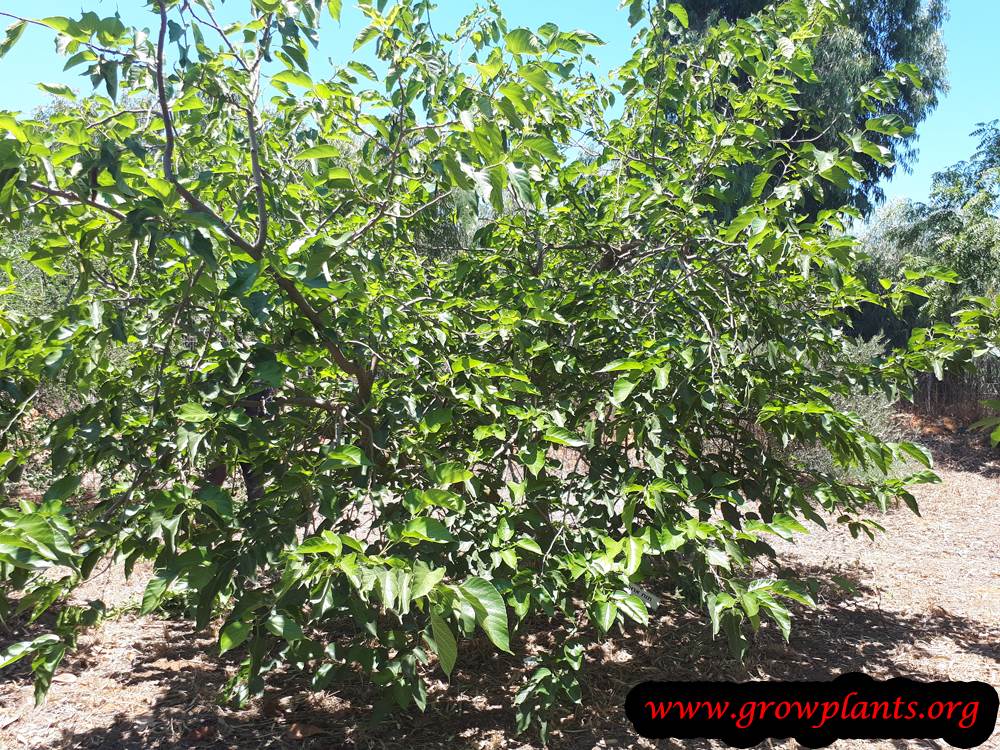
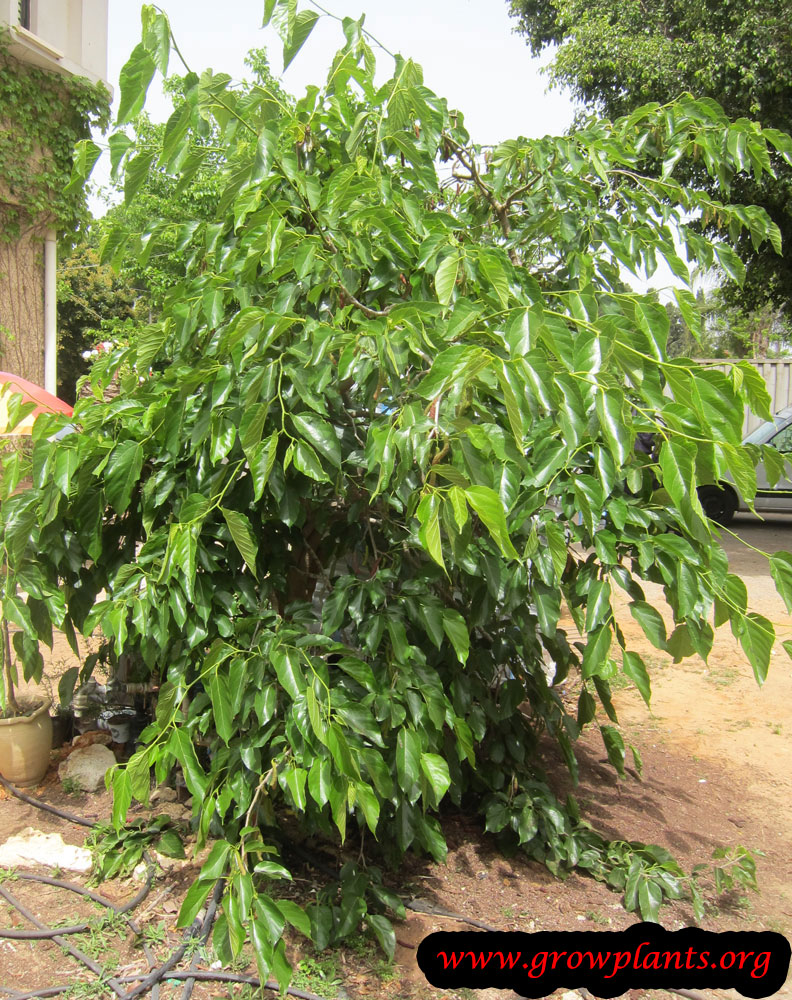
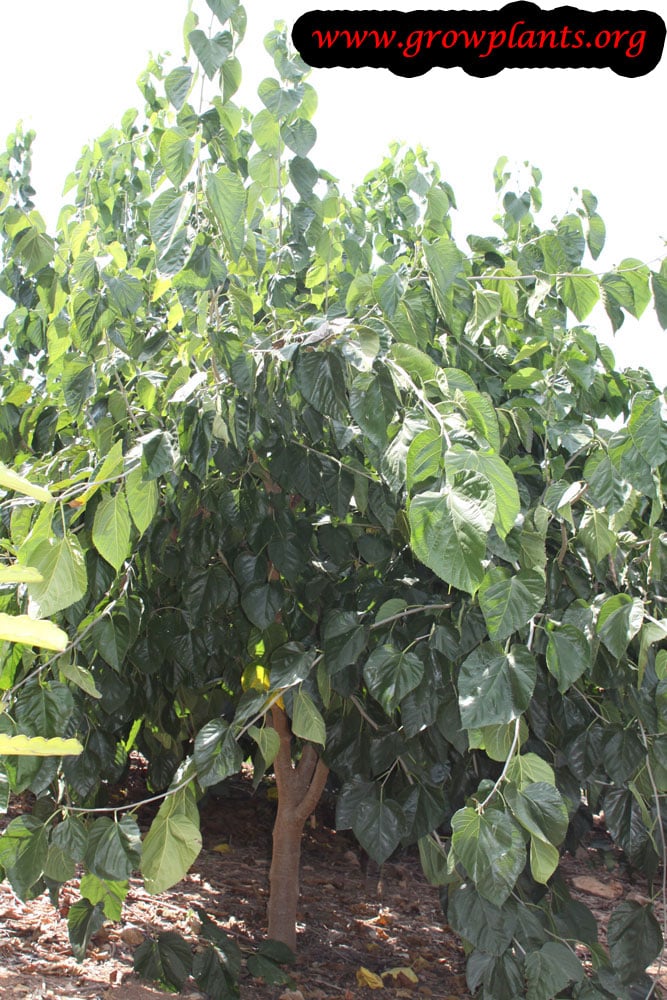
Overview: A deciduous mulberry tree growing 2-7 m tall, grown for its long, sweet mulberries and as an ornamental or shade tree. Male and female flowers are usually borne on separate trees.
Quick Specifications
| Specification | Attribute |
|---|---|
| Plant Type / Life Cycle | Perennial (deciduous tree) |
| Foliage Type | Deciduous |
| Mature Size | 2-7 m (6-21 ft) |
| Growth Rate | Moderate to Fast |
| Root System | Shallow, spreading (can be aggressive) |
| Toxicity | Ripe fruit edible; unripe fruit and milky sap can cause stomach upset |
| Hardiness | USDA zones 5-10 |
Growth Form & Structure
- Height & Spread: 2-7 m (6-21 ft), often pruned short for easier harvest; can be container-grown.
- Growth Habit & Form: Deciduous tree, usually dioecious (separate male and female trees).
- Lifespan & Maturity: Long-lived; bears fruit in about 2 years.
Anatomy & Physical Features
- Leaves & Foliage: Green deciduous leaves.
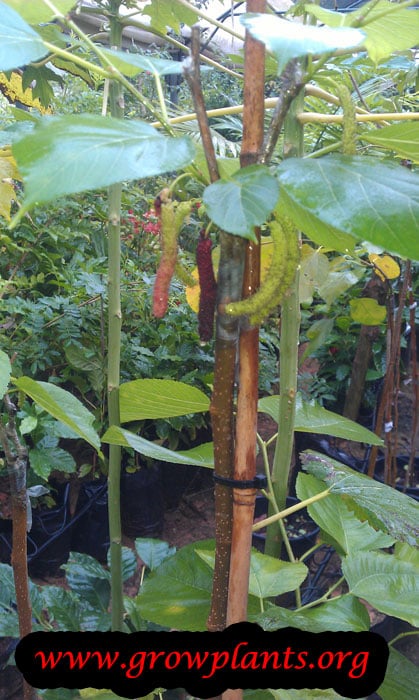
- Flower Characteristics: Small white flowers in cone-shaped catkins in spring.
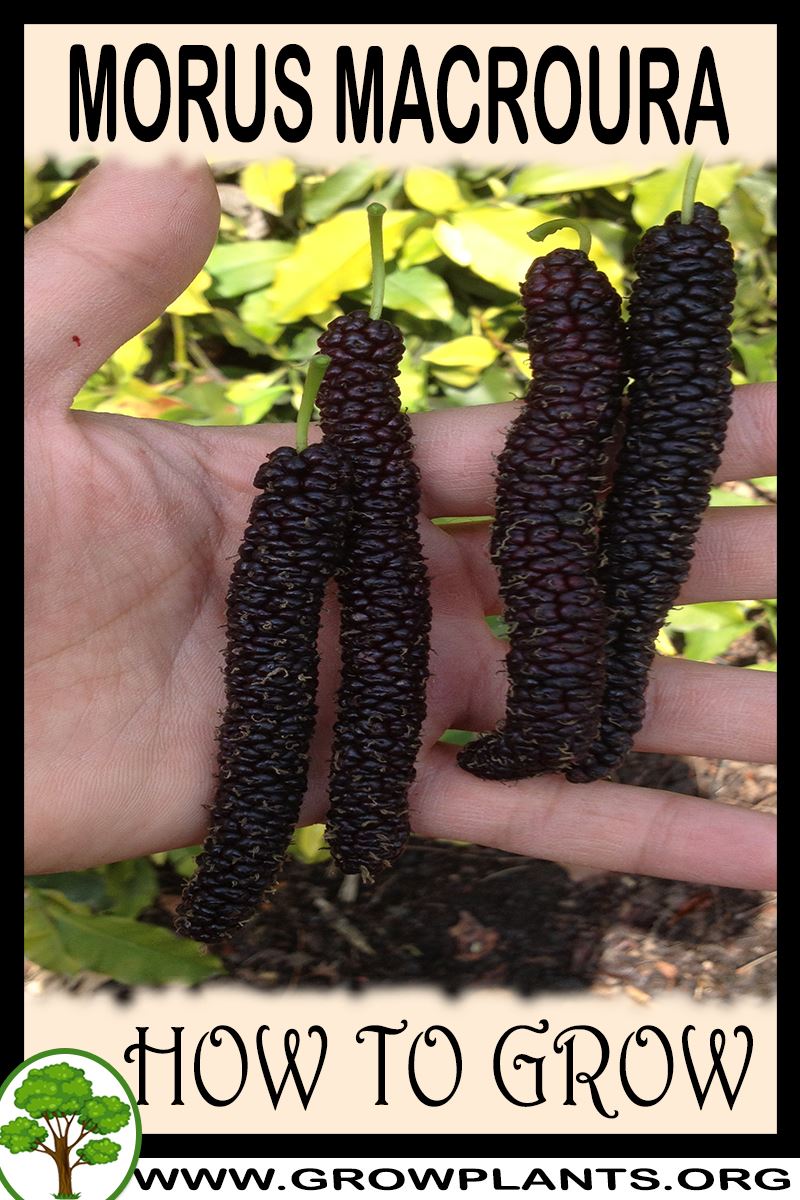
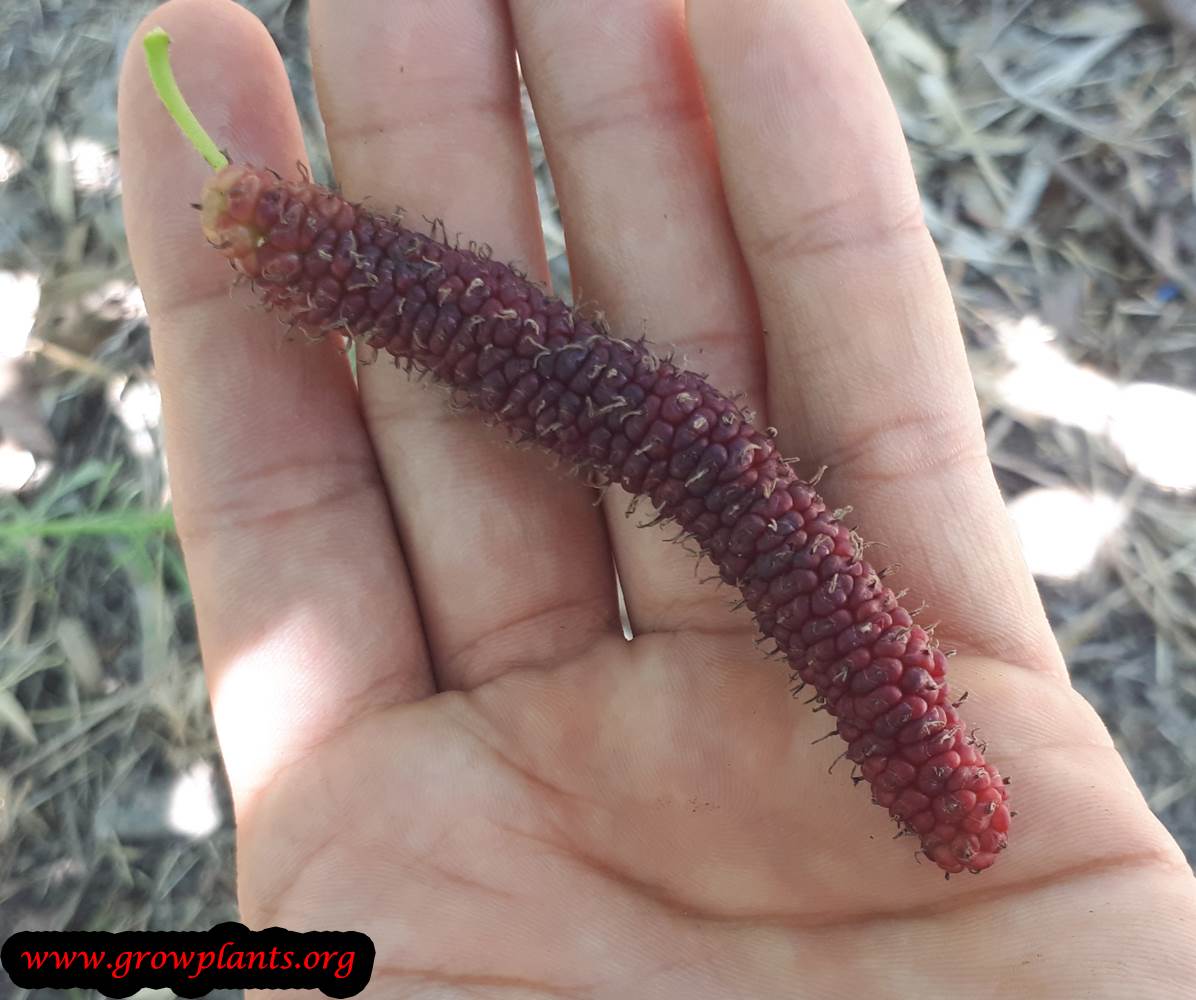
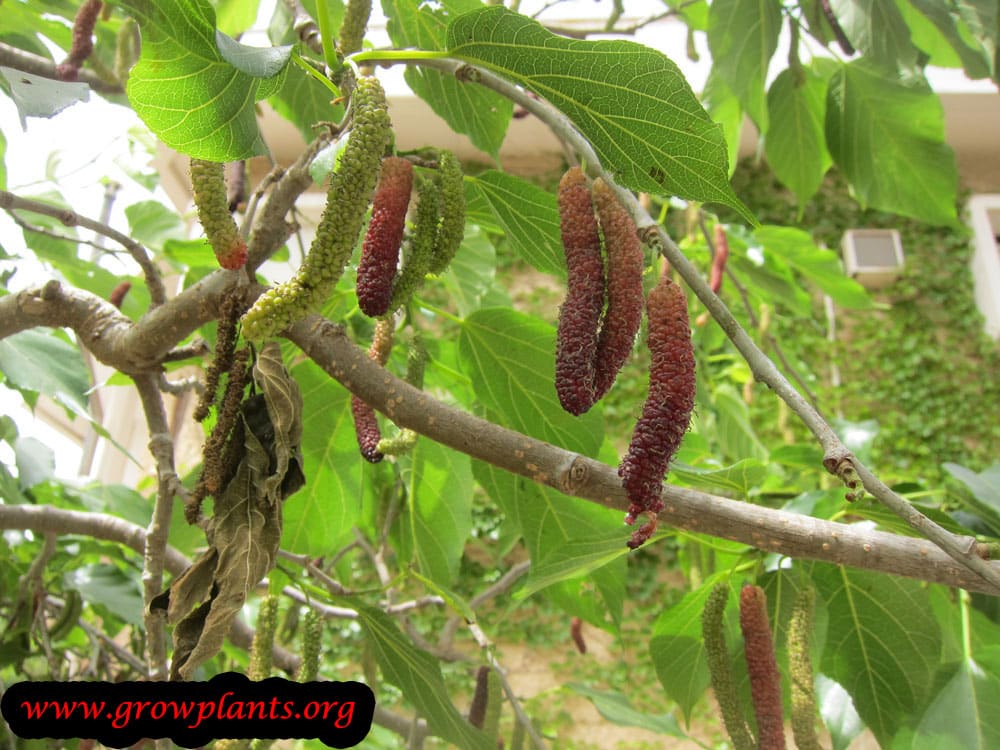
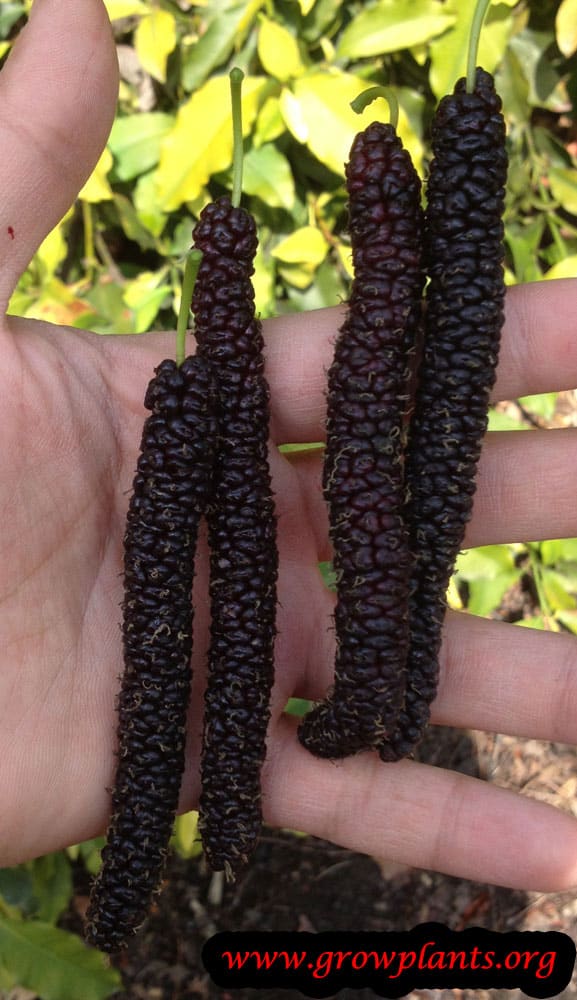
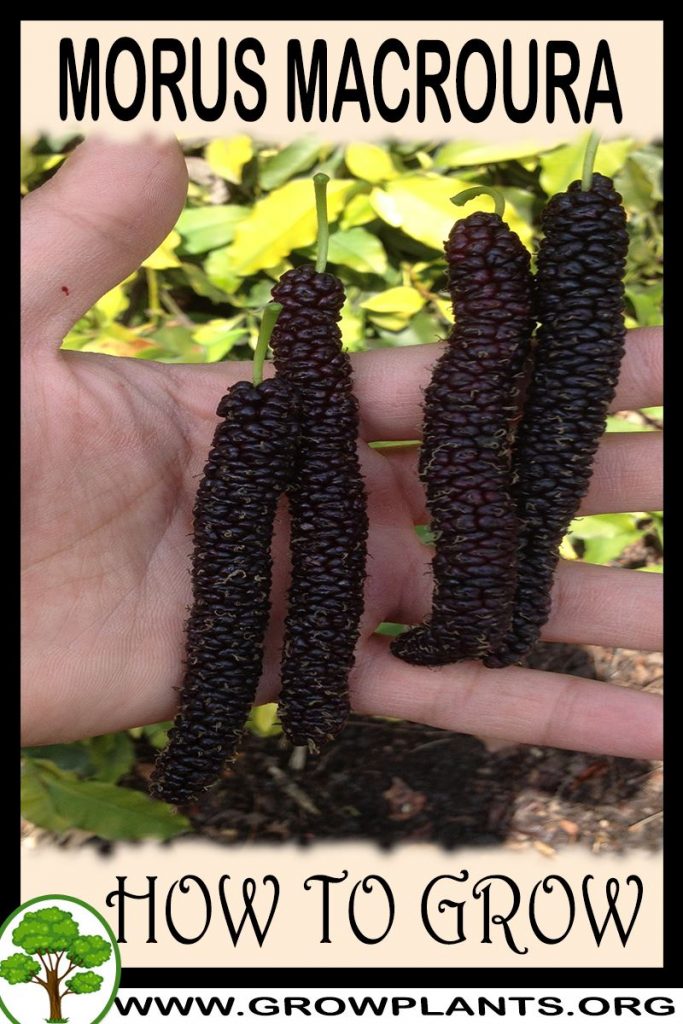
- Fruit Profile: Long cylindrical mulberries 7-10 cm, ripening red and purple to black, sweet.
Primary Uses & Landscape Value
- Edible Uses: Fruit eaten fresh or made into jam, juice and cakes.
- Functional & Ornamental Roles: Fruit tree that also serves as a shade and ornamental tree.
Care Guide: Planting, Soil & Watering
Overview: Morus macroura (Himalayan mulberry) is a deciduous fruiting tree that grows best in full sun in a temperate or mediterranean climate (hardiness zone 5–10). It is adaptable to a wide range of well-drained soils and is fairly drought-tolerant once established, though it appreciates extra water while the fruit forms.
Quick Care Requirements
| Requirement | Ideal Condition |
|---|---|
| Planting Season | End of winter to early spring, while dormant |
| Growth Rate | Moderate to Fast |
| Soil Type | Deep, well-draining; adaptable to most soils |
| Water Need | Low to Moderate – drought-tolerant once established |
Planting & Establishment
- Best Planting Season: Plant while the tree is dormant, at the end of winter or in early spring, so the roots settle in before growth begins.
- How to Plant:
- Hole Preparation: Dig a hole about twice the width of the root ball and no deeper, so the tree sits at the level it grew in the nursery.
- Soil Amendments: Loosen the native soil and mix in compost or well-rotted organic matter; mulberries are not fussy but reward fertile, free-draining ground.
- Planting Depth: Set the root collar (and any graft union) at or just above soil level – never bury the stem.
- Growth Speed & Expectations: Moderate to fast in good conditions; young trees usually begin bearing within about two years.
Soil, Watering & Drainage Care
- Soil Mix & Drainage Needs: Deep, well-drained soil is ideal; mulberries tolerate poorer ground but dislike waterlogging, which can rot the roots.
- Watering Schedule & Technique:
- Young / Newly Planted: Water regularly through the first season to build a strong root system, keeping the soil moist but never soggy.
- Established: Largely drought-tolerant; water deeply but occasionally, and step up watering while the fruit is swelling and ripening.
- Seasonal Adjustments: Cut back or stop watering in winter while the tree is dormant, and water more during prolonged heat.
Climate, Light & Hardiness
Morus macroura is a deciduous Himalayan mulberry tree suited to temperate to Mediterranean climates, thriving through hot summers but requiring a distinct winter chill to break dormancy properly. It performs best in full sun with an open, unobstructed canopy, and established wood tolerates cold winters well even though spring growth stays frost-sensitive.
Quick Climate Specifications
| Climate Zones | temperate to Mediterranean climates |
|---|---|
| USDA Hardiness Zones | 5–10 |
| Optimal Temp Range | approximately 18–29°C (64–84°F) during active growth, with a cool winter rest period |
| Cold Damage Begins | late hard frosts below about −4°C (25°F) can injure new spring leaves and flowers |
| Approx. Survival Minimum | dormant, established trees typically tolerate brief cold consistent with the zone range above; young trees are more cold-sensitive |
| Frost Tolerance | High (dormant season) / Low (new spring growth) |
| Light Conditions | Full Sun |
| Wind Tolerance | Moderate |
Sunlight & Light Exposure
Optimal Light Setup
Full, all-day sun produces the densest canopy and the heaviest fruit set; a partially shaded site thins the canopy and reduces fruiting.
Direct Sun Requirement
Direct sun is genuinely needed – this is not a plant for shaded gardens.
Shade & Heat Management
Handles hot summer sun well once established; extra afternoon shade is only useful in the hottest desert-type summers to reduce leaf scorch and water stress.
Best Exposure/Orientation
An open site away from low frost pockets, so spring frosts don't linger around emerging leaves and flowers.
Temperature Extremes & Hardiness
USDA Hardiness & Regional Limits
Hardy across zones 5–10, so it copes with cold winters in temperate climates while also handling warm Mediterranean and subtropical summers.
Cold Damage & Winter Protection
Moderate wind exposure is generally fine once the tree is established. Mature trees generally need no winter protection within their hardiness range; young, newly planted trees benefit from mulch over the root zone their first winter.
Frost Sensitivity
Dormant wood is frost-hardy, but new spring leaves, flowers and developing fruit are frost-sensitive and can be damaged or lost to a late freeze.
Extreme Heat Tolerance
Good – tolerates hot summer conditions well with adequate water.
Chilling Requirement
Needs only a brief winter chilling period (roughly down to about 5°C/41°F or colder for a short spell) to break dormancy evenly the following spring – a comparatively modest chill requirement.
Wind, Humidity & Microclimate
Humidity Preferences
Adaptable to both humid and dry summer climates.
Dry-Air Tolerance
Good; once established it tolerates low ambient humidity and needs only small to average irrigation.
Wind Tolerance
Moderate
Rainfall & Seasonal Moisture
Adapts to both dry-summer Mediterranean rainfall patterns and more evenly distributed temperate rainfall.
Microclimate Recommendations
Plant away from frost pockets and low-lying cold-air traps, since these increase the risk of spring frost damage to new leaves and flowers.
Growing in Pots, Balconies & Indoors
Morus macroura is a full-sun fruiting mulberry tree, not a houseplant – it simply grows too large for a room. In a big tub it can be grown on a sunny patio or balcony while young, and kept smaller by pruning.
Quick Details
- Container Size: A large tub (roughly 30-50 L / 8-13 gal) while young; pot up as it grows and prune to keep it in scale
- Indoor Suitability: Not a houseplant – a fruiting tree that needs full sun; grow it outdoors
- Best Spot: Full sun
- Soil & Drainage: Rich, free-draining potting mix; water freely but never waterlogged
- Watering in Pots: Moderate – keep the mix evenly moist, more while fruiting; pots dry fast
Indoors & On the Windowsill
- Too large for indoors: Even a pruned, dwarfed mulberry needs full sun and open air, so it isn’t a houseplant. A pot only makes sense outdoors, or in a bright conservatory while the tree is small.
- Overwintering: Deciduous types rest in winter; in cold regions a potted young tree can be moved to a sheltered spot while dormant.
On a Balcony or Patio
- Light, weight & fruit drop: Give it the sunniest spot. A fruiting tub is heavy – set it in place before it fills out – and remember ripe mulberries drop and can stain a balcony floor. Keep it well watered and pruned to a manageable size.
- Practicalities: Ensure drainage water runs away freely; a heavy, stable pot stops a top-heavy young tree blowing over.
Choosing the Pot, Soil & Long-Term Care
- Pot & drainage: A large tub with strong drainage holes; skip a standing-water saucer to avoid root rot. Bigger pots hold moisture longer, which suits a thirsty fruiting tree.
- Potting mix: A rich, free-draining potting mix with plenty of organic matter; mulch the surface to hold moisture.
- Feeding: Feed regularly through the growing season – a fruiting tree in a pot is hungry and nutrients leach out with watering.
- Repotting: Every couple of years refresh the mix and root-prune to keep a container mulberry compact and productive.
Growing this plant in a greenhouse
A greenhouse can give morus macroura frost protection and cold protection.
Greenhouse at a glance
| Greenhouse suitability | Conditional - depends on your climate |
|---|---|
| Main benefits | frost protection, cold protection |
| Season extension | earlier spring & later autumn |
| Outdoor protection advisable below | about 5°C |
| Maintain greenhouse minimum | around 5°C for active growth |
| Suitable types | unheated greenhouse, polycarbonate greenhouse |
| Heating | Heating is optional - useful mainly for winter growing in cold areas. |
Related greenhouse guides
- Greenhouses: How to Choose the Right Greenhouse
- Polycarbonate Greenhouses: What to Look for Before Buying
Fertilizing & Feeding
A moderate feeder: this fast-growing Himalayan mulberry needs steady nitrogen while it builds its framework, then a more balanced diet with extra irrigation and attentive feeding through its heavy, unevenly ripening fruit set.
Quick Fertilizing Specs
| Feeding Level | Moderate feeder |
|---|---|
| Main Nutrient Priority | Nitrogen-forward while young, shifting to balanced feeding with attention to potassium as the tree comes into bearing |
| Best Feeding Period | Late winter into early spring, before spring growth begins |
| Organic Options | Compost or well-rotted organic matter worked into the root zone |
| Reduce/Stop Feeding | Ease off nitrogen as fruit approaches ripeness, and reduce feeding heading into dormancy |
| Micronutrients | A complete fruit-tree fertilizer typically supplies routine trace elements; treat individual deficiencies only when diagnosed |
| Soil pH | Tolerates a range of soils; performs best in well-drained ground |
Feeding by Growth Stage
Newly planted tree
Establish root growth on a newly planted tree without pushing excessive, sappy top growth before the root system can support it.
| Nutrient direction | A light, balanced feeding, if any, favors root establishment over rapid top growth in the first season. |
|---|---|
| Timing | At planting, in late winter or early spring, and through the first growing season. |
| Frequency | A single light feeding at planting is usually enough while the tree establishes. |
| Fertilizer types | A balanced, complete fertilizer used at a light rate, Compost or organic matter worked into the planting area |
| Precautions | Avoid heavy feeding at planting; overly rich soil or fertilizer can burn newly forming roots and stress a young tree. |
Young, fast-growing tree
Build a strong branch framework quickly, since this is a naturally fast-growing tree that benefits from steady feeding while it is trained to a manageable height.
| Nutrient direction | A nitrogen-forward, complete fertilizer supports the vigorous framework growth this tree is known for. |
|---|---|
| Timing | Late winter to early spring, ahead of the flush of new growth. |
| Frequency | Regular feeding through the growing season supports the fast framework growth typical of a young tree of this species. |
| Fertilizer types | A nitrogen-forward, complete fruit-tree fertilizer, Compost or organic matter as a supplement |
| Routine trace nutrients | iron, manganese, zinc |
| Precautions | Keep pruning to control height in step with feeding; strong nitrogen feeding on an untrained tree makes for an unmanageably tall canopy at harvest time. |
Mature, fruit-bearing tree
Support a heavy, unevenly ripening mulberry crop that benefits from extra irrigation through the fruiting season, while keeping the tree healthy for the years ahead.
| Nutrient direction | A balanced, complete fertilizer with attention to potassium supports fruit development and quality as the crop matures. |
|---|---|
| Timing | Late winter into early spring, before bloom, with irrigation increased through the fruiting season. |
| Frequency | Regular, moderate feeding through the growing season supports the demands of a heavy fruit set. |
| Fertilizer types | A balanced, complete fruit-tree fertilizer, Compost or organic matter as a soil-building supplement |
| Routine trace nutrients | iron, manganese, zinc |
| Precautions | Ease back on nitrogen as fruit nears ripeness, since excess nitrogen late in the season favors leafy growth over fruit quality; keep irrigation consistent, as this tree specifically benefits from added water while fruiting. |
Nutrient Deficiency Signs & Corrections
Older leaves turn pale green to yellow and overall shoot growth slows.
| Possible causes | low available soil nitrogen, nutrient leaching after heavy rain or irrigation, competition from grass or weeds in the root zone |
|---|---|
| Appears first on | older, lower leaves |
| What to check | recent feeding history, grass or weed competition around the trunk, irrigation and drainage pattern |
| Possible correction | Apply a nitrogen-forward complete fertilizer and clear competing vegetation from the root zone. |
New leaves turn yellow between veins that stay green, most visible on the newest growth.
| Possible causes | high soil pH tying up available iron, waterlogged or compacted soil limiting root uptake, naturally alkaline or calcareous soil |
|---|---|
| Appears first on | newest growth at the shoot tips |
| What to check | soil pH and drainage, recent overwatering or compaction, whether nearby trees show the same pattern |
| Possible correction | Improve drainage, avoid overwatering, and apply a chelated iron product per its label if the pattern persists. |
New leaves are small and narrow with shortened distance between leaves, giving branch tips a rosetted look.
| Possible causes | low soil zinc availability, common in alkaline or sandy soils, high soil pH reducing zinc uptake, an unbalanced fertilizing program that has not supplied trace elements |
|---|---|
| Appears first on | newest growth at branch tips |
| What to check | soil pH, history of complete versus nitrogen-only fertilizing, whether the pattern is worst on the sunniest, most vigorous branches |
| Possible correction | Switch to a complete fruit-tree fertilizer that supplies trace elements, or apply a labeled zinc product per its instructions if the pattern persists. |
Leaf margins scorch or brown on older leaves, and fruit size or quality can decline.
| Possible causes | low soil potassium relative to this fruiting tree’s demand, sandy or fast-leaching soil unable to hold potassium, heavy nitrogen feeding without balancing potassium |
|---|---|
| Appears first on | margins of older leaves |
| What to check | soil potassium status, soil texture and drainage, the balance of recent fertilizer applications |
| Possible correction | Shift toward a balanced, complete fertilizer that supplies potassium alongside nitrogen, especially as fruit develops. |
Pruning, Training & Seasonal Maintenance
Morus macroura (Himalayan mulberry) is a moderately vigorous, fairly compact mulberry (2–7 m) that tolerates moderate to fairly hard structural pruning, best done in deep dormancy at the end of autumn/start of winter, since mulberries bleed sap heavily if cut while actively growing. Its own facts note a distinctive trait among the mulberries in this batch: a light prune after the main fruit harvest can trigger the tree to bloom and fruit again, so post-harvest cutting here is deliberately restrained rather than a hard renewal cut.
Quick Pruning & Maintenance Specs
| Pruning Tolerance | Moderate |
| Primary Pruning Window | End of autumn to start of winter (dormant) |
| Secondary Maintenance Window | Light prune immediately after harvest, to encourage a second bloom/fruit flush |
| Typical Frequency | Once annually (dormant), plus the optional light post-harvest prune |
| Main Objective | Keep the tree short and manageable for a heavy fruit set; encourage a post-harvest rebloom |
| Young Plant Priority | Build a low, open framework; thin the first year’s bloom to avoid overcropping a young tree |
| Mature Plant Priority | Annual dormant heading to control height; light post-harvest prune for rebloom |
| Best Tool Type | Bypass secateurs and loppers |
| Avoid Heavy Pruning During | Active spring growth/sap rise, and while the current fruit crop is developing |
Pruning by Plant Age & Size
Newly Established
Remove only damaged growth in the first year or two; avoid hard heading while the framework is still forming.
Young / Formative
Open-centre/multi-leader framework, headed low early to keep the mature tree short (per source) for easier fruit access and bird-netting; thin the first year’s flowers/fruit set, as recommended in the plant’s own facts, so the young tree isn’t overcropped before its structure is established.
Mature / Established
Dormant heading cuts to hold the tree at a manageable height; a light, restrained cut after harvest to promote the documented second bloom/fruit flush, rather than a hard renewal cut.
Seasonal Pruning Schedule
| Stage | Objective | Remove | Do NOT remove | Flowering/fruiting impact |
| Dormant (end of autumn–start of winter) | Structural size control while sap is not moving | Excess height/vigorous upright growth, crossing or damaged wood | Well-placed lower spurs and laterals that will carry next season’s crop | Sets the framework for the coming season without the heavy sap-bleeding risk of a growing-season cut |
| Post-harvest | Encourage a second bloom/fruit flush (species-specific trait) | Only light tip growth on shoots that have just finished fruiting | Most of the canopy – this is a light touch, not a renewal cut | Can trigger the tree to bloom and fruit again, per the plant’s own facts |
Flowering & Fruiting Wood
Fruits on the current season’s growth arising from the previous year’s wood, in the spur-and-shoot pattern typical of mulberries; because a light post-harvest prune can push a second flush of bloom on this species specifically, timing that cut lightly (not hard) is what protects the possibility of a second crop rather than removing it.
Structural Pruning & Training
- Height and spread control is the main structural objective, since the source recommends keeping the tree short to manage a heavy fruit set.
- Remove crossing or inward-growing branches during the dormant cut to keep the open, manageable framework the species is grown for.
Special Growth to Remove
- Excess first-year flowers/fruit, thinned per source to protect a young tree’s establishment.
- Rootstock suckers, only if the specimen is a grafted selection (grafting is optional for this species per its own facts, done mainly to guarantee fruiting).
Container & Small-Space Pruning
Given its already compact ultimate size (2–7 m) and good container tolerance per source, container specimens need only modest extra height control compared with ground-grown trees; keep the same dormant-season timing and avoid root disturbance alongside a hard top prune in the same season.
Tools
- Bypass secateurs for the light post-harvest touch-up and small dormant cuts.
- Loppers for thicker framework wood removed during the dormant prune.
Tool Hygiene & Disease Risk
Routine – clean, sharp tools are sufficient; the main documented pest is silkworm larvae feeding on foliage rather than a cut-transmissible disease.
Cut Placement & Technique
Make dormant heading cuts just above an outward-facing bud to keep the canopy open; keep the post-harvest cut shallow, removing only recent tip growth rather than cutting into older wood.
Heavy Pruning & Rejuvenation
Moderate hard pruning is tolerated in the dormant window to control size, but avoid combining a hard dormant cut with the post-harvest prune in the same year, since this can remove the wood needed for the species’ documented rebloom.
Post-Pruning Care
Increase irrigation modestly through the fruiting season as the source recommends; after a dormant structural cut, no extra feeding is needed since regrowth is already being triggered by the cut itself.
Common Pruning Mistakes
- Pruning hard during active spring growth, causing heavy sap bleeding typical of mulberries.
- Skipping the light post-harvest prune and missing the species’ characteristic second bloom.
- Letting a young tree overcrop in its first year by not thinning early flowers.
When NOT to Prune
Avoid pruning while the current fruit crop is actively developing, and avoid any pruning during active spring sap rise.
Pruning Troubleshooting
| Problem | Possible Cause | What to Check | Corrective Action |
| Heavy sap bleeding after a cut | Pruned during active growth rather than dormancy | Timing of the cut relative to the end-of-autumn/winter window | Move future cuts to full dormancy; avoid further cuts until the tree is dormant again |
| No second bloom/fruit flush after harvest | Post-harvest prune was too hard, or skipped entirely | How much wood was removed after harvest | Use only a light touch-up cut on recently fruited tips next season |
| Tree outgrowing manageable height | Dormant heading cuts skipped or too light | Height compared with the previous year | Increase the severity of the dormant heading cut, staged over one or two seasons if the tree is already large |
Recommended Tools (by task)
- bypass_secateurs – the light post-harvest prune and small dormant cuts.
- loppers – thicker framework wood removed during the dormant structural cut.
Propagation Guide
Morus macroura (Himalayan mulberry) is grown almost exclusively from hardwood cuttings, since seed-grown trees are dioecious and their eventual sex and fruiting quality stay unknown for years even though germination itself is easy. Vegetative propagation is preferred to secure a known, fruiting plant, and difficulty is easy for cuttings.
Quick Propagation Specs
| Best Propagation Method | Hardwood stem cuttings |
| Alternative Methods | Seed |
| Propagation Difficulty | Easy (cuttings); seed is easy to germinate but slow to confirm sex/fruiting quality |
| Seed True-to-Type | Variable (dioecious; sex and fruit quality are unknown until the tree matures) |
| Vegetative True-to-Type | Yes |
| Best Propagation Season | End of winter to early spring |
| Seed Germination Time | 1–7 weeks |
| Cutting Rooting Time | 3–4 weeks |
| Seed Sowing Depth | 1 cm |
Growing from Seed
Seed Handling & Viability
Clean the seed of fruit pulp, then dry it and store in a cool place until sowing.
Dormancy & Pre-Sowing Treatment
A brief chilling period (around 5°C/41°F or a little colder, not prolonged) is used before sowing.
Sowing Season
Bury the seed in winter; germination follows into spring.
Sowing Depth & Orientation
About 1 cm deep.
Germination Conditions
Moist soil in full sun, with average watering.
Germination Time
1–7 weeks.
Seedling Care
Keep moist, in full sun, with generous watering.
Stem Cuttings
Cutting Type
Hardwood cuttings, taken while the branch is still dormant, before it grows leaves.
Best Timing
End of winter to early spring.
Cutting Preparation
Take cuttings before leaf-out.
Rooting Setup
Root in half shade or light, keeping the medium moist with generous watering.
Rooting Hormone
Not specified by the site; optional, and can improve rooting consistency.
Rooting Time
3–4 weeks.
Bloom & Flower Guide
Quick Details
- Bloom Season: Spring
- Time to First Bloom: Grafted trees often flower within a year or two; seedlings take several years to mature
- Flower Appearance: Small white flowers packed together into short, cone-like catkins
- Edibility: Not eaten – Himalayan mulberry is grown for its fruit, and the flowers themselves are ornamental only
Detailed Blooming Overview
Himalayan mulberry (Morus macroura) flowers in spring, carrying its tiny white blooms in slender, cone-shaped catkins. The display is quiet and green-white rather than showy, but it is the beginning of the long, sweet fruit this species is prized for.
Flower Characteristics
- Small white flowers joined together into elongated, cone-shaped catkins.
- Inconspicuous blooms carried among the fresh spring foliage.
Bloom Care & Thinning
- Thinning: Only in the first year is thinning the bloom worthwhile; after that the tree regulates itself.
- Pollination: Mainly wind-pollinated, with bees and flies as occasional visitors.
Fruit & Uses
Morus macroura produces elongated mulberries — clusters of tiny drupelets fused into cone-shaped fruit 7-10 cm (2.8-4 in) long — that ripen to red, purple, or black. The fruit is eaten fresh off the tree or processed into jam, juice, and baked goods.
Quick Edible Specs
| Edible Parts | Fruit |
|---|---|
| Main Use(s) | Culinary — fresh eating, jam, juice, cakes |
| Eaten Raw or Cooked | Raw for fresh eating, cooked for jam/juice/baking |
| Preparation Required | None for fresh eating; cooking only for jam, juice, or baked uses |
| Harvest Season | Spring in warm climates, summer in temperate climates |
| Time to First Harvest | Young trees need a little time to begin fruiting — see Propagation/Care for details |
| Storage | Best used fresh soon after picking; process into jam or juice for longer storage |
| Safety/Toxicity Caveat | Only eat fully ripe, coloured, soft fruit — unripe green mulberries and the tree’s milky sap can upset the stomach |
Fruit
The long, cone-shaped mulberries (7-10 cm / 2.8-4 in) are made up of many small fused drupelets that don’t all ripen at once, so expect to pick over the tree several times as clusters colour up to red, purple, or black and soften. Because ripe fruit stains and drops readily, it’s common to spread a sheet or tarp under the canopy at harvest time rather than netting the tree. Ripe fruit is eaten straight from the tree or used for jam, juice, and cakes. A light prune after the main fruit flush can sometimes encourage the tree to bloom — and fruit — again.
Preparation, Uses & Safety
Ripe mulberries need no preparation beyond rinsing and are eaten fresh, cooked down into jam and juice, or baked into cakes. Watch for birds and Mediterranean fruit fly around ripening fruit. Only eat fruit once it is fully coloured and soft — unripe fruit and the plant’s milky sap can cause stomach upset.
Pests, Diseases & Troubleshooting
Overview: Mulberries are hardy, vigorous fruit trees with a fairly light pest load, but the ripening fruit draws birds, fruit flies and mealybugs, and the tree can develop bacterial blight, leaf spots, popcorn disease and, in wet or old soil, root rots. Most management is cultural and about protecting fruit; sprays are seldom needed on an established tree.
Quick Troubleshooting Overview
| Issue / Pest | Main Symptom | Primary Solution |
|---|---|---|
| Birds | Fruit stripped or pecked as it ripens | Netting, decoys, early harvest, sacrificial trees |
| Fruit fly | Maggoty, softening fruit that drops | Bag or net fruit, traps, sanitation |
| Mealybugs / scale | White fluff or bumps on stems, sooty mold | Wash off, horticultural oil, control ants |
| Bacterial blight | Angular black leaf spots, blackened shoots | Prune out, copper, avoid overhead wet |
| Popcorn disease | Swollen, popcorn-like distorted fruit | Remove and destroy affected fruit, sanitation |
| Fruit staining / mess | Stained paving and self-seeding under tree | Site away from paving, choose fruitless types |
Common Pests & Management
- Birds ((various)):
- Symptoms: Ripening berries are stripped, pecked or dropped as birds feed heavily on the sweet fruit; the single biggest cause of crop loss on mulberries.
- Prevention & Control: Net small trees as fruit colors, use reflective tape, decoys or noise deterrents, harvest promptly and often, and accept that a large tree usually yields enough to share; some grow mulberries as a decoy to protect other fruit.
- Mediterranean / fruit fly (Ceratitis capitata / Bactrocera spp.):
- Symptoms: Females sting ripening fruit to lay eggs; maggots tunnel inside so berries soften, rot and drop, and the fruit fly builds up on unpicked fruit.
- Prevention & Control: Harvest frequently, collect and destroy fallen and overripe fruit to break the cycle, hang protein-bait or pheromone traps, and bag or net where practical; garden hygiene is the core control.
- Mealybugs (incl. pink hibiscus mealybug) (Maconellicoccus hirsutus / Pseudococcus spp.):
- Symptoms: White cottony masses on shoot tips, leaf axils and fruit clusters, causing curled, bunched ‘bunchy top’ growth, honeydew and sooty mold; pink hibiscus mealybug can seriously distort growth.
- Prevention & Control: Prune out and destroy heavily infested bunched shoots, wash off colonies, apply horticultural oil, and control the ants that protect them; introduced parasitic wasps and ladybugs give good biological control.
- Scale insects (Pseudaulacaspis / Coccus spp.):
- Symptoms: Bumps and encrustations on bark and twigs with honeydew and sooty mold, weakening branches.
- Prevention & Control: Scrape off light infestations, apply horticultural or dormant oil, and prune out heavily encrusted wood; encourage natural enemies and manage ants.
- Spider mites and thrips (Tetranychus / Frankliniella spp.):
- Symptoms: Mites stipple and bronze leaves in hot, dry weather; thrips scar leaves and fruit surfaces.
- Prevention & Control: Rinse foliage, avoid drought stress, and treat only heavy infestations with horticultural oil or insecticidal soap.
Diseases & Fungal Issues
- Bacterial blight / leaf scorch (Pseudomonas syringae pv. mori):
- Symptoms: Angular, water-soaked to black spots on leaves with yellow halos, blackened blighted shoot tips, and distorted young leaves in cool, wet springs.
- Treatment & Management: Prune out blighted shoots in dry weather with sterile tools, avoid overhead watering, and improve airflow; a copper spray at bud break helps in wet climates and remove fallen debris.
- Popcorn disease (Ciboria carunculoides):
- Symptoms: Individual fruitlets swell and elongate into hard, distorted ‘popcorn’ shapes that fail to ripen normally, the fungus overwintering on fallen fruit.
- Treatment & Management: Remove and destroy all affected and fallen fruit to break the cycle, rake up debris, and mulch; sanitation is the main control and severity varies year to year.
- Leaf spot (Cercospora / Phloeospora / Pseudocercospora spp.):
- Symptoms: Brown to purple angular spots that can merge and cause early leaf yellowing and drop in warm, humid weather.
- Treatment & Management: Rake and remove fallen leaves, improve airflow, and avoid overhead watering; a copper fungicide can be used on young trees if defoliation is heavy.
- Root and crown rot (Armillaria / Phytophthora spp.):
- Symptoms: Decline, dieback, and white fungal fans or mushrooms at the base (Armillaria) or soft dark roots (Phytophthora), in wet, heavy or previously wooded soil.
- Treatment & Management: Plant in well-drained soil away from old tree stumps, avoid trunk waterlogging, and remove severely affected trees with their roots; there is no cure once established.
- Powdery mildew (Phyllactinia / Erysiphe spp.):
- Symptoms: White powdery growth on leaf undersides in late season, usually cosmetic.
- Treatment & Management: Improve airflow and tolerate late-season mildew; a sulfur spray is rarely necessary.
Growing Difficulties & Abiotic Problems
- Fruit staining and mess:
- Cause & Symptoms: The soft, dark, juicy fruit stains paving, cars and clothing and self-seeds via birds.
- Correction Strategy: Site trees away from paving, paths and parking, plant fruitless or lighter-fruited cultivars where mess is a concern, and harvest or clear dropped fruit.
- Sooty mold and sticky honeydew:
- Cause & Symptoms: Honeydew from mealybugs and scale coats leaves and anything below with sticky black sooty mold.
- Correction Strategy: Control the underlying sap-suckers and their ants; wash foliage and surfaces, and the sooty mold clears once honeydew stops.
- Sunburn and vigorous suckering:
- Cause & Symptoms: Exposed bark can scald and the vigorous tree throws suckers and heavy growth.
- Correction Strategy: Whitewash or shade exposed trunks after hard pruning, and remove suckers and prune to shape in the dormant season.
What Helps — Products & Tools
Most mulberry care is protection and hygiene rather than spraying. Keep fruit netting and protein-bait or pheromone fruit-fly traps for the fruit, horticultural or dormant oil for mealybugs and scale, ant baits to break the ant-mealybug link, and a copper fungicide for bacterial blight and leaf spot. Sanitation, removing fallen fruit, is the key against popcorn disease and fruit fly alike.