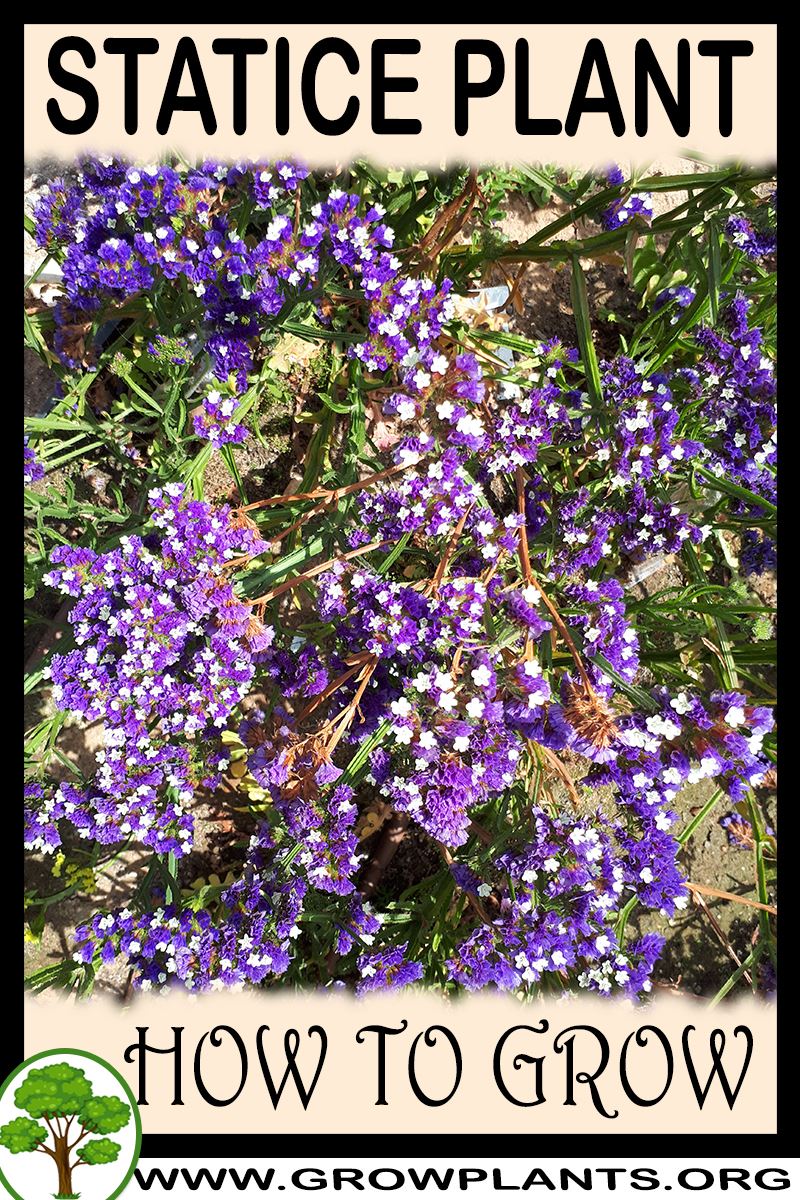


Plant Profile & Key Characteristics
Overview: Statice (Limonium sinuatum) is a rosette-forming herbaceous plant grown chiefly as an ornamental and long-lasting cut/dried flower. It is a compact, short-lived evergreen perennial (often grown as an annual) reaching about 20-70 cm.
Quick Specifications
| Specification | Attribute |
|---|---|
| Plant Type / Life Cycle | Short-lived perennial, often grown as an annual |
| Foliage Type | Evergreen |
| Mature Size | 20-70 cm tall and wide (8-28 in) |
| Growth Rate | Moderate to Fast |
| Root System | Taproot from a basal rosette |
| Hardiness | USDA zones 3-11 (grown as an annual in colder zones) |
Growth Form & Structure
- Height & Spread: Forms a low basal rosette 20-70 cm across with flower stems held above; well suited to containers.
- Growth Habit & Form: Clumping herbaceous rosette sending up branched, winged flowering stems.
- Lifespan & Maturity: Reaches flowering size in its first season; short-lived, so often treated as an annual.
Anatomy & Physical Features
- Leaves & Foliage: Green, linear leaves, often deeply lobed with a toothed margin.
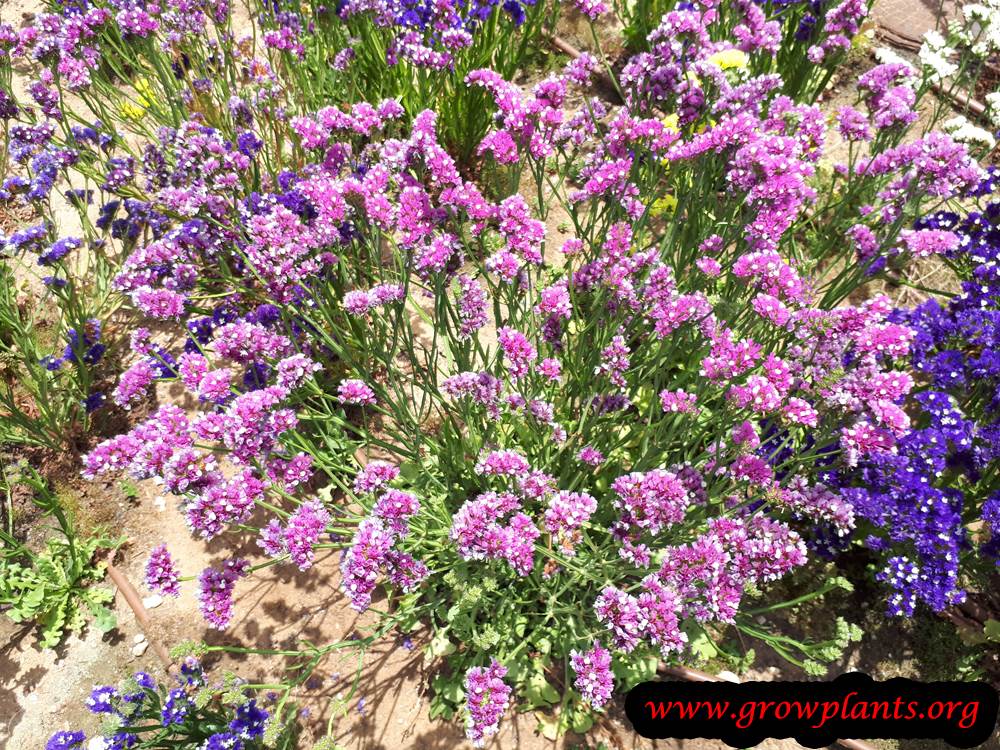
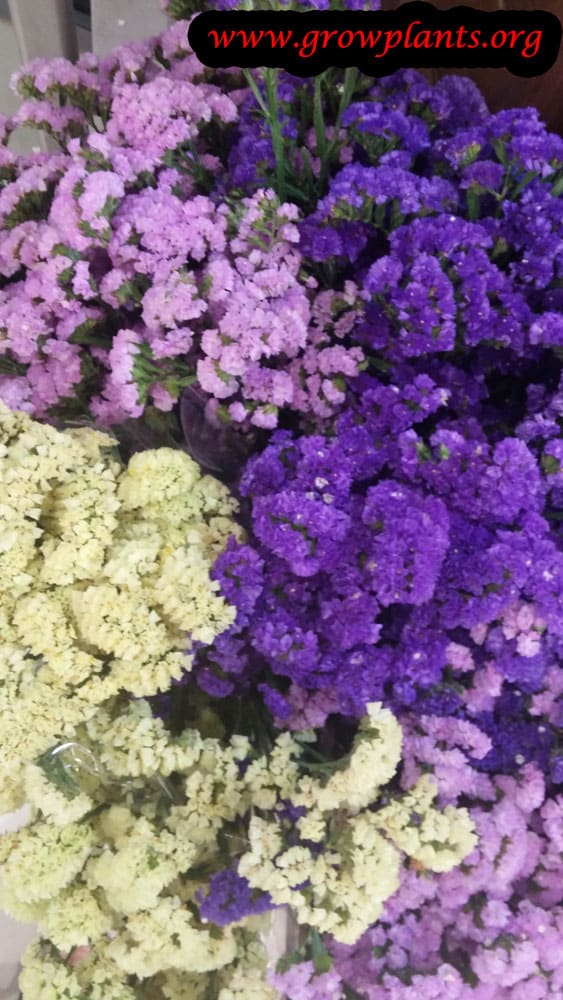
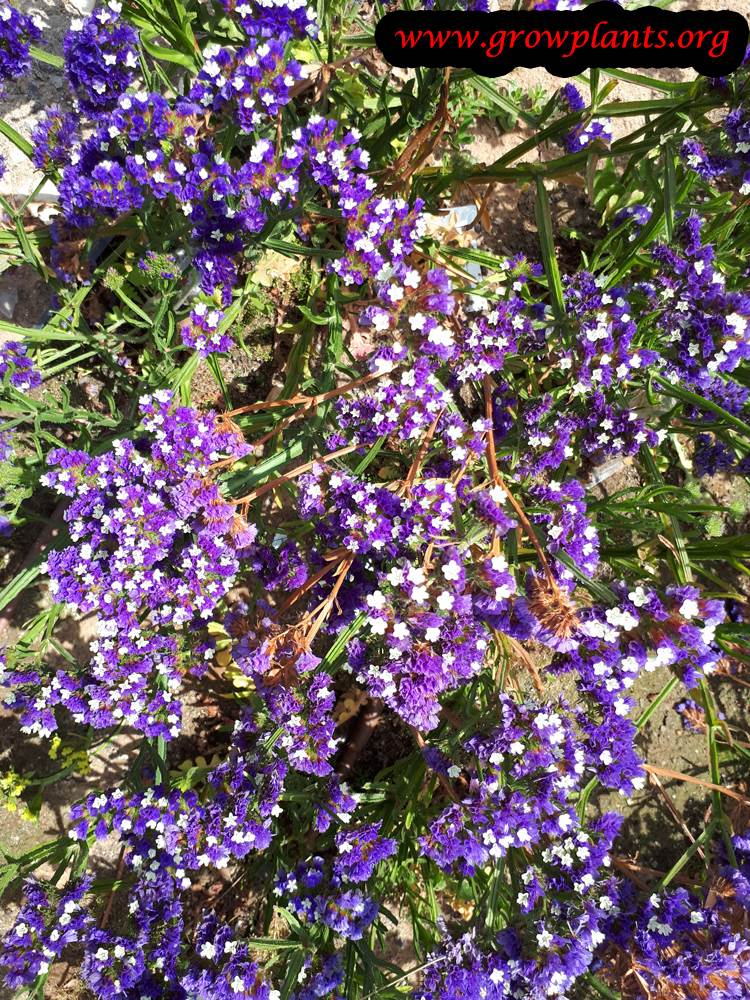
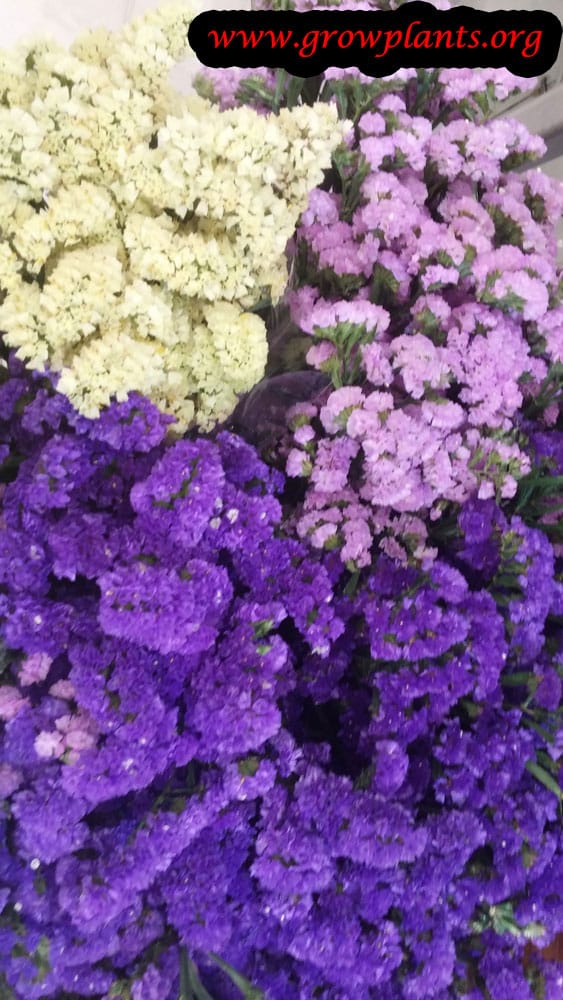
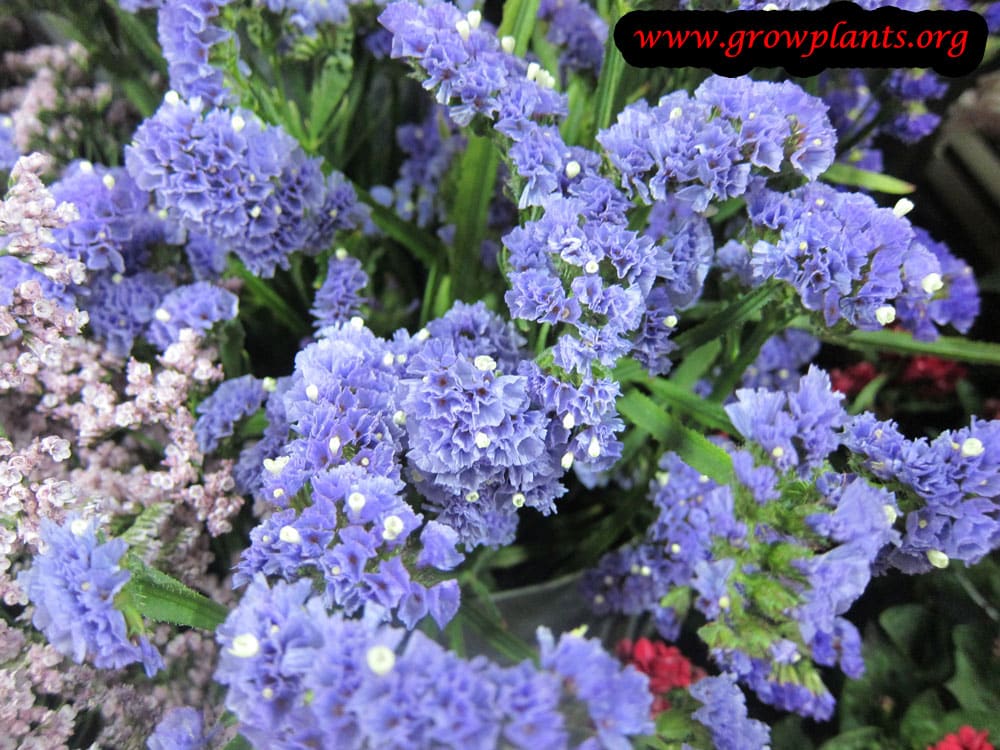
- Flower Characteristics: Small, papery (crepe-paper-like) flowers in purple, blue, pink, white or yellow, borne in dense inflorescences.
Primary Uses & Landscape Value
- Functional & Ornamental Roles: Ornamental bedding and container plant; premier fresh and dried (everlasting) cut flower. Self-seeds readily and can spread.
Care Guide: Planting, Soil & Watering
Overview: Statice (sea lavender) is a coastal, salt-tolerant plant that grows in full sun in Mediterranean, desert, subtropical, or temperate climates (hardiness zone 3-11). It needs a sandy, well-drained alkaline soil and only moderate water.
Quick Care Requirements
| Requirement | Ideal Condition |
|---|---|
| Planting Season | Spring through autumn |
| Growth Rate | Moderate to fast |
| Soil Type | Well-draining, sandy; alkaline |
| Soil pH | Alkaline |
| Water Need | Moderate; let it dry between waterings |
Planting & Establishment
- Best Planting Season: Plant from spring through autumn.
- How to Plant:
- Hole Preparation: Dig a hole about the width of the root ball, or sow seed shallowly.
- Soil Amendments: Use a sandy, free-draining soil.
- Planting Depth: Set the root collar level with the soil, or sow seed shallowly.
- Growth Speed & Expectations: A fast to moderate grower reaching about 20-70 cm (8-28 in).
Soil, Watering & Drainage Care
- Soil Mix & Drainage Needs: Use a sandy, free-draining alkaline soil; it is salt tolerant and dislikes waterlogging.
- Watering Schedule & Technique:
- Young / Newly Planted: Water moderately to help it establish.
- Established: Water moderately, letting the soil dry between waterings.
- Seasonal Adjustments: Reduce watering in winter.
Climate, Light & Hardiness
Statice is a short-lived, salt-tolerant perennial (grown as an annual in colder areas) native to coastal and alkaline habitats, thriving in mediterranean, desert, subtropical, and temperate climates. It grows best in full sun with alkaline, well-drained soil, and is broadly cold-hardy across a wide zone range.
Quick Climate Specifications
| Climate Zones | Mediterranean, desert, subtropics, temperate |
| USDA Hardiness Zones | 3–11 (behaves as a short-lived perennial in mild zones, an annual in cold ones) |
| Optimal Temp Range | Approximately 15–27°C (59–81°F) during active growth |
| Approx. Survival Minimum | In its coldest hardy zone, established plants may briefly withstand winter minimums around −40°C to −34°C (−40°F to −30°F) |
| Frost Tolerance | Moderate to High (varies with zone and whether grown as a perennial or annual) |
| Light Conditions | Full Sun |
| Wind Tolerance | High |
| Salt / Coastal Tolerance | High |
Sunlight & Light Exposure
Optimal Light Setup
Full sun gives the best flower production on strong, upright stems.
Direct Sun Requirement
Direct sun is important for abundant, long-lasting bloom.
Best Exposure / Orientation
An open, airy position with unobstructed sun suits this dry-climate, coastal-adapted plant well.
Temperature Extremes & Hardiness
USDA Hardiness & Regional Limits
Hardy as a perennial across a very wide range, USDA zone 3 through 11; in the coldest part of this range it is typically grown as a reseeding annual or short-lived perennial rather than surviving long-term outdoors.
Cold Damage & Winter Protection
Foliage can be damaged by hard freezes; where grown as a perennial in milder zones, plants generally recover from light frost without special protection.
Frost Sensitivity
Moderately frost tolerant; young seedlings are more vulnerable than established clumps.
Extreme Heat Tolerance
Very good heat tolerance in dry, sunny, mediterranean and desert summers.
Wind, Humidity & Microclimate
Humidity Preferences
Prefers relatively dry air over humid conditions, consistent with its coastal-cliff and dry-soil origins.
Dry-Air Tolerance
Tolerates dry air well.
Wind Tolerance
High wind tolerance, reflecting its native exposed coastal and dry-slope habitats.
Coastal / Salt Tolerance
Excellent salt tolerance - the Sea Lavender common name reflects its natural occurrence in coastal and even salt-marsh conditions.
Rainfall & Seasonal Moisture
Adapted to dry-summer, low-rainfall climates; good drainage is essential, especially in winter.
Microclimate Recommendations
An open, sunny, well-drained site with alkaline soil - such as a raised bed or gravelled border - best replicates its natural growing conditions.
Growing in Pots, Balconies & Indoors
Statice (Limonium) is a tough, sun-loving seaside perennial – not a houseplant, but a pretty, resilient container plant for a full-sun balcony or patio, and a long-standing favourite for cut and dried flowers.
Quick Details
- Container Size: A medium pot, roughly 5-10 L, for a 20-70 cm (8-28 in) plant
- Indoor Suitability: Not a houseplant (the grower marks it “No”); it needs full sun and open air
- Best Spot: Full sun, open and airy
- Soil & Drainage: Sandy, sharp-draining mix; it tolerates salt and poor soil
- Watering in Pots: Modest – drought tolerant once established; let it dry between waterings
Indoors & On the Windowsill
- Houseplant limits: The grower marks it as not suitable indoors. It demands full sun and good airflow, which most rooms lack, so it stretches and flowers poorly inside.
- Windowsill growing: Only the sunniest, brightest sill stands any chance, and even then blooms will be sparse.
- Overwintering: Perennial Limonium is fairly hardy; in hard-frost areas give the potted roots a sheltered spot for winter.
On a Balcony or Patio
- Light & wind: Give it full sun; it thrives in wind and coastal salt spray. Walls reflect heat and pots dry fast, but don’t overwater this drought-lover.
- Practicalities: Light and easy to move; make sure water drains away freely.
Choosing the Pot, Soil & Long-Term Care
- Pot & drainage: A pot with strong drainage holes; skip a standing water saucer to avoid root rot. Terracotta breathes and dries fast, which suits this plant.
- Potting mix: Free-draining and sandy; poor, gritty soil is fine.
- Feeding: Feed lightly – it performs well in lean soil, and heavy feeding just makes soft growth.
- Refreshing: Refresh the mix or pot up every couple of years; container plants leach nutrients faster.
Fertilizing & Feeding
A moderate feeder: steady, light feeding from establishment through the flowering season supports the long, sturdy stems this cut flower is grown for, without pushing soft growth.
Quick Fertilizing Specs
| Feeding Level | Moderate feeder |
|---|---|
| Main Nutrient Priority | Balanced feeding with adequate nitrogen and potassium for strong stems and blooms |
| Best Feeding Period | Through the growing season from establishment into flowering |
| Organic Options | Compost worked into the bed at planting and during heavy bloom |
| Micronutrients | Usually supplied by a complete fertilizer; correct specific issues only when diagnosed |
| Soil pH | Prefers alkaline to near-neutral, well-drained soil |
Feeding by Growth Stage
Establishment from seed or transplant
Build a strong root system and full rosette of leaves before flower stems form.
| Nutrient direction | A balanced, complete fertilizer with steady nutrition to establish roots and foliage. |
|---|---|
| Timing | From sowing or transplanting through early rosette growth. |
| Frequency | A light feeding as seedlings establish, continued at a steady pace as the plant fills out. |
| Fertilizer types | A balanced complete garden fertilizer, Compost worked into the bed at planting |
| Precautions | Keep feeding moderate on young plants and water in well to avoid salt stress. |
Flower stem production and bloom
Support the long, sturdy flower stems and papery blooms that make this a popular cut flower.
| Nutrient direction | Balanced feeding with adequate nitrogen and potassium supports strong stems and steady flowering; skip extra phosphorus, which doesn’t reliably boost bloom. |
|---|---|
| Timing | Through the main flowering flush, from bud formation to repeated cutting. |
| Frequency | Regular light feedings through the growing season keep stems and blooms coming. |
| Fertilizer types | A balanced complete fertilizer, Side-dressing with compost during heavy bloom |
| Precautions | Avoid heavy nitrogen alone, which can produce lush foliage at the expense of flower stems. |
Dormancy or rest between flushes
Allow the plant to rest between bloom flushes or through winter where it is grown as a short-lived perennial.
| Nutrient direction | None – withhold fertilizer while the plant is not in active growth. |
|---|---|
| Timing | Winter dormancy in cooler climates, or the lull between flowering flushes. |
| Frequency | No feeding at this stage. |
| Fertilizer types | No feeding at this stage; resume feeding when active growth returns. |
| Precautions | Do not fertilize while the plant is dormant or resting; wait for new growth to resume. |
Nutrient Deficiency Signs & Corrections
Pale or yellowing older leaves along with a reduced number of flower stems.
| Possible causes | low soil nitrogen, poor or thin planting soil, nutrient leaching from frequent watering |
|---|---|
| Appears first on | older leaves |
| What to check | feeding history, leaf color pattern, soil quality |
| Possible correction | Apply a balanced complete fertilizer and monitor for greener new growth. |
New leaves show interveinal yellowing while the veins remain green.
| Possible causes | high soil pH limiting iron availability, waterlogged roots, naturally alkaline soil |
|---|---|
| Appears first on | newest growth |
| What to check | soil pH, drainage, root health |
| Possible correction | Improve drainage and correct with a chelated iron product per its label if the pattern persists. |
Leaf tips or margins browning and stems weakening despite regular care.
| Possible causes | excess or too-frequent feeding, salt buildup from fertilizer, under-watering concentrating salts |
|---|---|
| Appears first on | leaf margins and tips |
| What to check | recent fertilizer amounts, watering consistency, drainage |
| Possible correction | Reduce the feeding rate, flush the soil with a thorough watering, then resume lighter feeding. |
Pruning, Training & Seasonal Maintenance
Statice (Limonium sinuatum) is a low, rosette-forming herbaceous plant grown mainly for its papery cut flowers, with no woody structure to manage. Because it blooms continuously from spring through autumn on new flower stems, its only real maintenance is cutting spent stems as they fade – which doubles as the cut-flower harvest – and tidying dead leaves, done on an ongoing basis rather than in one seasonal push.
Quick Pruning & Maintenance Specs
| Pruning Tolerance | Low (grooming/deadheading only) |
| Primary Pruning Window | All year, tracking the continuous bloom |
| Typical Frequency | Ongoing, as flower stems fade or are harvested |
| Main Objective | Remove spent flower stems and dead leaves; encourage continued bloom over seed-set |
| Young Plant Priority | None – let the rosette establish |
| Mature Plant Priority | Regular deadheading/harvest of flower stems at the base |
| Best Tool Type | Precision snips |
Pruning by Plant Age & Size
Newly Established
No cutting in the first weeks beyond removing any damaged nursery leaves; let the rosette bulk up before the first flower stems are harvested.
Young / Formative
No structural training – the plant forms a basal rosette on its own; the first flower stems can be cut for use once they are established.
Mature / Established
Cut flower stems at their base as they open (for use) or once they fade (for tidiness), and remove dead or browning leaves from the base of the rosette as they occur.
Seasonal Pruning Schedule
Ongoing Sanitary (Spring–Autumn bloom)
Objective: keep the plant producing new flower stems rather than setting seed, and supply cut flowers. Remove: flower stems at their base, either fresh for harvest or once faded; dead basal leaves. Do not remove: young, still-forming flower stems or the central rosette crown. Flowering impact: regular cutting favors continued stem production over seed-set, since this species is noted as self-seeding/invasive if left to go to seed.
Special Growth to Remove
- Spent (or harvest-ready) flower stems, cut at their base
- Dead or browning basal leaves
Container & Small-Space Pruning
Grows well in containers; deadhead somewhat more promptly in a pot, since the smaller root volume benefits from the plant putting energy into new blooms rather than maturing seed.
Tools
- Precision snips – the only tool needed, for cutting wiry flower stems and thin dead leaves
Tool Hygiene & Disease Risk
Routine: clean, sharp snips are sufficient. Only increase care when cutting stems showing aphid or mite activity – remove and dispose of affected stems rather than leaving them in place.
Cut Placement & Technique
Cut flower stems close to their base at the rosette rather than partway up, since this is also how the flowers are harvested for use; avoid cutting into the central crown.
Heavy Pruning & Rejuvenation
Not applicable in the woody sense – Statice has no framework to rejuvenate by hard pruning. A tired planting is renewed by replanting (if grown as an annual) or by division of an established perennial clump, not by cutting back hard.
Post-Pruning Care
No extra feeding is needed for routine deadheading; keep the crown from sitting in wet soil, since the plant prefers well-drained, alkaline soil and a damp crown is its main vulnerability.
Common Pruning Mistakes
- Leaving spent flower stems to set seed, encouraging unwanted self-seeding
- Cutting into the central rosette crown instead of removing individual stems at their base
- Overwatering after cutting back in already poorly drained soil
When NOT to Prune
Avoid removing the basal rosette leaves that fuel the next flush of bloom, and avoid cutting during prolonged wet weather given the crown’s rot risk in damp soil.
Recommended Tools (by task)
- precision_snips – deadheading and harvesting flower stems, and removing dead leaves, at any stage of growth
Propagation Guide
Statice is grown from seed, which is the standard and really the only practical method for this fast-growing, taprooted plant – it is not commonly propagated vegetatively. Seed-grown plants are generally true to type for the species, and propagation is easy.
Quick Propagation Specs
| Best Propagation Method | Seed |
| Propagation Difficulty | Easy |
| Seed True-to-Type | Yes |
| Best Propagation Season | Spring through autumn |
| Seed Germination Time | Typically 1–2 weeks |
| Germination Temperature | 18–22°C (64–72°F) |
| Seed Sowing Depth | Shallow, seed just covered or left close to the surface |
Growing from Seed
Sowing Season
Sow in spring through autumn, matching the plant’s normal planting window.
Sowing Depth & Orientation
Sow shallowly; the small seed should not be buried deeply.
Germination Conditions
Germinates best at moderate warmth around 18–22°C (64–72°F) in a free-draining seed mix.
Germination Time
Typically 1–2 weeks, though it can be slower and uneven.
Seedling Care
Because statice develops a taproot, it establishes best when sown directly in its final position or in individual plugs/cells rather than transplanted bare-root, which minimizes root disturbance.
Bloom & Flower Guide
Quick Details
- Bloom Season: Spring, summer and autumn
- Time to First Bloom: Fast – a spring sowing usually flowers the same year
- Flower Appearance: Branched sprays of papery, crepe-paper-textured flowers (purple, blue, pink, white or yellow)
- Edibility: Ornamental – a classic cut and dried “everlasting” flower, not grown to eat (generally regarded as non-toxic)
Detailed Blooming Overview
Statice (Sea lavender, Limonium sinuatum) is grown above all for its flowers. What looks like the colourful petals is really the papery calyx, and because that calyx keeps its colour long after cutting, statice is a favourite both fresh and dried – one of the best-known “everlasting” flowers. The blooms (purple, blue, pink, white or yellow) are carried in branched, flat-topped sprays held well above the rosette of foliage, from spring right through autumn.
Flower Characteristics
- Colour: purple, blue, pink, white or yellow
- Crepe-paper texture: The coloured, papery part is the persistent calyx, which holds its colour when dried
- Form: Small flowers massed in branched, winged inflorescences
- Use: Excellent as a cut flower and as a dried everlasting
Bloom Care & Thinning
- Cutting for drying: Harvest stems when most of the flowers on a spray have opened, then hang them upside down in a dry, airy place.
- Keep it cropping: Cutting and deadheading regularly encourages more flowering stems.
- Site for best bloom: Full sun and good drainage give the strongest, most colourful display.
Bloom Health & Protection
- Powdery mildew and grey mould (Botrytis): In humid, crowded plantings these can spot the flowers and stems. Better spacing and airflow, watering at the base rather than over the flowers, and – if needed – a sulfur-based fungicide all help.
Pests, Diseases & Troubleshooting
Overview: Statice and sea lavenders (Limonium) are tough, salt-tolerant coastal plants with relatively few pests, but they can be troubled by aphids, spider mites, whitefly and thrips, and by botrytis, powdery mildew, rust and – most importantly – crown and root rot in heavy, wet soils. Statice (Limonium) is grown as a cut and dried flower and shrugs off most pests when kept dry at the crown. The single best defence is sharp drainage and good air movement; they resent wet feet far more than any insect.
Quick Troubleshooting Overview
| Issue / Pest | Main Symptom | Primary Solution |
|---|---|---|
| Aphids | Sticky, distorted new shoots and flower stalks | Water jet, insecticidal soap or neem |
| Spider mites | Fine pale stippling and webbing in hot, dry spells | Rinse foliage, raise humidity, horticultural oil |
| Botrytis / crown rot | Grey mould and mushy crown in cool, wet weather | Improve drainage and airflow, remove debris |
| Powdery mildew | White powdery film on leaves and stems | Space plants, sulphur or potassium-bicarbonate spray |
| Root rot | Wilting despite moist soil, blackened roots | Fast-draining soil, ease off watering |
Common Pests & Management
- Aphids (Aphis spp. & Myzus persicae):
- Symptoms: Clusters on soft new growth and flower stems, sticky honeydew, sooty mould and puckered shoots.
- Prevention & Control: Knock off with water, then apply insecticidal soap or neem to the undersides; support ladybirds and lacewings and discourage ants.
- Two-spotted spider mite (Tetranychus urticae):
- Symptoms: Fine pale stippling that turns leaves bronze and dull, with fine webbing on undersides and shoot tips in hot, dry conditions.
- Prevention & Control: Rinse foliage regularly, raise humidity, avoid drought stress, and treat with horticultural oil or insecticidal soap, covering leaf undersides; predatory mites work well under cover.
- Whiteflies (Trialeurodes vaporariorum):
- Symptoms: Tiny white moth-like insects fly up when disturbed; sticky honeydew and sooty mould follow, and leaves yellow.
- Prevention & Control: Hang yellow sticky traps, encourage Encarsia parasitoids, and spray insecticidal soap or neem repeatedly to break the life cycle.
- Thrips (Frankliniella occidentalis):
- Symptoms: Silvery streaks and flecks on foliage and flowers, distorted blooms and black frass specks.
- Prevention & Control: Monitor with blue sticky traps, remove weeds and spent flowers, and use spinosad or insecticidal soap for outbreaks.
Diseases & Fungal Issues
- Botrytis grey mould (Botrytis cinerea):
- Symptoms: Brown collapsing patches on leaves and flower stalks with fuzzy grey spores in cool, damp, still air; opening flowers spot and rot.
- Treatment & Management: Increase spacing and airflow, avoid overhead watering, and cut out affected tissue promptly; a preventive fungicide helps only alongside these cultural steps.
- Powdery mildew (Leveillula / Erysiphe spp.):
- Symptoms: White powdery coating on leaves and stems, sometimes with yellowing and distortion in crowded, humid plantings.
- Treatment & Management: Improve air circulation and light, avoid excess nitrogen, and spray sulphur, potassium bicarbonate or a horticultural-oil solution at first sign.
- Rust (Uromyces limonii):
- Symptoms: Orange to brown powdery pustules on leaf undersides, with yellow flecking on the upper surface.
- Treatment & Management: Remove infected leaves, avoid wetting foliage, space for airflow, and use a sulphur or appropriate fungicide if it spreads.
- Crown & root rot (Rhizoctonia / Phytophthora spp.):
- Symptoms: Sudden wilting even in moist soil, a blackened rotting crown, and dark mushy roots – the classic wet-soil killer of Limonium.
- Treatment & Management: This is prevention-only: plant in very free-draining, gritty soil or raised beds, never overwater, and discard rotted plants with surrounding soil.
Growing Difficulties & Abiotic Problems
- Root rot from wet soil:
- Cause & Symptoms: Being adapted to lean, sandy coastal ground, Limonium collapses in heavy, waterlogged soil, wilting while the soil is still wet.
- Correction Strategy: Plant in gritty, fast-draining soil or raised beds, water sparingly once established, and never let the crown sit in standing water.
- Salt and lean-soil tolerance (a strength):
- Cause & Symptoms: These plants actually thrive in salty, low-fertility coastal conditions that trouble most perennials; over-rich soil makes them soft and floppy.
- Correction Strategy: Avoid heavy feeding and rich, moisture-retentive compost; a lean site gives sturdier stems and better flower colour.
- Weak, floppy stems in shade:
- Cause & Symptoms: Insufficient light produces lax growth and poor flowering.
- Correction Strategy: Grow in full sun with open spacing; these are sun-lovers and sulk in shade.
What Helps – Products & Tools
For Limonium the useful kit is small: insecticidal soap or neem oil for aphids, whitefly and thrips; horticultural oil for spider mites; sulphur or potassium-bicarbonate fungicide for powdery mildew and rust; and a copper fungicide only as a botrytis back-up. The real ‘tool’, though, is gritty, well-drained soil – most losses are rot, not pests. Spray in the evening to protect pollinators and follow the label.