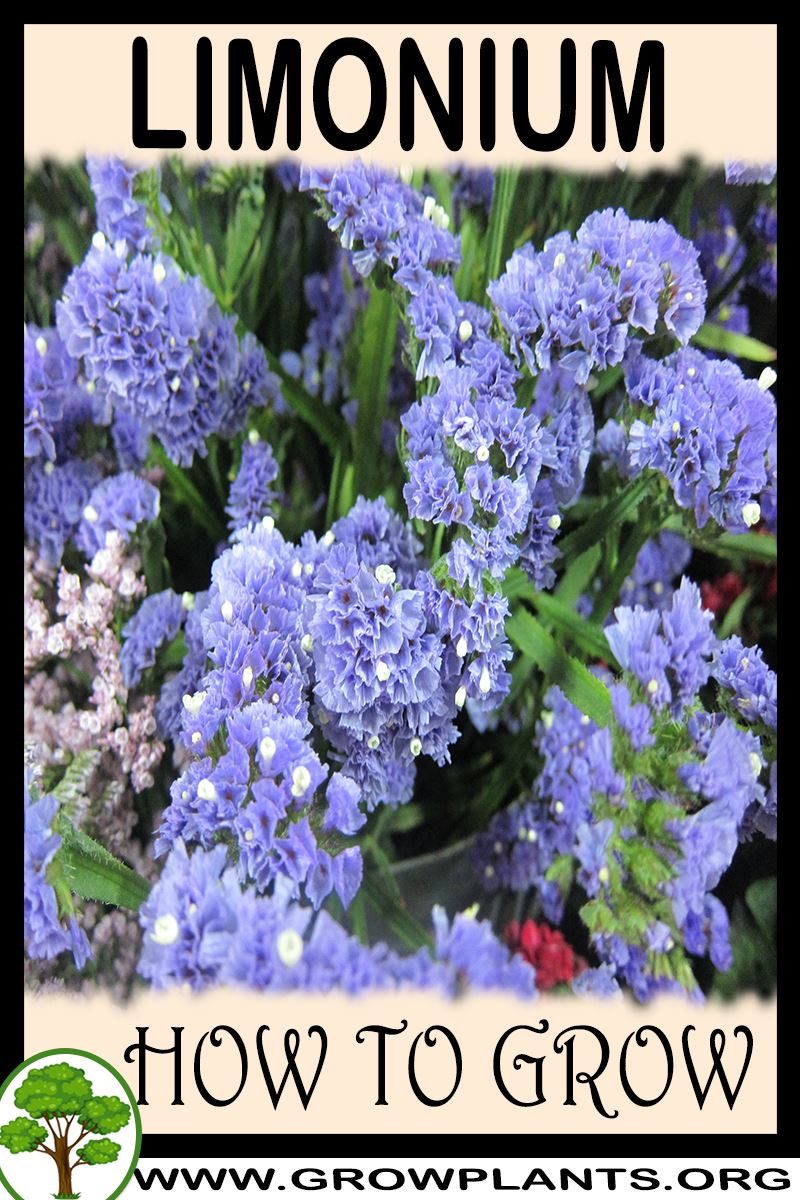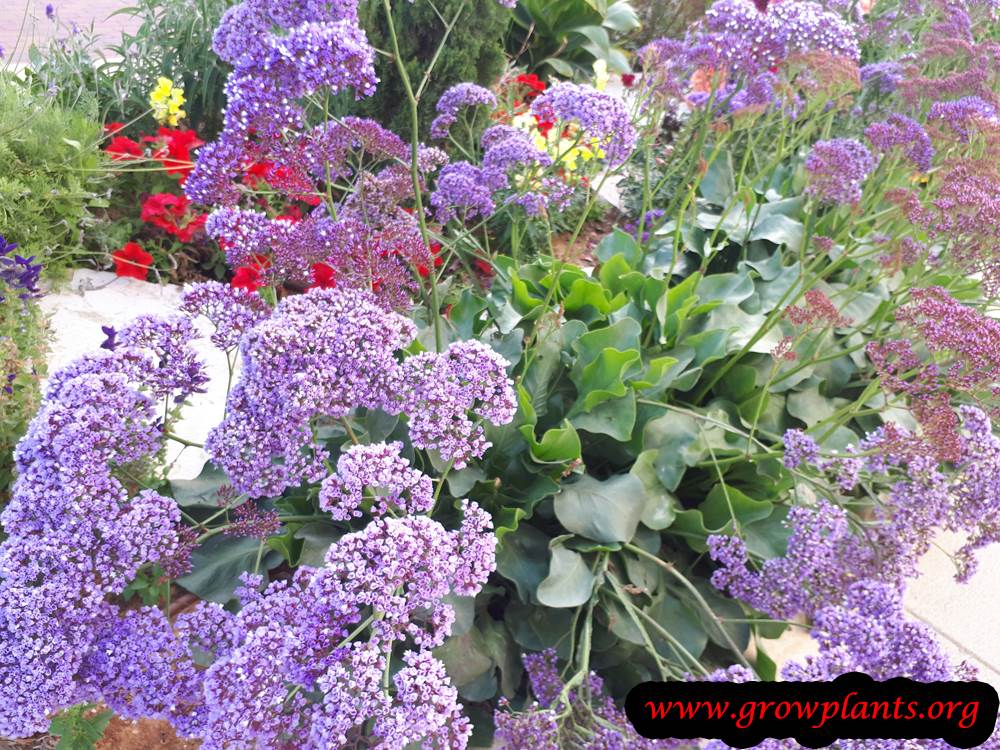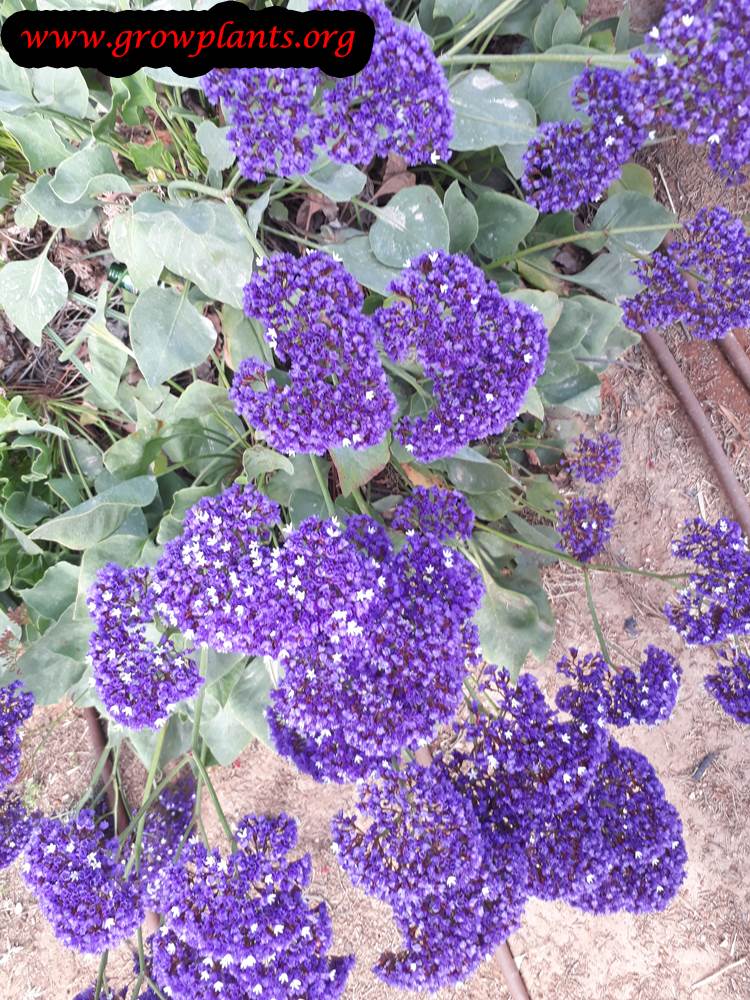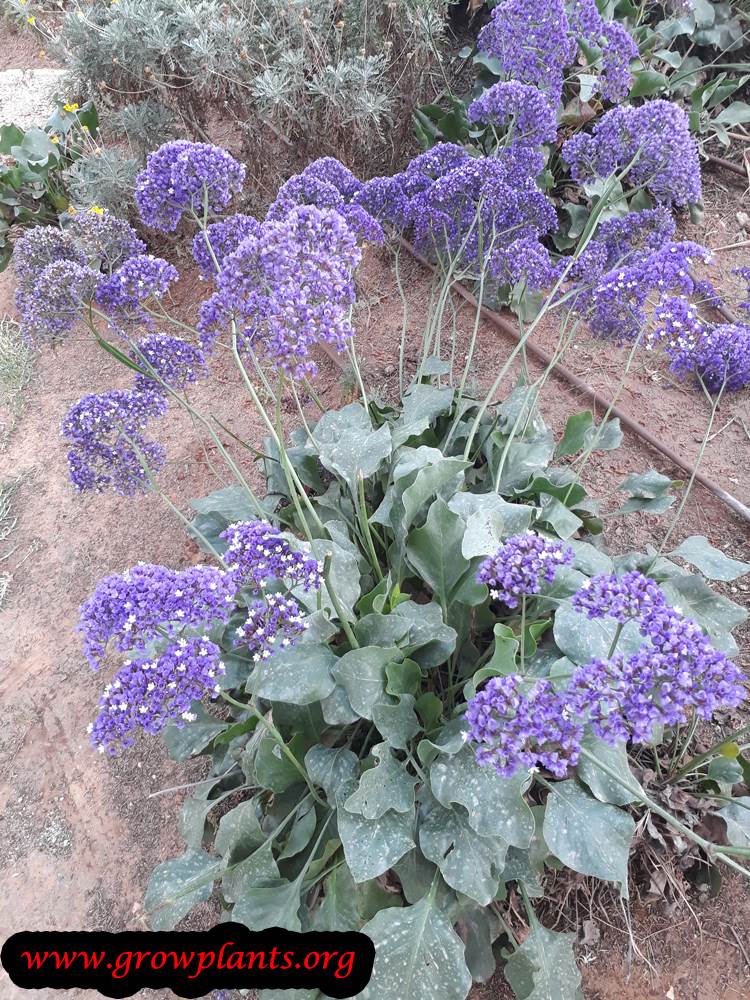
Plant Profile & Key Characteristics
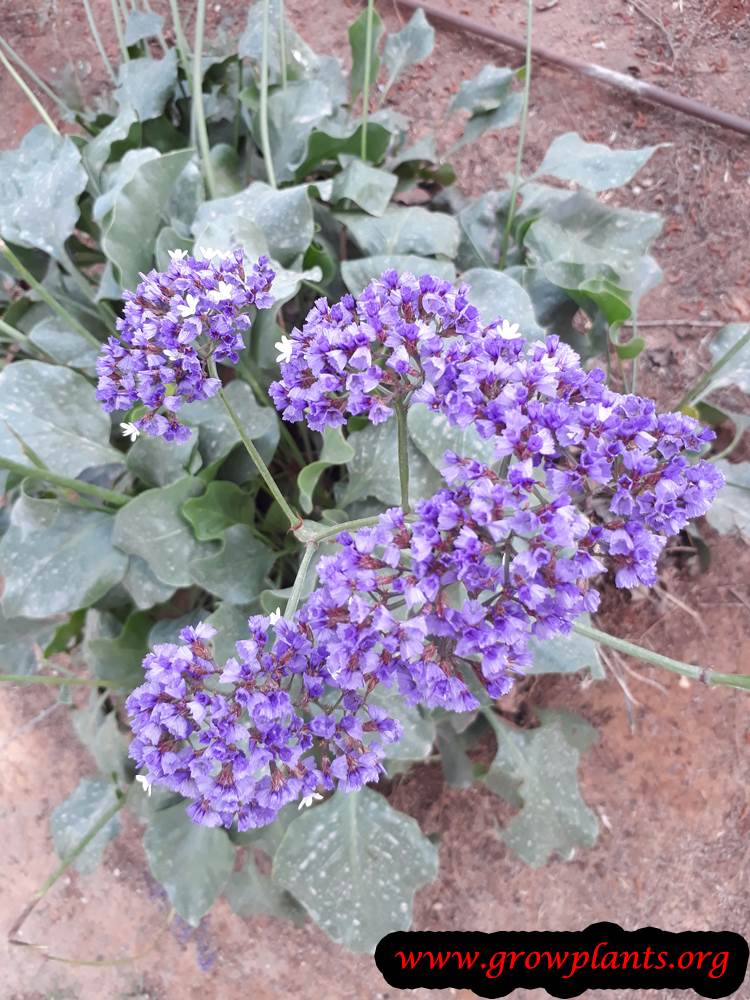
Overview: Statice / sea lavender (Limonium) is a rosette-forming herbaceous plant grown chiefly as an ornamental and long-lasting cut/dried flower. It is a compact, short-lived evergreen perennial (often grown as an annual) reaching about 20-70 cm.
Quick Specifications
| Specification | Attribute |
|---|---|
| Plant Type / Life Cycle | Short-lived perennial, often grown as an annual |
| Foliage Type | Evergreen |
| Mature Size | 20-70 cm tall and wide (8-28 in) |
| Growth Rate | Moderate to Fast |
| Root System | Taproot from a basal rosette |
| Hardiness | USDA zones 3-11 (grown as an annual in colder zones) |
Growth Form & Structure
- Height & Spread: Forms a low basal rosette 20-70 cm across with flower stems held above; well suited to containers.
- Growth Habit & Form: Clumping herbaceous rosette sending up branched, winged flowering stems.
- Lifespan & Maturity: Reaches flowering size in its first season; short-lived, so often treated as an annual.
Anatomy & Physical Features
- Leaves & Foliage: Green, linear leaves, often deeply lobed with a toothed margin.
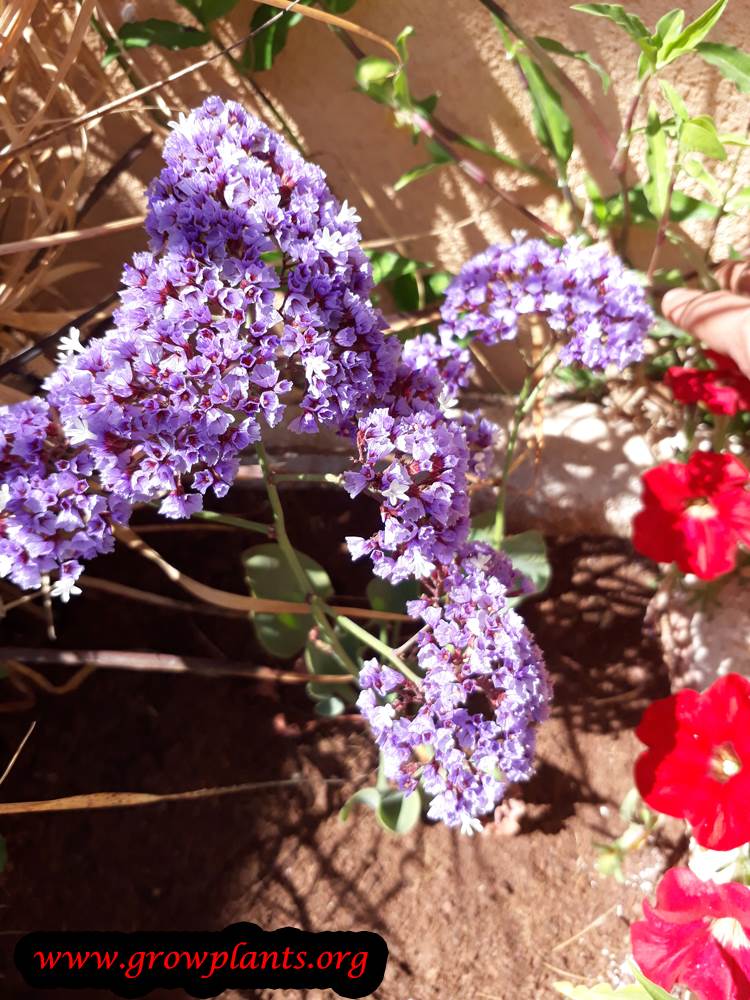
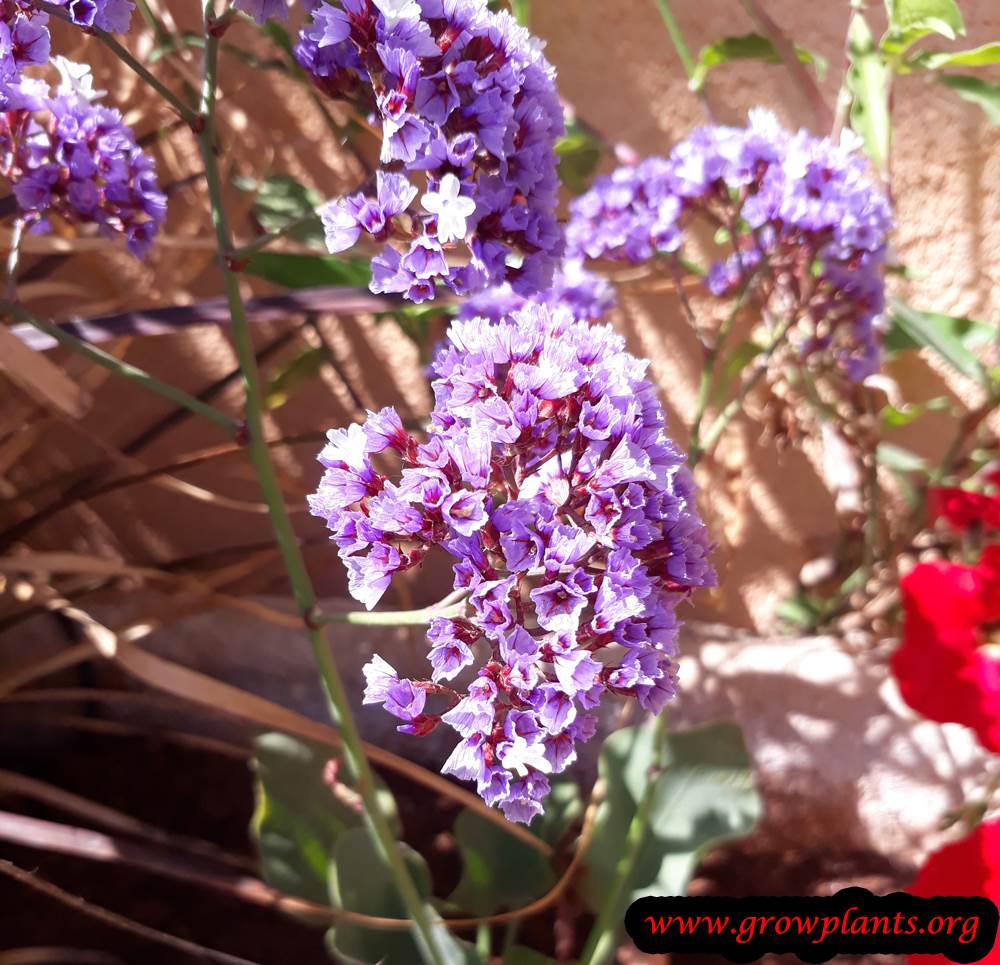
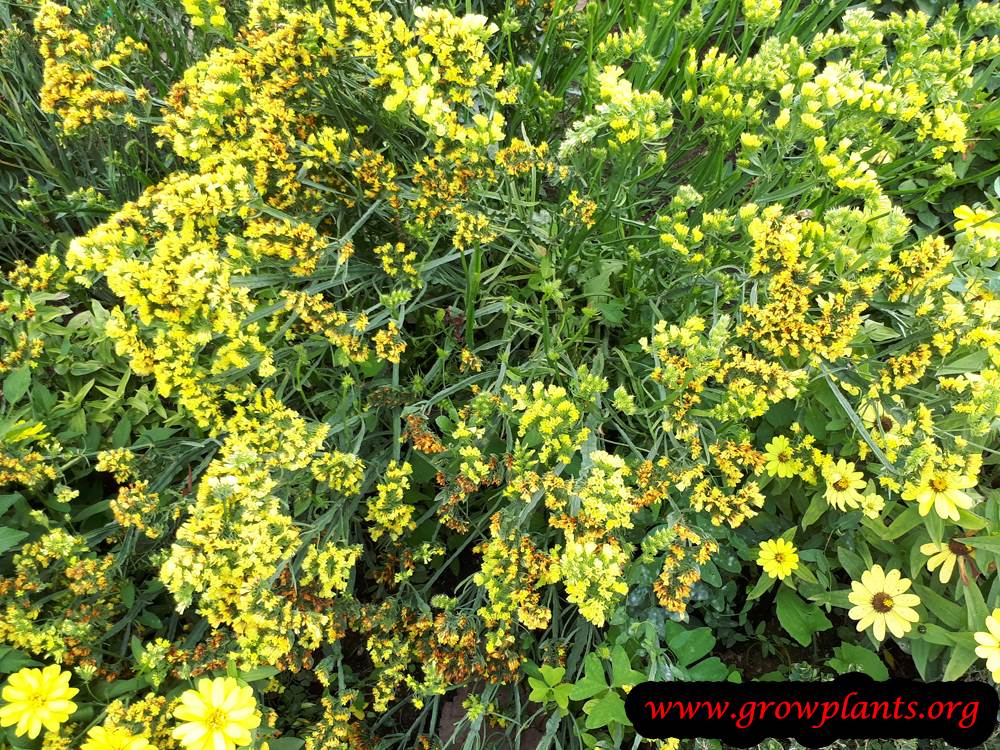
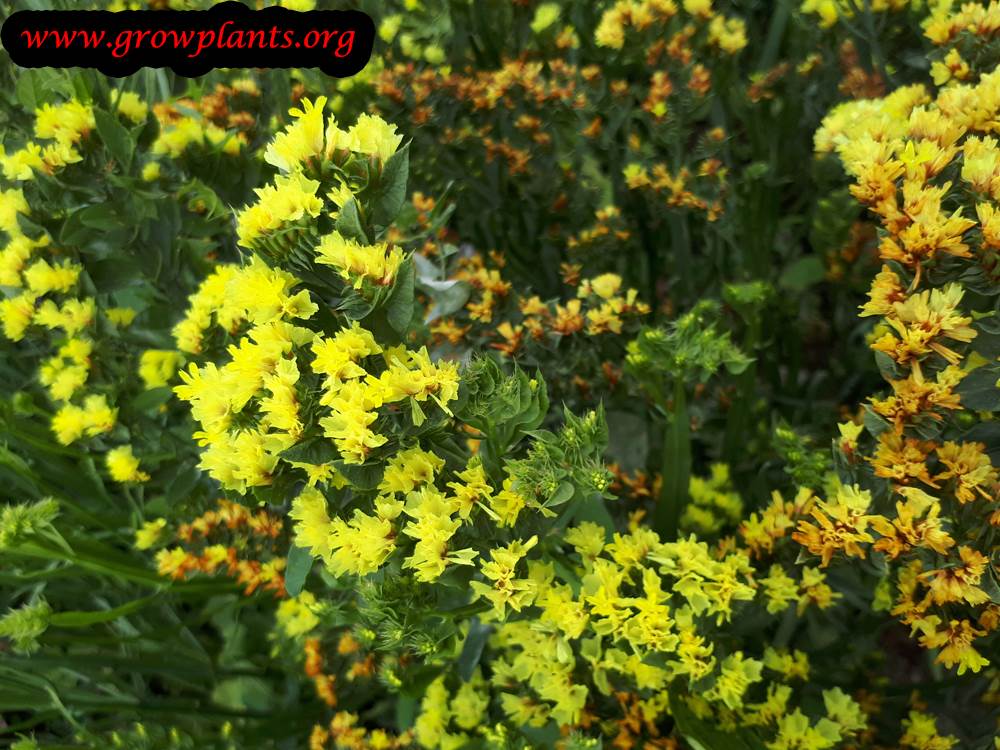
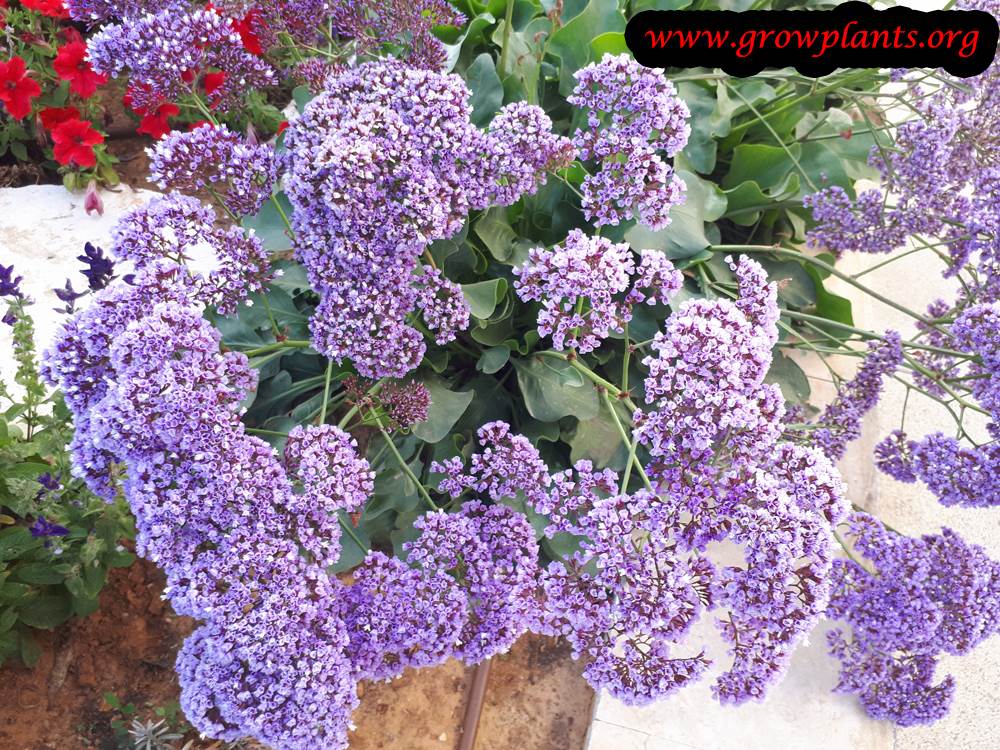
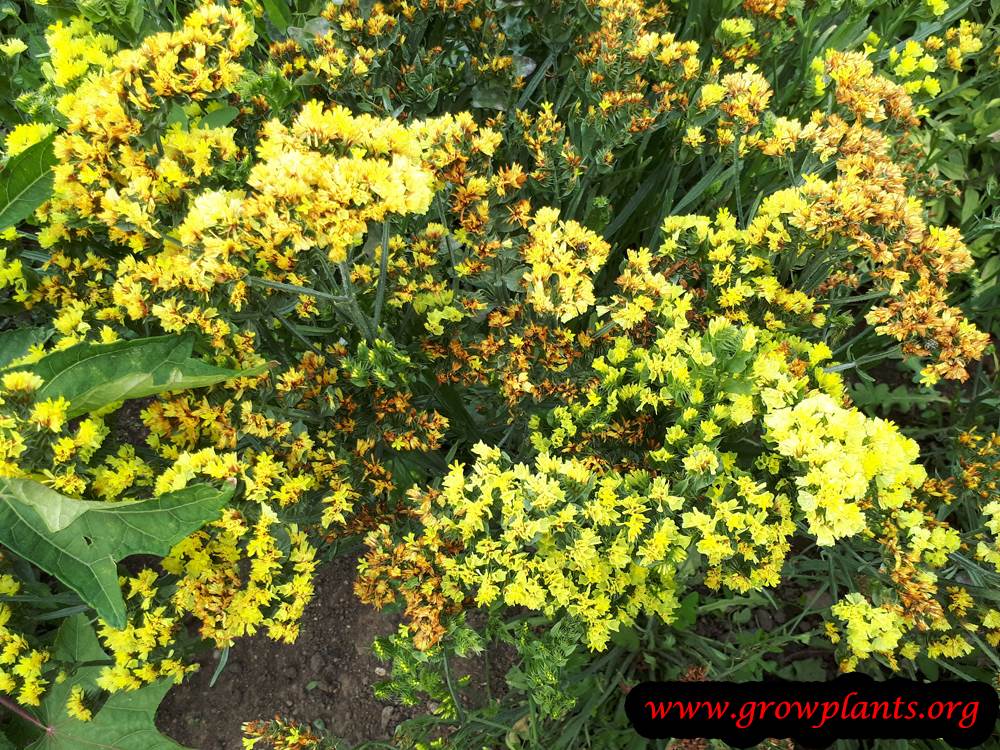
- Flower Characteristics: Small, papery (crepe-paper-like) flowers in purple, blue, pink, white or yellow, borne in dense inflorescences.
Primary Uses & Landscape Value
- Functional & Ornamental Roles: Ornamental bedding and container plant; premier fresh and dried (everlasting) cut flower. Self-seeds readily and can spread.
Care Guide: Planting, Soil & Watering
Overview: Limonium thrives in full sun and open, free-draining ground, and being a coastal genus it tolerates alkaline and even salty, sandy soils well. It needs only moderate watering and dislikes soggy conditions, so sharp drainage matters more than rich feeding.
Quick Care Requirements
| Requirement | Ideal Condition |
|---|---|
| Planting Season | Through the warm season, from spring to autumn |
| Growth Rate | Moderate to Fast |
| Soil Type | Sandy, well-draining soil; tolerates alkaline and saline conditions |
| Soil pH | Neutral to alkaline |
| Water Need | Moderate — keep the soil lightly moist, letting the surface dry between waterings |
Planting & Establishment
- Best Planting Season: Plant during the warm season, anytime from spring through autumn once the weather is settled.
- How to Plant:
- Hole Preparation: Dig a hole a little larger than the root ball and loosen the surrounding soil so young roots can spread easily.
- Soil Amendments: Work in compost or well-rotted organic matter to enrich the bed and improve both fertility and drainage. Sea lavender does not need rich soil, so keep amendments light and focus on drainage.
- Planting Depth: Set the plant at the same level it grew in its pot, with the root collar at the soil surface — do not bury the stem.
- Growth Speed & Expectations: Expect moderate to fast growth in optimal conditions, filling out quickly through the warm season.
Soil, Watering & Drainage Care
- Soil Mix & Drainage Needs: Provide open, sandy, sharply draining soil; in containers use a free-draining, gritty mix with drainage holes, as standing water quickly rots the crown.
- Watering Schedule & Technique:
- Young / Newly Planted: Water regularly after planting to keep the soil evenly moist while roots establish.
- Established: Water deeply and consistently, letting the surface dry slightly between waterings.
- Seasonal Adjustments: Water more often in summer heat and less in the cooler, wetter months.
Climate, Light & Hardiness
Statice thrives in full sun across mediterranean, desert, subtropical, and temperate climates, and is naturally at home in dry, exposed, coastal-type conditions. It tolerates a broad hardiness range, from cold-winter zone 3 gardens (as an annual) through zone 11.
Quick Climate Specifications
| Climate Zones | Mediterranean, Desert, Subtropics, Temperate |
|---|---|
| USDA Hardiness Zones | 3–11 |
| Frost Tolerance | Moderate |
| Light Conditions | Full Sun |
| Wind Tolerance | High |
| Salt / Coastal Tolerance | High |
Sunlight & Light Exposure
Optimal Light Setup
Needs full sun for compact growth and abundant papery flower clusters; shaded plants become sparse and flower poorly.
Best Exposure / Orientation
An open, unshaded bed or border suits it best; it is well suited to exposed, sun-baked sites where many other perennials struggle.
Temperature Extremes & Hardiness
USDA Hardiness & Regional Limits
As a perennial it is hardy through roughly zone 3–11 conditions, though in the coldest part of that range it is typically grown as an annual or dies back to the root over winter and resprouts in spring.
Cold Damage & Winter Protection
Foliage can be damaged by hard freezes; the crown of established plants generally survives where winters are within its hardiness range.
Wind, Humidity & Microclimate
Wind Tolerance
Naturally tolerant of open, windy sites; its low, tough rosette of leaves and wiry flower stems are not easily damaged by wind.
Coastal / Salt Tolerance
One of the classic seaside garden plants (Statice / Sea lavender), it tolerates salt spray and coastal exposure well, making it a reliable choice for beachfront or exposed coastal plantings.
Rainfall & Seasonal Moisture
Adapted to dry mediterranean and desert-type rainfall patterns; it does not need a consistently moist climate to thrive.
Growing in Pots, Balconies & Indoors
Statice (sea lavender) is a full-sun, salt- and drought-tolerant perennial the grower confirms is not a houseplant but grows well in containers. Enjoy it in a sunny pot on a patio or balcony, where its papery everlasting flowers dry beautifully – it is an outdoor plant, not a room plant.
Quick Details
- Container Size: A medium pot, 5-15 L, for a 20-70 cm plant
- Indoor Suitability: Not an indoor plant – it needs full sun
- Best Spot: Full sun on a patio or balcony
- Soil & Drainage: Sharp, free-draining, even sandy mix; it dislikes wet feet
- Watering in Pots: Average water; let the surface dry between waterings
Indoors & On the Windowsill
- Not a houseplant: A sun-loving coastal perennial that won’t thrive indoors; grow it outside.
- Windowsill: A sill is too dim for a full-sun plant.
On a Balcony or Patio
- Light & salt: Give it the sunniest, breeziest spot; it shrugs off coastal wind and salt, and pots dry fast so water when the surface dries.
- Everlastings: Cut the airy flower sprays for drying.
Choosing the Pot, Soil & Long-Term Care
- Pot & drainage: A free-draining pot with strong drainage holes and no standing-water saucer to avoid root rot; terracotta breathes and dries faster, glazed or plastic holds moisture longer.
- Potting mix: Sharp and free-draining – add grit or coarse sand.
- Feeding: Potted plants are fed more often than those in the ground, as watering steadily leaches nutrients from the mix – a light feed in the growing season.
- Repotting: Refresh the top of the mix and pot up about every couple of years, lightly trimming the root ball and top growth every couple of years.
Fertilizing & Feeding
A moderate feeder once established: balanced feeding through spring growth supports the plant into its long spring-through-autumn bloom, with lighter feeding through the flowering stretch keeping the papery flower clusters coming without pushing soft, floppy growth.
Quick Fertilizing Specs
| Feeding Level | Moderate feeder |
|---|---|
| Main Nutrient Priority | Balanced feeding through spring growth, then steady but lighter feeding to sustain the long bloom period |
| Best Feeding Period | From spring growth through the extended spring-to-autumn flowering season |
| Organic Options | Compost or well-rotted organic matter worked into well-drained soil |
| Micronutrients | Usually supplied by a complete fertilizer; correct specific issues only when diagnosed |
| Soil pH | Tolerates alkaline soil well and does not need acidifying amendments |
| Reduce/Stop Feeding | Taper off as flowering slows and growth slows going into the cooler part of the year |
Feeding by Growth Stage
Spring rosette and stem growth
Build a healthy rosette of leaves and strong flowering stems ahead of bloom.
| Nutrient direction | A balanced complete fertilizer to support steady leaf and stem development. |
|---|---|
| Timing | As new growth resumes in spring. |
| Frequency | A light feeding as growth resumes, worked into well-drained soil. |
| Fertilizer types | A balanced complete garden fertilizer, Compost or well-rotted organic matter |
| Precautions | Keep soil well drained; this plant tolerates alkaline conditions well and does not need lime or acidifying products. |
Extended flowering through summer and autumn
Sustain the long run of papery flower clusters without encouraging weak, floppy stems.
| Nutrient direction | A balanced feeding rather than a high-phosphorus ‘bloom booster’; adequate nitrogen alongside other nutrients is what keeps flowering going, not extra phosphorus. |
|---|---|
| Timing | Through the spring-to-autumn flowering period. |
| Frequency | Light, steady feeding through the bloom stretch, easing back once flowering begins to taper. |
| Fertilizer types | A balanced complete garden fertilizer |
| Precautions | Avoid overfeeding, which can produce excess soft foliage and weaker flowering stems in this naturally wiry-stemmed plant. |
Cool-season slowdown
Let growth wind down naturally as flowering finishes and the season cools.
| Nutrient direction | None – withhold fertilizer while growth is slow or dormant. |
|---|---|
| Timing | Once flowering has finished and growth slows going into winter. |
| Frequency | No feeding at this stage. |
| Fertilizer types | No feeding at this stage – resume light feeding when active spring growth returns |
| Precautions | Do not fertilize a plant that is not actively growing; unused nutrients can build up in the soil or wash away. |
Nutrient Deficiency Signs & Corrections
Leaves are pale green and overall growth and flower stem production are weaker than expected.
| Possible causes | low soil nitrogen, poor drainage limiting root function, prolonged period without feeding |
|---|---|
| Appears first on | older, lower leaves |
| What to check | recent feeding history, soil drainage, overall vigor compared to prior seasons |
| Possible correction | Resume balanced feeding during the active growing season and improve soil drainage if needed. |
Leaf margins yellow or scorch and flowering stems come thinner or fewer than usual.
| Possible causes | low soil potassium, an imbalanced, nitrogen-heavy feeding history, leaching in light, sandy soils |
|---|---|
| Appears first on | older leaf margins |
| What to check | recent feeding balance, soil texture and drainage, flowering stem quality compared to prior seasons |
| Possible correction | Shift to a balanced complete fertilizer and improve soil organic matter rather than relying on nitrogen alone. |
Growth stalls, lower leaves yellow and collapse, and flowering weakens despite feeding.
| Possible causes | poorly drained or waterlogged soil, root rot from overwatering, nutrient uptake blocked by damaged roots rather than a true feeding shortfall |
|---|---|
| Appears first on | lower leaves and the root zone |
| What to check | soil drainage and recent rainfall or irrigation, root condition if the plant can be checked, whether symptoms improve after feeding or persist regardless |
| Possible correction | Improve drainage before adjusting feeding, since this plant is intolerant of wet, poorly drained soil. |
Pruning, Training & Seasonal Maintenance
Limonium (statice, sea lavender) is a low, clump-forming herbaceous perennial (sometimes grown as an annual) with no woody framework to shape, so it tolerates a lot of light, ongoing maintenance rather than any structural cutting. The main jobs are removing spent flower stems and dead basal leaves and, since the plant can self-seed freely, deadheading before seed drop if you don’t want it to spread. This upkeep can be done safely at almost any time of year and simply keeps new bloom stalks coming from the basal rosette – it never affects a permanent framework the way pruning a shrub or tree would.
Quick Pruning & Maintenance Specs
| Pruning Tolerance | High – low bulk, regrows quickly from the crown |
| Primary Pruning Window | Ongoing, year-round |
| Typical Frequency | Light and frequent – every few weeks while in bloom |
| Main Objective | Prolong bloom / cut-flower harvest and keep the rosette tidy |
| Young Plant Priority | None – let the rosette establish |
| Mature Plant Priority | Deadhead spent stems; remove dead leaves |
| Best Tool Type | Precision snips |
| Avoid Heavy Pruning During | The first few weeks after transplanting |
Pruning by Plant Age & Size
Newly Established
Remove only damaged or discoloured leaves; do not cut into the young rosette while it is building its root system.
Young / Formative
No structural training – Limonium has a basal-rosette habit with no leader, cane, or vine to form.
Mature / Established
Routine deadheading of spent flower stems at the base to prolong flowering and, since the species can self-seed, to stop unwanted seedlings.
Seasonal Pruning Schedule
Ongoing Sanitary
Objective: keep the crown tidy and extend the bloom period.
Remove: dead or browning basal leaves; spent flower stems cut back to the rosette.
Do not remove: healthy young leaves at the crown.
Expected response: continued stem production from the crown through the growing season.
Flowering impact: prompt removal of spent stems redirects the plant’s energy into new bloom stalks instead of seed set.
Special Growth to Remove
- Spent flower stems – cut at the base once the bracts fade, both to tidy the plant and to harvest for cut-flower use.
- Dead or browned basal leaves.
- Spent flowerheads before they set seed, if self-sown seedlings are not wanted – Limonium is noted to spread readily this way.
Container & Small-Space Pruning
In a pot the limited soil volume pushes the plant to flower and set seed faster, so deadhead more often than an in-ground planting. Keep the rosette compact by removing outer dead leaves; there is no root-pruning or hard cutback routine to apply since the plant has no woody base.
Tools
Precision snips are sufficient for every cut this plant needs – stems are soft and thin, so no loppers or saw are ever required.
Tool Hygiene & Disease Risk
Routine – clean, sharp snips are enough. No transmissible pruning-borne disease is documented for Limonium.
Cut Placement & Technique
Cut flower stems back to the base of the rosette, just above a healthy set of basal leaves; never cut into the central crown, which is the plant’s only growing point.
Heavy Pruning & Rejuvenation
Limonium does not need or tolerate hard structural rejuvenation – it is herbaceous with no framework to renew. If a clump becomes congested or woody at the crown after several years, divide it in spring rather than attempting a hard cutback.
Post-Pruning Care
Minimal – a light watering after a deadheading flush is enough; no feeding is needed simply because stems were trimmed.
Common Pruning Mistakes
- Letting spent stems set seed, leading to unwanted self-sown seedlings.
- Cutting into the central crown and damaging the plant’s only growing point.
- Trimming hard immediately after transplanting, before roots are established.
When NOT to Prune
Avoid cutting the plant back in the first few weeks after transplanting, and never cut into the crown itself at any time of year.
Recommended Tools (by task)
- precision_snips – deadheading spent stems and harvesting flowers for cut-flower use; clean, angled cuts on soft, thin stems.
Propagation Guide
Limonium is most reliably grown from seed, sown directly or started as seedlings and transplanted; vegetative propagation is not required, which fits this plant’s typically taprooted, non-clumping growth habit that doesn’t lend itself to division or cuttings. Propagation is Easy, though seed from named colored selections can vary somewhat in flower color compared with the parent plant.
Quick Propagation Specs
| Best Propagation Method | Seed (direct sow or seedling/transplant) |
| Propagation Difficulty | Easy |
| Seed True-to-Type | Usually true-to-type for the species; cultivar-dependent for named color selections |
| Best Propagation Season | Spring, summer or autumn |
| Seed Germination Time | Typically a few weeks, though timing can vary and emergence is often staggered |
| Germination Temperature | Moderate, roughly 18–22°C (64–72°F) |
| Seed Sowing Depth | Shallow – press seed lightly into the surface rather than burying it deeply |
Growing from Seed
Sowing Season
Sow in spring, summer or autumn.
Sowing Depth & Orientation
Sow shallowly; do not bury seed deeply.
Germination Conditions
Germinate at moderate warmth in a sunny, well-drained position; avoid waterlogging, since this plant prefers well-drained, alkaline soil once established.
Germination Time
Germination is generally slow to moderate and can be uneven; allow a few weeks and expect staggered emergence.
Seedling Care
Grow seedlings on before transplanting. Per the site’s own difficulty note this plant can behave as invasive in favorable conditions, so remove unwanted self-sown volunteer seedlings if spread is a concern.
Bloom & Flower Guide
Quick Details
- Bloom Season: Spring, summer and autumn
- Flower Appearance: Papery, crepe-paper-like flowers in purple, blue, pink, white or yellow, massed on branched heads
- Edibility: Grown as a cut and dried flower, not eaten
Detailed Blooming Overview
Statice, or sea lavender, is prized for its long-lasting, papery flowers held in airy branched sprays above a low rosette of leaves. The colourful part is largely the dry, crepe-textured calyx, which is why the blooms hold their colour so well when dried – making this a classic “everlasting” cut flower. It flowers over a long season and thrives in sun and free-draining, even salty soils.
Flower Characteristics
- Small papery flowers in purple, blue, pink, white or yellow.
- Massed on branched, winged flower stems in flat-topped sprays.
- Hold their colour exceptionally well, fresh or dried.
Bloom Care & Thinning
- Pollination: Bees and other insects visit the open sprays.
- Managing the bloom: Cut stems for drying just as the flowers open fully; regular cutting encourages more sprays.
Pests, Diseases & Troubleshooting
Overview: Statice and sea lavenders (Limonium) are tough, salt-tolerant coastal plants with relatively few pests, but they can be troubled by aphids, spider mites, whitefly and thrips, and by botrytis, powdery mildew, rust and – most importantly – crown and root rot in heavy, wet soils. As a genus, Limonium is coastal and salt-hardy, so its problems are overwhelmingly rot-related rather than insect-related. The single best defence is sharp drainage and good air movement; they resent wet feet far more than any insect.
Quick Troubleshooting Overview
| Issue / Pest | Main Symptom | Primary Solution |
|---|---|---|
| Aphids | Sticky, distorted new shoots and flower stalks | Water jet, insecticidal soap or neem |
| Spider mites | Fine pale stippling and webbing in hot, dry spells | Rinse foliage, raise humidity, horticultural oil |
| Botrytis / crown rot | Grey mould and mushy crown in cool, wet weather | Improve drainage and airflow, remove debris |
| Powdery mildew | White powdery film on leaves and stems | Space plants, sulphur or potassium-bicarbonate spray |
| Root rot | Wilting despite moist soil, blackened roots | Fast-draining soil, ease off watering |
Common Pests & Management
- Aphids (Aphis spp. & Myzus persicae):
- Symptoms: Clusters on soft new growth and flower stems, sticky honeydew, sooty mould and puckered shoots.
- Prevention & Control: Knock off with water, then apply insecticidal soap or neem to the undersides; support ladybirds and lacewings and discourage ants.
- Two-spotted spider mite (Tetranychus urticae):
- Symptoms: Fine pale stippling that turns leaves bronze and dull, with fine webbing on undersides and shoot tips in hot, dry conditions.
- Prevention & Control: Rinse foliage regularly, raise humidity, avoid drought stress, and treat with horticultural oil or insecticidal soap, covering leaf undersides; predatory mites work well under cover.
- Whiteflies (Trialeurodes vaporariorum):
- Symptoms: Tiny white moth-like insects fly up when disturbed; sticky honeydew and sooty mould follow, and leaves yellow.
- Prevention & Control: Hang yellow sticky traps, encourage Encarsia parasitoids, and spray insecticidal soap or neem repeatedly to break the life cycle.
- Thrips (Frankliniella occidentalis):
- Symptoms: Silvery streaks and flecks on foliage and flowers, distorted blooms and black frass specks.
- Prevention & Control: Monitor with blue sticky traps, remove weeds and spent flowers, and use spinosad or insecticidal soap for outbreaks.
Diseases & Fungal Issues
- Botrytis grey mould (Botrytis cinerea):
- Symptoms: Brown collapsing patches on leaves and flower stalks with fuzzy grey spores in cool, damp, still air; opening flowers spot and rot.
- Treatment & Management: Increase spacing and airflow, avoid overhead watering, and cut out affected tissue promptly; a preventive fungicide helps only alongside these cultural steps.
- Powdery mildew (Leveillula / Erysiphe spp.):
- Symptoms: White powdery coating on leaves and stems, sometimes with yellowing and distortion in crowded, humid plantings.
- Treatment & Management: Improve air circulation and light, avoid excess nitrogen, and spray sulphur, potassium bicarbonate or a horticultural-oil solution at first sign.
- Rust (Uromyces limonii):
- Symptoms: Orange to brown powdery pustules on leaf undersides, with yellow flecking on the upper surface.
- Treatment & Management: Remove infected leaves, avoid wetting foliage, space for airflow, and use a sulphur or appropriate fungicide if it spreads.
- Crown & root rot (Rhizoctonia / Phytophthora spp.):
- Symptoms: Sudden wilting even in moist soil, a blackened rotting crown, and dark mushy roots – the classic wet-soil killer of Limonium.
- Treatment & Management: This is prevention-only: plant in very free-draining, gritty soil or raised beds, never overwater, and discard rotted plants with surrounding soil.
Growing Difficulties & Abiotic Problems
- Root rot from wet soil:
- Cause & Symptoms: Being adapted to lean, sandy coastal ground, Limonium collapses in heavy, waterlogged soil, wilting while the soil is still wet.
- Correction Strategy: Plant in gritty, fast-draining soil or raised beds, water sparingly once established, and never let the crown sit in standing water.
- Salt and lean-soil tolerance (a strength):
- Cause & Symptoms: These plants actually thrive in salty, low-fertility coastal conditions that trouble most perennials; over-rich soil makes them soft and floppy.
- Correction Strategy: Avoid heavy feeding and rich, moisture-retentive compost; a lean site gives sturdier stems and better flower colour.
- Weak, floppy stems in shade:
- Cause & Symptoms: Insufficient light produces lax growth and poor flowering.
- Correction Strategy: Grow in full sun with open spacing; these are sun-lovers and sulk in shade.
What Helps – Products & Tools
For Limonium the useful kit is small: insecticidal soap or neem oil for aphids, whitefly and thrips; horticultural oil for spider mites; sulphur or potassium-bicarbonate fungicide for powdery mildew and rust; and a copper fungicide only as a botrytis back-up. The real ‘tool’, though, is gritty, well-drained soil – most losses are rot, not pests. Spray in the evening to protect pollinators and follow the label.