


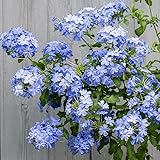


Plant Profile & Key Characteristics
Overview: Plumbago europaea (Common leadwort) is an evergreen flowering shrub or scrambling climber reaching 1-2 m (3-6 ft). This fast- to moderate-growing, drought-tolerant perennial is grown as an ornamental for its long display of five-petalled flowers.
Quick Specifications
| Specification | Attribute |
|---|---|
| Plant Type / Life Cycle | Perennial (evergreen) |
| Foliage Type | Evergreen |
| Mature Size | 1-2 m (3-6 ft) |
| Growth Rate | Fast to moderate |
| Hardiness | USDA zone 8+ |
Growth Form & Structure
- Height & Spread: 1-2 m (3-6 ft) as a loose shrub or, with support, trained as a scrambling climber; well suited to large containers.
- Growth Habit & Form: Sprawling, semi-woody shrub or scrambling climber with slender, arching stems.
- Lifespan & Maturity: Fast to establish and long-lived; can spread vigorously where conditions suit it.
Anatomy & Physical Features
- Leaves & Foliage: Green, elliptic leaves with a slightly wavy surface.
- Flower Characteristics: Purple to pink five-petalled flowers with a sticky calyx, carried in clusters through spring, summer and autumn.
Primary Uses & Landscape Value
- Functional & Ornamental Roles: Ornamental flowering hedge, screen or bank cover, and container plant; valued for drought tolerance.
Care Guide: Planting, Soil & Watering
Overview: Plumbago thrives in full sun to light shade in light, well-draining soil, and once established it is notably drought tolerant. It needs only low to moderate watering and prefers soil that dries out between drinks rather than staying constantly wet.
Quick Care Requirements
| Requirement | Ideal Condition |
|---|---|
| Planting Season | Spring through autumn, ideally in spring after the last frost once the soil has warmed |
| Growth Rate | Moderate to fast |
| Soil Type | Light, well-draining soil; tolerates poor and sandy ground |
| Water Need | Low to moderate — drought tolerant; let the soil dry between waterings |
Planting & Establishment
- Best Planting Season: Plant in spring once the danger of frost has passed and the soil has warmed; within its frost-free range it can also go in through summer and autumn. Establishing in the warm season lets the roots settle before cooler weather.
- How to Plant:
- Hole Preparation: Dig a hole about twice as wide as the root ball and just as deep, loosening the surrounding soil so young roots can spread easily.
- Soil Amendments: Mix a little compost or well-rotted organic matter into the backfill to feed the plant and improve drainage; lighten heavy clay with added grit or coarse sand.
- Planting Depth: Set the plant so the top of the root ball sits level with the surrounding soil — keep the root collar at grade and never bury the stem.
- Growth Speed & Expectations: A vigorous grower that puts on height quickly in warm conditions, filling out into a mounding shrub or scrambling climber within a season or two.
Soil, Watering & Drainage Care
- Soil Mix & Drainage Needs: Provide light, airy, free-draining soil; in containers use a quality free-draining potting mix and make sure the pot drains freely, as soggy soil invites root rot.
- Watering Schedule & Technique:
- Young / Newly Planted: Water regularly after planting to settle the roots, keeping the soil lightly moist while the plant establishes over the first few weeks.
- Established: Once established, water deeply but infrequently, letting the top few centimetres of soil dry out before watering again — it copes well with dry spells.
- Seasonal Adjustments: Increase watering during prolonged heat and cut right back in cool or wet weather; established plants need very little supplemental water in winter.
Climate, Light & Hardiness
Plumbago europaea is a drought-tolerant, subtropical-to-warm-temperate evergreen shrub or scrambling climber that grows best in full sun to half shade. It is frost-tender to varying degrees by species and is reliably hardy outdoors only from about USDA zone 8+ and warmer.
Quick Climate Specifications
| Climate Zones | Subtropics, mediterranean, temperate, desert, tropics |
| USDA Hardiness Zones | 8+ and warmer |
| Optimal Temp Range | Approximately 18–29°C (64–85°F) during active growth |
| Approx. Survival Minimum | Established plants may briefly tolerate winter minimums around −12°C to −7°C (10°F to 20°F), reflecting its zone 8 rating; cold tolerance varies by cultivar, plant age, and exposure duration |
| Frost Tolerance | Moderate |
| Light Conditions | Full sun to half shade |
| Wind Tolerance | Moderate |
| Salt / Coastal Tolerance | Moderate |
Sunlight & Light Exposure
Optimal Light Setup
Full sun gives the heaviest, longest bloom; a site with several hours of direct light daily is ideal.
Direct Sun Requirement
Direct sun encourages the strongest flowering flush, though the plant tolerates half shade with somewhat lighter bloom.
Shade & Heat Management
In the hottest, most intense-sun climates, light afternoon shade can prevent leaf scorch without significantly reducing flowering.
Best Exposure / Orientation
As a 1–2 m (3–6 ft) shrub or climber, a warm, sheltered, south- or west-facing wall or fence line supports both growth habit and cold protection.
Temperature Extremes & Hardiness
USDA Hardiness & Regional Limits
Reliably grown outdoors from about zone 8+ and warmer; in marginal zones at the cold edge of its range it is best given a sheltered, warm microclimate such as a south-facing wall.
Cold Damage & Winter Protection
Foliage and stem tips are damaged by frost; in borderline climates the plant may die back to the base in winter and resprout from the roots in spring if the root zone stays above its survival threshold.
Frost Sensitivity
Frost-sensitive as a subtropical evergreen; young, newly planted specimens are more vulnerable to cold than mature, established plants.
Extreme Heat Tolerance
Good heat tolerance in subtropical, mediterranean, and desert summers, provided root moisture is adequate.
Wind, Humidity & Microclimate
Humidity Preferences
Adapts to both humid subtropical conditions and drier mediterranean or desert air.
Dry-Air Tolerance
Tolerates dry air well once established, in keeping with its drought-tolerant nature.
Wind Tolerance
Moderate wind tolerance; as a scrambling shrub or climber it benefits from a wall, fence, or trellis for support in exposed sites.
Coastal / Salt Tolerance
Generally moderate tolerance of coastal exposure; some protection from direct salt spray is preferable for best appearance.
Rainfall & Seasonal Moisture
Well suited to climates with dry summers and adequate drainage in winter; it does not tolerate waterlogged soil.
Microclimate Recommendations
A warm, sunny, sheltered spot - such as against a south-facing wall in cooler parts of its range - extends the zones where it can be grown successfully.
Growing in Pots, Balconies & Indoors
Plumbago is a vigorous, sun-loving shrub and scrambler – not a houseplant, but a superb large container plant for a hot patio or balcony, where it flowers for months. Indoors the light is far too weak; the real value of growing it in a pot is that a frost-tender plant can be moved under cover for winter.
Quick Details
- Container Size: A large, sturdy pot – this is a big shrub (1-2 m / 3-6 ft), so give it room and pot up as it grows
- Indoor Suitability: Not a houseplant (the grower marks it “No”); a full-sun plant that turns leggy and flowerless in indoor light
- Best Spot: Full sun to light shade, warm and sheltered
- Soil & Drainage: Open, free-draining potting mix; strong drainage holes
- Watering in Pots: Moderate – drought tolerant once established, but pots dry faster; water in heat, ease off in cool weather
Indoors & On the Windowsill
- Houseplant limits: The grower marks it as not suitable indoors. It needs full sun and grows lax and shy-flowering in the low light of a room.
- Overwintering indoors: This is the main reason to pot it. In cold climates it is frost-tender, so move the container into a bright, frost-free room, porch or conservatory for winter, cut back on watering, and return it outdoors once frost has passed.
On a Balcony or Patio
- Light & wind: Give it the hottest, sunniest wall – it loves reflected heat. As a lax scrambler it benefits from a trellis, obelisk or tie-in, and some shelter from strong wind.
- Practicalities: A big pot of Plumbago is heavy – stand it where you won’t need to move it far, and raise it on pot feet so water drains away.
Choosing the Pot, Soil & Long-Term Care
- Pot & drainage: A large pot with strong drainage holes; skip a standing water saucer to avoid root rot. Terracotta breathes and dries faster; glazed or plastic holds moisture longer.
- Potting mix: An open, aerated organic mix – for example coir or peat with perlite.
- Feeding: Potted plants use up their food fast and nutrients leach out – feed regularly through the growing season for continuous bloom.
- Pruning & repotting: Prune hard in the cool/dormant season to keep it shapely and within the pot; pot up or refresh the mix every couple of years.
Safety
- Irritant sap: Plumbago sap and leaves can irritate skin and are mildly toxic if eaten – keep it away from children and pets, and wear gloves when pruning.
Fertilizing & Feeding
Common leadwort is a vigorous evergreen shrub grown for its purple-to-pink flowers across a long spring-to-autumn season; moderate, steady feeding through the growing months supports the extended bloom, easing off as the plant slows into winter.
Quick Fertilizing Specs
| Feeding Level | Moderate feeder |
|---|---|
| Main Nutrient Priority | Balanced feeding with adequate nitrogen to support leafy growth and sustained flowering |
| Best Feeding Period | Spring through the long spring-to-autumn bloom season |
| Organic Options | Compost or well-rotted organic matter worked around the root zone |
| Reduce/Stop Feeding | Ease off as growth slows heading into the winter pruning season |
| Micronutrients | Usually supplied by a complete fertilizer and organic matter; correct only a diagnosed deficiency |
| Soil pH | Adaptable across a wide range of well-drained soils |
Feeding by Growth Stage
Spring growth flush
Push out vigorous new stems and foliage as this shrub comes out of winter dormancy.
| Nutrient direction | A balanced, complete fertilizer with adequate nitrogen supports the flush of new growth after winter pruning. |
|---|---|
| Timing | As new growth begins in spring, following the winter prune. |
| Frequency | A feeding at the start of active growth sets the plant up for the season. |
| Fertilizer types | A balanced, complete fertilizer, Compost or organic matter worked into the root zone |
| Precautions | This species grows quickly and can be locally invasive; avoid excess nitrogen that pushes rampant stems at the expense of flowers. |
Early purple-to-pink bloom period
Support the first flush of purple-to-pink, five-petaled flowers as the main bloom season begins.
| Nutrient direction | Balanced feeding sustains flowering; extra phosphorus is not needed to encourage bloom in this species. |
|---|---|
| Timing | As the first flowers open, typically moving from spring into summer. |
| Frequency | Continue a moderate, steady feeding schedule through this flowering flush. |
| Fertilizer types | A balanced, complete fertilizer, An organic top-dressing to sustain soil fertility |
| Precautions | Keep nitrogen in balance with other nutrients; too much can favor leafy growth over the flower display this plant is grown for. |
Extended repeat-flowering through summer and autumn
Sustain successive flushes of bloom as this shrub flowers repeatedly across summer and into autumn.
| Nutrient direction | Balanced feeding with adequate potassium supports the plant through its long, repeat-flowering cycle. |
|---|---|
| Timing | Through summer and into autumn as new flower flushes appear. |
| Frequency | Maintain a moderate, steady feeding rhythm to support the extended bloom season. |
| Fertilizer types | A balanced, complete fertilizer with attention to potassium, Organic matter renewed as the season progresses |
| Precautions | Container specimens dry out and use up nutrients faster than open-ground plants, so pair feeding with attentive watering. |
Winter rest and pruning
Let growth slow naturally heading into the cool season and this plant’s winter pruning window.
| Nutrient direction | None – withhold fertilizer while the plant is not in active growth. |
|---|---|
| Timing | Through winter, coinciding with winter pruning for shape and control. |
| Frequency | No feeding at this stage. |
| Fertilizer types | No feeding at this stage; do not fertilize until active spring growth resumes. |
| Precautions | Do not fertilize during winter dormancy; feeding now wastes nutrients and can push tender growth vulnerable to cold. |
Nutrient Deficiency Signs & Corrections
Foliage pales to light green or yellow overall and new growth is sparse for this normally vigorous shrub.
| Possible causes | low available soil nitrogen, an underfed plant relative to its fast growth habit, nitrogen leaching from frequent watering in fast-draining soil |
|---|---|
| Appears first on | older, lower leaves |
| What to check | recent feeding history relative to growth rate, soil organic matter, watering and drainage |
| Possible correction | Apply a balanced, complete fertilizer with adequate nitrogen and refresh organic matter around the root zone. |
New leaves emerge pale yellow while the veins stay green.
| Possible causes | high soil pH reducing iron availability, poorly drained or waterlogged soil, root stress in heavy or compacted soil |
|---|---|
| Appears first on | newest foliage |
| What to check | soil pH, drainage around the root zone, recent watering pattern |
| Possible correction | Improve drainage and soil pH where possible, or apply a chelated iron product per its label. |
Leaf margins brown or scorch despite regular watering, most often on container-grown or hedge-trimmed specimens.
| Possible causes | fertilizer salt buildup in the root zone, especially in containers with limited soil volume, over-application of fertilizer relative to actual growth rate, inconsistent watering that concentrates salts around the roots |
|---|---|
| Appears first on | leaf margins and tips |
| What to check | recent fertilizer amount and frequency, container drainage and pot size, if applicable, watering consistency |
| Possible correction | Ease off feeding, flush the root zone with a thorough watering, and consider fresh soil for a container specimen. |
Pruning, Training & Seasonal Maintenance
Plumbago europaea (common leadwort) is a Mediterranean-native subshrub that stays smaller and less woody than its more vigorous relatives, growing as a low, sprawling mound of stems rather than a true climber. It flowers on new growth through spring, summer and autumn, so a light winter cutback before spring growth begins keeps it compact and encourages fresh flowering stems without sacrificing any bloom.
Quick Pruning & Maintenance Specs
| Pruning Tolerance | Moderate–High |
| Primary Pruning Window | Winter, before spring growth resumes |
| Secondary Maintenance Window | Spring–Autumn light deadheading |
| Typical Frequency | One light-to-moderate winter cutback annually |
| Main Objective | Keep the sprawling mound compact and prevent it rooting outward |
| Young Plant Priority | Light pinching to build a bushy base; no support structure needed |
| Mature Plant Priority | Annual containment cut; remove rooted sprawling stems |
| Best Tool Type | Precision snips and bypass secateurs |
| Avoid Heavy Pruning During | Active bloom flushes |
Pruning by Plant Age & Size
Newly Established
Remove only damaged growth; let the plant establish its low mound before shaping.
Young / Formative
Pinch young shoot tips lightly to encourage a bushier, more compact base; no trellis or climbing support is typically warranted for this more herbaceous, sprawling species.
Mature / Established
Cut the mound back lightly to moderately each winter to keep it dense rather than sparse and sprawling, and remove any stems that have rooted where they touch the ground.
Seasonal Pruning Schedule
Dormant/Winter
Objective: renew growth and contain spread. Remove: spent flowering stems and any rooted, outward-creeping growth. Expected response: a fresh, bushier mound of new growth in spring that carries the season’s flowers.
Ongoing Sanitary (Spring–Autumn)
Objective: tidy the display through its long bloom season. Remove: faded flower clusters. Flowering impact: none – the plant keeps producing new flowering shoots.
Flowering & Fruiting Wood
Flowers on the current season’s new growth rather than persistent old wood, so the winter cutback does not remove any of the coming season’s flowers and instead promotes bushier new growth that flowers more freely.
Structural Pruning & Training
- Height & spread control: the main structural concern for this species – its low, sprawling stems root readily where they touch soil
- Renewal pruning: cut back the oldest, woodiest sections of the mound periodically to keep it from becoming sparse in the center
Special Growth to Remove
- Faded flower stems
- Sprawling stems that have rooted at ground contact points, since this species spreads that way
Container & Small-Space Pruning
Its smaller, more compact stature suits container growing well; keep it in check with light pinching and an annual winter tidy rather than the harder, more frequent cutbacks a larger climbing Plumbago would need.
Tools
- Precision snips – pinching and deadheading
- Bypass secateurs – the winter containment cut
Tool Hygiene & Disease Risk
Routine: clean, sharp tools are sufficient; only increase care when cutting out shoot tips infested with mealybug, whitefly or aphids.
Cut Placement & Technique
Use light heading cuts to encourage bushiness, and cut rooted sprawling stems back to their point of origin rather than just trimming their tips.
Heavy Pruning & Rejuvenation
Tolerates a fairly hard cutback if the mound becomes woody and sparse in the middle, reshooting readily from the base in spring.
Post-Pruning Care
Water in after cutting back; no extra feeding is needed, as regrowth from a subshrub like this is typically vigorous enough on its own.
Common Pruning Mistakes
- Letting sprawling stems root unchecked, allowing the plant to spread well beyond its intended footprint
- Skipping the winter cutback and ending up with a sparse, woody-centered mound
- Treating it like the larger climbing Plumbago species and training it onto a trellis it doesn’t need
When NOT to Prune
Avoid a hard cutback during an active bloom flush.
Recommended Tools (by task)
- precision_snips – pinching young growth and deadheading
- bypass_secateurs – the annual winter containment cut
Propagation Guide
Common leadwort can be grown from seed or increased vegetatively by cuttings or division, with no grafting needed. As a hardy Mediterranean perennial it is generally easy to propagate, though less horticultural documentation exists for it than for the tropical, widely cultivated Plumbago species.
Quick Propagation Specs
| Best Propagation Method | Seed or division of the clump |
| Alternative Methods | Stem cuttings |
| Propagation Difficulty | Easy to Moderate |
| Vegetative True-to-Type | Yes |
| Best Propagation Season | Spring through autumn |
Growing from Seed
Sowing Season
Sow in spring through autumn, matching the plant’s normal planting window.
Germination Conditions
Sow in a well-drained mix; as with most Mediterranean perennials, germination can be uneven and is best treated cautiously with a moderate, not hot, temperature range.
Stem Cuttings
Cutting Type
Cuttings from firm, non-flowering shoots.
Rooting Setup
Root in a free-draining, moist propagation mix.
Rooting Hormone
Optional.
Division, Offsets, Pups & Suckers
Established clumps can be divided, lifting and separating rooted sections in spring, similar to other clump-forming Mediterranean perennials.
Bloom & Flower Guide
Quick Details
- Bloom Season: Spring through autumn
- Flower Appearance: Small, 5-petalled flowers in purple to pink, set on a sticky, glandular calyx
- Edibility: Not edible — this plant contains plumbagin, an irritant; keep the flowers and sap away from skin, eyes and mouth
Detailed Blooming Overview
Common leadwort flowers over a long season, its slender stems tipped with clusters of purple-to-pink blooms. A distinctive detail is the sticky, glandular end of each flower, which clings to fur and clothing and helps the plant spread its seed. Handle with care, as the sap can irritate the skin.
Flower Characteristics
- Five petals per flower, purple to pink.
- The flower base is sticky and glandular, clinging readily to passing animals.
Bloom Care & Thinning
- Managing the bloom: Cut the stems back after flowering to keep the plant tidy; wear gloves, as the plant is an irritant.
- Safety: Plumbago contains plumbagin and is not edible; avoid contact with the sap.
Pests, Diseases & Troubleshooting
Overview: Plumbago europaea is a tough, largely trouble-free Plumbaginaceae shrub whose main pests are the usual sap-suckers of soft new growth — mealybugs, whitefly and aphids — with spider mites in hot dry spells. A hardier Mediterranean species with pale flowers, tolerant of poorer, drier soils. Diseases are minor and mostly cosmetic; most problems trace back to overwatering or low light. Favor airflow, sun and lean care, treating organically first.
Quick Troubleshooting Overview
| Issue / Pest | Main Symptom | Primary Solution |
|---|---|---|
| Mealybugs | White cottony masses at nodes and leaf axils | Alcohol swab, hose off, horticultural oil |
| Whitefly | Tiny white flies rising in clouds; sticky leaves | Yellow sticky traps, insecticidal soap, predators |
| Aphids | Curled shoot tips, honeydew, ants | Blast off, encourage ladybirds, soap spray |
| Spider mites | Fine stippling and webbing in hot dry air | Rinse, raise humidity, insecticidal soap |
| Powdery mildew | White powdery film on leaves in humid shade | Airflow, sun, sulfur/potassium-bicarbonate |
Common Pests & Management
- Mealybugs (Planococcus and Pseudococcus spp.):
- Symptoms: White cottony tufts clustered at stem nodes, leaf axils and undersides, with honeydew and sooty mold; growth of the affected shoots slows.
- Prevention & Control: Dab colonies with an isopropyl-alcohol swab, hose off with a firm jet, and encourage lacewings and mealybug destroyers; spray horticultural oil or insecticidal soap for persistent infestations and control attendant ants.
- Whitefly (Trialeurodes vaporariorum, Bemisia tabaci):
- Symptoms: Clouds of tiny white flies lift from the foliage when disturbed; leaves turn sticky with honeydew, then blacken with sooty mold and may yellow.
- Prevention & Control: Hang yellow sticky traps, encourage Encarsia parasitoids and hoverflies, and spray insecticidal soap or horticultural oil to leaf undersides in the evening, repeating to catch new hatches.
- Aphids (Aphis and Myzus spp.):
- Symptoms: Green or black colonies on tender shoot tips and flower buds cause curling and stickiness, drawing ants and sooty mold.
- Prevention & Control: Blast off with water, pinch heavily infested tips, and protect ladybirds and lacewings; insecticidal soap handles stubborn outbreaks.
- Spider mites (Tetranychus urticae):
- Symptoms: Fine pale stippling and delicate webbing on leaf undersides, worst on drought-stressed plants in hot, dry, dusty positions.
- Prevention & Control: Rinse foliage, keep the plant watered and unstressed, raise humidity, and apply insecticidal soap or a light oil; encourage predatory mites.
- Caterpillars (blue butterfly larvae) (Leptotes and Cacyreus spp.):
- Symptoms: Small green caterpillars nibble flower buds, blooms and soft new leaves — plumbago is a larval host plant for zebra/blue butterflies, so light feeding is normal and beneficial.
- Prevention & Control: Tolerate minor feeding to support butterflies; hand-pick or spot-treat with Bacillus thuringiensis only if damage is heavy, sparing the wider planting.
Diseases & Fungal Issues
- Powdery mildew (Erysiphales (e.g. Golovinomyces spp.)):
- Symptoms: White powdery coating on leaves and stems in humid, crowded, shady conditions, sometimes with distortion and early leaf drop.
- Treatment & Management: Increase sun and airflow, thin congested growth, avoid overhead watering, and apply sulfur, potassium bicarbonate or a horticultural oil at first signs.
- Leaf spot (Cercospora / Alternaria spp.):
- Symptoms: Brown or grey spots with darker margins on older leaves in wet, still weather; mostly cosmetic.
- Treatment & Management: Remove and bin affected leaves, water at the base, improve airflow, and use a copper fungicide only if spread is significant.
- Root & stem rot (Phytophthora / Rhizoctonia spp.):
- Symptoms: Wilting, blackening stem bases and collapse in heavy, waterlogged soil despite adequate watering.
- Treatment & Management: Plant in free-draining soil, never let roots sit wet, and remove affected plants; a biofungicide drench can protect neighbors.
Growing Difficulties & Abiotic Problems
- Poor flowering:
- Cause & Symptoms: Too much shade, over-feeding with nitrogen, or hard pruning at the wrong time gives lush growth but few of the signature blue (or red/white) flowers.
- Correction Strategy: Site in full sun, feed lightly and favor potassium, and prune after the main flush since bloom forms on new wood.
- Chlorosis:
- Cause & Symptoms: Yellowing between veins on alkaline or waterlogged soil where iron uptake is limited.
- Correction Strategy: Improve drainage, mulch, and correct with chelated iron and an acidifying feed if soil is very alkaline.
- Cold / frost damage:
- Cause & Symptoms: Blackened, wilted shoot tips after frost; the plant is tender in cold climates.
- Correction Strategy: Grow in a sheltered warm spot or containers that can be protected; cut back frost-killed wood in spring as it regrows readily from the base.
- Sap irritation (handling):
- Cause & Symptoms: The sap and spent flowers can irritate skin and eyes on sensitive people during pruning.
- Correction Strategy: Wear gloves and wash after handling; this is a grower-safety note rather than a plant health problem.
What Helps – Products & Tools
Sun, airflow and lean watering prevent most issues. Useful products are insecticidal soap and horticultural/neem oil for mealybugs, whitefly, aphids and mites, yellow sticky traps for whitefly, Bacillus thuringiensis (Bt) for heavy caterpillar damage, and sulfur or potassium bicarbonate for powdery mildew.