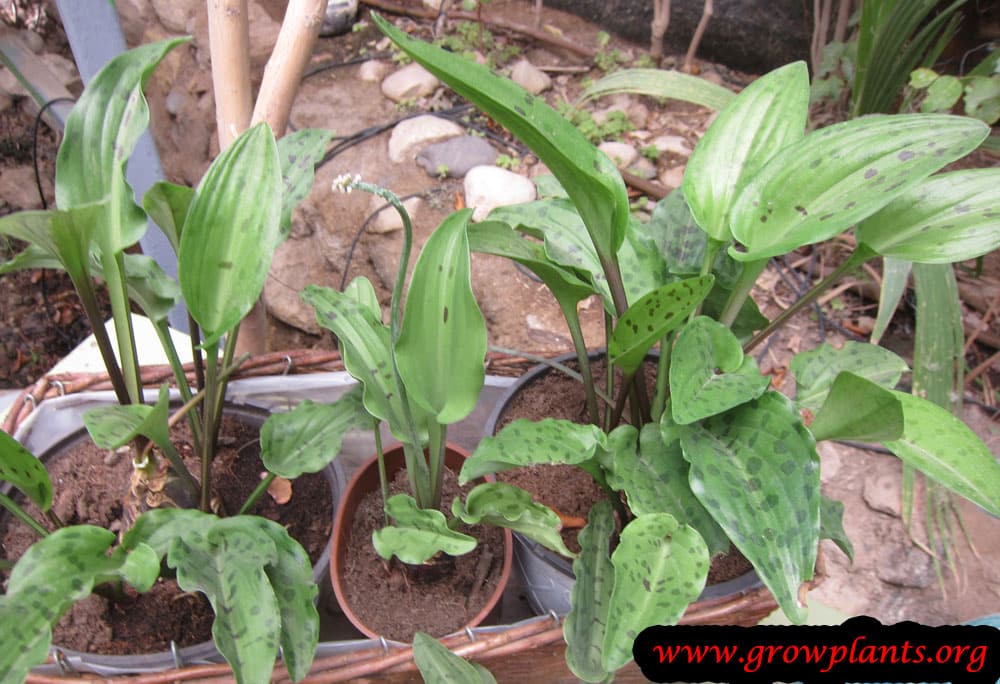
Plant Profile & Key Characteristics
Also known as: Ledebouria maculate, Little white soldiers
Overview: Drimiopsis maculata (leopard plant / little white soldiers) is a small evergreen bulbous geophyte, 15–30 cm (6–12 in), grown as a drought-tolerant ornamental foliage and houseplant. It is prized for its purple-spotted, spoon-shaped leaves and spikes of small white flowers.
Quick Specifications
| Specification | Attribute |
|---|---|
| Plant Type / Life Cycle | Perennial (evergreen bulbous geophyte; may go dormant in cold winters) |
| Foliage Type | Evergreen (deciduous in dormancy where winters are cold) |
| Mature Size | 15–30 cm (6–12 in) |
| Growth Rate | Slow |
| Root System | Bulbous geophyte (grows from surface bulbs, spreading by offsets) |
| Toxicity | Toxic – the leaves and plant are poisonous |
| Hardiness | USDA zones 9–12 |
Growth Form & Structure
- Height & Spread: Forms low clumps 15–30 cm high that spread by offset bulbs; excellent in pots and shaded spots.
- Growth Habit & Form: Low clump of leaves rising from partly exposed surface bulbs; may die back and rest over winter in cold climates.
- Lifespan & Maturity: Long-lived perennial bulb.
Anatomy & Physical Features
- Leaves & Foliage: Green, spoon-shaped leaves patterned with darker green or purple spots.
- Flower Characteristics: Small white flowers in a ball-like cluster on upright stems.
Primary Uses & Landscape Value
- Functional & Ornamental Roles: Shade-tolerant ornamental groundcover, container plant and houseplant grown mainly for its spotted foliage.
Care Guide: Planting, Soil & Watering
Overview: Drimiopsis maculata (leopard plant) is a small, drought-tolerant bulbous succulent that likes sandy, sharply drained soil and only light watering. It tolerates light frost but goes dormant in cold weather, so it needs a dry rest in winter.
Quick Care Requirements
| Requirement | Ideal Condition |
|---|---|
| Planting Season | Spring through autumn, during the warm growing season |
| Growth Rate | Slow (dormant in cold winters) |
| Soil Type | Sandy, well-aerated, sharply draining soil with only a little organic matter |
| Water Need | Low — let the soil dry between waterings and avoid overwatering |
Planting & Establishment
- Best Planting Season: Plant in the warm season, from spring to autumn; in cold-winter areas start it as growth resumes in spring.
- How to Plant:
- Hole Preparation: Plant the bulb in a hole just deep enough to seat it, in a spot with excellent drainage; a layer of lava grit or gravel below improves drainage.
- Soil Amendments: Use a gritty, sandy mix with only a little humus or organic matter; heavy, rich soil holds too much water.
- Planting Depth: Set the bulb with its neck at or just below the surface — don’t bury it deeply.
- Growth Speed & Expectations: Growth is slow, and in cool climates the plant dies back and rests over winter, returning in spring.
Soil, Watering & Drainage Care
- Soil Mix & Drainage Needs: Sharp drainage is key — use a sandy, well-ventilated mix; in pots choose a gritty potting soil with good drainage holes, adding lava grit at the base if needed.
- Watering Schedule & Technique:
- Young / Newly Planted: Water lightly and evenly as growth begins, keeping the soil just barely moist.
- Established: Water sparingly, letting the soil dry between waterings; take extra care not to overwater, especially near heating or air-conditioning indoors.
- Seasonal Adjustments: Reduce watering sharply and keep the bulb nearly dry during winter dormancy; resume light watering in spring.
Climate, Light & Hardiness
Leopard plant (Drimiopsis maculata) is a shade-loving geophyte succulent best grown frost-free or as a houseplant, though it can survive light frost. It prefers full shade to light morning sun and is not reliably cold-hardy outside warm subtropical, Mediterranean, or desert climates.
Quick Climate Specifications
| Climate Zones | Subtropics, Mediterranean, Desert; also grown as a houseplant |
|---|---|
| USDA Hardiness Zones | 9–12 |
| Optimal Temp Range | Typically 18–27°C (64–81°F) during active growth |
| Cold Damage Begins | Foliage can be damaged by frost, though the plant is described as able to survive occasional light frost |
| Approx. Survival Minimum | Best kept essentially frost-free; established bulbs may survive brief light frost but growth and appearance suffer |
| Frost Tolerance | Low |
| Light Conditions | Full Shade (preferred); tolerates morning sun |
| Wind Tolerance | Low–Moderate |
| Salt / Coastal Tolerance | Low |
Sunlight & Light Exposure
Optimal Light Setup
Prefers full shade with bright ambient light; this is fundamentally a shade-tolerant understory-type plant.
Direct Sun Requirement
Direct sun isn't required; in half shade it does best with gentle morning sun rather than harsh afternoon exposure, and full, intense sun in warm climates can scorch the leaves.
Shade & Heat Management
In cooler parts of its range some direct sun is tolerated, but in warmer climates strong sun causes leaf burn, so more shade is needed as temperatures rise.
Best Exposure / Orientation
An east-facing or filtered-light position suits it best, whether grown outdoors in mild climates or indoors near a bright window.
Temperature Extremes & Hardiness
USDA Hardiness & Regional Limits
Listed hardy to USDA zones 9–12, and commonly grown as a houseplant outside that range. Bloom timing itself tracks climate: in zone 12 it can flower most of the year, in zones 10b–11 from spring to autumn, and in zones 9–10a mainly spring to summer - reflecting how much warm-season growth the local climate allows.
Cold Damage & Winter Protection
In climates with any winter cold, the plant goes dormant; in colder gardens within its range it is best treated as frost-free-only, with containers moved indoors or protected before frost.
Frost Sensitivity
Leaves are frost-sensitive; while the plant may survive an occasional light frost, hard or prolonged freezing is likely to kill top growth and risk the bulb.
Extreme Heat Tolerance
Tolerates warm subtropical and desert heat well provided it has shade; direct summer sun in hot climates causes scorch.
Wind, Humidity & Microclimate
Humidity Preferences
Adapts to typical indoor and subtropical humidity; as a houseplant it benefits from steady conditions away from drafts, heaters, or air-conditioning vents.
Wind Tolerance
Best in a sheltered spot; not suited to strong, exposed winds outdoors.
Coastal / Salt Tolerance
Generally low tolerance of salt spray or coastal exposure.
Microclimate Recommendations
A shaded, sheltered spot - under trees, on a covered patio, or as a houseplant near a bright but not sun-blasted window - suits it best.
Growing in Pots, Balconies & Indoors
Drimiopsis maculata is a small, shade-tolerant bulb with spotted leaves that makes an easy and attractive houseplant. It grows well indoors in good light and does nicely in pots, provided the soil drains freely.
Quick Details
- Container Size: Small – a 2-5 L pot; it is compact and flowers well slightly pot-bound
- Indoor Suitability: A genuine houseplant – grows well indoors in good, bright, indirect light
- Best Spot: Bright shade to filtered light; avoid harsh midday summer sun
- Soil & Drainage: Free-draining mix – the grower stresses getting drainage right by choosing the correct soil
- Watering in Pots: Small amounts – let the surface dry between waterings; do not overwater the bulb
Indoors & On the Windowsill
- Houseplant: A good indoor plant that grows well in good light indoors (the grower’s own note). A bright spot out of scorching direct sun keeps the leaf spotting attractive; too little light makes it lanky.
- Windowsill & overwintering: An east- or north-facing sill, or a little back from a bright window, suits it. As a tender bulb it is also an easy plant to keep frost-free indoors over winter in cold climates.
- Safety: The bulbs and sap can be toxic if eaten, so keep the plant away from children and pets.
On a Balcony or Patio
- Light & shelter: Give it a shaded or filtered-light corner outdoors in warm weather – direct sun, especially in hot regions, can scorch the leaves. Bring it in before frost.
- Practicalities: Small and light and easy to move; make sure pots drain freely so the bulb never sits wet.
Choosing the Pot, Soil & Long-Term Care
- Pot & drainage: A pot with strong drainage holes; skip a standing water saucer – the grower rightly stresses good drainage. Terracotta breathes and dries faster than glazed or plastic.
- Potting mix: A free-draining mix – good potting soil with added perlite or grit.
- Feeding: In pots, feed lightly during active growth and ease off as growth slows.
- Repotting: Every couple of years refresh the mix; divide crowded bulb clumps to propagate.
Fertilizing & Feeding
A light feeder: this shade-loving geophyte succulent, grown mainly for its leopard-spotted leaves, needs only a weak occasional feeding (or simply a light organic top-dressing) during active leaf growth, and no feeding while it rests.
Quick Fertilizing Specs
| Feeding Level | Light feeder |
|---|---|
| Main Nutrient Priority | A dilute, low-nitrogen or balanced feed, or a light organic top-dressing, to support foliage color |
| Best Feeding Period | During active leaf growth in the warm season |
| Organic Options | A light top-dressing of humus or other organic matter in place of, or alongside, liquid feeding |
| Reduce/Stop Feeding | Pause feeding whenever leaf growth clearly slows or in cooler conditions |
| Micronutrients | Usually met by a complete fertilizer or organic matter; correct only a diagnosed issue |
| Soil pH | Tolerates a wide range in a sandy, well-ventilated, well-drained mix |
Feeding by Growth Stage
Active leaf growth
Support steady leaf growth and the leopard-spotted foliage that makes this shade-loving geophyte succulent an attractive houseplant.
| Nutrient direction | A weak, diluted low-nitrogen or balanced feed, or simply a light top-dressing of humus or organic matter, is enough to support foliage color without forcing soft growth. |
|---|---|
| Timing | During the warm season while the bulb is producing new leaves. |
| Frequency | Light, infrequent feeding suits this slow-growing succulent; an organic top-dressing can substitute for liquid feeding. |
| Fertilizer types | A dilute low-nitrogen or balanced liquid fertilizer, A light top-dressing of humus or other organic matter |
| Precautions | Feed sparingly and keep the sandy, well-ventilated mix well-drained; this plant is sensitive to a soggy, overfed root zone, and its leaves and sap are poisonous, so handle with care. |
Slower-growth rest period
Let the bulb rest through its slower, cooler period without pushing tender new leaves.
| Nutrient direction | None – withhold fertilizer while growth is slow. |
|---|---|
| Timing | During cooler weather or whenever leaf growth clearly slows. |
| Frequency | No feeding at this stage; resume only when active leaf growth returns. |
| Fertilizer types | No feeding at this stage; do not fertilize until active growth resumes. |
| Precautions | Withhold fertilizer now; feeding a resting geophyte wastes nutrients and risks bulb rot. |
Nutrient Deficiency Signs & Corrections
Leaves lose their deep green background color and overall leaf production slows.
| Possible causes | low available nitrogen in a long-unfed potting mix, nutrients leached from frequent light watering, spent, exhausted potting medium |
|---|---|
| Appears first on | older, lower leaves |
| What to check | how long since the last feeding or top-dressing, age and condition of the potting mix, watering frequency and drainage |
| Possible correction | Apply a dilute nitrogen-containing feed or refresh with an organic top-dressing, and check the mix isn’t exhausted. |
Leaf tips and edges brown or scorch and the leopard-spotted leaves look stressed despite adequate watering.
| Possible causes | fertilizer salt buildup in a small indoor pot, overfeeding or feeding too concentrated a solution, poor drainage concentrating salts in a sandy mix that isn’t well ventilated |
|---|---|
| Appears first on | leaf tips and margins |
| What to check | recent fertilizer strength and amount, pot drainage and mix condition, any visible salt crust on the soil surface |
| Possible correction | Ease off feeding, water thoroughly to flush accumulated salts, then return to lighter feeding or organic top-dressing. |
Leaves droop and start to weep or soften even though the plant is being watered.
| Possible causes | waterlogged, poorly drained soil limiting root and nutrient uptake, a mix that has lost its drainage over time and needs replacing, underlying nutrient shortage compounded by stressed roots |
|---|---|
| Appears first on | whole leaves, which tend downward and soften |
| What to check | how quickly water drains from the pot after watering, whether excess water is being emptied from the pot’s drainage tray promptly, age and drainage quality of the current mix |
| Possible correction | Improve drainage, empty standing water promptly after watering, and refresh the mix before resuming light feeding. |
Pruning, Training & Seasonal Maintenance
Drimiopsis maculata is a small bulbous (geophyte) succulent grown for its spotted, spoon-shaped leaves rather than for a woody framework, so it needs almost no pruning beyond basic sanitation. The only routine cuts are removing fully dead leaves and spent flower stems, which can be done at any time of year; this tidying has no effect on the plant’s next bloom, since new leaves and flower spikes rise fresh from the bulb rather than from last year’s growth.
Quick Pruning & Maintenance Specs
| Pruning Tolerance | Low (little cutting needed; not a plant that is shaped or cut back) |
| Primary Pruning Window | Year-round, as dead material appears |
| Typical Frequency | A few times a year, as leaves or flower stems finish |
| Main Objective | Sanitation – remove dead/yellowed leaves and spent flower stems |
| Young Plant Priority | None – leave newly planted bulbs untouched while they establish |
| Mature Plant Priority | Remove fully brown leaves and finished flower stalks at the base |
| Best Tool Type | Precision snips (or pinch by hand) |
| Avoid Heavy Pruning During | Not applicable – this plant is never hard-pruned |
Pruning by Plant Age & Size
Newly Established
Do not remove any leaves while a newly planted bulb or division is rooting in; even leaves that look tired help the bulb recover.
Young / Formative
No structural training applies – the plant forms a low rosette from the bulb and has no branch framework to shape.
Mature / Established
Ongoing removal of fully dead leaves and spent flower stems; in cold-climate gardens the plant goes dormant over winter, so leaves that are dying back for dormancy should be left until they are completely brown rather than cut while still partly green, since the bulb is still resorbing nutrients from them.
Seasonal Pruning Schedule
Ongoing Sanitary
Objective: keep the rosette tidy and reduce rot risk. Remove: fully dead/yellowed leaves and spent flower stalks once bloom has faded. Do not remove: green or partly-green leaves, or leaves that are dying back naturally into winter dormancy. Expected response: none needed – new leaves and flower spikes emerge from the bulb on their own schedule. Flowering impact: none – removing a spent stalk does not affect the next bloom, which comes from a new spike.
Special Growth to Remove
- Dead or yellowed leaves – cut at the base rather than pulling, since the leaves attach directly to the bulb and tearing can injure it.
- Spent flower stems – once the ball-shaped white flower cluster has finished, cut the stalk down to its base.
Container & Small-Space Pruning
Grown almost exclusively as a houseplant/container geophyte. Because indoor drainage and airflow are more limited than outdoors, remove yellowing leaves promptly to reduce rot risk, and keep an eye out for leaves that droop from overwatering (a known sensitivity for this plant) rather than treating drooping leaves as a pruning issue.
Tools
Precision snips are all that is needed for this small plant; fingers can also pinch off a fully dry leaf. The plant’s foliage and sap are poisonous, so wear gloves and wash tools and hands after cutting.
Tool Hygiene & Disease Risk
Routine – use clean, sharp snips; no specific transmissible disease is documented for this species.
Cut Placement & Technique
Cut dead leaves close to the base without nicking the bulb or crown; cut spent flower stalks at their base rather than partway up the stem.
Heavy Pruning & Rejuvenation
Not applicable – this is a small bulb-forming rosette, not a plant that is cut back hard to rejuvenate it. If a clump becomes overcrowded or tired-looking, propagate fresh plants from offsets/daughter bulbs instead of pruning the parent hard.
Post-Pruning Care
No feeding is needed after routine tidying. Since the plant is poisonous, wash hands and tools after handling cut material and keep it away from pets and children.
Common Pruning Mistakes
- Pulling dead leaves off by hand instead of cutting, which can tear tissue at the bulb.
- Removing leaves before they are fully brown, interrupting the bulb’s nutrient resorption ahead of dormancy.
- Handling the poisonous sap without gloves.
When NOT to Prune
Avoid stripping leaves that are still green, and avoid cutting leaves that are naturally yellowing into winter dormancy until they are fully brown.
Recommended Tools (by task)
- precision_snips – the only tool this small rosette plant needs, for removing dead leaves and spent flower stalks with clean, small cuts.
Propagation Guide
The easiest and most reliable way to increase Drimiopsis maculata is by separating the daughter bulbs (offsets) it produces at its base, waiting until each has at least three leaves before detaching it. Seed is also viable but takes longer to reach a useful size, and leaf-base cuttings work as a slower supplementary option, so overall this is an Easy plant to propagate.
Quick Propagation Specs
| Best Propagation Method | Division of daughter bulbs (offsets) |
| Alternative Methods | Leaf-base cuttings; seed |
| Propagation Difficulty | Easy |
| Seed True-to-Type | Usually true-to-type (species, not a named cultivar) |
| Vegetative True-to-Type | Yes |
| Best Propagation Season | Spring through autumn, during active growth |
Growing from Seed
Sowing Season
Sow during the warm growing months (spring to autumn) in a well-drained, sandy mix.
Germination Time
Germination, and the further growth needed to reach a flowering-size bulb, is slow, which is why most growers prefer to start from a daughter plant rather than seed.
Leaf & Root Cuttings
A leaf can be removed with a small piece of tissue at its base, rather than snipped mid-blade, and set into a well-drained, sandy mix. Forming a new bulblet at the cut base is a slow process, so this method is mainly used to bulk up extra material rather than as the primary method.
Division, Offsets, Pups & Suckers
Drimiopsis maculata regularly produces small daughter plants (bulb offsets) alongside the parent. Wait until each daughter plant has developed at least three leaves before separating it with its roots intact, then transplant it to its own well-drained position or pot to establish.
Bloom & Flower Guide
Quick Details
- Bloom Season: Spring to summer, and nearly year-round in the warmest zones (though bloom is never guaranteed)
- Flower Appearance: Small white flowers packed into rounded, ball-like spikes on upright stems
- Edibility: Grown as an ornamental bulb; not eaten – like many bulbs of its family it is best kept away from pets and children
Detailed Blooming Overview
The leopard plant sends up slender stems topped with rounded, ball-like heads of tiny white flowers, mostly through spring and summer. In the warmest zones it may flower on and off much of the year, though flowering is never a certainty.
Flower Characteristics
- Tiny white flowers massed into ball-shaped heads on upright stems.
Bloom Care & Thinning
- After bloom: Small berries may follow; remove the spent stalks to tidy the clump.
- Rest: A drier winter rest helps the bulb flower well the next season.
Pests, Diseases & Troubleshooting
Drimiopsis maculata (little white soldiers, a spotted-leaved bulb in the Asparagaceae, close to Ledebouria and Scilla) is an easy, near-pest-free plant whose troubles are almost all about water and its natural dormancy. The bulb rots readily if kept wet, especially while dormant; the few insect pests — mealybugs, scale, and the occasional mite or aphid — are minor, and slugs or snails may graze the soft leaves. Grow it in gritty, free-draining soil, respect its dry rest period, and it looks after itself.
Quick Troubleshooting Overview
| Issue / Pest | Main Symptom | Primary Solution |
|---|---|---|
| Bulb / root rot | Soft mushy bulb, yellowing collapsing leaves in wet soil | Dry off, unpot, cut to firm tissue, gritty mix |
| Mealybugs | White cottony tufts on leaf bases, bulb and roots | Alcohol swab, insecticidal soap, horticultural oil |
| Scale insects | Small brown bumps on leaves and bulb neck | Scrape off, horticultural oil |
| Spider mites | Fine stippling and dullness in hot dry air | Raise humidity, rinse foliage, horticultural oil |
| Slugs & snails | Chewed, ragged leaves; slime trails | Hand-pick, iron-phosphate bait, grit barrier |
| Fungus gnats | Small flies over constantly moist soil | Dry soil surface, sticky traps, Bti drench |
Common Pests & Management
- Mealybugs (Pseudococcus / Planococcus spp.):
- Symptoms: White cottony tufts tucked into the leaf bases, around the bulb neck, and among the roots; sticky honeydew may appear. Root mealybugs on the bulb are the most persistent form.
- Prevention & Control: Dab colonies with an alcohol-dipped swab and wipe the leaves. Treat with insecticidal soap or horticultural oil, repeating every 7–10 days. If roots are infested, lift the bulb, rinse it, and repot into fresh, gritty mix.
- Scale insects (Coccus / Aspidiotus spp.):
- Symptoms: Small brown, tan or grey bumps on the leaves, leaf bases and bulb neck, sometimes with honeydew and sooty mould; easy to overlook until numerous.
- Prevention & Control: Scrape scale off gently and dab with alcohol, then smother the rest with horticultural oil. Repeat for crawlers; remove badly affected old leaves.
- Spider mites (Tetranychus urticae):
- Symptoms: Fine pale stippling and a dull, greyish look to the leaves in hot, dry, still air, with faint webbing in severe cases.
- Prevention & Control: Raise humidity and rinse or wipe the foliage. Apply horticultural oil or insecticidal soap to both leaf surfaces, repeating to break the cycle.
- Aphids (Aphis / Myzus spp.):
- Symptoms: Small clusters of soft green or black insects on tender new leaves and any flower spike, with honeydew and slight leaf distortion.
- Prevention & Control: Rinse them off with water and wipe the growth. Apply insecticidal soap if they persist, and encourage natural predators when grown outdoors.
- Slugs & snails (Deroceras / Helix spp.):
- Symptoms: Ragged holes and chewed edges on the soft, fleshy leaves, with tell-tale silvery slime trails; worst on plants grown outdoors in damp, shady spots.
- Prevention & Control: Hand-pick after dark and clear damp hiding places. Use iron-phosphate bait or a grit/diatomaceous-earth barrier around the plant; copper tape protects containers.
Diseases & Fungal Issues
- Bulb & root rot (Fusarium / Pythium / Phytophthora spp.):
- Symptoms: A soft, mushy, often foul-smelling bulb with yellowing, collapsing leaves; roots turn brown and slimy. Driven by overwatering, heavy soil, or watering during the dormant rest.
- Treatment & Management: Withhold water and lift the bulb; cut away all soft, rotten tissue to firm flesh, dust the cuts, and let them dry before repotting into fresh, very free-draining, gritty mix. Water sparingly and keep the bulb dry during dormancy.
- Fungal leaf spot (Cercospora / Colletotrichum spp.):
- Symptoms: Brown or blackish spots, sometimes with yellow halos, on the leaves, spreading in humid, crowded, wet conditions.
- Treatment & Management: Remove spotted leaves and improve air circulation. Keep water off the foliage and avoid overcrowding; a copper-based fungicide helps if it spreads.
- Grey mould (Botrytis) (Botrytis cinerea):
- Symptoms: Soft browning and a fuzzy grey mould on leaves or flowers in cool, damp, poorly ventilated conditions, often on tissue already weakened by rot or damage.
- Treatment & Management: Remove affected tissue and dead leaves, and improve ventilation and light. Reduce humidity around the foliage; treat with a suitable fungicide only if it persists.
Growing Difficulties & Abiotic Problems
- Overwatering & bulb rot (signature issue):
- Cause & Symptoms: As a bulb it stores its own water and rots quickly in soggy soil; wet feet, especially during its dormant rest, are the commonest cause of loss, shown by yellowing leaves and a soft bulb.
- Correction Strategy: Grow in a gritty, sharply drained mix and water only when the soil has dried; reduce watering hard as the leaves die back and keep the bulb nearly dry through dormancy. Always use a pot with drainage.
- Dormancy & leaf dieback:
- Cause & Symptoms: Many plants naturally die back and rest; leaves yellowing and collapsing at the end of the growing season can alarm growers into overwatering a bulb that simply wants to rest.
- Correction Strategy: Recognise the natural rest: let the foliage die down, stop feeding, and water only enough to keep the bulb from shrivelling. Resume normal watering when new growth appears.
- Etiolation / poor colour in low light:
- Cause & Symptoms: Too little light makes the leaves stretch, pale, and lose their attractive spotting, and can make growth floppy.
- Correction Strategy: Give bright light with some gentle direct sun (protected from harsh midday sun). Better light restores compact growth and leaf markings on new leaves.
- Cold damage:
- Cause & Symptoms: Frost or prolonged cold damages the soft foliage and can rot a wet bulb; this is a tender, warmth-preferring plant.
- Correction Strategy: Keep it above freezing and on the dry side in the cool season; grow in containers that can be moved indoors, or lift and store bulbs dry in cold climates.
What Helps – Products & Tools
Very little is usually needed: insecticidal soap and neem / horticultural oil for the occasional mealybug, scale or mite; rubbing alcohol for spot-dabbing; iron-phosphate slug bait or a grit barrier for slugs and snails; sticky traps and Bti for fungus gnats; and a copper fungicide for leaf spot. The most important ‘tool’ is a gritty, free-draining mix and disciplined watering, which prevent bulb rot.