


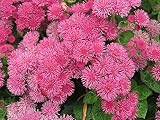

Plant Profile & Key Characteristics
Overview: Ageratum corymbosum is a compact, fast-growing herbaceous plant reaching 5-80 cm (2-32 in), grown as a warm-season annual. It forms bushy clumps topped with fluffy pompom flowerheads of thread-like blue, purple, pink or white petals that attract pollinators from summer into autumn.
Quick Specifications
| Specification | Attribute |
|---|---|
| Plant Type / Life Cycle | Annual (herbaceous) |
| Mature Size | 5-80 cm (2-32 in) |
| Growth Rate | Moderate to fast |
| Root System | Fibrous, shallow |
| Toxicity | Toxic – contains pyrrolizidine alkaloids (liver toxins); not for consumption and can harm grazing animals |
| Hardiness | USDA zone 3+ (grown as an annual) |
Growth Form & Structure
- Height & Spread: Bushy clumps 5-80 cm (2-32 in) tall; well suited to beds, edging, borders and containers.
- Growth Habit & Form: Low, bushy herbaceous clump with a mounding to upright habit.
- Lifespan & Maturity: Completes its life cycle in a single growing season, flowering from summer into autumn.
Anatomy & Physical Features
- Leaves & Foliage: Soft, ovate leaves in green to purple.
- Flower Characteristics: Fluffy pompom flowerheads of soft, needle-like petals in blue, purple, pink or white (full detail in the Bloom accordion).
Primary Uses & Landscape Value
- Functional & Ornamental Roles: Bedding and edging plant, border filler, container plant, cut flower and pollinator-attracting ornamental.
Care Guide: Planting, Soil & Watering
Overview: This floss flower prefers full sun to light shade in rich, well-drained soil kept evenly moist. It grows quickly and blooms freely from summer into autumn when given steady moisture.
Quick Care Requirements
| Requirement | Ideal Condition |
|---|---|
| Planting Season | In spring after the last frost |
| Growth Rate | Moderate to Fast |
| Soil Type | Rich, well-draining, kept evenly moist |
| Water Need | Moderate — keep the soil evenly moist |
Planting & Establishment
- Best Planting Season: Plant out in spring once frost has passed and the soil has warmed.
- How to Plant:
- Hole Preparation: Dig a hole the same depth and a little wider than the root ball, spacing plants to allow good airflow around the mounded foliage.
- Soil Amendments: Enrich the bed with compost or organic matter so it holds moisture while still draining freely.
- Planting Depth: Set each plant at the same depth it grew in its pot, with the crown level with the soil surface.
- Growth Speed & Expectations: Fast to moderate — it quickly forms neat, mounded clumps that flower from summer into autumn.
Soil, Watering & Drainage Care
- Soil Mix & Drainage Needs: Rich, moisture-retentive but free-draining soil. In containers use a good potting mix with drainage holes so the roots stay damp but never waterlogged.
- Watering Schedule & Technique:
- Young / Newly Planted: Keep the soil consistently moist while young plants root in, watering whenever the surface starts to dry.
- Established: Provide regular, even moisture — an average amount of water; do not let it dry out for long, as flowering suffers in drought.
- Seasonal Adjustments: Water more often in summer heat, and less during cool or wet spells.
Climate, Light & Hardiness
Ageratum is a herbaceous plant grown outdoors as a warm-season annual in nearly all climates, since it is frost-tender and dies back once winter cold arrives, and it thrives in full sun to half shade. It performs well across mediterranean, desert, subtropical, temperate, and tropical climates as long as it is planted after the last frost and given a warm growing season.
Quick Climate Specifications
| Climate Zones | Mediterranean, Desert, Subtropical, Temperate, Tropical |
|---|---|
| USDA Hardiness Zones | 3+ (reflects where it can be grown outdoors as a warm-season annual, not winter survival as a perennial) |
| Optimal Temp Range | Typically warm, roughly 18–27°C (65–80°F) during the growing season |
| Cold Damage Begins | Approximately near 0°C (32°F); cool temperatures slow growth and frost damages foliage |
| Approx. Survival Minimum | Killed by the first hard frost, which is why it is grown as an annual |
| Frost Tolerance | None to Very Low |
| Light Conditions | Full Sun / Half Shade |
Sunlight & Light Exposure
Optimal Light Setup
Full sun produces the most compact, floriferous plants; light half shade is tolerated.
Direct Sun Requirement
Needs several hours of direct sun daily for strong, continuous flowering.
Shade & Heat Management
In hot, high-sun climates such as desert or subtropical gardens, light afternoon shade and consistent moisture help prevent heat stress and flower fade.
Best Exposure & Orientation
Open beds or containers with morning sun suit most climates; afternoon relief from the strongest sun benefits the hottest regions.
Temperature Extremes & Hardiness
USDA Hardiness & Regional Limits
Site data lists zone 3+, which describes where it can be grown outdoors as a summer annual - essentially any climate with a warm growing season - rather than winter cold survival, since it is not reliably perennial in cold-winter regions.
Cold Damage & Winter Protection
Chilly nights slow growth and can cause leaf discoloration; no winter protection is normally attempted since the plant is treated as an annual and replaced each year.
Frost Sensitivity
Frost-sensitive: the first fall frost typically ends the growing season and kills the plant.
Extreme Heat Tolerance
Tolerates warm-season heat well with consistent watering; prolonged extreme heat combined with drought can reduce flowering.
Frost-Free Growing Season
Needs a full frost-free warm season, from spring planting after the last frost through to the first fall frost, for continuous bloom.
Wind, Humidity & Microclimate
Humidity Preferences
Adapts to both the humid conditions of subtropical and tropical climates and the drier air of mediterranean and desert climates, provided soil moisture is maintained.
Dry-Air Tolerance
Reasonably tolerant of dry air with regular watering; prolonged drought combined with heat stresses the plant and reduces flowering.
Wind Tolerance
Moderate: as a low, soft-stemmed bedding plant it does best with some wind shelter to avoid flopping, though it is not fundamentally wind-fragile.
Rainfall & Seasonal Moisture
Grows best with consistent moisture through the warm season; avoid waterlogged, cold soil.
Microclimate Recommendations
In cooler-summer or higher-elevation gardens, a warm, sun-facing bed lengthens the effective flowering season.
Growing in Pots, Balconies & Indoors
Ageratum (flossflower) is a compact, sun-loving bedding annual that shines in pots, window boxes and along balcony rails, but it is not a true houseplant – it needs plenty of light to keep flowering. A very bright, sunny windowsill can support a dwarf type, though it always performs best outdoors in the sun.
Quick Details
- Container Size: A small pot or window box (about 2-5 L / 1 gal); several plants can share a trough (mature height about 5-80 cm (2-32 in))
- Indoor Suitability: Not a houseplant – a compact type can manage on a very bright, sunny sill
- Best Spot: Full sun to half shade, outdoors
- Soil & Drainage: Aerated, organic-rich mix that drains freely
- Watering in Pots: Keep evenly moist – small pots and troughs dry fast in sun; do not let it wilt, but avoid waterlogging
Indoors & On the Windowsill
- Houseplant limits: The grower marks it as not a houseplant – in a room the light is too weak and plants get leggy and stop flowering.
- Windowsill growing: A dwarf type can grow and flower on a bright, sunny sill with direct sun; pinch the tips to keep it bushy.
- As an annual: In most climates it is grown as a single-season annual, so there is no overwintering – sow or plant afresh each season.
- Safety: Ageratum is mildly toxic if eaten – keep it away from children and pets, especially any plants kept on an indoor sill.
On a Balcony or Patio
- Light & wind: Give it a sunny to lightly shaded spot; reflected heat from walls and paving dries small pots quickly, so check moisture daily in warm weather. Taller types may need light support on windy balconies.
- Practicalities: Deadhead to keep the flowers coming, and make sure troughs and boxes drain freely.
Choosing the Pot, Soil & Long-Term Care
- Pot & drainage: Any pot or box with strong drainage holes; skip a standing-water saucer to avoid root rot. Terracotta breathes and dries fast; glazed or plastic holds moisture longer.
- Potting mix: Well-aerated, organic-rich – peat or coir with perlite or vermiculite.
- Feeding: Container plants leach nutrients faster – a regular balanced feed keeps them flowering all season.
- Replanting: As an annual there is no repotting – simply replant with fresh mix each season.
Growing this plant in a greenhouse
A greenhouse can give ageratum corymbosum frost protection, cold protection, humidity control and extra warmth.
Greenhouse at a glance
| Greenhouse suitability | Conditional - depends on your climate |
|---|---|
| Main benefits | frost protection, cold protection, humidity control, extra warmth |
| Season extension | earlier spring & later autumn |
| Outdoor protection advisable below | about 10°C |
| Maintain greenhouse minimum | around 15°C for active growth |
| Suitable types | heated greenhouse, polycarbonate greenhouse |
| Heating | Heating is recommended in cold climates for continuous growth. |
Related greenhouse guides
- Greenhouses: How to Choose the Right Greenhouse
- Best Greenhouse Heaters
- Greenhouse Climate Control: Temperature, Ventilation and Humidity
- Polycarbonate Greenhouses: What to Look for Before Buying
Fertilizing & Feeding
A moderate feeder: rich, well-drained soil plus a balanced complete fertilizer through the warm growing season keeps this annual in steady leafy growth and continuous bloom.
Quick Fertilizing Specs
| Feeding Level | Moderate feeder |
|---|---|
| Main Nutrient Priority | A balanced complete fertilizer; steady nutrition supports both foliage and the long run of pompom flowers |
| Best Feeding Period | From planting through the warm summer-to-autumn flowering season |
| Organic Options | Rich soil improved with compost or other organic matter |
| Reduce/Stop Feeding | Feeding tapers as the annual finishes its cycle in autumn |
| Micronutrients | Usually supplied by a complete fertilizer and organic matter; correct only a diagnosed deficiency |
| Soil pH | Adaptable, from slightly acidic to near neutral |
Feeding by Growth Stage
Establishment after planting
Settle young plants or seedlings into rich soil and encourage strong roots and early growth.
| Nutrient direction | Start in compost-enriched soil and support new growth with a balanced complete fertilizer. |
|---|---|
| Timing | At planting in spring and the early weeks of growth. |
| Frequency | A light feeding as the young plants settle in. |
| Fertilizer types | A balanced complete fertilizer, Compost or rich organic matter worked into the bed |
| Precautions | Avoid overfeeding young plants; rich soil already supplies much of their early needs. |
Vegetative growth
Build bushy, well-branched plants heading into the flowering season.
| Nutrient direction | Continue a balanced complete fertilizer to support leafy growth and branching. |
|---|---|
| Timing | Through late spring and early summer as plants bulk up. |
| Frequency | Light, regular feeding through active growth. |
| Fertilizer types | A balanced complete fertilizer, Compost or organic matter |
| Precautions | Keep nitrogen moderate; excess pushes soft foliage and delays flowering. |
Summer-to-autumn flowering
Sustain the long run of pompom flowers through the warm season.
| Nutrient direction | Maintain a balanced complete fertilizer; steady balanced nutrition supports continuous bloom better than forcing phosphorus. |
|---|---|
| Timing | Through the summer and autumn flowering season. |
| Frequency | Light, regular feeding spread across the flowering period. |
| Fertilizer types | A balanced complete fertilizer, Compost or organic mulch |
| Precautions | Remove spent flowers and keep feeding light and steady to prolong the display. |
Nutrient Deficiency Signs & Corrections
Older, lower leaves turn pale green to yellow and overall growth and flowering slow.
| Possible causes | low available soil nitrogen, nitrogen leaching after heavy rain or watering, thin soil low in organic matter |
|---|---|
| Appears first on | older, lower leaves |
| What to check | recent feeding history, soil organic matter, watering and drainage |
| Possible correction | Apply a nitrogen-containing complete fertilizer and build soil organic matter, then water evenly. |
The newest leaves yellow between the veins while the veins themselves stay green.
| Possible causes | high soil pH reducing iron availability, waterlogged or poorly drained roots limiting uptake, low available soil iron |
|---|---|
| Appears first on | youngest leaves |
| What to check | soil pH and drainage, root health and watering, whether symptoms begin on new growth |
| Possible correction | Correct soil pH and drainage and, if needed, apply a chelated iron product per its label. |
Leaf margins brown or scorch and growth stalls despite adequate watering.
| Possible causes | fertilizer salt buildup in the root zone, under-watering that concentrates salts, excessive or too-frequent feeding |
|---|---|
| Appears first on | leaf margins and tips |
| What to check | recent fertilizer amounts, watering consistency, drainage, especially in containers |
| Possible correction | Ease off feeding, water thoroughly to flush accumulated salts, then return to lighter feeding. |
Pruning, Training & Seasonal Maintenance
Ageratum corymbosum is a wild-type species with a much wider size range (5–80 cm) than the bred bedding cultivars, since its final size depends heavily on growing conditions. Left unpruned it tends toward a looser, more informal habit than a named cultivar like ‘Blue mink’; a light pinch on young plants can tighten this up for garden use, but the main recurring task is the same as elsewhere in the genus – deadheading spent flowerheads, which here does double duty of tidying the plant and limiting the self-sown seedlings this species readily produces.
Quick Pruning & Maintenance Specs
| Pruning Tolerance | High |
| Primary Pruning Window | Throughout the growing season |
| Typical Frequency | Deadhead every 1–2 weeks; pinch once if grown for a tidier bed habit |
| Main Objective | Shape a naturally variable/informal habit and limit self-seeding |
| Young Plant Priority | Optional pinch of the growing tip to encourage a more compact, branched habit |
| Mature Plant Priority | Deadhead before seed-set; cut back any stems that outgrow their space |
| Best Tool Type | Precision snips |
| Avoid Heavy Pruning During | Not applicable to this soft annual |
Pruning by Plant Age & Size
Newly Established
Remove only damaged leaves; let the transplant settle in first.
Young / Formative
An optional pinch of the growing tip helps produce a fuller, more garden-appropriate habit than this species would show growing wild; skip it if a looser, naturalistic look is wanted instead.
Mature / Established
Deadhead before the blue, purple, pink or white flowerheads set seed; because final size varies so much with conditions, cut back any individual stems that outgrow their allotted space rather than shearing the whole plant to a fixed height.
Seasonal Pruning Schedule
Ongoing Sanitary
Objective: control self-seeding and keep growth proportionate to its site. Remove: spent flowerheads before seed matures, and any oversized or sprawling stems. Do not remove: new growth at the plant’s base – this is where the next flush of branching and bloom comes from. Impact: deadheading is the main control on this self-seeding species’ spread.
Special Growth to Remove
- Spent flower stems – remove before seed-set given this species’ self-seeding tendency.
- Any stem that has outgrown the plant’s allotted space, given its highly variable mature size.
Container & Small-Space Pruning
A pot naturally caps this variable-sized species at the smaller end of its range; deadhead regularly since seed dropped in a container has nowhere else to go. Pinch young plants to keep growth compact if space is tight.
Tools
- precision_snips – sufficient for the soft stems and flowerheads at any size within this species’ range.
Tool Hygiene & Disease Risk
Routine – clean sharp snips are enough; its pests (aphids, spider mites) are not tool-transmitted.
Cut Placement & Technique
Deadhead to just above the nearest leaf node; pinch or cut back oversized stems just above a healthy leaf pair to encourage a bushier regrowth point.
Heavy Pruning & Rejuvenation
Tolerates a hard cutback if it has outgrown its space or become leggy, with quick regrowth given its fast growth rate; given its short annual life, this is more often a size-control measure than true rejuvenation.
Post-Pruning Care
Water after cutting back; avoid extra feeding, which only pushes this already vigorous species larger.
Common Pruning Mistakes
- Leaving spent flowers to set seed, given this species’ documented self-seeding.
- Shearing the whole plant to a fixed height rather than removing individual oversized stems, given how much its mature size varies with conditions.
When NOT to Prune
Not immediately after transplanting, to let it root in.
Recommended Tools (by task)
- precision_snips – deadheading before seed-set and shaping this size-variable wild-type species.
Propagation Guide
Ageratum corymbosum, like its better-known relatives, is grown from seed with no grafting needed; being a less widely cultivated species, home stock is usually built up from seed rather than nursery-propagated cuttings. As an open-pollinated species it should come reasonably true from its own seed, making it an Easy plant to start where seed is available.
Quick Propagation Specs
| Best Propagation Method | Seed |
| Alternative Methods | Softwood stem cuttings — not commonly documented for this species specifically, but plausible by analogy with other soft-stemmed Ageratum |
| Propagation Difficulty | Easy |
| Seed True-to-Type | Usually true-to-type from its own seed as an open-pollinated species |
| Best Propagation Season | Spring |
| Seed Germination Time | Generally quick under warm conditions, similar to related Ageratum species |
| Germination Temperature | Warm, roughly 20–25°C (68–77°F) |
| Seed Sowing Depth | Surface-sown or barely covered, as with other fine-seeded Ageratum |
Growing from Seed
Seed Handling & Viability
Keep seed dry and cool until sowing; use it reasonably fresh, as with other composite (daisy-family) seed of this size.
Sowing Season
Sow in spring once frost risk has passed.
Sowing Depth & Orientation
Scatter the small seed on the surface of a moist mix and press it in lightly without burying it.
Germination Conditions
Keep warm and evenly moist; germination is generally reliable but timing can vary more than in the well-documented bedding cultivars.
Seedling Care
Grow seedlings on in bright light and pot up as they establish before moving them to their final position.
Bloom & Flower Guide
Quick Details
- Bloom Season: Summer through autumn, until the first frost
- Time to First Bloom: In its first season – usually about eight to ten weeks from sowing
- Flower Appearance: Soft, fluffy pompom heads made of thread-like florets, blue, purple, pink, or white
- Edibility: Not edible – an ornamental only; Ageratum contains pyrrolizidine alkaloids and should not be eaten
Detailed Blooming Overview
Floss flower earns its name from the powder-puff blooms – here in blue, purple, pink, or white – that cover the plant from summer until the first frost. The heads sit in clusters just above the foliage, hold their color for weeks, and make a fine, long-lasting cut flower while feeding passing butterflies and bees.
Flower Characteristics
- Flower color blue, purple, pink, or white.
- Each head is a soft pompom of fine, needle-thin florets rather than broad petals.
- Held in tight clusters above the leaves; long-lasting and good for cutting.
- Nectar-rich and a dependable draw for butterflies and bees.
Bloom Care & Thinning
- Managing the bloom: Deadhead spent heads through the season to keep a steady show of fresh pompoms.
- Encouraging more flowers: Pinch young plants once while small to build a bushier, more floriferous habit.
- Pollination: Insects do the work – the nectar-rich heads are especially popular with butterflies.
Bloom Health & Protection
- Aphids and spider mites: These pests cluster on buds and new growth, particularly in dry heat; insecticidal soap or neem oil keeps them in check.
- Powdery mildew and grey mould (botrytis): In humid or crowded plantings these can spot the leaves and flowers – space plants for good airflow, and a sulfur-based fungicide helps if it takes hold.
- Safety: The plant is toxic if eaten – enjoy the blooms in the vase or border, not on the plate.
Pests, Diseases & Troubleshooting
Overview: Ageratum are soft, fast-growing members of the daisy family, and their problems reflect that: sap-sucking pests (aphids, whitefly, spider mites, thrips) that thrive on tender growth, damping-off and root rots in wet or crowded seedbeds, and foliar mildew where air is still. They are frost-tender, so most troubles are managed with good spacing, airflow, and moderate watering rather than heavy spraying. An uncommon, little-cultivated species of Ageratum; specific pest records are scarce, so the reliable genus profile below is applied — confirm any local pest before treating.
Quick Troubleshooting Overview
| Issue / Pest | Main Symptom | Primary Solution |
|---|---|---|
| Aphids | Curled, sticky new growth with clustered soft green/black insects | Blast off with water; insecticidal soap; encourage lady beetles |
| Whitefly | Clouds of tiny white flies rise when disturbed; sticky, sooty leaves | Yellow sticky traps; insecticidal soap/oil to undersides |
| Spider mites | Fine pale stippling and webbing in hot, dry weather | Raise humidity, rinse foliage, insecticidal soap/miticide |
| Powdery mildew | White powdery film on leaves in crowded, shady sites | Improve airflow and spacing; sulfur or potassium-bicarbonate spray |
| Damping-off / root rot | Seedlings collapse at soil line; older plants wilt and blacken at base | Sterile mix, avoid overwatering, improve drainage |
| Botrytis gray mold | Fuzzy grey mould on faded flowers/leaves in damp weather | Remove spent blooms, improve airflow, reduce leaf wetness |
Common Pests & Management
- Aphids (Aphis / Myzus spp.):
- Symptoms: Dense colonies of small soft-bodied insects on the tender shoot tips, flower buds and leaf undersides. New growth curls and puckers, becomes sticky with honeydew, and often blackens with sooty mould. Aphids also transmit mosaic viruses.
- Prevention & Control: Knock colonies off with a strong jet of water. Encourage lady beetles, lacewings and hoverflies by avoiding harsh sprays. For persistent infestations use insecticidal soap or a light horticultural oil, coating the undersides and growing points; repeat as needed.
- Greenhouse whitefly (Trialeurodes vaporariorum):
- Symptoms: Tiny white moth-like flies that flutter up in a cloud when the plant is disturbed, with pale scale-like nymphs on the leaf undersides. Feeding causes yellowing, weak growth, honeydew and sooty mould, and is worst under glass or on bedding plants in still air.
- Prevention & Control: Hang yellow sticky traps to monitor and reduce adults. Spray insecticidal soap or horticultural oil onto the leaf undersides, repeating every few days to catch newly hatched nymphs. In greenhouses the parasitic wasp Encarsia formosa gives good biological control.
- Two-spotted spider mite (Tetranychus urticae):
- Symptoms: A hot-weather, dry-air pest. Leaves show fine yellow stippling, take on a dull bronzed cast, and in bad cases carry fine webbing on the undersides and shoot tips; heavily infested plants dry and drop leaves.
- Prevention & Control: Raise humidity and hose down the foliage regularly. Insecticidal soap or horticultural oil, thoroughly covering the undersides, controls them; predatory mites work well in protected culture. Avoid drought-stressing the plants.
- Western flower thrips (Frankliniella occidentalis):
- Symptoms: Slender fast-moving insects that rasp the flowers and young leaves, causing silvery flecking, distorted buds and browned petals. Crucially, thrips transmit tomato/impatiens spotted wilt viruses.
- Prevention & Control: Use blue sticky traps to monitor. Remove badly infested blooms, keep plants unstressed, and encourage predatory mites and minute pirate bugs. Insecticidal soap, spinosad or an azadirachtin product helps where numbers are high; rogue out virus-symptomatic plants.
- Root-knot nematodes (Meloidogyne spp.):
- Symptoms: Above ground, stunting, wilting in heat, and poor vigor despite good care; below ground, characteristic knotty galls on the roots. Common in warm sandy soils.
- Prevention & Control: A soil problem: rotate planting sites, add organic matter, and use clean container mix for raised beds and pots. Solarise infested beds and grow in fresh soil; there is no home rescue for a badly galled plant.
- Cabbage looper & other caterpillars (Trichoplusia ni):
- Symptoms: Ragged holes chewed in leaves and flowers, with dark frass pellets and green looping caterpillars feeding mostly at night.
- Prevention & Control: Hand-pick at dusk. The biological spray Bacillus thuringiensis (Bt) is selective and effective against young larvae; encourage birds and parasitic wasps.
Diseases & Fungal Issues
- Damping-off & root/stem rot (Pythium / Rhizoctonia spp.):
- Symptoms: Seedlings fail to emerge or topple with a pinched, water-soaked, blackened stem at the soil line; older plants wilt, and the base and roots turn brown and rotten. Driven by overwatering, cold wet mix, and sowing too thickly.
- Treatment & Management: Sow into sterile, well-drained mix, don’t overwater, and give seedlings light and airflow. Thin to reduce crowding. Discard collapsed seedlings; drenching with a biological (Trichoderma) or labelled fungicide can protect a valuable batch.
- Powdery mildew (Golovinomyces / Podosphaera spp.):
- Symptoms: White powdery patches on the upper leaf surfaces and stems, later yellowing and distorting the foliage. Worst on crowded plants in shade with poor air movement, especially late in the season.
- Treatment & Management: Space plants and site in good light and airflow. Remove badly affected leaves. Sprays of sulfur, potassium bicarbonate or a horticultural oil check its spread; avoid wetting foliage late in the day.
- Botrytis gray mold (Botrytis cinerea):
- Symptoms: Soft brown rot and a fuzzy grey mould on spent flowers, then spreading to leaves and stems in cool, damp, still weather.
- Treatment & Management: Deadhead regularly, remove faded blooms and debris, and improve airflow. Keep foliage as dry as possible; a fungicide is rarely needed if sanitation and spacing are good.
- Spotted wilt & mosaic viruses (TSWV / INSV / CMV):
- Symptoms: Ring spots, bronzing, mottling, distorted growth and stunting. Spotted wilt is spread by thrips, mosaic by aphids; there is no cure.
- Treatment & Management: Control the insect vectors, buy clean plants, and remove and destroy symptomatic plants promptly to protect the rest. Disinfect tools and hands between plants.
- Aster yellows (phytoplasma (leafhopper-borne)):
- Symptoms: Yellowed, stunted growth with green, deformed, sterile flowers; spread by leafhoppers.
- Treatment & Management: No cure; remove and destroy affected plants, and manage leafhoppers and weedy reservoirs nearby.
Growing Difficulties & Abiotic Problems
- Overwatering & poor drainage:
- Cause & Symptoms: Yellowing lower leaves, wilting despite wet soil, and root rot where beds or pots stay soggy.
- Correction Strategy: Plant in free-draining soil, let the surface dry between waterings, and ensure containers drain freely. Water at the base, not over the foliage.
- Leggy, sparse growth & poor flowering:
- Cause & Symptoms: Plants stretch, flop and bloom poorly in too much shade or when nitrogen is excessive.
- Correction Strategy: Grow in full sun to light shade, pinch young plants to encourage branching, deadhead to keep them blooming, and feed moderately.
- Frost & cold damage:
- Cause & Symptoms: A tender annual: leaves blacken and the plant collapses with light frost, and growth stalls in cold soil.
- Correction Strategy: Plant out only once the weather is reliably warm and frost has passed; protect from unexpected cold snaps.
- Heat & drought stress:
- Cause & Symptoms: Wilting, scorched leaf edges and stalled flowering in prolonged heat and dry soil, which also invites spider mites.
- Correction Strategy: Mulch to conserve moisture, water consistently in hot spells, and give afternoon shade in the hottest climates.
What Helps — Products & Tools
Useful tools here are the gentle, bedding-plant kind: insecticidal soap and light horticultural/neem oil for aphids, whitefly and mite, yellow and blue sticky traps for whitefly and thrips, Bacillus thuringiensis (Bt) for caterpillars, sulfur or potassium-bicarbonate spray for powdery mildew, and sterile seed-starting mix plus a Trichoderma or labelled drench to prevent damping-off. Sanitation and spacing do most of the work. Follow the label and protect pollinators — spray oils in the evening.