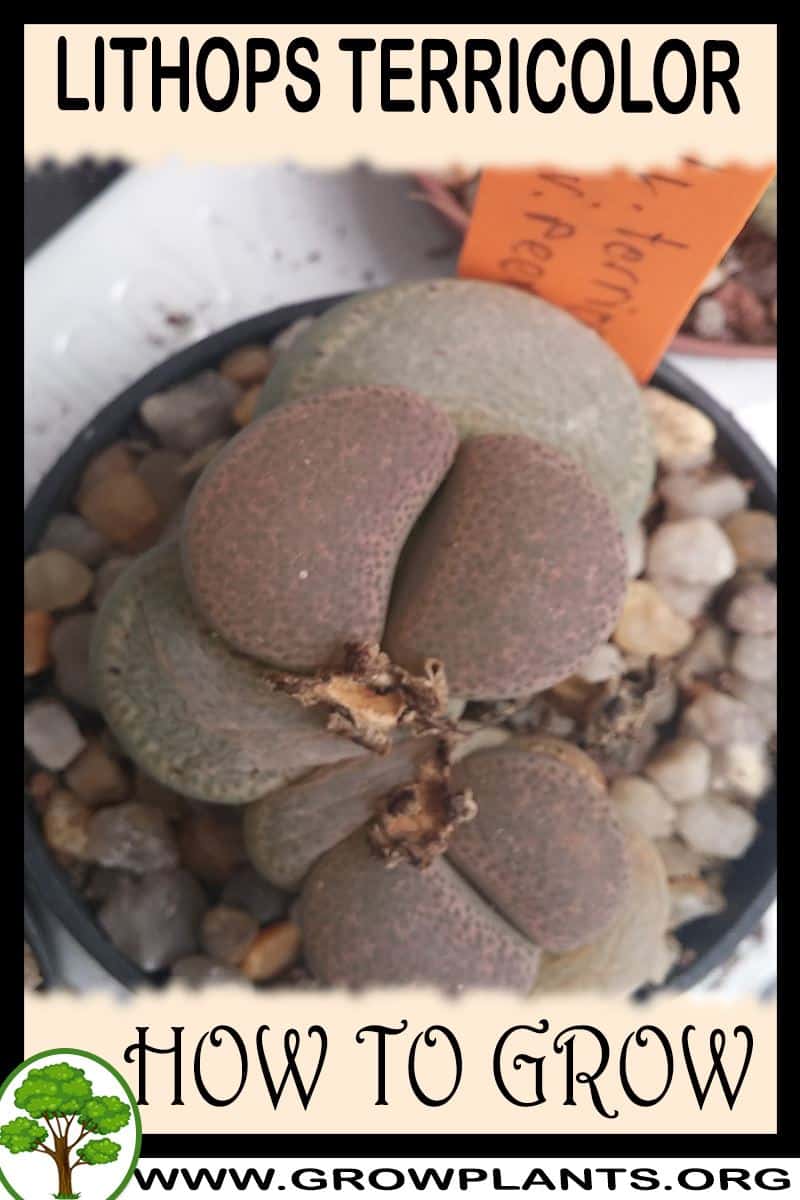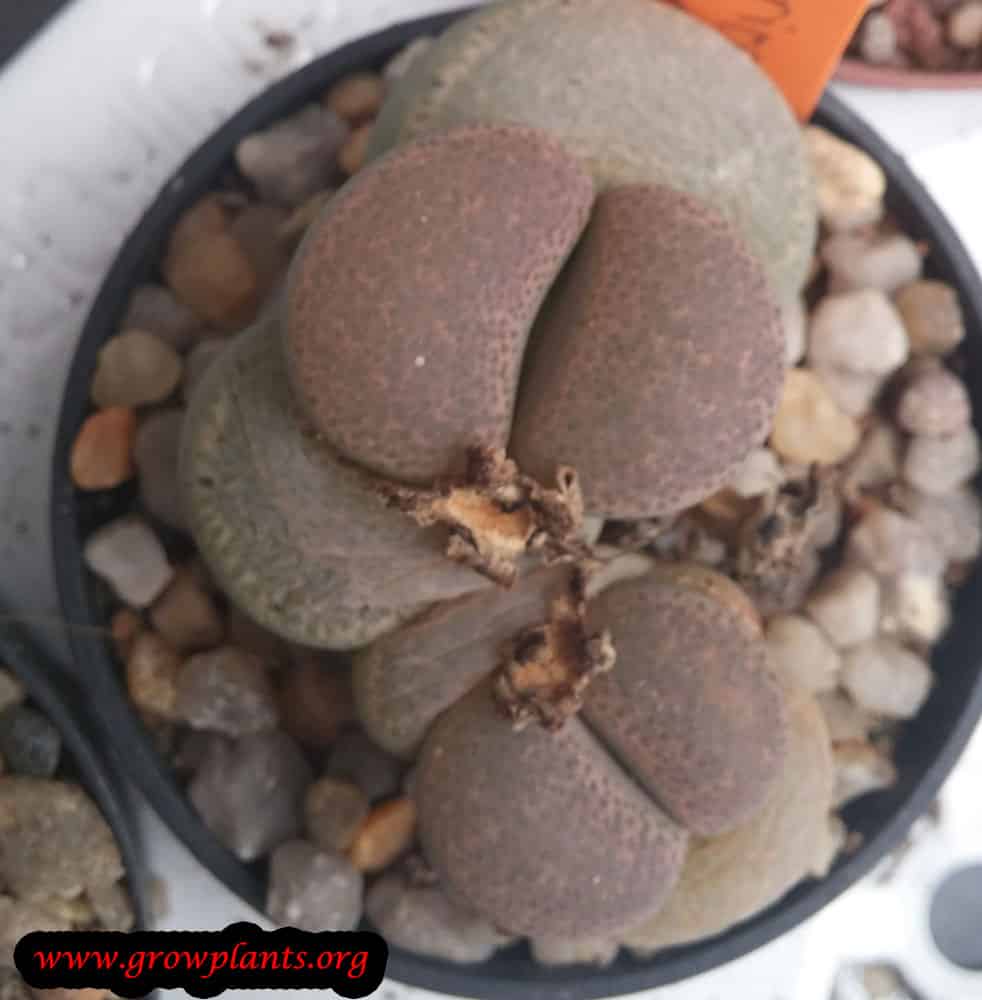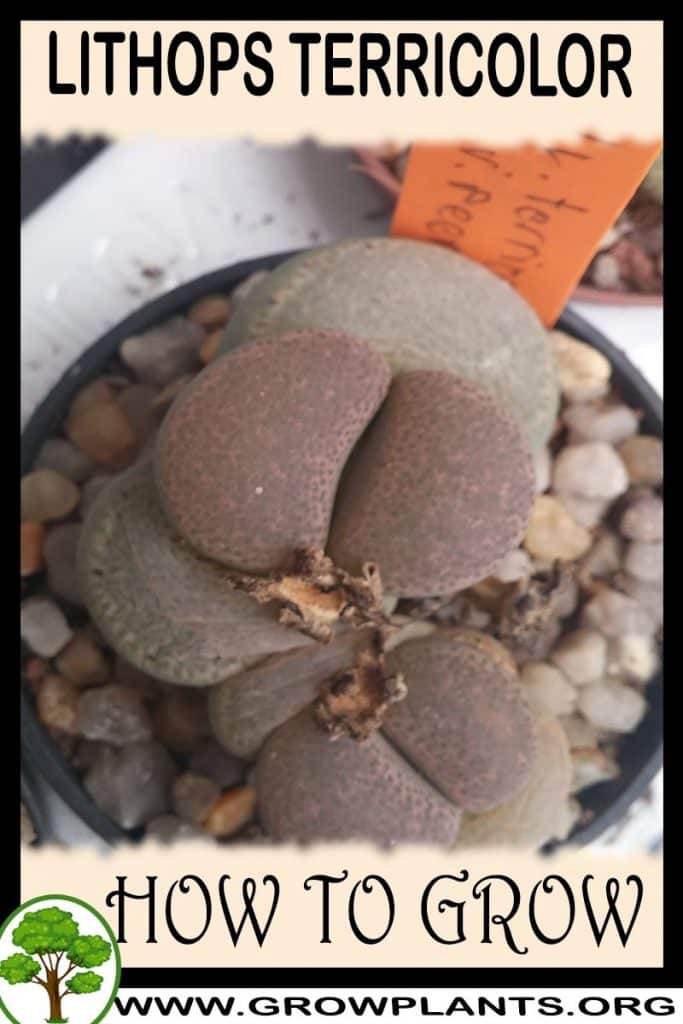
Plant Profile & Key Characteristics
Overview: Lithops terricolor is a tiny, stemless mimicry succulent whose paired, stone-like leaves sit almost flush with the soil. It is an evergreen perennial grown as an ornamental curiosity and houseplant, flowering with a daisy-like bloom in the cool season.
Quick Specifications
| Specification | Attribute |
|---|---|
| Plant Type / Life Cycle | Perennial (succulent) |
| Foliage Type | Evergreen (succulent) |
| Mature Size | About 0.5-1.5 cm tall (0.2-0.6 in), forming clumps a few cm wide |
| Growth Rate | Slow |
| Root System | Single taproot (contractile, pulling the plant into the soil) |
| Toxicity | Non-toxic |
| Hardiness | USDA zones 10-12 (grow as a houseplant in colder climates) |
Growth Form & Structure
- Height & Spread: Sits almost at soil level, barely 1-2 cm tall, slowly forming small clumps; ideal for shallow pots and as a bright-light houseplant.
- Growth Habit & Form: Stemless, ground-hugging succulent of paired fused leaves; clusters over time to form a mat-like groundcover in habitat.
- Lifespan & Maturity: Long-lived and very slow; each year one new leaf pair replaces the old from within.
Anatomy & Physical Features
- Leaves & Foliage: Fused paired stone-like leaves, often multi-coloured in green, orange, brown, purple or yellow, with a fissure on top; a new pair grows from within the old at 90 degrees.
- Flower Characteristics: A single daisy-like flower of many narrow petals emerges from the fissure, in white.
Primary Uses & Landscape Value
- Functional & Ornamental Roles: Ornamental container and windowsill succulent, succulent-collection and dish-garden novelty; a groundcover in its native desert habitat.
Care Guide: Planting, Soil & Watering
Overview: Lithops terricolor is a slow-growing desert succulent for full sun to bright light that demands a very gritty, sharply draining mineral soil. It stores water in its stone-like leaves and needs only occasional watering — a hot dry summer and cool dry winter suit it, and overwatering is fatal.
Quick Care Requirements
| Requirement | Ideal Condition |
|---|---|
| Planting Season | Year-round in frost-free conditions or under protection |
| Growth Rate | Slow |
| Soil Type | Very gritty, fast-draining mineral / cactus mix |
| Water Need | Low — water sparingly and let the soil dry out well between waterings |
Planting & Establishment
- Best Planting Season: Can be planted at any time of year in frost-free conditions or grown indoors under bright light.
- How to Plant:
- Hole Preparation: Use a small hole just large enough for the roots in a shallow, well-drained pot.
- Soil Amendments: Amend a cactus mix with extra coarse sand, pumice, or perlite rather than rich organic matter, which holds too much moisture.
- Planting Depth: Set the plant so the body sits at soil level with only the roots buried; a top-dressing of grit keeps the base dry.
- Growth Speed & Expectations: Expect very slow growth; these plants take their time and increase in size only gradually over years.
Soil, Watering & Drainage Care
- Soil Mix & Drainage Needs: Use a very gritty, fast-draining mineral mix — cactus or succulent soil cut with extra coarse sand, pumice, or perlite — in a pot with generous drainage, since any lingering moisture at the roots causes rot.
- Watering Schedule & Technique:
- Young / Newly Planted: Water seedlings and newly potted plants very sparingly, letting the gritty mix dry completely between light waterings.
- Established: Follow a soak-and-dry rhythm during the active growing periods, then let the soil dry out fully; overwatering is the quickest way to kill these plants.
- Seasonal Adjustments: Keep the plants bone dry through the heat of summer and the cold of winter, and withhold water entirely while the old leaf pair is being reabsorbed.
Climate, Light & Hardiness
Lithops terricolor (living stone) is a South African mesemb succulent for mediterranean, desert or subtropical climates, or a bright windowsill indoors. It needs a hot, sunny summer growing season followed by a cool, fairly dry winter rest, and has only low cold tolerance, generally thriving from about USDA zone 10 upward.
Quick Climate Specifications
| Climate Zones | Mediterranean, desert and subtropical climates; also grown as a houseplant in bright light |
| USDA Hardiness Zones | approximately 10–12 |
| Optimal Temp Range | approximately 18–28°C (64–82°F) during active summer growth; cooler, roughly 8–15°C (46–59°F), through winter rest |
| Cold Damage Begins | below approximately 5°C (41°F), especially in wet soil |
| Approx. Survival Minimum | a dry-kept, established plant may briefly tolerate light chill near 0°C (32°F), but combined cold-and-wet is far more damaging than dry cold alone |
| Frost Tolerance | Low |
| Light Conditions | Full sun to half shade |
Sunlight & Light Exposure
Optimal Light Setup
As much bright light as possible; full sun to half shade outdoors, or the brightest available windowsill indoors.
Direct Sun Requirement
Mature, well-acclimated plants enjoy strong sun, which keeps growth compact and colorful; introduce to full sun gradually.
Shade & Heat Management
Light half-shade can help in the very hottest desert summers, but overall this genus wants far more light than most houseplants – insufficient light causes stretching and loss of the camouflage form.
Best Exposure / Orientation
A south-facing bright exposure indoors or out.
Temperature Extremes & Hardiness
USDA Hardiness & Regional Limits
Site data places Lithops at approximately zone 10–12; below this range grow it as a container/houseplant in a bright spot rather than outdoors year-round.
Cold Damage & Winter Protection
Keep on the dry side and cool (not warm) through winter dormancy, and protect from frost – the main risk is cold combined with wet soil, not cold alone.
Frost Sensitivity
Low tolerance; protect from any frost, particularly on damp ground.
Extreme Heat Tolerance
Good; adapted to hot, sun-baked summer conditions in its native habitat, provided it is not overwatered.
Wind, Humidity & Microclimate
Humidity Preferences
Naturally suited to dry, low-humidity climates.
Dry-Air Tolerance
High; thrives in arid air, including dry, centrally heated indoor rooms.
Rainfall & Seasonal Moisture
Adapted to a hot-summer-growth, cool-dry-winter-rest rhythm rather than steady rainfall; the plant is sensitive to excess water, so good drainage and a distinct dry season matter more than total rainfall.
Microclimate Recommendations
Grow in very free-draining, mineral-rich soil in full light; indoors, a bright windowsill with some winter coolness suits its natural rest period.
Growing in Pots, Balconies & Indoors
Lithops terricolor (“living stone”) is a tiny, fascinating pebble-like succulent grown only in pots. The grower says it can be kept indoors “with light” – and that is the key: it needs the brightest, sunniest windowsill you have, as it will not survive in a dim room.
Quick Details
- Container Size: A small but fairly deep pot for its long taproot; the plant itself is only 0.5-1.5 cm (0.25-0.5 in) across
- Indoor Suitability: Indoors only on the brightest, sunniest windowsill – the grower stresses it needs strong light
- Best Spot: Full sun to light shade; as much direct light as possible
- Soil & Drainage: A very gritty, mostly-mineral mix with sharp drainage; no moisture-retentive compost
- Watering in Pots: Minimal and seasonal – tiny amounts with long dry spells; overwatering splits and rots them
Indoors & On the Windowsill
- Bright sill essential: The grower’s “yes, with light” is the whole story – only a very sunny windowsill gives enough light; in a dim room it etiolates and dies.
- Windowsill growing: A hot, south-facing sill is ideal. Turn the pot occasionally for even growth and keep it dry for weeks at a time between waterings.
- Warmth & rest: Keep it warm and completely dry during its rest period; cold, damp conditions are fatal.
On a Balcony or Patio
- Light & shelter: A hot, sunny, rain-sheltered balcony suits it, but it must be protected from prolonged rain; standing water quickly rots these tiny plants.
- Drainage: Raise the pot and use a mineral top-dressing so water drains instantly and never sits around the body.
Choosing the Pot, Soil & Long-Term Care
- Pot & drainage: A small, deep pot with generous holes and a gravel or grit top-dressing; never a standing saucer of water.
- Potting mix: A sharply draining, mostly-mineral mix (pumice, grit and coarse sand with only a little organic matter).
- Feeding: Practically none – at most a very dilute feed once in active growth.
- Repotting: Rarely needed – repot only every several years into fresh gritty mix, handling the taproot gently.
Growing this plant in a greenhouse
A greenhouse can give lithops terricolor frost protection and cold protection.
Greenhouse at a glance
| Greenhouse suitability | Good - clearly useful |
|---|---|
| Main benefits | frost protection, cold protection |
| Outdoor protection advisable below | about 5°C |
| Maintain greenhouse minimum | around 5°C for active growth |
| Suitable types | unheated greenhouse, polycarbonate greenhouse |
| Heating | Heating is optional - useful mainly for winter growing in cold areas. |
Related greenhouse guides
- Greenhouses: How to Choose the Right Greenhouse
- Polycarbonate Greenhouses: What to Look for Before Buying
- Greenhouse Climate Control: Temperature, Ventilation and Humidity
Fertilizing & Feeding
A very light feeder: at most an occasional dilute, low-nitrogen feeding during active growth, and none while dormant. Lean conditions keep these succulents compact and well colored.
Quick Fertilizing Specs
| Feeding Level | Light feeder |
|---|---|
| Main Nutrient Priority | Lean, low-nitrogen feeding to keep growth firm and compact |
| Best Feeding Period | Only during the active growing season |
| Organic Options | A little low-nutrient gritty compost or worm castings worked into the mix |
| Reduce/Stop Feeding | Stop feeding through dormancy and cool, low-light rest |
| Micronutrients | Usually adequate in fresh mix; correct only a diagnosed deficiency |
| Soil pH | Slightly acidic to near neutral, with sharp drainage |
Feeding by Growth Stage
Active growth
Support steady, compact growth during the active growing season without forcing soft, weak tissue.
| Nutrient direction | A dilute, low-nitrogen complete fertilizer made for cacti and succulents; lean nutrition keeps growth firm and well colored. |
|---|---|
| Timing | During the active growing season, while the plant is putting on new growth. |
| Frequency | Feed sparingly and infrequently through the active season; this is a low-demand succulent that needs very little. |
| Fertilizer types | A dilute complete fertilizer formulated for cacti and succulents, A little low-nutrient gritty compost or worm castings worked into the mix |
| Precautions | Feed lightly and only into already-moist gritty mix; overfeeding produces soft, stretched, rot-prone growth and salt buildup. |
Dormancy and rest
Let the plant rest through its dormant period without pushing new growth.
| Nutrient direction | None – withhold fertilizer while the plant is dormant and not in active growth. |
|---|---|
| Timing | During the dormant rest period, when growth naturally stops in the hot, dry or cold part of the year. |
| Frequency | No feeding at this stage. |
| Fertilizer types | No feeding at this stage; do not fertilize until active growth resumes. |
| Precautions | Do not fertilize a dormant succulent; feeding now wastes nutrients and raises the risk of salt injury and rot. |
Nutrient Deficiency Signs & Corrections
Overall growth slows and older growth fades to a pale, washed-out green, sometimes with weak, stretched development.
| Possible causes | low available nitrogen in a lean, gritty mix, long spell in old, exhausted potting mix, nitrogen leaching from repeated watering |
|---|---|
| Appears first on | older, lower growth |
| What to check | how long since repotting into fresh mix, recent feeding history, light levels, since low light also causes pale, stretched growth |
| Possible correction | Apply a dilute low-nitrogen complete succulent fertilizer during active growth and refresh exhausted mix; also correct low light if present. |
Tips or margins brown and scorch, roots may blacken, and growth stalls despite adequate watering.
| Possible causes | fertilizer salt buildup in the gritty mix, overfeeding or feeding at too high a strength, poor drainage that concentrates salts around the roots |
|---|---|
| Appears first on | growing tips and margins |
| What to check | recent fertilizer strength and how often it was applied, drainage and the condition of the mix, whether water flushes freely through the pot |
| Possible correction | Ease off feeding, flush the mix with clean water to leach accumulated salts, then return to lighter, dilute feeding. |
Newest growth turns pale or yellow between the green veins while older growth stays greener.
| Possible causes | high soil or irrigation-water pH reducing iron availability, overwatering and cold, poorly aerated mix limiting root uptake, genuinely low micronutrient availability in old, spent mix |
|---|---|
| Appears first on | the newest growth |
| What to check | soil and irrigation-water pH, drainage and how wet the mix stays, how long since the mix was refreshed |
| Possible correction | Correct pH and improve drainage first; if it persists, apply a chelated iron product per its label. |
Pruning, Training & Seasonal Maintenance
Lithops terricolor is a stemless, paired-leaf stone plant maturing at only 0.5–1.5cm, with a leaf range of green, orange, brown, purple and yellow, and a fissured, sometimes brain-like leaf face. As with the genus generally, pruning is grooming rather than shaping: there is no wood or branch structure to train. The outer leaf pair is left to shrink and dry fully as the new pair emerges inside it, and the spent flower stem is cleared once the white autumn bloom (occasionally purple-toned) finishes. Facts list the pruning season as all year, so timing follows leaf condition rather than a fixed calendar window, and neither task affects the plant’s slow growth or next year’s flowering.
Quick Pruning & Maintenance Specs
| Pruning Tolerance | Low – grooming only, at sub-centimetre scale |
| Primary Pruning Window | Cued by leaf condition year-round – remove the old leaf pair only once fully shrivelled and papery |
| Secondary Maintenance Window | After the autumn bloom, once the flower stem has dried |
| Typical Frequency | Once per annual leaf-succession cycle, matching its slow growth rate |
| Main Objective | Tidy appearance; prevent the spent leaf pair holding moisture against the new pair |
| Mature Plant Priority | Remove fully desiccated leaf pairs and dried flower stems only |
| Best Tool Type | Fine-point precision snips, matched to the sub-centimetre scale |
| Avoid Heavy Pruning During | While the old leaf pair is still plump, coloured or only partly shrivelled |
Pruning by Plant Age & Size
Newly Established
Leave completely untouched through its first season while it settles in.
Young / Formative
No structural training applies. The only choice is whether to let offsets cluster into a small group or separate them once large enough to handle.
Mature / Established
Annual removal of the fully dried outer leaf pair and the spent flower stem is the entire maintenance task.
Seasonal Pruning Schedule
Post-Flowering (After Autumn Bloom)
Objective: tidy the plant once the white bloom finishes. Remove: the flower stem once dried and browned at the base. Do not remove: leaf tissue that is still firm or coloured. Expected response: none, cosmetic only. Flowering impact: none, bloom already over.
Ongoing Sanitary (Leaf-Succession Cleanup)
Objective: clear the outer leaf pair once it has finished feeding the new pair growing inside it. Remove: only leaf material that is papery-dry and detaches without resistance. Do not remove: any pair still plump or holding colour. Expected response: none. Flowering impact: none.
Special Growth to Remove
- Fully desiccated outer leaf pair – remove only once papery
- Spent flower stem after the autumn bloom fades
- Offsets/clustered heads are not unwanted growth – leave to form a small group or separate carefully for propagation
Container & Small-Space Pruning
Typically grown in small, shallow, well-draining pots or as a houseplant given its tiny mature size and sensitivity to water. No root pruning is needed; disturbance itself is a stress at this scale, so repot only when the clump outgrows its container. Let the surface dry after grooming before the next watering, to keep moisture off the exposed crown.
Tools
- Fine-point precision snips – the only tool this plant’s scale calls for, used on the dry flower stem; the old leaf pair usually lifts away by hand once fully papery
Tool Hygiene & Disease Risk
Routine care with a clean, sharp fine point is sufficient. The real risk is rot from cutting into living tissue or leaving moisture on a fresh cut, not pathogen transfer between plants.
Cut Placement & Technique
Cut the flower stem at its base without touching the leaf pair, working carefully at this sub-centimetre scale. Never cut into the fissure between the new pair and the old one; stop at the first sign of resistance, which signals living tissue.
Heavy Pruning & Rejuvenation
Not tolerated and not applicable at this scale – there is no dormant growing point to regenerate from, and cutting into a living leaf pair kills that tissue outright.
Post-Pruning Care
Withhold water for a few days after grooming to let the area dry and limit rot risk, given this species’ listed sensitivity to water. No feeding is needed.
Common Pruning Mistakes
- Peeling the old leaf pair away before it is fully desiccated, cutting off the new pair’s moisture supply
- Watering immediately after grooming, inviting rot in a water-sensitive species
- Confusing the fissured, brain-like leaf face for damage and cutting into otherwise healthy tissue
When NOT to Prune
- While the old leaf pair is still plump, coloured or only partly shrivelled
- Immediately after repotting, while roots are settling
- On wet or recently watered soil
Recommended Tools (by task)
- Mature plant – spent flower stem and dry leaf removal: precision_snips – a fine, controlled cut at sub-centimetre scale without disturbing the new leaf pair.
Propagation Guide
Lithops terricolor is most reliably raised from seed, as its stone-like leaf pairs cannot be taken as cuttings and grafting is not used on this species; splitting a mature clump that has formed several rooted heads is a vegetative option when keeping a specific colour form true to the parent is the priority. Overall difficulty is moderate, since germination is manageable but the tiny seedlings demand patient, careful attention through their first year.
Quick Propagation Specs
| Best Propagation Method | Seed |
| Alternative Methods | Division of rooted offsets/heads (to keep a particular colour form) |
| Propagation Difficulty | Moderate |
| Seed True-to-Type | Mostly uniform at the species level; individual leaf colour and pattern vary between seedlings |
| Vegetative True-to-Type | Yes |
| Best Propagation Season | Spring, as temperatures warm and growth resumes |
| Seed Germination Time | Roughly 1–3 weeks, can be uneven |
| Germination Temperature | About 20–25°C (68–77°F) |
| Seed Sowing Depth | Surface-sow, uncovered – the fine seed needs light to germinate |
Growing from Seed
Seed Handling & Viability
Seed is fine and dust-like, with viability that declines over time, so sow relatively fresh seed where possible; store any reserve seed dry, dark and cool.
Dormancy & Pre-Sowing Treatment
No pretreatment is required before sowing.
Sowing Season
Spring, once warm weather is established, is the most reliable sowing time.
Sowing Depth & Orientation
Sow on the surface of a fine, gritty, free-draining mix without covering – light is needed to trigger germination.
Germination Conditions
Cover the tray to keep humidity up, maintain the mix lightly and evenly moist, and provide bright, filtered light at roughly 20–25°C (68–77°F).
Germination Time
Usually about 1–3 weeks, sometimes slower or uneven.
Seedling Care
Seedlings begin very small and slow-growing. Ease humidity down gradually over the first weeks, keep them shaded from harsh sun, and water carefully – overwatering is the main cause of losses at this stage. Wait until plants are well established before starting a drier winter rest.
Division, Offsets, Pups & Suckers
Mature plants often split into multiple heads over time. Once a head has its own root system it can be carefully separated at repotting, ideally during active growth; let the cut surface dry and callus for a few days in shade before potting into gritty mix and watering sparingly until re-rooted.
Bloom & Flower Guide
Quick Details
- Bloom Season: Autumn
- Flower Appearance: Daisy-like, many-petalled white flowers (sometimes with a pale yellow centre) that emerge from the slit between the paired leaves
- Edibility: Ornamental only
Detailed Blooming Overview
Lithops are the classic living stones, and in autumn a single many-petalled flower pushes up from the fissure between each plant body – often nearly as wide as the plant itself. The flowers open around midday and close in the evening over several days. In this species they are white, occasionally with a paler yellow eye.
Flower Characteristics
- Many narrow petals in a daisy-like form, white (sometimes pale-yellow centred).
- One flower per plant body, from the leaf slit; opens midday, closes toward evening.
Bloom Care & Thinning
- Watering rhythm: A little water as the new season starts helps flowering; keep dry during dormancy.
- Light: Bright light is essential for buds to form and open.
Pests, Diseases & Troubleshooting
Overview: Living stones (Lithops) are remarkably pest-free succulents – their real enemies are cultural, above all rot from overwatering, especially during dormancy and leaf renewal. When pests do appear they are mealybugs, scale, spider mites, fungus gnats and the occasional slug; genuine diseases are essentially all root and basal rot. Lithops terricolor is a clustering species that is equally unforgiving of water during dormancy or leaf renewal. The guiding philosophy is restraint: bright light, gritty soil, and very sparing water on the plant’s seasonal rhythm.
Quick Troubleshooting Overview
| Issue / Pest | Main Symptom | Primary Solution |
|---|---|---|
| Root / basal rot | Body goes soft, translucent, yellow-brown and mushy | Stop watering, gritty mix, remove rot |
| Mealybugs | White cottony fluff in the fissure and at roots | Alcohol swab, systemic/oil, isolate |
| Spider mites | Fine russeting/scarring on the body surface | Rinse, raise humidity, miticide if severe |
| Fungus gnats | Tiny flies from wet mix; larvae attack roots | Let mix dry, sticky traps, Bti |
| Splitting / etiolation | Elongated, pale, multiple bodies | Cut water, increase light |
Common Pests & Management
- Mealybugs (Pseudococcus & Rhizoecus spp.):
- Symptoms: Cottony white specks tucked in the leaf fissure and among the roots (root mealybugs), sapping the plant and inviting rot; growth stalls and the body softens.
- Prevention & Control: Dab visible colonies with an alcohol-moistened cotton swab, isolate affected plants, drench or repot into fresh gritty mix if root mealybugs are found, and use horticultural oil or a systemic only sparingly on these sensitive plants.
- Scale insects (Diaspididae):
- Symptoms: Small immobile brown discs on the body surface, sometimes with slight yellowing and honeydew.
- Prevention & Control: Scrape off gently, wipe with alcohol, and treat lightly with horticultural oil, keeping it off the sensitive epidermis in strong sun.
- Spider mites (Tetranychus spp.):
- Symptoms: Fine pale russeting or scarring on the body surface and faint webbing in hot, dry, stagnant air; the mites are almost invisible.
- Prevention & Control: Rinse the plant, improve air movement, avoid heat stress, and use a miticide or light horticultural oil only if damage is spreading.
- Fungus gnats (Bradysia spp.):
- Symptoms: Small dark flies hovering over the mix; their larvae live in persistently wet soil and can graze roots and the sensitive base, encouraging rot.
- Prevention & Control: The cure is dryness – let the mix dry thoroughly, use a gritty inorganic-topped medium, catch adults on yellow sticky traps, and drench with Bti if larvae persist.
- Slugs and snails (Deroceras spp.):
- Symptoms: Occasional gouges and slime trails on the soft bodies, mainly in humid, sheltered conditions.
- Prevention & Control: Hand-collect at night, keep the growing area clean and dry, and use iron-phosphate bait if needed.
Diseases & Fungal Issues
- Root and basal rot (Fusarium / Pythium / Phytophthora spp.):
- Symptoms: The body turns soft, translucent, yellow-brown and mushy, often from the base up, and collapses; this is by far the most common and fatal Lithops problem, caused by too much water at the wrong time.
- Treatment & Management: Prevention is everything: use a very gritty, fast-draining, mostly-mineral mix, water only lightly and only in the active growing periods, and never water during dormancy or leaf renewal. If rot appears, cut away all affected tissue, dry the plant, and re-root the firm remainder in dry grit.
- Sooty mould (secondary on honeydew):
- Symptoms: Black powdery film on the body wherever mealybugs or scale have left honeydew, blocking light.
- Treatment & Management: Control the underlying insects, then gently wipe the body clean; improve airflow to keep the surface dry.
Growing Difficulties & Abiotic Problems
- Overwatering rot (the number-one killer):
- Cause & Symptoms: Water given during dormancy or leaf renewal, or in a moisture-retentive mix, saturates the roots and rots the plant from within.
- Correction Strategy: Follow the seasonal cycle – water sparingly only while actively growing, keep completely dry during dormancy and while the new leaf pair absorbs the old, and always use a gritty, sharply draining mix in a pot that dries out.
- Splitting, doubling and failure to shed old leaves:
- Cause & Symptoms: Watering during leaf renewal stops the old leaf pair from being reabsorbed, causing extra ‘stacked’ bodies, splitting and a tatty, congested plant.
- Correction Strategy: Withhold water entirely through the renewal period so the plant lives off the old leaves; resume only once the old pair has dried to papery husks.
- Etiolation and sunburn:
- Cause & Symptoms: Too little light stretches and pales the bodies and washes out their patterning, while a sudden move to fierce sun scorches the soft epidermis with sunken tan patches.
- Correction Strategy: Grow in very bright light for compact, well-marked bodies, but acclimatise gradually to strong sun and give light shade at the fiercest midday to prevent scorch.
- Corky scarring and dented bodies:
- Cause & Symptoms: Physical damage, erratic watering or edema (water taken up faster than lost) leaves permanent corky marks or a shrivelled, dented look.
- Correction Strategy: Handle gently, water evenly and lightly in the growing season, and accept minor cosmetic scars – they do not harm a firm, healthy plant.
What Helps – Products & Tools
Lithops want tools of restraint more than sprays: a gritty, mostly-mineral potting mix and a well-draining pot are the main ‘products’. For the rare pest, keep isopropyl alcohol and cotton swabs for mealybugs, a little horticultural oil for scale, yellow sticky traps and Bti for fungus gnats, and iron-phosphate bait for slugs. There is no chemical fix for rot – only correct watering. Follow any product label and keep oils off the body in strong sun.