Plant Profile & Key Characteristics
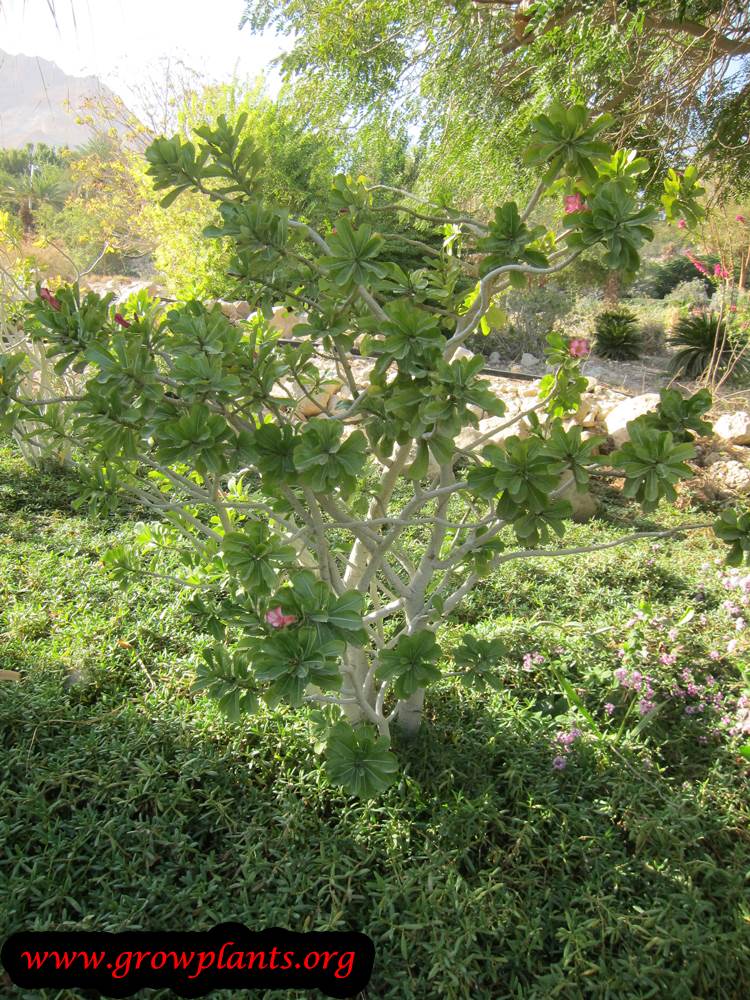
Overview: Desert rose (Adenium obesum) (Adenium) is a slow-growing, succulent perennial shrub reaching 0.5-2 m (20-80 in), with a swollen water-storing base. It is grown as an ornamental specimen, bonsai and houseplant, and is drought-deciduous, dropping its leaves in dry or cool spells but able to stay evergreen if kept watered.
Quick Specifications
| Specification | Attribute |
|---|---|
| Plant Type / Life Cycle | Perennial (succulent shrub) |
| Foliage Type | Drought-deciduous (can remain evergreen with watering) |
| Mature Size | 0.5-2 m (20-80 in) |
| Growth Rate | Slow to moderate |
| Root System | Caudiciform – swollen, water-storing base (caudex) |
| Toxicity | Toxic – the milky sap contains cardiac glycosides and is poisonous if ingested |
| Hardiness | USDA zones 10b-12 |
Growth Form & Structure
- Height & Spread: 0.5-2 m (20-80 in) in the ground; readily kept far smaller as a potted or bonsai specimen, where the swollen caudex is displayed above the soil.
- Growth Habit & Form: Fleshy, succulent shrub with a thick, tapering caudex and stout branches carrying leaves toward the tips.
- Lifespan & Maturity: Long-lived perennial that thickens its caudex slowly over many years.
Anatomy & Physical Features
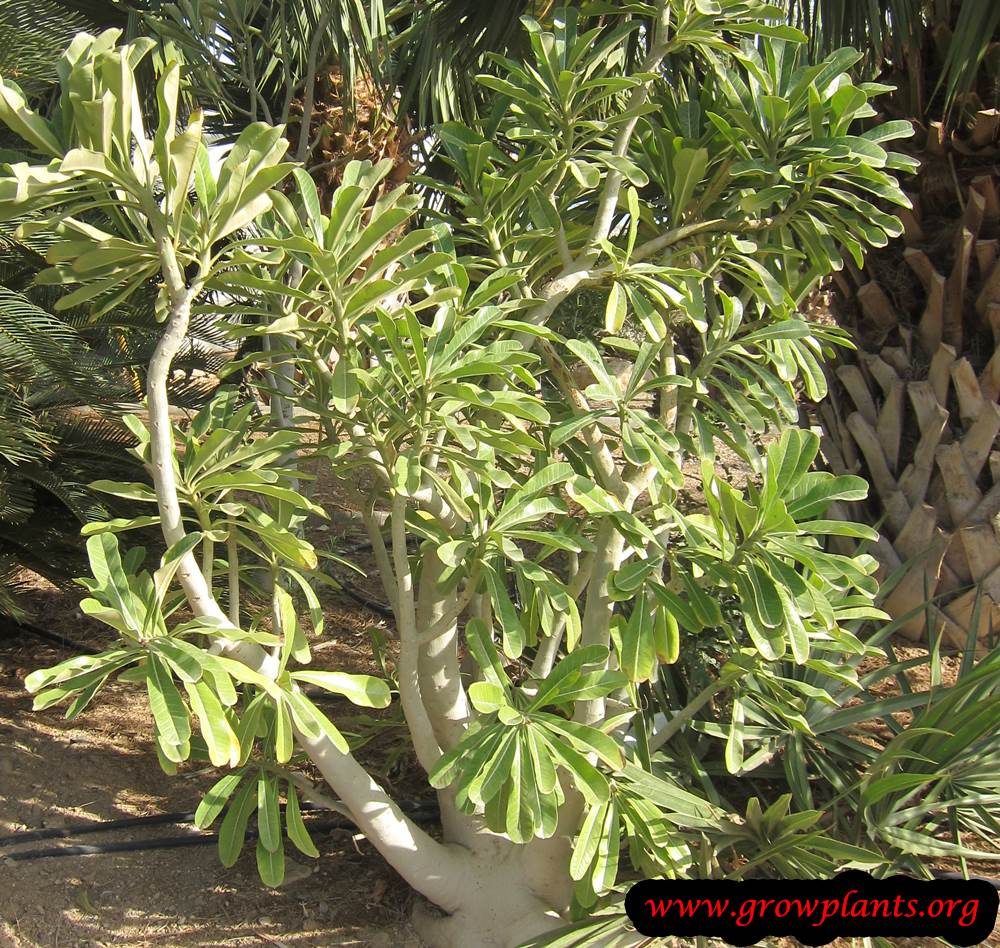
- Trunk & Bark: Swollen, water-storing caudex and thick branches with smooth, pale grey-green bark.
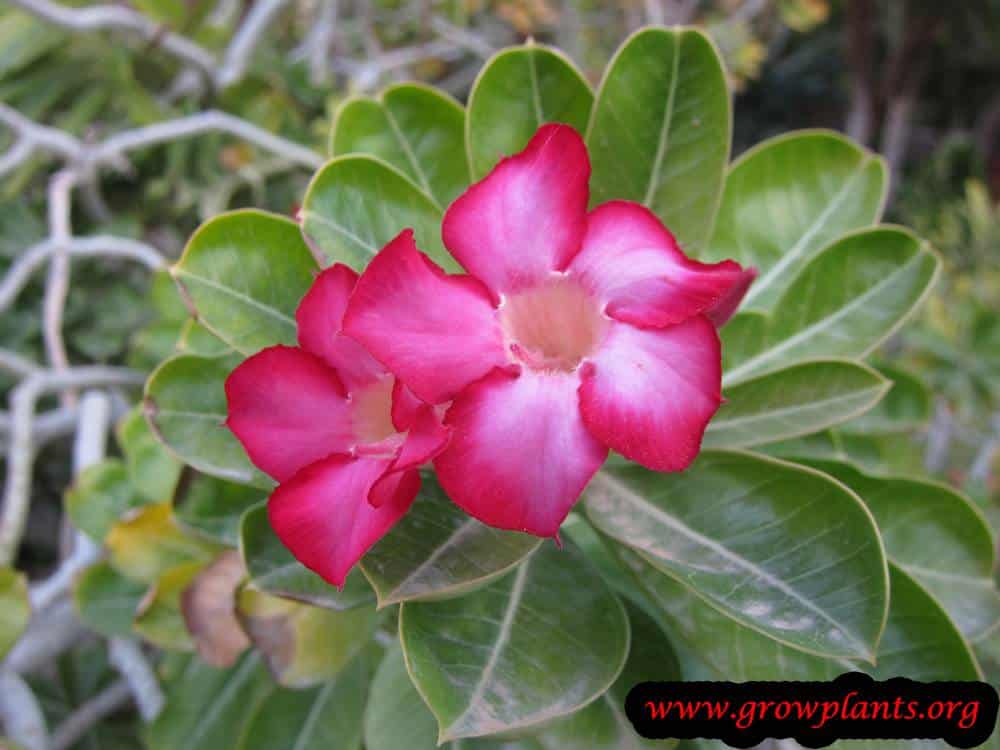
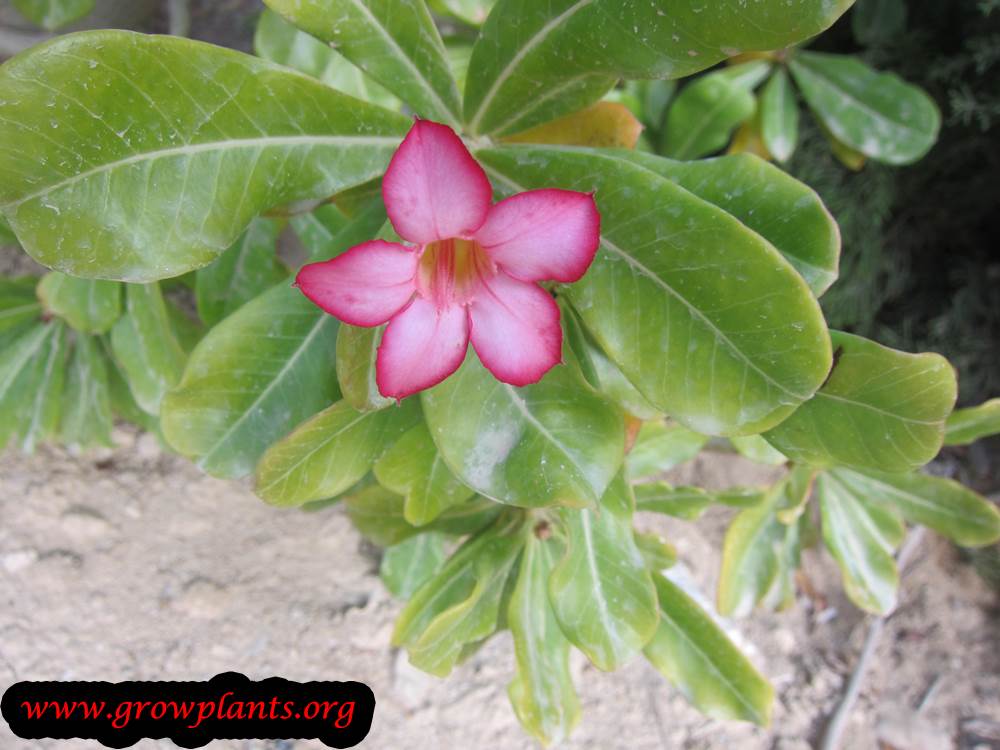
- Leaves & Foliage: Green, glossy, egg-shaped (obovate) leaves, narrow at the base and wider toward the tip, clustered at the branch ends.
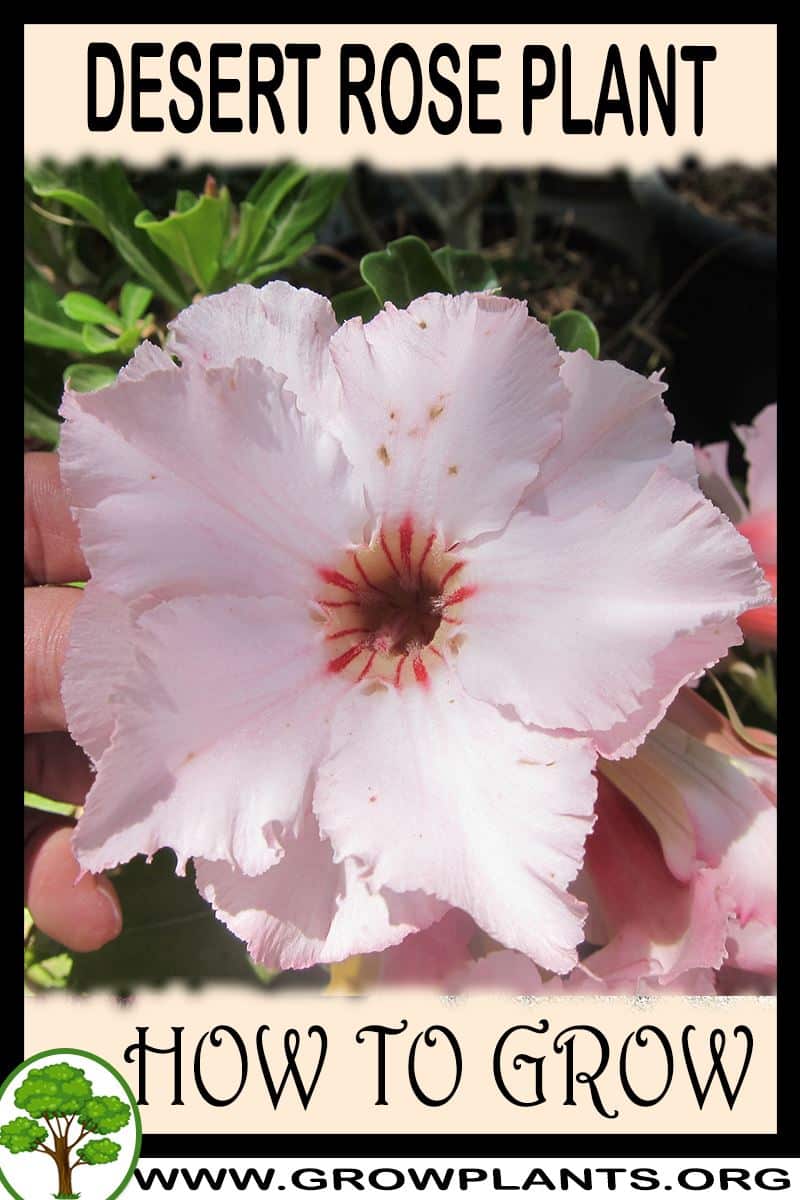
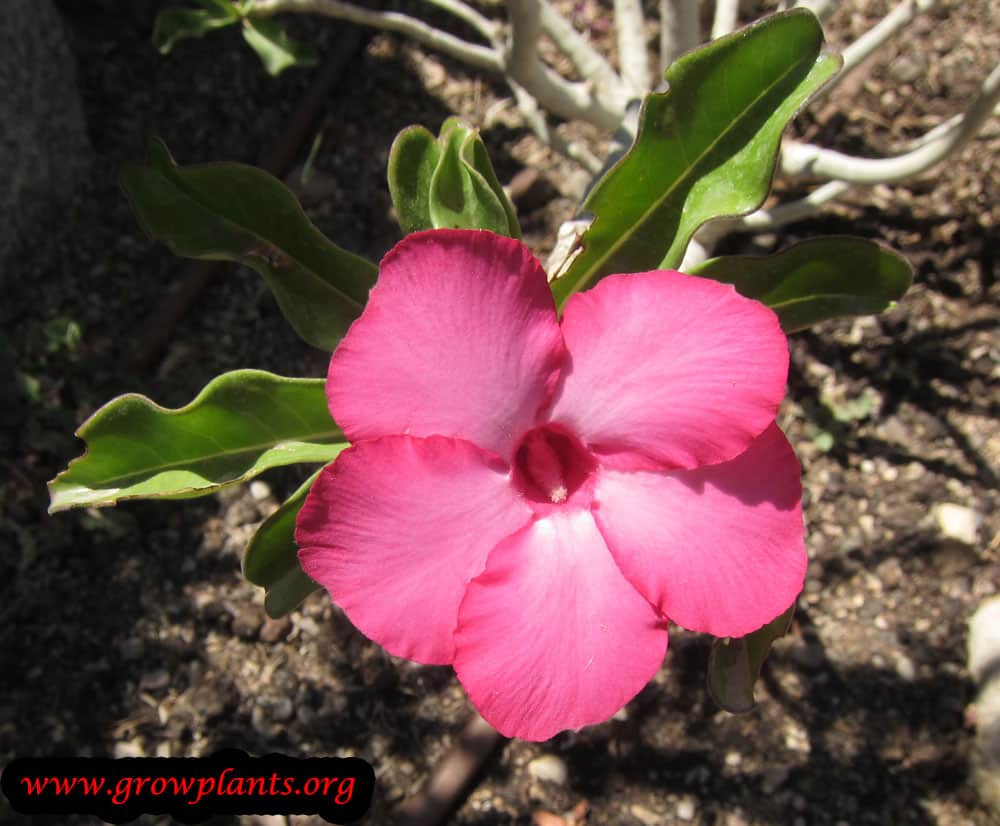
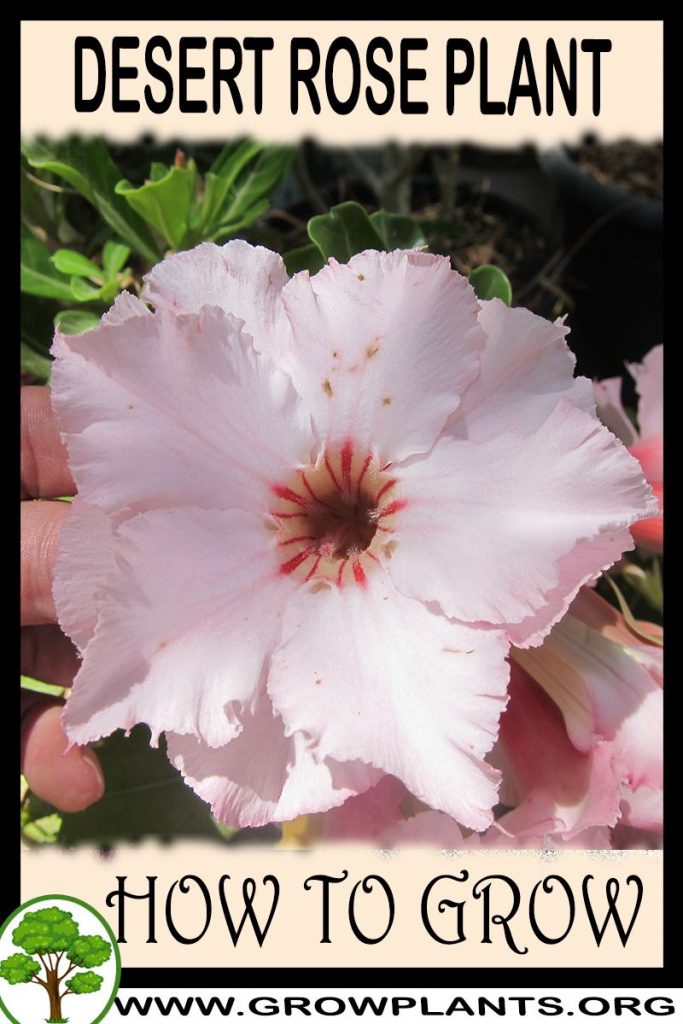
- Flower Characteristics: Showy, mostly flat, trumpet-like flowers with five petals (sometimes double or full), in shades of pink, red, white, yellow, orange, purple or black.
Primary Uses & Landscape Value
- Functional & Ornamental Roles: Ornamental flowering specimen for bonsai, containers, houseplant culture and hot, dry (desert / xeriscape) plantings.
Care Guide: Planting, Soil & Watering
Overview: The desert rose is a succulent shrub with a swollen water-storing base that needs a bright, frost-free position and fast-draining soil. It stores moisture in its caudex, so it is watered on a soak-and-dry basis – let the mix dry out fully before watering again to keep the roots and base from rotting.
Quick Care Requirements
| Requirement | Ideal Condition |
|---|---|
| Planting Season | Autumn through spring in frost-free climates |
| Growth Rate | Slow to Moderate |
| Soil Type | Gritty, fast-draining succulent mix |
| Water Need | Low – soak-and-dry; let the soil dry out completely between waterings |
Planting & Establishment
- Best Planting Season: In frost-free climates plant from autumn through spring; always keep it out of frost, which the plant cannot tolerate.
- How to Plant:
- Hole Preparation: Dig a hole a little wider than the root ball in a warm, sunny, sheltered spot, and loosen any heavy surrounding soil to improve drainage.
- Soil Amendments: Blend coarse sand or grit into the soil (or use a dedicated cactus/succulent mix) so water drains away quickly – avoid rich, water-holding ground.
- Planting Depth: Set the plant so the swollen caudex sits at or just above soil level; do not bury the base, as buried tissue rots easily.
- Growth Speed & Expectations: Growth is slow to moderate, forming a compact shrub with a characterful thickened base over time.
Soil, Watering & Drainage Care
- Soil Mix & Drainage Needs: Use a gritty, very free-draining mix so water never lingers around the roots. It grows well in a container, where a cactus/succulent potting mix with plenty of drainage holes suits it far better than heavy garden soil.
- Watering Schedule & Technique:
- Young / Newly Planted: Water sparingly to settle it in, letting the surface dry before watering again while the roots establish.
- Established: Soak the soil thoroughly, then let it dry out completely before the next watering; err on the side of too little rather than too much.
- Seasonal Adjustments: Water a little more in the warm growing season and keep it nearly dry when cool and leafless, so the caudex is never sitting in wet soil.
Climate, Light & Hardiness
Desert rose (Adenium, commonly Adenium obesum) is a true desert/subtropical succulent shrub that needs a frost-free climate or container culture, growing best in full sun to light shade. It has essentially no cold tolerance and is easily killed or badly damaged by frost, so in any climate with freezing winters it must be grown as a container plant brought indoors.
Quick Climate Specifications
| Climate Zones | Desert, mediterranean and subtropical climates outdoors; widely grown as a houseplant/container succulent elsewhere |
| USDA Hardiness Zones | approximately 10b–12 (frost-free); grown in containers and moved indoors in colder zones |
| Optimal Temp Range | approximately 21–35°C (70–95°F) |
| Cold Damage Begins | below approximately 10°C (50°F) growth stops and stems become vulnerable |
| Approx. Survival Minimum | typically needs to stay above approximately 5°C (41°F); frost or prolonged cold near 0°C (32°F) is usually fatal, especially to the swollen caudex |
| Frost Tolerance | None |
| Light Conditions | Full sun to full shade (best flowering and compact form in full sun) |
Sunlight & Light Exposure
Optimal Light Setup
As much bright light as possible; full sun gives the strongest growth, best flowering, and most compact caudex form.
Direct Sun Requirement
Full sun is ideal outdoors in warm climates; indoors, place in the brightest window available or supplement with grow lights.
Shade & Heat Management
Tolerates half shade to full shade, but growth becomes leggier and flowering declines with less light.
Best Exposure / Orientation
South-facing or unobstructed bright exposure, whether in-ground in frost-free climates or as a container specimen.
Temperature Extremes & Hardiness
USDA Hardiness & Regional Limits
Reliable only in essentially frost-free zones, roughly 10b–12; anywhere colder it must be grown as a container plant and brought under cover for winter.
Cold Damage & Winter Protection
Bring indoors or under glass well before the first frost; keep dry and cool-but-frost-free through winter dormancy rather than warm and wet.
Frost Sensitivity
Very high – even light frost can damage or kill stems and the caudex; this is fundamentally a frost-free-climate plant, and cold tolerance is not something to rely on regardless of size or age.
Extreme Heat Tolerance
Excellent; a true desert species that thrives in intense heat given adequate warm-season water.
Wind, Humidity & Microclimate
Humidity Preferences
Prefers relatively dry air; tolerates humid subtropical summers but good airflow reduces rot risk.
Dry-Air Tolerance
High – well adapted to arid desert conditions.
Rainfall & Seasonal Moisture
Naturally adapted to a wet-summer, bone-dry-winter rhythm; the plant is summer-deciduous and rests in cooler, drier weather, though it can stay evergreen if kept warm and watered.
Microclimate Recommendations
In any climate with cold winters, grow in a container so it can be moved to a warm, bright, frost-free spot for the dormant season.
Growing in Pots, Balconies & Indoors
The desert rose (Adenium) is a striking caudex succulent that makes both an excellent houseplant and a superb container specimen for a hot, sunny balcony or patio. Reaching about 0.5-2 m (20-80 in), it stores water in its swollen stem, so it tolerates drought well – given strong light and sharp drainage it is easy and rewarding in a pot.
Quick Details
- Container Size: A snug pot suits it – it flowers better slightly potbound; pot up gradually as it grows
- Indoor Suitability: Yes – a fine houseplant given the brightest spot you have
- Best Spot: Full sun to bright light; the more light, the better the bloom and the fatter the caudex
- Soil & Drainage: Very free-draining, gritty succulent mix
- Watering in Pots: Sparingly; let it dry well between waterings, and much less during winter rest
Indoors & On the Windowsill
- A genuine houseplant: Yes – give it your brightest, sunniest window. In low light it grows leggy and will not flower well.
- Windowsill growing: A hot, sunny sill is ideal; it loves direct sun.
- Overwintering: Keep it warm and nearly dry through winter, above about 10 C (50 F); a pot makes it easy to bring indoors before cold arrives.
On a Balcony or Patio
- Light & heat: It revels in full sun and the reflected heat off walls and railings. Shelter it from cold and from prolonged heavy rain, which can rot the caudex.
- Practicalities: Pots dry fast in the heat – check moisture, but always err on the dry side; ensure runoff drains freely.
Choosing the Pot, Soil & Long-Term Care
- Pot & drainage: A pot with strong drainage holes and no standing saucer of water; terracotta is ideal, breathing and drying faster than glazed or plastic.
- Potting mix: A gritty, very free-draining succulent mix – potting mix cut with plenty of perlite, pumice or coarse sand.
- Feeding: A light feed in the growing season supports flowering; potted plants need it a little more often as nutrients leach.
- Repotting: Every couple of years, refreshing the mix and potting up only a size at a time.
Safety: Adenium sap is highly toxic (it contains cardiac glycosides). Keep it well away from children and pets, never allow any part to be eaten, and wash your hands after pruning.
Growing this plant in a greenhouse
A greenhouse can give desert rose plant frost protection and cold protection.
Greenhouse at a glance
| Greenhouse suitability | Good - clearly useful |
|---|---|
| Main benefits | frost protection, cold protection |
| Outdoor protection advisable below | about 10°C |
| Maintain greenhouse minimum | around 10°C for active growth |
| Suitable types | unheated greenhouse, polycarbonate greenhouse |
| Heating | Heating is optional - useful mainly for winter growing in cold areas. |
Related greenhouse guides
- Greenhouses: How to Choose the Right Greenhouse
- Polycarbonate Greenhouses: What to Look for Before Buying
- Greenhouse Climate Control: Temperature, Ventilation and Humidity
Fertilizing & Feeding
A light feeder: it needs little fertilizer and grows best in a lean, well-drained mix with only occasional dilute feeding during active growth.
Quick Fertilizing Specs
| Feeding Level | Light feeder |
|---|---|
| Main Nutrient Priority | Lean, low-nitrogen feeding |
| Best Feeding Period | Active growing season only |
| Reduce/Stop Feeding | Stop feeding during cool, dark, or dormant rest periods |
| Organic Options | A little compost or worm castings worked into the gritty mix |
| Soil pH | Tolerates a wide range; slightly acidic to near neutral |
| Micronutrients | Rarely needed; correct only if a deficiency shows |
Feeding by Growth Stage
Active growth
Support steady, firm growth during the active growing season without forcing soft, weak tissue.
| Nutrient direction | Lean, low-nitrogen complete feeding; keep it dilute and light. |
|---|---|
| Timing | During the active growing season when new leaves are forming. |
| Frequency | Feed sparingly, with only occasional light feedings while the plant is actively growing. |
| Fertilizer types | A balanced or low-nitrogen complete fertilizer, well diluted, A specialized cactus and succulent fertilizer |
| Precautions | Avoid heavy or high-nitrogen feeding, which forces soft, stretched growth and makes roots prone to rot; always apply to moist soil rather than a bone-dry mix. |
Dormant rest
Let the plant rest; there is no active growth to support, so added nutrients are not needed.
| Nutrient direction | None – withhold fertilizer during the rest period. |
|---|---|
| Timing | During the cool, low-light, or dormant rest period. |
| Frequency | No feeding at this stage. |
| Fertilizer types | No feeding at this stage; do not fertilize until active growth resumes. |
| Precautions | Do not fertilize resting plants; feeding now pushes weak growth and lets salts build up in the mix. |
Nutrient Deficiency Signs & Corrections
Older leaves turn uniformly pale and growth slows over a long stretch.
| Possible causes | Low nitrogen availability in an old, depleted mix, Roots damaged or restricted by soggy, poorly drained soil, Very low light limiting overall growth |
|---|---|
| Appears first on | Oldest, lower leaves |
| What to check | Whether the mix is old and has never been refreshed, Drainage and whether roots are sitting wet, Light levels |
| Possible correction | Refresh into a fresh, gritty mix, correct drainage and light, then resume light feeding once the plant is actively growing. |
Brown, dry leaf tips or margins with a white crust on the soil surface.
| Possible causes | Fertilizer salts accumulating in the mix from overfeeding, Infrequent, incomplete watering that never flushes the pot |
|---|---|
| Appears first on | Leaf tips and margins |
| What to check | Whether feeding has been too strong or too frequent, Whether the pot ever drains freely when watered |
| Possible correction | Leach the pot thoroughly with clean water to flush accumulated salts, then ease back on feeding. |
Newest leaves yellow between still-green veins.
| Possible causes | High soil pH reducing iron and manganese availability, Cold, waterlogged soil impairing root uptake |
|---|---|
| Appears first on | Youngest leaves |
| What to check | Whether the soil is alkaline, Whether the soil stays cold and wet |
| Possible correction | Improve drainage and correct pH; if it persists, apply a chelated iron or manganese product per its label. |
Pruning, Training & Seasonal Maintenance
Desert rose (Adenium obesum) is a succulent-stemmed caudex shrub that tolerates hard pruning well and, unusually for this batch, actually benefits from it: because flowers form at the tips of branches, cutting back a stem forces new side branches, and each one becomes a future flowering point – more pruning generally means more bloom, not less. It is summer/dry-season deciduous unless kept consistently watered, and the leafless period is actually the easiest time to see its branch structure clearly for design work. The safest, most effective window is late dormancy, just before the new growth flush, when temperatures are reliably frost-free.
Quick Pruning & Maintenance Specs
| Pruning Tolerance | High – responds to hard cuts by branching, which increases future flower sites |
| Primary Pruning Window | Late dormancy/early spring, just before the new growth flush |
| Secondary Maintenance Window | Light shaping cuts through the growing season |
| Typical Frequency | Annual structural cut, plus occasional light shaping |
| Main Objective | Force branching (more flower tips) and shape the caudex/canopy |
| Young Plant Priority | Early branch selection; begin caudex development if grown as a specimen/bonsai |
| Mature Plant Priority | Renewal cuts to maintain a compact, multi-branched, floriferous crown |
| Best Tool Type | Bypass secateurs for most stems; a clean knife for fine caudex/graft work |
| Avoid Heavy Pruning During | Cool weather below its frost-free requirement; prolonged wet/humid spells |
Pruning by Plant Age & Size
Newly Established
Remove only damaged growth in the first season while the plant settles in; avoid heavy structural cuts until roots are established.
Young / Formative
Pinch or cut young stem tips to force early branching – a desert rose left uncut tends to grow as one or two long stems with flowers only at their ends, so early branching investment pays off in bloom count for years. If a swollen caudex (basal trunk) is wanted for a bonsai-style specimen, this is also when root pruning at repotting begins to expose and shape it.
Mature / Established
Renewal-style cutting back of leggy or overly long branches to keep the crown compact and encourage fresh flowering wood; on grafted cultivars, watch the base for rootstock suckers that need removing.
Seasonal Pruning Schedule
Dormant/Winter
Objective: structural shaping while the branch framework is visible (especially if the plant has dropped its leaves) and before the plant commits energy to new growth. Remove: overly long or leggy stems, crossing growth, and any dead tissue. Do not remove: more of the plant than can be supported by remaining stored reserves in the caudex – even a tolerant plant benefits from restraint on a very young or recently repotted specimen. Expected response: a flush of new branches from just below each cut once growth resumes. Flowering impact: positive – new branch tips from this cut become bloom sites in the coming season.
Ongoing Sanitary
Objective: remove dead, damaged or pest-affected growth as it appears through the growing season. Remove: aphid-damaged shoot tips, dead stems. Do not remove: healthy stems currently in flower, if the display is wanted; light deadheading of spent blooms is fine at any time.
Flowering & Fruiting Wood
Flowers form terminally on new growth at branch tips, not on old wood – which is exactly why pruning (specifically, cutting back to force more branch tips) increases the next bloom cycle rather than reducing it, as long as the cut is timed for late dormancy/early spring rather than mid-bloom.
Structural Pruning & Training
Branch selection to build a well-spaced, multi-tipped crown is the main structural task. If grown as a caudex specimen or bonsai, structural work also includes shaping and gradually exposing the swollen basal caudex over successive repottings, and removing any rootstock growth below a graft union that would compete with or overtake the intended cultivar.
Special Growth to Remove
- Rootstock suckers – relevant on grafted cultivars (grafting is used specifically to propagate named flower-color/form cultivars); remove growth arising below the graft union so it doesn’t overtake the grafted top.
- Leggy, overextended stems – cut back to encourage branching rather than left to keep flowering only at a single far tip.
- Spent flower stems – can be deadheaded, though this is cosmetic rather than necessary.
Container & Small-Space Pruning
Very commonly grown as a container/bonsai specimen. Root pruning at repotting – cutting back and gradually raising the root mass – is the standard technique for developing and exposing the ornamental swollen caudex, distinct from simply managing root-bound growth; pair it with corresponding top pruning so the reduced root system isn’t left supporting an oversized crown.
Tools
Bypass secateurs for most branch cuts; a clean, sharp knife for fine caudex-shaping or graft-related cuts. Wipe blades after cutting – the stems exude a milky, irritant, toxic latex sap that should be kept off skin and out of eyes, and away from other cuts.
Tool Hygiene & Disease Risk
Increased – fresh cuts into the succulent stem are vulnerable to bacterial or fungal stem rot, particularly if made in cool or humid conditions, so clean tools and a dry aftercare period both matter more here than on a typical woody shrub. This risk is worth taking seriously on grafted stock, where a rotted graft union can lose the whole cultivar.
Cut Placement & Technique
Use clean, angled cuts just above a node/bud; on caudex or root work, aim for smooth, single cuts rather than ragged ones, since the exposed succulent tissue needs to seal cleanly. Wipe the milky sap from the tool and let it stop bleeding before making the next cut.
Heavy Pruning & Rejuvenation
Well tolerated – this is one of the few plants in this batch where a hard, whole-plant cutback is a standard technique (commonly used by growers specifically to force a dense, compact, multi-branched crown). Time it for late dormancy/just before the spring growth flush, and expect a full leafless period afterward if the cut coincides with the natural dry-season leaf drop.
Post-Pruning Care
Hold off watering heavily until cuts have dried and sealed, particularly in cool or damp weather, to avoid inviting stem rot at the wound. Keep the plant frost-free and in full sun to half shade while it regrows. Watch new soft growth for aphids, the pest already noted for this species.
Common Pruning Mistakes
- Never cutting back at all, leaving a leggy plant that flowers only at the ends of a few long stems.
- Pruning hard in cool, wet weather, inviting stem rot at the cut.
- Leaving rootstock suckers on a grafted cultivar to grow unchecked, letting the rootstock overtake the named cultivar.
- Handling cuts without care for the toxic latex sap.
When NOT to Prune
- During cold weather or whenever temperatures are not reliably frost-free.
- During prolonged wet or humid spells, when a fresh cut is more likely to rot than seal.
- Mid-bloom, if preserving the current flower display is the priority (deadheading alone is fine).
Recommended Tools (by task)
- bypass_secateurs – the primary tool for branch and stem cuts on this shrub.
- grafting_knife – fine caudex-shaping cuts and any graft-related work, given this species is commonly propagated by grafting named cultivars.
- blade_disinfectant – between plants and especially around grafted stock, given the elevated stem-rot risk on fresh succulent-tissue cuts.
Pruning Troubleshooting
| Problem | Possible Cause | What to Check | Corrective Action |
| Leggy plant, flowers only at a few stem tips | Never cut back to force branching | Number of branch tips versus overall stem length | Cut back main stems in late dormancy to force new side branches |
| Stem rot at a cut | Pruned during cool or wet conditions, or watered too soon after cutting | Recent weather and watering relative to the cut date | Cut back to clean tissue; prune only in frost-free, drier conditions going forward and delay watering after cuts |
| Rootstock growth overtaking the plant, different flower color/form appearing | Unremoved sucker growth below a graft union | Growth origin relative to the visible graft line | Remove rootstock suckers at their point of origin as soon as identified |
| Sparse flowering despite healthy growth | Pruning done too late, after branch tips (and this season’s flower sites) had already formed | Timing of the last cut relative to the growth flush | Shift structural pruning earlier, to late dormancy before new growth starts |
Propagation Guide
Desert rose (Adenium) is usually grown from seed for the plain species and for developing the ornamental swollen caudex, while named hybrid cultivars with particular flower colors are propagated vegetatively – by grafting onto a vigorous seedling rootstock, or by stem cuttings – since hybrid seed does not come true to the parent’s flower color. As the site notes, grafting or vegetative propagation is only necessary for preserving a specific cultivar. Seed germinates fairly readily, so overall difficulty is moderate; grafting is a more specialist skill.
Quick Propagation Specs
| Best Propagation Method | Seed (species/caudex plants); grafting (named hybrid cultivars) |
| Alternative Methods | Stem cuttings |
| Propagation Difficulty | Moderate (seed, cuttings); Specialist (grafting) |
| Seed True-to-Type | Mostly true for the plain species; hybrid offspring vary widely in flower color and form |
| Vegetative True-to-Type | Yes – cuttings and grafts reproduce the exact cultivar’s flowers |
| Best Propagation Season | Warm growing season (spring–summer) for seed, cuttings, and grafting |
| Seed Germination Time | Often around 1–2 weeks under warm conditions |
| Cutting Rooting Time | Several weeks |
| Graft Union/Establishment Time | A few weeks to knit and show new growth |
| Germination Temperature | Roughly 24–30°C (75–86°F) |
| Seed Sowing Depth | Shallow – press onto the surface or barely cover |
Growing from Seed
Seed Handling & Viability
Adenium seed loses viability fairly quickly in storage; sow fresh or within a few months for best results, keeping stored seed cool and dry until then.
Sowing Depth & Orientation
Sow shallowly – press the seed onto the surface of a well-drained mix or barely cover it, since good airflow around the seed helps prevent rot.
Germination Conditions
Needs consistent warmth, roughly 24–30°C (75–86°F), in a well-drained, frost-free setting. Keep the mix lightly moist but not wet – seed and seedlings are prone to rot if kept soggy.
Germination Time
Often within about 1–2 weeks under warm conditions – comparatively fast for a succulent.
Seedling Care
Give bright light and water carefully, letting the mix dry somewhat between waterings once past the earliest seedling stage; protect from cold. Seed-grown plants typically develop the ornamental swollen caudex more readily than cutting-grown plants.
Stem Cuttings
Cutting Type
A firm, non-flowering shoot tip.
Best Timing
The warm growing season (spring to summer).
Cutting Preparation
Let the cut end callus/dry for a few days before inserting, as with other succulents, to reduce the risk of rot.
Rooting Setup
Insert into a well-drained, gritty/sandy mix; water sparingly until roots have formed.
Rooting Hormone
Optional – may improve rooting success but is not strictly required.
Rooting Time
Generally several weeks. Cuttings root readily but tend to develop a less pronounced caudex than seed-grown plants.
Grafting & Budding
Why Grafting Is Used
To reproduce a named hybrid’s flower color and form exactly, since these do not come true from seed, and to grow a slower or weaker cultivar on more vigorous roots.
Preferred Grafting Methods
Cleft (wedge) or side-veneer grafts onto seedling rootstock are the methods most commonly used with Adenium.
Rootstock
A vigorous Adenium obesum seedling, or an established caudex plant, is typically used as rootstock.
Scion Selection
A healthy, firm shoot of the desired named cultivar.
Best Grafting Season
The warm growing season, when both rootstock and scion are actively growing.
Graft Aftercare
Keep humid and shaded from direct hot sun until the graft union knits and new growth confirms it has taken, generally a matter of a few weeks.
Bloom & Flower Guide
Quick Details
- Bloom Season: Through the warm growing season (reported across autumn, winter and spring in frost-free conditions)
- Time to First Bloom: Grafted plants flower young; seed-grown plants usually take a year or two to reach flowering size
- Flower Appearance: Showy, trumpet-shaped flowers with five petals (sometimes double or fully petalled) in pink, red, white, yellow, orange, near-black or blends
- Edibility: Highly toxic – NOT edible; all parts, and especially the sap, contain cardiac glycosides
Detailed Blooming Overview
The desert rose earns its name with lavish, trumpet-shaped blooms that flare open in five broad petals, in shades from soft pink and white through red, orange and yellow to almost black, and in double and fully petalled forms. Flowering is at its most generous when the plant is warm, sunny and in active growth; a dry rest followed by watering often triggers a fresh flush, sometimes even while the plant is leafless. It is a spectacular bloomer – but every part of it is poisonous, so it is strictly for looking at, never tasting.
Flower Characteristics
- Flowers: Flat, five-petalled trumpets (single, double or fully petalled) in a wide colour range including pink, red, white, yellow, orange, near-black and multicolours.
- Form: Held on the swollen, caudex-topped branches for a bold, sculptural effect.
- Season of colour: Best in warmth and strong light during active growth.
Bloom Care & Thinning
- Encouraging bloom: Give it the brightest, warmest spot you can; full sun and a distinct dry rest before watering bring on the heaviest flowering.
- After flowering: Deadhead spent blooms to keep the display tidy and encourage more.
- Safety: The milky sap is highly toxic (it has been used as an arrow poison); wear gloves when pruning and keep the plant and its trimmings away from children and pets.
Bloom Health & Protection
- Aphids and thrips on buds and flowers: These pests cluster on soft new growth and flower buds, distorting the blooms; insecticidal soap or a neem-oil spray keeps them down.
Pests, Diseases & Troubleshooting
Overview: The desert rose (Adenium) is a caudex-forming succulent of the Apocynaceae; it is grown as an ornamental caudex bonsai and houseplant, mostly the species Adenium obesum. Its main vulnerabilities are soft-bodied sap-suckers on the fleshy new growth and flower buds, and — the number-one killer — rot of the roots, stem and swollen caudex from overwatering and cold. Management is cultural first: a sharply draining mineral mix, strong light, warmth, and disciplined watering, with gentle organic controls for pests. Note the milky sap is toxic (Apocynaceae) — wear gloves and keep away from children and pets.
Quick Troubleshooting Overview
| Issue / Pest | Main Symptom | Primary Solution |
|---|---|---|
| Root / caudex rot | Soft, brown, mushy stem or caudex; yellowing, collapse — from wet/cold soil | Dry out, cut to firm tissue, sharp drainage, water less |
| Oleander aphids | Bright yellow aphids massing on buds and new shoots; sticky honeydew | Rinse off, insecticidal soap, encourage predators |
| Mealybugs | White cottony tufts in leaf axils, flowers and on roots | Alcohol swab, isolate, check root ball, oil/soap |
| Scale & spider mites | Bumps on stems / fine stippling and webbing in dry heat | Wipe off, raise humidity, horticultural oil |
| Thrips / whitefly | Distorted, silvered new leaves and flowers; flying whitefly | Sticky traps, remove affected buds, soap/oil |
| Cold / overwatering | Leaf drop, soft blackened stem tips in cold wet conditions | Keep warm and drier, especially in winter rest |
Common Pests & Management
- Oleander aphid (Aphis nerii):
- Symptoms: As an Apocynaceae relative of oleander, Adenium draws the bright yellow, black-legged oleander aphid, which masses on flower buds, stalks and soft new shoots, deforming them and coating growth in sticky honeydew and sooty mould.
- Prevention & Control: Blast them off with a water jet, squash small colonies, and encourage ladybirds, lacewings and hoverflies. For heavier cases use insecticidal soap or a light horticultural/neem oil, sprayed in the cool evening to protect pollinators.
- Mealybugs, including root mealybugs (Planococcus citri, Rhizoecus spp.):
- Symptoms: White cottony tufts in leaf axils, flower clusters and stem crevices; root mealybugs show as white waxy deposits on the roots and inner pot wall at repotting, quietly weakening the plant.
- Prevention & Control: Dab foliage colonies with diluted alcohol, isolate the plant, and inspect the root ball at every repot — rinse roots and repot into fresh dry mineral mix if root mealybugs are present. Oil or soap drenches help; avoid overly rich, soft growth.
- Scale insects (soft & armored):
- Symptoms: Brown or grey limpet-like bumps on stems, caudex and leaf ribs, with honeydew and sooty mould from soft scale; weakens and yellows the plant.
- Prevention & Control: Scrape or wipe off, prune badly infested twigs, and smother with horticultural oil. Support natural enemies when grown outdoors.
- Spider mites (Tetranychus urticae):
- Symptoms: In hot, dry, still air, fine pale stippling, dull bronzed leaves and faint webbing on undersides; leaves yellow and drop.
- Prevention & Control: Improve airflow, rinse foliage, and avoid hot stagnant spots; spot-treat with a light horticultural oil if they persist.
- Thrips & whitefly:
- Symptoms: Thrips silver and distort new leaves and flowers, leaving dark specks; whitefly rise in clouds when disturbed and add honeydew.
- Prevention & Control: Use blue (thrips) and yellow (whitefly) sticky traps to monitor, remove badly affected buds/leaves, and treat with insecticidal soap or oil; conserve predatory insects.
Diseases & Fungal Issues
- Root, stem & caudex rot (Fusarium, Phytophthora, Pythium):
- Symptoms: The number-one killer of Adenium. The caudex, stem base or roots turn soft, brown-black and mushy, often with a foul smell; leaves yellow and drop and branches collapse. Triggered by overwatering, heavy soil, poor drainage and cold, wet conditions — especially in the cool rest period.
- Treatment & Management: Prevent with a fast, gritty mineral mix, a well-drained pot, strong light and warmth, and watering only when the soil is dry and the plant is in active growth. If rot appears, unpot, cut back to firm, clean, green tissue, let the wound callus in the air for several days, dust with sulfur/fungicide, and repot dry. Keep it warm and nearly dry to recover.
- Fungal leaf spot & anthracnose (Cercospora, Colletotrichum):
- Symptoms: Brown or black spots and blotches on leaves, sometimes with yellow halos, spreading in warm, humid, wet-foliage conditions; heavy infection causes leaf drop.
- Treatment & Management: Remove spotted leaves, water at the base and keep foliage dry, improve airflow and spacing, and use a copper fungicide only if it keeps spreading.
- Bacterial stem rot & sooty mould:
- Symptoms: Soft, water-soaked collapsing stem tips (bacterial rot) entering through wounds in warm wet conditions; black sooty mould coating leaves beneath aphid/scale honeydew.
- Treatment & Management: Cut out bacterial rot well into healthy tissue with a sterile blade, keep the plant drier and warmer, and avoid overhead water and wounding. Control sap-suckers to clear sooty mould.
Growing Difficulties & Abiotic Problems
- Overwatering & cold (rot trigger):
- Cause & Symptoms: Wet soil plus cool temperatures is the fatal combination — soft caudex, yellowing and leaf drop. Adenium is summer-active and rests in the cool season.
- Correction Strategy: Water freely only in warm active growth and let the mix dry between waterings; cut back sharply in the cool rest period and keep the plant above about 10°C.
- Dormancy leaf drop (normal):
- Cause & Symptoms: Yellowing and leaf loss as temperatures fall is natural summer/winter deciduous behaviour, not disease — provided the caudex stays firm.
- Correction Strategy: Reduce water, keep warm and bright, and resume normal care as growth restarts. Check the caudex is firm to rule out rot.
- Sunburn & corky edema:
- Cause & Symptoms: Sudden full sun after low light scorches leaves and caudex; erratic watering and low light/humidity swings can raise corky, warty edema patches on leaves.
- Correction Strategy: Reacclimatise to full sun gradually, and steady the watering and light to prevent edema; affected leaves are cosmetic and shed naturally.
- Few flowers (light/feed):
- Cause & Symptoms: Sparse bloom usually means too little light or too much nitrogen driving leaves over flowers.
- Correction Strategy: Give maximum sun and use a bloom-type (higher phosphorus/potassium) feed in the growing season for best flowering.
What Helps — Products & Tools
For desert rose the essentials are a gritty, sharply draining succulent/cactus mix and sulfur or copper fungicide plus rooting/wound powder for treating rot cuts. Against pests use insecticidal soap and light horticultural / neem oil for oleander aphids, mealybugs, scale and mites, with yellow and blue sticky traps for whitefly and thrips. Strong light, warmth and disciplined, dry-side watering prevent nearly every serious problem. Handle with gloves — the sap is toxic.
Frequently Asked Questions
How do you grow a desert rose plant?
Grow desert rose in full sun with a gritty, fast-draining succulent or cactus mix, watering on a soak-and-dry basis so the soil dries out completely before you water again. It has essentially no cold tolerance, so in any climate with freezing winters it must be grown as a container plant brought indoors and kept above roughly 10°C (50°F).
Is the desert rose plant poisonous?
Yes. The desert rose’s milky sap contains cardiac glycosides and is poisonous if ingested — it has even been used as an arrow poison — so keep the plant and its trimmings away from children and pets, and wear gloves when pruning.
Why is my desert rose losing its leaves?
It’s often normal: desert rose is drought-deciduous and naturally sheds leaves as temperatures fall or during a dry spell, provided the caudex stays firm. Check the caudex for firmness to rule out rot, then reduce water, keep the plant warm and bright, and resume normal care as growth restarts.
Should you prune a desert rose plant?
Yes — desert rose tolerates hard pruning well and actually benefits from it, because flowers form at the tips of branches, so cutting back a stem forces new side branches that become future flowering points. The safest window is late dormancy, just before the new growth flush; avoid pruning hard in cool, wet weather, which invites stem rot at the cut.
Can desert rose be grown indoors as a houseplant?
Yes — give it your brightest, sunniest window; in low light it grows leggy and will not flower well. Use a pot with strong drainage holes and no standing water (terracotta is ideal), and keep it warm and nearly dry through winter, above about 10°C (50°F).