Plant Profile & Key Characteristics
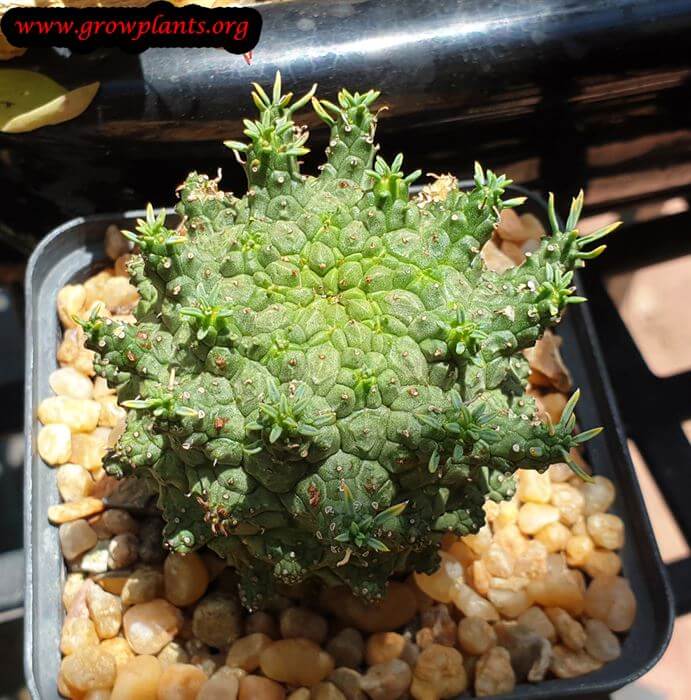
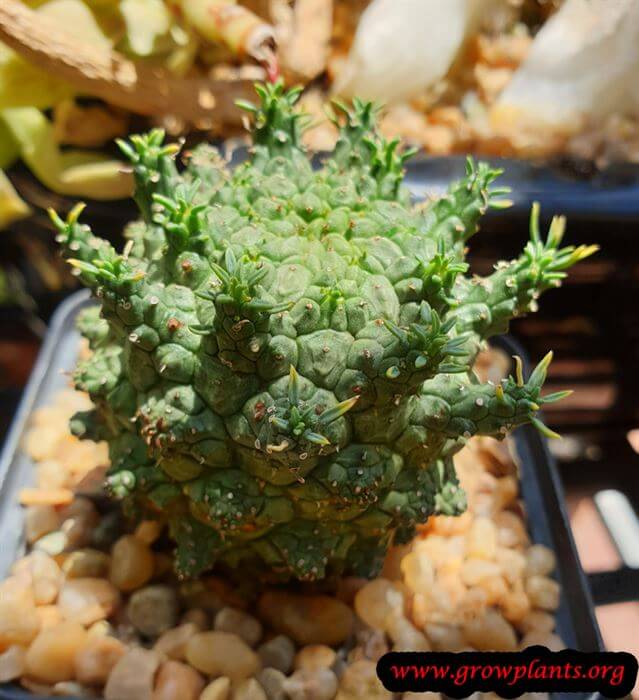
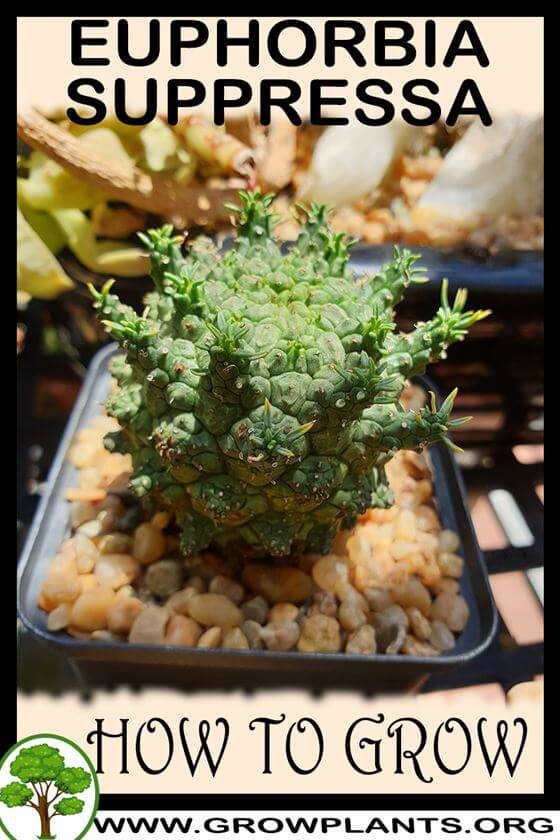
Overview: A dwarf deciduous succulent (5-15 cm / 2-6 in) with rounded green stems bearing horn-like tubercles, formerly Monadenium suppressa. A slow-growing, drought-tolerant ornamental perennial.
Quick Specifications
| Specification | Attribute |
|---|---|
| Plant Type / Life Cycle | Perennial (deciduous succulent) |
| Foliage Type | Deciduous |
| Mature Size | 5-15 cm tall (2-6 in) |
| Growth Rate | Slow |
| Toxicity | Toxic – milky latex (Euphorbia); irritant and poisonous if ingested |
| Hardiness | USDA zones 10-11 |
Growth Form & Structure
- Height & Spread: Low, 5-15 cm (2-6 in); well suited to containers.
- Growth Habit & Form: Clustering succulent with rounded green stems bearing horn-like tubercles in radial growth.
- Lifespan & Maturity: Slow-growing perennial reaching mature size over several years.
Anatomy & Physical Features
- Leaves & Foliage: Small green oval leaves borne mainly at the stem tips.
- Flower Characteristics: Yellow, feeler-shaped flowers (full detail in the Bloom guide).
Primary Uses & Landscape Value
- Functional & Ornamental Roles: Succulent collector’s ornamental for containers and rockeries; drought tolerant and best grown outdoors rather than as an indoor houseplant.
Care Guide: Planting, Soil & Watering
Overview: Euphorbia suppressa is a slow-growing succulent for subtropical and Mediterranean climates (hardiness zone 10-11) that thrives in bright light, from full sun to half shade. It needs sharply well-draining soil and only light watering – the fleshy stems store water, so the plant rots quickly if kept wet.
Quick Care Requirements
| Requirement | Ideal Condition |
|---|---|
| Planting Season | Warm season, spring through autumn |
| Growth Rate | Slow |
| Soil Type | Sharply well-draining (gritty cactus or succulent mix) |
| Water Need | Low – let the soil dry between waterings |
Planting & Establishment
- Best Planting Season: Plant during the warm season, from spring through autumn, once temperatures are reliably warm; avoid cold, wet spells that encourage rot.
- How to Plant:
- Hole Preparation: Plant on freely draining ground in a hole no deeper than the root ball.
- Soil Amendments: Open up heavy soil with coarse sand, grit or perlite so water drains away fast.
- Planting Depth: Set the plant at the depth it grew in its pot, keeping the base of the stem at or just above soil level – never buried.
- Growth Speed & Expectations: Slow growing even in ideal conditions; expect gradual growth to a compact 5-15 cm (2-6 in).
Soil, Watering & Drainage Care
- Soil Mix & Drainage Needs: Use a free-draining succulent or cactus mix; in pots add grit and ample drainage holes so water never pools around the shallow roots.
- Watering Schedule & Technique:
- Young / Newly Planted: Water lightly but a little more frequently while the roots establish, always letting the surface dry first.
- Established: Water sparingly – a light soak only once the soil has fully dried; the plant handles drought far better than excess moisture.
- Seasonal Adjustments: Cut watering right back in the cool season when growth slows, and give a little more during hot, dry spells, especially in full sun.
Climate, Light & Hardiness
Euphorbia suppressa is a low-growing, drought-tolerant succulent well suited to subtropical and Mediterranean climates, thriving in full sun to half shade. Its slightly wider USDA range than close relatives still leaves it with limited cold tolerance and no meaningful frost hardiness.
Quick Climate Specifications
| Climate Zones | Subtropical and Mediterranean climates |
|---|---|
| USDA Hardiness Zones | 10–11 |
| Frost Tolerance | Low |
| Light Conditions | Full sun to half shade |
Sunlight & Light Exposure
Optimal Light Setup
Full sun to half shade both suit this compact, radially-branching succulent well.
Direct Sun Requirement
Tolerates full sun once established; half shade is an acceptable alternative in hotter climates.
Shade & Heat Management
Some afternoon shade during peak summer heat can help reduce stress, particularly for younger plants.
Best Exposure/Orientation
A bright, open, well-drained position is ideal.
Temperature Extremes & Hardiness
USDA Hardiness & Regional Limits
Hardy in USDA zones 10–11; needs container culture and winter protection in cooler climates.
Cold Damage & Winter Protection
Being deciduous, it may shed foliage during cooler or drier periods; keep it dry over winter, since cold combined with wet soil causes more damage than cold alone.
Frost Sensitivity
Frost-sensitive - protect from any freeze exposure.
Extreme Heat Tolerance
Copes well with warm subtropical and Mediterranean summer heat in well-drained soil.
Wind, Humidity & Microclimate
Dry-Air Tolerance
Good - as a drought-tolerant plant it is comfortable in dry air with modest watering.
Rainfall & Seasonal Moisture
Prefers a distinct dry season and well-drained soil; prolonged wet spells raise the risk of rot.
Microclimate Recommendations
In climates with cool or wet winters, a raised bed or container with sharp drainage and a warm, sheltered spot works best.
Growing in Pots, Balconies & Indoors
This small, slow-growing succulent (only about 5-15 cm / 2-6 in) is not a true deep-room houseplant, but it makes an easy, rewarding pot plant on a bright, sunny windowsill or a sunny balcony. It asks for very little water and sharp drainage, so a pot is actually an ideal way to control moisture.
Quick Details
- Container Size: A small, snug pot barely larger than the plant (about 30% bigger than the root ball); pot up only when it fills out
- Indoor Suitability: Not a low-light houseplant, but happy on a sunny windowsill with strong direct light
- Best Spot: Full sun to half shade – the brightest spot you can give it
- Soil & Drainage: Gritty, free-draining mix – sandy/cactus mix or peat and perlite, with lava grit or coarse sand; strong drainage holes and no water-holding saucer. A ready-made cactus and succulent soil mix provides that structure without mixing it yourself.
- Watering in Pots: Very little – let it dry out fully between waterings; overwatering rots it
Indoors & On the Windowsill
- Houseplant limits: The grower does not rate it a room houseplant – away from a window the light is too weak and it etiolates.
- Windowsill growing: On the sunniest sill it does well; its compact size suits a windowsill perfectly. Give strong direct light and keep it well away from heaters and cold drafts.
- Overwintering: As a tender succulent, bring it indoors to a bright, cool, frost-free spot over cold winters and keep it nearly dry until growth resumes.
- Safety: Like all Euphorbias, the milky sap is toxic and irritates skin and eyes – keep it away from children and pets and wash hands after handling.
On a Balcony or Patio
- Light & warmth: A sunny, sheltered balcony or patio suits it; walls and paving reflect heat and help it thrive, but small pots dry fast – still, this plant prefers to run dry.
- Practicalities: Protect from prolonged rain, which can waterlog and rot it; move it under cover or into the eaves in wet spells.
Choosing the Pot, Soil & Long-Term Care
- Pot & drainage: A snug pot only slightly larger than the root ball, with strong drainage holes; skip a standing-water saucer to prevent rot. Terracotta breathes and dries fast, which suits succulents better than glazed or plastic.
- Potting mix: Free-draining and gritty – cactus/succulent mix, or peat/coir with plenty of perlite and some coarse sand or lava grit.
- Feeding: Feed sparingly – a dilute low-strength feed once or twice in the growing season is plenty for a potted succulent.
- Repotting: Refresh the mix and pot up every couple of years, lightly trimming roots and top growth on perennials to keep them in scale with the pot.
Fertilizing & Feeding
A light feeder overall: this slow-growing succulent needs only minimal, low-nitrogen feeding during active growth, with no feeding at all while it rests.
Quick Fertilizing Specs
| Feeding Level | Light feeder |
|---|---|
| Main Nutrient Priority | Low-nitrogen, minimal feeding that keeps growth compact and true to the plant’s naturally slow habit |
| Best Feeding Period | During the warm active growing season, never during the rest period |
| Organic Options | A gritty mineral succulent mix rarely needs added organic matter beyond what it starts with |
| Micronutrients | Rarely an issue; an occasional dilute balanced feed usually covers what little the plant needs |
| Soil pH | Well-drained, gritty soil matters far more than a specific pH target; tolerates a wide range |
| Reduce/Stop Feeding | Stop feeding entirely as growth slows and the plant settles into its rest period |
Feeding by Growth Stage
Active warm-season growth
Support steady but naturally slow growth of the rounded, horn-like radiating stems without pushing soft, over-lush tissue.
| Nutrient direction | A dilute, low-nitrogen balanced feed keeps growth compact and in character for this slow-growing succulent. |
|---|---|
| Timing | Through the warmer active growing months when new growth is visibly forming. |
| Frequency | Minimal feeding is usually enough – an occasional light dose rather than a regular routine. |
| Fertilizer types | A cactus/succulent-formulated fertilizer diluted well below normal garden strength |
| Precautions | Keep the mix gritty and free-draining; overfeeding or overwatering this small, slow grower risks soft, rot-prone tissue. |
Cool-season deciduous rest
Let the plant rest undisturbed through its slow season rather than pushing new growth it can’t sustain.
| Nutrient direction | None – withhold fertilizer while growth is at a standstill. |
|---|---|
| Timing | As it moves into its natural deciduous dormancy and drops its stems’ active growth, typically through the cooler part of the year. |
| Frequency | No feeding at this stage. |
| Fertilizer types | No feeding at this stage – let the plant coast on stored reserves |
| Precautions | Do not fertilize a dormant or resting plant; unused nutrients just build up as salts around roots that aren’t actively taking anything up. |
Nutrient Deficiency Signs & Corrections
New growth on the rounded, horn-like radiating stems comes in pale, washed-out green rather than a healthy deep green, and overall growth stays noticeably slow.
| Possible causes | little to no nitrogen reaching the roots over a long stretch without feeding, a gritty, low-organic mix that holds almost no nutrient reserve, roots that are compromised by overwatering and can’t take up what nutrients are present |
|---|---|
| Appears first on | newest growth |
| What to check | how long it has been since any feeding, root health and soil moisture, overall vigor compared with the plant’s normal slow pace |
| Possible correction | Work a light, diluted balanced feed into the active growing season rather than skipping feeding indefinitely; correct any overwatering issue first. |
Stem or leaf tips turn brown or corky, and the base of the plant can look stressed or soft even though watering seems appropriate.
| Possible causes | mineral salts accumulating from repeated feeding without adequate flushing, feeding at a stronger dose than this slow-growing succulent can use, a container without enough drainage to let excess salts wash out |
|---|---|
| Appears first on | stem or leaf tips and the base near the soil line |
| What to check | recent feeding strength and frequency, drainage of the pot and soil mix, any crusty residue on the soil surface |
| Possible correction | Flush the soil with plain water to carry off excess salts, cut back feeding strength, and confirm the mix and container drain freely. |
Older, lower growth shows yellowing between the veins or in blotchy patches while the newest growth still looks normal.
| Possible causes | low magnesium in the soil or potting mix, an imbalanced feeding history that leans heavily on other nutrients, leaching from a very free-draining, mineral-heavy mix |
|---|---|
| Appears first on | older, lower stems or leaves |
| What to check | age and pattern of the affected growth, recent feeding history and mix composition, whether new growth is unaffected |
| Possible correction | Apply a labeled magnesium source such as Epsom salt sparingly and rebalance the general feeding routine. |
Pruning, Training & Seasonal Maintenance
Euphorbia suppressa grows as a small (5–15cm), slow, deciduous succulent with stems radiating outward in a distinctive horned pattern from a central base. That radial structure is fixed and decorative in itself, so pruning tolerance is very low – the only task is removing dead or damaged parts as they arise, with no fixed season. Removing a living horn permanently changes the plant’s symmetry, so cuts should stay strictly to dead or damaged tissue.
Quick Pruning & Maintenance Specs
| Pruning Tolerance | Low |
| Primary Pruning Window | As needed, year-round (reactive) |
| Typical Frequency | Occasional – only on dead or damaged tissue |
| Main Objective | Sanitation: remove dead/damaged horns or parts without disturbing the radial form |
| Young Plant Priority | Leave undisturbed so the radial branching pattern establishes naturally |
| Mature Plant Priority | Remove only clearly dead or damaged horns |
| Best Tool Type | Sterile fine blade or precision snips |
| Avoid Heavy Pruning During | Not applicable – heavy or structural pruning is not appropriate for this plant |
Pruning by Plant Age & Size
Newly Established
No cutting beyond removing tissue that arrived already dead or damaged; let the radial branch pattern develop undisturbed.
Young / Formative
No training applies – the horned, radiating growth habit is inherent to the species and should not be shaped or thinned.
Mature / Established
Limited to removing an individual horn only if it is dead, rotted, or broken; otherwise leave the form intact.
Special Growth to Remove
Only dead, rotted, or broken horns/stem sections, and the spent yellow feeler-shaped flower once dried. Because each horn contributes to the plant’s radial symmetry, do not remove living horns for shaping.
Tools
A sterile fine-point blade or precision snips, sized to the plant’s slender horn-like stems.
Tool Hygiene & Disease Risk
Increased – cut tissue is rot-prone, and the milky latex is a skin and eye irritant, so cut with gloves and a clean blade, avoiding contact with your face.
Cut Placement & Technique
Cut a damaged horn back to its point of attachment at the base, into clean tissue only. Let the latex stop bleeding and allow the wound to callus in a shaded, dry spot before watering resumes near it.
Heavy Pruning & Rejuvenation
Not tolerated. There is no framework to renew by hard pruning – losing a horn is permanent, and the plant does not regenerate a new one to replace it.
Post-Pruning Care
Keep the cut dry until fully callused; do not water directly onto a fresh wound.
Common Pruning Mistakes
- Removing a healthy horn for symmetry or size, which cannot be undone
- Cutting without gloves and contacting the irritant sap
- Mistaking natural deciduous leaf drop for dieback
When NOT to Prune
Avoid any non-essential cutting – this plant’s form depends on keeping its horns intact – and avoid cutting during cool, damp periods when wounds heal slowly.
Recommended Tools (by task)
- Removing a dead or broken horn – precision_snips: slender stems need only fine, deliberate cuts.
- Preventing rot spread and limiting sap exposure – blade_disinfectant: keeps cuts clean given this genus’s rot susceptibility.
Propagation Guide
Euphorbia suppressa is most easily propagated from stem cuttings, which root faster than seed and preserve its distinctive horn-like radial growth; as a true species, seed-grown plants are usually true-to-type. Propagation is easy for a home grower.
Quick Propagation Specs
| Best Propagation Method | Stem cuttings |
| Alternative Methods | Seed |
| Propagation Difficulty | Easy |
| Seed True-to-Type | Usually true-to-type |
| Vegetative True-to-Type | Yes |
| Best Propagation Season | Spring through autumn, during active growth |
| Germination Temperature | Warm conditions, roughly 20–27°C (68–80°F) |
| Seed Sowing Depth | Surface-sown, only lightly covered |
Growing from Seed
Sowing Season
Spring through summer, matching the plant’s main planting season.
Sowing Depth & Orientation
Sow on the surface of a well-drained mix and cover only lightly.
Germination Conditions
Warm and only lightly moist, in keeping with this species’ generally low water need.
Germination Time
Typically within a few weeks under warm conditions, though timing can be irregular.
Stem Cuttings
Cutting Type
A section cut from one of the horn-like radiating stems.
Best Timing
Spring to summer, during active growth; autumn is also workable in mild climates.
Cutting Preparation
The site notes cuttings are the easier route to a new plant than seed. Let the cut surface dry and callus for a few days in a shaded spot before inserting into soil to reduce rot risk.
Rooting Setup
Insert into a well-drained soil mix and water sparingly.
Rooting Hormone
Optional; Euphorbia cuttings of this type generally root without it.
Rooting Time
Roots are typically established within a few weeks under warm conditions.
Bloom & Flower Guide
Quick Details
- Bloom Season: Spring and summer
- Flower Appearance: Small yellow flower structures (cyathia) with slender, feeler-like parts, borne near the top of the stems
- Edibility: Not edible – like all Euphorbia it carries a toxic, milky latex that irritates skin and eyes and is poisonous if swallowed
Detailed Blooming Overview
Euphorbia suppressa (formerly Monadenium suppressa) is a horned, deciduous succulent that produces its small yellow flowers in spring and summer. As with other spurges, the “flower” is really a specialised cup (cyathium) with fine, feeler-like appendages rather than a showy petalled bloom, appearing toward the tops of the green stems.
Flower Characteristics
- Small yellow cyathia (the spurge flower structure) with slender, feeler-like parts.
- Borne mostly near the top of the stems, where the leaves cluster.
Bloom Care & Thinning
- Encouraging bloom: Bright light and a drier winter rest help bring on the spring and summer flowers.
- Safety: Wear gloves when handling or cutting – the milky sap is toxic and a strong skin and eye irritant; keep away from children and pets.
Pests, Diseases & Troubleshooting
Overview: This is an obscure dwarf South African succulent spurge with little published horticultural data, so treat species-specific advice cautiously. The dependable, genus-level threats are mealybug, scale and spider mites and, most of all, rot from overwatering; grow it as a small, slow succulent in a very free-draining mix and handle the irritant latex with care.
Quick Troubleshooting Overview
| Issue / Pest | Main Symptom | Primary Solution |
|---|---|---|
| Root / stem rot | Soft, blackening, collapsing base; sour smell | Withhold water; improve drainage; cut back to firm tissue |
| Mealybugs | White cottony tufts in growth points / on roots | Alcohol swab, water spray, oil as needed |
| Spider mites | Fine stippling, bronzing, webbing in tips | Raise humidity, rinse, predatory mites, oil |
| Scale | Fixed brown bumps on stems / ribs | Scrape off, prune, horticultural oil |
| Corking / sunburn | Brown patches or brown corky base | Acclimatise to sun; corking on old growth is normal |
| Latex contact | Skin / eye irritation when cut | Wear gloves and eye protection |
Common Pests & Management
- Mealybugs (Pseudococcus / Planococcus spp.):
- Symptoms: White cottony tufts in growth points, leaf axils, spine cushions and around the base; sticky honeydew and sooty mould follow. Root mealybugs (white “mould” and waxy specks on roots at repotting) are common on potted succulent spurges.
- Prevention & Control: Inspect new plants and quarantine. Dab visible colonies with a cotton swab dipped in dilute alcohol; wash off with a firm water spray. For root mealybug, bare-root, rinse and repot into fresh gritty mix. Encourage predators (ladybirds, Cryptolaemus); as a last resort use horticultural oil or insecticidal soap, testing first as spurges can mark.
- Spider mites (Tetranychus urticae):
- Symptoms: Fine pale stippling and a dusty bronzed look on stems/leaves, with fine webbing in the growth tips; worst in hot, dry, still air.
- Prevention & Control: Raise humidity and airflow; hose down periodically to break the cycle. Introduce predatory mites (Phytoseiulus, Amblyseius). Spot-treat with horticultural oil or insecticidal soap, repeating every 5–7 days; avoid broad-spectrum insecticides that kill mite predators.
- Scale insects (Coccus / Saissetia / Diaspis spp.):
- Symptoms: Fixed brown, tan or grey bumps along stems and spine ridges that do not rub off easily; soft scales produce honeydew and sooty mould.
- Prevention & Control: Scrape or rub off with a soft brush and dilute alcohol. Prune out heavily encrusted stems. Encourage parasitic wasps and lacewings; smother remaining scale with horticultural oil applied in the cool of the evening, repeating to catch crawlers.
- Whitefly (Trialeurodes / Bemisia spp.):
- Symptoms: Tiny white moth-like flies rising in clouds when disturbed; yellow flecking and honeydew on softer, leafier spurges.
- Prevention & Control: Hang yellow sticky traps to monitor and reduce adults. Encourage Encarsia parasitoids and lacewings. Rinse foliage and treat undersides with insecticidal soap or horticultural oil, repeating weekly until clear.
Diseases & Fungal Issues
- Root, basal & stem rot (Pythium / Phytophthora / Fusarium spp.):
- Symptoms: The base softens, browns or blackens and the plant collapses or topples; often a sour smell and mushy interior. Nearly always follows overwatering, a cold wet spell, or a poorly drained mix.
- Treatment & Management: Prevention is everything: fast-draining gritty mineral mix, unglazed pots with drainage, water only when the mix is dry, and keep it drier and warmer in the cool season. If rot appears, cut back to clean firm tissue, dust the wound, dry it off and re-root the healthy top; discard badly rotted roots and refresh the mix.
- Fungal leaf / stem spot (Cercospora / Colletotrichum spp.):
- Symptoms: Sunken tan to black spots or blotches on stems and any leaves, sometimes with concentric rings; spreads in humid, still, crowded conditions.
- Treatment & Management: Improve airflow and avoid wetting the plant when watering. Remove spotted tissue and fallen debris. A copper fungicide can check spread on valued specimens; correct the underlying humidity/crowding.
- Southern blight / crown rot (Sclerotium rolfsii):
- Symptoms: White fungal threads and small mustard-seed-like bodies at the soil line, with rapid wilting and basal collapse in warm, humid, wet conditions.
- Treatment & Management: Remove and destroy affected plants and surrounding mix; avoid burying the crown; improve drainage and airflow. Solarising or replacing infected media helps prevent recurrence.
Growing Difficulties & Abiotic Problems
- Overwatering & rot:
- Cause & Symptoms: The single biggest killer: soft, discoloured, collapsing tissue and mushy roots from too-frequent watering, water-retentive mix, or a cold wet rest period.
- Correction Strategy: Use a gritty mineral mix and pots with drainage; water thoroughly then let the mix dry fully before watering again; keep nearly dry and frost-free during the cool-season rest.
- Sunburn & etiolation:
- Cause & Symptoms: Bleached, brown scorched patches when moved abruptly into strong sun; or pale, stretched, weak growth in too little light.
- Correction Strategy: Acclimatise gradually to brighter light over 2–3 weeks; give bright light (with shade from the fiercest mid-day sun in hot climates) to keep growth compact and firm.
- Corking & cold damage:
- Cause & Symptoms: Brown, corky, bark-like texture on the oldest lower growth (normal ageing); soft, glassy, blackened patches after frost or cold-wet conditions.
- Correction Strategy: Accept basal corking as natural maturity. Protect from frost and keep dry when cold; provide minimum warmth for tender succulent spurges.
- Latex irritation:
- Cause & Symptoms: Milky sap released when cut or broken irritates skin and eyes and is toxic if ingested.
- Correction Strategy: Wear gloves and eye protection; keep pets and children away from cut plants; rinse any sap contact promptly with plenty of water.
What Helps – Products & Tools
For spurges the mainstays are horticultural (neem) oil and insecticidal soap for mealybug, scale, whitefly and mites; isopropyl alcohol on cotton swabs for spot-treating mealybug and scale; yellow sticky traps for monitoring whitefly; predatory mites and Cryptolaemus for biological control; and, for disease, a copper fungicide for leaf/stem spot plus sulfur or potassium bicarbonate for powdery mildew. The best “product”, though, is a fast-draining gritty mix and disciplined watering. Always wear gloves and eye protection because of the irritant latex, and spray oils in the cool of the evening.