Plant Profile & Key Characteristics
Overview: Catharanthus roseus ‘Tattoo Tangerine’ (vinca) is a compact evergreen subshrub, usually 30-70 cm (12-28 in), grown as a perennial in frost-free climates or as an annual elsewhere. It is a fast-growing ornamental bedding and container plant prized for its long season of orange-to-purple bloom.
Quick Specifications
| Specification | Attribute |
|---|---|
| Plant Type / Life Cycle | Perennial (frost-free) / annual |
| Foliage Type | Evergreen |
| Mature Size | 30-70 cm tall (12-28 in) |
| Growth Rate | Fast |
| Toxicity | Toxic – all parts contain vinca alkaloids; harmful to people and pets if ingested. |
| Hardiness | USDA zones 10+ (perennial); 4-9 (annual) |
Growth Form & Structure
- Height & Spread: 30-70 cm (12-28 in) in beds; stays neat and compact in pots and planters.
- Growth Habit & Form: Bushy, mounding subshrub with a herbaceous habit.
- Lifespan & Maturity: Fast-growing; short-lived perennial in warm zones, treated as a single-season annual in cooler ones.
Anatomy & Physical Features
- Leaves & Foliage: Glossy green oval leaves; evergreen.
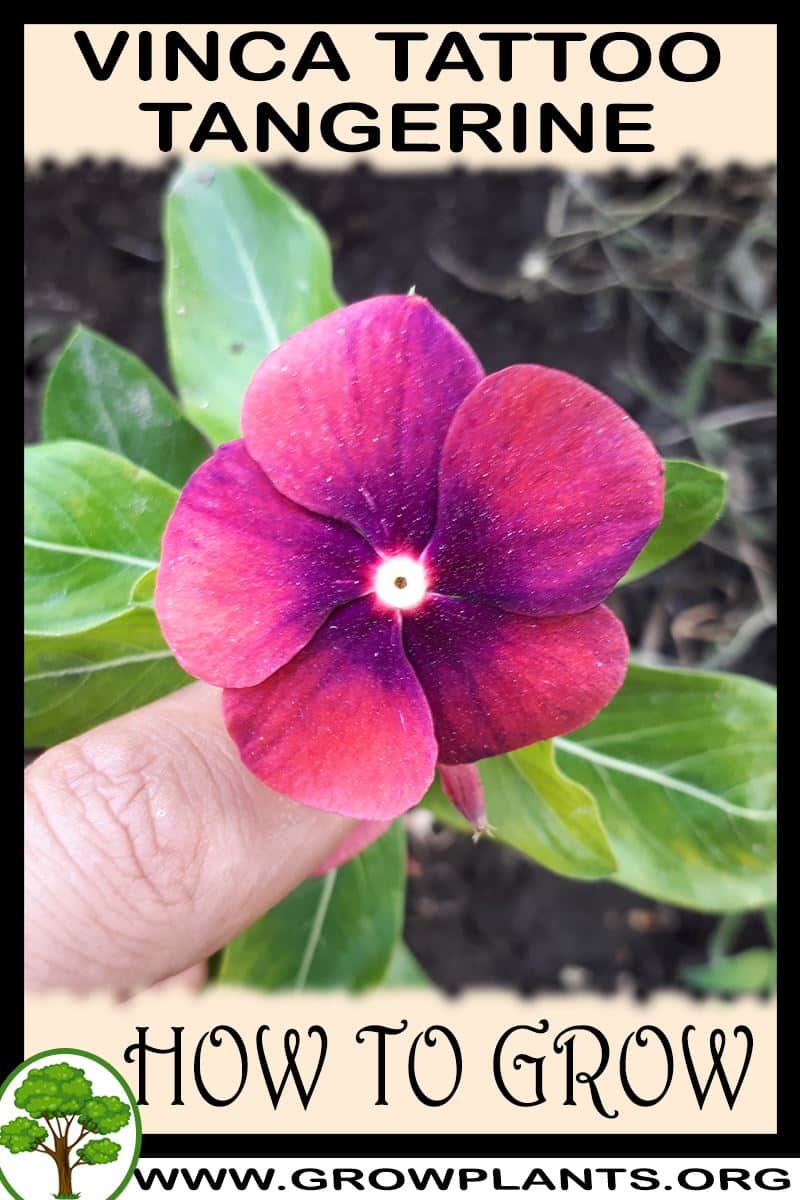
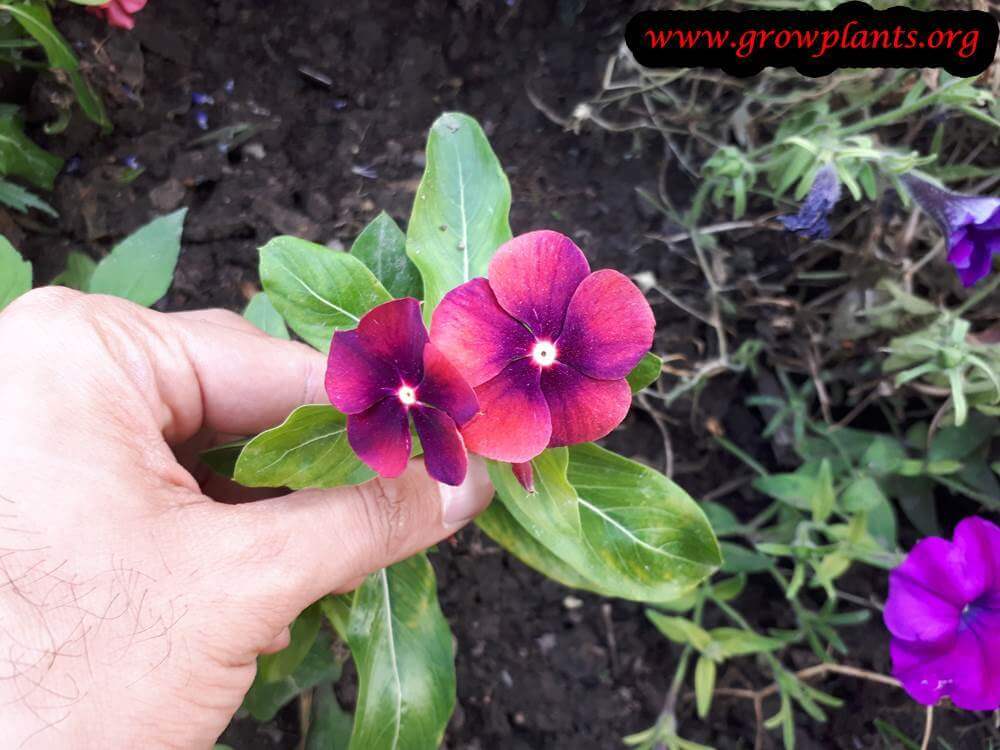
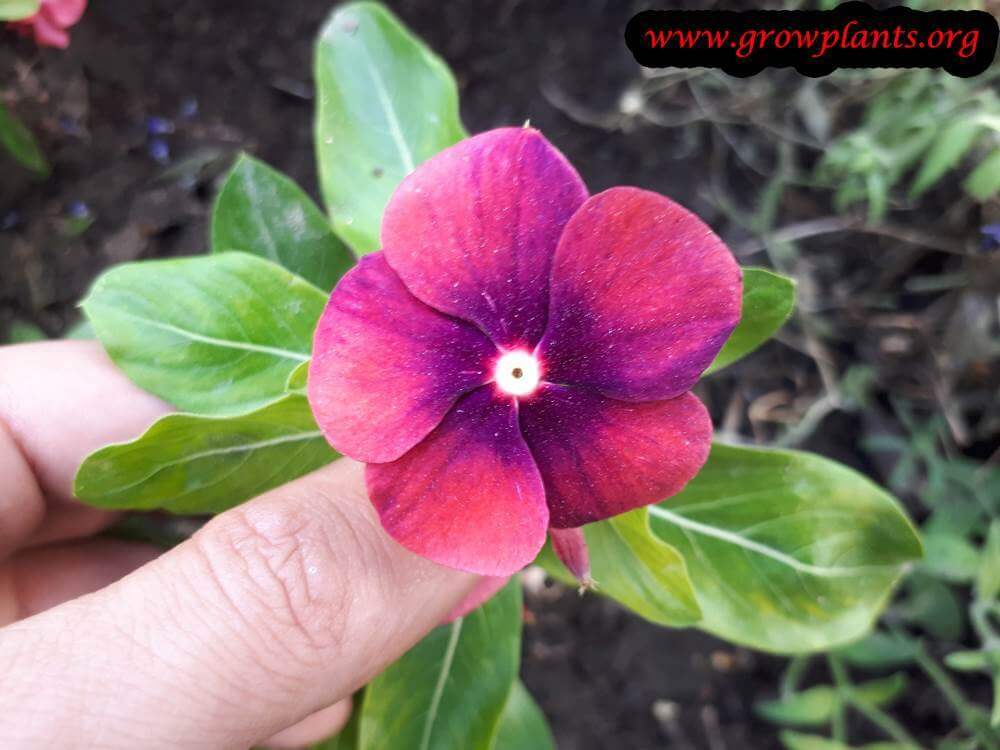
- Flower Characteristics: Five-petalled flowers in orange or purple, often with a contrasting darker or lighter eye, produced from spring through autumn.
Primary Uses & Landscape Value
- Functional & Ornamental Roles: Ornamental bedding, border and container plant valued for heat tolerance and continuous flowering; can naturalise and become invasive in mild climates.
Care Guide: Planting, Soil & Watering
Overview: Madagascar periwinkle is a fast-growing, heat-loving evergreen grown as a perennial in frost-free zones (10+) and as an annual in cooler ones (zone 4-9), preferring full sun to part shade. It thrives in a well-drained soil with moderate moisture and shrugs off heat and humidity.
Quick Care Requirements
| Requirement | Ideal Condition |
|---|---|
| Planting Season | In spring once the soil has warmed and frost has passed |
| Growth Rate | Fast |
| Soil Type | Light, well-drained soil |
| Water Need | Moderate – water when the top of the soil dries; avoid waterlogging |
Planting & Establishment
- Best Planting Season: Plant in spring after the last frost, once the soil is warm.
- How to Plant:
- Hole Preparation: Dig a hole about twice the width of the root ball and the same depth.
- Soil Amendments: Mix in a little compost on poor soils; sharp drainage matters more than richness.
- Planting Depth: Set the root ball level with the surrounding soil.
- Growth Speed & Expectations: A fast grower forming a bushy 30-70 cm (12-28 in) mound within a single season.
Soil, Watering & Drainage Care
- Soil Mix & Drainage Needs: Needs a free-draining soil or potting mix; soggy soil quickly causes root and stem rot.
- Watering Schedule & Technique:
- Young / Newly Planted: Keep evenly moist while establishing, but never waterlogged.
- Established: Water moderately, allowing the top few cm to dry between waterings; it is quite drought-tolerant once settled.
- Seasonal Adjustments: More in summer heat; much less in cool, wet weather.
Climate, Light & Hardiness
This Catharanthus (vinca) selection suits tropical, subtropical, desert, Mediterranean and warm-temperate climates, growing as a true perennial only where winters stay essentially frost-free. It wants full sun to half shade and has good heat tolerance, but is killed outright by any real cold.
Quick Climate Specifications
| Climate Zones | Tropical, subtropical, desert, Mediterranean, temperate (as a warm-season annual in the last two) |
|---|---|
| USDA Hardiness Zones | 10+ as a true perennial; commonly grown as an annual in zones 4–9 |
| Approx. Survival Minimum | Site data indicates the plant needs to stay above approximately 5°C (41°F) to persist as a perennial |
| Frost Tolerance | None |
| Light Conditions | Full sun to half shade |
Sunlight & Light Exposure
Optimal Light Setup
Full sun gives the most flowers; half shade is tolerated, particularly useful in the hottest climates where it still performs well.
Shade & Heat Management
Genuinely heat-loving - comfortable in tropical and desert conditions - so shade is optional rather than necessary for heat protection.
Temperature Extremes & Hardiness
USDA Hardiness & Regional Limits
Hardy as a perennial only in USDA zone 10 and warmer. In zones 4–9 it is commonly grown as a warm-season annual, since it cannot survive a freezing winter outdoors - but where winters stay frost-free (zone 10+), the same plant persists and continues growing year after year. Hardiness and its "grown as an annual" habit are separate facts: cold is what forces annual treatment, not the plant's own lifespan.
Cold Damage & Winter Protection
Site data puts its cold limit at roughly 5°C (41°F) for the plant to remain a living perennial; below that, expect decline and death rather than mere dormancy.
Frost Sensitivity
Not frost-hardy at all - even a light frost is expected to kill it, which is the main reason it is treated as a bedding annual outside zone 10+.
Extreme Heat Tolerance
Strong heat tolerance, thriving through tropical, desert and Mediterranean summers with average watering.
Frost-Free Growing Season
Where grown as an annual, it needs the full frost-free part of the season (spring through the first autumn frost) to flower continuously, since any frost ends its display.
Wind, Humidity & Microclimate
Microclimate Recommendations
A warm, sheltered, sunny bed or container that can be moved or replanted seasonally suits this cultivar outside its zone 10+ perennial range.
Growing in Pots, Balconies & Indoors
This is Madagascar periwinkle (Catharanthus roseus), a heat-loving bedding and container plant grown for its glossy leaves and continuous flowers. The grower says it is not a houseplant because it needs sun; on a very bright, sunny windowsill it can bloom indoors, and it is a star of sunny balcony and patio pots. Note that every part is toxic if eaten.
Quick Details
- Container Size: A medium pot – 3-7 L for a single plant, or a larger trough for a group
- Indoor Suitability: Not a deep-room houseplant; it can flower on a bright, sunny windowsill
- Best Spot: Full sun to half shade – a warm, bright, sunny spot; the sunniest sill indoors
- Soil & Drainage: Free-draining, light potting mix; it dislikes heavy, wet soil
- Watering in Pots: Average water – keep lightly moist but let the surface dry between waterings; it is fairly drought-tolerant and rots in soggy soil
Indoors & On the Windowsill
- Not a deep-room houseplant: The grower says no – it needs sun. In a dim room it stops flowering and grows leggy, so keep it hard against your brightest, warmest window.
- Sunniest windowsill: On a bright, sunny sill it will flower well through the warm season; it loves heat and light.
- Keep it away from mouths: Catharanthus roseus is poisonous if eaten (it contains potent vinca alkaloids), so place it out of reach of children and pets and never treat any part as edible.
On a Balcony or Patio
- Light & heat: A hot, sunny balcony or patio is ideal; it thrives on reflected wall heat and full sun and shrugs off dry spells.
- Practicalities: It is tender and dislikes cold and wet – keep it warm, ensure sharp drainage, and bring it in or replace it when cold weather comes.
Choosing the Pot, Soil & Long-Term Care
- Pot & drainage: A pot with strong drainage holes and no standing-water saucer; wet feet cause rot in this heat-lover.
- Potting mix: A light, free-draining potting mix; nothing heavy or water-holding.
- Feeding: Feed regularly through the flowering season for continuous bloom; potted plants leach nutrients fast.
- As a perennial: It is a tender perennial usually grown as a warm-season annual; where frost-free, refresh the mix each year and trim to keep it bushy.
Fertilizing & Feeding
A moderate feeder – this fast-growing, continuously flowering plant benefits from light, regular feeding through the season rather than infrequent heavy applications.
Quick Fertilizing Specs
| Feeding Level | Moderate feeder – benefits from light, regular feeding through the season. |
|---|---|
| Main Nutrient Priority | Balanced feeding; avoid excess nitrogen, which favors foliage over the continuous flower display. |
| Best Feeding Period | From planting through the full spring-to-autumn bloom season. |
| Reduce/Stop Feeding | Stop feeding as the season ends or if the plant is not being kept over as a perennial. |
Feeding by Growth Stage
Establishment After Planting
Help a newly planted or transplanted Vinca settle in and establish roots before pushing heavy top growth.
| Nutrient direction | A light, balanced feeding at planting helps roots establish; avoid heavy nitrogen right away. |
|---|---|
| Timing | At planting or transplanting in spring. |
| Frequency | A single light feeding at planting is usually enough to start the plant off. |
| Fertilizer types | A balanced, diluted starter fertilizer worked into the planting hole or bed, Compost mixed into the planting area |
| Precautions | Avoid overfeeding right after transplanting – Vinca is fast-growing and can become leggy or spread aggressively if pushed too hard early on. |
First Bloom Flush
Support the first wave of orange or purple flowers as the plant fills out.
| Nutrient direction | Continue balanced feeding; avoid nitrogen-heavy products that favor leaves over the continuous flowering this plant is grown for. |
|---|---|
| Timing | As the plant fills out and begins flowering through summer. |
| Frequency | Light, regular feeding through the main flowering period supports continuous bloom better than one heavy application. |
| Fertilizer types | A balanced, water-soluble fertilizer for flowering annuals and bedding plants |
| Precautions | Keep nitrogen moderate – too much produces lush foliage at the expense of the continuous flower display. |
Repeat Bloom Through the Season
Sustain the plant’s characteristic continuous flowering from spring through autumn.
| Nutrient direction | Maintain light, regular balanced feeding to support the ongoing flush of new blooms through the season. |
|---|---|
| Timing | Through summer and into autumn while the plant keeps flowering. |
| Frequency | Light, regular feeding through the flowering season keeps continuous bloom going; ease off if growth looks lush but flowering slows. |
| Fertilizer types | A balanced, water-soluble fertilizer applied lightly and regularly through the growing season |
| Precautions | Watch for overly lush, leafy growth with few flowers – a sign feeding has become too heavy on nitrogen. |
End-of-Season Decline
Let the plant wind down naturally as the growing season ends, whether grown as an annual or going semi-dormant as a perennial in a warm climate.
| Nutrient direction | None – withhold fertilizer as the growing season winds down. |
|---|---|
| Timing | Autumn into winter, as growth slows or the season ends. |
| Frequency | No feeding at this stage. |
| Fertilizer types | No feeding at this stage; if kept as a perennial, feeding resumes with new growth the following spring. |
| Precautions | Do not fertilize a plant that is winding down for the season or approaching frost – new growth encouraged now is unlikely to survive and wastes the plant’s energy. |
Nutrient Deficiency Signs & Corrections
Long, leggy stems with fewer flowers than expected.
| Possible causes | Excess nitrogen favoring stem and leaf growth over flowers, Insufficient light causing stretching, Overcrowding among plants competing for light and nutrients |
|---|---|
| Appears first on | New stem growth and overall plant shape |
| What to check | Review recent fertilizer nitrogen content, Check the plant’s light exposure, Assess plant spacing |
| Possible correction | Reduce nitrogen, pinch back leggy stems, and confirm the planting gets adequate sun. |
Pale green leaves and reduced vigor despite regular watering.
| Possible causes | General nutrient deficiency in depleted bedding soil, Root stress from waterlogged or compacted soil, Pest damage from thrips, aphids, or spider mites reducing plant vigor |
|---|---|
| Appears first on | Whole-plant color and older leaves |
| What to check | Review feeding history and soil fertility, Check soil drainage, Inspect closely for thrips, aphids, or spider mites |
| Possible correction | Resume a light, balanced feeding schedule, correct drainage issues, and treat any pest problem found. |
Browning leaf edges or scorched-looking foliage.
| Possible causes | Fertilizer salt buildup from overfeeding, Drought stress between waterings, Root or stem disease affecting nutrient and water uptake |
|---|---|
| Appears first on | Leaf edges and tips |
| What to check | Review recent fertilizer strength and frequency, Check watering consistency, Inspect roots and stem base for disease |
| Possible correction | Flush the soil with water to leach excess salts and reduce feeding strength going forward. |
Pruning, Training & Seasonal Maintenance
Vinca tattoo tangerine (Catharanthus roseus) is a low, fast-growing subshrub grown as a tender perennial in warm climates (zone 10+) or as a summer annual elsewhere. It tolerates and benefits from frequent light pruning — pinching and deadheading — to keep the mound compact and to slow its tendency to sprawl and root where it touches soil, a habit flagged as invasive in this plant’s own data. Because it flowers continuously on new growth, pruning timing has little effect on bloom itself; the main timing concern is avoiding cuts during hot, humid stretches that raise fungal disease risk.
Quick Pruning & Maintenance Specs
| Pruning Tolerance | High (tip growth) / Moderate (renovation cutback) |
| Primary Pruning Window | Ongoing through the growing season (year-round where grown as a perennial) |
| Typical Frequency | Light pinching/deadheading every 1–2 weeks during bloom |
| Main Objective | Compact, floriferous habit; contain spread |
| Young Plant Priority | Pinch tips to force branching from the base |
| Mature Plant Priority | Periodic cutback of leggy stems; control spreading/rooting stems |
| Best Tool Type | Precision snips / fingers (pinching) |
| Avoid Heavy Pruning During | Hot, humid weather (fungal risk); near first frost where grown as an annual |
Pruning by Plant Age & Size
Newly Established
Pinch out the growing tips once several leaf pairs have formed — left unpinched, a young plant tends to grow one upright stem instead of a bushy mound.
Young / Formative
No leader or framework training applies. Continue tip-pinching every few weeks through the first growing season to build density.
Mature / Established
As a perennial in warm climates, cut back rangy or bare-based stems by up to half in early spring to renew compact growth; as an annual, ongoing light shaping is all that’s needed for its one season.
Seasonal Pruning Schedule
Pre-Growth/Early-Spring (perennial form only)
Objective: renew a compact shape after winter slowdown. Remove: leggy, bare, or damaged stems, cut back up to half. Do not remove: fresh basal shoots. Expected response: denser new branching flush. Flowering impact: brief pause, then heavier bloom.
Ongoing Sanitary
Objective: keep bloom continuous and foliage clean. Remove: spent flowers, yellowed leaves. Do not remove: healthy foliage or unopened buds. Expected response: tidier plant, slightly heavier bloom. Flowering impact: deadheading sustains rather than forces bloom — the plant reflowers readily on its own.
Special Growth to Remove
- Spent flowers and dead/yellowed leaves — remove as they occur.
- Trailing stems that root where they touch soil or spread past the intended bed edge — trim back given this species’ noted invasive tendency.
Container & Small-Space Pruning
In containers the plant cannot spread by rooting stems, so deadheading and tip-pinching matter more than spread control — trim lightly after each flush to prevent legginess in the confined root zone.
Tools
- Precision snips (or fingers) for pinching and deadheading — stems are soft throughout, with no woody growth to justify heavier tools.
Tool Hygiene & Disease Risk
Increased — Catharanthus is notably prone to fungal blights (Botrytis, Phytophthora) in humid conditions, so avoid cutting wet foliage and let cuts dry; wipe blades between plants if any disease is present.
Cut Placement & Technique
Pinch just above a leaf node to force two new shoots. Deadhead by snipping the flower stalk back to the nearest leaf node.
Heavy Pruning & Rejuvenation
The perennial form tolerates a hard cutback (to within a few inches of the base) in spring to renew a sparse, woody-based plant; expect several weeks before it fills back in and resumes full bloom.
Post-Pruning Care
Water normally; skip heavy feeding right after a hard cutback. Watch the resulting flush of tender new growth for aphids, thrips and spider mites, all listed pests for this species.
Common Pruning Mistakes
- Shearing on a fixed schedule instead of pinching individual tips, leaving a bare center.
- Pruning during peak heat/humidity, raising fungal risk.
- Letting sprawling stems root unchecked given this species’ invasive tendency.
When NOT to Prune
Avoid pruning during extended wet, humid weather. Avoid hard renovation right before a cold snap where grown at the edge of its perennial hardiness; as an annual, there’s no need to prune hard near season’s end.
Recommended Tools (by task)
- precision_snips — the only cuts this soft-stemmed subshrub needs are pinching and deadheading; no woody growth to justify bypass secateurs or loppers.
Propagation Guide
Vinca Tattoo Tangerine is grown from seed, in line with how this cultivar is typically raised, and does not require grafting or vegetative propagation. Overall difficulty is easy, though germination is a little fussier than average and benefits from warmth and darkness.
Quick Propagation Specs
| Best Propagation Method | Seed |
| Alternative Methods | Softwood stem cuttings |
| Propagation Difficulty | Easy |
| Seed True-to-Type | Cultivar-dependent |
| Vegetative True-to-Type | Yes |
| Best Propagation Season | Spring (as an annual); spring through autumn where grown as a perennial in zone 10b |
Growing from Seed
Germination Conditions
Site data does not give a specific protocol for this cultivar. As is typical for Catharanthus roseus generally, seed usually germinates best in warm conditions with darkness until sprouting; treat this as a general guideline rather than a confirmed figure for this exact cultivar.
Sowing Season
Sow in spring where grown as an annual; where perennial (zone 10b and warmer), can also be started through summer into autumn.
Stem Cuttings
Not required for this plant, but softwood tip cuttings root readily and are a convenient way to multiply a specific plant or overwinter it indoors in colder climates. Use a moist, well-drained mix and warm, humid conditions; a rooting hormone is optional rather than necessary.
Bloom & Flower Guide
Quick Details
- Bloom Season: Spring, summer and autumn (near-continuous in warm climates)
- Flower Appearance: Flat, five-lobed flowers in orange or purple, often with a darker or lighter eye
- Edibility: None — the whole plant is toxic if eaten; do not consume the flowers
Detailed Blooming Overview
This is a Madagascar periwinkle (Catharanthus roseus), grown for its cheerful, near-continuous display of flat, five-petalled flowers through the warm months. It blooms prolifically in heat and shrugs off dry spells — but every part of the plant is poisonous, so it is strictly ornamental.
Flower Characteristics
- Flat flowers with five lobed petals in orange or purple, sometimes with a contrasting eye.
- Produced continuously through spring, summer and autumn.
Bloom Care & Thinning
- Managing the bloom: Modern types are largely self-cleaning, but removing tired flowers keeps plants tidy and blooming.
- Position: Full sun and warmth give the heaviest flowering.
- Pollination: The long-throated flowers are pollinated by butterflies and moths.
- Safety: All parts of Catharanthus roseus are toxic if ingested (it contains vinca alkaloids); keep away from children and pets and never eat the flowers.
Pests, Diseases & Troubleshooting
Madagascar periwinkle is a heat-loving bedding plant that is genuinely tough in warmth and drought but has two characteristic weaknesses: it is the classic host for aster-yellows-type phytoplasma dieback, and it collapses quickly from Phytophthora/Pythium root and stem rot in cool, wet or poorly drained soil. Sap-suckers that spread disease are the main insects, so management means warm well-drained siting, careful watering and prompt removal of diseased plants. This ‘Tattoo Tangerine’ vinca is a modern bedding selection; its pest and disease profile is identical to the species.
Quick Troubleshooting Overview
| Issue / Pest | Main Symptom | Primary Solution |
|---|---|---|
| Aster yellows / phytoplasma | Yellow-green virescent, deformed flowers, witches’-broom, dieback | Rogue out infected plants; control leafhopper vectors; no cure |
| Root & stem rot | Sudden wilt, blackened stem base, collapse in wet soil | Sharp drainage, warm soil, ease off water; remove rotted plants |
| Aphids | Curled shoot tips, honeydew; spread disease | Encourage predators; insecticidal soap; monitor as vectors |
| Whitefly | Clouds of white flies, sticky honeydew, sooty mould | Yellow sticky traps; insecticidal soap or oil |
| Spider mites | Fine stippling, webbing in hot dry conditions | Raise humidity; hose; horticultural oil |
Common Pests & Management
- Aphids (Myzus persicae):
- Symptoms: Clusters of soft green or black aphids on tender shoot tips and buds, curling new leaves and coating growth with honeydew; crucially they and leafhoppers transmit the phytoplasma that causes fatal dieback.
- Prevention & Control: Encourage ladybirds, lacewings and hoverflies; dislodge colonies with a water jet; treat persistent numbers with insecticidal soap or horticultural oil in the evening; controlling vectors also reduces phytoplasma spread.
- Leafhoppers (Macrosteles / Empoasca spp.):
- Symptoms: Small wedge-shaped hoppers that dart off when disturbed; feeding causes pale stippling and leaf-margin yellowing, but their real danger is transmitting aster-yellows phytoplasma between plants.
- Prevention & Control: Monitor with yellow sticky traps; remove weedy reservoirs nearby; encourage predators; treat with insecticidal soap where phytoplasma is a known problem, and rogue out symptomatic plants immediately.
- Whitefly (Bemisia tabaci):
- Symptoms: Tiny white flies rise in clouds when foliage is disturbed; nymphs on leaf undersides suck sap, weakening plants and depositing honeydew that blackens with sooty mould.
- Prevention & Control: Hang yellow sticky traps to monitor and trap adults; encourage parasitic wasps (Encarsia); spray insecticidal soap or horticultural oil on undersides, repeating to break the cycle; isolate infested stock.
- Spider mites (Tetranychus urticae):
- Symptoms: Fine pale stippling and a bronzed, dull look to leaves with delicate webbing underneath, worst in hot, dry, sheltered spots.
- Prevention & Control: Raise humidity and hose foliage; remove badly affected leaves; treat with horticultural oil or insecticidal soap and repeat; introduce predatory mites under cover.
- Slugs and snails (Deroceras / Cornu spp.):
- Symptoms: Irregular holes in leaves and slime trails on seedlings and soft new growth, mainly in damp conditions.
- Prevention & Control: Hand-pick after dark; remove hiding places; use barriers of grit or copper tape; iron-phosphate slug pellets around vulnerable young plants.
Diseases & Fungal Issues
- Aster yellows / periwinkle phytoplasma (Candidatus Phytoplasma):
- Symptoms: Catharanthus is the textbook host: infected plants show yellow-green (virescent) flowers, leafy phyllody, dense witches’-broom shoots, stunting, small deformed leaves and progressive dieback. It is systemic and incurable.
- Treatment & Management: There is no cure-immediately dig up and destroy symptomatic plants to stop spread; control the leafhopper and aphid vectors; remove weedy reservoir hosts; do not propagate from affected plants; start with clean, healthy stock.
- Root and stem rot / damping-off (Phytophthora / Pythium spp.):
- Symptoms: The commonest killer in gardens: plants wilt suddenly despite moist soil, the stem base blackens and softens, and seedlings collapse (damping-off). Driven by cool, wet, poorly drained or overwatered soil.
- Treatment & Management: Prevent with warm, sharply drained soil and careful watering-never waterlog and avoid cold wet spells; use clean mix and containers for seedlings; remove and destroy collapsed plants and surrounding soil; avoid overhead watering late in the day.
- Alternaria / Phyllosticta leaf spot (Alternaria spp.):
- Symptoms: Brown to black spots, sometimes ringed, on leaves in warm humid weather, occasionally with early leaf drop.
- Treatment & Management: Improve airflow and keep foliage dry; remove affected leaves and debris; copper fungicide only if spotting becomes severe and persistent.
- Botrytis grey mould (Botrytis cinerea):
- Symptoms: Fuzzy grey mould on faded flowers and damaged tissue in cool, damp, still conditions, spreading into stems.
- Treatment & Management: Deadhead spent blooms; improve air movement and spacing; avoid overhead watering; remove infected tissue promptly.
Growing Difficulties & Abiotic Problems
- Root rot from cold, wet soil:
- Cause & Symptoms: Periwinkle demands warmth and drainage; cold, heavy or overwatered soil suffocates roots, invites Phytophthora and causes yellowing, wilting and collapse-the number-one cause of failure.
- Correction Strategy: Plant out only once soil is reliably warm; use raised, free-draining beds or gritty potting mix; water in the morning and let soil dry between; never leave pots in saucers of water.
- Chlorosis in cool or alkaline conditions:
- Cause & Symptoms: Cold soils and high pH cause overall paleness or interveinal yellowing and stalled growth, as roots cannot take up iron and nutrients.
- Correction Strategy: Wait for warm conditions; feed lightly with a balanced fertiliser; correct iron chlorosis with chelated iron; ensure drainage and warmth so roots function.
- Cold and frost sensitivity:
- Cause & Symptoms: As a tropical perennial grown as an annual, it stops growing in the cold and is killed by frost, blackening and wilting.
- Correction Strategy: Grow as a warm-season plant; do not set out too early; protect or bring under cover if unseasonal cold threatens.
What Helps — Products & Tools
Management leans on culture: warm, free-draining soil, morning watering and prompt roguing of diseased plants. For insect vectors and sap-suckers, insecticidal soap and horticultural oil cover aphids, whitefly, leafhoppers and mites, with yellow sticky traps for monitoring and iron-phosphate pellets for slugs. Copper fungicide addresses leaf spot; there is no chemical fix for phytoplasma or established root rot-sanitation and drainage are decisive.