

Plant Profile & Key Characteristics
Overview: A compact evergreen semi-succulent subshrub grown chiefly for its ornamental foliage, typically reaching only 10-25 cm (4-10 in). It is an easy, slow-growing houseplant prized for its fleshy, patterned leaves rather than its insignificant flowers.
Quick Specifications
| Specification | Attribute |
|---|---|
| Plant Type / Life Cycle | Herbaceous perennial (semi-succulent subshrub) |
| Foliage Type | Evergreen |
| Mature Size | 10-25 cm (4-10 in) tall |
| Growth Rate | Slow |
| Root System | Shallow, fine root system (many peperomias are semi-epiphytic) |
| Toxicity | Non-toxic — Peperomia is listed as non-toxic to cats and dogs |
Growth Form & Structure
- Height & Spread: A small plant reaching 10-25 cm (4-10 in) tall; grown almost exclusively in a pot, where a container of about 10-15 L (2.6-4 gal) suits a mature specimen and keeps its size naturally restrained.
- Growth Habit & Form: A compact, rosette-forming plant with short leaf-stalks arising from the centre.
- Lifespan & Maturity: A long-lived foliage perennial that grows slowly; it reaches display size within a couple of seasons and is easily renewed from leaf or stem cuttings.
Anatomy & Physical Features
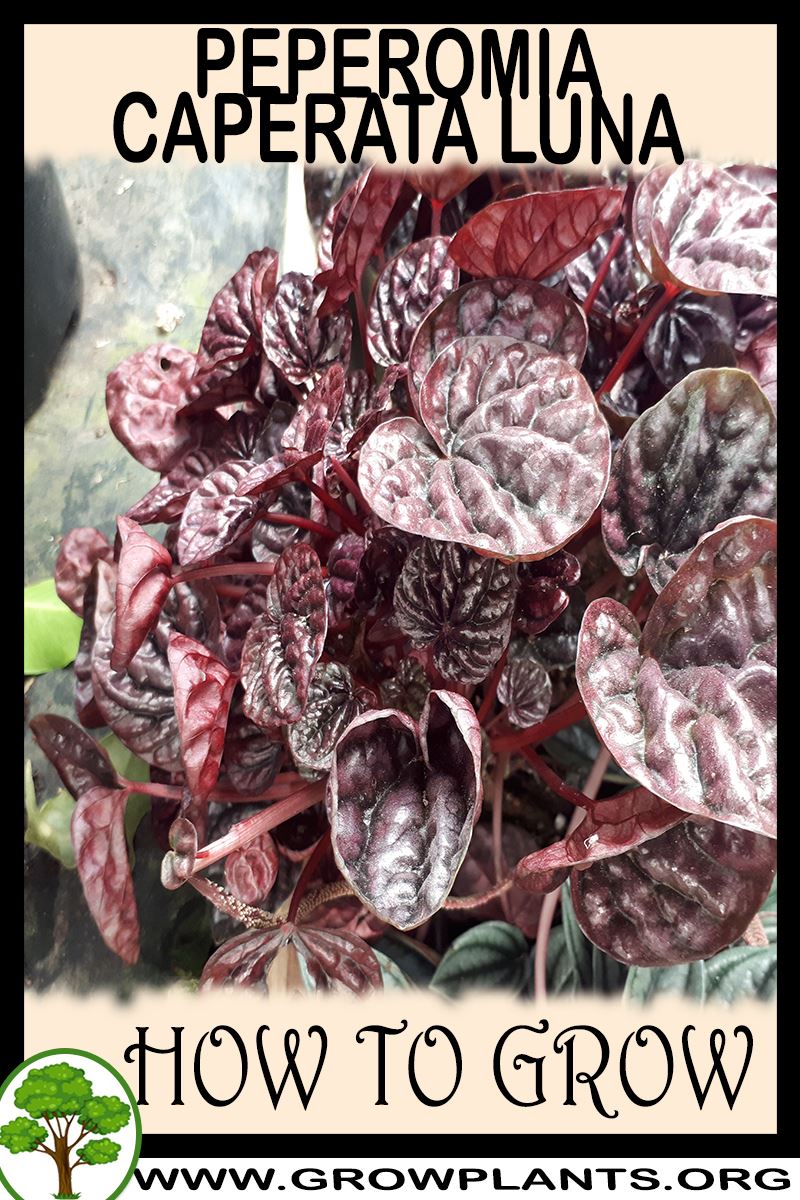
- Leaves & Foliage: Deeply corrugated heart-shaped leaves in deep purple ageing to green, with strongly sunken veins.
- Flower Characteristics: Slender, white rat-tail spikes shaped like an ice-pop; insignificant and grown-through rather than a display feature.
Primary Uses & Landscape Value
- Functional & Ornamental Roles: A popular foliage houseplant for tabletops, shelves, terrariums and dish gardens; also grown outdoors in frost-free gardens as a shady ground-level accent.
Care Guide: Planting, Soil & Watering
Overview: Peperomia caperata ‘Luna’ is a compact, semi-succulent evergreen grown mainly for its foliage, suited to warm frost-free gardens (hardiness zone 11b+, or 11a with care) or as a houseplant elsewhere. It likes warmth (above about 16°C), bright indirect light, and a light, rich, well-drained mix kept lightly moist but never soggy.
Quick Care Requirements
| Requirement | Ideal Condition |
|---|---|
| Planting Season | Spring in zone 10a; spring–summer in 10b; spring–autumn in 11; year-round in 12+ |
| Growth Rate | Slow |
| Soil Type | Light, rich, well-draining and moisture-retentive (peat or potting mix with perlite) |
| Soil pH | Slightly acidic (around 6.0) |
| Water Need | Low to Moderate – keep lightly moist, let the surface dry, never soggy |
Planting & Establishment
- Best Planting Season: Plant in spring in zone 10a, spring–summer in 10b, spring–autumn in 11, and year-round in zone 12 and warmer; in cooler areas grow it under cover as a houseplant.
- How to Plant:
- Hole Preparation: Settle the plant into a pot or gap only about 30–50% larger than its root ball; a large volume of wet mix around small roots invites rot.
- Soil Amendments: Blend perlite into a peat- or potting-mix base for aeration, with some humus or organic matter for fertility.
- Planting Depth: Keep the crown at the surface of the mix and do not bury the fleshy stems; firm lightly and water in.
- Growth Speed & Expectations: Expect slow growth even in ideal conditions, so start with a well-grown plant for quicker impact.
Soil, Watering & Drainage Care
- Soil Mix & Drainage Needs: Use a light, airy, well-drained mix – peat or potting mix with perlite and a little organic matter – that holds slight moisture without staying wet. Sharp drainage is essential to prevent root and stem rot; in pots let the base drain fully and never leave the plant standing in water.
- Watering Schedule & Technique:
- Young / Newly Planted: After potting, water lightly and keep the mix just moist while new roots form; rain or clean water is best.
- Established: Water when the top of the mix begins to dry – keep it lightly moist but never soggy, and never leave it in standing water.
- Seasonal Adjustments: Water more often in warm, bright spells and much less in winter when growth slows.
Climate, Light & Hardiness
Peperomia caperata Luna is a tropical foliage houseplant that wants warm, stable temperatures and bright, indirect light rather than direct sun. It has essentially no frost tolerance and is best kept as an indoor plant outside the mildest tropical climates.
Quick Climate Specifications
| Climate Zones | Tropical, Subtropical, Mediterranean (outdoors); Houseplant elsewhere |
|---|---|
| USDA Hardiness Zones | 11b+ (11a possible with attentive care) |
| Optimal Temp Range | 18–26°C (64–80°F) |
| Cold Damage Begins | below approximately 16°C (60°F) |
| Frost Tolerance | None |
| Light Conditions | Bright, indirect light (no direct sun) |
Sunlight & Light Exposure
Optimal Light Setup
Place in bright, filtered or indirect light - near an east- or north-facing window, or a few feet back from a brighter one.
Shade & Heat Management
Direct sun, especially through glass, can scorch the decorative crinkled leaves; keep it out of direct midday sun.
Best Exposure & Orientation
An east-facing window or similarly bright, indirect spot indoors suits it best.
Temperature Extremes & Hardiness
USDA Hardiness & Regional Limits
Rated to USDA zone 11b+, with zone 11a possible given careful siting and care - meaning outdoor, year-round culture is realistic only in essentially frost-free tropical and warm subtropical climates. Elsewhere it is grown as an indoor houseplant.
Cold Damage & Winter Protection
Growth suffers once temperatures drop much below about 16°C (60°F); keep it away from cold windows, unheated rooms, and winter drafts.
Frost Sensitivity
Has no meaningful frost tolerance and should never be exposed to freezing temperatures.
Extreme Heat Tolerance
Comfortable within its 18–26°C (64–80°F) optimal range; sustained heat well above this, especially combined with low humidity, can stress the plant.
Wind, Humidity & Microclimate
Humidity Preferences
Appreciates elevated humidity; keep the surrounding air from becoming too dry.
Dry-Air Tolerance
Low - the dry air produced by heating and air-conditioning systems can stress the plant, so keep it away from vents and consider a humidity tray or humidifier in dry rooms.
Microclimate Recommendations
Group with other houseplants or use a pebble tray to raise local humidity, and avoid spots near heaters, air conditioners, or draughty windows.
Growing in Pots, Balconies & Indoors
This compact Peperomia is an ideal houseplant – the grower confirms it grows well indoors. Its small size and love of bright, sun-free light make it perfect for a shelf, sill, or shaded balcony; keep the soil lightly moist and the air humid.
Quick Details
- Container Size: Start about 30-50% bigger than the plant; it is happy in a small pot, up to roughly 10-15 L (2.6-4 gal) at maturity
- Indoor Suitability: An excellent, compact houseplant for bright, indirect light
- Best Spot: Bright shade / plenty of indirect light – no harsh direct sun
- Soil & Drainage: Airy, well-drained mix – potting mix or peat with perlite, plus humus and organic matter
- Watering in Pots: Keep the mix lightly moist but never soggy; the grower prefers rain or clean water – avoid overwatering
Indoors & On the Windowsill
- A real houseplant: The grower confirms it grows well indoors. Give bright, indirect light, keep the soil lightly moist and the air humid, and feed at least once a year.
- Protect from dry air: Keep it away from the dry draught of heaters and air conditioners, which the grower warns against; group plants or use a pebble tray for humidity.
- Windowsill growing: A bright, sun-free sill is ideal for this small plant; its compact size suits shelves and desks too.
- Pet-friendly: Peperomias are non-toxic to cats and dogs – a safe pick for homes with pets.
On a Balcony or Patio
- Light & shelter: Outdoors keep it in bright shade, sheltered and warm; it is tender and dislikes wind, cold, and direct sun.
- Practicalities: Its small pot dries fast in warmth – check often, and bring it in before cold nights.
Choosing the Pot, Soil & Long-Term Care
- Pot & drainage: A small pot with strong drainage holes suits it; the grower’s bottom-water-and-drain routine keeps the mix moist without waterlogging – no standing saucer.
- Potting mix: Potting mix or peat with perlite, enriched with humus and organic matter.
- Feeding: Feed at least once a year as the grower advises; a balanced feed through the growing season keeps the leaf colour strong in nutrient-leaching pots.
- Repotting: Refresh the soil every few years with the grower’s root-wash and prune method (see tip).
Grower’s Container Tip
- Repotting routine (grower’s method): Start in a pot about 30-50% bigger than the plant, around 10-15 L (2.6-4 gal). Every few years, ideally during the cool/dormant season, switch to fresh soil: wash the old soil from the roots, trim the roots, and prune the plant. Use potting mix or peat with perlite blended with humus and organic matter, and top with chopped mulch to hold moisture.
- Bottom watering: The grower lets the base of the pot fill with water so the mix drinks up moisture – but ensures it drains dry the same day, so the roots never sit waterlogged.
Growing this plant in a greenhouse
A greenhouse can give peperomia caperata luna frost protection, cold protection, humidity control and extra warmth.
Greenhouse at a glance
| Greenhouse suitability | Good - clearly useful |
|---|---|
| Main benefits | frost protection, cold protection, humidity control, extra warmth |
| Outdoor protection advisable below | about 16°C |
| Maintain greenhouse minimum | around 16°C for active growth |
| Suitable types | unheated greenhouse, polycarbonate greenhouse |
| Heating | Heating is optional - useful mainly for winter growing in cold areas. |
Related greenhouse guides
- Greenhouses: How to Choose the Right Greenhouse
- Polycarbonate Greenhouses: What to Look for Before Buying
- Greenhouse Climate Control: Temperature, Ventilation and Humidity
Fertilizing & Feeding
A compact, slow-growing foliage plant that is a naturally light feeder; it thrives on sparing, well-timed feeding rather than a regular heavy schedule.
Quick Fertilizing Specs
| Feeding Level | Light – a naturally light feeder |
|---|---|
| Main Nutrient Priority | A balanced, foliage-friendly houseplant feed for healthy leaf color and vein pattern |
| Best Feeding Period | The warmer months when the plant is putting out new leaves |
| Micronutrients | Iron and manganese are useful in a complete indoor-plant feed to prevent pale new leaves |
| Reduce/Stop Feeding | Feeding tapers off when light and growth slow, and stops right after repotting until roots settle back in |
Feeding by Growth Stage
Establishment After Repotting or New Planting
Let roots settle into fresh soil before asking them to take up added nutrients
| Nutrient direction | None – withhold fertilizer until new growth confirms the plant has settled in |
|---|---|
| Timing | The first weeks after transplanting or bringing the plant home in new soil |
| Frequency | No feeding at this stage |
| Fertilizer types | No feeding at this stage – the fresh potting mix provides enough initially |
| Precautions | Do not fertilize freshly disturbed roots; wait for clear signs of new leaf growth first |
Active Growth
Support steady leaf production and rich leaf color without pushing leggy, weak growth
| Nutrient direction | A balanced, nitrogen-leaning houseplant feed diluted for this plant’s light appetite |
|---|---|
| Timing | Through the warmer months while the plant is actively producing new leaves |
| Frequency | Light feeding is usually enough through the growing season, well spaced apart |
| Fertilizer types | Diluted balanced liquid houseplant fertilizer, Complete indoor-plant feed with trace elements |
| Routine trace nutrients | iron, manganese |
| Precautions | Feed into moist soil, never dry, and always at a diluted strength; this plant is easily over-fed |
Low-Light Slowdown
Avoid feeding a plant that has slowed its growth due to reduced indoor light
| Nutrient direction | None – withhold fertilizer while growth is minimal |
|---|---|
| Timing | Darker, shorter-day months or whenever indoor light drops noticeably |
| Frequency | No feeding at this stage |
| Fertilizer types | No feeding at this stage – allow the plant to rest until light and growth pick back up |
| Precautions | Do not fertilize a plant that is not actively growing; unused nutrients can build up as salts in the soil |
Nutrient Deficiency Signs & Corrections
New leaves emerge pale green or yellowish while older leaves stay a normal color
| Possible causes | Iron or manganese deficiency, often from an alkaline or overly wet potting mix, Insufficient light limiting chlorophyll development, Depleted potting mix that has not been fed or refreshed in a long while |
|---|---|
| Appears first on | Newest leaves at the growing tips |
| What to check | Time since last repotting or feeding, Soil moisture and drainage, Light level at the plant’s location |
| Possible correction | Correct watering and drainage first, then resume light feeding with a complete houseplant fertilizer that includes chelated iron and manganese |
Leaf tips or edges turn brown and crisp
| Possible causes | Fertilizer salt buildup from over-feeding or infrequent watering-through, Low humidity or dry indoor air stressing the leaf margins, Inconsistent watering causing root stress that shows up at leaf edges |
|---|---|
| Appears first on | Tips and outer edges of mature leaves |
| What to check | Frequency and strength of recent feeding, Whether the pot is ever watered through to flush the soil, Room humidity and proximity to heating or cooling vents |
| Possible correction | Flush the soil thoroughly with plain water to clear excess salts and reduce feeding strength going forward |
Stems stretch thin and leaves stay small and sparse instead of the plant’s normal compact rosette form
| Possible causes | Insufficient light causing the plant to stretch toward a light source, Too little feeding during the active growing season leaving the plant undernourished, Rootbound conditions limiting overall vigor |
|---|---|
| Appears first on | New stem growth |
| What to check | Distance and angle from the nearest light source, Feeding history over the past growing season, Roots visible at drainage holes or soil surface |
| Possible correction | Improve light exposure and resume light, regular feeding during the active season if the plant has gone unfed |
Pruning, Training & Seasonal Maintenance
Peperomia caperata luna is a low, rosette-forming succulent-leaved subshrub grown almost entirely as a houseplant for its heart-shaped, deeply veined foliage. It tolerates only light, corrective grooming rather than any structural cutting, and the aim is tidiness and propagation material, not shaping. Grown indoors/frost-free year-round, it has no dormant season restricting cutting, so light grooming can be done any time flowers or leaves decline, though it is gentlest on the plant during active spring and summer growth.
Quick Pruning & Maintenance Specs
| Pruning Tolerance | Low |
| Primary Pruning Window | Year-round grooming (no fixed season) |
| Typical Frequency | A few light grooming passes a year |
| Main Objective | Remove spent flower spikes and tired/damaged leaves, keep the rosette compact |
| Young Plant Priority | Avoid cutting; let a new plant or fresh cutting establish |
| Mature Plant Priority | Groom regularly; take cuttings to renew a leggy crown rather than cutting it back hard |
| Best Tool Type | Precision snips |
Pruning by Plant Age & Size
Newly Established
Do not cut; remove only leaves or a flower spike that are already dead or damaged while the plant settles in.
Young / Formative
No structural training applies to this low rosette plant. If started from a leaf or stem cutting, simply let it root and fill out.
Mature / Established
Main task is removing the thin, upright, ice-pop-shaped flower spikes once they brown, and thinning old, yellowed or shriveled leaves from the base of the rosette. If the crown becomes leggy or sparse (common after a few years in low light), cut a stem back to 2–3 leaves and use the removed piece to propagate a fuller replacement.
Seasonal Pruning Schedule
Ongoing Sanitary
Objective: keep the rosette clean and redirect energy from spent growth. Remove: yellow/brown/damaged leaves and finished flower spikes at their base. Do not remove: healthy turgid leaves even if older, or unopened flower spikes. Expected response: a cleaner rosette and renewed leaf growth. Flowering impact: none – removing spent spikes does not reduce future bloom, since peperomia flowers are inconspicuous and produced continuously.
Structural Pruning & Training
If the crown becomes sparse or etiolated, selectively cut back the leggiest stems to encourage fuller regrowth from the base; no other structural framework applies to this low, rosette-forming plant.
Special Growth to Remove
- Spent flower spikes – cut at the base once brittle/brown.
- Old, yellowing basal leaves.
Container & Small-Space Pruning
This is grown as a container/houseplant. When repotting every few years, root pruning and top pruning are done together – wash old soil from the roots, trim the roots, and trim a matching portion of top growth so the plant is not left with more leaf area than the reduced root system can support. Keep the rosette compact by pinching back leggy stems rather than letting them sprawl over the pot’s edge.
Tools
Precision snips for all cuts – every cut here is on soft, fleshy leaf or flower-spike tissue.
Tool Hygiene & Disease Risk
Routine – clean, sharp snips are sufficient. No specific transmissible disease risk is documented for this species, though wiping blades between plants is good practice if any leaf spotting is present.
Cut Placement & Technique
Cut flower spikes at their base where they emerge from the leaf axil. Remove leaves with a clean cut or a gentle pull at the base of the petiole, close to the stem, avoiding tearing the fleshy leaf’s epidermis.
Heavy Pruning & Rejuvenation
Not tolerated well – Peperomia caperata does not respond reliably to a hard, whole-plant cutback. A leggy or overgrown specimen is better renewed by taking leaf or stem cuttings (its own listed propagation method) and starting a fresh, fuller plant rather than cutting the original back hard.
Post-Pruning Care
Keep the soil evenly moist as usual, per this plant’s steady, modest watering need – no extra fertilizing beyond its normal once-a-year feeding. Watch cut leaf or stem surfaces for rot in humid conditions, since caperata’s fleshy leaves can be prone to rot at a damaged point.
Common Pruning Mistakes
- Pulling leaves off roughly and tearing the stem tissue instead of cutting cleanly.
- Leaving spent flower spikes on indefinitely, wasting the plant’s energy and looking untidy.
- Attempting a hard structural cutback expecting bushy regrowth – propagation gives a better result.
When NOT to Prune
Avoid cutting right after repotting or a location change, until the plant re-establishes. Avoid removing healthy leaves just because they are older – they still photosynthesize.
Recommended Tools (by task)
- precision_snips – clean removal of spent flower spikes and old leaves without crushing this houseplant’s soft, fleshy stem tissue.
Propagation Guide
The best and most practical way to propagate Peperomia caperata luna is by leaf or stem cuttings, which is also necessary to keep this cultivar’s distinctive purple-to-green foliage true. Seed is biologically possible but is not the practical route for a named cultivar like Luna, and cuttings are easy for a home grower to root.
Quick Propagation Specs
| Best Propagation Method | Leaf or stem cuttings |
| Alternative Methods | Division of an established clump |
| Propagation Difficulty | Easy |
| Vegetative True-to-Type | Yes – necessary to keep this cultivar |
| Best Propagation Season | Spring – Autumn (all year in hardiness zone 12+) |
| Cutting Rooting Time | Several weeks |
| Germination Temperature | Above 16°C (60°F), optimal 18–26°C (64–80°F) |
Stem Cuttings
Cutting Type
A short stem section with at least one node, cut cleanly by hand.
Cutting Preparation
Take care not to break or crush the stem when cutting; let the cut end sit a few days in the shade until the tissue heals over before setting it in soil.
Rooting Setup
Once healed, place the cutting in soil and grow it on under the same warm, humid, well-drained conditions given to a mature plant.
Rooting Hormone
Not necessary — Peperomia stem cuttings root readily without it.
Leaf & Root Cuttings
Whole leaves (with a short petiole) can also be used. Cut the leaf carefully by hand to avoid breaking it, let the wound heal in the shade for a few days as with stem cuttings, then insert the petiole into soil and keep conditions similar to the mature plant until a new plantlet forms at the base.
Bloom & Flower Guide
Quick Details
- Bloom Season: Spring and summer
- Flower Appearance: Slender white flower spikes shaped rather like an ice-pop (sometimes likened to a little boot), held above the leaves
- Edibility: Grown as an ornamental foliage houseplant; the flower spikes are not eaten, though the plant is non-toxic and pet-safe
Detailed Blooming Overview
Peperomia caperata “Luna” is grown for its deeply crinkled, richly coloured leaves, but in spring and summer it also sends up narrow, tail-like flower spikes. The blooms are slim and pale rather than showy – a quiet bonus on top of the foliage – and the plant is safe around pets.
Flower Characteristics
- Thin white spikes (spadix-like), shaped like an ice-pop stick.
- Held upright above the rippled leaves; understated rather than showy.
Bloom Care & Thinning
- Managing the bloom: Trim the spent spikes off at the base to keep the plant looking neat; the foliage remains the main attraction.
- Encouraging bloom: Bright, indirect light and steady warmth bring on the flower spikes.
Pests, Diseases & Troubleshooting
Peperomias are compact, generally pest-tolerant houseplants whose real weakness is water management rather than insects. The genuine pests are mealybugs, spider mites, fungus gnats, whiteflies and occasional thrips or scale, while the important disorders are overwatering root rot, edema (corky leaf bumps), Cercospora leaf spot and Peperomia ringspot virus. Bright indirect light and a ‘dry-out-then-water’ routine keep them thriving.
Quick Troubleshooting Overview
| Issue / Pest | Main Symptom | Primary Solution |
|---|---|---|
| Mealybugs | White cottony tufts in leaf axils and on stems | Alcohol swab, insecticidal soap/oil, isolate plant |
| Spider mites | Fine stippling, dull leaves, webbing in dry air | Raise humidity, hose/wipe leaves, insecticidal soap/oil |
| Fungus gnats | Small black flies around the pot, larvae in wet mix | Let soil dry, use sticky traps and BTI drench |
| Root rot | Wilting, mushy stems, blackened roots in wet soil | Cut back watering, repot into airy mix, remove rot |
| Edema | Corky raised bumps/scabs on leaf undersides | Water more evenly, improve light and airflow |
| Leaf spot / ringspot | Brown ringed spots or ring-shaped distortion | Remove leaves; discard virus-infected plants |
Common Pests & Management
- Mealybugs (Pseudococcidae):
- Symptoms: White cottony masses tucked into leaf axils, stems and sometimes roots, with honeydew, stunting and leaf yellowing; the commonest peperomia pest.
- Prevention & Control: Isolate the plant, dab visible clusters with a 70% alcohol swab, then treat with insecticidal soap or horticultural oil weekly until clear; drench for root mealybugs and repot if needed.
- Spider mites (Tetranychidae):
- Symptoms: Fine pale stippling, dull or bronzed thick leaves and faint webbing, worst in dry indoor air.
- Prevention & Control: Raise humidity, wipe or hose the foliage, keep the plant from drying out, and treat persistent mites with insecticidal soap or horticultural oil.
- Fungus gnats (Sciaridae (Bradysia spp.)):
- Symptoms: Small dark flies drifting around the pot; their larvae feed in constantly wet mix and can nibble fine roots of seedlings.
- Prevention & Control: Let the top of the mix dry between waterings, use yellow sticky traps for adults, and drench with Bacillus thuringiensis israelensis (BTI) or apply a fine sand top-dressing for larvae.
- Whiteflies (Aleyrodidae):
- Symptoms: Tiny white flies that fly up when disturbed, with honeydew and yellow-flecked leaves; less common but seen in greenhouses.
- Prevention & Control: Monitor with yellow sticky traps, encourage parasitoids in greenhouses, and spray insecticidal soap or horticultural oil on the leaf undersides.
- Thrips and scale (Thysanoptera / Coccidae):
- Symptoms: Thrips cause silvery flecking and distorted new growth; scale appear as brown or waxy bumps on stems with honeydew.
- Prevention & Control: Use blue sticky traps for thrips, scrape off scale, and treat both with insecticidal soap, horticultural oil or spinosad for thrips, repeating to catch new stages.
Diseases & Fungal Issues
- Cercospora leaf spot (Cercospora spp.):
- Symptoms: Raised brown-to-black spots, often on leaf undersides, that enlarge and disfigure the foliage in warm, wet, crowded conditions.
- Treatment & Management: Avoid wetting the leaves, improve airflow and spacing, remove affected leaves, and apply a copper-based fungicide only if it spreads.
- Rhizoctonia / Pythium root and stem rot (Rhizoctonia solani / Pythium spp.):
- Symptoms: Blackened, collapsing stem bases and soft, discoloured roots in soggy mix—the most frequent fatal disease.
- Treatment & Management: Keep the mix airy and let it dry between waterings; remove rotted tissue, take healthy cuttings and repot into fresh, free-draining medium.
- Peperomia ringspot virus (Peperomia ringspot virus (PRSV)):
- Symptoms: Concentric brown rings, ring-shaped chlorotic patterns and distorted, puckered leaves; incurable and spread by handling and propagation.
- Treatment & Management: There is no cure—isolate and discard infected plants, sanitise tools and hands, and propagate only from clean stock.
Growing Difficulties & Abiotic Problems
- Overwatering and root rot:
- Cause & Symptoms: Soggy mix is the number-one cause of peperomia loss: roots suffocate and rot, leaves wilt, yellow and drop, and the base turns mushy.
- Correction Strategy: Use a light, free-draining mix, water only when the top of the soil dries, empty saucers, and repot the moment you see rot, removing affected tissue.
- Edema (oedema):
- Cause & Symptoms: Erratic watering—especially wet, cool, low-light conditions—makes cells burst and form corky raised bumps or scabs, mainly on leaf undersides.
- Correction Strategy: Water more evenly, increase light and airflow, and avoid watering in cool, dim conditions; damaged leaves won’t recover but new growth will be clean.
- Underwatering / low humidity:
- Cause & Symptoms: Very dry mix or air causes limp, curling or crisping leaves and dropped foliage.
- Correction Strategy: Water thoroughly when the surface dries, and provide moderate humidity; most peperomias tolerate average room humidity well.
- Cold and light stress:
- Cause & Symptoms: Cold draughts blacken or drop leaves, while too little light gives leggy, faded growth and too much direct sun scorches leaves.
- Correction Strategy: Keep above about 15°C away from draughts, and grow in bright indirect light, easing into any brighter position gradually.
What Helps – Products & Tools
Care is mostly cultural—light, airy mix and careful watering. Keep 70% rubbing alcohol, insecticidal soap and light horticultural oil for mealybugs, mites, whitefly, thrips and scale; yellow sticky traps and BTI for fungus gnats; and a copper-based fungicide for leaf spot. There is no treatment for ringspot virus—discard infected plants and keep tools clean.