Plant Profile & Key Characteristics
Overview: Blue Chiffon hibiscus (Hibiscus syriacus ‘Blue Chiffon’) is a hardy deciduous shrub of 1-2 m grown as an ornamental for its double blue-to-purple flowers, with edible leaves as a secondary use. It is cold-hardy in zones 5-10b.
Quick Specifications
| Specification | Attribute |
|---|---|
| Plant Type / Life Cycle | Perennial (shrub) |
| Foliage Type | Deciduous |
| Mature Size | 1-2 m tall (3-6 feet) |
| Growth Rate | Fast to moderate |
| Toxicity | Non-toxic – leaves and flowers are edible |
| Hardiness | USDA zones 5-10b |
Growth Form & Structure
- Height and Spread: Reaches 1-2 m (3-6 feet); grows in containers of about 10-20 L (2-4 gallons) or larger.
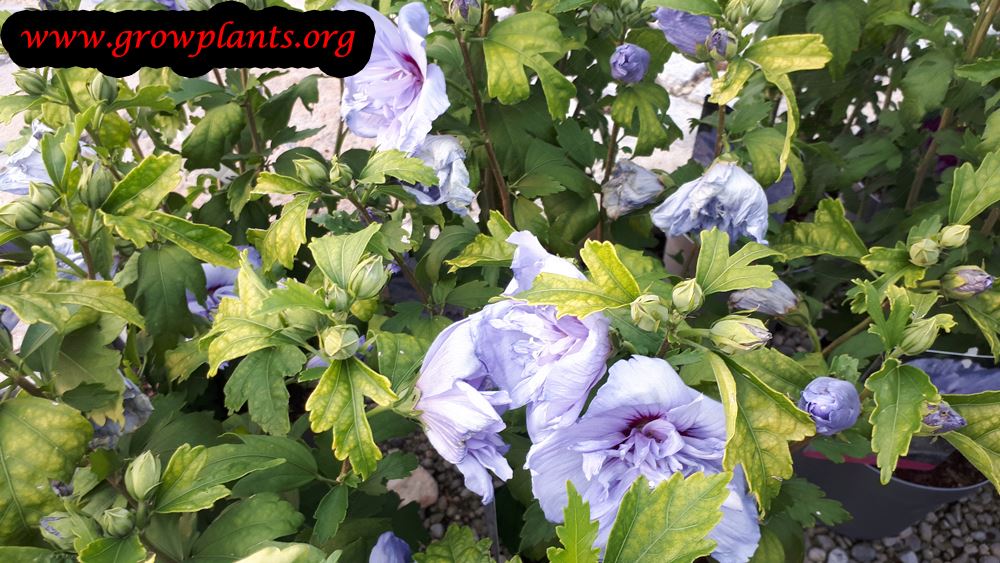
- Growth Habit and Form: Upright, multi-stemmed shrub suited to hedging and specimen use.
- Lifespan and Maturity: Fast to moderate growing perennial shrub; a hybrid best kept true from cuttings.
Anatomy & Physical Features
- Leaves and Foliage: Edible green leaves in rhomboid or lobed shape.
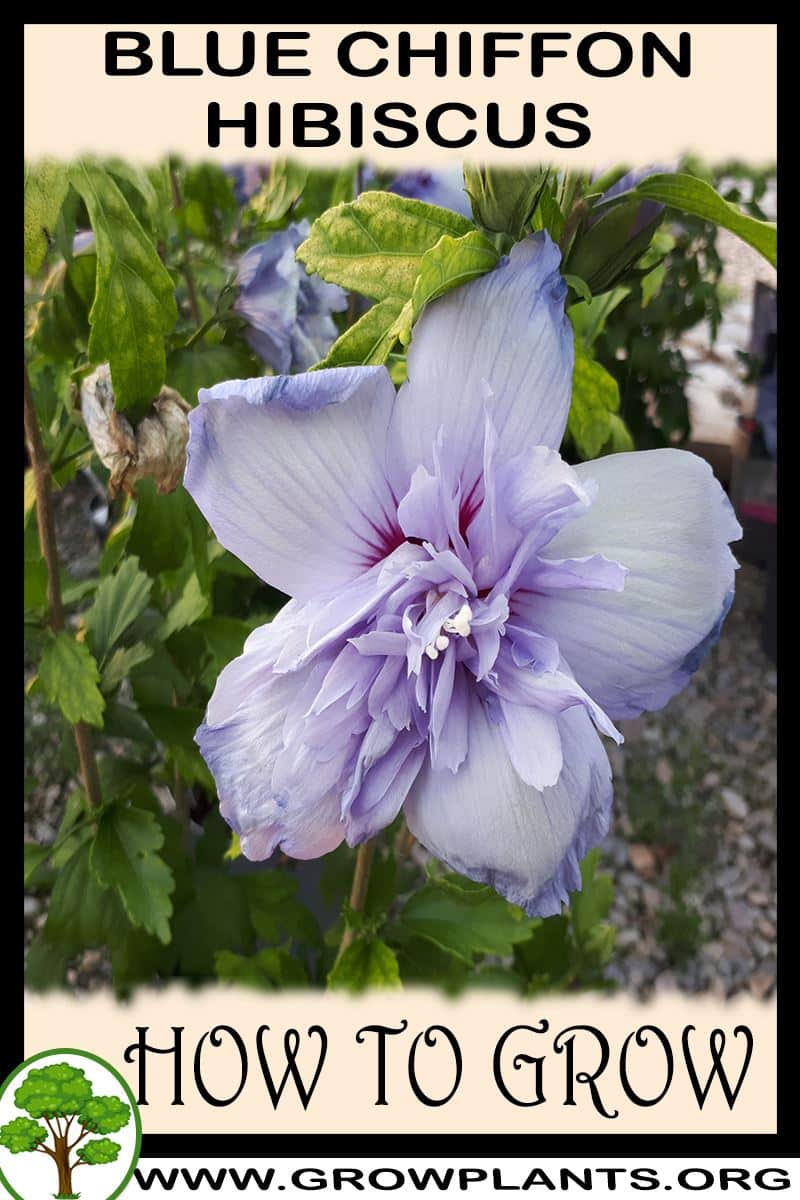
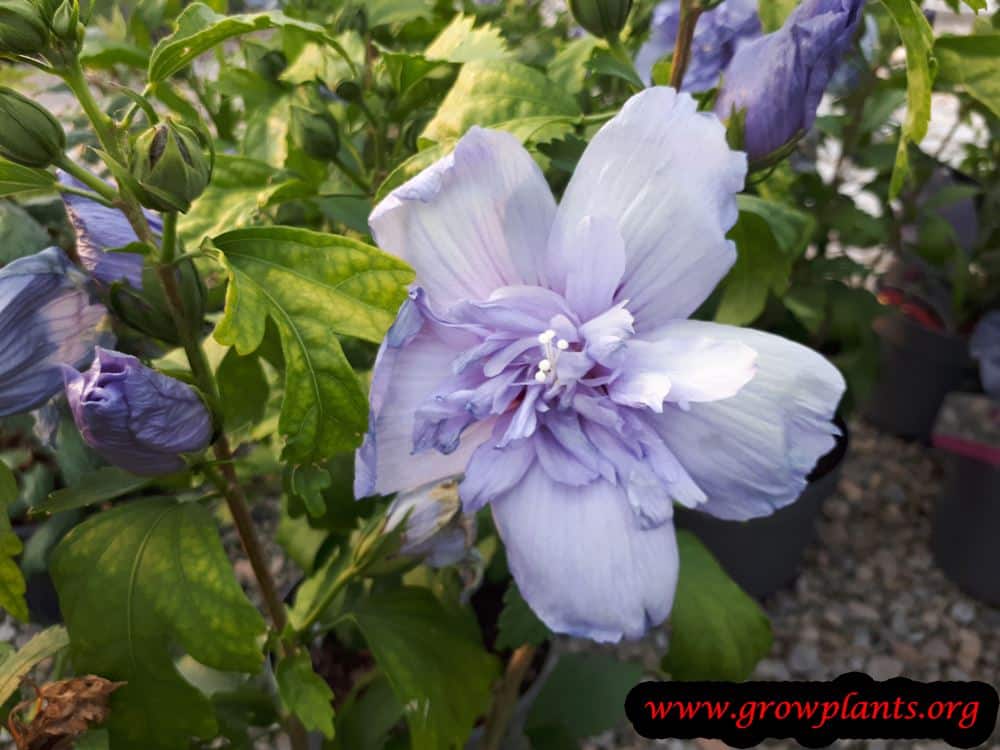
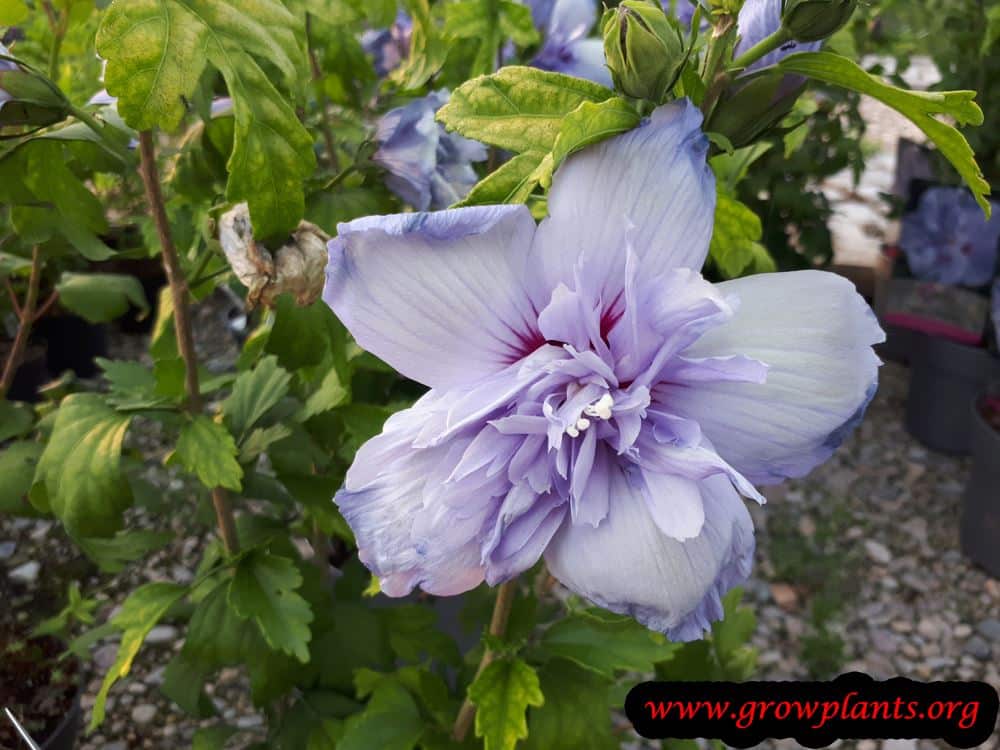
- Flower Characteristics: Full, double blue-to-purple flowers (full detail in the Bloom accordion).
Primary Uses & Landscape Value
- Edible Uses: Flowers used in salads and beverages; leaves cooked or used for beverages.
- Functional and Ornamental Roles: Ornamental flowering shrub and hedge for temperate and warm gardens.
Care Guide: Planting, Soil & Watering
Overview: Blue Chiffon rose of Sharon is a hardy deciduous hibiscus for full sun and rich, well-drained soil with organic matter. It grows steadily with moderate moisture and needs much more water in extreme heat.
Quick Care Requirements
| Requirement | Ideal Condition |
|---|---|
| Planting Season | Cool season to spring (avoid peak summer heat in hot zones) |
| Growth Rate | Moderate to fast |
| Soil Type | Rich, well-drained soil with organic matter |
| Water Need | Moderate to high – much more on very hot days |
Planting & Establishment
- Best Planting Season: Plant from winter through spring into summer; in zone 10b avoid summer and plant in the cooler winter-to-early-spring window.
- How to Plant:
- Hole Preparation: Dig the hole about 50% wider than the root ball so roots can spread into loosened soil.
- Soil Amendments: Work plenty of organic matter into the backfill (compost, well-rotted leaves and humus), then mulch the surface to hold moisture; hold back on fertiliser until the plant has established.
- Planting Depth: Set the plant so the top of the root ball sits level with the surrounding soil, firm it in gently and stake if unstable, without burying the stem.
- Growth Speed & Expectations: Moderate to fast – an upright shrub that fills out over a few seasons.
Soil, Watering & Drainage Care
- Soil Mix & Drainage Needs: Rich, free-draining soil improved with organic matter and mulched to hold moisture; keep containers well-drained.
- Watering Schedule & Technique:
- Young / Newly Planted: Water twice on planting day, then daily for the first two weeks until established.
- Established: Water deeply and regularly; add a lot more water when temperatures rise above about 38C (100F).
- Seasonal Adjustments: Give plenty of water in summer heat; in winter water only lightly and wait for spring growth before resuming regular watering.
Climate, Light & Hardiness
Blue chiffon hibiscus is a winter-deciduous shrub suited to temperate, subtropical, and Mediterranean climates, thriving in full sun to half shade. It is one of the more cold-hardy hibiscus types, reliably surviving harsh winter freezes through USDA zone 5, though its flowers can scorch in extreme summer heat.
Quick Climate Specifications
| Climate Zones | Temperate, subtropical, Mediterranean |
|---|---|
| USDA Hardiness Zones | 5–10a reliably, extending into 10b with attentive siting and care |
| Approx. Survival Minimum | Typical of zone 5 winters, approximately −29°C to −23°C (−20°F to −10°F) |
| Frost Tolerance | High |
| Light Conditions | Full Sun / Half Shade |
Sunlight & Light Exposure
Optimal Light Setup
Best flowering occurs in full sun; half shade is tolerated and useful where summer heat is intense.
Direct Sun Requirement
Needs several hours of direct sun daily for a full display of blooms.
Shade & Heat Management
In hot-summer regions (zone 10b and anywhere with many days above 38°C/100°F), afternoon half shade helps prevent flowers from burning during heat waves, and extra watering is needed on those days.
Temperature Extremes & Hardiness
USDA Hardiness & Regional Limits
Reliably hardy in USDA zones 5–10a; with the right care and siting it can also be grown into zone 10b, at the warm edge of its range.
Cold Damage & Winter Protection
As a winter-deciduous shrub it drops its leaves and goes dormant for the cold season, which is how established plants survive hard winters down to roughly zone 5 minimums without special protection.
Frost Sensitivity
Low once dormant - hardened wood tolerates hard frost and freezing winters well, unlike more tender tropical hibiscus.
Extreme Heat Tolerance
Flowers can burn or scorch during intense heat waves, especially where daytime temperatures repeatedly exceed 38°C (100°F); increase watering and provide afternoon shade under these conditions.
Chilling Requirement
Benefits from at least about a month of cool winter temperatures to complete dormancy properly; in essentially frost-free zone 10b gardens, some cool winter exposure still supports vigorous spring growth.
Wind, Humidity & Microclimate
Microclimate Recommendations
In climates with frequent extreme summer heat, choose a site with some afternoon shade to protect the blooms while still allowing several hours of morning sun for strong flowering.
Growing in Pots, Balconies & Indoors
Rose of Sharon ‘Blue Chiffon’ is a hardy deciduous shrub, not a houseplant – the grower says it is not suited to indoor life. It does, however, grow well in a large pot on a sunny balcony or patio, where it flowers freely in full sun.
Quick Details
- Container Size: Roughly 50% larger than the root ball; a 10-20 L (2-4 gal) pot or bigger (grower’s values)
- Indoor Suitability: Not a houseplant – an outdoor shrub for sun
- Best Spot: Full sun (light afternoon shade only in very hot, above-38C/100F climates)
- Soil & Drainage: Potting soil or a light peat/perlite mix enriched with organic matter; free-draining
- Watering in Pots: Regular – average, rising to generous on very hot days; never leave water standing at the base
Indoors & On the Windowsill
- Not for indoors: The grower rates it a No as a houseplant – it is a light-hungry, deciduous shrub that drops its leaves and needs a winter chill, so it belongs outside.
- Overwintering: Fully hardy in most climates; a potted plant can simply sit out the winter dormant outdoors, watered only sparingly.
On a Balcony or Patio
- Light & wind: Give it the sunniest spot on the balcony or patio; walls and paving reflect heat, so check moisture daily in hot weather and water more when it climbs above 38C (100F). A drip irrigation kit with a timer can take over that watering check automatically.
- Practicalities: A sizeable, heavy pot – set it in its final position; be careful, as the grower warns, not to let water sit in the saucer for days.
Choosing the Pot, Soil & Long-Term Care
- Pot & drainage: Start about 50% larger than the root ball and step up over time; a 10-20 L pot or bigger, with strong drainage. Each time you pot up, replace some of the old soil with fresh (grower’s method).
- Potting mix: Potting soil, or a light mix of peat and perlite, enriched with humus and organic matter; mulch the surface to hold moisture (grower’s advice).
- Feeding: Potted plants exhaust their mix faster than those in open ground – nutrients leach away with each watering – so feed lightly through the active growing season. The grower adds humus, organic matter and fertiliser.
- Repotting: Once at its final pot size, every few years replace part of the soil and cut back some roots from the side of the pot – no need to lift the whole plant (grower’s method).
Fertilizing & Feeding
This hibiscus is a moderate feeder – a balanced feeding in spring supports the flush of new growth, and light feeding through summer helps sustain its long bloom season into autumn, but it does not need heavy or constant fertilizing to flower well.
Quick Fertilizing Specs
| Feeding Level | Moderate feeder |
|---|---|
| Main Nutrient Priority | Balanced feeding through spring and summer growth and bloom, tapering into autumn |
| Best Feeding Period | Spring through summer, easing off as the extended autumn bloom winds down |
| Organic Options | Compost, well-rotted organic matter, or mulch worked into the root zone |
| Soil pH | Adaptable to a range of well-drained, fertile garden soils |
| Reduce/Stop Feeding | Stop feeding as leaves begin to drop and the shrub heads into its cold winter dormancy |
Feeding by Growth Stage
Spring Growth Flush
Support strong new leafy growth as the shrub breaks dormancy in spring.
| Nutrient direction | A balanced, complete fertilizer supports the flush of new growth after winter dormancy. |
|---|---|
| Timing | As new growth begins in spring after the last frost. |
| Frequency | A single balanced feeding early in the growing season is often enough to carry the shrub through spring growth. |
| Fertilizer types | A balanced, general-purpose shrub or garden fertilizer, Compost, well-rotted organic matter, or mulch worked in around the root zone |
| Precautions | Wait until the shrub shows new growth after planting before applying fertilizer, and keep fertilizer away from direct contact with stems. |
Main Summer Flowering
Support the shrub’s main flush of flowers through summer without pushing excess leafy growth.
| Nutrient direction | Continue balanced feeding; adequate nitrogen alongside the other nutrients supports good flowering, so there’s no need for a specialty high-phosphorus bloom formula. |
|---|---|
| Timing | Through the main summer flowering period. |
| Frequency | Light, infrequent feeding is generally enough while the shrub is in full bloom. |
| Fertilizer types | A balanced, general-purpose shrub or garden fertilizer used lightly |
| Precautions | Keep watering consistent during bloom, especially in hot weather, since heat stress can cause flowers to fail even when feeding is adequate. |
Continued Flowering Into Autumn
Sustain the shrub’s ability to keep producing new flower buds as it continues blooming into autumn.
| Nutrient direction | A light, balanced feeding can help sustain continued bud production on new growth, tapering off as the season progresses. |
|---|---|
| Timing | Late summer into autumn while the shrub is still actively producing new flowering growth. |
| Frequency | Reduce feeding compared with spring and summer, and stop well before the shrub begins preparing for dormancy. |
| Fertilizer types | A balanced, general-purpose shrub fertilizer used sparingly, if at all, this late in the season |
| Precautions | Avoid late-season feeding that pushes tender new growth too close to the shrub’s dormant period, since soft growth is more vulnerable to cold. |
Winter Dormancy
Let the shrub complete its natural leaf drop and cold dormancy undisturbed.
| Nutrient direction | None – withhold fertilizer while the shrub is dormant. |
|---|---|
| Timing | After leaf drop, through the winter cold period the shrub needs before spring growth resumes. |
| Frequency | No feeding at this stage. |
| Fertilizer types | No feeding at this stage – allow the shrub to complete its winter dormancy undisturbed |
| Precautions | Do not fertilize a dormant, leafless shrub; feeding late in the year can push tender growth that is easily damaged by cold. |
Nutrient Deficiency Signs & Corrections
Older leaves turn pale green to yellow overall and new growth is sparse.
| Possible causes | low soil nitrogen, poor soil fertility from lack of organic matter, root stress limiting nutrient uptake |
|---|---|
| Appears first on | older, lower leaves |
| What to check | overall foliage color across the shrub, soil fertility and organic matter, root health and drainage |
| Possible correction | Apply a balanced, nitrogen-containing fertilizer at the recommended label rate during active growth and work organic matter into the soil. |
New leaves yellow between the veins while the veins stay green.
| Possible causes | iron chlorosis from high soil pH, waterlogged or poorly aerated roots, root stress limiting micronutrient uptake |
|---|---|
| Appears first on | new growth |
| What to check | soil pH, soil drainage and aeration, recent watering pattern |
| Possible correction | Correct drainage and soil conditions first, then apply a chelated iron product per its label if chlorosis continues. |
Flower buds form but drop before opening, or open flowers wilt and scorch quickly in hot weather.
| Possible causes | heat stress during periods of extreme heat, inconsistent watering during bud development, insect feeding on buds |
|---|---|
| Appears first on | flower buds and open blooms |
| What to check | recent temperature extremes, watering consistency during bud development, buds and flowers for signs of pests |
| Possible correction | Keep watering consistent through heat waves and provide afternoon shade in hot climates; this issue is generally not corrected by feeding. |
The shrub wilts or declines despite adequate watering, with soft or discolored roots.
| Possible causes | poorly drained or waterlogged soil, overwatering, fungal root pathogens favored by consistently wet soil |
|---|---|
| Appears first on | roots and lower stems |
| What to check | soil drainage, recent watering frequency, root color and firmness |
| Possible correction | Improve drainage, reduce watering frequency, and hold off on feeding until the shrub shows signs of recovery. |
Pruning, Training & Seasonal Maintenance
Blue Chiffon hibiscus (Hibiscus syriacus) is a deciduous flowering shrub that tolerates moderate-to-fairly-heavy pruning well and flowers on the current season’s new growth, not on old wood. That makes the dormant window – end of autumn through winter, before spring growth resumes – the safest and most effective time to cut: it does not sacrifice the coming season’s flowers and instead encourages the vigorous new shoots that carry them. Pruning here mainly affects shape, size and flower size/count (harder cuts trade more numerous small blooms for fewer, larger ones), not the plant’s survival.
Quick Pruning & Maintenance Specs
| Pruning Tolerance | Moderate–High (tolerates structural cuts well while dormant) |
| Primary Pruning Window | End of autumn to winter (dormant, before spring growth) |
| Typical Frequency | Once a year |
| Main Objective | Shape/design, remove dead wood, remove non-blooming inner branches, control size |
| Young Plant Priority | Establish framework (single-trunk or multi-stem, as desired); minimal cutting beyond shaping |
| Mature Plant Priority | Renew flowering vigor by heading back last season’s growth; open the interior; control height/spread |
| Best Tool Type | Bypass secateurs for most cuts, loppers for thicker stems |
| Avoid Heavy Pruning During | Active bloom (summer–autumn) and periods of heat-wave stress, which already burns the flowers |
Pruning by Plant Age & Size
Newly Established
Minimal: remove only damaged or crossing growth; avoid a hard cutback in the first dormant season so the plant can build a root system and framework.
Young / Formative
No single mandatory training system – Blue Chiffon can be trained either as a multi-leader shrub or limbed up into a small single/multi-trunk standard. Choose the main stems (or trunk) in the first couple of dormant seasons and remove competing basal shoots that don’t fit the chosen form.
Mature / Established
Annual dormant-season cut: head back a portion of the previous season’s growth to encourage new flowering wood, remove dead or winter-damaged branches, and thin out inward-facing, non-blooming interior branches to open the canopy.
Seasonal Pruning Schedule
- Dormant / Late Autumn–Winter: Objective – shape the plant and set up the coming season’s bloom. Remove: dead/damaged wood, crossing or rubbing branches, weak interior growth that isn’t flowering, and head back some of last year’s shoots for size control. Do NOT remove: all of the previous season’s growth at once on a mature plant, or the main framework branches. Expected response: a flush of vigorous new shoots in spring, which is where this season’s flowers will form. Flowering impact: harder heading cuts generally produce fewer but larger flowers; lighter thinning produces more, smaller flowers.
Flowering & Fruiting Wood
Blue Chiffon flowers on current-season (new) growth, not on one-year-old or older wood. This means dormant pruning does not remove the coming year’s flower buds – it actually helps produce more of the new growth those buds form on. Pruning too late in spring, after new shoots have already started extending, can delay and reduce flowering for that season.
Structural Pruning & Training
- Remove crossing, rubbing or strongly inward-growing branches to keep an open, airflow-friendly framework, which also helps with this shrub’s aphid/mealybug pressure.
- Manage height and spread through the annual dormant heading cuts rather than repeated hard shearing.
- Thin dense interior growth on mature plants so light reaches more of the canopy and flowering isn’t pushed only to the outer surface.
Special Growth to Remove
- Basal/root suckers arising from the base of this own-root shrub, if a single clean framework (rather than a thicket) is wanted.
- Dead or winter-damaged wood.
- Weak, shaded interior branches that aren’t producing flowers.
Container & Small-Space Pruning
Grown in pots needs the same dormant-season shaping, but kept tighter: prune harder for compactness since a container restricts root volume and the plant’s natural size (1–2 m) is otherwise too large for most pots. When repotting into a container roughly 50% bigger than the root ball, some root trimming can accompany the top pruning to keep the plant in balance.
Tools
- Bypass secateurs for most stems.
- Loppers for thicker basal or framework branches.
- Pruning saw only if an old, thick trunk/limb needs removal on a well-established plant.
Tool Hygiene & Disease Risk
Increased: this cultivar is noted as susceptible to nematodes, galls, aphids and mealybugs. While nematodes are soil-borne rather than tool-spread, clean tools between plants are still warranted given the gall and pest pressure, and any obviously diseased/galled wood should be cut well back into clean tissue and removed from the site rather than composted nearby.
Cut Placement & Technique
Use thinning cuts (removing a branch at its point of origin) to open the canopy, and heading cuts (shortening a stem to an outward-facing bud) to control size and encourage branching. Cut just outside the branch collar on larger limbs; avoid flush cuts and long stubs.
Heavy Pruning & Rejuvenation
Tolerated: Blue Chiffon can take a fairly hard dormant-season cutback to renew an overgrown or leggy plant, since it reliably resprouts from new wood. Expect a strong flush of vegetative regrowth the following spring with flowering resuming that same season, though possibly with somewhat larger, fewer blooms the year of a hard cut. Avoid repeating a severe cutback in consecutive years.
Post-Pruning Care
Water as usual through the dormant season; once spring growth resumes after a harder cut, keep up with regular watering, increasing in hot weather above about 38°C (100°F), since this cultivar is already prone to flower burn in heat waves. No extra feeding is needed just because of the prune. Watch new growth for aphids and mealybugs.
Common Pruning Mistakes
- Pruning in spring after new growth has started, which delays and reduces that season’s flowering.
- Shearing into a uniform ball instead of using thinning cuts, which crowds the interior and concentrates bloom only at the surface.
- Leaving galled or heavily pest-infested wood in place instead of cutting it out and removing it from the site.
- Ignoring basal suckers if a clean single/multi-trunk form is the goal.
When NOT to Prune
- Avoid pruning once spring growth is underway – it removes the wood that would otherwise carry this season’s flowers.
- Avoid pruning during or right before a heat wave, since flowers already burn under heat stress and fresh cuts add stress.
- Hold off major cuts right after transplanting; let the plant establish first.
Recommended Tools (by task)
- Annual dormant shaping and thinning (young to mature shrub): bypass_secateurs – most cuts are on pencil-to-finger-thick current or one-year wood.
- Removing thicker basal shoots or framework branches (mature shrub): loppers – needed for stems too thick for secateurs on an established 1–2 m shrub.
- Occasional old-wood removal (mature, overgrown plant): pruning_saw – only for a genuinely thick trunk/limb during rejuvenation.
Pruning Troubleshooting
| Problem | Possible Cause | What to Check | Corrective Action |
| Few or no flowers after a prune | Pruned too late, after spring growth had already started | Timing of last prune vs. spring bud break | Shift pruning earlier, to end of autumn–winter dormancy, next cycle |
| Dense, twiggy interior with bloom only on the outer surface | Repeated shearing instead of thinning cuts | Whether cuts have been heading-only vs. removed at the branch base | Switch to selective thinning cuts to open the canopy |
| Swollen or distorted growths on stems/roots | Gall-forming pest or nematode pressure noted for this cultivar | Inspect suspect wood and, if accessible, root zone | Prune out and remove affected wood; address soil-borne nematodes separately from pruning |
| Sticky residue or clusters of small insects on new shoots | Aphids or mealybugs, both noted pests of this cultivar | Undersides of new leaves and shoot tips | Treat the pest; avoid heavy nitrogen-driven regrowth right after pruning, which attracts more aphids |
Propagation Guide
Blue chiffon Hibiscus is best propagated from stem cuttings, since as a named cultivar it must be grown vegetatively to keep its true blue, ruffled flower color and form – seedlings from this hybrid can differ in flower color. Cuttings root in a few weeks under warm, humid conditions, and while the seed itself germinates fairly easily too, it is only useful for growing a hibiscus in general rather than reproducing this exact cultivar.
Quick Propagation Specs
| Best Propagation Method | Stem cuttings |
| Alternative Methods | Seed (does not preserve cultivar identity) |
| Propagation Difficulty | Easy–Moderate (cuttings); Easy (seed germination itself) |
| Seed True-to-Type | Cultivar-dependent – seedlings may not retain the ‘Blue chiffon’ flower color |
| Vegetative True-to-Type | Yes |
| Best Propagation Season | Early spring before new growth resumes after dormancy, or generally 15–26°C (59–79°F) |
| Seed Germination Time | 10–20 days |
| Cutting Rooting Time | A few weeks |
| Germination Temperature | 20–26°C (68–80°F) |
| Seed Sowing Depth | 0.5–1cm (0.25–0.5in) |
Growing from Seed
Seed Handling & Viability
Store seed in a dry, dark location, refrigerated, until sowing.
Dormancy & Pre-Sowing Treatment
At least one month of cold benefits the seed; keeping it with moist peat in cold conditions (cold, moist stratification) is recommended before sowing.
Sowing Season
Spring, summer, or autumn – temperature matters more than the calendar season.
Sowing Depth & Orientation
About 0.5–1cm (0.25–0.5in) deep, covered lightly without pressing the soil down; the seed does need to be buried rather than left on the surface.
Germination Conditions
Moist soil, full sun (half sun if a heat wave hits in spring), 20–26°C (68–80°F), with good humidity.
Germination Time
10–20 days.
Seedling Care
Space seedlings about 3x5cm apart before transplanting, ideally not before they have 5 leaves; direct-sown plants can eventually be thinned to about 1x1m (40x40cm) spacing. Begin light fertilizing once seedlings have 5 leaves.
Stem Cuttings
Cutting Type
Tip cuttings taken from stems that are not going to flower.
Best Timing
Early spring, before the plant resumes growth after winter dormancy, or whenever temperatures are around 15–26°C (59–79°F).
Cutting Preparation
Choose non-blooming stems for cuttings.
Rooting Setup
Use a moist, humid, peat-based mix. A greenhouse or a small enclosed container (such as a plastic box with holes) is strongly recommended to hold humidity around the cutting.
Rooting Hormone
Recommended to encourage root growth.
Rooting Time
Roots typically form within a few weeks.
Bloom & Edible Flower Guide
Quick Details
- Bloom Season: Spring, through summer and into autumn
- Flower Appearance: Full, bowl-shaped flowers in shades of blue to purple
- Edibility: Edible – the flowers are used in salads and beverages
Detailed Blooming Overview
Blue Chiffon is a Rose of Sharon (Hibiscus syriacus) prized for its long summer show of soft blue to purple, chiffon-textured flowers. Blooming carries on from spring into autumn, with fresh flowers opening day after day. The blooms are edible and, like other Hibiscus syriacus flowers, are used fresh in salads or steeped for drinks. Bees work the flowers steadily.
Flower Characteristics
- Full, bowl-shaped flowers in blue to purple tones.
- Each flower is short-lived, but the shrub blooms in long succession.
- Edible, with a mild flavour suited to salads and infusions.
Bloom Care & Thinning
- Prolonging bloom: Flowers form on new growth, so a late-winter prune encourages plenty of flowering wood.
- Pollination: Bees are the main pollinators.
- Harvesting flowers: Pick freshly opened blooms in the morning, and only from plants that have not been sprayed.
Bloom Health & Protection
- Japanese beetles: These beetles are drawn to the open flowers and can chew the petals. Hand-picking in the early morning keeps numbers down; where pressure is heavy a targeted treatment such as neem oil can help – avoid spraying blooms you intend to eat.
- Bud drop: Sudden dryness can cause buds to fall before opening; steady moisture during flowering keeps buds setting.
Fruit & Uses
Blue Chiffon Hibiscus (Hibiscus syriacus) is grown mainly for its ornamental flowers, but both the tender young leaves and the flowers are edible. The flowers are used raw in salads and beverages, while the leaves are typically used in beverages or cooked rather than eaten raw.
Quick Edible Specs
| Edible Parts | Leaves, flowers |
|---|---|
| Main Use(s) | Culinary – salad and beverage (flowers); beverage and cooked greens (leaves) |
| Eaten Raw or Cooked | Flowers raw; leaves mainly cooked or infused, not typically eaten raw |
| Preparation Required | None for flowers; cook or steep leaves |
| Harvest Season | Leaves: spring, summer, autumn (avoid heavy picking while the plant is in bloom); Flowers: spring, summer, autumn (bloom season) |
| Time to First Harvest | Once the plant is established |
| Storage | Best used fresh; not noted for long storage |
| Safety/Toxicity Caveat | No toxicity noted on site; this is primarily an ornamental shrub, so treat edible use as a minor, secondary use rather than a dedicated food crop |
Leaves & Greens
Young, tender leaves (green, rhomboid to lobed) are harvested by cutting once the plant is established, ideally in spring through autumn and away from the main bloom period. They are used in beverages or cooked rather than eaten raw.
Flowers & Flower Buds
The blue-to-purple, bowl-shaped flowers are edible and used fresh in salads and beverages. Pick flowers as they open during the spring–autumn bloom season; harvesting flowers for eating reduces the plant’s ornamental display, so balance picking against the desire for bloom (see Pruning for general flowering effects).
Preparation, Uses & Safety
Flowers need no preparation and are used raw in salads or steeped for beverages. Leaves are best used cooked or as a beverage rather than raw. No specific toxicity is noted for this plant, but as with any ornamental shrub grown mainly for its flowers, edible use here is a secondary, minor use rather than a dedicated food crop, so eat in modest amounts.
Pests, Diseases & Troubleshooting
Overview: Hibiscus syriacus (Rose of Sharon) is a hardy, deciduous flowering shrub. Across the genus, hibiscus are magnets for sap-sucking insects — aphids, whitefly, mealybugs (including the serious pink hibiscus mealybug), spider mites and thrips — and they suffer bud drop, leaf spot and root rot when stressed. Manage them with vigilant scouting, strong plant health, and organic controls first (water jets, soaps, oils, beneficials), keeping stronger products for outbreaks.
Quick Troubleshooting Overview
| Issue / Pest | Main Symptom | Primary Solution |
|---|---|---|
| Aphids | Colonies on buds & shoot tips; honeydew, sooty mould | Hose off; insecticidal soap; beneficials |
| Whitefly | Clouds of tiny white flies under leaves; sticky honeydew | Yellow sticky traps; oil/soap; Encarsia |
| Mealybugs | White cottony masses; distorted growth | Alcohol/oil; control ants; ladybird predators |
| Hibiscus gall midge | Yellow buds drop before opening (maggots inside) | Pick & destroy dropped/yellow buds |
| Spider mites | Stippling, bronzing and webbing in heat | Hose; raise humidity; horticultural oil |
| Japanese beetle | Skeletonised leaves and chewed flowers | Hand-pick into soapy water; protect blooms |
| Root rot / bud drop | Wilting in wet soil; buds yellow and drop | Improve drainage; reduce stress; steady watering |
Common Pests & Management
- Aphids (Aphis gossypii and others):
- Symptoms: Dense colonies of soft green, yellow or black aphids on shoot tips, buds and leaf undersides, coating growth in honeydew and sooty mould and distorting new leaves and flowers.
- Prevention & Control: Blast off with water, encourage ladybirds, lacewings and hoverflies, and use insecticidal soap or neem oil in the evening. Control ants, which farm and protect aphids.
- Whitefly (Bemisia tabaci / giant whitefly Aleurodicus dugesii):
- Symptoms: Clouds of tiny white moth-like flies rising when the plant is disturbed, with sticky honeydew and sooty mould on leaves; a chronic hibiscus pest under warm conditions.
- Prevention & Control: Hang yellow sticky traps, spray horticultural oil or insecticidal soap to the leaf undersides, and introduce the parasitic wasp Encarsia formosa under glass; keep plants unstressed.
- Mealybugs, incl. pink hibiscus mealybug (Maconellicoccus hirsutus):
- Symptoms: White cottony masses on shoot tips, buds and leaf axils; the pink hibiscus mealybug injects a toxic saliva that causes severely bunched, distorted “bonsai-like” growth and is a serious quarantine pest.
- Prevention & Control: Dab colonies with alcohol, wash off, use horticultural oil, and control tending ants. For pink hibiscus mealybug, biological control (the ladybird Cryptolaemus and parasitoid wasps) is the mainstay; report suspected outbreaks in regulated areas.
- Japanese beetle (Popillia japonica):
- Symptoms: Metallic beetles skeletonise leaves between the veins and chew ragged holes in flowers during summer, often in groups.
- Prevention & Control: Hand-pick beetles into soapy water in the cool of morning, protect prized blooms with netting, and treat turf for grubs where populations are high; avoid pheromone traps that lure more beetles in.
- Spider mites (Tetranychus urticae):
- Symptoms: Fine pale stippling, bronzing and fine webbing on leaf undersides, worst in hot, dry, dusty conditions; leaves yellow and drop.
- Prevention & Control: Raise humidity and hose down foliage, introduce predatory mites, and apply horticultural oil or insecticidal soap; avoid drought stress.
- Thrips (Frankliniella spp.):
- Symptoms: Silvery flecking on leaves and, importantly, streaked, distorted flowers and buds that may drop before opening.
- Prevention & Control: Use blue sticky traps, remove weeds and spent blooms, and apply insecticidal soap or spinosad; encourage predatory mites.
Diseases & Fungal Issues
- Leaf spot & bacterial leaf spot (Cercospora, Pseudomonas spp.):
- Symptoms: Brown, tan or angular water-soaked spots on leaves, sometimes with yellow haloes, leading to yellowing and leaf drop in warm, wet weather.
- Treatment & Management: Remove affected leaves, improve airflow, avoid overhead watering, and use a copper fungicide for persistent bacterial or fungal spotting.
- Root & collar rot (Phytophthora / Pythium):
- Symptoms: Wilting despite moist soil, yellowing lower leaves, and dark, decayed roots and stem base in wet, poorly drained ground.
- Treatment & Management: Improve drainage, avoid overwatering, plant at the correct depth, and remove badly rotted plants; prevention through good drainage is far more effective than cure.
- Botrytis / grey mould (Botrytis cinerea):
- Symptoms: Fuzzy grey mould on flowers and soft growth in cool, damp, crowded conditions.
- Treatment & Management: Remove spent blooms and dead tissue, improve airflow, and avoid wetting the flowers.
Growing Difficulties & Abiotic Problems
- Bud drop:
- Cause & Symptoms: Flower buds yellow and drop before opening due to stress — sudden temperature swings, dryness, overwatering, low light or a check to growth (as well as gall midge or thrips). Correction Strategy: Keep watering, light and temperature steady, avoid moving plants in bud, and rule out midge/thrips.
- Chlorosis (iron / manganese deficiency):
- Cause & Symptoms: Yellowing leaves with green veins, common on hibiscus in alkaline or waterlogged soil where iron uptake is blocked. Correction Strategy: Improve drainage, acidify slightly, and apply chelated iron/manganese; feed with a balanced fertiliser.
- Overwatering & poor drainage:
- Cause & Symptoms: Yellow leaves, wilting and root rot from soggy soil. Correction Strategy: Let the top of the soil dry between waterings and ensure containers drain freely.
- Aborted / few flowers & self-seeding:
- Cause & Symptoms: Bud drop from erratic watering, and prolific self-sown seedlings from spent flowers. Correction Strategy: Water evenly through summer, and deadhead or prune to reduce unwanted seedlings.
What Helps — Products & Tools
For hibiscus keep insecticidal soap and neem/horticultural oil for aphids, whitefly, mealybugs and mites; yellow sticky traps for whitefly; spinosad for thrips; copper fungicide for leaf spot; and chelated iron for chlorosis. Beneficials — ladybirds, lacewings, Encarsia and predatory mites — do much of the work if you avoid harsh sprays. Steady watering and good drainage prevent most of the abiotic troubles.