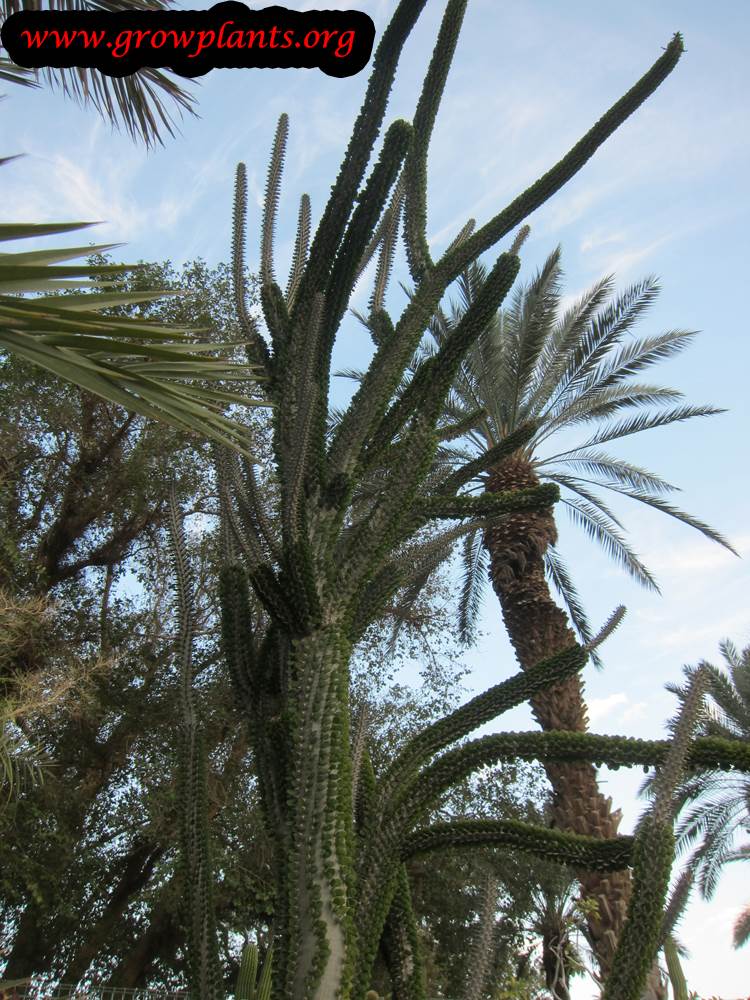
Plant Profile & Key Characteristics
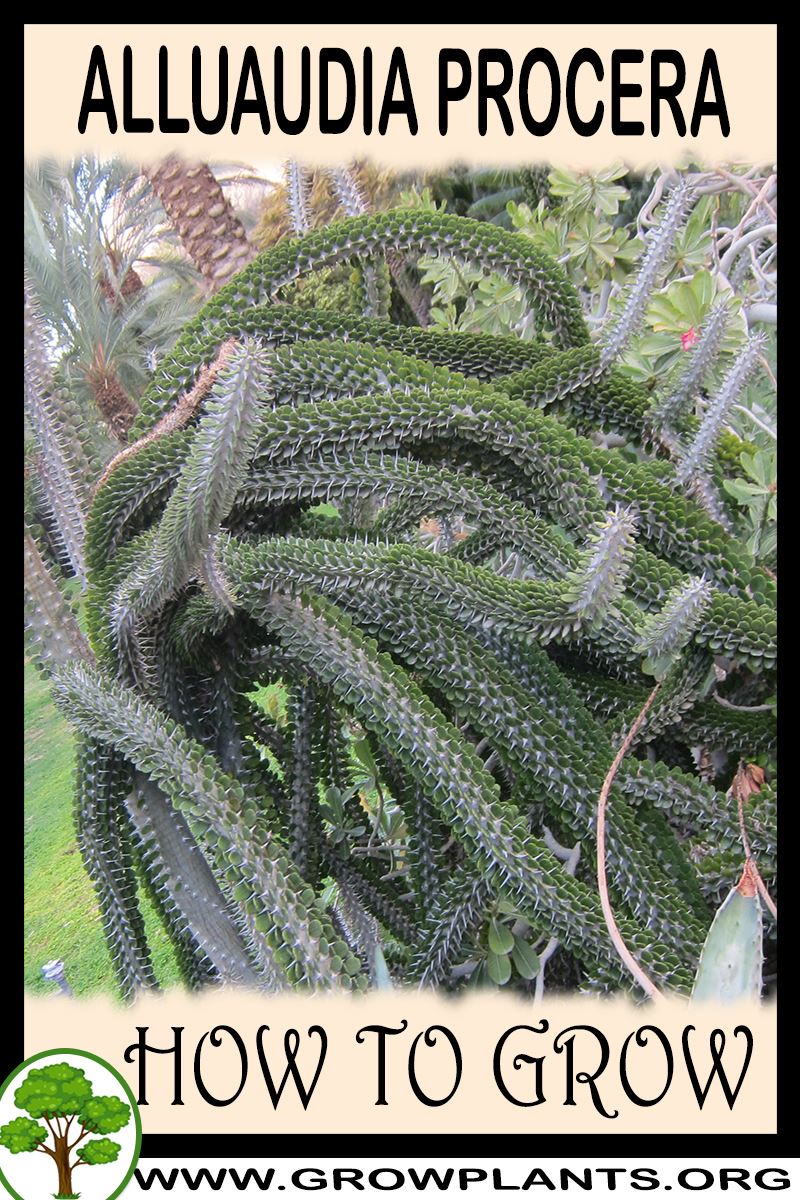
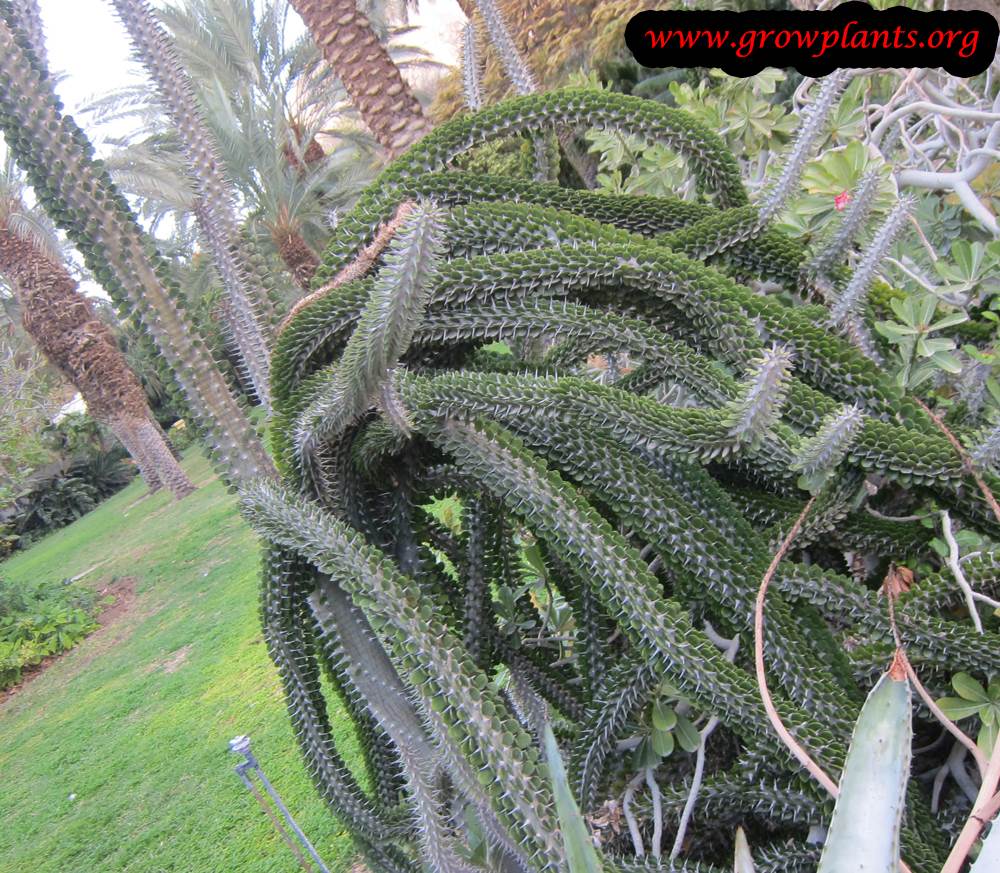
Overview: A slow-growing, drought-tolerant succulent shrub or small tree from Madagascar, reaching 1–10 m (3–30 ft) on spiny, sparsely branched stems. A deciduous perennial grown as an ornamental for its architectural, ocotillo-like structure.
Quick Specifications
| Specification | Attribute |
|---|---|
| Plant Type / Life Cycle | Perennial (succulent shrub/small tree) |
| Foliage Type | Deciduous (sheds leaves in drought/dormancy) |
| Mature Size | 1–10 m (3–30 ft) |
| Growth Rate | Slow |
| Hardiness | USDA zone 9–12a |
Growth Form & Structure
- Height & Spread: About 1–10 m (3–30 ft) in the ground; stays smaller and slower in a container.
- Growth Habit & Form: Erect, sparsely branched succulent with spiny stems in an ocotillo-like form; container-friendly. It also tolerates indoor culture as a potted succulent.
- Lifespan & Maturity: Long-lived perennial; slow to reach full size.
Anatomy & Physical Features
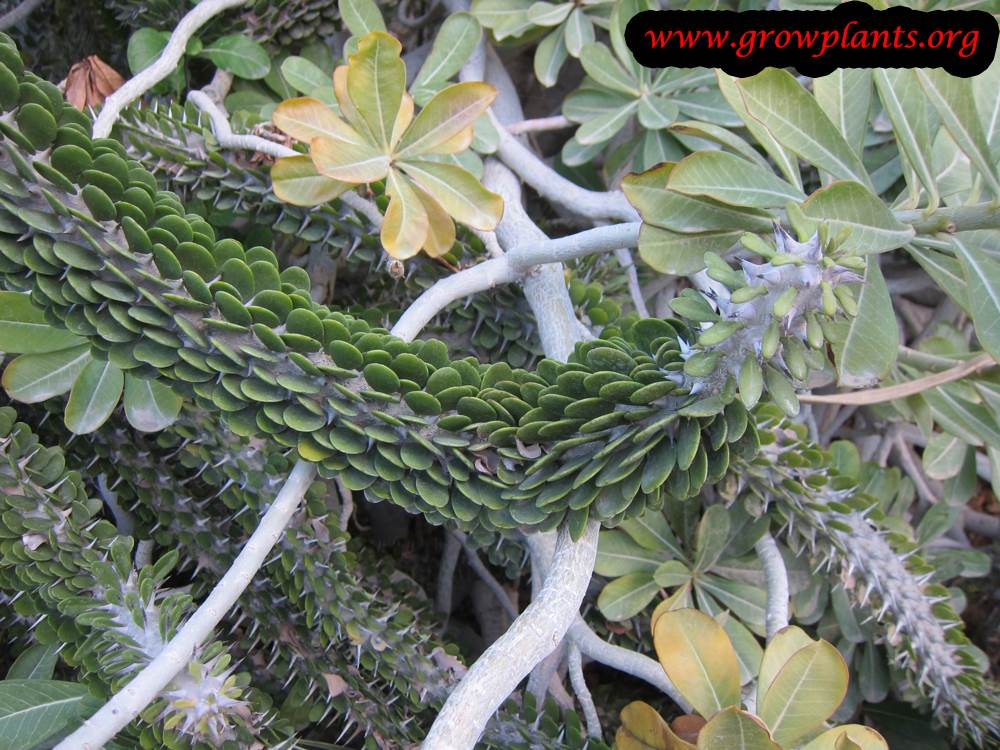
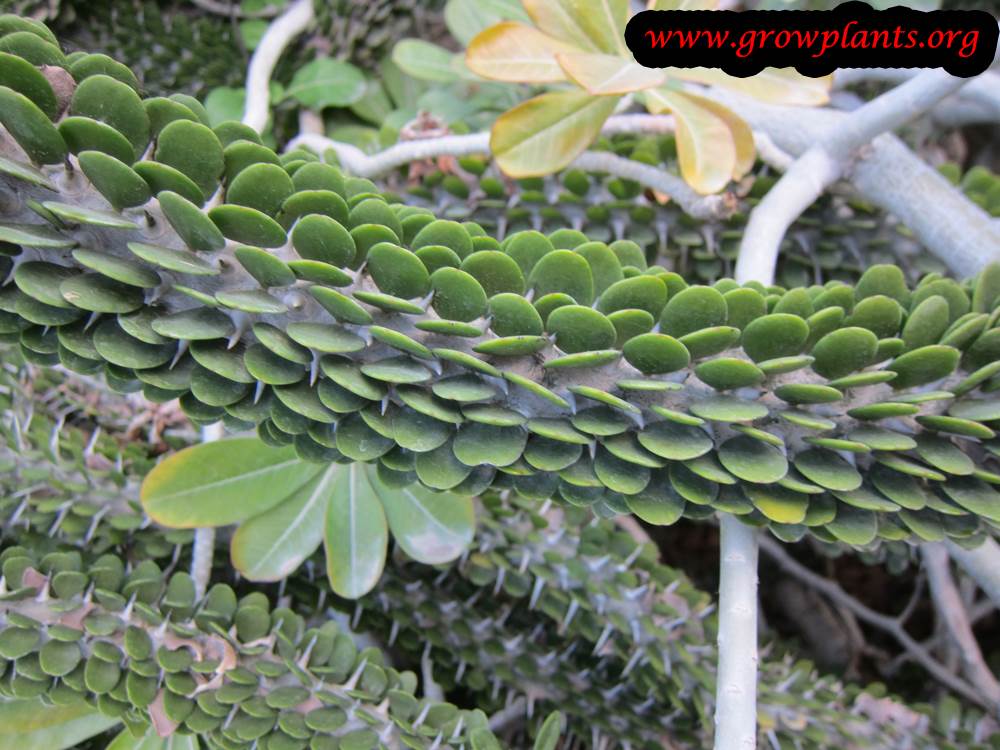
- Leaves & Foliage: Small, rounded green leaves borne along the stems beside paired spines; shed during drought or dormancy.
- Flower Characteristics: Small yellow or green flowers in umbel-like clustered inflorescences (see the Bloom guide for detail).
Primary Uses & Landscape Value
- Functional & Ornamental Roles: Architectural specimen for xeriscape, rock and desert gardens and succulent collections; drought-tolerant and well suited to containers, including indoors.
Care Guide: Planting, Soil & Watering
Overview: Alluaudia is a slow-growing Madagascan succulent that demands sharp drainage and full sun, storing water in its stems to survive drought. It wants a lean, gritty, fast-draining soil and only occasional, sparing watering.
Quick Care Requirements
| Requirement | Ideal Condition |
|---|---|
| Planting Season | Spring–summer in zones 9–10a, spring–autumn in 10b–11, year-round in zone 12a |
| Growth Rate | Slow |
| Soil Type | Sharply draining, sandy or gritty soil (cactus / succulent mix) |
| Water Need | Low — let the soil dry between waterings |
Planting & Establishment
- Best Planting Season: Plant in the warm season — spring to summer in zones 9–10a, spring to autumn in 10b–11, and year-round in zone 12a — once temperatures are reliably warm.
- How to Plant:
- Hole Preparation: Dig a hole slightly larger than the root ball into gritty, fast-draining ground; on heavy or rainy sites plant into a raised bed or add coarse grit or lava rock beneath so water never pools.
- Soil Amendments: Amend with coarse sand, grit or pumice to guarantee drainage rather than adding rich, moisture-holding matter.
- Planting Depth: Set the plant at the same level it grew, keeping the base and stem out of wet soil.
- Growth Speed & Expectations: Expect slow growth even in ideal conditions (slower still from seed), so plants take time to reach size.
Soil, Watering & Drainage Care
- Soil Mix & Drainage Needs: Use a very free-draining, sandy or cactus-type mix; in pots ensure excellent aeration and open drainage holes, as standing moisture quickly causes stem and root rot in this succulent. Grown indoors it needs an airy, well-ventilated sandy or cactus mix.
- Watering Schedule & Technique:
- Young / Newly Planted: Water sparingly while establishing, keeping the mix barely moist but never wet.
- Established: Water only occasionally once established, letting the soil dry out between waterings; never overwater.
- Seasonal Adjustments: Give a little more water in the heat of active growth and keep the plant nearly dry through the cool months.
Climate, Light & Hardiness
Alluaudia procera is a spiny, drought-deciduous succulent shrub from Madagascar's hot, arid spiny forest, at home in warm desert, Mediterranean and subtropical climates and needing strong sun. It grows into a tall, columnar spiny succulent, the best-known 'Madagascar ocotillo'. It is frost-tender, dropping its leaves through the cool, dry season and relying on its green stems, so grow it where winters stay near or above freezing.
Quick Climate Specifications
| Climate Zones | Hot, arid semi-desert to warm Mediterranean and subtropical climates |
|---|---|
| USDA Hardiness Zones | Site lists roughly zone 9b–12a; young plants may fail outdoors below about zone 10b and need winter cover in the cooler part of that range |
| Optimal Temp Range | Warm to hot - generally comfortable through the warm season, roughly 21–32 °C (70–90 °F); growth slows as it cools |
| Cold Damage Begins | Near 0 °C (32 °F) - frost damages soft new growth and stem tips |
| Approx. Survival Minimum | Established plants may briefly tolerate a light frost around 0 to −2 °C (about 28–32 °F); young plants are readily killed by frost |
| Frost Tolerance | Very Low |
| Light Conditions | Full sun; tolerates part to full shade with good light (site) |
| Wind Tolerance | Moderate |
Sunlight & Light Exposure
Optimal Light Setup
Give it the brightest position you can. Full sun produces sturdy, upright, well-armed stems and keeps growth compact; in weak light it grows thin and lax.
Direct Sun Requirement
This is a full-sun plant from an open, sun-baked habitat and needs long hours of direct sun to thrive. Part shade is tolerated, but deep shade weakens it.
Shade & Heat Management
It revels in heat and needs no shading in the ground. A young or newly moved container plant can scorch if rushed from shade into fierce sun, so step up the exposure gradually.
Best Exposure / Orientation
A south- or west-facing, fully open aspect suits it best; a warm wall that stores heat helps at the cool edge of its range.
Temperature Extremes & Hardiness
USDA Hardiness & Regional Limits
Site data lists roughly zone 9b–12a, but notes that in the cooler part of that range young plants can die over winter and need covering, so zone 10b and warmer is the safer outdoor home. Winter cold, not summer heat, sets the limit.
Cold Damage & Winter Protection
Frost injures the soft new growth and stem tips near 0 °C (32 °F). In marginal areas cover plants or move containers under shelter on frosty nights; container root zones freeze faster than open ground. Cold combined with wet soil is the most dangerous combination and readily causes rot.
Frost Sensitivity
Frost sensitivity is high, and young plants are the most vulnerable - the site specifically warns that juveniles may not survive winter unprotected in the cooler zones. Mature, well-established specimens are a little tougher but are still marked or set back by frost.
Extreme Heat Tolerance
Heat is no problem for a spiny-forest succulent; it grows actively through hot weather and simply drops its leaves and rests when heat is paired with drought.
Wind, Humidity & Microclimate
Humidity Preferences
It is adapted to dry air and low humidity and needs nothing added; damp, stagnant air is more of a risk than dry air.
Dry-Air Tolerance
Excellent - its water-storing stems are built for arid, low-humidity conditions.
Wind Tolerance
Woody, self-supporting stems handle moderate wind once established, though tall, top-heavy specimens are steadier with a sheltered position or light support; wind also dries the plant faster, which it handles well.
Rainfall & Seasonal Moisture
Adapted to a strongly seasonal wet-and-dry climate, it takes summer rain but resents cool-season wet and standing water; drought-deciduous, it sheds its leaves in the dry season to conserve moisture. In rainy areas a raised, sharply drained position matches its climate - a siting point, not a watering schedule.
Microclimate Recommendations
Give it a hot, bright, sharply drained pocket, sheltered from cold - a raised bed or the foot of a sun-warmed wall extends where it can be grown. Where it is grown under cover, give it a bright, airy, warm spot with good ventilation.
Growing in Pots, Balconies & Indoors
Alluaudia procera (Madagascar ocotillo) can reach tree size outdoors, but the grower confirms it can be grown indoors as a houseplant – kept in a pot it stays slow and manageable. Give it the brightest spot you have and an airy, sharp-draining soil.
Quick Details
- Container Size: A stable pot sized to the plant; pot up gradually – in a container it grows slowly and stays compact
- Indoor Suitability: Can be kept as a houseplant in a very bright spot with good air movement
- Best Spot: Full sun to light shade (tolerates full shade with good light); a bright, sunny window indoors
- Soil & Drainage: Well-aerated, airy sandy or cactus mix; never waterlogged
- Watering in Pots: Sparingly – let it dry between waterings; in wet climates raise the pot so water drains away freely
Indoors & On the Windowsill
- A houseplant with care: The grower keeps it indoors. It needs good air ventilation and a well-aerated, airy soil – use sandy soil or a cactus mix. Bright light is essential; a sunny window keeps it in character.
- Windowsill growing: The sunniest sill you have; in poor light it becomes weak and drawn.
- Overwintering indoors: Frost-tender – keep it warm, bright and nearly dry over winter.
On a Balcony or Patio
- Light & wind: Give it the hottest, sunniest corner. Pots dry fast against sun-warmed walls, so check moisture but err on the dry side. Mind the spiny stems near paths and seating.
- Practicalities: Use a heavy, stable pot with good drainage holes, and empty any saucer after rain.
Choosing the Pot, Soil & Long-Term Care
- Pot & drainage: Strong drainage holes, sharp-draining mix, no standing water. Terracotta breathes and suits it well.
- Potting mix: Airy sandy or cactus mix, sharpened with grit or lava rock.
- Feeding: A light, dilute succulent feed during active growth is enough.
- Repotting: Pot on as it fills the container and refresh spent mix every couple of years.
Growing this plant in a greenhouse
A greenhouse can give alluaudia procera frost protection and cold protection.
Greenhouse at a glance
| Greenhouse suitability | Conditional - depends on your climate |
|---|---|
| Main benefits | frost protection, cold protection |
| Outdoor protection advisable below | about 2°C |
| Maintain greenhouse minimum | around 2°C for active growth |
| Suitable types | unheated greenhouse, polycarbonate greenhouse |
| Heating | Heating is optional - useful mainly for winter growing in cold areas. |
Related greenhouse guides
- Greenhouses: How to Choose the Right Greenhouse
- Polycarbonate Greenhouses: What to Look for Before Buying
- Greenhouse Climate Control: Temperature, Ventilation and Humidity
Fertilizing & Feeding
Succulents are very light feeders; a little balanced fertilizer during the active growing season is plenty, and none is needed while the plant is resting.
Quick Fertilizing Specs
| Feeding Level | Light – this succulent needs very little fertilizer |
|---|---|
| Main Nutrient Priority | A balanced feed that stays low in nitrogen; too much nitrogen forces soft, weak growth |
| Best Feeding Period | During the active growing season |
| Soil pH | Tolerates a wide range; prefers well-drained, slightly acidic to near-neutral soil |
| Micronutrients | Not usually needed; a complete fertilizer supplies trace elements |
| Reduce/Stop Feeding | Stop feeding during the dormant rest period |
| Organic Options | Well-composted matter used sparingly, or a diluted balanced liquid feed |
Feeding by Growth Stage
Active growth
Support steady, compact rosette growth without forcing soft, weak tissue.
| Nutrient direction | A balanced fertilizer leaning low in nitrogen, kept gentle and well diluted rather than rich. |
|---|---|
| Timing | Through the active growing season, once the plant is putting out fresh growth. |
| Frequency | Only a few light feedings across the growing season; this succulent rarely needs more. |
| Fertilizer types | A balanced, low-nitrogen liquid fertilizer used sparingly, A diluted general-purpose or cactus and succulent feed |
| Precautions | Avoid heavy nitrogen and over-feeding, which cause floppy, stretched growth and make the plant prone to rot; keep feeding light. |
Dormant rest
Let the plant coast through its rest period on stored reserves.
| Nutrient direction | None – withhold fertilizer while the plant is resting. |
|---|---|
| Timing | During the dormant rest period, when growth naturally slows or stops. |
| Frequency | No feeding at this stage. |
| Fertilizer types | No feeding at this stage; do not fertilize until active growth resumes. |
| Precautions | Do not fertilize a resting or stressed succulent; feeding now encourages rot and weak growth. |
Nutrient Deficiency Signs & Corrections
Overall pale, yellowish leaves with weak, slow growth.
| Possible causes | Low nitrogen availability in a long-unfed or exhausted mix, Cold or low light slowing nutrient uptake, Water-logged or compacted soil impairing the roots |
|---|---|
| Appears first on | Older, lower leaves |
| What to check | Whether the plant has gone a long time without any feeding, Light levels and temperature, Drainage and whether roots sit in constantly wet soil |
| Possible correction | Give a light, balanced feeding during active growth and correct any light or drainage problems before adding more fertilizer. |
Yellowing between the veins on the newest leaves while the veins stay green.
| Possible causes | Iron becoming unavailable in overly alkaline or wet soil, High soil pH locking up micronutrients, Damaged or overwatered roots that cannot take up iron |
|---|---|
| Appears first on | Youngest leaves at the growing tips |
| What to check | Soil pH and whether it is very alkaline, Whether the soil stays wet and poorly drained, Root health |
| Possible correction | Correct soil pH and drainage; if it persists, apply a chelated iron product according to its label. |
Brown, dry, scorched leaf tips or margins.
| Possible causes | Fertilizer salt build-up from over-feeding, Infrequent watering that concentrates salts in the mix, Root damage from soggy soil reducing water uptake |
|---|---|
| Appears first on | Leaf tips and margins, often on older leaves |
| What to check | Recent feeding history and whether the feed was too strong, Salt or mineral crust on the soil surface or pot rim, Drainage and watering habits |
| Possible correction | Ease off feeding and flush the soil with plain water to leach out excess salts; resume only light feeding once the plant recovers. |
Pruning, Training & Seasonal Maintenance
Alluaudia procera is a spiny, columnar Madagascar succulent that can reach up to about 10m at maturity, and it needs pruning to be reactive and deliberate rather than routine. Its own growth is not always straight or predictable – stems can twist as they age rather than growing cleanly upward, and branches occasionally develop at awkward, near-horizontal angles that become a structural hazard as they lengthen and gain weight; these are the main triggers for a corrective cut, alongside rot and disease. There is no fixed pruning season in the source material; cuts are made whenever a problem is found, with fastest wound closure during active growth. The sap is toxic and the stems spined, so every cut is handled with care.
Quick Pruning & Maintenance Specs
| Pruning Tolerance | Low – corrective and sanitary only |
| Primary Pruning Window | As needed, on finding rot, disease, or a hazardous branch |
| Secondary Maintenance Window | Active growing season, for fastest wound closure |
| Typical Frequency | Infrequent – periodic inspection of stem angle and condition, cut only when warranted |
| Main Objective | Remove rot, disease, or dangerously angled/twisted growth before it worsens |
| Young Plant Priority | Leave undisturbed; monitor how the stem develops |
| Mature Plant Priority | Watch for horizontal or twisted branches becoming hazardous, and age-related stem rot |
| Best Tool Type | Bypass secateurs on young growth, loppers or a pruning saw for a mature trunk/branch |
| Avoid Heavy Pruning During | Cool, wet, or humid conditions when wounds heal slowly |
Pruning by Plant Age & Size
Newly Established
Leave a young plant to establish without cutting, beyond removing anything clearly dead or damaged; its eventual growth direction is not yet apparent.
Young / Formative
No formal training system is used – this species is not shaped to a leader or vase form, and it does not always grow straight up on its own, sometimes twisting as it develops. The main formative task is simply monitoring the stem rather than cutting it, since heavy-handed early pruning is not part of normal care here.
Mature / Established
On a mature plant, watch specifically for branches that have grown sideways or near-horizontal in a way that puts them at risk of breaking under their own weight, and for stems that have begun to rot with age; both are legitimate reasons to cut, unlike routine shaping.
Seasonal Pruning Schedule
Ongoing Sanitary
- Objective: remove rot, disease, or a structurally hazardous branch before it worsens or spreads
- Remove: any rotten or age-affected stem section, cutting into clean tissue well below the visible damage; virus-infected material, removed promptly so it does not spread through the rest of the plant; a horizontally growing or badly twisted branch that has become a genuine structural risk
- Do not remove: healthy stems that are simply growing at an unusual angle without posing a real hazard – this species naturally does not always grow perfectly straight
- Expected response: the remaining plant is protected from spreading rot, disease, or the risk of a heavy branch failing
- Flowering impact: none – the small flowers are not a pruning consideration
Structural Pruning & Training
Structural correction here is specifically about hazard management, not aesthetic shaping: a branch growing sideways or horizontally that has become heavy enough to risk breaking is removed at its origin, and a badly twisted or age-rotted stem is cut back into sound tissue. Otherwise, the plant’s naturally irregular growth habit is left alone.
Special Growth to Remove
- Rotten or age-affected stem tissue
- Virus-infected material, removed to prevent it spreading to the rest of the plant
- Horizontally growing or dangerously twisted branches that pose a structural risk
- Dead branches
Container & Small-Space Pruning
Commonly grown indoors as a young container specimen, where it needs good air ventilation and an airy, sandy or cactus-mix soil rather than any routine pruning. At this stage growth is manageable and cutting should stay limited to genuinely dead, rotten, or damaged tissue, the same rule as for larger in-ground plants.
Tools
- Bypass secateurs for young or thin stems
- Loppers for thicker branches, including a hazardous horizontal branch on a semi-mature plant
- Pruning saw for trunk-scale wood on a fully mature, tall specimen
Tool Hygiene & Disease Risk
Increased/High-risk. The source material specifically describes age-related stem rot and virus-infected tissue that must be removed to stop it spreading through the plant – this is a real, named disease pathway, not a generic caution. Disinfect the blade before and after any cut into rotten, aged, or suspected virus-infected tissue, and before moving on to a healthy cut elsewhere on the same plant.
Cut Placement & Technique
Cut at least a centimetre into clearly healthy tissue below any rotten, aged, or infected section, not at the visible edge of the damage. Remove a hazardous horizontal or twisted branch back to its point of origin rather than partway along its length. Wear gloves for the spines and toxic sap, and use a tool sized to the stem so a thick or twisted branch is cut cleanly.
Heavy Pruning & Rejuvenation
Not tolerated as a routine technique. This is a slow-growing (and very slow from seed) species that does not rejuvenate from hard cutback the way a fast-growing shrub would. Cutting is reserved for rot, disease, or a genuinely hazardous branch, never for general size reduction, and regrowth after any necessary major cut will be slow.
Post-Pruning Care
Let the cut surface dry and the sap stop weeping before it is wetted again, and keep the plant in a well-ventilated, drier spot afterward – given this species’ documented susceptibility to stem rot and virus spread, a fresh wound is a genuine point of vulnerability that benefits from close monitoring in the following weeks, not just casual aftercare.
Common Pruning Mistakes
- Cutting rot or disease out flush at the visible edge instead of well into clean tissue, letting it return or spread
- Leaving a virus-infected stem in place, allowing infection to spread through the plant
- Ignoring a horizontal or heavily twisted branch until it fails under its own weight
- Pruning in cool, wet, or humid weather when wounds close slowly and rot risk is higher
When NOT to Prune
- During cool, wet, or high-humidity periods, when wounds close slowly and rot risk rises
- Right after transplanting
- Purely to straighten a naturally twisted stem that is not actually hazardous
Recommended Tools (by task)
- bypass_secateurs – young or thin stem tissue
- loppers – thicker or hazardous horizontal branches on a semi-mature plant
- pruning_saw – trunk-scale wood on a fully mature, tall specimen
- blade_disinfectant – essential before and after cutting rotten, aged, or virus-suspect tissue
Propagation Guide
Alluaudia procera (Madagascar ocotillo) is most easily and reliably propagated from stem cuttings, which root readily and reproduce the plant true to type; growing from seed is also true-to-type but noticeably slower. Propagation is easy by cuttings, though patience is needed either way given the plant’s naturally slow growth.
Quick Propagation Specs
| Best Propagation Method | Stem Cuttings |
| Alternative Methods | Seed |
| Propagation Difficulty | Easy (cuttings); seed is slower and less commonly used |
| Seed True-to-Type | Yes |
| Vegetative True-to-Type | Yes |
| Best Propagation Season | Spring to summer |
Growing from Seed
Sowing Season
Spring to summer.
Germination Conditions
Sow in a sunny location and keep the soil lightly moist – not waterlogged.
Seedling Care
Seed-grown plants are very slow growing, markedly slower than cutting-grown plants.
Stem Cuttings
Cutting Type
Stem cuttings at least 5cm (2in) long are easiest to handle; longer cuttings can be taken but will need staking or support until rooted, since they cannot yet support their own weight.
Best Timing
Spring to summer, in step with the plant’s active growth.
Cutting Preparation
After cutting, let the wound callus (heal over) before planting – do not insert a fresh, unhealed cut directly into soil.
Rooting Setup
Use well-drained soil and keep the cutting in a shaded, dry-ish spot. Water sparingly, letting the soil dry out somewhat between waterings without letting it go fully dry; good drainage is important and overwatering should be avoided.
Rooting Hormone
Not indicated as necessary – the species roots readily from cuttings unaided.
Rooting Time
Roots develop gradually over the following weeks. Keep the young plant shaded while it establishes, then expose it to sun gradually rather than all at once.
Bloom & Flower Guide
Quick Details
- Bloom Season: Summer
- Time to First Bloom: Only on mature, well-grown plants – flowering is uncommon in cultivation
- Flower Appearance: Small yellow to green flowers gathered into rounded, umbel-like clusters
- Edibility: Ornamental only – not grown for eating
Detailed Blooming Overview
Alluaudia procera (Madagascar ocotillo) is grown mainly as a striking spiny succulent, and its flowers are a modest, occasional bonus. When it does bloom, in summer, it carries small yellow-green flowers massed into rounded clusters at the top of the tall stems. Flowering typically only happens on large, established specimens.
Flower Characteristics
- Small individual flowers, yellow to green.
- Held in umbel- or ball-shaped clusters (inflorescences).
Bloom Care & Thinning
- Encouraging bloom: Give it full sun, warmth and a long, dry rest – blooming rewards mature plants grown hard, close to their natural desert conditions.
Pests, Diseases & Troubleshooting
Overview: Alluaudia procera (Madagascar ocotillo) is a spiny, drought-deciduous succulent tree/shrub from the arid south of Madagascar (family Didiereaceae) and is genuinely near pest-free – its real enemy is water, not insects. The few pests it gets (mealybugs, scale, occasional spider mites) mostly appear on indoor or greenhouse plants, while root and stem rot from overwatering is by far the commonest cause of death. Grow it lean, gritty, sunny and dry and it needs almost no intervention.
Quick Troubleshooting Overview
| Issue / Pest | Main Symptom | Primary Solution |
|---|---|---|
| Mealybugs | White cottony specks in spine axils & on roots | Alcohol swab; horticultural oil; check roots when repotting |
| Scale | Brown/grey bumps on stems & spine bases | Scrape off / alcohol; light oil spray |
| Spider mites | Fine stippling & webbing on tips (dry indoor air) | Raise humidity/airflow; light oil or soap |
| Root & stem rot | Soft brown/black mushy base; collapse | Gritty mix; water only when dry; keep dry in winter |
| Overwatering | Yellow, soft, translucent stems | Sharp drainage; drastically reduce water |
| Sunburn | Bleached/brown scorch after sudden sun | Acclimatise gradually to full sun |
Common Pests & Management
- Mealybugs (Planococcus / Pseudococcus spp.):
- Symptoms: Cottony white specks tucked between the spines, at leaf bases and along the stems, and grey-white root mealybugs on the roots when unpotted; they suck sap, weaken the plant and leave honeydew. The most likely pest of an otherwise tough succulent, mainly on indoor/greenhouse plants.
- Prevention & Control: Inspect regularly, especially the spine axils and roots; wipe visible colonies with an alcohol-dipped swab. Keep plants unstressed and uncrowded, quarantine new arrivals, and repot root-mealybug plants into fresh dry mix with the roots cleaned. Spot-treat with 70% isopropyl alcohol or a light horticultural oil; avoid soaking the plant in cool weather.
- Scale Insects ((armored & soft scale)):
- Symptoms: Small immobile brown or grey bumps on the stems and spine bases; they sap-feed and cause slow decline and yellowing, and soft scales leave honeydew and sooty mould.
- Prevention & Control: Scrape off with a fingernail or soft brush, or dab with alcohol; prune out heavily encrusted stems. A light horticultural-oil spray smothers scale and crawlers – apply in mild, not blazing, conditions and repeat once.
- Spider Mites (Tetranychus urticae):
- Symptoms: Fine pale stippling and a dull, rusty look on the youngest stems, sometimes with fine webbing, in hot, dry, still air – mainly a problem on indoor plants in dry winter heat.
- Prevention & Control: Improve air movement and mist occasionally to raise humidity around indoor plants; keep them unstressed. Wipe or gently hose affected growth. A light oil or insecticidal-soap spray to the affected tips clears them; repeat at 5–7 days.
- Aphids (Aphis spp.):
- Symptoms: Small soft-bodied insects clustering on fresh new growth and flower buds, distorting tender shoots and leaving honeydew; only an occasional visitor on succulent new growth.
- Prevention & Control: Rinse off with water and encourage ladybirds and lacewings. Insecticidal soap clears the odd colony; rarely needed on an established plant.
Diseases & Fungal Issues
- Root & Stem Rot (Phytophthora / Fusarium / Pythium):
- Symptoms: Soft, brown, mushy or blackened patches at the base or on the stem, collapse and a sour smell; roots dead and rotten. Almost always from overwatering, cold-wet soil or poor drainage – the number-one killer of this desert succulent.
- Treatment & Management: Grow in a very free-draining gritty mix, water sparingly and only when dry, and keep cool and drier in winter dormancy. Cut well back into clean healthy tissue, let cuttings callus, and re-root in dry mix. Prevention (dry, warm, airy roots) matters far more than any fungicide.
- Fungal Leaf Spot / Sooty Mould ((minor, secondary)):
- Symptoms: Occasional black or brown spots on the small deciduous leaves in prolonged damp, or a black sooty film over honeydew from scale/mealybugs; largely cosmetic on a healthy plant.
- Treatment & Management: Improve airflow and avoid overhead watering and stagnant humidity; control any sap-sucking insects to stop sooty mould. Remove badly spotted leaves – the plant is naturally drought-deciduous and sheds them anyway.
Growing Difficulties & Abiotic Problems
- Overwatering / Rot (No.1 issue):
- Cause & Symptoms: Yellowing, softening, translucent or blackening stems and sudden collapse – the classic result of too-frequent watering, a moisture-retentive mix, or cold wet roots in dormancy.
- Correction Strategy: Use a gritty, sharply draining succulent mix, water only when the soil is fully dry, and cut back hard in the cool/dormant season. Never let the pot stand in water. When in doubt, stay dry – Alluaudia tolerates drought far better than wet feet.
- Sunburn / Scorch:
- Cause & Symptoms: Bleached white or brown scorched patches on stems after a sudden move from shade/indoors into intense direct sun, or behind glass.
- Correction Strategy: Acclimatise gradually to full sun over a week or two; provide light shade during the fiercest midday heat when first moved outdoors. Scorched tissue does not recover but the plant grows on.
- Etiolation (Weak, Stretched Growth):
- Cause & Symptoms: Pale, thin, stretched stems with widely spaced leaves and a floppy habit – from too little light indoors or in shade.
- Correction Strategy: Give the brightest possible position (full sun); this is a high-light desert plant. Move gradually into stronger light and it will resume tight, sturdy growth.
- Seasonal Leaf Drop (Normal):
- Cause & Symptoms: The small leaves yellow and fall in the dry/cool season, leaving bare spiny stems; this is natural drought-deciduous dormancy, not disease.
- Correction Strategy: Reduce watering and let the plant rest bare over its dormant period; leaves flush again when warmth and light return. Do not react by watering more, which risks rot.
- Cold Damage:
- Cause & Symptoms: Blackened, water-soaked, collapsing stems after exposure to frost or prolonged cold; Alluaudia is frost-tender (best kept above about 5–10 °C).
- Correction Strategy: Keep dry and above 10 °C in winter and protect from frost; a plant kept dry withstands cold far better than a wet one. Remove frost-damaged tissue once growth resumes in warmth.
What Helps – Products & Tools
Alluaudia is genuinely near pest-free, so tools stay simple: 70% isopropyl alcohol on a swab and a light horticultural oil or insecticidal soap handle the occasional mealybug, scale or spider mite, and a gritty free-draining succulent mix plus disciplined watering prevents the rot that actually kills these plants. Fungicide is rarely worthwhile – dry, warm, airy roots are the real defence. No routine spraying is needed on a healthy specimen.