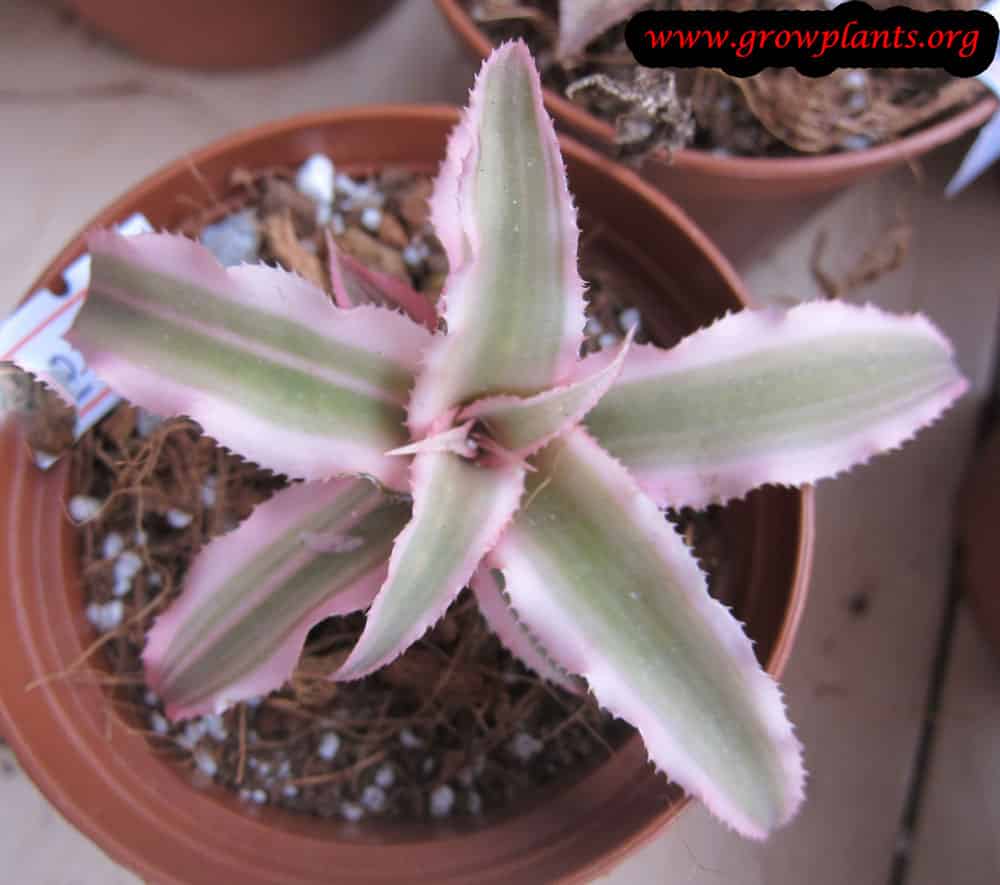
Plant Profile & Key Characteristics
Overview: Cryptanthus bivittatus (Earth Star / Starfish Plant) is a small evergreen bromeliad forming a flat, stemless rosette only 5–20 cm (2–8 in) across, with boldly coloured strappy leaves. It is a perennial grown mainly for its ornamental foliage, outdoors in frost-free areas or as a houseplant.
Quick Specifications
| Specification | Attribute |
|---|---|
| Plant Type / Life Cycle | Perennial (terrestrial bromeliad) |
| Foliage Type | Evergreen |
| Mature Size | 5–20 cm (2–8 in) across |
| Growth Rate | Moderate to slow |
| Root System | Shallow, fibrous (roots mainly anchor the plant) |
| Toxicity | Non-toxic – bromeliads are considered pet-safe |
| Hardiness | USDA zones 10b+, and 10a with overwinter care |
Growth Form & Structure
- Height & Spread: A low, spreading rosette 5–20 cm (2–8 in) wide and only a few centimetres tall; suits shallow pots, dish gardens and terrariums, and spreads by offsets (pups).
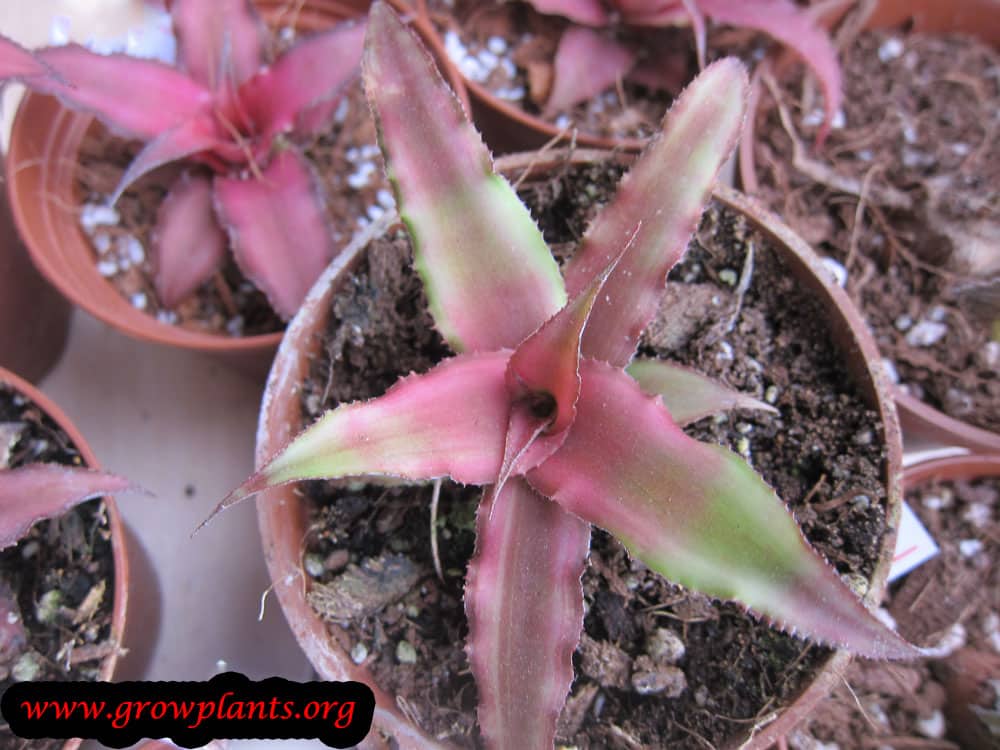
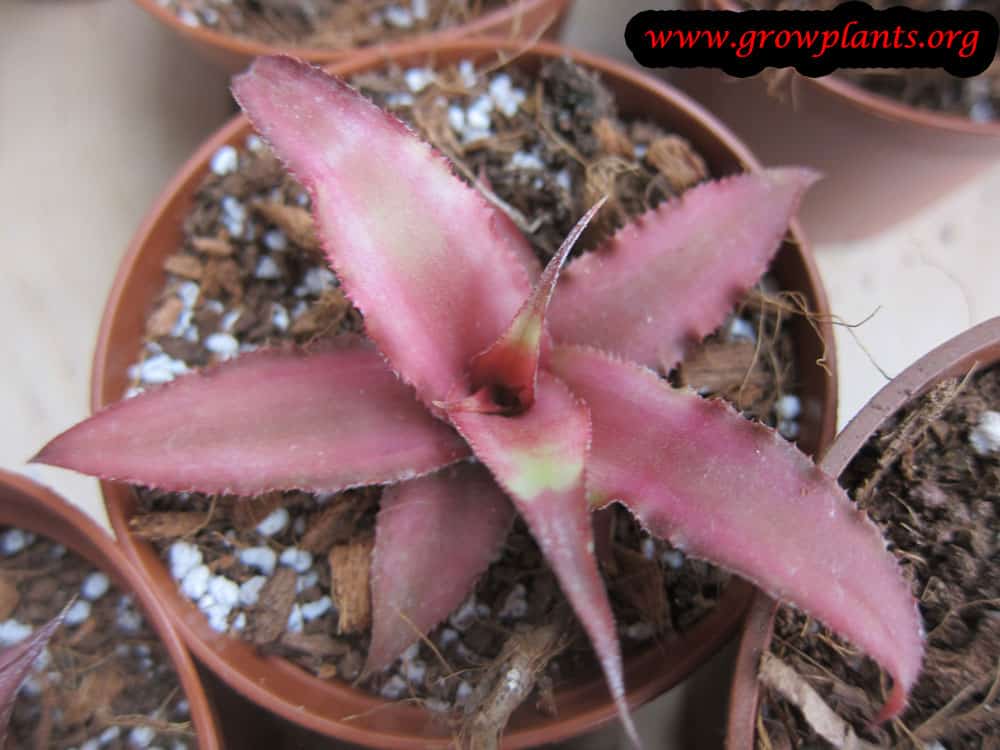
- Growth Habit & Form: Stemless, flattened, star-shaped rosette pressed close to the ground, multiplying into clumps as it produces pups.
- Lifespan & Maturity: Each rosette flowers once and then slowly dies back, replaced by the surrounding offsets.
Anatomy & Physical Features
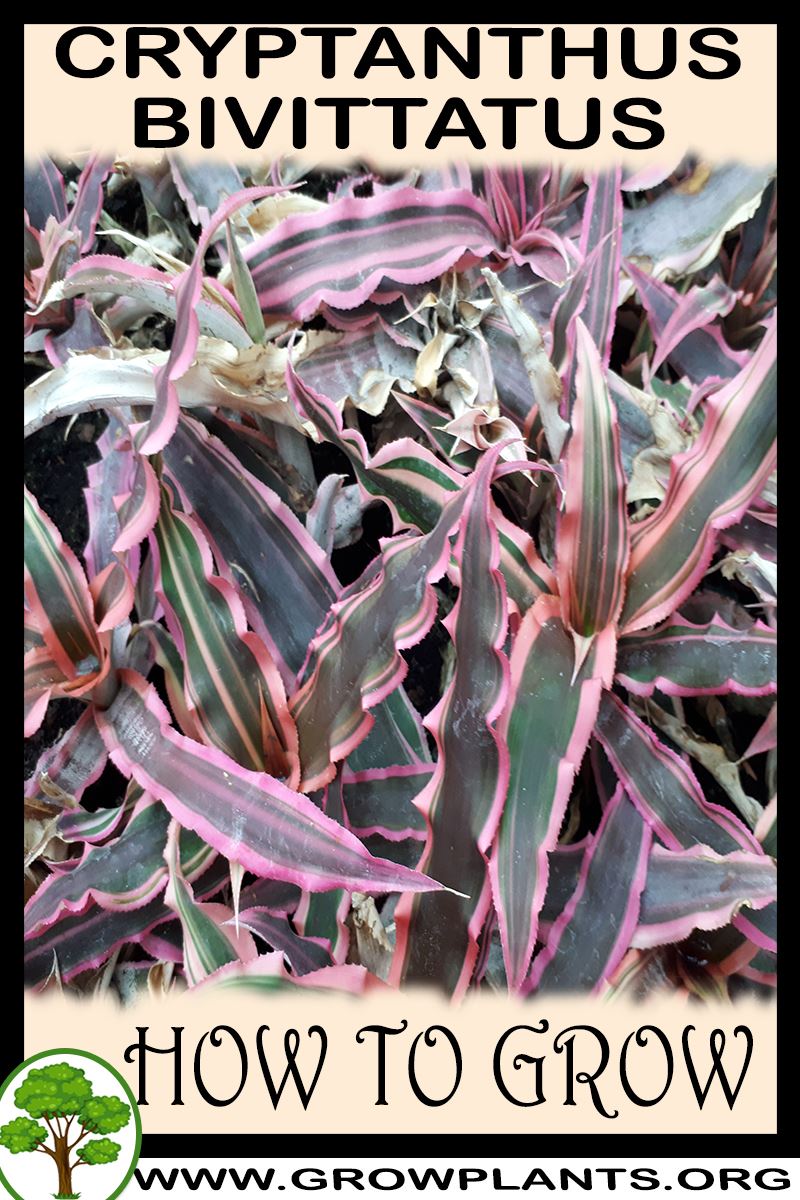
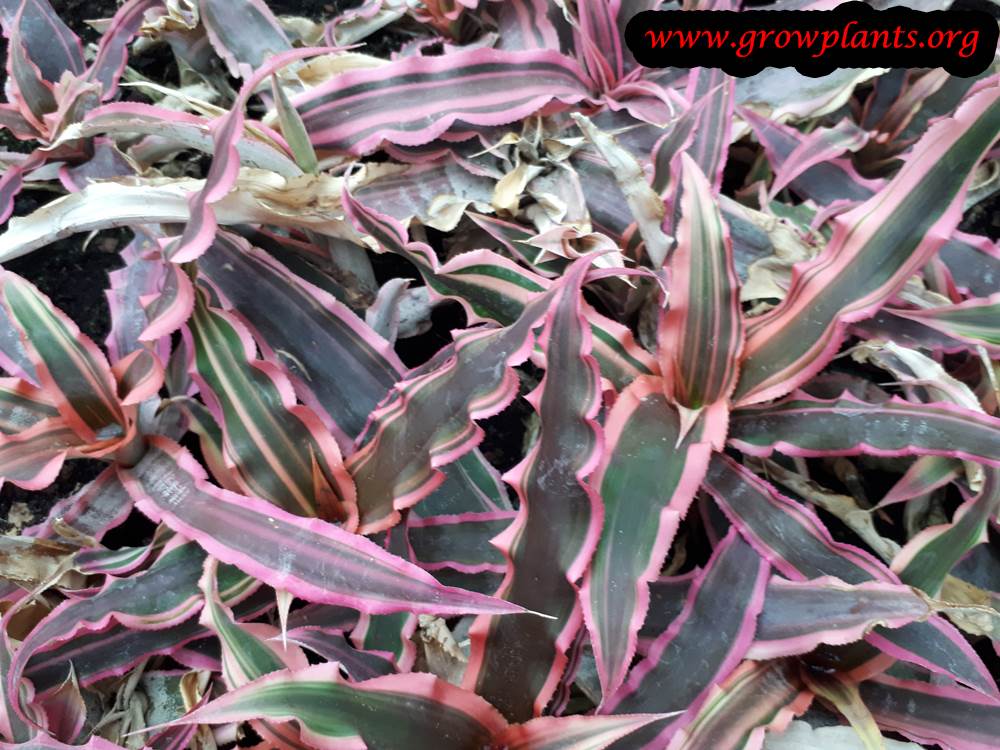
- Leaves & Foliage: Strappy, wavy leaves in green, pink, red, orange, purple, white or yellow, often multicoloured with a darker central band and finely toothed, spiny margins.
- Flower Characteristics: Small green or white flowers nestled in the centre of the rosette in summer to autumn.
Primary Uses & Landscape Value
- Functional & Ornamental Roles: Ornamental foliage houseplant for terrariums, dish gardens and windowsills; used as low groundcover under trees in frost-free climates.
Care Guide: Planting, Soil & Watering
Overview: Cryptanthus bivittatus is a small bromeliad (Earth Star) that grows best in a light, airy, well-drained and slightly acidic mix kept lightly moist and humid, in bright shade out of direct sun. As a near-epiphyte it needs an open, inert medium and gentle watering, ideally with rain or purified water into the central rosette.
Quick Care Requirements
| Requirement | Ideal Condition |
|---|---|
| Planting Season | Spring in cooler zones, extending through summer and autumn in warmer zones, and year-round in frost-free tropical zones |
| Growth Rate | Moderate to slow |
| Soil Type | Light, airy, inert and well-drained mix; naturally epiphytic |
| Soil pH | Slightly acidic |
| Water Need | Moderate — keep humid and lightly moist; water into the central rosette |
Planting & Establishment
- Best Planting Season: Plant during the warm season — spring in cooler zones, through autumn in warmer ones, and any time in frost-free climates; choose a warm, brightly lit spot shaded from direct sun, which scorches the leaves.
- How to Plant:
- Hole Preparation: It needs very little rooting depth; nestle the rosette into a shallow pocket of light, open mix, or mount it on cork or bark like the epiphyte it is.
- Soil Amendments: Use a light, inert, free-draining medium such as bark with some peat rather than heavy soil, so the shallow roots stay aerated.
- Planting Depth: Set the base of the rosette at the surface — never bury the crown, or it will rot; if mounting on bark, keep the roots covered and moist.
- Growth Speed & Expectations: Growth is moderate at best and often slow as a houseplant, forming a low, colourful rosette 5–20 cm across.
Soil, Watering & Drainage Care
- Soil Mix & Drainage Needs: Use a light, inert, sharply drained medium — these plants are naturally air plants on rocks and tree bark, so aeration matters more than richness. Keep the roots humid and moist but never waterlogged; growing on cork or bark works well if you keep the roots covered and damp.
- Watering Schedule & Technique:
- Young / Newly Planted: Keep the mix lightly moist and the air humid while the plant establishes.
- Established: Water moderately, adding water into the central rosette, and keep humidity high; use rain or purified water where possible. Grown indoors or in a humid spot such as a bathroom, water less to avoid rot.
- Seasonal Adjustments: Water a little more in warm, dry conditions and reduce it in cool weather; keep it barely moist and frost-free through winter.
Climate, Light & Hardiness
Cryptanthus bivittatus (Earth Star) is a small terrestrial bromeliad for warm, humid, frost-free subtropical to tropical climates, grown in bright shade out of direct sun. It is cold-sensitive: keep it above about 3 °C (37 °F), ideally above 15 °C (59 °F), as it only briefly withstands a touch of light frost near 0 °C (32 °F).
Quick Climate Specifications
| Climate Zones | Subtropical, Mediterranean or tropical (frost-free), or indoor |
|---|---|
| USDA Hardiness Zones | 10b and warmer; about 10a with good overwinter care |
| Optimal Temp Range | Warm, above about 15 °C (59 °F) |
| Cold Damage Begins | Below about 15 °C (59 °F) growth slows; stress rises toward 3 °C (37 °F) |
| Approx. Survival Minimum | Briefly near 0 °C (32 °F) light frost; not recommended |
| Frost Tolerance | Very Low |
| Light Conditions | Bright shade; no direct sun (sun scorches the leaves) |
| Wind Tolerance | Low (keep away from drafts) |
Sunlight & Light Exposure
Optimal Light Setup
Give plenty of bright, indirect light but no direct sun, which scorches the leaves and flowers. A well-lit spot out of the sun's direct beam is ideal.
Shade & Heat Management
Partial to full shade with good light suits it; deeper shade is tolerated at the cost of colour. In heat, more shade plus humidity protects the foliage.
Best Exposure / Orientation
A bright position shielded from direct sun - for example near a bright but not sun-struck window - works best.
Temperature Extremes & Hardiness
USDA Hardiness & Regional Limits
Hardy outdoors only in USDA zone 10b and warmer, and about 10a with careful overwintering, in frost-free subtropical to tropical areas. Grow it indoors in colder regions.
Cold Damage & Winter Protection
Keep it above about 3 °C (37 °F), ideally above 15 °C (59 °F); growth slows in the cold and stress increases as it nears freezing. A touch of light frost near 0 °C (32 °F) may be survived briefly but is not recommended.
Frost Sensitivity
Frost tolerance is very low - only a brief, light frost may be tolerated, and freezing readily damages the foliage.
Extreme Heat Tolerance
It takes warmth well when humidity and airflow are good; in hot, dry air raise humidity and improve ventilation to avoid leaf stress.
Wind, Humidity & Microclimate
Humidity Preferences
Coming from humid tropical forests, it prefers moderate to high humidity around the leaves.
Dry-Air Tolerance
It tolerates average indoor air but colours and grows better with added humidity; very dry air dulls and crisps the foliage.
Wind Tolerance
Keep it away from ventilators, heaters and air-conditioning drafts, which dry the leaves and the central cup.
Rainfall & Seasonal Moisture
It is adapted to steady tropical humidity and rain; the leaf cup should hold water, but cold, wet winter conditions invite rot, so keep it drier and warmer when cool.
Microclimate Recommendations
A warm, humid, sheltered, well-lit spot out of direct sun and drafts gives the best leaf colour and health.
Growing in Pots, Balconies & Indoors
Cryptanthus bivittatus (Cryptanthus bivittatus) is an epiphytic bromeliad and an easy, rewarding houseplant. In the wild it perches on tree branches rather than rooting in the ground, so indoors it is happiest in a small pot of very free-draining mix – or mounted on cork or bark – kept in bright, indirect light. The grower finds it is actually easier to grow indoors than out.
Quick Details
- Container Size: A small pot is plenty, with excellent drainage – or grow it mounted on cork or bark.
- Indoor Suitability: A genuine houseplant – one of the best bromeliads for indoors.
- Best Spot: Bright, indirect light – harsh midday sun scorches the leaves and flower.
- Soil & Drainage: Open, airy epiphyte mix (orchid bark, perlite, some coir); never dense, wet soil.
- Watering in Pots: Average water into the rosette and mix; keep it humid and moist but well-drained – never waterlogged.
Indoors & On the Windowsill
- A real houseplant: The grower keeps this one indoors, where there is no wind and humidity is easy to manage. Water into the central rosette cup, keep the air a little humid, and keep the plant away from heaters, air-conditioning and fans. A bright bathroom or kitchen suits its humidity – then water more sparingly.
- Windowsill growing: A bright sill with no scorching midday sun is ideal; strong direct sun marks the leaves and flower.
- Overwintering: This is a tender tropical – keep it warm, above about 10-13 C (50-55 F). Indoors it is comfortable year round; if summered outdoors, bring it in before cold nights.
On a Balcony or Patio
- Light & wind: It can spend the warm season outdoors in bright shade, sheltered from wind and hot midday sun. Pots dry quickly against warm walls, so check moisture and keep the cup topped up.
- Practicalities: Refresh the water in the cup every so often so it stays clean, and make sure drainage water can run away freely. Bring it back indoors before the first cold nights.
Choosing the Pot, Soil & Long-Term Care
- Pot & drainage: A small pot with strong drainage holes and no standing saucer, so the roots never sit in water. Alternatively, mount it on cork or bark and, as the grower advises, wrap the roots in moist moss or bark to hold humidity.
- Potting mix: An open epiphyte blend – orchid bark with perlite and a little coir – not heavy potting soil.
- Feeding: Feed only lightly – a very dilute bromeliad feed added to the mix or misted on; these plants are easily harmed by too much fertiliser salt.
- Repotting & pups: Each rosette flowers once, then produces offsets (pups) around the base. Pot the pups on into fresh, airy mix rather than repotting the spent parent.
Growing this plant in a greenhouse
A greenhouse can give cryptanthus bivittatus frost protection, cold protection, humidity control and extra warmth. In the right climate it may also be kept growing through winter, depending on how much warmth and light are provided.
Greenhouse at a glance
| Greenhouse suitability | Good - clearly useful |
|---|---|
| Main benefits | frost protection, cold protection, humidity control, extra warmth |
| Season extension | earlier spring & later autumn |
| Outdoor protection advisable below | about 15°C |
| Maintain greenhouse minimum | around 15°C for active growth |
| Suitable types | heated greenhouse, polycarbonate greenhouse |
| Heating | Heating is recommended in cold climates for continuous growth. |
Related greenhouse guides
- Greenhouses: How to Choose the Right Greenhouse
- Best Greenhouse Heaters
- Greenhouse Climate Control: Temperature, Ventilation and Humidity
- Polycarbonate Greenhouses: What to Look for Before Buying
Fertilizing & Feeding
A light feeder: bromeliads take most of their nutrition from a lean, airy epiphytic mix and dilute feeding through the warm season, with feeding paused while growth is slow.
Quick Fertilizing Specs
| Feeding Level | Light feeder |
|---|---|
| Main Nutrient Priority | Dilute balanced feeding for healthy foliage and colorful bracts |
| Best Feeding Period | Warm active growing season |
| Organic Options | A lean, airy epiphytic mix with occasional weak organic feed |
| Reduce/Stop Feeding | Pause feeding in cool weather, low light, and just after potting or dividing |
| Micronutrients | Iron and manganese are usually supplied by a complete fertilizer; correct only diagnosed chlorosis |
| Soil pH | Slightly acidic and low in minerals; rain or purified water preferred |
Feeding by Growth Stage
Settling in after potting or dividing
Let a newly potted, divided, or newly bought plant settle and root before any feeding.
| Nutrient direction | None – withhold fertilizer until the plant is established and back in active growth. |
|---|---|
| Timing | Right after potting up, dividing off a pup, or bringing a new plant home. |
| Frequency | No feeding during this settling-in period. |
| Fertilizer types | No feeding at this stage; do not fertilize until the plant is established and actively growing. |
| Precautions | Do not fertilize a freshly potted or stressed plant; wait until new growth appears. |
Warm-season active growth
Support healthy rosette leaves and colorful bracts through the warm active season.
| Nutrient direction | A dilute balanced complete fertilizer, applied lightly to the foliage and around the roots, keeps growth steady. |
|---|---|
| Timing | Through the warm active growing season. |
| Frequency | Light feeding through the active growing season; these are not hungry plants. |
| Fertilizer types | A dilute balanced complete fertilizer, A foliar spray feed misted onto the leaves and into the central rosette tank, Occasional weak feeding, suited to an epiphyte adapted to lean conditions |
| Routine trace nutrients | iron, manganese |
| Precautions | Feed sparingly and at dilute strength; bromeliads are easily harmed by strong fertilizer and by salt building up in the leaf tank. |
Cool or low-light slowdown
Let the plant rest through cool, dim conditions without pushing weak growth.
| Nutrient direction | None – withhold fertilizer while growth is slow in cool or low-light conditions. |
|---|---|
| Timing | During cool weather, short winter days, or extended low light indoors. |
| Frequency | No feeding while the plant is resting. |
| Fertilizer types | No feeding at this stage; do not fertilize until brighter, warmer conditions return. |
| Precautions | Do not fertilize a resting plant; feeding now wastes nutrients and raises salt levels in the tank and mix. |
Nutrient Deficiency Signs & Corrections
Older, lower leaves fade to pale green or uniform yellow and the whole plant grows slowly.
| Possible causes | low available nitrogen in a lean epiphytic mix, nitrogen leaching from frequent watering and tank flushing, thin, low-organic-matter growing medium |
|---|---|
| Appears first on | older, lower leaves |
| What to check | recent feeding history, richness of the growing mix, watering and flushing frequency |
| Possible correction | Apply a dilute balanced complete fertilizer and improve the growing medium, then keep feeding light. |
Newest leaves yellow between the veins while the fine veins stay green.
| Possible causes | alkaline, high-pH water or mix locking up iron, cold or waterlogged roots limiting uptake, hard tap water high in minerals |
|---|---|
| Appears first on | youngest leaves |
| What to check | water and mix pH, drainage and root-zone temperature, whether hard tap water is being used |
| Possible correction | Switch to rain or purified water, correct pH, and apply a chelated iron product per its label. |
Leaf tips and margins brown or scorch and a crust may form in the central tank.
| Possible causes | fertilizer salt buildup in the tank and mix, hard-water minerals accumulating, overfeeding or feeding at too-strong a strength |
|---|---|
| Appears first on | leaf tips and margins |
| What to check | feeding strength and frequency, water hardness, how often the tank is flushed |
| Possible correction | Flush the tank and mix with rain or purified water to rinse out salts, then feed more lightly. |
Pruning, Training & Seasonal Maintenance
Cryptanthus bivittatus is grown for its low, star-shaped rosette of colorfully banded leaves, and its flowers are small and tucked into the center rather than a showy bract spike. Pruning tolerance is low and entirely sanitary – there is no framework to train on a plant this flat and compact. The only real decisions are when to remove a browning leaf and when to cut out the spent bloom stem once it has finished, both of which can be done through the plant’s active growing season.
Quick Pruning & Maintenance Specs
| Pruning Tolerance | Low – sanitary only |
| Primary Pruning Window | Spring through autumn in cooler climates, year-round in warm ones |
| Typical Frequency | Occasional – slow to medium growth means little to remove at any one time |
| Main Objective | Remove dead leaves and spent bloom stems to keep the star-shaped rosette clean |
| Young Plant Priority | None – let new offsets establish undisturbed |
| Mature Plant Priority | Remove the spent bloom stem once flowering finishes; thin crowded offsets |
| Best Tool Type | Precision snips |
| Avoid Heavy Pruning During | Not applicable – there is no heavy pruning to schedule around on this plant |
Pruning by Plant Age & Size
Legacy grower notes give a more granular hardiness-zone breakdown for this timing: all year in zone 11b and above, spring through summer in zone 10a, and spring through autumn in zones 10b–11a.
Newly Established
A freshly potted offset needs no pruning beyond removing any leaf damaged during separation.
Young / Formative
No structural training – the flat, star-shaped rosette form is fixed from early growth.
Mature / Established
Remove the small spent flower stem from the rosette’s center once blooming finishes, and thin offsets if the clump becomes crowded enough to hide the leaf pattern.
Seasonal Pruning Schedule
Ongoing Sanitary
Objective: keep the colored leaf rosette clean and legible. Remove: dead or fully browned leaves and the spent bloom stem. Do not remove: leaves showing their normal color banding – that patterning is the plant’s main feature. Expected response: none, purely hygienic. Flowering impact: none, since the small inner flower has already finished by the time the stem is removed.
Special Growth to Remove
- Spent bloom stem – remove from the rosette center once flowering has fully finished.
- Dead or fully browned leaves – remove at the base.
- Offsets – retain until they have their own roots, then treat as propagation material rather than crowding growth.
Container & Small-Space Pruning
Almost always grown in small pots, terrariums or as ground cover under larger plants given its compact size (5–20 cm). Thin offsets so the low rosette pattern stays visible rather than letting the pot fill with a dense, overlapping clump; root-pruning is not part of routine care for this shallow-rooted plant.
Tools
Precision snips only – every cut on a plant this size is fine work. The leaf edges carry small spines, so light glove use is worthwhile.
Tool Hygiene & Disease Risk
Routine – clean, sharp blades. Mealybugs are the notable pest and are not spread by pruning cuts.
Cut Placement & Technique
Cut the spent bloom stem down at the point it emerges from the rosette center without disturbing surrounding leaves. Remove dead leaves flush at their base.
Heavy Pruning & Rejuvenation
Not applicable – a rosette this flat and compact does not resprout from hard cutting back; renewal comes from offsets as the mother rosette ages.
Post-Pruning Care
No feeding change needed. Keep the shallow center cup lightly moist as usual and avoid over-wetting after a trim.
Common Pruning Mistakes
- Removing leaves for their natural color variation, mistaking pattern for damage.
- Cutting the spent bloom stem too close to the crown and nicking surrounding leaves.
- Separating offsets before they have rooted.
When Not to Prune
Avoid removing leaves while the plant is actively flowering in summer/autumn – wait until the small central bloom has finished before clearing the stem.
Recommended Tools (by task)
- precision_snips – fine, close-in cuts for the spent bloom stem and dead leaf tissue on this compact rosette.
Propagation Guide
Cryptanthus bivittatus is increased from the offsets that form between the lower leaves and around the base of the parent (site). Offsets are needed to keep the colourful leaf patterning true (site), while seed is slow and variable, so propagation is Easy by offsets.
Quick Propagation Specs
| Best Propagation Method | Offset (pup) division |
| Alternative Methods | Seed (slow) |
| Propagation Difficulty | Easy |
| Seed True-to-Type | Variable — use offsets to keep the leaf colouring (site) |
| Vegetative True-to-Type | Yes — offsets are clones of the parent |
| Best Propagation Season | Spring (site) |
Growing from Seed
Seed is possible but slow and seldom used. Clean all pulp from the fresh berry seed before surface-sowing it on damp, sterile moss, then keep it warm, humid and bright; germination is erratic and seedlings develop slowly. Offsets are the practical choice.
Division, Offsets, Pups & Suckers
The parent rosette is monocarpic: after flowering it slowly dies while pushing out offsets (pups) at its base (site notes pups appear after a few leaves have formed). Once a pup is about one-third to one-half the size of the mother and has started its own roots, cut it away cleanly, keeping any roots attached, and separate it in spring (site). Pot or mount it as you would an adult, keep it warm and humid while it establishes, and avoid moving it more than necessary (site). Rooting hormone is unnecessary.
In this terrestrial ‘earth star’ the offsets appear low down between the outer leaves and around the base; ease each rooted rosette away and pot it into a light, well-drained, slightly acid mix.
Bloom & Flower Guide
Quick Details
- Bloom Season: Summer to autumn
- Time to First Bloom: Once the rosette is mature, usually after a couple of years
- Flower Appearance: Small green or white flowers tucked into the centre of the rosette
- Edibility: Ornamental – the flowers are not eaten
Detailed Blooming Overview
Earth stars are grown for their flat, patterned, star-shaped rosettes rather than for their flowers. When a mature plant does bloom, small green or white flowers appear low in the crown, nestled in the centre. After flowering the rosette produces offsets around its base that can be separated to grow on.
Flower Characteristics
- Small green or white flowers set deep in the centre of the rosette.
- The bloom is modest – the patterned foliage remains the main attraction.
Bloom Care & Thinning
- Light: Bright, indirect light keeps the leaf colours strong and supports flowering.
- After flowering: Detach offsets once they are a good size to raise new plants.
Pests, Diseases & Troubleshooting
Overview: Cryptanthus (earth stars) are small terrestrial bromeliads that are naturally quite pest-resistant; their real vulnerabilities are crown and root rot from over-watering, and the sap-sucking scale and mealybug that trouble all bromeliads. Because they grow in soil rather than as epiphytes, drainage and not over-watering the crown matter most. Bright, humid, airy warmth with a light, fast-draining mix keeps them colourful and healthy.
Quick Troubleshooting Overview
| Issue / Pest | Main Symptom | Primary Solution |
|---|---|---|
| Mealybug | White cottony masses between leaves and on roots | Alcohol dab; insecticidal soap / horticultural oil |
| Scale | Small brown/grey bumps on leaf undersides and bases | Scrape off; horticultural oil |
| Crown & root rot | Soft, browning centre; leaves pull away; collapse | Ease watering; free-draining mix; keep crown drier |
| Fungal leaf spot | Brown/black spots, sometimes with a yellow halo | Airflow; avoid overhead wet; remove affected leaves |
| Tip burn (fluoride/salts) | Brown, scorched leaf tips and margins | Use rainwater/low-mineral water; flush salts |
| Colour/pattern loss | Faded, drawn, green-washed leaves in low light | Brighter (indirect) light to restore banding |
Common Pests & Management
- Mealybug (Pseudococcus / Planococcus spp.):
- Symptoms: White, cottony, waxy insects hidden between the overlapping leaf bases and in the crown, and sometimes on the roots, with sticky honeydew and sooty mould. Colonies weaken the plant and are easily overlooked in the tight rosette.
- Prevention & Control: Isolate the plant and spot-treat individual insects with an alcohol-dipped cotton bud, working into the leaf bases. Follow up with insecticidal soap or a light horticultural/neem oil, repeating to catch hatchlings, and check the roots at repotting for root mealybug – bare-root and refresh the mix if found.
- Scale insects (Diaspididae (bromeliad scale)):
- Symptoms: Small brown, grey or white immobile bumps and flecks clinging to the leaf undersides, along the bases and on the lower surfaces; heavy infestations yellow and speckle the foliage and sap vigour.
- Prevention & Control: Rub or scrape off light infestations, and apply horticultural oil to smother scale, targeting the mobile crawler stage and repeating. Keep plants uncrowded so all surfaces can be inspected and reached.
- Aphids (Aphididae):
- Symptoms: Occasional soft aphids on the tenderest new growth and on any flower, with a little honeydew; a minor, transient nuisance on these low-growing plants.
- Prevention & Control: Wipe or rinse off, and use insecticidal soap only if a colony builds. Avoid over-feeding lush growth.
Diseases & Fungal Issues
- Crown & root rot (Fusarium / Rhizoctonia / Pythium / Phytophthora):
- Symptoms: The main killer of earth stars: the centre of the rosette softens, browns and rots, leaves pull away easily from a mushy base, and the plant collapses. It follows over-watering, water left sitting in the crown, heavy soil, or cold-wet conditions.
- Treatment & Management: Prevention is cultural – a light, very free-draining bromeliad or orchid-type mix, watering the soil (not sitting water in the crown), and letting the surface dry between waterings, especially when cool. If rot begins, dry the plant out, cut away rotten tissue, and salvage healthy offsets (‘pups’) to grow on; discard collapsed plants and their mix.
- Fungal leaf spot (Helminthosporium / Exserohilum etc.):
- Symptoms: Brown, black or watery spots and blotches on the leaves, sometimes ringed with yellow, in overly wet, humid, crowded or poorly-ventilated conditions.
- Treatment & Management: Improve airflow, avoid wetting the foliage and leaving water on the leaves overnight, and remove affected leaves. Spotting is usually cosmetic; a copper-based fungicide is warranted only in a persistent outbreak.
Growing Difficulties & Abiotic Problems
- Crown/root rot from over-watering:
- Cause & Symptoms: As terrestrial bromeliads, earth stars rot readily if the soil stays soggy or water pools in the crown; the centre softens and the plant collapses.
- Correction Strategy: Grow in a light, sharply-draining mix, water the soil rather than filling the crown, and let the top dry between waterings. Never leave the pot standing in water; reduce watering when cool.
- Leaf-tip burn (fluoride & salts):
- Cause & Symptoms: Bromeliads are sensitive to fluoride and to salt build-up; tap water high in fluoride or chlorine, or accumulated fertiliser salts, scorch the leaf tips and margins brown.
- Correction Strategy: Water with rainwater, distilled or low-mineral water where the tap supply is hard or fluoridated, feed only lightly, and periodically flush the pot with clean water to leach out salts.
- Loss of colour / drawn growth:
- Cause & Symptoms: In too little light the vivid banding and reddish tones fade to plain green and the rosette becomes loose and drawn.
- Correction Strategy: Give bright, indirect light (some gentle sun deepens the colours) to restore the markings, acclimatising gradually to avoid scorch.
- Cold & draught damage:
- Cause & Symptoms: These are warm-growing tropicals; cold, and cold draughts, cause leaf spotting, browning and stalled, damaged growth.
- Correction Strategy: Keep warm and away from cold windows and draughts, and reduce watering in cooler spells. Grow above the low temperatures that mark and rot the foliage.
What Helps – Products & Tools
Most care is cultural – the right light, warmth, humidity and a fast-draining mix, with careful watering to avoid crown rot. Where products help, use insecticidal soap and light horticultural or neem oil for mealybug, scale and aphids; rainwater or low-mineral water to prevent tip burn; and a copper-based fungicide only for persistent leaf spot. Handle the tight rosettes gently and keep water out of the crown. Spray oils in the evening and keep humidity up to protect the plant.