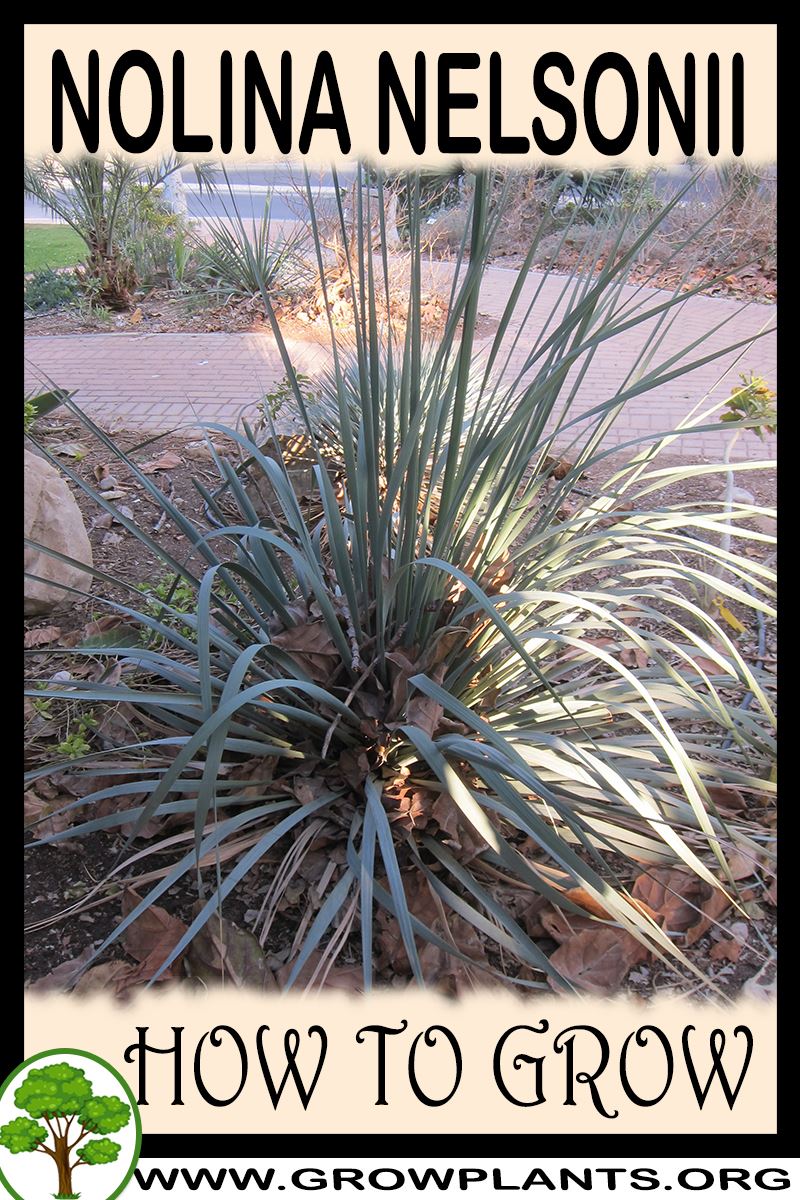
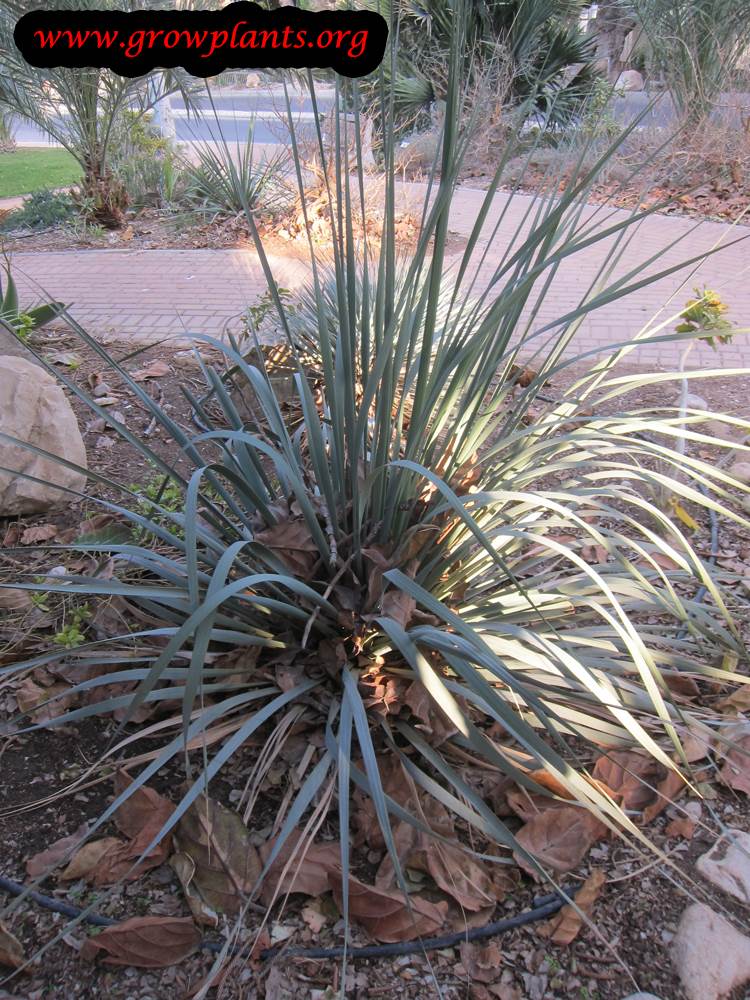
Plant Profile & Key Characteristics
Overview: Nolina nelsonii (Nelson’s bear grass or blue nolina) is a slow-growing evergreen succulent perennial reaching 2-4 m (6-12 ft) tall. It is grown as a drought-tolerant ornamental for its dense head of narrow, blue-green foliage.
Quick Specifications
| Specification | Attribute |
|---|---|
| Plant Type / Life Cycle | Perennial (herbaceous succulent) |
| Foliage Type | Evergreen |
| Mature Size | 2-4 m (6-12 ft) tall |
| Growth Rate | Slow |
| Root System | Shallow-rooted |
| Hardiness | USDA zones 8-12 |
Growth Form & Structure
- Height & Spread: Reaches 2-4 m (6-12 ft) in the ground; in a container use a pot 70-100% wider than the root ball, which need not be deep as the roots are shallow.
- Growth Habit & Form: Rosette-forming succulent with a stout base and arching, grass-like leaves that form a rounded head.
- Lifespan & Maturity: Long-lived and slow to reach full size; blooms only after several years.
Anatomy & Physical Features
- Leaves & Foliage: Green or blue-green, spear-shaped leaves.
- Flower Characteristics: Small white-to-yellow flowers in plume-like (beard) clusters, produced only on mature plants.
Primary Uses & Landscape Value
- Functional & Ornamental Roles: Drought-tolerant ornamental and architectural accent for desert, Mediterranean, subtropical and temperate gardens; also suited to containers.
Care Guide: Planting, Soil & Watering
Overview: Nolina (bear grass) is a slow-growing, drought-tolerant succulent that needs sharply drained, gritty soil in full sun to part shade. It wants little water, drying out between waterings, and resents being overwatered.
Quick Care Requirements
| Requirement | Ideal Condition |
|---|---|
| Planting Season | Spring in cold zones (5–7); spring–summer (8–10a); spring–autumn (10b–11); year-round in zone 12 |
| Growth Rate | Slow |
| Soil Type | Well-drained, gritty / sandy |
| Water Need | Low to moderate – let it dry between waterings; do not overwater |
Planting & Establishment
- Best Planting Season: Plant according to zone: spring in cold zones (5–7), spring to summer in 8–10a, spring to autumn in 10b–11, and year-round in zone 12.
- How to Plant:
- Hole Preparation: Dig a hole larger than the root ball; in wet climates, plant slightly raised so water does not pool around the crown.
- Soil Amendments: Loosen the soil for better aeration and add only a small amount of organic matter.
- Planting Depth: Cover the roots lightly but firmly enough to hold the plant stable; do not plant deep (the roots are shallow).
- Growth Speed & Expectations: Slow.
Soil, Watering & Drainage Care
- Soil Mix & Drainage Needs: Sharp-draining, gritty soil; in pots use a cactus mix over a drainage layer of gravel or lava rock, and switch the soil out every few years.
- Watering Schedule & Technique:
- Young / Newly Planted: Light watering to establish.
- Established: Infrequent deep watering, letting the soil dry between; the plant is drought-tolerant.
- Seasonal Adjustments: Sparing water in winter; a little more during summer heat.
Climate, Light & Hardiness
Nelson's Bear Grass is a drought-tolerant succulent adapted to desert, Mediterranean, subtropical, and temperate climates, thriving in full sun to half shade. It is hardy through USDA zones 8–12.
Quick Climate Specifications
| Climate Zones | Desert, Mediterranean, Subtropical, Temperate |
|---|---|
| USDA Hardiness Zones | 8–12 |
| Frost Tolerance | Moderate |
| Light Conditions | Full Sun / Half Shade |
Sunlight & Light Exposure
Optimal Light Setup
Full sun to half shade both suit this succulent; strong, open sun is closest to its natural desert and dry-slope habitat.
Temperature Extremes & Hardiness
USDA Hardiness & Regional Limits
Hardy through USDA zones 8–12, making it suitable for warm-temperate through desert and subtropical gardens but not reliably cold-hardy in colder temperate zones.
Frost Sensitivity
As a succulent, it is more vulnerable to hard freezes and especially to cold, wet soil in winter than to dry cold alone.
Wind, Humidity & Microclimate
Dry-Air Tolerance
Highly drought- and dry-air tolerant, reflecting its desert and arid-slope origins; the care notes explicitly warn against over-watering and stress letting the soil dry between waterings.
Rainfall & Seasonal Moisture
Adapted to low, seasonal rainfall; planting guidance even recommends elevating the plant in high-rainfall sites so winter puddling does not sit around the base.
Growing in Pots, Balconies & Indoors
Nolina is a slow-growing, drought-hardy desert plant that eventually makes a big rosette, yet it stays compact in a pot for years. The grower does not class it as a houseplant, but as a bright-light succulent it can sit in a very sunny window; on a hot, sunny patio it is right at home.
Quick Details
- Container Size: A pot 70-100% larger than the root ball – it need not be deep, as the roots are shallow
- Indoor Suitability: Not a true houseplant, but tolerates a very bright, sunny window as a slow succulent
- Best Spot: Full sun to part shade – the brighter the better
- Soil & Drainage: Cactus/succulent mix over a drainage layer of gravel, lava rock or pebbles
- Watering in Pots: Small to average; let it dry out well between waterings and never overwater
Indoors & On the Windowsill
- Bright window only: The grower does not rate it as a houseplant, but as a desert succulent it can hold on a very sunny sill where it gets strong direct light; deep in a room it will weaken.
- Overwintering: In cold climates it is easily kept in a pot and brought into a bright, frost-free spot for winter.
On a Balcony or Patio
- Light & heat: Loves a hot, sunny balcony or patio and shrugs off reflected wall heat; just avoid leaving it waterlogged. Its drought tolerance makes it forgiving of missed waterings.
Choosing the Pot, Soil & Long-Term Care
- Pot & drainage: Choose a wide, not-too-deep pot 70-100% bigger than the root ball with drainage holes; lay gravel, lava rock or pebbles in the base for free drainage.
- Cactus mix: Use a cactus/succulent potting mix so water runs through quickly.
- Feeding: Feed lightly and only in the growing season – this is a lean-soil plant.
- Refresh: After a few years, once the roots fill the pot or the soil is spent, change the soil and pot on.
Grower’s Container Tip
- Shallow pot, gravel base: Because the roots are shallow, the grower favours a wide, shallow pot rather than a deep one, with a coarse gravel or lava-rock layer at the bottom for drainage.
Fertilizing & Feeding
A light feeder overall: this slow-growing, drought-tolerant succulent needs only occasional, low-nitrogen feeding during active warm-season growth, with none while it rests through the cooler season.
Quick Fertilizing Specs
| Feeding Level | Light feeder |
|---|---|
| Main Nutrient Priority | Low-nitrogen and minimal, in keeping with a slow-growing, drought-tolerant succulent |
| Best Feeding Period | The warm active growing season only |
| Organic Options | Not typically needed; a diluted succulent or cactus fertilizer is more common than organic amendments |
| Micronutrients | Rarely needed; usually supplied by a complete succulent fertilizer if used |
| Soil pH | Tolerates a wide range in fast-draining, gritty or sandy soil |
| Reduce/Stop Feeding | Stop feeding through the cooler, slow-growth season |
Feeding by Growth Stage
Active warm-season growth
Support slow, steady growth during the plant’s active season without pushing soft, rot-prone growth.
| Nutrient direction | A light, low-nitrogen feeding is enough for this slow-growing, drought-tolerant plant. |
|---|---|
| Timing | During the warm active growing season. |
| Frequency | An occasional light feeding through the growing season; more is not needed for such a slow grower. |
| Fertilizer types | A diluted balanced fertilizer formulated for succulents or cacti, used sparingly, A slow-release, low-nitrogen product worked lightly into well-drained soil |
| Precautions | Always let soil dry between waterings before feeding; excess nitrogen or moisture together invite rot in this drought-adapted plant. |
Cool-season dormant rest
Let the plant rest through its slow, cool-season period without encouraging growth it cannot support.
| Nutrient direction | None – withhold fertilizer while the plant rests. |
|---|---|
| Timing | Through the cooler part of the year when growth stalls. |
| Frequency | No feeding at this stage. |
| Fertilizer types | No feeding at this stage – allow the plant to rest through its dormant period |
| Precautions | Do not fertilize during this rest period; feeding combined with cooler, wetter conditions raises the risk of root and crown rot. |
Nutrient Deficiency Signs & Corrections
The base of the plant softens, discolors, or smells musty, and leaves may wilt despite moist soil.
| Possible causes | overwatering, poorly drained soil, feeding during cool, slow-growth periods |
|---|---|
| Appears first on | the base and crown of the plant |
| What to check | soil drainage and container drainage holes, recent watering frequency, whether feeding happened during the dormant season |
| Possible correction | Improve drainage, let soil dry fully between watering, and hold off feeding until active growth is clearly underway again; trim away badly affected tissue. |
New growth comes in unusually soft, pale, or stretched rather than the plant’s normal compact form.
| Possible causes | too much nitrogen feeding, insufficient light causing stretched growth, overwatering encouraging soft tissue |
|---|---|
| Appears first on | newest leaves at the growing point |
| What to check | recent feeding strength and frequency, light exposure, watering routine |
| Possible correction | Cut back to a lighter, low-nitrogen feeding and confirm the plant gets plenty of direct light. |
Leaf tips brown and crisp, most noticeably on container-grown plants.
| Possible causes | mineral salt buildup from fertilizer or hard water, infrequent flushing of the container soil, overly strong feeding |
|---|---|
| Appears first on | leaf tips |
| What to check | how long since the container soil was last flushed with water, feeding strength used, water source, since hard water can add minerals |
| Possible correction | Flush the container soil thoroughly with water and reduce feeding strength going forward. |
Pruning, Training & Seasonal Maintenance
Nolina nelsonii is a slow-growing, trunked succulent with a single permanent growing point (or a small number of them) at the crown, so its pruning tolerance is low and strictly cosmetic: remove only fully dead, browned leaves and the spent flower stalk after the rare bloom, since damaging the crown itself can permanently disfigure or kill that growing point. Because it is evergreen with no strict dormancy, dead material can be removed any time it appears rather than on a fixed calendar, and grooming has no effect on the plant’s slow overall growth rate or on the multi-year cycle before it next flowers.
Quick Pruning & Maintenance Specs
| Pruning Tolerance | Low – dead-leaf and spent-stalk grooming only |
| Primary Pruning Window | Year-round, as dead leaves or a spent flower stalk appear |
| Typical Frequency | A few times a year |
| Main Objective | Remove dead/browned leaves and the spent bloom stalk while protecting the single growing point |
| Young Plant Priority | Leave all leaves in place while the caudex/trunk is establishing; remove only clearly dead ones |
| Mature Plant Priority | Trim the lowest ring of fully dead leaves for a tidier trunk without touching the live crown |
| Best Tool Type | Bypass secateurs or loppers, depending on leaf-base thickness |
Pruning by Plant Age & Size
Newly Established
Do not remove any leaf unless it is fully dead or was damaged in transplanting; this slow grower needs its full leaf area to build up the trunk.
Young / Formative
No structural training applies to a single-rosette succulent – there is no leader, cane, or vase shape to build. Formative care is limited to protecting the crown from injury.
Mature / Established
Established plants benefit from periodic removal of the lowest, fully browned leaf tier for a tidier trunk. After the infrequent bloom (facts note it can take years to first flower), the dried flowering stalk can be cut out at its base.
Seasonal Pruning Schedule
| Stage | Objective | Remove | Do Not Remove | Response / Impact |
| Ongoing Sanitary (year-round) | Keep the trunk and rosette tidy | Fully brown/dead leaves; dried spent flower stalks | Green leaves, even older lower ones, and the crown itself | Purely cosmetic – cutting dead tissue does not stimulate new growth or affect the next bloom cycle |
Special Growth to Remove
- Dead or browned leaves, cut near their base without nicking the crown tissue.
- The spent flowering stalk, once fully dried, cut off at its base.
Container & Small-Space Pruning
Facts confirm this species is grown in containers with a cactus-type mix. Pruning stays the same dead-leaf-only approach; because cutting does not reduce or reshape this plant’s growth, size management in a pot is handled by repotting rather than by pruning.
Tools
- Bypass secateurs for individual dead-leaf removal.
- Loppers for tougher, older leaf bases and for cutting out the dried flower stalk on a mature plant.
Tool Hygiene & Disease Risk
Routine – clean tools are sufficient. The only pest documented for this species is mealybugs, which is not spread by pruning cuts, so no special disinfection is required.
Cut Placement & Technique
Cut dead leaves close to their point of attachment without cutting into the caudex or crown. Cut the spent flower stalk at its base rather than leaving a tall dry stub.
Heavy Pruning & Rejuvenation
Not tolerated. Like other single-growing-point succulents, Nolina nelsonii has no reserve of dormant buds lower on the stem to regrow from if the crown is cut or damaged, so hard cutback or rejuvenation pruning should never be attempted.
Post-Pruning Care
No extra watering or feeding is needed after light grooming. Check leaf bases for mealybugs, the documented pest, especially where old leaf litter has collected.
Common Pruning Mistakes
- Cutting into the crown while removing dead leaves, which can kill that growing point.
- Removing still-green lower leaves purely for a neater look, which only reduces leaf area with no benefit.
- Leaving dead leaf litter packed around the base, where it can harbor mealybugs.
When NOT to Prune
Avoid pruning right after transplanting or repotting while roots are re-establishing, and avoid cutting while the plant is drought-stressed, since this small-water-need succulent heals wounds more slowly under stress.
Recommended Tools (by task)
- bypass_secateurs – routine removal of individual dead leaves without crushing the leaf base.
- loppers – tougher, older leaf bases and the dried flower stalk on a mature plant.
Propagation Guide
Nolina nelsonii is propagated from seed, sown in well-drained, sandy soil with careful moisture control; seed generally comes true to type for this species. Growth from seed is slow, as is typical of caudiciform, rosette-forming succulents in this genus, so overall difficulty is best rated moderate rather than easy.
Quick Propagation Specs
| Best Propagation Method | Seed |
| Alternative Methods | Vegetative reproduction (occasional basal offsets on mature plants, not well documented for this species) |
| Propagation Difficulty | Moderate |
| Seed True-to-Type | Usually true-to-type |
| Best Propagation Season | Spring is best; possible into summer or autumn in warmer hardiness zones, but avoid sowing during peak summer heat |
| Seed Germination Time | 4–8 weeks |
| Seed Sowing Depth | 0.5cm (0.25in) |
Growing from Seed
Seed Handling & Viability
Store seed in a dry, dark place at room temperature until ready to sow.
Sowing Season
Spring is the best time to sow. In hardiness zone 10a, sowing can extend from spring into summer; in zones 10b–11, from spring into autumn; in zone 12 and warmer, sowing is possible year-round, though very hot summer conditions should be avoided.
Sowing Depth & Orientation
Sow about 0.5cm (0.25in) deep, in a sunny location with sandy, well-ventilated soil and good drainage. If sowing directly in the ground in rows, space seeds roughly 40–50cm (16–20in) apart to give seedlings room to develop.
Germination Conditions
Keep the soil moist but not waterlogged; avoid letting it dry out and avoid overwatering.
Germination Time
Germination takes about 4–8 weeks.
Seedling Care
Grow seedlings in sun with moist, well-ventilated soil, using small to average amounts of water and taking care not to overwater.
Division, Offsets, Pups & Suckers
Vegetative reproduction is listed as possible for this species, though specific methods are not well documented; in related rosette-forming succulents, mature plants occasionally form small basal offsets that can be removed with roots attached once large enough to handle independently.
Bloom & Flower Guide
Quick Details
- Bloom Season: Summer into autumn
- Time to First Bloom: Only after several years – a plant must reach good size before it flowers
- Flower Appearance: Many tiny white to yellow flowers massed into a soft, feathery, beard-like plume
- Edibility: Ornamental – grown for its grassy form, not eaten
Detailed Blooming Overview
Blue Nolina is grown for its fountain of blue-green, grass-like leaves, but a mature plant crowns itself with a tall flowering plume in summer and autumn. The individual flowers are minute and creamy, but they are carried in such numbers that the whole inflorescence reads as a soft, feathery beard held above the foliage. Patience is needed – it takes some years of growth before a plant blooms.
Flower Characteristics
- Very small white to yellow flowers.
- Massed into a large, plume-like inflorescence with a beard-like look.
Bloom Care & Thinning
- After flowering: Cut the spent flower plume down once it fades to keep the plant looking neat.
- Timing: Flowering is reserved for well-established, mature plants.
Pests, Diseases & Troubleshooting
Overview: Nolina are tough, drought-adapted rosette plants (beargrass / relatives of the ponytail palm) with few natural enemies; the overwhelming majority of problems come from excess moisture, not insects. Kept lean, dry between waterings, and in bright light with sharp drainage, they are among the most trouble-free plants you can grow. Manage pests culturally first — inspect, wipe, and correct watering — before reaching for any product. N. nelsonii (Blue Nolina) is a robust, blue-leaved species with the same easy, rot-averse care.
Quick Troubleshooting Overview
| Issue / Pest | Main Symptom | Primary Solution |
|---|---|---|
| Root & crown rot | Soft, browning caudex/base; collapse | Cut watering; fast-draining mineral mix; never let the swollen base sit wet |
| Mealybugs | White cottony tufts in leaf axils & crown | Dab with alcohol; horticultural oil / insecticidal soap |
| Scale insects | Brown/tan bumps on strap leaves | Scrape off; horticultural oil, repeat |
| Spider mites | Fine stippling, webbing in hot dry air | Rinse foliage; raise humidity; oil/soap if persistent |
| Leaf-tip browning | Dry brown tips on strap leaves | Usually cosmetic/abiotic — check watering & salts, trim tips |
Common Pests & Management
- Mealybugs (Pseudococcus / Planococcus spp.):
- Symptoms: White, cottony masses tucked where leaves meet the crown and along leaf bases; sticky honeydew and sooty mould follow a heavy infestation. Root mealybugs may also appear as white deposits in the rootball.
- Prevention & Control: Inspect the dense crown regularly — that is where they hide. Spot-treat by dabbing colonies with a cotton swab dipped in rubbing alcohol, then rinse. For wider spread, apply horticultural oil or insecticidal soap into the crown and repeat every 7–10 days. Quarantine new plants and avoid over-feeding, which fuels soft growth they favour.
- Scale insects (armored & soft scale, Diaspididae / Coccidae):
- Symptoms: Small brown, tan or waxy bumps stuck along the strap-like leaves and stems that do not brush off; yellowing and honeydew with soft scale.
- Prevention & Control: Scrape off the few you see by hand or with a soft brush; wipe leaves. Treat lingering populations with horticultural oil to smother them, repeating to catch newly hatched crawlers. Good light and airflow keep numbers low.
- Spider mites (Tetranychus urticae):
- Symptoms: Fine pale stippling and a dusty look on leaves, sometimes faint webbing near the crown — almost always in hot, dry, stagnant air or indoors in winter.
- Prevention & Control: Rinse the foliage periodically and improve air movement; raise humidity a little. If they persist, insecticidal soap or horticultural oil applied to cover the leaf undersides works well; avoid dusty, drought-stressed conditions.
Diseases & Fungal Issues
- Root & crown rot (Phytophthora / Fusarium / Pythium spp.):
- Symptoms: The single most serious threat. The swollen base or roots turn soft, brown and foul; lower leaves yellow and the rosette loosens or topples. Driven by cold, wet, poorly drained soil.
- Treatment & Management: Prevention is everything — a gritty, free-draining mineral mix, an unglazed pot with drainage, and thorough dry-downs between waterings. If caught early, unpot, cut away all soft tissue to clean firm flesh, dust with sulphur, let it callus and re-root in dry mix. Advanced rot is usually fatal.
- Fungal leaf spots (various):
- Symptoms: Occasional brown or black spots on leaves in prolonged damp, crowded conditions — uncommon on well-grown plants.
- Treatment & Management: Improve airflow, keep water off the foliage, remove affected leaves. A copper fungicide is rarely needed but effective if spotting spreads.
Growing Difficulties & Abiotic Problems
- Overwatering / soggy soil:
- Cause & Symptoms: Yellowing lower leaves, a spongy base, and stalled growth from soil kept too wet or too dense — the classic killer of Nolina.
- Correction Strategy: Water only when the mix is fully dry, cut back sharply in cool months, and use a very open substrate. When in doubt, stay dry.
- Leaf-tip browning:
- Cause & Symptoms: Dry, brown strap-leaf tips from erratic watering, low humidity, or salt/fluoride build-up.
- Correction Strategy: Even watering, occasional leaching of the pot with plenty of water, and trimming tips to a natural point for looks.
- Cold damage:
- Cause & Symptoms: Mushy, translucent or blackened tissue after frost.
- Correction Strategy: Protect from hard frost; keep dry and cool rather than wet and cold overwinter.
- Sunburn (rushed sun exposure):
- Cause & Symptoms: Bleached or tan scorch patches when a shade-grown plant is moved abruptly into fierce sun.
- Correction Strategy: Acclimatise gradually to strong light over two to three weeks.
What Helps — Products & Tools
For this drought-lover, reach for gentle, cultural tools first: rubbing alcohol on a swab for spot mealybug control, insecticidal soap and horticultural (or neem) oil for scale and mites, and a sulphur or copper fungicide only if rot or leaf spotting appears. A gritty mineral potting mix and a moisture meter do more to keep it healthy than any spray.