


Plant Profile & Key Characteristics
Overview: A perennial tree or large shrub, evergreen to deciduous, reaching 5-20 m (15-60 ft) as a tree, grown for its sweet edible fruit and as an ornamental. It is a drought-adapted subtropical to desert species.
Quick Specifications
| Specification | Attribute |
|---|---|
| Plant Type / Life Cycle | Perennial |
| Foliage Type | Evergreen or deciduous |
| Mature Size | 5-20 m (15-60 ft) as a tree; 3-5 m (10-15 ft) as a shrub |
| Growth Rate | Moderate |
| Hardiness | USDA zone 10b-12 |
Growth Form & Structure
- Height & Spread: 5-20 m (15-60 ft) grown as a tree, or 3-5 m (10-15 ft) kept as a shrub; not suited to containers.
- Growth Habit & Form: Can be trained to a single-trunk tree or grown as a multi-stemmed shrub.
- Lifespan & Maturity: Long-lived tree; slow to start bearing, taking about 7-10 years to first fruit.
Anatomy & Physical Features
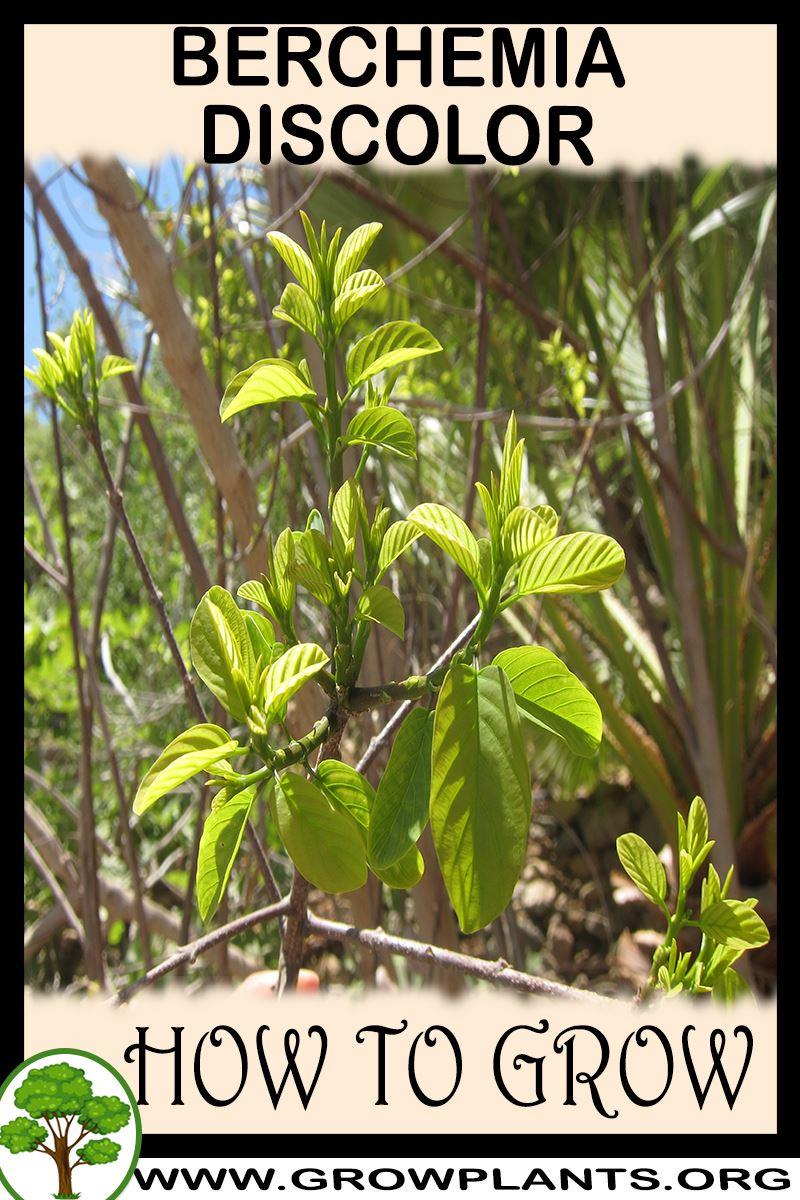
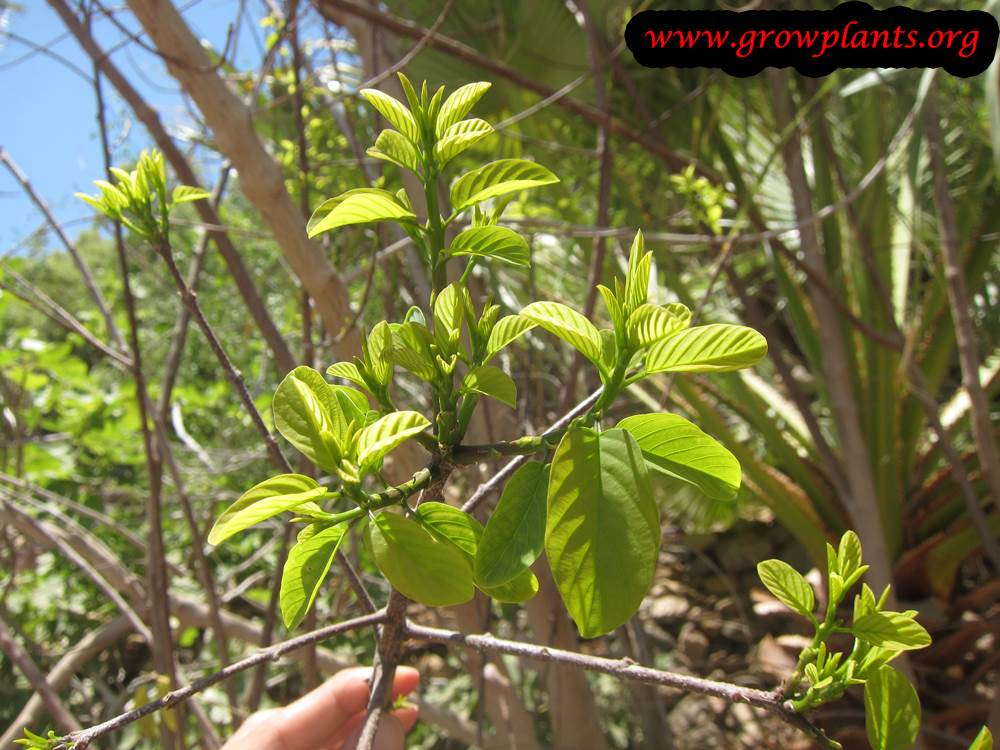
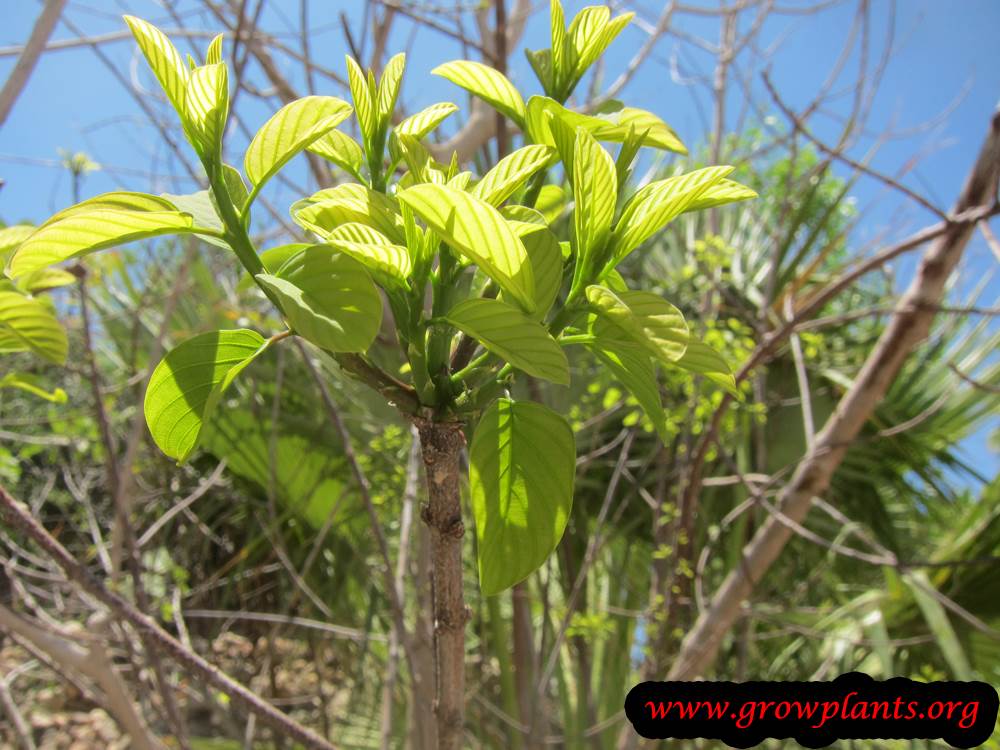
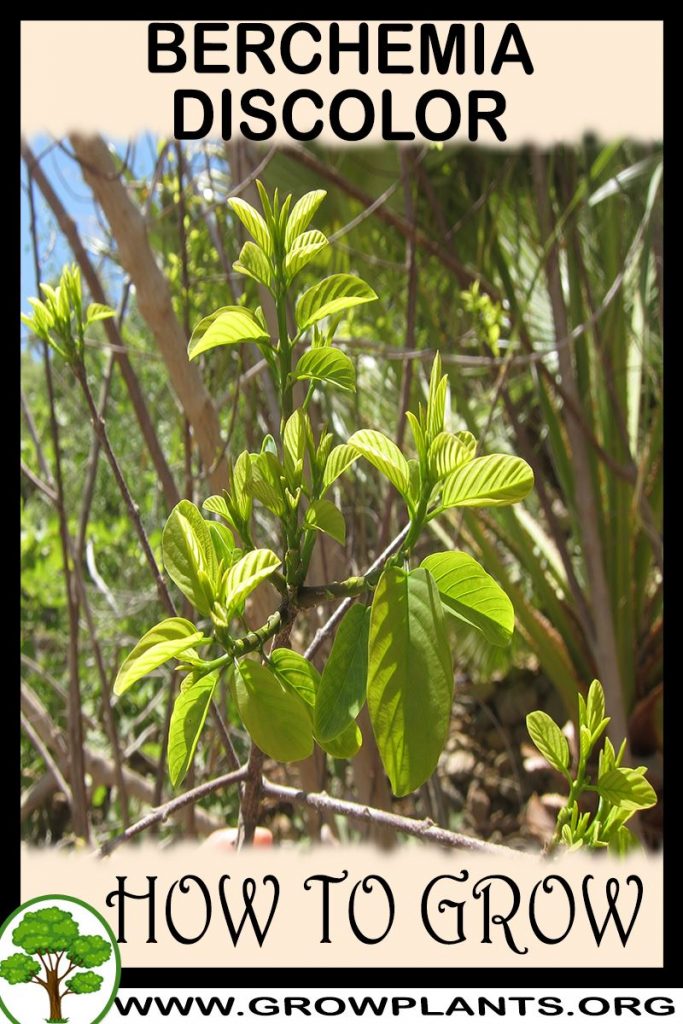
- Leaves & Foliage: Green, elliptic leaves.
- Flower Characteristics: White-and-pink flowers of a distinctive bird-like shape (full detail in the Bloom section).
- Fruit Profile: Sweet, oval, yellow edible fruit (full detail in the Fruit section).
Primary Uses & Landscape Value
- Edible Uses: Fruit eaten raw or cooked.
- Functional & Ornamental Roles: Grown as a fruiting shade and ornamental tree.
Care Guide: Planting, Soil & Watering
Overview: Berchemia discolor (bird plum) is a warm-climate, evergreen-to-deciduous tree or shrub that needs full sun and a well-drained soil. Once established it is fairly drought-tolerant, needing only low to moderate water.
Quick Care Requirements
| Requirement | Ideal Condition |
|---|---|
| Planting Season | In the warm season – spring through autumn |
| Growth Rate | Moderate |
| Soil Type | Well-draining |
| Water Need | Low to moderate; let the soil dry between waterings once established |
Planting & Establishment
- Best Planting Season: Plant during the warm season (spring to autumn) so it establishes in warmth; it needs frost-free conditions (zone 10b+).
- How to Plant:
- Hole Preparation: Dig a hole about twice the width of the root ball.
- Soil Amendments: Incorporate some organic matter and, on heavy soil, grit to improve drainage.
- Planting Depth: Set the root collar at soil level; do not bury the trunk base.
- Growth Speed & Expectations: Moderate; can become a large tree (5–20 m) or a 3–5 m shrub, so allow room.
Soil, Watering & Drainage Care
- Soil Mix & Drainage Needs: Needs a freely draining soil; it is not suited to pots and dislikes waterlogging.
- Watering Schedule & Technique:
- Young / Newly Planted: Water regularly to establish a deep root system.
- Established: Water deeply but infrequently, letting the soil dry well between waterings – it tolerates dry spells.
- Seasonal Adjustments: A little more in prolonged summer heat; minimal in cool weather.
Climate, Light & Hardiness
Bird plum is a subtropical-to-desert-margin tree or shrub, evergreen in the mildest climates and deciduous in cooler ones, needing full sun and only reliably cold hardy in warm, essentially frost-free regions.
Quick Climate Specifications
| Climate Zones | Subtropical, Mediterranean, Desert |
|---|---|
| USDA Hardiness Zones | 10b–12 |
| Frost Tolerance | Low |
| Light Conditions | Full Sun |
Sunlight & Light Exposure
Optimal Light Setup
Needs full sun for healthy growth and fruiting.
Direct Sun Requirement
Essential; this is an open-savanna-type tree in its native range.
Best Exposure / Orientation
Open, unshaded planting sites.
Temperature Extremes & Hardiness
USDA Hardiness & Regional Limits
Hardy only in essentially frost-free zones 10b–12.
Cold Damage & Winter Protection
Frost can damage or kill young growth; site in the warmest, most sheltered available spot in marginal areas, and protect young trees.
Frost Sensitivity
Frost sensitive, more so when young; mature trees may tolerate brief light frost better than saplings.
Extreme Heat Tolerance
Excellent; well adapted to hot subtropical and desert-margin conditions.
Wind, Humidity & Microclimate
Humidity Preferences
Adaptable to both humid subtropical and drier desert-margin/Mediterranean air.
Dry-Air Tolerance
Good, consistent with the light watering needs noted for this species.
Rainfall & Seasonal Moisture
Tolerates a fairly wide range of seasonal rainfall; established trees are reasonably drought tolerant.
Growing in Pots, Balconies & Indoors
The bird plum (Berchemia discolor) grows into a large tree of 5-20 m (as a shrub, 3-5 m). The grower marks it as neither a houseplant nor a container plant – it needs open ground and full sun to develop.
Quick Details
- Indoor Suitability: Not a houseplant and not suited to long-term pots
- Best Spot: Full sun, in the open ground
- Soil & Drainage: Deep, free-draining soil
- Watering in Pots: Small to average once established, drought-tolerant
Indoors & On the Windowsill
- Houseplant limits: Not an indoor plant – it becomes a substantial tree needing strong sun and deep root run.
- While young: A seedling can spend its first year or two in a deep pot, but it must be planted out to grow properly.
On a Balcony or Patio
- Reality check: Only a young plant suits a large tub, and only briefly; give it full sun and plan to plant it out before it outgrows the container.
- Practicalities: Use the deepest tub you can for the taproot while the plant is young.
Choosing the Pot, Soil & Long-Term Care
- Pot & drainage: If raising a young plant, use a deep pot with strong drainage and move it to open ground within a couple of years.
- Potting mix: A well-aerated, organic-rich mix – peat or coir blended with perlite or vermiculite so it drains freely.
- Feeding: Potted plants need feeding more often than those in open ground, since frequent watering leaches nutrients from the mix – feed regularly through the growing season.
- Repotting: Refresh the top of the mix each year and pot up about every two years; for perennials, lightly prune the root ball and top growth when you do.
Fertilizing & Feeding
A moderate feeder: this slow-maturing fruit tree needs only modest feeding while young, with steady balanced nutrition once it settles into bearing.
Quick Fertilizing Specs
| Feeding Level | Moderate |
|---|---|
| young_feeding | Balanced feeding to build a strong framework, as tree or shrub |
| mature_feeding | Balanced feeding with adequate potassium once bearing |
| Main Nutrient Priority | Nitrogen while young; balanced with potassium once bearing |
| Best Feeding Period | Through the active growing season |
| Organic Options | Compost, aged manure and mulch |
| Soil pH | Tolerates a wide range; needs well-drained soil |
| Reduce/Stop Feeding | Ease back in late season and during dormancy |
Feeding by Growth Stage
Newly planted
Help the newly planted tree or shrub settle in and establish healthy roots.
| Nutrient direction | A gentle, balanced complete fertilizer once new growth appears, kept light while roots establish. |
|---|---|
| Timing | The first growing season after planting, once active new growth is visible. |
| Frequency | Light feeding spread across the active growing season. |
| Fertilizer types | Balanced complete fruit-tree or garden fertilizer, Compost or well-rotted organic matter worked into the surface |
| Precautions | Keep fertilizer off the trunk and avoid heavy applications before roots are established. |
Young, pre-bearing tree
Build a strong framework of branches and foliage during the many years before this slow-to-bear tree first fruits.
| Nutrient direction | Lean a little more toward nitrogen to drive vegetative growth, supplied within a complete fertilizer. |
|---|---|
| Timing | Through the active growing seasons of the young, pre-bearing years. |
| Frequency | Several light feedings across the growing season. |
| Fertilizer types | Nitrogen-forward complete fruit-tree fertilizer, Compost and mulch for steady background nutrition |
| Routine trace nutrients | iron, manganese, zinc |
| Precautions | Avoid pushing soft, late-season growth with excess nitrogen, as it is prone to cold and pests. |
Established, approaching bearing age
Maintain steady growth as this long-lived tree finally approaches bearing age.
| Nutrient direction | A balanced complete fertilizer keeps growth steady without over-pushing nitrogen this late before fruiting begins. |
|---|---|
| Timing | Through the active growing season in the years leading up to first fruiting. |
| Frequency | A few light feedings during the active growing season. |
| Fertilizer types | Balanced complete fruit-tree fertilizer, Compost or aged manure as organic backing |
| Routine trace nutrients | iron, manganese, zinc |
| Precautions | Feed to match the tree’s growth rather than a fixed schedule. |
Mature and bearing
Sustain reliable cropping and sweet fruit quality on the mature, bearing tree.
| Nutrient direction | Keep a balanced base with enough potassium as fruit develops, while avoiding excess nitrogen that favours leaves over fruit. |
|---|---|
| Timing | From the growing season’s start through fruit development to the autumn harvest. |
| Frequency | Light feedings early in the season, easing back as fruit ripens. |
| Fertilizer types | Balanced fruit-tree fertilizer with adequate potassium, Compost and mulch to maintain soil organic matter |
| Routine trace nutrients | iron, manganese, zinc |
| Precautions | Excess nitrogen can reduce fruiting, so feed to match growth rather than a fixed schedule. |
Nutrient Deficiency Signs & Corrections
Older leaves turn pale green to yellow and shoot growth slows.
| Possible causes | Low soil nitrogen, Cold or waterlogged soil limiting uptake, Heavy grass or weed competition around the base |
|---|---|
| Appears first on | Older, lower leaves |
| What to check | Recent feeding history, Soil drainage and root health, Weed competition at the base |
| Possible correction | Apply a complete nitrogen-containing fertilizer as growth resumes and build soil organic matter with compost. |
Youngest leaves yellow between still-green veins.
| Possible causes | High soil pH reducing iron availability, Waterlogged or cold soils, A genuine iron shortage |
|---|---|
| Appears first on | Youngest leaves at the shoot tips |
| What to check | Soil pH, Drainage, Whether only new growth is affected |
| Possible correction | Correct soil pH where possible and apply a chelated iron product per its label. |
Margins of older leaves scorch and brown and fruit quality drops.
| Possible causes | Low soil potassium, Heavy fruit load drawing down reserves, Sandy soils that leach potassium |
|---|---|
| Appears first on | Margins of older leaves |
| What to check | Soil potassium status, Fruit load, Soil type and leaching |
| Possible correction | Feed with a potassium-containing complete fertilizer during fruit development. |
Pruning, Training & Seasonal Maintenance
Berchemia discolor tolerates only light to moderate pruning. The single most important decision happens early: the grower must choose whether to train the plant as a single-trunk tree (eventually 5–20m) or a multi-stemmed shrub (3–5m) – after that decision, pruning is limited to shaping and removing dead or damaged wood. The safest window is autumn to winter, when growth is slowest in its subtropical, Mediterranean or desert range; because this species already takes 7–10 years to bear its first fruit, avoid unnecessary hard cuts that could delay bearing further.
Quick Pruning & Maintenance Specs
| Pruning Tolerance | Low to Moderate |
| Primary Pruning Window | Autumn – Winter |
| Typical Frequency | Once yearly, or as needed for form and sanitation |
| Main Objective | Commit to tree-form or shrub-form while young; thereafter shape and remove dead wood |
| Young Plant Priority | Select and commit to single-leader (tree) or multi-stem (shrub) structure |
| Mature Plant Priority | Remove dead, damaged or crossing wood; minor shaping only |
| Best Tool Type | Bypass secateurs for twigs; pruning saw for larger limbs on tree-form specimens |
| Avoid Heavy Pruning During | Spring–summer growth flush and flowering |
Pruning by Plant Age & Size
Newly Established
Remove only transplant damage; do not force branching with structural cuts until the plant is settled.
Young / Formative
If grown as a tree, train to a central leader. If grown as a shrub, select 3–5 well-spaced stems from the base and remove the rest. The species is not typically grafted, so form is entirely the grower’s choice rather than dictated by rootstock.
Mature / Established
Sanitary removal of dead, storm-damaged or crossing branches; light shaping only. The canopy is best left open and naturalistic rather than heavily thinned.
Seasonal Pruning Schedule
Dormant / Winter (Autumn–Winter)
Objective: finalize framework and remove dead or damaged wood. Remove: dead, diseased, crossing wood. Do not remove: healthy structural branches. Expected response: minimal regrowth reaction given the slow-growth season. Flowering/fruiting impact: none, since flowering follows in the next spring–summer flush.
Flowering & Fruiting Wood
Flowers and the fruit that follows form on the current season’s new growth flush in spring and summer, with fruit ripening by autumn. Because first bearing already takes 7–10 years, keep structural cuts confined to the autumn–winter dormant window so the next flowering flush is not disrupted, and avoid repeated hard pruning, which delays bearing rather than improving it.
Structural Pruning & Training
The tree-vs-shrub decision made while young is the plant’s single biggest structural choice. Beyond that, remove crossing or rubbing branches as they appear. Height and spread control is possible but should be done gradually – specimens grown as trees can reach 5–20m, so mature height work needs scaled tools.
Special Growth to Remove
Not grafted, so there is no rootstock-sucker concern. On shrub-form plants, remove root suckers at the base if a cleaner, tree-like form is later wanted. Remove dead or storm-damaged wood as it appears; fruit itself needs no thinning – source notes fruit work is simply collection.
Tools
- Bypass secateurs – twigs and small sanitary cuts
- Pruning saw – larger structural limbs, especially on tree-form specimens
- Pole pruner – upper canopy work once a tree-form specimen approaches its mature 5–20m height
Tool Hygiene & Disease Risk
Routine: clean, sharp tools are sufficient. The only pest/disease note in the source is birds taking the fruit, not a tool-transmissible pathogen, so there is no elevated sterilization requirement.
Cut Placement & Technique
Favor thinning cuts over heading cuts to keep the naturalistic tree or shrub form. On larger limbs, cut just outside the branch collar and avoid flush cuts, which heal poorly on a specimen of this eventual size.
Heavy Pruning & Rejuvenation
Not recommended for this species. The source describes only an initial form-choice plus ongoing light maintenance – there is no indication it tolerates or benefits from hard rejuvenation, and given the already-long juvenile period, a hard cut would likely delay fruiting rather than reinvigorate the plant.
Post-Pruning Care
After formative cuts, water normally and monitor larger wounds as they heal; no extra feeding is needed after routine sanitary pruning.
Common Pruning Mistakes
- Continuing to cut hard every year instead of committing to one form (tree or shrub) while the plant is young
- Pruning during the active spring–summer growth and flowering flush
- Using shears on what should remain a naturalistic tree or shrub outline
When NOT to Prune
Avoid heavy cuts during the spring–summer growth and flowering flush, and avoid unnecessary pruning that adds stress given how slow this species already is to reach first fruiting.
Recommended Tools (by task)
- Young plant, form selection cuts (choosing tree vs shrub structure): bypass_secateurs, pruning_saw – bypass secateurs for thin stems, a saw for any thicker competing stems removed at the base.
- Mature tree, sanitary and height work (5–20m specimens): pruning_saw, pole_pruner – scaled tools needed once the tree reaches its mature height.
- Routine dead-wood and twig removal: bypass_secateurs – clean small cuts without disturbing the surrounding canopy.
Pruning Troubleshooting
| Problem | Possible Cause | What to Check | Corrective Action |
| No fruit after many years | Natural juvenility (7–10 years to bear) or repeated hard pruning | Plant age and pruning history | Stop hard pruning, ensure full sun, and be patient through the juvenile period |
| Weak or overcrowded form | Multiple competing stems left unselected while young | Number of stems from the base or leader competition | Select the intended stems while the plant is young and remove the rest at the base |
Propagation Guide
Berchemia discolor (bird plum) is most practically raised from seed extracted from the ripe yellow fruit, though germination can be slow and uneven as with many Rhamnaceae, so cleaning the pulp promptly and considering scarification or stratification can help. Vegetative propagation by cuttings is possible but less commonly needed since grafting or vegetative propagation is not required to keep this species’ character; overall difficulty is Moderate, mainly due to seed handling and dormancy.
Quick Propagation Specs
| Best Propagation Method | Seed |
| Alternative Methods | Semi-hardwood cuttings |
| Propagation Difficulty | Moderate |
| Seed True-to-Type | Usually true-to-type (species, not a cultivar) |
| Vegetative True-to-Type | Yes |
| Best Propagation Season | Spring through autumn, matching this plant’s broad planting window |
| Seed Germination Time | Often several weeks to a few months, and can be uneven |
| Cutting Rooting Time | Typically several weeks; can be slower and less reliable than seed |
| Germination Temperature | 20–28°C (68–82°F), reflecting its subtropical/desert origin |
| Seed Sowing Depth | Lightly cover the seed |
Growing from Seed
Seed Handling & Viability
Clean the pulp from the ripe yellow fruit promptly; the stony seed coat can slow germination further if the seed is allowed to dry out too much.
Dormancy & Pre-Sowing Treatment
Scarifying the hard coat and/or a period of warm or cold stratification commonly improves germination in this genus.
Sowing Season
Spring through autumn, matching this plant’s broad planting window.
Sowing Depth & Orientation
Lightly cover the seed.
Germination Conditions
Keep consistently moist and warm; as a subtropical/desert-climate species it favors warm conditions over cool, wet ones.
Germination Time
Often several weeks to a few months and can be uneven.
Seedling Care
Grow on in a container, protected from frost, before planting out.
Stem Cuttings
Cutting Type
Semi-hardwood cuttings.
Best Timing
During the growing season.
Rooting Setup
A humid, sheltered, free-draining propagating mix.
Rooting Hormone
May improve rooting consistency; not always necessary.
Rooting Time
Typically several weeks; woody Rhamnaceae cuttings can be slower and less reliable than seed.
Bloom & Flower Guide
Quick Details
- Bloom Season: Spring into summer.
- Flower Appearance: Small white flowers flushed with pink, carried in clusters along the branches.
- Edibility: Ornamental only – the flowers are not eaten.
Detailed Blooming Overview
Berchemia discolor is a shrubby tree that flowers in the warm season with small, pinkish-white blooms clustered on the branches. The flowers are quiet in appearance but are the prelude to the tree’s later fruit.
Flower Characteristics
- Small white flowers tinged with pink.
- Borne in clusters along the branches.
- Modest but a good early-season nectar source.
Bloom Care & Thinning
- Encouraging bloom: A warm, sunny position suits this drought-tolerant tree and supports its spring-summer flowering.
Fruit & Uses
The ripe fruit is the edible part of this tree (also grown as a shrub) – small oval fruits that turn yellow and sweet when ready. They can be eaten fresh off the tree or cooked, with no special preparation required either way.
Quick Edible Specs
| Edible Parts | Fruit |
|---|---|
| Main Use(s) | Culinary (fresh eating and cooking) |
| Eaten Raw or Cooked | Both – raw or cooked |
| Preparation Required | None |
| Harvest Season | Autumn |
| Time to First Harvest | A long-lived tree that takes many years to begin fruiting (see Propagation) |
| Storage | Best used fresh; ripe fruit does not keep long once picked |
| Safety/Toxicity Caveat | None documented; birds compete for the ripening fruit |
Fruit
Fruits are oval and ripen to yellow, with a sweet flavour, in autumn. Harvest is simple hand-picking once fruit has coloured and softened – site data notes the work required is "just collect," with no thinning. Birds are a recorded pest on the ripening fruit. Fruits can be eaten straight off the tree or cooked into dishes; this species is notably slow to begin bearing (roughly 7-10 years from planting), so fruit is a longer-term reward from an established tree rather than an early crop.
Harvesting
Pick in autumn once fruit is fully yellow and sweet; no curing step is needed. Given the long juvenile period before fruiting begins, harvesting only becomes relevant once the tree or shrub is mature.
Preparation, Uses & Safety
No preparation is required to eat the fruit raw; it can also be cooked. No toxicity or safety issues are documented for this fruit.
Pests, Diseases & Troubleshooting
Overview: Berchemia is a genus of climbing shrubs and small trees in the buckthorn family (Rhamnaceae) that is not heavily documented for pests. In cultivation they behave like other robust Rhamnaceae woody plants: generally hardy, with the usual sap-suckers (scale, aphids, mealybugs) and their attendant sooty mould, occasional leaf-spot fungi in wet weather, and – because the fruit is sweet – heavy interest from birds. The profile below is drawn at the family level; verify locally.
Quick Troubleshooting Overview
| Issue / Pest | Main Symptom | Primary Solution |
|---|---|---|
| Scale insects | Brown or waxy bumps on stems, sticky honeydew, sooty mould | Prune, horticultural oil, control ants |
| Aphids | Curled shoot tips and honeydew on new growth | Water blast, insecticidal soap, predators |
| Mealybugs | White cottony masses at leaf axils | Wipe/alcohol, insecticidal soap |
| Leaf spot | Brown spots and blotches on leaves in wet spells | Airflow, sanitation, remove litter |
| Birds | Ripe fruit stripped from the plant | Netting where a crop is wanted; otherwise a wildlife benefit |
Common Pests & Management
- Scale insects (Coccidae / Diaspididae):
- Symptoms: Stationary brown, waxy or armoured bumps on stems and leaf undersides; soft scales excrete honeydew that blackens with sooty mould and weakens growth.
- Prevention & Control: Prune out heavily encrusted wood, wipe or scrub light infestations, apply horticultural oil to smother crawlers, and control the ants that protect them.
- Aphids (Aphididae):
- Symptoms: Soft-bodied insects clustering on new shoots and leaf undersides, curling growth and leaving sticky honeydew.
- Prevention & Control: Hose them off, spray insecticidal soap or neem, and encourage ladybirds, lacewings and hoverflies.
- Mealybugs (Pseudococcidae):
- Symptoms: White cottony tufts in leaf axils and stem joints with honeydew and sooty mould.
- Prevention & Control: Dab with alcohol, rinse, treat with insecticidal soap or horticultural oil, and manage ants.
- Fruit-eating birds ((various)):
- Symptoms: Ripe berries are eaten and stripped by birds – a benefit for wildlife, a nuisance only where fruit is being harvested.
- Prevention & Control: Net individual branches or plants if a fruit crop is wanted; otherwise no action is needed.
Diseases & Fungal Issues
- Leaf spot (Cercospora / Phyllosticta spp.):
- Symptoms: Brown to purplish spots and blotches on leaves, sometimes merging in prolonged wet weather.
- Treatment & Management: Rake and destroy fallen leaves, improve airflow, water at the base, and use copper only if it recurs.
- Sooty mould ((saprophytic fungi)):
- Symptoms: A black superficial coating on leaves and stems, growing on the honeydew from scale, aphids and mealybugs.
- Treatment & Management: Control the sap-sucking insects producing the honeydew; the mould then weathers away and can be wiped off.
- Root / collar rot (Phytophthora / Pythium spp.):
- Symptoms: Wilting and dieback in heavy, poorly drained or overwatered soil, with dark rotted roots or collar.
- Treatment & Management: Plant in free-draining soil, avoid waterlogging, and remove severely affected plants.
Growing Difficulties & Abiotic Problems
- Waterlogging / root rot:
- Cause & Symptoms: Heavy, wet soil suffocates roots and invites rot, causing dieback.
- Correction Strategy: Improve drainage, avoid overwatering, and site on higher, freer-draining ground.
- Chlorosis:
- Cause & Symptoms: Poor or alkaline soil yellows the foliage.
- Correction Strategy: Improve soil and feed lightly; apply iron chelate only if a deficiency is confirmed.
- Frost / cold damage:
- Cause & Symptoms: Tender young growth can be nipped in cold snaps.
- Correction Strategy: Shelter young plants and mulch the root zone in cold areas.
What Helps – Products & Tools
Keep horticultural oil and insecticidal soap for scale, aphids and mealybugs, and a light copper fungicide for leaf spot in wet seasons. Because pest data for this genus is thin, monitor first and treat only what you actually find; netting protects fruit from birds where that matters.