

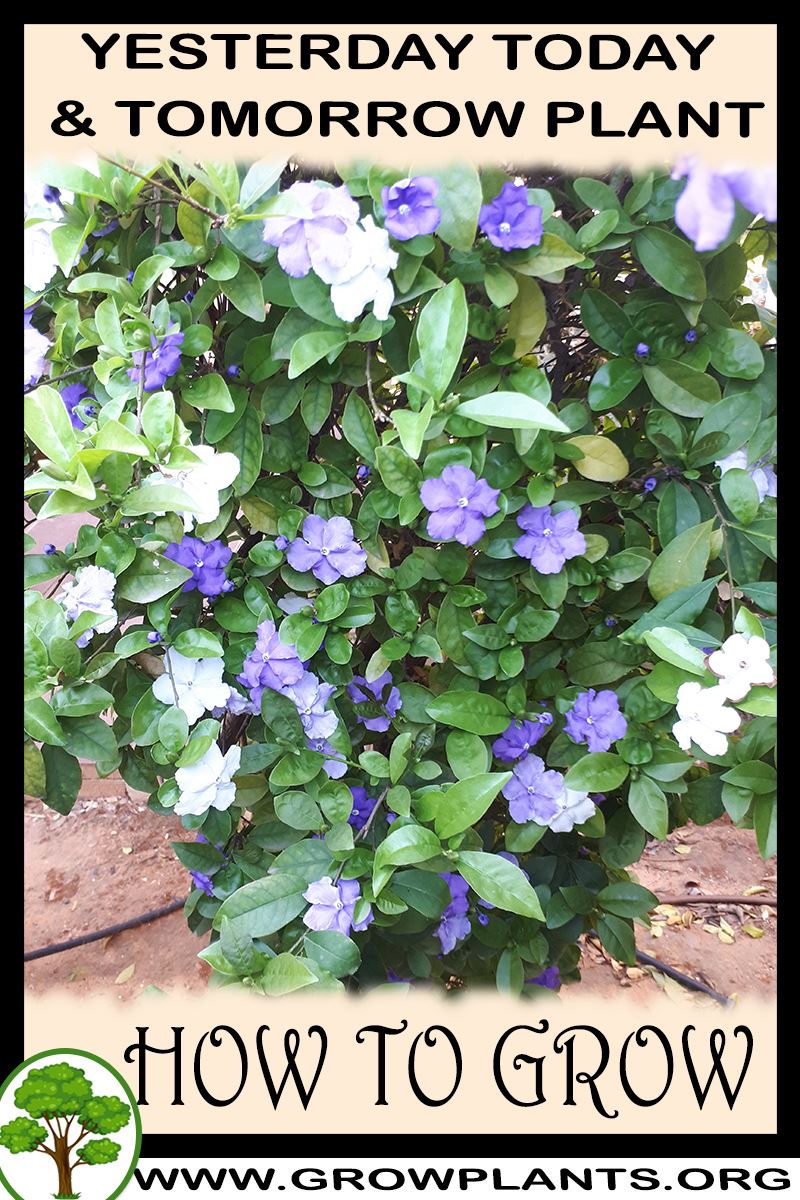
Plant Profile & Key Characteristics
Overview: Yesterday-today-and-tomorrow is a perennial evergreen (sometimes deciduous) shrub or small tree, 1-3 m (40-120 in), grown as an ornamental for its fragrant flowers that fade from purple to white. The plant is toxic.
Quick Specifications
| Specification | Attribute |
|---|---|
| Plant Type / Life Cycle | Perennial (shrub or small tree) |
| Foliage Type | Semi-evergreen (evergreen to deciduous) |
| Mature Size | 1-3 m (40-120 in) tall |
| Growth Rate | Moderate |
| Toxicity | Toxic (Brunfelsia contains brunfelsamidine; poisonous to pets and people) |
| Hardiness | USDA zones 8+ |
Growth Form & Structure
- Height & Spread: 1-3 m (40-120 in) in the ground; also grown in a container.
- Growth Habit & Form: Bushy shrub or small tree, pruned mainly for shape.
- Lifespan & Maturity: Long-lived perennial; moderate growth.
Anatomy & Physical Features
- Leaves & Foliage: Green to light-green elliptic leaves, 4-12 cm.
- Flower Characteristics: Fragrant wrinkled five-petalled flowers that open blue-purple and fade to white – giving the yesterday-today-and-tomorrow effect.
Primary Uses & Landscape Value
- Functional & Ornamental Roles: Ornamental flowering and fragrant shrub for gardens and containers.
Care Guide: Planting, Soil & Watering
Overview: Yesterday-today-and-tomorrow is a moderate-growing frost-free shrub that grows best in full sun to light shade and rich, well-draining soil. Give it humus-rich ground kept evenly moist, letting the surface dry slightly between waterings.
Quick Care Requirements
| Requirement | Ideal Condition |
|---|---|
| Planting Season | Warm season – spring to summer, in frost-free areas |
| Growth Rate | Moderate |
| Soil Type | Rich, humus-rich, well-draining soil |
| Water Need | Moderate – keep evenly moist, letting the surface dry slightly |
Planting & Establishment
- Best Planting Season: Plant in the warm season, spring to summer, once frost has passed; it needs a frost-free spot.
- How to Plant:
- Hole Preparation: Dig a hole roughly twice as wide as the root ball and no deeper than it, loosening the sides.
- Soil Amendments: Mix compost and organic matter into the backfill to build the rich, humus-rich soil it favours.
- Planting Depth: Set the plant with the root collar level with the surrounding soil – do not bury the stem – and firm it in.
- Growth Speed & Expectations: Growth is moderate; with warmth, rich soil and regular water it develops steadily into a shapely shrub.
Soil, Watering & Drainage Care
- Soil Mix & Drainage Needs: Give it rich, humus-rich soil that stays lightly moist but drains freely; add organic matter and avoid waterlogged spots. Containers need good drainage holes.
- Watering Schedule & Technique:
- Young / Newly Planted: Water in well and keep the soil evenly moist while it settles in.
- Established: Water regularly so the soil stays lightly moist, letting the top layer dry a little between waterings.
- Seasonal Adjustments: More in summer heat, less in winter.
Climate, Light & Hardiness
Yesterday-today-and-tomorrow is a tender evergreen (sometimes semi-deciduous) flowering shrub for tropical, Mediterranean and subtropical climates, named for blooms that age from purple through lavender to white. It grows in full sun to partial shade, prefers warmth and humidity, and needs a frost-free position, with the site rating it at hardiness zone 8 and warmer.
Quick Climate Specifications
| Climate Zones | Tropical, Mediterranean, subtropical |
|---|---|
| USDA Hardiness Zones | Approximately 8 and warmer (site data) |
| Optimal Temp Range | Warm, roughly 18–28°C (64–82°F) |
| Cold Damage Begins | Foliage and soft growth damaged by frost near 0°C (32°F) |
| Approx. Survival Minimum | Top growth killed by hard frost; established plants may resprout from the base |
| Frost Tolerance | Low |
| Light Conditions | Full sun to partial shade |
Sunlight & Light Exposure
Optimal Light Setup
Full sun in mild climates gives the most flowers; in hot regions it does best with morning sun and light afternoon shade, which also keeps the foliage from scorching.
Temperature Extremes & Hardiness
USDA Hardiness & Regional Limits
Site data lists zone 8 and warmer; the lower edge of zone 8 corresponds to winter lows around −12 to −7°C (10 to 20°F). Cold tolerance improves with plant age and shelter, and young plants are more tender.
Cold Damage & Winter Protection
Frost burns leaves and soft tips near 0°C (32°F); a hard freeze cuts the shrub back, though established plants often resprout from the base in spring. Mulch protects the crown, and container plants can be moved under cover in the coldest zones.
Extreme Heat Tolerance
Good in warm, humid conditions, but in dry heat and strong sun the foliage scorches, so afternoon shade and steady moisture help.
Wind, Humidity & Microclimate
Humidity Preferences
Prefers moderate to high humidity; it flowers and grows most lushly in warm, humid air and tends to look tired in very dry atmospheres.
Dry-Air Tolerance
Limited – in hot, dry climates give it shelter, mulch and a more humid, protected microclimate.
Microclimate Recommendations
A warm, sheltered, frost-free spot with morning sun and some humidity – a courtyard or a position among other plantings – suits it best.
Growing in Pots, Balconies & Indoors
The yesterday-today-and-tomorrow plant (Brunfelsia pauciflora) is a tender shrub (1-3 m / 40-120 in) whose flowers fade from purple through lavender to white. It is not a houseplant, but it makes an excellent large-container plant for a sunny patio or balcony, and potting it lets you move it under cover to overwinter where winters are cold.
Quick Details
- Container Size: A roomy pot sized to the plant; pot up as the root ball fills
- Indoor Suitability: Not a houseplant – too light-hungry for a room; pot it mainly so it can be overwintered frost-free
- Best Spot: Full sun to half shade
- Soil & Drainage: Well-aerated, organic-rich mix (potting mix, or peat with perlite); must drain freely
- Watering in Pots: Average and evenly moist – pots dry faster than open ground; let water drain away
Indoors & On the Windowsill
- Houseplant limits: Grown for its flowers, it needs strong sun and will not thrive deep indoors.
- Overwintering: This is the main reason to pot it – in cold climates move the container somewhere bright and frost-free over winter and water sparingly until growth restarts.
- Safety: All parts, and especially the berries, are toxic if eaten and are particularly dangerous to dogs – keep it away from children and pets.
On a Balcony or Patio
- Light & wind: Give it the sunniest spot; it can grow tall, so shelter it from strong wind and stake if needed. Walls and paving reflect heat, so pots dry quickly – check moisture daily in warm weather.
- Practicalities: A large filled pot is heavy – make sure the balcony can take the weight and that drainage runoff will not be a nuisance below.
Choosing the Pot, Soil & Long-Term Care
- Pot & drainage: A roomy pot with strong drainage holes; skip a standing water saucer to avoid root rot. Terracotta breathes and dries faster, while glazed or plastic pots hold moisture longer.
- Potting mix: Aerated and organic-rich – potting mix, or peat with perlite.
- Feeding: Potted shrubs need feeding more often than those in the ground, as nutrients wash out with each watering – a balanced feed through the growing season.
- Repotting: Pot up as the roots fill the container, and every couple of years refresh the mix and lightly prune the root ball and top growth.
Growing this plant in a greenhouse
A greenhouse can give yesterday today and tomorrow plant frost protection and cold protection. In the right climate it may also be kept growing through winter, depending on how much warmth and light are provided.
Greenhouse at a glance
| Greenhouse suitability | Conditional - depends on your climate |
|---|---|
| Main benefits | frost protection, cold protection |
| Season extension | earlier spring & later autumn |
| Outdoor protection advisable below | about 5°C |
| Maintain greenhouse minimum | around 5°C for active growth |
| Suitable types | unheated greenhouse, polycarbonate greenhouse, lean-to |
| Heating | Heating is optional - useful mainly for winter growing in cold areas. |
Related greenhouse guides
- Greenhouses: How to Choose the Right Greenhouse
- Best Lean-To Greenhouses
- Polycarbonate Greenhouses: What to Look for Before Buying
Fertilizing & Feeding
A steady, light feeder: a balanced complete fertilizer through the growing and blooming season keeps flowering ornamentals healthy without forcing soft growth.
Quick Fertilizing Specs
| Feeding Level | moderate |
|---|---|
| Main Nutrient Priority | A balanced complete fertilizer with steady nitrogen; extra phosphorus is not needed for bloom. |
| Best Feeding Period | Through the active growing and flowering season. |
| Organic Options | Compost and other organic matter improve the soil and supply gentle, steady nutrition. |
| Soil pH | Slightly acidic to near neutral suits most flowering ornamentals. |
| Reduce/Stop Feeding | Ease off feeding as growth slows heading into the cool, dormant rest period. |
Feeding by Growth Stage
Spring growth flush
Support healthy new shoots and leaf growth as the plant wakes up.
| Nutrient direction | A complete, balanced fertilizer with steady nitrogen to build strong foliage and stems. |
|---|---|
| Timing | As new growth begins in spring and the weather warms. |
| Frequency | Light, regular feedings through the active growing season. |
| Fertilizer types | A balanced complete garden fertilizer, A slow-release complete fertilizer worked into the soil, Compost or other organic matter to enrich the soil |
| Precautions | Feed lightly and avoid overfeeding with nitrogen, which pushes soft leafy growth at the expense of flowers. |
Flowering period
Fuel abundant, well-colored flowers while keeping the plant vigorous.
| Nutrient direction | A balanced complete fertilizer with adequate nitrogen; balanced feeding, not extra phosphorus, drives good bloom. |
|---|---|
| Timing | Through the blooming season. |
| Frequency | Steady, light feeding maintained across the flowering period. |
| Fertilizer types | A balanced complete flowering-plant fertilizer, A water-soluble complete fertilizer for container plants |
| Precautions | Skip high-phosphorus ‘bloom booster’ products; they are rarely needed and excess phosphorus can harm the soil. Container plants need even feeding to avoid salt buildup. |
Dormancy or cool-season rest
Let the plant rest through cold or low-light conditions without forcing new growth.
| Nutrient direction | None – withhold fertilizer while the plant is resting. |
|---|---|
| Timing | During cold winter weather or the plant’s low-light dormant rest. |
| Frequency | No feeding at this stage. |
| Fertilizer types | No feeding at this stage – resume only when active growth returns. |
| Precautions | Do not fertilize until active growth resumes; feeding a resting plant risks salt buildup and root injury. |
Nutrient Deficiency Signs & Corrections
Older, lower leaves fade to pale green or yellow and overall growth is weak.
| Possible causes | Low nitrogen in the soil, Nutrients leached out by heavy rain or frequent watering, Cold, wet roots slowing nutrient uptake |
|---|---|
| Appears first on | Older, lower leaves |
| What to check | Recent feeding history, Soil drainage and how often it is watered, Whether roots are healthy and warm enough |
| Possible correction | Apply a balanced complete fertilizer and improve drainage; correct soil pH if it is far off so nutrients stay available. |
Newest leaves turn yellow between green veins (interveinal yellowing) while older leaves stay greener.
| Possible causes | High soil pH locking up iron, Waterlogged or poorly aerated roots, Genuinely low available iron |
|---|---|
| Appears first on | Youngest, newest leaves |
| What to check | Soil pH, Drainage and root health, Whether only new growth is affected |
| Possible correction | Correct soil pH and improve drainage; where iron is truly short, apply a chelated iron product per its label. |
Lush leaves but few flowers, or pale weak blooms.
| Possible causes | Excess nitrogen driving leafy growth over flowers, Too little light for good flowering, A pest or cultural problem rather than a nutrient shortage |
|---|---|
| Appears first on | Flower buds and flowering shoots |
| What to check | How much nitrogen was applied, Hours of direct light, General plant health and pest pressure |
| Possible correction | Ease off nitrogen, move the plant to brighter light, and keep feeding balanced rather than reaching for high-phosphorus products. |
Pruning, Training & Seasonal Maintenance
Yesterday-today-and-tomorrow (Brunfelsia pauciflora) is a neat, rounded evergreen shrub grown for its fragrant flowers that open purple and fade through lavender to white. It needs only a light hand: flower buds form on the new spring growth, so the safe and effective time to shape it is right after the main flush finishes – pruning late, in autumn or winter, cuts off the wood that would carry the next display and exposes frost-tender growth. Slow-to-medium in growth and only moderately tolerant of cutting, it is shaped and deadheaded rather than hard-pruned; the berries and foliage are toxic, so wear gloves.
Quick Pruning & Maintenance Specs
| Pruning Tolerance | Moderate – light selective cuts, not hard shearing |
| Primary Pruning Window | Just after the main spring / early-summer flush |
| Secondary Maintenance Window | Occasional deadheading during bloom |
| Typical Frequency | Light annual shaping only |
| Main Objective | Keep the natural rounded form and maximise next season’s bloom |
| Young Plant Priority | Light tip-pinching to build a bushy, well-shaped framework |
| Mature Plant Priority | Light shaping right after flowering; thin weak interior twigs |
| Best Tool Type | Bypass secateurs and precision snips |
| Avoid Heavy Pruning During | Autumn / winter (removes spring buds) and any frost period |
Pruning by Plant Age & Size
Newly Established
Remove only damaged shoots and let it settle in; this is a slow shrub that resents disturbance while establishing.
Young / Formative
Light tip-pinching on young plants encourages branching and sets up the naturally rounded, bushy shape. There is no structural framework to force – just guide it towards an even, well-clothed dome.
Mature / Established
Keep to light shaping done immediately after the main flush, taking back over-long shoots to tidy the outline and thinning weak, crossing interior twigs. Avoid any routine hard cutting.
Seasonal Pruning Schedule
Just after the spring / early-summer flush (main shaping): shorten wayward shoots and tidy the outline now, before the plant sets the buds for next year’s flowers. This is the one window where cutting does not cost you bloom.
During bloom: deadhead spent flowers to keep the plant tidy and prolong the display.
Autumn / winter: essentially no pruning – cutting now removes developing flower wood and leaves tender regrowth exposed to frost.
Flowering & Fruiting Wood
Brunfelsia sets its flower buds on the new growth made after the spring flush, so timing is everything: prune lightly as soon as flowering finishes and the plant has the whole season to build next year’s buds; prune in autumn or winter and you remove that flowering wood, giving a poor display the following spring. Because it recovers slowly, a mistimed hard cut can cost more than one season of bloom.
Structural Pruning & Training
Little structural work is needed – the plant naturally forms a tidy rounded shrub or small multi-stem tree. Limit yourself to thinning weak or crossing interior stems and lightly reducing over-long shoots to keep the shape balanced. It can be grown as a small standard if a leader is selected early, but heavy reshaping is best avoided.
Special Growth to Remove
Deadhead spent flowers to tidy the plant and extend the display, and remove any weak, twiggy interior growth and the toxic berries that can follow. There are no suckers, runners or watersprouts to deal with on this well-behaved shrub.
Container & Small-Space Pruning
It is often grown as a patio, conservatory or container plant, where its compact habit and fragrance shine. Keep to the same light regime – shape just after flowering, thin lightly – and root-prune gently at repotting rather than relying on top cuts to control size. Keep container plants frost-free.
Tools
Bypass secateurs and precision snips are all that this compact, small-stemmed shrub calls for – snips for deadheading and fine shaping, secateurs for the occasional slightly thicker shoot. Loppers, saws and hedge shears are unnecessary and inappropriate here.
Tool Hygiene & Disease Risk
Routine. There is no significant tool-borne disease; keep blades clean and sharp. The plant’s usual troubles – whitefly and spider mite – are stress- and pest-related rather than spread by tools, so hygiene here mainly means gloves and hand-washing because the plant is toxic.
Cut Placement & Technique
Make light heading cuts to an outward-facing node to preserve the rounded outline, and thin weak twigs back to their origin. Keep cuts few and small – this is a shrub that prefers selective tidying to wholesale shortening.
Heavy Pruning & Rejuvenation
Brunfelsia is only moderately tolerant of hard pruning and recovers slowly, so it does not rejuvenate like a vigorous cestrum. An overgrown plant can be reduced, but do it gradually over two seasons, always cutting just after flowering, and accept a temporary loss of bloom – never renovate it with a single severe cut-back.
Post-Pruning Care
Water in after shaping and give a light feed suited to an acid-loving shrub to support the new flush; do not over-feed simply because you pruned. Watch the soft new growth for whitefly and spider mite, and keep the plant out of frost while it regrows.
Common Pruning Mistakes
- Pruning in autumn or winter, which removes the spring flower wood and exposes tender growth to frost.
- Shearing a plant that wants light, selective cuts, spoiling its natural rounded form and its bloom.
- Cutting hard and expecting quick recovery – it regrows slowly and sulks after heavy pruning.
- Pruning during flowering and losing the current display before it finishes.
When NOT to Prune
Do not prune in autumn, winter or any frost period, and avoid cutting during flowering – wait until the flush finishes. Hold off, too, on a newly transplanted or heat- and drought-stressed plant.
Recommended Tools (by task)
- bypass_secateurs – light shaping cuts and the occasional thicker shoot on a compact shrub.
- precision_snips – deadheading and fine tip-work to keep the rounded form.
Pruning Troubleshooting
| Problem | Possible Cause | What to Check | Corrective Action |
| Poor flowering next spring | Pruned at the wrong time, removing flower buds | When it was last cut | Prune only just after flowering; leave it undisturbed through autumn and winter |
| Slow, weak recovery after cutting | Pruned too hard for a slow shrub | Severity of the cut | Reduce gradually over two seasons rather than in one hard cut-back |
| Leggy, open habit | Low light or too little early tip-pinching | Light levels and young-plant training | Move to brighter position; tip-pinch young growth to rebuild density |
| Frost damage to new growth | Cut too late in the season | Timing versus frost | Confine pruning to after the spring flush; protect from frost |
Propagation Guide
Yesterday-today-and-tomorrow is most reliably increased from semi-hardwood stem cuttings, which reproduce the parent’s flower colour and habit exactly and root far more predictably than seed. Seed is possible but germinates slowly and erratically, so cuttings are the practical choice; overall a moderate shrub to propagate.
Quick Propagation Specs
| Best Propagation Method | Semi-hardwood stem cuttings |
| Alternative Methods | Seed; simple (ground) layering of low branches |
| Propagation Difficulty | Moderate |
| Seed True-to-Type | Species comes mostly true; named colour selections must be taken from cuttings |
| Vegetative True-to-Type | Yes – cuttings and layers are clonal |
| Best Propagation Season | Cuttings in late spring to summer; sow seed in spring warmth |
| Cutting Rooting Time | Several weeks under warm, humid conditions |
| Germination Temperature | Warm, roughly 21–24°C (70–75°F) |
Stem Cuttings
Cutting Type
Take semi-hardwood tip cuttings about 10–15 cm long from firm current-season growth that is no longer soft and floppy.
Best Timing
Late spring through summer, while the shrub is in active growth and stems have begun to firm.
Cutting Preparation
Remove the lower leaves and any flower buds so the cutting puts its energy into rooting rather than blooming.
Rooting Setup
Insert into a free-draining, moist rooting mix, keep warm with high humidity (a covered propagator or clear bag helps), and give bright indirect light. Gentle bottom warmth speeds rooting.
Rooting Hormone
Rooting hormone is beneficial for these semi-hardwood cuttings and improves take, though not strictly essential.
Rooting Time
Expect roots over several weeks; pot on once a firm root system has formed.
Growing from Seed
Seed Handling & Viability
Sow reasonably fresh seed for the best result, as viability is not long-lasting.
Sowing Season
Sow in spring once warmth is reliable.
Sowing Depth & Orientation
Cover the small seed only lightly with fine mix.
Germination Conditions
Keep warm, evenly moist and humid. Germination is slow and uneven, so be patient and do not discard trays early.
Air & Ground Layering
As a multi-stemmed shrub it also responds to simple (ground) layering: pin a flexible low branch down into the soil, keep the buried section moist until roots form, then sever and lift the rooted layer.
Bloom & Flower Guide
Quick Details
- Bloom Season: Spring and summer
- Time to First Bloom: Mature shrubs flush heavily in spring
- Flower Appearance: Fragrant, wrinkled, five-petalled flowers that open blue-purple and fade to lavender then white
- Edibility: None – Brunfelsia is poisonous (the berries and seeds especially) and is particularly dangerous to dogs; no part should be eaten
Detailed Blooming Overview
This shrub earns its common name from a colour-change trick: each flower opens deep blue-purple (‘yesterday’), fades to pale lavender (‘today’), then to white (‘tomorrow’), so the bush shows all three shades at once. The blooms are sweetly fragrant, strongest in the evening.
Flower Characteristics
- Wrinkled, five-petalled, flat-faced flowers.
- Open blue-purple and fade through lavender to white.
- Sweetly scented, carried through spring and summer.
Bloom Care & Thinning
- Keeping it flowering: A light prune after the main flush and steady feeding encourage repeat bloom.
- Safety: Berries and seeds are toxic, especially to dogs – site the shrub with care.
Pests, Diseases & Troubleshooting
Overview: Yesterday-today-and-tomorrow (Brunfelsia pauciflora) is a relatively pest-resistant tropical Solanaceae shrub whose main troubles are sap-sucking insects under warm, dry or indoor conditions and yellowing (chlorosis) when its need for moist, acidic soil is not met. Grow it in rich, well-drained acidic soil with steady moisture and bright filtered light and it stays largely trouble-free. Note that all parts are toxic if eaten — it is a known poisoning risk to dogs — so site it thoughtfully.
Quick Troubleshooting Overview
| Issue / Pest | Main Symptom | Primary Solution |
|---|---|---|
| Mealybugs | White cottony tufts in leaf axils & stems, honeydew | Alcohol swab, oil/soap sprays, repeat |
| Scale insects | Brown/waxy bumps on stems & leaf veins, sooty mould | Prune out, horticultural oil on crawlers |
| Whitefly | White flies rising from undersides, sticky honeydew | Sticky traps, insecticidal soap/oil |
| Spider mites | Fine stippling & webbing in warm dry air | Raise humidity, hose foliage; hort oil |
| Chlorosis | Yellow leaves with green veins | Acidify soil, chelated iron feed |
| Root rot | Wilting, blackened roots in wet heavy soil | Improve drainage, ease off water |
Common Pests & Management
- Mealybugs (Planococcus citri, Pseudococcus spp.):
- Symptoms: White cottony clusters tuck into leaf axils, along stems and around new growth, leaving sticky honeydew and sooty mould; the commonest pest on indoor and greenhouse plants.
- Prevention & Control: Dab clusters with 70% isopropyl alcohol on a cotton bud, then spray horticultural oil or insecticidal soap and repeat weekly until clear. Isolate new plants and inspect regularly, as warm dry indoor air favours them.
- Scale insects (soft & armoured scales):
- Symptoms: Immobile brown, tan or waxy bumps along stems and leaf veins; soft scales drip honeydew that blackens with sooty mould, while armoured scales cause yellow flecking and weak growth.
- Prevention & Control: Prune out heavily encrusted stems, scrub off light infestations, and apply horticultural oil to smother the mobile crawler stage, repeating to catch later hatchlings.
- Whitefly (Trialeurodes vaporariorum):
- Symptoms: Tiny white flies rise in a cloud when the plant is disturbed; nymphs on leaf undersides excrete honeydew, drawing sooty mould.
- Prevention & Control: Use yellow sticky traps to monitor and thin adults, and spray insecticidal soap or oil onto the undersides on a still evening; encourage or introduce parasitic wasps under glass.
- Spider mites (Tetranychus urticae):
- Symptoms: Fine pale stippling that dulls and bronzes the leaves, with faint webbing on the undersides in hot, dry, still conditions; leaves may yellow and drop.
- Prevention & Control: Raise humidity and airflow and rinse the foliage regularly. Spray horticultural oil or insecticidal soap on the undersides, repeating every few days, and step up to a labelled miticide only if needed.
- Aphids (Myzus persicae, Aphis spp.):
- Symptoms: Soft green or black colonies on tender new shoots and buds, curling the growth and leaving honeydew.
- Prevention & Control: Rinse off small colonies, encourage natural predators, and spray insecticidal soap or neem on the shoot tips; avoid heavy nitrogen feeding that fuels soft growth.
Diseases & Fungal Issues
- Root & stem rot (Phytophthora, Pythium):
- Symptoms: Wilting despite wet soil, yellowing leaves and a softening, browning stem base; roots turn brown and mushy in heavy, waterlogged or cold soil.
- Treatment & Management: Prevent with free-draining acidic soil and careful watering — moist but never sodden. Remove rotted tissue, repot container plants into fresh mix, and hold drier until recovery.
- Fungal leaf spot (Cercospora and related):
- Symptoms: Brown or black spots, sometimes with yellow halos, on the leaves in warm, wet, crowded conditions; mostly cosmetic.
- Treatment & Management: Remove spotted leaves, water at the base to keep foliage dry, and improve airflow; a copper spray helps only in persistent outbreaks.
- Botrytis / grey mould (Botrytis cinerea):
- Symptoms: Fuzzy grey mould on flowers and soft growth in cool, damp, still air, causing them to brown and collapse.
- Treatment & Management: Improve ventilation, remove fading flowers and dead material promptly, and avoid wetting the blooms.
Growing Difficulties & Abiotic Problems
- Chlorosis (iron shortage / wrong pH):
- Cause & Symptoms: Yellowing leaves with contrasting green veins, most obvious on new growth; this acid-loving plant cannot take up iron in alkaline or over-limed soil.
- Correction Strategy: Keep the soil acidic with an ericaceous mix, elemental sulfur or an acidifying feed, mulch with organic matter, and apply chelated iron for a quick green-up. Water with rainwater rather than hard tap water where possible.
- Bud & flower drop:
- Cause & Symptoms: Flower buds yellow and fall before opening after a check from dryness, cold draughts or a sudden move.
- Correction Strategy: Keep watering, warmth and position steady through the budding and flowering period, and never let the root ball dry out while in bud.
- Cold sensitivity:
- Cause & Symptoms: Leaf drop, blackening or dieback below about 5-10 C; the plant is frost-tender.
- Correction Strategy: Grow under cover or bring indoors over cold spells, keep it away from cold draughts, and cut back any cold-damaged growth once warmth returns.
- Poor flowering from low light:
- Cause & Symptoms: Sparse bloom and leggy growth in too much shade.
- Correction Strategy: Give bright, filtered light (some gentle direct sun) and feed with a bloom-type fertiliser in the growing season to encourage the three-day colour-changing flowers.
What Helps — Products & Tools
Reach for horticultural or neem oil and insecticidal soap for mealybugs, scale, whitefly, mites and aphids, with 70% alcohol swabs for spot-treating mealybug and scale and yellow sticky traps for monitoring. For the plant’s most typical complaint — yellowing — keep an ericaceous/acidifying feed, elemental sulfur and chelated iron on hand, and use free-draining acidic mix to avoid root rot. A copper spray covers occasional leaf spot. All parts are toxic if eaten (a known hazard to dogs), so handle and site with care; spray oils in the evening.
Frequently Asked Questions
Why is it called the yesterday-today-and-tomorrow plant?
Each flower opens deep blue-purple, fades to pale lavender, then to white, so the shrub shows all three shades at once – the ‘yesterday, today, tomorrow’ effect. The blooms are sweetly fragrant, strongest in the evening, and are carried through spring and summer.
How do you grow and care for the yesterday-today-and-tomorrow plant?
It grows best in full sun to light shade in rich, well-draining, humus-rich soil, kept evenly moist while letting the surface dry slightly between waterings. Plant it in the warm season, spring to summer, once frost has passed, since it needs a frost-free spot – water more in summer heat and less in winter.
How do you propagate the yesterday-today-and-tomorrow plant?
It is most reliably propagated from semi-hardwood tip cuttings about 10-15 cm long, taken from firm current-season growth in late spring through summer, and rooted warm and humid – roots form over several weeks, and rooting hormone helps. Seed is possible but germinates slowly and erratically, and low branches can also be simple (ground) layered.
What problems does the yesterday-today-and-tomorrow plant have?
It is a relatively pest-resistant shrub whose main troubles are sap-sucking insects (mealybugs, scale, whitefly, spider mites, aphids) in warm, dry or indoor conditions, plus yellowing (chlorosis) when its need for moist, acidic soil isn’t met, and root rot in waterlogged soil. Grow it in rich, well-drained acidic soil with steady moisture and bright filtered light and it stays largely trouble-free; note all parts are toxic if eaten.
When and how do you prune the yesterday-today-and-tomorrow plant?
Prune lightly right after the main spring/early-summer flush, since flower buds form on new spring growth – pruning in autumn or winter cuts off the wood that would carry the next display and exposes frost-tender growth. Use bypass secateurs or precision snips for light shaping and deadheading and to thin weak interior twigs; it is only moderately tolerant of cutting, so avoid hard pruning, and wear gloves since the berries and foliage are toxic.
Is the yesterday-today-and-tomorrow plant toxic to pets?
Yes. All parts are toxic, especially the berries and seeds, and it is a known poisoning risk to dogs – it contains brunfelsamidine and is poisonous to pets and people – so site and handle it with care, keeping it away from children and pets.


