
Plant Profile & Key Characteristics
Overview: A deciduous azalea shrub 0.5-1 m (20-40 in) tall, grown as an ornamental for its large, showy multi-coloured spring flowers. It loses its leaves in winter and needs acidic soil.
Quick Specifications
| Specification | Attribute |
|---|---|
| Plant Type / Life Cycle | Perennial (deciduous shrub) |
| Foliage Type | Deciduous |
| Mature Size | 0.5-1 m (20-40 in) |
| Growth Rate | Moderate |
| Root System | Shallow, fine fibrous roots (needs acidic, well-drained soil) |
| Toxicity | Toxic — all parts of azaleas/rhododendrons contain grayanotoxins, harmful to people and pets |
| Hardiness | USDA zones 4-9 |
Growth Form & Structure
- Height & Spread: 0.5-1 m (20-40 in) in the ground or a large container of acidic mix.
- Growth Habit & Form: Rounded, twiggy deciduous shrub.
- Lifespan & Maturity: Long-lived flowering shrub.
Anatomy & Physical Features
- Leaves & Foliage: Green leaves, elliptic to ovate.
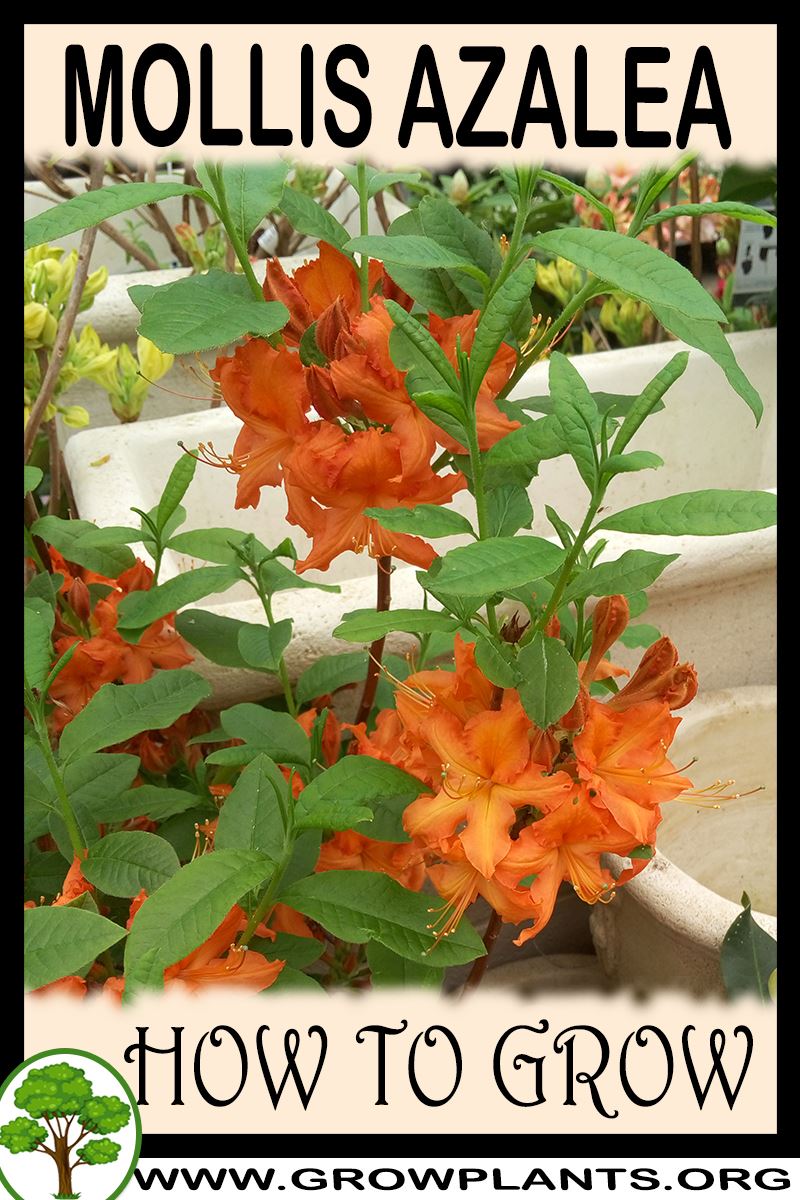
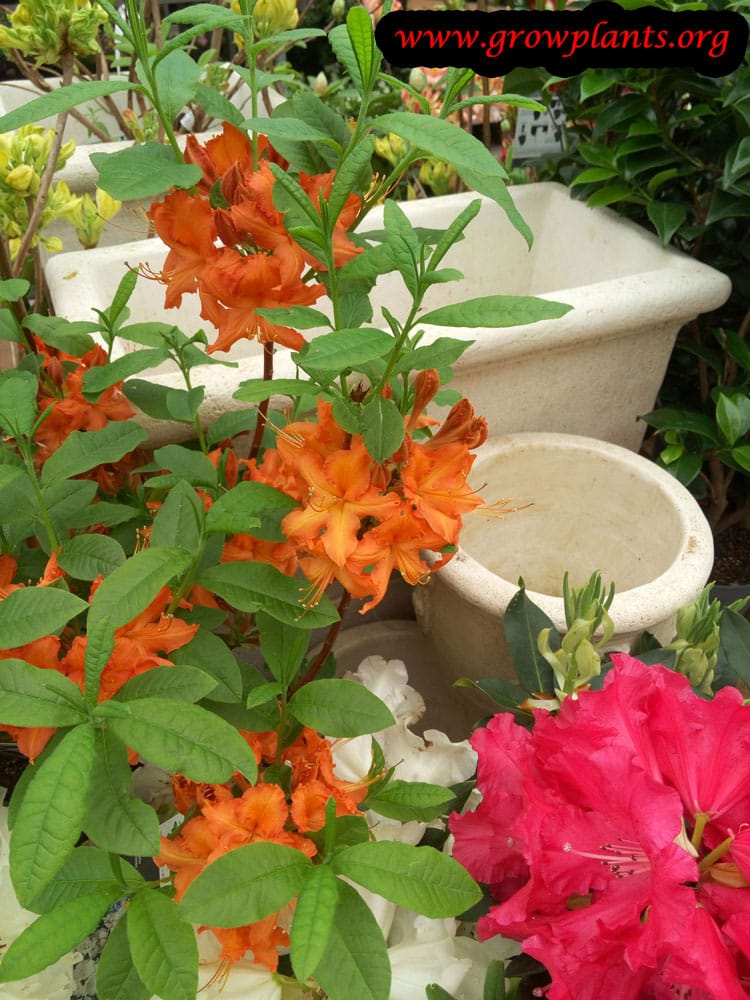
- Flower Characteristics: Large five-petalled trumpet blooms in orange, peach, yellow, red, pink, white or bicolour, some cultivars spotted.
Primary Uses & Landscape Value
- Functional & Ornamental Roles: Ornamental flowering shrub for borders, woodland-edge and acidic-mix containers.
Care Guide: Planting, Soil & Watering
Overview: Mollis azalea is a deciduous rhododendron that grows best in full sun to part shade in rich, moist, well-drained soil that is distinctly acidic. It is a classic acid-lover that needs cool, humus-rich, evenly moist ground and dislikes alkaline soil or waterlogging.
Quick Care Requirements
| Requirement | Ideal Condition |
|---|---|
| Planting Season | Spring (or autumn in mild areas), avoiding frozen or waterlogged ground |
| Growth Rate | Moderate |
| Soil Type | Rich, humus-rich, moist but well-draining, acidic |
| Soil pH | Acidic (about 4.5–6.0) |
| Water Need | Moderate to High — keep consistently moist |
Planting & Establishment
- Best Planting Season: Plant in spring so the shrub can establish through the growing season (in mild climates autumn planting also works). Choose a sheltered spot in dappled light and avoid frozen or waterlogged soil.
- How to Plant:
- Hole Preparation: Dig a broad hole about twice the width of the root ball and no deeper; azaleas are shallow-rooted, so a wide, loosened planting area suits them.
- Soil Amendments: Blend in plenty of acidic organic matter — leaf mould, composted pine bark or ericaceous compost — to enrich the soil, hold moisture and keep the pH low. Avoid lime.
- Planting Depth: Plant shallowly, with the top of the root ball at or just above the soil surface, and mulch over the roots; never bury the stem base, as the roots need air near the surface.
- Growth Speed & Expectations: A moderate grower reaching roughly 0.5–1 m, forming a rounded, free-flowering shrub over several seasons.
Soil, Watering & Drainage Care
- Soil Mix & Drainage Needs: Above all it needs acidic, humus-rich soil that stays moist yet drains freely; improve heavy or limey soils with ericaceous matter, or grow it in a container of ericaceous mix. Mulch to keep the shallow roots cool and moist.
- Watering Schedule & Technique:
- Young / Newly Planted: Keep the soil consistently moist while the shrub establishes; the shallow roots dry out quickly, so never let them parch.
- Established: Water regularly and deeply in dry spells, ideally with soft or rainwater; mulch heavily to conserve moisture around the shallow roots.
- Seasonal Adjustments: Water more in warm, dry weather and while flowering; reduce in winter dormancy, keeping the soil just moist but not soggy.
Climate, Light & Hardiness
Mollis azalea is a deciduous flowering shrub for temperate and cooler subtropical climates, dropping its leaves and going dormant in winter. It grows in full sun to half shade in acidic, moist, well-drained soil and is cold-hardy, needing a cool winter rather than a frost-free one.
Quick Climate Specifications
| Climate Zones | Temperate, cooler subtropical |
| USDA Hardiness Zones | Approximately 4–9 (per site data) |
| Optimal Temp Range | Approximately 15–27 °C (59–81 °F) in the growing season |
| Frost Tolerance | High when dormant; open spring flowers are frost-tender |
| Light Conditions | Full sun to half shade |
Sunlight & Light Exposure
Optimal Light Setup
Full sun to half shade; good light supports strong flowering, while light shade protects the blooms in hot areas.
Shade & Heat Management
Afternoon shade in hot climates reduces leaf scorch and extends flower life.
Temperature Extremes & Hardiness
USDA Hardiness & Regional Limits
The site places it around zones 4–9, making it genuinely cold-hardy but reliant on a cool, dormant winter; it is less suited to hot, frost-free climates. Exact minimums vary by plant age and conditions.
Cold Damage & Winter Protection
Being deciduous, it overwinters bare and dormant and needs no special protection within its zone range; late frosts can, however, damage early open flowers.
Frost Sensitivity
Dormant wood is frost-hardy; the spring blooms are the frost-sensitive part.
Extreme Heat Tolerance
Prolonged extreme heat is the practical upper limit; it prefers cooler summers than evergreen tropical azaleas.
Wind, Humidity & Microclimate
Humidity Preferences
Prefers moderate humidity with consistently moist, cool root conditions.
Wind Tolerance
Low to moderate; shelter from drying winds protects buds and foliage.
Coastal / Salt Tolerance
Low; salt-sensitive and not suited to coastal salt exposure.
Microclimate Recommendations
A sheltered, lightly shaded site with acidic, moist soil and a proper cool winter suits it best; containers freeze faster at the roots.
Growing in Pots, Balconies & Indoors
Mollis azalea is a hardy, deciduous shrub grown for its blaze of spring colour – unlike the florist types, the grower does not class it as a houseplant, and its winter dormancy makes it an outdoor patio or balcony container plant. A pot lets you give it the acid soil it needs and place it where the spring flowers can be enjoyed up close.
Quick Details
- Container Size: Medium – a 10-20 L (2.5-5 gal) pot suits this 0.5-1 m shrub
- Indoor Suitability: Not a houseplant – a hardy deciduous shrub for outdoor pots
- Best Spot: Full sun to half shade; light shade protects the blooms in hot areas
- Soil & Drainage: Acidic (pH 4-6), rich, moist, well-drained mix with mulch (grower’s guidance)
- Watering in Pots: Average to generous – keep the acid mix moist, ideally with rainwater; never dry out
Indoors & On the Windowsill
- Not a houseplant: The grower marks it unsuitable indoors – it needs an outdoor season and a winter chill, and drops its leaves in dormancy.
- Overwintering: Hardy to zone 4, it rests outdoors over winter; protect the pot from freezing solid in very cold spells rather than bringing it into a warm room.
On a Balcony or Patio
- Light & shelter: A bright, lightly shaded, sheltered spot suits it; screen from harsh midday sun and cold wind.
- Watering: Pots dry fast near warm walls – check often and keep the acid mix evenly moist.
Choosing the Pot, Soil & Long-Term Care
- Pot & drainage: A pot with strong drainage holes; skip a standing water saucer to prevent root rot. Terracotta dries faster, glazed or plastic holds moisture longer.
- Potting mix: An acidic (ericaceous), rich, open mix with perlite; mulch the surface as the grower advises.
- Feeding: Use an ericaceous feed through growth; potted nutrients leach with watering, so feed lightly and regularly.
- Repotting: Refresh the mix and pot up every couple of years; prune lightly after flowering for shape.
- Safety: All parts are toxic if eaten – keep it away from children and pets.
Fertilizing & Feeding
A moderate feeder: give balanced nutrition as growth begins and through the flowering season, then reduce feeding as growth slows and stop during dormancy.
Quick Fertilizing Specs
| Feeding Level | Moderate |
|---|---|
| Main Nutrient Priority | Balanced nutrition using an acidifying fertilizer; adequate nitrogen supports both foliage and bloom |
| Best Feeding Period | Active growth through the flowering season |
| Soil pH | Distinctly acidic soil |
| Reduce/Stop Feeding | Taper off as growth slows and stop feeding during dormancy. |
| Organic Options | Compost or a slow-release organic fertilizer worked into the soil |
| Micronutrients | Iron and manganese availability drops in alkaline soil; watch for interveinal yellowing on new leaves |
Feeding by Growth Stage
Spring growth flush
Support new shoots and leaves as growth resumes in spring.
| Nutrient direction | A balanced complete fertilizer formulated for acid-loving plants with enough nitrogen to drive healthy new growth. |
|---|---|
| Timing | As new growth begins in spring. |
| Frequency | Light feedings through the active growing season as growth develops. |
| Fertilizer types | Balanced complete fertilizer for acid-loving plants, Slow-release granular fertilizer, Compost or well-rotted organic matter |
| Precautions | Avoid heavy nitrogen, which pushes soft leafy growth at the expense of flowers. |
Flowering period
Sustain flowering and overall vigor during bloom.
| Nutrient direction | Continue balanced nutrition; steady, adequate nitrogen and potassium support flowering better than high-phosphorus bloom products. |
|---|---|
| Timing | Through the flowering season. |
| Frequency | Light, steady feeding while the plant is actively flowering. |
| Fertilizer types | Balanced complete fertilizer for acid-loving plants, Slow-release granular fertilizer, Compost or well-rotted organic matter |
| Precautions | Do not rely on high-phosphorus bloom boosters; balanced feeding with enough nitrogen drives better flowering. |
Dormancy / winter rest
Let the plant rest through its dormant period; no nutrients are needed while growth has stopped.
| Nutrient direction | None – withhold fertilizer while the plant is dormant. |
|---|---|
| Timing | During the dormant or resting period, generally from late autumn through winter. |
| Frequency | No feeding at this stage. |
| Fertilizer types | No feeding at this stage – withhold fertilizer until active growth resumes in spring. |
| Precautions | Do not fertilize until active growth resumes in spring; feeding a dormant plant risks salt buildup and root injury. |
Nutrient Deficiency Signs & Corrections
Older, lower leaves turn uniformly pale green to yellow and growth is weak and slow.
| Possible causes | Low nitrogen availability in the soil, Cold or waterlogged soil limiting root uptake, Leaching of nitrogen from light, sandy soils |
|---|---|
| Appears first on | Older, lower leaves first. |
| What to check | Recent feeding history, Soil drainage and moisture, Whether older leaves are affected before the new growth |
| Possible correction | Apply a balanced complete fertilizer and correct any drainage or watering problems before adding more. |
The youngest leaves yellow between the veins while the veins themselves stay green.
| Possible causes | Alkaline soil pH reducing iron availability, Waterlogged or cold roots impairing uptake, A genuine shortage of available iron |
|---|---|
| Appears first on | New, young leaves at the shoot tips. |
| What to check | Soil pH, Drainage and root health, Whether only the new growth is affected |
| Possible correction | Correct soil pH toward the plant’s preferred range and, if the problem persists, apply a chelated iron product per its label. |
Brown, scorched leaf edges and tips, sometimes with wilting even when the soil is moist.
| Possible causes | Excess fertilizer or salt buildup in the soil, Under-watering that concentrates salts around the roots, Salt accumulation in containers |
|---|---|
| Appears first on | Leaf margins and tips across many leaves. |
| What to check | Recent fertilizer amounts, Salt buildup or the need to leach the soil, Watering consistency |
| Possible correction | Ease off feeding, leach the soil with plain water, and give only light feeding once the plant recovers. |
Pruning, Training & Seasonal Maintenance
Mollis azalea (Rhododendron x kosteranum) is a deciduous, upright azalea grown for its warm-toned spring flush of orange, yellow, red and pink blooms. Like all azaleas it flowers on the previous season’s wood and sets next year’s buds soon after flowering, so pruning is a light, prompt, post-bloom job. Being deciduous rather than evergreen, it renews less aggressively than evergreen azaleas, so any renovation is done gently and gradually rather than by hard cutting.
Quick Pruning & Maintenance Specs
| Pruning Tolerance | Moderate – light pruning; gradual renewal only |
| Primary Pruning Window | Immediately after flowering, before new buds set |
| Secondary Maintenance Window | Deadheading right after bloom |
| Typical Frequency | Minimal – light annual tidy |
| Main Objective | Keep a tidy, well-flowering upright shape |
| Young Plant Priority | Encourage branching; deadhead carefully |
| Mature Plant Priority | Deadhead, remove weak/dead wood, renew oldest stems gradually |
| Best Tool Type | Precision snips and bypass secateurs |
| Avoid Heavy Pruning During | Summer to spring (bud set through bloom) |
Pruning by Plant Age & Size
Newly Established
Remove only damaged shoots and let the young plant build its branch structure; deadhead gently after the first bloom.
Young / Formative
Encourage a balanced, branching upright frame with light post-bloom cuts. No leader training or shearing — a naturally shaped shrub.
Mature / Established
Deadhead, remove weak, crossing or dead wood, and if the plant becomes congested or bare-based, renew a few of the oldest stems each year rather than all at once.
Seasonal Pruning Schedule
Post-Flowering (late spring / early summer)
Objective: deadhead and shape in the safe window. Snap off the spent trusses without harming the new shoots pushing just behind them, and make any light shaping cuts now, before buds set.
Ongoing Sanitary
Rub out aphid-infested tips and remove dead twiggy wood.
Flowering & Fruiting Wood
Bloom comes on last season’s shoots, with next year’s buds forming just behind the flowers soon after they fade. Careful deadheading — removing only the spent truss while sparing the fresh shoot tips at its base — is the single most useful cut for maintaining bloom. Any pruning past mid-summer removes formed buds.
Structural Pruning & Training
Thin weak inner twigs and shorten the occasional over-long shoot to a bud or side branch; a deciduous azalea is shaped by selective cuts, not shearing. Manage size by removing whole old stems rather than heading, which spoils the open habit.
Special Growth to Remove
Own-rooted, so no graft suckers; remove spent trusses and dead interior twigs and retain healthy low shoots. Take out the oldest exhausted stems in gradual renewal.
Container & Small-Space Pruning
Workable in a large pot; keep it shapely with light post-bloom cuts and careful deadheading, matching the canopy to the shallow, acid-loving roots. Avoid hard cutting, which a deciduous azalea recovers from slowly.
Tools
Precision snips for deadheading and thin twigs; bypass secateurs for woodier shoots and gradual stem renewal. No shears or saw are needed on a shrub of this size.
Tool Hygiene & Disease Risk
Routine — clean, sharp tools. Aphids on soft new growth are the main pest; there is no strong pruning-borne disease risk to warrant disinfecting between cuts.
Cut Placement & Technique
Deadhead by pinching out only the spent truss, sparing the new shoot tips at its base; shorten shoots to an outward-facing bud; remove renewal stems low at the base.
Heavy Pruning & Rejuvenation
Only gradual: unlike evergreen azaleas, deciduous mollis types resent being cut hard all at once and can be lost that way. Renovate a leggy plant by removing a share of the oldest stems each year over several seasons, keeping some bloom throughout.
Post-Pruning Care
Keep the acidic, rich, moist, mulched soil evenly watered after any renewal; feeding is not needed for the light routine cutting this plant wants.
Common Pruning Mistakes
- Cutting the fresh shoot tips behind a spent truss when deadheading.
- Pruning after mid-summer and losing next spring’s flowers.
- Hard-renovating a deciduous azalea in one go, as if it were evergreen.
When NOT to Prune
Do not prune from summer through flowering, and avoid heavy cuts on a deciduous azalea at any time. Spare plants stressed by heat or drought, and let new plantings establish first.
Recommended Tools (by task)
- precision_snips — for careful deadheading and thin twiggy cuts.
- bypass_secateurs — for woodier shoots and gradual stem-by-stem renewal.
Pruning Troubleshooting
| Problem | Possible Cause | What to Check | Corrective Action |
| Few flowers next spring | Deadheaded roughly or pruned after mid-summer | Whether new tips behind trusses were cut; timing | Deadhead gently; prune only just after bloom |
| Dieback after renovation | Cut too hard at once for a deciduous type | Severity of the last cut | Renew a few old stems per year instead |
| Sparse, bare-based old plant | Never renewed | Age of the main stems | Begin gradual stem renewal after bloom |
Propagation Guide
Mollis azaleas are a deciduous hybrid group, so seedlings vary and do not reproduce a named plant. Because deciduous azaleas are notoriously slow from cuttings, layering is the most dependable way to increase a chosen plant, with grafting used commercially and seed reserved for breeding.
Quick Propagation Specs
| Best Propagation Method | Simple or ground layering |
| Alternative Methods | Softwood cuttings (early and difficult); grafting; seed for breeding |
| Propagation Difficulty | Difficult by cuttings |
| Seed True-to-Type | Hybrid offspring vary |
| Vegetative True-to-Type | Yes |
| Best Propagation Season | Layer in spring; take softwood cuttings very early in the season |
| Germination Temperature | 18–21°C (64–70°F) |
| Seed Sowing Depth | Surface-sown, uncovered |
Growing from Seed
Sowing Depth & Orientation
Surface-sow the fine seed onto moist, acidic medium and leave uncovered; light aids germination.
Germination Conditions
Keep humid and evenly moist at about 18–21°C (64–70°F). Seedlings are variable, since this is a hybrid group.
Stem Cuttings
Cutting Type
Only very soft, early-season growth roots, and then slowly.
Best Timing
Very early in the growing season, while shoots are still soft.
Rooting Hormone
Beneficial, and generally needed for any success.
Rooting Time
Slow and uncertain. A rooted deciduous-azalea cutting should be kept growing rather than allowed to go dormant, as cuttings that stop growing after rooting often fail to survive the first winter.
Air & Ground Layering
The most reliable method for amateurs: peg a low, flexible shoot into acidic soil in spring; roots usually form over about a year, after which the layer is separated.
Grafting & Budding
Why Grafting Is Used
Grafting is used commercially because deciduous azaleas root so poorly from cuttings.
Preferred Grafting Methods
Side grafting onto a seedling rootstock.
Graft Aftercare
Keep warm and humid until the union takes and the scion grows away.
Bloom & Flower Guide
Quick Details
- Bloom Season: Spring into summer
- Flower Appearance: Warm-toned funnel-shaped flowers in orange, peach, yellow, red, pink or white (some spotted), with five petals fused at the base
- Edibility: Toxic – do not eat; all parts of azaleas contain harmful compounds
Detailed Blooming Overview
Mollis azalea is a deciduous shrub that flowers in a burst through spring and into summer, often before or with the emerging leaves. Its funnel-shaped blooms carry unusually warm colours – orange, peach, yellow and red as well as pink and white – and can be lightly spotted. As with all azaleas, every part is poisonous if eaten, so keep it away from children and pets.
Flower Characteristics
- Funnel-shaped flowers with five petals fused at the base
- Warm colours: orange, peach, yellow, red, pink or white, sometimes spotted or bicoloured
- Carried in generous trusses on a deciduous shrub
Bloom Care & Thinning
- Deadheading: snap off spent trusses to tidy the plant and build next year’s buds
- Siting for bloom: a spot in dappled shade or gentle sun with steady moisture flowers best
- Safety: wash up after handling and never let any part of the plant be eaten
Bloom Health & Protection
- Azalea petal blight can turn open flowers watery and slimy in warm, wet weather – removing affected blooms and fallen litter helps, and a fungicide can protect the display where it recurs
Pests, Diseases & Troubleshooting
Mollis azaleas (deciduous Rhododendron) have a well-defined problem list led by azalea lace bug and, in damp springs, petal blight and leaf gall, all against a backdrop of iron chlorosis and root rot if the soil is not acidic and well drained. Acid soil, good drainage, airflow and vigilance for lace bug keep them healthy.
Quick Troubleshooting Overview
| Issue / Pest | Main Symptom | Primary Solution |
|---|---|---|
| Azalea lace bug | Silvery-grey stippled leaves; black specks beneath | Inspect undersides early; horticultural oil/soap; beneficials |
| Vine weevil | Notched leaf edges; grubs eat roots, plant wilts | Nematodes for grubs; handpick adults at night |
| Aphids & spider mites | Curled sticky shoots / stippled leaves | Water jet, soap, oil; raise humidity for mites |
| Petal blight | Spotting then slimy collapse of open flowers | Remove blooms/litter, airflow, avoid wetting flowers |
| Leaf gall | Swollen pale fleshy galls on leaves/buds | Pick off and destroy galls before they turn white |
| Chlorosis / root rot | Yellow leaves; wilt in wet or limey soil | Acid, free-draining soil; chelated iron |
Common Pests & Management
- Azalea lace bug (Stephanitis pyrioides):
- Symptoms: The upper leaf surface becomes silvery-grey and coarsely stippled while the undersides carry shiny black tar-like spots of excrement and the lacy-winged bugs and spiny nymphs themselves; heavy attacks bleach and disfigure the whole plant. The most important azalea pest, worst in sun and heat.
- Prevention & Control: Inspect leaf undersides from early in the season and act on the first generation. Encourage lacewings, predatory bugs and spiders by avoiding broad-spectrum sprays, and hose off nymphs. Insecticidal soap or horticultural/neem oil, thoroughly wetting the leaf undersides and repeated, gives good control; siting in light shade reduces pressure.
- Vine weevil (Otiorhynchus sulcatus):
- Symptoms: Adults notch the leaf margins with characteristic scalloped bites at night, but the real damage is done by the white, legless, brown-headed grubs that eat the roots, causing sudden wilting and collapse – especially in containers.
- Prevention & Control: Drench the compost with pathogenic nematodes (Steinernema/Heterorhabditis) to kill the grubs, and trap or handpick the flightless adults after dark. Check the rootball of container plants and repot into clean compost if grubs are found.
- Aphids (Aphididae):
- Symptoms: Colonies on soft new shoots and buds curl and distort growth and leave sticky honeydew and sooty mould.
- Prevention & Control: Wash off with water, encourage ladybirds and lacewings, and remove infested tips. Insecticidal soap or neem controls persistent colonies; spray in the evening to protect pollinators.
- Spider mites (Tetranychidae):
- Symptoms: Fine pale stippling and bronzing of leaves with faint webbing in hot, dry conditions; heavy attacks cause early leaf drop.
- Prevention & Control: Hose down foliage and raise humidity, keep plants watered to reduce stress, and treat hotspots with horticultural oil or insecticidal soap.
- Thrips (Thysanoptera):
- Symptoms: Silvery flecking and fine black frass specks on leaves and petals, with distorted new growth.
- Prevention & Control: Hose foliage, use blue sticky traps, encourage predatory mites and lacewings, and spray insecticidal soap or spinosad on bad outbreaks in the evening.
Diseases & Fungal Issues
- Azalea petal blight (Ovulinia azaleae):
- Symptoms: Small water-soaked spots on the open flowers rapidly enlarge until the whole bloom turns slimy, brown and collapses, then dries and hangs on the plant; worst in warm, humid weather at flowering. Chiefly a Bloom-stage problem.
- Treatment & Management: Remove and destroy infected flowers and clear fallen petals and mulch that harbour the resting bodies. Improve airflow and avoid overhead watering during bloom; protectant fungicides applied as buds colour help where the disease recurs.
- Leaf & flower gall (Exobasidium vaccinii):
- Symptoms: Young leaves and buds swell into thick, pale-green then white, fleshy galls in cool, damp spring weather; unsightly but rarely serious.
- Treatment & Management: Pick off and destroy the galls before they turn white and release spores, and improve airflow. Fungicides are seldom needed if galls are removed promptly.
- Powdery mildew (Erysiphe / Microsphaera spp.):
- Symptoms: White powdery patches or yellow blotching on the leaves, common on deciduous azaleas in late summer.
- Treatment & Management: Improve airflow, avoid drought stress, and remove fallen leaves. Sulfur, potassium bicarbonate or a light horticultural oil checks it at first signs.
- Phytophthora root rot & dieback (Phytophthora spp.):
- Symptoms: Wilting, dull, yellowing foliage, branch dieback and reddish-brown decay in the roots and stem base, in wet or poorly drained soil. A frequent cause of azalea death.
- Treatment & Management: Plant high in acidic, free-draining, humus-rich soil, never let plants sit wet, and mulch (keeping mulch off the stem). Remove severely affected plants and improve drainage before replanting with resistant stock.
- Rust & leaf spot (Pucciniastrum / Cercospora spp.):
- Symptoms: Orange rust pustules on leaf undersides (rust) or brown-purple leaf spots that cause early leaf drop, in wet seasons.
- Treatment & Management: Rake up fallen leaves, improve airflow, and avoid overhead watering. Copper or sulfur protects new growth where the diseases are troublesome.
Growing Difficulties & Abiotic Problems
- Iron chlorosis (lime-induced):
- Cause & Symptoms: Azaleas are acid-loving; in neutral or alkaline soil, or where the soil is waterlogged, iron becomes unavailable and young leaves yellow between green veins.
- Correction Strategy: Grow in acidic (pH ~4.5–6), humus-rich, free-draining soil, mulch with pine needles or bark, use rainwater where tap water is hard, and correct with chelated iron and acidifying feeds.
- Root rot & waterlogging:
- Cause & Symptoms: Heavy, wet soil suffocates the fine surface roots and invites Phytophthora.
- Correction Strategy: Plant high in free-draining, organic soil, water with soft water when dry rather than keeping soggy, and never plant in a wet hollow.
- Drought & leaf scorch:
- Cause & Symptoms: Shallow-rooted azaleas scorch at the leaf margins in dry soil, drying wind or fierce sun.
- Correction Strategy: Mulch generously, water in dry spells (ideally with rainwater), and site in light dappled shade with wind shelter.
- Frost & bud damage:
- Cause & Symptoms: Late frosts damage tender new growth and opening flower buds.
- Correction Strategy: Site away from frost pockets and early-morning sun, and shelter or fleece plants during late frosts.
What Helps – Products & Tools
For azaleas keep insecticidal soap and horticultural/neem oil for lace bug, aphids and mites, pathogenic nematodes for vine-weevil grubs, and blue sticky traps for thrips. Against disease, use protectant fungicide for petal blight at bloom, sulfur for powdery mildew, and above all acidic, free-draining soil plus chelated iron to prevent chlorosis and root rot.