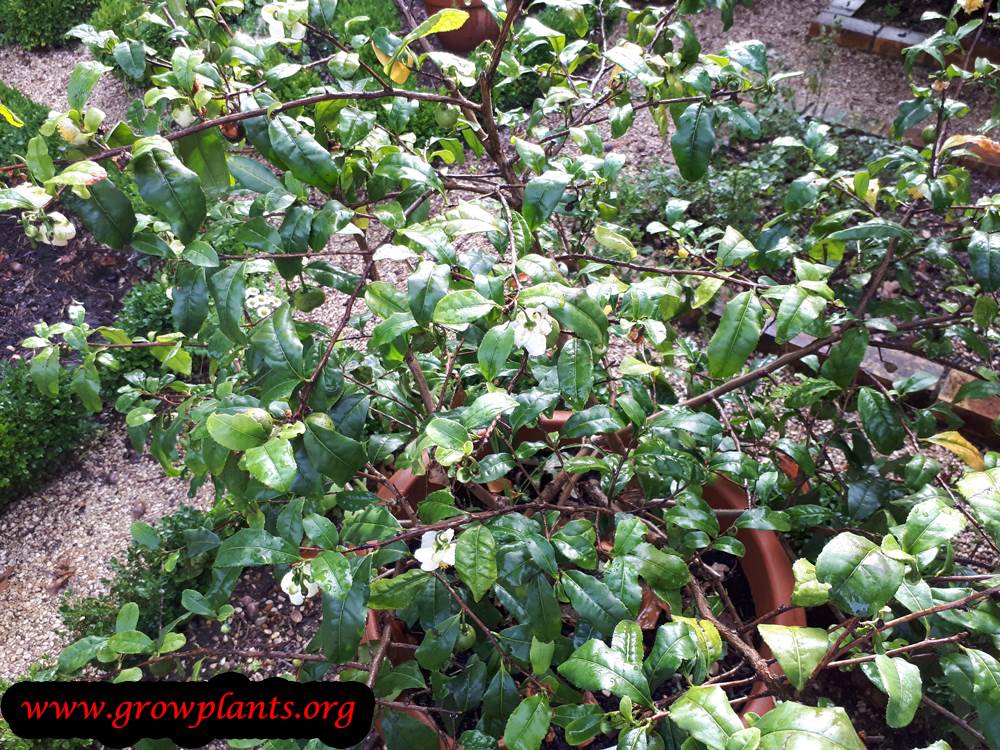
Plant Profile & Key Characteristics
Overview: An evergreen perennial shrub or small tree 1-4 m (3-13 ft) tall, grown for its edible leaves, which are the source of all true tea. It can also be kept as an ornamental clipped hedge.
Quick Specifications
| Specification | Attribute |
|---|---|
| Plant Type / Life Cycle | Perennial |
| Foliage Type | Evergreen |
| Mature Size | 1-4 m (3-13 ft) tall |
| Growth Rate | Slow |
| Toxicity | Non-toxic / edible (leaves used for tea) |
| Hardiness | USDA zone 9+ |
Growth Form & Structure
- Height & Spread: 1-4 m (3-13 ft) tall, usually kept lower by pruning; grows in the ground or in containers.
- Growth Habit & Form: Bushy evergreen shrub or small tree that responds well to hard clipping, keeping it as a low leaf-producing hedge.
- Lifespan & Maturity: Long-lived and slow-growing; leaf harvesting typically starts about 4-5 years after planting.
Anatomy & Physical Features
- Leaves & Foliage: Glossy green, ovate leaves with denticulate (finely toothed) edges; the young leaves are the edible part.
- Flower Characteristics: Small white to yellowish flowers, bee-pollinated (full detail in the Bloom section).
Primary Uses & Landscape Value
- Edible Uses: Young leaves and buds are processed into white, green and black tea (all from this one plant, differing only in processing).
- Functional & Ornamental Roles: Grown as a tea crop and as an evergreen ornamental or clipped hedge; suited to containers.
Care Guide: Planting, Soil & Watering
Overview: A slow-growing evergreen shrub (the source of tea) that needs a rich, moist, acidic soil and humid conditions. Steady moisture, mulch and good drainage keep it healthy.
Quick Care Requirements
| Requirement | Ideal Condition |
|---|---|
| Planting Season | Spring, summer or autumn |
| Growth Rate | Slow |
| Soil Type | Rich, moist, well-draining, acidic and mulched |
| Soil pH | Acidic (approximately 5.5-6.5) |
| Water Need | Moderate – keep evenly moist with humidity |
Planting & Establishment
- Best Planting Season: Plant in spring, summer or autumn.
- How to Plant:
- Hole Preparation: Dig a hole wider than the root ball.
- Soil Amendments: Amend with organic matter or compost and mulch to keep the acidic soil moist.
- Planting Depth: Set the root collar at soil level.
- Growth Speed & Expectations: Slow – patience is needed, with leaves harvested only after several years.
Soil, Watering & Drainage Care
- Soil Mix & Drainage Needs: Rich, humus-rich acidic soil that stays moist but drains freely; mulch conserves moisture.
- Watering Schedule & Technique:
- Young / Newly Planted: Keep consistently moist while young plants establish.
- Established: Water regularly to keep the soil evenly moist, with ambient humidity.
- Seasonal Adjustments: More water in summer heat, less in winter.
Climate, Light & Hardiness
The tea plant is a subtropical broadleaf evergreen that grows best in mild, humid climates with warm summers and no more than light winter frost. It takes full sun to half shade, prefers acidic soil and good atmospheric humidity, and is generally suited to warmer regions rather than cold-winter areas.
Quick Climate Specifications
| Climate Zones | Subtropical, warm temperate |
| USDA Hardiness Zones | Approximately zone 9 and warmer (per site data); some cultivars are reported to tolerate colder zones |
| Optimal Temp Range | Approximately 18–30 °C (64–86 °F) |
| Cold Damage Begins | Tender new growth and buds can be harmed around freezing, near 0 °C (32 °F) |
| Frost Tolerance | Low to Moderate (varies by cultivar and plant age) |
| Light Conditions | Full sun to half shade |
Sunlight & Light Exposure
Optimal Light Setup
Grow in full sun to half shade. In cooler, cloudier regions more direct sun encourages steady leaf production, while in hot climates some afternoon shade helps protect the foliage.
Shade & Heat Management
Light dappled shade during the hottest part of the day reduces leaf scorch and moisture stress in strong heat.
Temperature Extremes & Hardiness
USDA Hardiness & Regional Limits
The site classifies the tea plant around USDA zone 9 and warmer, reflecting its preference for mild winters. Cold tolerance varies by cultivar, plant age, exposure duration, and conditions, and some selections are reported to withstand somewhat colder conditions.
Cold Damage & Winter Protection
Young plants are noticeably more cold-sensitive than established specimens. Soft new growth and flower buds are the first tissues to suffer as temperatures approach and dip below freezing.
Frost Sensitivity
Established plants may briefly tolerate a few degrees of frost, but hard or prolonged freezes can cause dieback; treat any exact minimum with caution.
Extreme Heat Tolerance
Tolerates warm summers well when humidity and soil moisture are maintained; very hot, dry air increases stress on the foliage.
Wind, Humidity & Microclimate
Humidity Preferences
Prefers moderate to high atmospheric humidity, consistent with its origins in humid subtropical hill climates.
Dry-Air Tolerance
Low in very dry air - hot, arid winds can brown leaf margins.
Wind Tolerance
Moderate; shelter from strong, desiccating winds keeps foliage in good condition.
Microclimate Recommendations
A sheltered spot with morning sun and protection from cold winter winds suits it well; container plants freeze and dry at the root zone faster and benefit from extra winter protection.
Growing in Pots, Balconies & Indoors
The tea plant is an evergreen shrub that makes an excellent long-term container plant for a patio, balcony or cool conservatory, but the grower does not class it as a room houseplant – it wants strong light and fresh air. A pot is especially useful in cold areas, since it lets you move this tender, zone-9+ shrub under frost-free cover for winter.
Quick Details
- Container Size: Generous – start around 10 L and pot up toward 30-50 L (8-13 gal) as this 1-4 m shrub matures
- Indoor Suitability: Not a room houseplant; better on a bright patio or in a cool, bright sunroom
- Best Spot: Full sun to half shade, sheltered from cold drying wind
- Soil & Drainage: Rich, moist, acidic mix with mulch and humidity (grower’s guidance); must drain freely
- Watering in Pots: Average and steady – keep the acid mix moist; soft or rainwater suits it best
Indoors & On the Windowsill
- Not a room houseplant: The grower marks it unsuitable indoors – a warm, dim room gives too little light and humidity.
- Cool, bright cover: A cool sunroom, porch or bright cool sill can hold a young plant, especially over winter; keep it out of hot, dry air.
- Overwintering: In cold climates this is the main reason to pot it – shift it to a frost-free, bright spot before hard frost and back out in spring.
On a Balcony or Patio
- Light & shelter: A bright, sheltered patio or balcony suits it; screen it from cold, drying winds and fierce midday heat.
- Weight & runoff: A mature tub is heavy – set it on the strongest part of a balcony and mind acidic runoff on paving.
Choosing the Pot, Soil & Long-Term Care
- Pot & drainage: A large pot with strong drainage holes; skip a standing water saucer to avoid root rot. Terracotta breathes and dries faster, glazed or plastic holds moisture longer.
- Potting mix: An acidic (ericaceous), organic-rich mix with perlite for drainage; mulch the surface to hold moisture, as the grower advises.
- Feeding: Feed with an acid-loving (ericaceous) fertiliser through the growing season – potted nutrients leach with watering, so feed regularly but lightly.
- Repotting: Refresh the mix and pot up about every two years; on established plants, a light root and top prune keeps it in a manageable tub.
Fertilizing & Feeding
A moderate feeder grown for its leaves: give steady, nitrogen-leaning balanced nutrition through the growing season using an acidifying fertilizer, then ease off as growth slows.
Quick Fertilizing Specs
| Feeding Level | Moderate |
|---|---|
| Main Nutrient Priority | Balanced nutrition with a nitrogen lean to support leaf harvest, using an acidifying fertilizer |
| Best Feeding Period | Through the active growing season |
| Soil pH | Distinctly acidic soil |
| Reduce/Stop Feeding | Reduce feeding as growth slows and stop during the cool-season rest |
| Organic Options | Compost, mulch, or a slow-release organic fertilizer for acid-loving plants |
| Micronutrients | Iron and manganese availability drops in alkaline soil; watch for interveinal yellowing on new leaves |
Feeding by Growth Stage
Establishment after planting
Build a strong root system and framework in the first seasons after planting.
| Nutrient direction | Light balanced nutrition, ideally from a fertilizer formulated for acid-loving plants, while roots establish. |
|---|---|
| Timing | Through the first seasons after planting, during active growth. |
| Frequency | Light feeding during the active growing season. |
| Fertilizer types | Balanced complete fertilizer for acid-loving plants, Slow-release granular fertilizer, Compost or well-rotted organic matter |
| Precautions | Go easy on fertilizer while the plant is young; excess salts can burn developing roots. |
Active leaf growth
Sustain repeated flushes of tender new leaves, which are the harvest.
| Nutrient direction | A complete fertilizer with a nitrogen emphasis, ideally one for acid-loving plants, to keep pushing healthy new foliage. |
|---|---|
| Timing | Through the active growing season when new leaves are forming. |
| Frequency | Light, regular feeding across the growing season to support leaf flushes. |
| Fertilizer types | Nitrogen-forward complete fertilizer for acid-loving plants, Slow-release granular fertilizer, Compost or well-rotted organic matter |
| Precautions | Keep nitrogen steady but not excessive; overly lush growth is weaker and more pest-prone. |
Cool-season rest
Allow growth to slow in the cool season; feeding is not needed while growth has largely stopped.
| Nutrient direction | None – withhold fertilizer while growth is at rest. |
|---|---|
| Timing | During the cool season when growth slows markedly. |
| Frequency | No feeding at this stage. |
| Fertilizer types | No feeding at this stage – withhold fertilizer until active growth resumes. |
| Precautions | Do not fertilize while growth is at rest; wait until warm-season growth resumes. |
Nutrient Deficiency Signs & Corrections
Older, lower leaves turn uniformly pale green to yellow and growth is weak and slow.
| Possible causes | Low nitrogen availability in the soil, Cold or waterlogged soil limiting root uptake, Leaching of nitrogen from light, sandy soils |
|---|---|
| Appears first on | Older, lower leaves first. |
| What to check | Recent feeding history, Soil drainage and moisture, Whether older leaves are affected before the new growth |
| Possible correction | Apply a balanced complete fertilizer and correct any drainage or watering problems before adding more. |
The youngest leaves yellow between the veins while the veins themselves stay green.
| Possible causes | Alkaline soil pH reducing iron availability, Waterlogged or cold roots impairing uptake, A genuine shortage of available iron |
|---|---|
| Appears first on | New, young leaves at the shoot tips. |
| What to check | Soil pH, Drainage and root health, Whether only the new growth is affected |
| Possible correction | Correct soil pH toward the plant’s preferred range and, if the problem persists, apply a chelated iron product per its label. |
Brown, scorched leaf edges and tips, sometimes with wilting even when the soil is moist.
| Possible causes | Excess fertilizer or salt buildup in the soil, Under-watering that concentrates salts around the roots, Salt accumulation in containers |
|---|---|
| Appears first on | Leaf margins and tips across many leaves. |
| What to check | Recent fertilizer amounts, Salt buildup or the need to leach the soil, Watering consistency |
| Possible correction | Ease off feeding, leach the soil with plain water, and give only light feeding once the plant recovers. |
Pruning, Training & Seasonal Maintenance
The tea plant (Camellia sinensis) is a slow-growing evergreen camellia that naturally becomes a small tree of 1–4 m but is almost always kept low by pruning — either as a modest ornamental shrub or, where grown for leaf, as a knee-to-waist-high “plucking table.” It tolerates pruning well and even breaks readily from old wood, so the real question is which of two goals you are pruning for: flowers and form, or a dense flush of young pluckable shoots. Because it flowers on the previous season’s wood in autumn–spring, shaping is safest just after that bloom, while leaf-harvest tipping happens through the growing season regardless of bloom.
Quick Pruning & Maintenance Specs
| Pruning Tolerance | High – reshoots freely, including from old wood |
| Primary Pruning Window | Early spring, just after the autumn–spring flowering ends and before the main growth flush |
| Secondary Maintenance Window | Growing season (spring–autumn) for leaf-tip harvesting / table maintenance |
| Typical Frequency | Light shaping yearly; frequent tipping if grown for tea; hard renewal every several years |
| Main Objective | Keep low and dense – either an ornamental shape or a flat plucking surface of young shoots |
| Young Plant Priority | Tip early and repeatedly to force low branching and build a wide frame |
| Mature Plant Priority | Maintain height/density; renew tired wood; harvest young flushes |
| Best Tool Type | Bypass secateurs for shaping; shears only for a formal plucking table; saw for renewal |
| Avoid Heavy Pruning During | Cold snaps and mid-winter in marginal zones; just before an expected frost on the new flush |
Pruning by Plant Age & Size
Newly Established
For the first year or two remove only damaged or weak twigs and let roots establish. If you intend a plucking table, begin low formative tipping early rather than allowing a single tall leader.
Young / Formative
Build a low, wide, multi-branched frame by pinching or tipping the leaders repeatedly — this “centering” forces the flat, densely branched table that makes leaf harvest easy and also suits a compact ornamental bush. No single-leader tree training is wanted here.
Mature / Established
Keep the bush at working height, thin any congested or exhausted wood, and — for tea — skim the surface regularly to keep a carpet of tender young shoots. Every few years a harder cut-back renews vigour.
Seasonal Pruning Schedule
Early Spring (post-flowering, pre-flush)
Objective: shape and renew before the strong spring flush. Remove dead, crossing and worn-out stems and lower the frame if needed. Do not strip all the healthy young wood if you also want some autumn bloom.
Growing Season (spring–autumn)
Objective: harvest and maintain density. Tip the soft flushes (the two-leaves-and-a-bud used for tea) — this doubles as pinching and keeps the table flat and productive. Expect fresh flushes to follow each tipping.
Ongoing Sanitary
Remove leaf-spotted foliage and any stems showing crown gall or black rot, and clear fallen debris to reduce reinfection.
Flowering & Fruiting Wood
Flower buds form on the previous season’s growth and open from autumn into spring, so a hard late-summer or autumn cut removes that bloom. Because the plant is grown chiefly for its leaves, most tea growers accept reduced flowering in exchange for continual young-shoot production; if you value the small white flowers, confine shaping to just after bloom and keep tipping light.
Structural Pruning & Training
Select a framework of well-spaced low branches, remove crossing or inward wood, and control height and spread to keep the bush at a comfortable working level. Thinning a congested centre improves light and shoot quality; a flat, wide silhouette is deliberately encouraged for leaf work.
Special Growth to Remove
Not grafted, so any basal shoots are the plant’s own — retain a few strong ones to renew the frame over time and remove only weak twiggy clutter. Clear old worn wood during the renewal cut rather than treating every vigorous shoot as a problem.
Container & Small-Space Pruning
Tea grows well in a pot; keep it compact by frequent tipping rather than one hard annual cut, and balance top growth to the restricted roots. Regular light pinching gives the fullest small bush and a steady supply of young leaves.
Tools
Bypass secateurs for shaping and thinning; a small pruning saw or loppers for renewal cuts on older basal wood; precision snips or fingertips for harvesting soft tips. Hedge shears are appropriate only if you are deliberately maintaining a formal flat plucking table — not for selective ornamental shaping.
Tool Hygiene & Disease Risk
Increased where crown gall, black rot or leaf spot are present: crown gall is a soil-borne bacterium that enters wounds, so avoid needless basal injuries and clean blades after cutting galled or spotted material before moving to healthy plants.
Cut Placement & Technique
Shape with thinning cuts back to a branch junction; tip to an outward-facing bud to keep the centre open. Harvest leaf by pinching the soft flush just above a node so the shoot rebranches. Cut larger renewal wood cleanly just above healthy growth.
Heavy Pruning & Rejuvenation
Well tolerated — an old, leggy or exhausted bush can be cut back hard (in some tea culture almost to a low collar) and will regenerate from the framework over one to two seasons. Expect a season of leafy regrowth with little flowering before it settles back into production.
Post-Pruning Care
Keep the acid, humus-rich soil evenly moist and mulched after a hard cut to support regrowth; feeding is only needed if growth is genuinely weak. Watch the tender new flush for frost and for the pests noted above.
Common Pruning Mistakes
- Letting a young plant run up as a single tall stem instead of building a low, wide frame.
- Shearing an ornamental specimen like a hedge, spoiling its form and removing flower wood.
- Timing a heavy cut in autumn and losing the winter bloom, when early spring would keep it.
- Wounding the base carelessly where crown gall is about.
When NOT to Prune
Avoid hard cuts going into cold weather in marginal zones, and hold off just before a frost that could scorch a fresh flush. Do not cut back a plant already stressed by drought — water and recover it first.
Recommended Tools (by task)
- bypass_secateurs — the everyday tool for shaping, thinning and renewal of pencil-thick stems.
- hedge_shears — only if maintaining a formal flat plucking table of dense young shoots.
- pruning_saw — for the occasional hard renewal cut on thick old basal wood.
Pruning Troubleshooting
| Problem | Possible Cause | What to Check | Corrective Action |
| Bush tall and bare at the base | Never tipped low when young; grown as a leader | Height of lowest live branches; age | Hard-renew and retrain a low wide frame with early tipping |
| Few young pluckable shoots | Table not skimmed; wood aged out | Density of soft new flushes | Tip regularly through the season; renew tired wood |
| Little or no bloom after pruning | Cut in autumn removed previous-season flower wood | Timing of last hard cut vs bud set | Shift shaping to just after flowering; keep some healthy wood |
| Dieback from a cut | Cutting into disease or during cold; galled base | Cut ends, cold events, crown gall | Remove to clean wood, clean tools, avoid cold-season heavy cuts |
Propagation Guide
The tea plant is most usefully increased by semi-hardwood cuttings, which the site notes are easy to take and which reproduce a chosen bush exactly. Seed is viable but short-lived and gives variable plants, so it is used mainly for raising quantities or for breeding.
Quick Propagation Specs
| Best Propagation Method | Semi-hardwood cuttings |
| Alternative Methods | Seed; ground or air layering |
| Propagation Difficulty | Moderate |
| Seed True-to-Type | Variable |
| Vegetative True-to-Type | Yes |
| Best Propagation Season | Late summer for cuttings; sow seed fresh in autumn |
| Germination Temperature | 20–25°C (68–77°F) |
| Cutting Rooting Time | Typically several months |
| Seed Sowing Depth | About 1–2 cm |
Growing from Seed
Seed Handling & Viability
Camellia seed is short-lived and does not store well; sow it fresh and do not let it dry out, as viability falls quickly.
Dormancy & Pre-Sowing Treatment
The seed has a hard coat; soaking in warm water, and lightly nicking the coat, speeds water uptake and evens up germination.
Germination Conditions
Sow into a moist, acidic, free-draining medium and keep warm, about 20–25°C (68–77°F).
Germination Time
Germination is often staggered, from several weeks to a few months. Seedlings are variable and take time to reach a useful size.
Stem Cuttings
Cutting Type
Take semi-hardwood, single-node (leaf-bud) cuttings from the current season’s growth.
Best Timing
Late summer, once the new growth has begun to firm.
Cutting Preparation
Use pieces about 8–10 cm with a leaf or two retained, and give the base a light wound.
Rooting Setup
Root in an acidic, free-draining mix under high humidity or mist, with gentle bottom warmth.
Rooting Hormone
Beneficial, because tea cuttings are slow to root.
Rooting Time
Rooting typically takes several months.
Air & Ground Layering
Low branches can be ground-layered by wounding and pegging a shoot into acidic soil; roots usually form over about a year, after which the layer is separated. Air layering of a firm shoot works on the same principle.
Bloom & Flower Guide
Quick Details
- Bloom Season: Autumn through winter and into spring
- Flower Appearance: Small, nodding white to cream flowers with a boss of yellow stamens
- Edibility: Grown for its leaves, the source of tea; the flowers are treated as ornamental
Detailed Blooming Overview
The tea plant is an evergreen camellia that flowers in the cool part of the year, from autumn through winter into spring. Its small white blooms, centred with fluffy yellow stamens, are lightly fragrant and draw bees on mild days, though the plant is of course grown mainly for the young leaves that make tea.
Flower Characteristics
- Small, cupped white to cream flowers
- Prominent central cluster of yellow stamens
- Lightly scented and attractive to bees
Bloom Care & Thinning
- Pollination: worked by bees, so no intervention is needed
- Siting for bloom: shelter, steady moisture and light shade in hot climates give the best flowering
- Balancing leaf and flower: on plants harvested for tea, regular tipping of the shoots naturally limits flowering
Bloom Health & Protection
- Camellia petal blight can brown and collapse open flowers in damp weather – clearing fallen blooms and refreshing mulch reduce it, and a suitable fungicide can help in bad spells
- Aphids sometimes gather on soft buds and shoots – a water jet or insecticidal soap keeps them down
Fruit & Uses
The tea plant is grown for its young leaves, buds and tender shoots, which are processed into tea and drunk as a beverage. Green, black and white tea all come from this one plant — the differences are in how the picked leaves are processed.
Quick Edible Specs
| Edible Parts | Young leaves, buds and tender shoots/stems |
|---|---|
| Main Use(s) | Beverage — green tea, black tea, white tea and more |
| Eaten Raw or Cooked | Processed (withered, dried and variably oxidised), then infused in hot water |
| Preparation Required | Pick the young flush of leaves and buds; process according to the tea type (the degree of oxidation gives green vs. black vs. white tea) |
| Harvest Season | All year (picking the young flushes) |
| Time to First Harvest | Only a few years after planting, once the shrub is established (see the growing/pruning notes) |
| Storage | Dried, processed tea keeps well when kept dry and sealed |
| Safety/Toxicity Caveat | None noted for normal beverage use |
Leaves & Greens
The ovate, denticulate-edged young leaves — together with the leaf buds and tender stem tips — are the harvested part. Pick the soft young flush rather than old, hardened leaves. Once the shrub is established (a few years after planting), the young leaves can be trimmed for use year-round.
Preparation, Uses & Safety
The picked leaves are processed — withered, dried and oxidised to varying degrees — to make the different teas (white, green and black all from the same plant), then infused in hot water as a beverage. No special safety preparation is required for ordinary tea use.
Pests, Diseases & Troubleshooting
Overview: Camellias are acid-loving broadleaf evergreens whose glossy leaves and buds attract scale insects, mites and aphids, while their fine surface roots are sensitive to alkaline soil and drought. The signature disorders are lime-induced iron chlorosis and bud drop, and the signature diseases are petal blight and root rot. Right soil (acidic, moist, well-drained), shelter and good hygiene prevent most trouble; treat the sap-suckers organically before reaching for stronger sprays.
Quick Troubleshooting Overview
| Issue / Pest | Main Symptom | Primary Solution |
|---|---|---|
| Tea scale | White/brown flecks under leaves, yellow tops | Horticultural oil, prune, encourage parasitoids |
| Spider mites | Bronzed, dull, speckled leaves | Hose off, oil in dry heat |
| Tea mosquito bug | Blackened blister spots on shoots/leaves | Prune, encourage predators, targeted spray |
| Iron chlorosis | Yellow leaves, green veins on new growth | Acidify soil, iron chelate, mulch |
| Root rot | Wilting, dieback, dark rotten roots | Improve drainage, no cure, remove plant |
| Blister blight | Translucent then blistered leaf spots (tea) | Airflow, remove leaves, copper if severe |
Common Pests & Management
- Tea scale (Fiorinia theae):
- Symptoms: The signature camellia scale: tiny elongate white (male) and brown (female) scales encrusting leaf undersides, causing yellow blotches on the upper surface, leaf drop and thin, weak plants; heavy honeydew brings sooty mould.
- Prevention & Control: Prune to open up dense bushes for spray penetration and light, encourage the many parasitoid wasps and ladybirds that attack scale, and remove badly encrusted leaves. Apply horticultural oil thoroughly to leaf undersides, timing repeat sprays to the crawler stage.
- Soft scales and mealybugs (Coccus, Saissetia, Pseudococcus species):
- Symptoms: Brown domed or waxy bumps on stems and leaf midribs and cottony mealybug tufts in leaf axils, with sticky honeydew and blackening sooty mould.
- Prevention & Control: Scrape off or wipe with alcohol on small plants, encourage natural enemies, and smother with horticultural oil, repeating to catch crawlers. Control ants that farm the scale.
- Camellia aphid and tea aphid (Toxoptera aurantii, Aphis species):
- Symptoms: Dark colonies on soft new shoots and flush growth, curling the tender leaves and coating them with sticky honeydew and sooty mould; especially on spring and autumn flushes.
- Prevention & Control: Hose off, encourage predators, and pinch out badly infested tips. Treat persistent colonies on the new flush with insecticidal soap or neem in the cool of the day.
- Spider mites (southern red mite) (Oligonychus ilicis, Tetranychus urticae):
- Symptoms: Fine stippling, a dull bronze-grey cast to the leaves and delicate webbing, worst in hot, dry, dusty conditions; older leaves look tired and off-colour.
- Prevention & Control: Hose down foliage and reduce dust and drought stress. Release predatory mites where practical, and treat outbreaks with horticultural oil, covering leaf undersides; avoid broad insecticides that kill mite predators.
- Tea mosquito bug (Helopeltis species):
- Symptoms: A key pest of tea: slender long-legged bugs whose feeding leaves dark, blister-like necrotic spots on young shoots, leaves and buds, deforming and blackening the flush and reducing yields.
- Prevention & Control: Prune and maintain an even plucking surface, remove alternate weed hosts, and encourage natural predators. On tea grown for harvest, monitor the flush closely and use targeted, label-approved sprays only when thresholds are crossed, protecting beneficials.
- Vine weevil (Otiorhynchus sulcatus):
- Symptoms: Adults notch leaf margins at night; grubs eat the roots of container camellias, causing wilting and collapse of apparently healthy potted plants.
- Prevention & Control: Inspect the rootball of wilting pots for creamy C-shaped grubs, and drench with parasitic nematodes in warm soil. Remove adults at night; keep plants vigorous.
Diseases & Fungal Issues
- Phytophthora root rot (Phytophthora cinnamomi):
- Symptoms: A major killer: plants become dull, sparse and yellow, wilt despite moisture, and die back branch by branch as the fine roots rot dark and brittle; worst in heavy, wet or alkaline soil.
- Treatment & Management: There is no cure – improve drainage before planting, never plant too deep or overwater, and remove and destroy badly affected plants. Grow in raised, acidic, humus-rich free-draining soil and choose resistant rootstocks/species where available.
- Blister blight (Exobasidium vexans):
- Symptoms: The key tea disease in humid regions: small translucent spots on young leaves that swell into pale blisters on the underside, then brown and shot-hole, damaging the harvestable flush.
- Treatment & Management: Prune and pluck to reduce dense wet canopy, improve airflow and avoid excess shade and leaf wetness. On tea grown for harvest, protective copper fungicides are used in wet seasons, following local guidance.
- Leaf gall (Exobasidium camelliae / vexans):
- Symptoms: Young leaves and shoots swell into thick, fleshy, pale galls that later turn white and powdery as they release spores, then brown and shrivel.
- Treatment & Management: Pick off and destroy galls before they turn white and shed spores, and improve airflow. It is disfiguring but rarely serious; sanitation usually controls it.
- Algal leaf spot (Cephaleuros virescens):
- Symptoms: Raised, velvety grey-green to rust-coloured circular spots on the upper leaf surface in warm, humid, still conditions, especially on stressed plants.
- Treatment & Management: Improve airflow and light by pruning, reduce leaf wetness, and keep plants vigorous. Remove badly spotted leaves; a copper-based spray helps on valued plants under high pressure.
- Sooty mould (Capnodium and related fungi):
- Symptoms: Black, soot-like coating over leaves and stems, growing on the honeydew excreted by scale, aphids and mealybugs; it blocks light but does not infect the plant directly.
- Treatment & Management: Control the underlying sap-suckers (scale, aphids, mealybugs) and the mould will weather off. Wipe leaves of prized plants; treat ants that spread the honeydew producers.
- Camellia yellow mottle virus (Camellia yellow mottle virus):
- Symptoms: Irregular yellow or white blotches and mottling on leaves and sometimes flowers; often mild, but not correctable and spread through propagation.
- Treatment & Management: There is no cure; propagate only from clean, healthy stock and remove severely affected plants. Some growers tolerate mild leaf variegation caused by the virus as ornamental.
Growing Difficulties & Abiotic Problems
- Lime-induced iron chlorosis (wrong pH):
- Cause & Symptoms: The signature camellia disorder: on alkaline soil or with hard water the newest leaves yellow between green veins and the plant weakens, because iron and manganese are locked up.
- Correction Strategy: Grow only in acidic soil (pH about 5.5–6.5) or ericaceous compost, use rain or soft water, and mulch with composted bark or pine needles. Correct symptoms with an iron chelate (Fe-EDDHA) and acidifying ericaceous feed.
- Bud drop and bud balling:
- Cause & Symptoms: Flower buds form but drop off before opening, or fail to open and brown (‘balling’), caused by drought or erratic watering in late summer, cold snaps or sudden weather swings.
- Correction Strategy: Water consistently through the bud-forming period from late summer, mulch to buffer moisture, and shelter from cold drying winds and hard frost. Avoid letting plants dry out when buds are developing.
- Oedema (corky leaf bumps):
- Cause & Symptoms: Rough, corky, blister-like bumps on leaf undersides form when roots take up more water than cool, humid air lets the leaves transpire, common on over-watered container plants.
- Correction Strategy: Reduce watering in cool, damp, low-light spells, improve airflow and light, and avoid soggy compost. The existing marked leaves will not recover but new growth will be clean.
- Sunscald and cold/frost damage:
- Cause & Symptoms: Fierce sun scorches brown patches on leaves and flowers, while frost browns and drops buds and marks tender growth and open blooms.
- Correction Strategy: Site camellias in dappled shade or morning sun with shelter from hot afternoon sun and cold dawn sun after frost; protect early bloomers from frost. Avoid planting on frost-pocket east-facing walls.
What Helps – Products & Tools
The camellia toolkit blends organic pest control and acid-soil care: horticultural oil and insecticidal soap for scale, mites, aphids and mealybugs, blue sticky traps for thrips, and parasitic nematodes for vine-weevil grubs in pots. For disease, hygiene leads – removing blighted flowers, galls and fallen debris – with copper fungicide for algal or blister issues on valued plants. Correct the signature yellowing with iron chelate (Fe-EDDHA), ericaceous feed and acidic mulch, and keep soil moist and well drained.