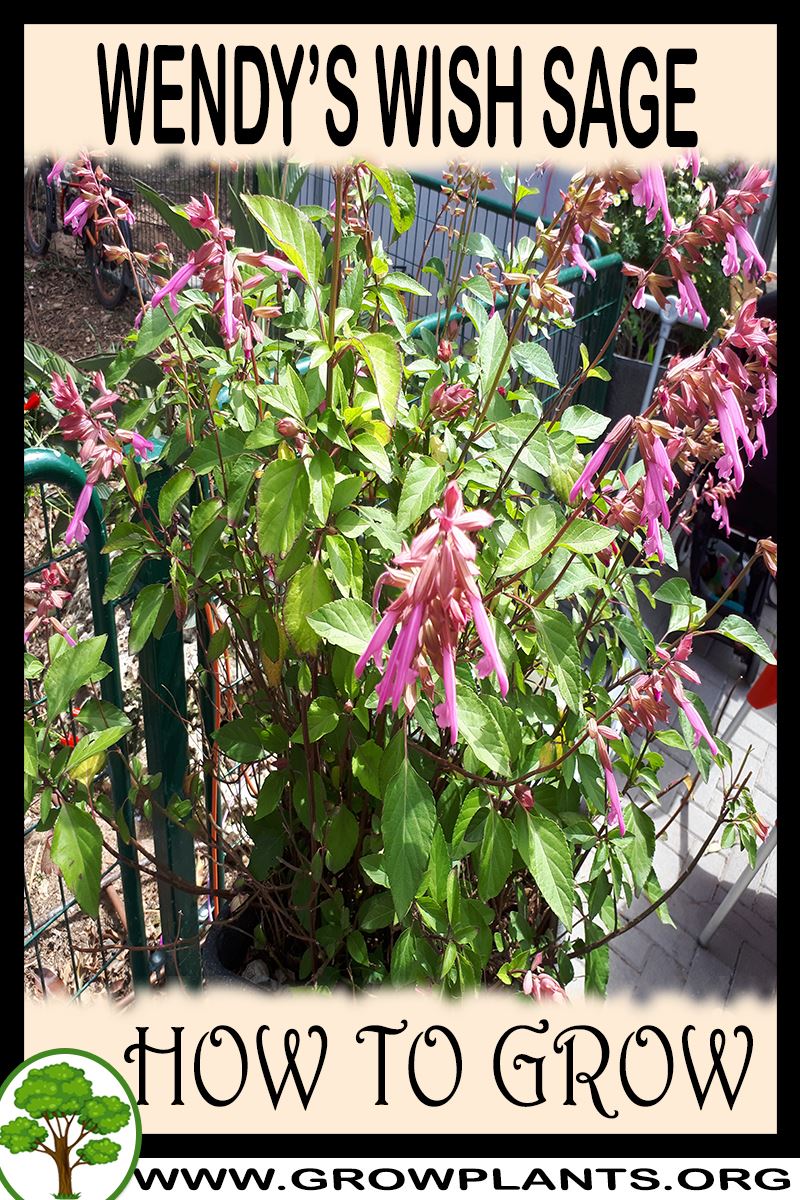
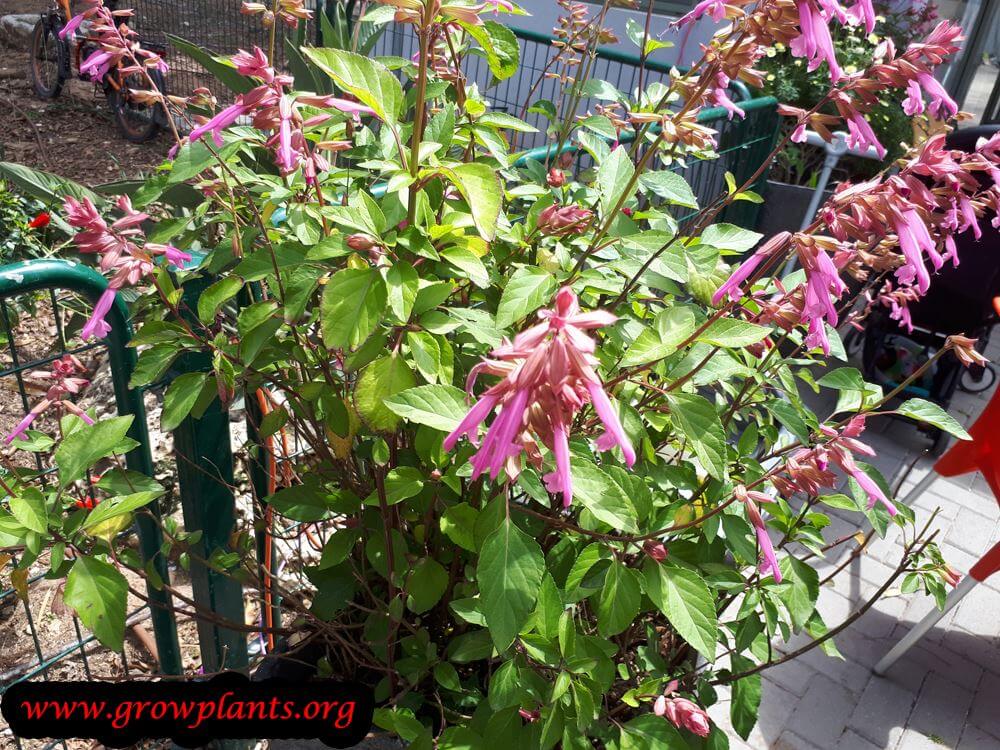
Plant Profile & Key Characteristics
Overview: A shrubby sage hybrid reaching about 50-90 cm (20-36 in) tall, grown as an ornamental and a magnet for pollinators. It is evergreen in frost-free climates and grown as an annual where winters are cold.
Quick Specifications
| Specification | Attribute |
|---|---|
| Plant Type / Life Cycle | Tender woody perennial (grown as an annual in cold climates) |
| Foliage Type | Evergreen in frost-free climates |
| Mature Size | 50-90 cm (20-36 in) tall |
| Growth Rate | Moderate |
| Hardiness | USDA zone 10b and warmer as a perennial; grown as an annual in zones 5-10a |
Growth Form & Structure
- Height & Spread: In the ground a bushy plant 50-90 cm (20-36 in) tall; grows well in a container.
- Growth Habit & Form: Upright, well-branched shrubby sage that forms a bushy mound of leafy stems.
- Lifespan & Maturity: A tender perennial that returns from the base where frost-free and reaches flowering size in its first season, blooming spring through autumn.
Anatomy & Physical Features
- Leaves & Foliage: Green oval leaves carried on upright branching stems.
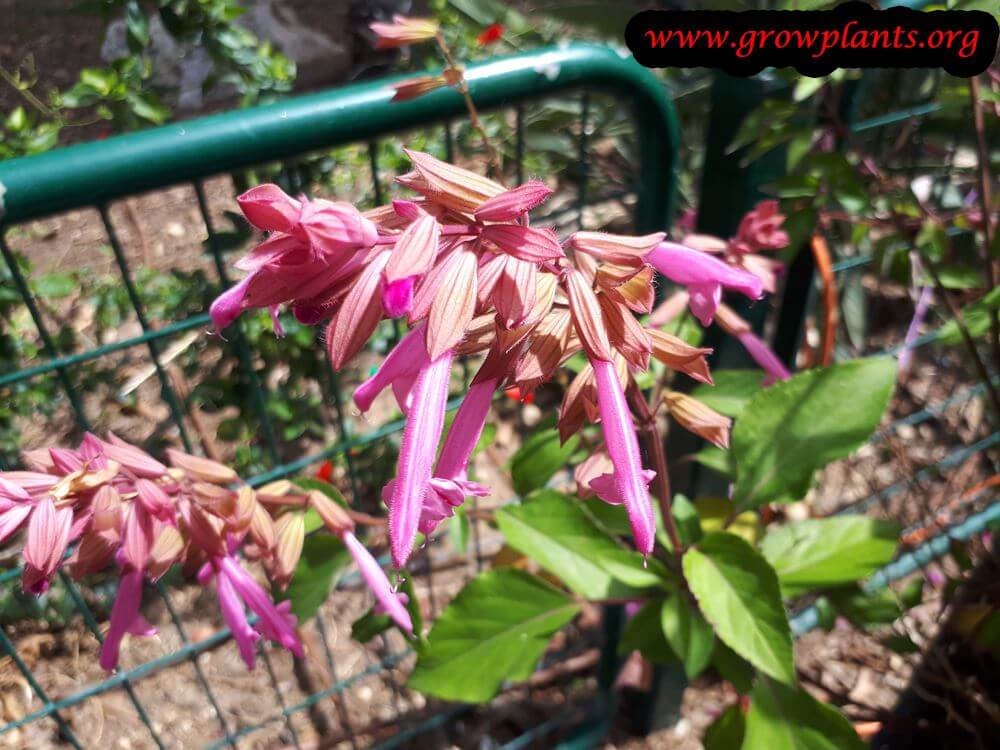
- Flower Characteristics: Tubular flowers in purple, pink and magenta, borne over a long season and attractive to hummingbirds and other pollinators.
Primary Uses & Landscape Value
- Functional & Ornamental Roles: Border and container ornamental grown for its long flowering season and strong value as a pollinator and hummingbird plant.
Care Guide: Planting, Soil & Watering
Overview: Wendy’s Wish is a vigorous hybrid sage for full sun to light shade in rich, well-draining soil. It flowers best with steady moderate to generous moisture and a yearly feed.
Quick Care Requirements
| Requirement | Ideal Condition |
|---|---|
| Planting Season | Spring (as an annual, zones 5-10a); spring to summer (10b); spring, autumn or year-round (11) |
| Growth Rate | Moderate |
| Soil Type | Rich, well-draining soil |
| Water Need | Moderate to high — keep the soil consistently moist, never letting it dry out for long |
Planting & Establishment
- Best Planting Season: Plant in spring as an annual in zones 5-10a, spring to summer in zone 10b, and spring, autumn or year-round in zone 11.
- How to Plant:
- Hole Preparation: Dig a planting hole roughly twice as wide as the root ball but no deeper, so the roots can spread into loosened soil.
- Soil Amendments: Work in plenty of compost or well-rotted organic matter to enrich the soil and help it hold moisture while still draining freely.
- Planting Depth: Set the plant at the same depth it grew in its pot, with the root collar level with the surface — never bury the stem, which invites rot.
- Growth Speed & Expectations: Expect a moderate, steady pace of growth, reaching a good size over a season or two.
Soil, Watering & Drainage Care
- Soil Mix & Drainage Needs: Provide rich but well-aerated soil that drains freely; in containers use a quality potting mix lightened with perlite or vermiculite, and ensure the pot drains freely so water never pools around the roots.
- Watering Schedule & Technique:
- Young / Newly Planted: Water generously and often after planting to keep the soil consistently moist while the roots establish.
- Established: Provide regular, deep watering so the soil stays reliably moist; do not let it dry out for long.
- Seasonal Adjustments: Increase watering through summer heat and reduce it in winter, keeping the soil from ever fully drying.
Note: Space plants roughly 30-40cm (12-16in) apart.
Climate, Light & Hardiness
Salvia 'Wendy's Wish' suits Mediterranean, subtropical, temperate, and tropical climates in full sun to half shade. It stays evergreen and perennial in essentially frost-free areas, while colder regions grow it as a warm-season annual.
Quick Climate Specifications
| Climate Zones | Mediterranean, Subtropical, Temperate, Tropical |
|---|---|
| USDA Hardiness Zones | 10b and warmer as a perennial; grown as an annual in zones 5–10a |
| Frost Tolerance | Low |
| Light Conditions | Full Sun to Half Shade |
Sunlight & Light Exposure
Optimal Light Setup
Full sun to half shade both suit this salvia; more sun generally means denser growth and heavier bloom.
Temperature Extremes & Hardiness
USDA Hardiness & Regional Limits
Perennial and evergreen in USDA zone 10b and warmer. In zones 5–10a, winter freezes typically kill the plant, so it is grown as an annual, planted out in spring.
Cold Damage & Winter Protection
At the cooler edge of its perennial range, mulching the base with wood chips or dead leaves over winter helps protect the crown for spring regrowth.
Frost Sensitivity
Frost blackens foliage and flowers; hard freezes kill the plant outside zone 10b.
Growing in Pots, Balconies & Indoors
Wendy’s Wish sage (Salvia ‘Wendy’s Wish’) is a 50-90 cm (20-36 in) flowering shrub that the grower grows in containers but not as a houseplant. It is a magnet for pollinators on a sunny patio or balcony, and a pot lets you shelter this tender salvia over winter in cold areas.
Quick Details
- Container Size: A 10-20 L (3-5 gal) pot for a mature plant
- Indoor Suitability: Not a houseplant; it needs strong light to flower
- Best Spot: Full sun to half shade – warm and bright; light shade in the hottest climates
- Soil & Drainage: Rich, well-drained mix
- Watering in Pots: Average to generous – keep evenly moist in heat, but never waterlogged
Indoors & On the Windowsill
- Houseplant limits: The grower does not list it as a houseplant – a room’s light is too weak for good bloom.
- Overwintering: It is frost-tender (a perennial only in zone 10b+). In cold climates, growing it in a pot lets you move it to a bright, frost-free spot over winter.
On a Balcony or Patio
- Light & wind: Give it the sunniest spot; walls, railings and paving throw back heat so pots dry quickly – check moisture often and shelter or stake it on an exposed, windy balcony.
- Practicalities: Account for the weight of a full pot and make sure drainage water can run away freely without staining the balcony.
Choosing the Pot, Soil & Long-Term Care
- Pot & drainage: Use a pot with strong drainage holes and skip a standing-water saucer to avoid root rot; terracotta breathes and dries faster, while glazed or plastic holds moisture longer.
- Potting mix: Well-aerated and organic-rich – a quality potting mix, or peat/coir with perlite or vermiculite.
- Feeding: A hungry, long-flowering salvia in a pot – feed regularly through the growing season as nutrients leach out.
- Repotting: Refresh the surface mix each year and pot on or divide every couple of years, trimming the roots lightly once it fills the container.
Fertilizing & Feeding
A light feeder: this pollinator-friendly salvia grows well in rich, well-drained soil with only modest balanced feeding through its long bloom season, needing little beyond that to perform well.
Quick Fertilizing Specs
| Feeding Level | Light feeder |
|---|---|
| Main Nutrient Priority | Balanced feeding that favors steady flowering over rank stem growth |
| Best Feeding Period | Spring through the long spring-to-autumn bloom season |
| Organic Options | Compost or well-rotted organic matter worked into rich, well-drained soil |
| Reduce/Stop Feeding | Ease off as the plant heads into winter protection under mulch |
| Micronutrients | Usually met by rich soil and a complete fertilizer; correct only a diagnosed deficiency |
| Soil pH | Tolerates a wide range, doing well in fertile, well-drained soil |
Feeding by Growth Stage
Spring growth after winter mulch is removed
Support fresh shoot growth as the plant comes out of winter protection.
| Nutrient direction | A light, balanced feeding is enough to restart growth without pushing soft new stems. |
|---|---|
| Timing | In spring once new growth appears and winter mulch is pulled back. |
| Frequency | A single light feeding at the start of spring growth is generally enough. |
| Fertilizer types | A balanced complete fertilizer at a light rate, Compost or organic matter refreshed around the base |
| Precautions | Keep feeding light; this plant does not need heavy fertilizing to perform well. |
Main bloom flush
Fuel the tubular purple, pink, or magenta flowers that draw in pollinators.
| Nutrient direction | A light, balanced feeding sustains flowering without forcing excess foliage. |
|---|---|
| Timing | As the main flush of flowers opens through the warm season. |
| Frequency | Rarely needs more than an occasional light feeding through this stretch. |
| Fertilizer types | A balanced complete fertilizer at a light rate |
| Precautions | Avoid heavy nitrogen feeding, which can favor foliage over the flowers pollinators are drawn to. |
Repeat flowering into autumn
Keep this long-blooming salvia flowering for pollinators later in the season.
| Nutrient direction | A light follow-up feeding after trimming spent flower spikes helps renew blooming. |
|---|---|
| Timing | Late summer into autumn as flowering continues. |
| Frequency | A single light follow-up feeding is generally enough. |
| Fertilizer types | A balanced complete fertilizer at a light rate |
| Precautions | Taper feeding as autumn approaches so growth can harden off before winter protection goes down. |
Winter protection under mulch
Let the plant rest through winter under a protective layer of mulch or dead leaves.
| Nutrient direction | None – withhold fertilizer while the plant is protected and not in active growth. |
|---|---|
| Timing | Through winter while mulched for protection at the base. |
| Frequency | No feeding at this stage. |
| Fertilizer types | No feeding at this stage; hold off fertilizing until spring growth resumes. |
| Precautions | Do not fertilize the mulched, dormant plant; withhold feeding until new spring growth appears. |
Nutrient Deficiency Signs & Corrections
Older leaves fade to pale green or yellow and flowering slows even during the main bloom season.
| Possible causes | low available soil nitrogen, nutrients leached from well-drained soil, thin soil low in organic matter |
|---|---|
| Appears first on | older, lower leaves |
| What to check | recent feeding history, soil organic matter, overall vigor compared with earlier in the season |
| Possible correction | Apply a light, balanced complete fertilizer and refresh organic matter around the base. |
Interveinal yellowing shows on older leaves while the veins themselves stay green.
| Possible causes | low soil magnesium, leaching in light, well-drained soil, potassium-heavy feeding competing with magnesium uptake |
|---|---|
| Appears first on | older, lower leaves |
| What to check | soil magnesium status, soil texture and drainage, recent fertilizer balance |
| Possible correction | Apply a labeled magnesium source such as Epsom salt and keep feeding balanced. |
Leaf margins brown or scorch and growth stalls even with adequate watering.
| Possible causes | fertilizer salts accumulating from feeding more than this light feeder needs, irregular watering concentrating salts, poor drainage holding salts near the roots |
|---|---|
| Appears first on | leaf margins and tips |
| What to check | how much and how often fertilizer has been applied, watering consistency, soil drainage around the base |
| Possible correction | Ease off feeding and water thoroughly to flush accumulated salts before returning to a light routine. |
Pruning, Training & Seasonal Maintenance
Salvia ‘Wendy’s Wish’ is a vigorous, semi-woody flowering subshrub that blooms almost continuously on new growth. It tolerates frequent light pruning very well, and because flowers form on new wood rather than old, regular tip-pinching and deadheading only encourage more bloom. Where it is grown as a perennial (hardiness zone 10b+), an annual renewal cutback in early spring is the main structural task, keeping the plant from becoming sparse and woody at the base.
Quick Pruning & Maintenance Specs
| Pruning Tolerance | High |
| Primary Pruning Window | Early spring, as new growth resumes (perennial zones) |
| Secondary Maintenance Window | Ongoing light deadhead/tip-prune through spring–autumn bloom |
| Typical Frequency | Light trimming every couple of weeks in bloom; one hard cutback per year |
| Main Objective | Prolong continuous bloom and prevent a leggy, woody base |
| Young Plant Priority | Pinch tips to build a bushy, multi-branched base |
| Mature Plant Priority | Annual renewal cutback plus ongoing deadheading |
| Best Tool Type | Precision snips for deadheading; bypass secateurs for the spring cutback |
| Avoid Heavy Pruning During | Autumn/pre-frost period in marginal zones (5–10a grown as annual, 10b as perennial) |
Pruning by Plant Age & Size
Newly Established
Pinch out the growing tip once the young plant has a couple of leaf pairs to encourage branching from low down, rather than one tall single stem.
Young / Formative
Continue pinching tips through the first season to build a dense, bushy, multi-stemmed framework — this salvia has no formal leader/framework training, just repeated tip pinching.
Mature / Established
Deadhead spent flower spikes continuously to sustain bloom, and where grown as a perennial, give the whole plant a renewal cutback each early spring before new growth begins.
Seasonal Pruning Schedule
Pre-Growth/Early-Spring
Objective: rejuvenate a plant that has become woody or straggly at the base over the previous season. Remove: up to a third to half of the previous season’s growth, and any frost- or cold-damaged stems. Do not remove: live basal growth needed to resprout. Expected response: a flush of vigorous new shoots. Flowering impact: none lost, since bloom forms on the new growth this cutback stimulates.
Ongoing Sanitary
Objective: keep the long spring–summer–autumn bloom period going. Remove: spent flower spikes, cutting back to a healthy leaf pair. Do not remove: developing buds. Expected response: continued reflowering. Flowering impact: directly extends bloom.
Flowering & Fruiting Wood
This salvia flowers on current-season growth, not old wood, so pruning at almost any point in the growing season simply delays the next flush rather than sacrificing a whole year’s bloom — which is what makes the early-spring hard cutback safe and effective.
Structural Pruning & Training
The only structural concern is the plant becoming woody, sparse, and open at the base with age; the annual renewal cutback keeps it compact and full rather than leggy. No formal leader or framework training applies.
Special Growth to Remove
- Frost- or cold-damaged stem tips, best removed once new growth shows where the live wood begins, rather than guessed at in autumn.
- Spent flower spikes, to keep the continuous bloom cycle going.
Container & Small-Space Pruning
Grows well in containers; pot-grown plants benefit from slightly more frequent pinching to stay compact, since limited root volume can otherwise push it toward a single leggy stem. The same early-spring renewal cutback applies.
Tools
- Precision snips — for pinching tips and deadheading through the bloom season.
- Bypass secateurs — for the coarser semi-woody renewal cutback in spring.
Tool Hygiene & Disease Risk
Routine: clean, sharp tools are sufficient; no significant transmissible disease risk is noted for this salvia.
Cut Placement & Technique
Pinch or deadhead just above a leaf pair or healthy bud; for the spring renewal cutback, cut stems back to a low set of live buds rather than to bare wood.
Heavy Pruning & Rejuvenation
Tolerates a hard cutback of a third to half its size each early spring to rejuvenate leggy, woody growth; strong regrowth and bloom follow within the same season since flowers form on new wood.
Post-Pruning Care
Water in after the spring cutback; the care notes already call for fertilizing once a year, so avoid adding extra feed purely because of pruning. In winter, mulching the base (as noted in the plant’s own care instructions) protects the crown rather than the pruning itself doing so.
Common Pruning Mistakes
- Hard-pruning in autumn or right before frost, which removes cold-hardiness margin and can kill the plant back further than necessary in zone 10b, where it is only marginally perennial.
- Never doing the annual renewal cut, leading to a sparse, woody, less floriferous plant over time.
- Skipping early pinching, resulting in a single leggy stem instead of a full bushy mound.
When NOT to Prune
Avoid hard cutback in autumn or just before the first frost in marginal zones (5–10a as annual, 10b as perennial) — save the hard renewal cut for early spring instead, once the frost risk has passed.
Recommended Tools (by task)
- precision_snips — for regular tip-pinching and deadheading of soft new growth.
- bypass_secateurs — for the annual early-spring renewal cutback of semi-woody stems.
Propagation Guide
Wendy’s wish sage is best propagated using stem cuttings when the goal is to preserve the current plant form.
Quick Propagation Specs
| Preferred Method | Stem cuttings |
| Seed | Seed should not be relied on to reproduce the hybrid cultivar true-to-type |
This can also be propagated by layering – bending a branch over and covering it with soil – or by cutting, rooted either in water (changed every few days) or in soil, ideally peat, with a rooting hormone. In summer, increase watering for seedlings in sunny spots.
Vegetative Propagation
Take healthy vegetative material with viable nodes, avoid flowering or damaged growth, and root it in a clean, free-draining propagation medium. Maintain steady humidity without keeping the medium waterlogged.
Seed Propagation
Seed should not be relied on to reproduce the hybrid cultivar true-to-type. When seed is used, sow mature viable seed in a clean, free-draining medium at around 20-25C (68-77F); germination is possible down to about 15C and up to about 29C, but is slower and less reliable outside the ideal range.
Aftercare
Protect newly propagated plants from severe drought, heat and waterlogging until new roots and shoots are established.
Note: Sow seed about 3-6mm deep, or barely cover.
Bloom & Flower Guide
Quick Details
- Bloom Season: Spring, summer and autumn – nearly year-round in frost-free climates
- Time to First Bloom: In its first season once established
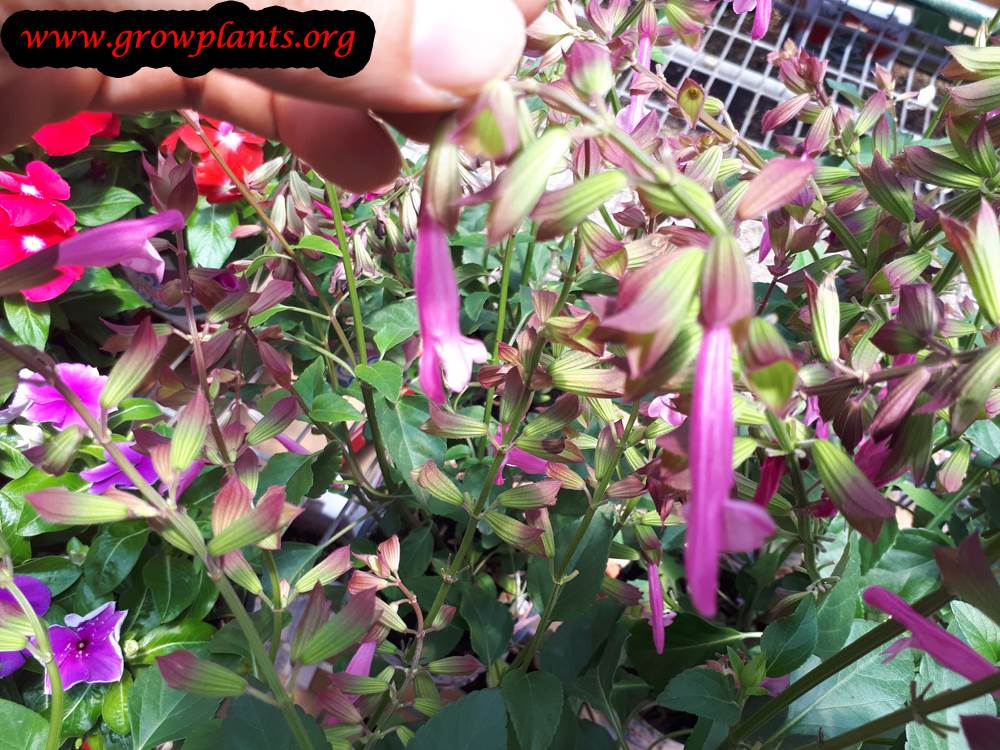
- Flower Appearance: Slender tubular flowers in magenta to purple-pink, held in dark-stemmed clusters
- Edibility: Grown as an ornamental; flower edibility is not documented for this hybrid, so it is best enjoyed for colour and wildlife
Detailed Blooming Overview
Wendy’s Wish is a vigorous hybrid sage prized for its long flush of vivid magenta-to-purple tubular flowers, carried on distinctive dark red stems. It blooms from spring through autumn – and almost continuously where winters are mild – and is a standout for drawing in hummingbirds, bees and butterflies. The plant makes a large, bushy clump and rewards a mid-season trim with a fresh wave of bloom.
Flower Characteristics
- Long, tubular flowers in magenta, pink and purple tones.
- Held in loose clusters on deep red flower stems.
- Rich in nectar and highly attractive to hummingbirds and bees.
Bloom Care & Thinning
- Managing the bloom: Shear the plant back by about a third after a heavy flush to keep it tidy and flowering.
- Pollination & wildlife: A reliable, long-season nectar plant – leave it in bloom for pollinators.
Pests, Diseases & Troubleshooting
Overview: ‘Wendy’s Wish’ is a vigorous, tender hybrid sage, often grown under glass or as a summer container plant. Its pest profile is the standard salvia set, but greenhouse culture makes whitefly, aphids and mealybugs more likely, and it is decidedly frost-tender. Manage with airflow, sharp drainage and frost protection.
Quick Troubleshooting Overview
| Issue / Pest | Main Symptom | Primary Solution |
|---|---|---|
| Aphids | Sticky, distorted new shoots & buds | Water jet, beneficials, insecticidal soap |
| Whitefly | White clouds & sooty mould, esp. under glass | Sticky traps, airflow, horticultural oil |
| Spider mite | Stippled, bronzed leaves in heat | Raise humidity, predatory mites, oil spray |
| Powdery mildew | White powder on leaves in crowding/shade | Spacing, airflow, sulphur/bicarb spray |
| Frost damage | Blackened growth, winter losses | Overwinter under frost-free cover |
Common Pests & Management
- Aphids (Aphis spp. / Myzus persicae):
- Symptoms: Clusters of soft green, grey or black insects on soft new shoots, flower stalks and leaf undersides; sticky honeydew, sooty mould and distorted tips; ants farming them.
- Prevention & Control: Blast off with a strong jet of water; encourage ladybirds, lacewings and hoverflies; pinch out badly infested tips. For persistent colonies use insecticidal soap or a light horticultural/neem oil, spraying undersides in the evening to spare pollinators.
- Whitefly (Trialeurodes vaporariorum):
- Symptoms: Tiny white moth-like insects that fly up in clouds when disturbed; sticky honeydew and sooty mould; worst on tender salvias under glass or in still, warm air.
- Prevention & Control: Improve airflow and avoid over-feeding with nitrogen; hang yellow sticky traps; introduce Encarsia parasitic wasps under cover. Spray insecticidal soap or horticultural oil on leaf undersides, repeating every few days to catch new hatches.
- Two-spotted spider mite (Tetranychus urticae):
- Symptoms: Fine pale stippling and bronzing of leaves in hot, dry conditions; delicate webbing on undersides and shoot tips; leaves dry and drop.
- Prevention & Control: Raise humidity and hose foliage in hot spells; remove badly affected growth. Release predatory mites (Phytoseiulus) under cover, or treat with horticultural oil / insecticidal soap, ensuring undersides are covered.
- Mealybugs (Pseudococcus / Planococcus spp.):
- Symptoms: White cottony tufts in leaf axils, stem joints and the crown; honeydew and sooty mould; slow, stunted growth. Common on salvias overwintered indoors.
- Prevention & Control: Dab colonies with a cotton bud dipped in dilute alcohol; wash plants and isolate new stock. For heavier infestations use horticultural oil or insecticidal soap, repeating to reach protected crevices.
- Spittlebugs (froghoppers) (Philaenus spumarius):
- Symptoms: Frothy white ‘cuckoo spit’ on stems and leaf joints in spring, hiding a soft green nymph; minor cosmetic distortion of shoots.
- Prevention & Control: Largely harmless – simply wash the froth off with a hose. No chemical control is needed on established plants.
Diseases & Fungal Issues
- Powdery mildew (Golovinomyces / Erysiphe spp.):
- Symptoms: White powdery patches on upper leaf surfaces and stems, spreading to coat foliage; worst in crowded plantings, shade, and humid nights with dry days.
- Treatment & Management: Space and thin plants for airflow, avoid overhead watering late in the day, and cut out affected growth. Grow in good light; if needed apply a sulphur or potassium-bicarbonate fungicide, or a milk/bicarb spray at first signs.
- Botrytis / grey mould (Botrytis cinerea):
- Symptoms: Fuzzy grey-brown mould on damaged shoots, dying flowers and crowded stems in cool, damp, still conditions; soft rotting patches.
- Treatment & Management: Remove faded flowers and dead material promptly, improve ventilation, and avoid wetting foliage. Water at the base and thin congested growth; fungicide is rarely needed if hygiene and airflow are good.
- Root and crown rot (Phytophthora / Rhizoctonia / Pythium spp.):
- Symptoms: Wilting despite moist soil, blackened stem bases, and roots that are brown and mushy rather than white; the classic killer of salvias in wet, heavy ground.
- Treatment & Management: Prevention is everything: plant in free-draining soil, never let salvias sit in waterlogged winter ground, and avoid overwatering. Raise beds or add grit; remove and destroy collapsed plants and do not replant salvias in the same spot.
Growing Difficulties & Abiotic Problems
- Winter root rot / waterlogging:
- Cause & Symptoms: Most salvias die not from cold alone but from cold, wet, poorly drained soil that suffocates and rots the roots over winter.
- Correction Strategy: Plant on free-draining ground or a raised bed with added grit; go easy on watering in cool weather. In heavy clay, grow in pots of gritty mix that can be sheltered.
- Legginess and flopping:
- Cause & Symptoms: Soft, sprawling stems and sparse flowering caused by too much shade, rich soil, or excess nitrogen.
- Correction Strategy: Grow in full sun on lean soil; pinch young plants to bush out, and trim after the first flush to encourage compact regrowth and repeat bloom.
- Frost / cold damage:
- Cause & Symptoms: A tender hybrid: growth blackens with the first frost and plants rarely survive cold winters outdoors.
- Correction Strategy: Mulch the crown in cold areas, or lift and overwinter tender types under frost-free cover; delay hard cut-back until spring so old growth protects the crown.
- Hungry, thirsty growth in containers:
- Cause & Symptoms: As a vigorous grower it exhausts pot compost and wilts quickly when root-bound.
- Correction Strategy: Feed regularly through the growing season, keep evenly moist (but never waterlogged), and pot on or refresh compost each year.
What Helps – Products & Tools
Salvias respond well to a light touch: insecticidal soap or horticultural/neem oil handles aphids, whitefly, mites and mealybugs; yellow sticky traps monitor and reduce whitefly; and a sulphur or potassium-bicarbonate fungicide manages powdery mildew. The best ‘product’, though, is sharp drainage and good airflow – most salvia losses are wet-soil root rot, not insects.