

Plant Profile & Key Characteristics
Overview: A vigorous, suckering shrub reaching about 1-2 m (40-80 in), evergreen in mild climates and deciduous where colder. It is grown as an ornamental, informal hedge and cut flower for its very large white, crepe-petalled poppy blooms.
Quick Specifications
| Specification | Attribute |
|---|---|
| Plant Type / Life Cycle | Perennial (woody-based shrub) |
| Foliage Type | Evergreen or deciduous depending on climate |
| Mature Size | 1-2 m (40-80 in) tall |
| Growth Rate | Fast to moderate |
| Root System | Rhizomatous and suckering — spreads to form colonies |
| Hardiness | USDA zones 8-10 |
Growth Form & Structure
- Height & Spread: Reaches 1-2 m (40-80 in) tall in the ground and spreads outward by underground runners; can be container-grown to help contain that spread.
- Growth Habit & Form: A fast-spreading, suckering shrub that forms broad colonies; can be cut back hard in the dormant season to renew growth.
- Lifespan & Maturity: A persistent perennial that, once established, expands steadily and can become invasive if unchecked.
Anatomy & Physical Features
- Leaves & Foliage: Green, oval, deeply lobed leaves with a grey-green cast.
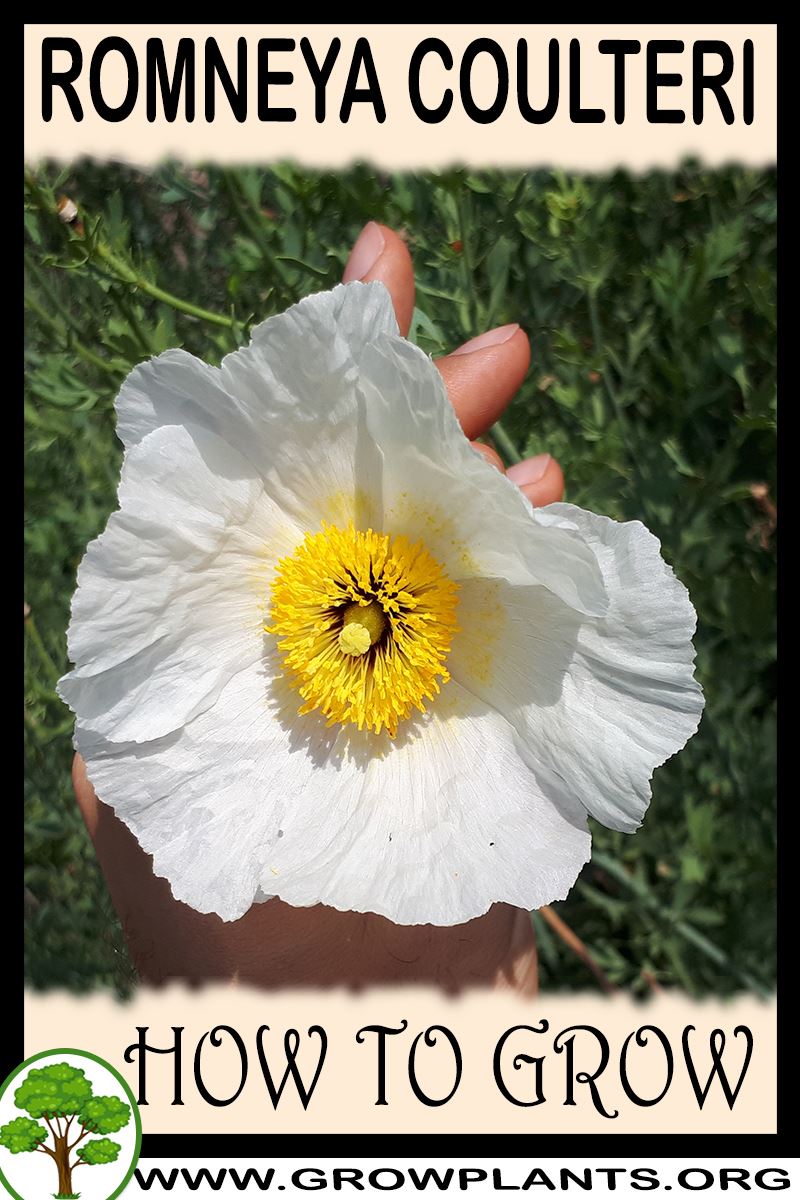
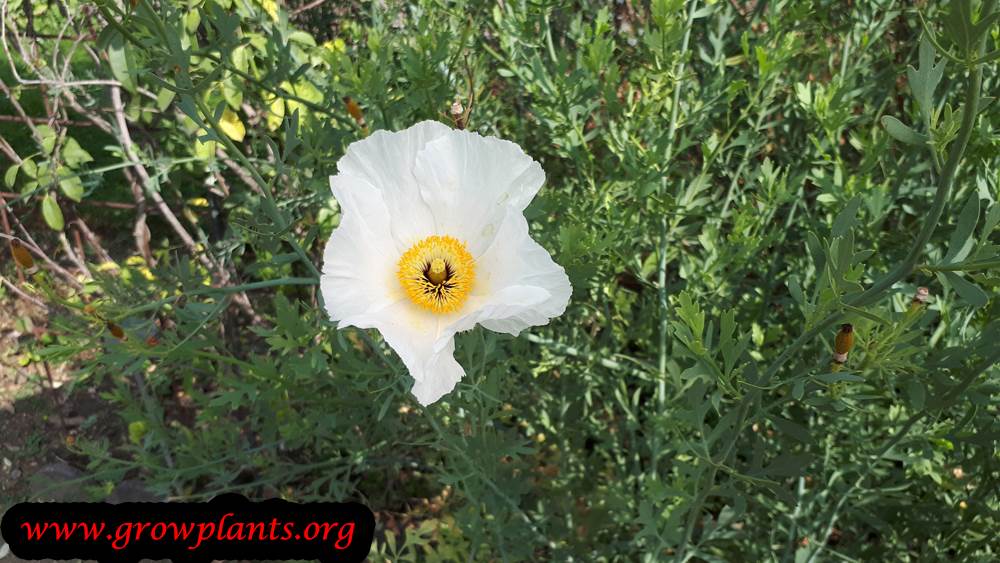
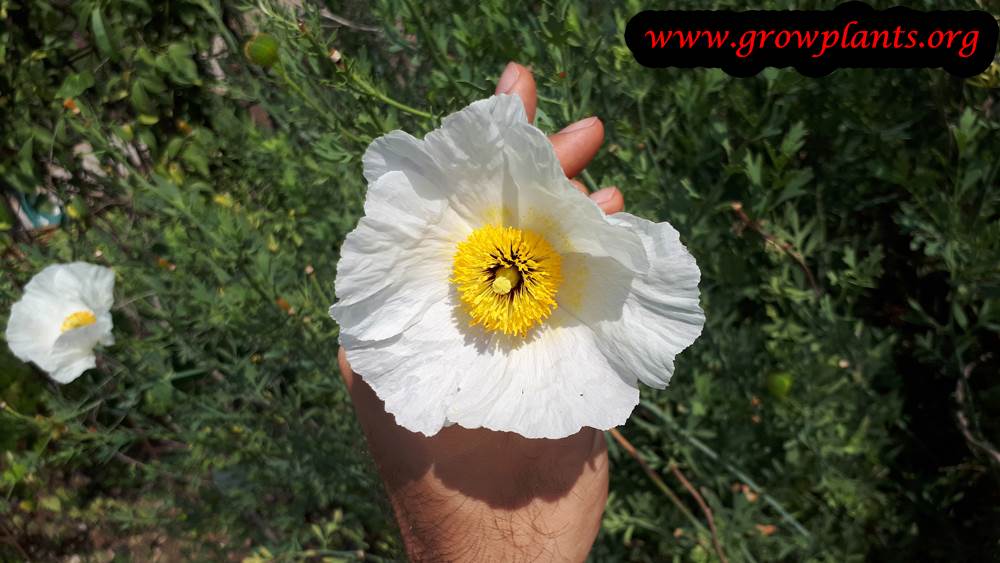
- Flower Characteristics: Very large white flowers with a boss of yellow stamens, the petals thin and crinkled like crepe paper.
Primary Uses & Landscape Value
- Functional & Ornamental Roles: Grown as a specimen ornamental, informal flowering hedge and cut flower; excellent for large, sunny, well-drained sites where its spreading habit has room.
Care Guide: Planting, Soil & Watering
Overview: The California tree poppy (Romneya coulteri) grows best in full sun to light shade in sharply drained soil and tolerates lean, poor ground once established. It needs only modest watering — good drainage matters far more than rich feeding, since it resents soggy, waterlogged roots.
Quick Care Requirements
| Requirement | Ideal Condition |
|---|---|
| Planting Season | At the start of the warm season (spring), or year-round in the mild conditions of zone 10b |
| Growth Rate | Moderate to Fast (vigorous once established) |
| Soil Type | Sharply drained soil; tolerates poor, lean ground |
| Water Need | Low to Moderate — water to establish, then drought-tolerant; always let the soil dry between waterings |
Planting & Establishment
- Best Planting Season: Plant at the start of the warm season, ideally in spring; in the mild conditions of zone 10b it can be planted year-round, though spring and summer give the strongest establishment.
- How to Plant:
- Hole Preparation: Dig a hole a little wider than the root ball on a free-draining site; Romneya dislikes root disturbance, so handle the rootball gently and disturb the roots as little as possible.
- Soil Amendments: Work grit or coarse organic matter into heavy ground to sharpen drainage; it does not need rich soil.
- Planting Depth: Set the crown at soil level and firm gently, keeping the base of the stems free of buried, damp soil.
- Growth Speed & Expectations: Slow to settle in but vigorous once established — often fast-spreading and even invasive, so give it plenty of room.
Soil, Watering & Drainage Care
- Soil Mix & Drainage Needs: The key is drainage: light, gritty, well-aerated soil that never stays wet. In containers use a free-draining mix and ensure water escapes freely, since standing moisture rots the roots.
- Watering Schedule & Technique:
- Young / Newly Planted: Water regularly through the first season to help it establish, letting the surface dry between waterings.
- Established: Once established it is highly drought-tolerant; water only occasionally and deeply, allowing the soil to dry out well in between.
- Seasonal Adjustments: Give a little more water in prolonged heat and almost none in winter, when it should be kept on the dry side.
Climate, Light & Hardiness
Romneya coulteri (Matilija poppy, California tree poppy) is a drought-tolerant, sun-loving shrub native to dry-summer climates, suited to subtropical, Mediterranean, and warm temperate zones. It needs full sun and is hardy from USDA zone 8.
Quick Climate Specifications
| Climate Zones | Subtropical, mediterranean, temperate |
|---|---|
| USDA Hardiness Zones | 8–10 |
| Light Conditions | Full sun to half shade |
| Frost Tolerance | Moderate within its hardiness range |
Sunlight & Light Exposure
Optimal Light Setup
Full sun is best for the strongest flowering of its large, crepe-textured white poppies; half shade is tolerated.
Extreme Heat Tolerance
Well adapted to hot, dry Mediterranean-type summers as a California native.
Temperature Extremes & Hardiness
USDA Hardiness & Regional Limits
Hardy from zone 8 to 10, tolerating winter cold typical of dry-summer Mediterranean and mild temperate climates.
Cold Damage & Winter Protection
Top growth can die back in colder winters within its range and resprout from the roots in spring; sharp drainage helps avoid winter rot.
Wind, Humidity & Microclimate
Dry-Air Tolerance
Very well suited to dry Mediterranean-climate air and low summer rainfall once established.
Rainfall & Seasonal Moisture
Adapted to a distinct dry summer/wet winter rainfall pattern and does not need consistent summer moisture.
Growing in Pots, Balconies & Indoors
The Matilija (California tree) poppy is a large, sun-loving perennial with a deep, resentful root system. The grower allows it can be potted, but it is not a houseplant and is happiest given a big, deep container in full sun where its roots have room.
Quick Details
- Container Size: A large, deep pot, 30-50 L (8-13 gal) or more – it dislikes root disturbance
- Indoor Suitability: Not a houseplant – a big, full-sun perennial
- Best Spot: Full sun to half shade
- Soil & Drainage: Sharply drained, gritty mix; it loathes winter wet
- Watering in Pots: Sparing once established – drought-tolerant, modest to average water
Indoors & On the Windowsill
- Houseplant limits: Not a houseplant – it is a big Mediterranean perennial that wants full sun and a deep, dry root run, impossible to give indoors.
- Handle roots gently: It resents having its brittle roots disturbed, so pot it young into its long-term container and avoid frequent repotting.
On a Balcony or Patio
- Light & heat: Give it the hottest, sunniest, sheltered spot; it enjoys reflected heat and lean, dry conditions. Stake or shelter the tall stems on an exposed balcony.
- Practicalities: A filled pot is heavy once watered – check the balcony can take the load, and stand it where drainage runoff will not be a nuisance. Use a deep pot to suit its questing roots.
Choosing the Pot, Soil & Long-Term Care
- Pot & drainage: A large, deep pot with strong drainage holes and never leave it standing in a saucer of water, or the roots rot. Terracotta breathes and dries faster; glazed or plastic holds moisture longer.
- Potting mix: A gritty, free-draining mix – potting compost with plenty of grit or coarse sand.
- Feeding: Feed only lightly; too rich a diet gives soft, floppy growth.
- Repotting: Disturb it as little as possible – top-dress rather than repot, and only pot on when truly essential.
Fertilizing & Feeding
This California native poppy performs best in lean soil and is one of the lightest feeders among garden ornamentals – extra fertilizer usually produces weaker stems and fewer flowers, not better growth.
Quick Fertilizing Specs
| Feeding Level | Light – a lean-soil native that resents rich fertilizing. |
|---|---|
| Main Nutrient Priority | A balanced feed used sparingly; keep nitrogen light to avoid floppy, weak growth. |
| Best Feeding Period | During the establishment year in spring; little to none needed once established. |
| Soil pH | Tolerates a wide range of soil pH; not a demanding factor for this species. |
| Reduce/Stop Feeding | Taper down to little or no feeding once the plant is established and flowering well. |
| Organic Options | A light compost topdressing is usually all a mature planting needs. |
Feeding by Growth Stage
Establishment Year
Help a newly planted Matilija poppy build a strong root system in its first growing season.
| Nutrient direction | A light, balanced feeding to support establishment – this drought-tolerant native does not need rich or frequent fertilizing. |
|---|---|
| Timing | Through the first growing season after planting, starting in spring. |
| Frequency | A light feeding at planting time and again as new growth appears is usually enough; there is no need to repeat it often. |
| Fertilizer types | Balanced, lean-application fertilizer for drought-tolerant natives, Light compost topdressing |
| Precautions | Avoid rich or high-nitrogen feeding, which tends to produce weak, floppy growth and fewer flowers on this drought-adapted plant. |
Flowering Season
Support the large papery white flowers through spring and summer bloom without pushing soft growth.
| Nutrient direction | Established plants rarely need feeding during bloom; a very light balanced feeding only helps if growth looks thin or flowering is sparse. |
|---|---|
| Timing | Through the spring-to-summer bloom period. |
| Frequency | Minimal feeding is typical here – most established plants flower well on residual soil fertility alone. |
| Fertilizer types | Light balanced fertilizer, only if growth looks thin, Compost topdressing |
| Precautions | Skip feeding altogether on healthy, well-established plants – this species flowers best in lean soil and can flop or decline in vigor if overfed. |
Post-Bloom Rest
Let the plant move into its natural dry-season and winter rest without pushing new growth.
| Nutrient direction | None – do not feed once flowering finishes and the plant heads into its dry-season and winter rest. |
|---|---|
| Timing | From late summer through winter, after flowering has finished and before spring pruning. |
| Frequency | No feeding at this stage. |
| Fertilizer types | No feeding at this stage – this native poppy rests through the dry season and winter without supplemental nutrition. |
| Precautions | Do not fertilize during this rest period; let the plant draw down naturally on its own reserves before spring growth resumes. |
Nutrient Deficiency Signs & Corrections
Pale, weak stems with sparse foliage and slow new growth.
| Possible causes | Nitrogen deficiency in very poor or heavily leached soil, Root stress from poor drainage or recent transplant shock, Insufficient sun exposure reducing overall vigor |
|---|---|
| Appears first on | New growth and overall stem vigor |
| What to check | Soil quality and organic matter content, Sun exposure, Watering and drainage |
| Possible correction | Apply a light balanced feeding at the start of the growing season and monitor for improved vigor before adding more. |
Weak, floppy stems with lush foliage but noticeably fewer flowers than expected.
| Possible causes | Over-fertilizing, especially with high-nitrogen products, Garden soil that is too rich or a heavy compost application, Excess water encouraging soft, sappy growth |
|---|---|
| Appears first on | New stem growth throughout the plant |
| What to check | Recent fertilizer and compost history, Soil richness relative to what this lean-soil native prefers, Watering frequency |
| Possible correction | Stop supplemental feeding, let soil richness decline naturally over time, and hold off on further compost or fertilizer until growth firms up and flowering improves. |
Yellowing between the veins on new leaves while the veins stay green.
| Possible causes | High soil pH limiting iron availability, Poor drainage or waterlogged roots, Root stress from a recent transplant |
|---|---|
| Appears first on | New leaves |
| What to check | Soil pH and drainage, Recent lime application or alkaline irrigation water, Root health |
| Possible correction | Improve drainage and soil pH first, then apply a chelated iron product per its label if the pattern persists. |
Pruning, Training & Seasonal Maintenance
Romneya coulteri (Matilija poppy, California tree poppy) is a fast-growing, rhizome-spreading subshrub that tolerates – and actually thrives on – being cut back hard every year. Because its large white poppies form on the current season’s new growth, the safest and most effective pruning period is late autumn into winter, once flowering has finished and top growth has turned tattered or frost-damaged. Cutting hard at this time does not cost you next season’s bloom; it produces it. Because the plant spreads aggressively by underground rhizomes, ongoing maintenance is as much about containing spread as shaping habit.
Quick Pruning & Maintenance Specs
| Pruning Tolerance | High |
| Primary Pruning Window | Late autumn – winter, after flowering finishes and foliage declines |
| Secondary Maintenance Window | Spring – summer, light deadheading of spent flowers |
| Typical Frequency | One hard cutback per year, plus occasional deadheading through bloom season |
| Main Objective | Renew flowering canes; contain rhizome spread |
| Young Plant Priority | Build root/rhizome system; remove only damaged growth, don’t hard-prune yet |
| Mature Plant Priority | Annual hard cutback to keep the clump floriferous and prevent a woody, sprawling base |
| Best Tool Type | Loppers / bypass secateurs (canes are soft-wooded, not thick) |
| Avoid Heavy Pruning During | Active spring – summer flowering flush; peak summer drought stress |
Pruning by Plant Age & Size
Newly Established
In the first year, skip the hard cutback and remove only dead, damaged, or frost-blackened stems, allowing the plant to put its energy into establishing roots and rhizomes.
Young / Formative
No structural training system applies – Romneya is not trained to a leader or framework. If a bushier base is wanted, lightly pinch young canes; otherwise let the clump develop naturally.
Mature / Established
The main task is the annual (or, in the mildest climates, every-other-year) hard cutback that renews flowering wood and stops the clump from becoming thin-caned, leggy, and top-heavy.
Seasonal Pruning Schedule
Dormant / Winter
Objective: rejuvenate the clump for the coming bloom season. Remove: nearly all top growth, cutting canes back to about 15–20cm (6–8in) above ground or to strong basal shoots. Do not remove: the rhizome/root crown itself. Expected response: a vigorous flush of new flowering canes from spring. Flowering impact: positive – this cutback is what produces next season’s display, not what removes it.
Ongoing Sanitary
Objective: tidy the plant and prolong the display through spring and summer. Remove: spent flower stems as blooms fade. Do not remove: unopened buds nearby. Expected response: a tidier plant and occasional extra flowers; impact on the overall bloom is minimal.
Flowering & Fruiting Wood
Flowers form on the current season’s new growth produced after the winter cutback, not on old persistent wood. This is exactly why the plant tolerates, and benefits from, an annual hard renewal: the harder the winter cutback, the stronger the flowering canes that follow.
Structural Pruning & Training
Little formal structure is trained into this plant. Management centers on renewal (the annual hard cutback) and on containing spread – thin excess rhizome shoots at the clump’s perimeter to keep it within bounds, rather than removing interior growth for airflow, which this subshrub does not need.
Special Growth to Remove
Rhizome/root suckers emerging beyond the intended planting area: Romneya spreads aggressively underground and is flagged as invasive in cultivation, so cut or dig out unwanted suckers at their point of origin promptly, ideally before they form their own independent root system. Spent flower stems should also be removed for tidiness, though this is not required to trigger rebloom.
Container & Small-Space Pruning
Growing Romneya in a large container is a practical way to contain its rhizome spread where garden space is limited. Container plants still get the same hard winter cutback; when repotting every few years, also trim back any rhizomes that have circled the pot.
Tools
Loppers for the base of season-old canes (pencil-to-thumb thickness); bypass secateurs for finer stems and deadheading; a spade or edging tool for severing unwanted rhizome suckers from the main clump.
Tool Hygiene & Disease Risk
Routine – clean, sharp tools are sufficient. No major transmissible pruning-borne disease is documented for this species, so no special disinfection protocol is needed between cuts.
Cut Placement & Technique
Make the winter cutback as a heading cut just above a low set of buds or the woody base. When removing rhizome suckers, cut or dig below soil level at their point of origin rather than simply snipping the visible stem, or they will resprout.
Heavy Pruning & Rejuvenation
Well tolerated – in fact this is the standard annual practice. Cutting the whole clump back to near ground level each winter keeps it compact and floriferous and prevents the base from becoming woody, sparse, and sprawling.
Post-Pruning Care
Water normally through the following spring flush; avoid fertilizing to “push” recovery – Matilija poppy is adapted to lean soils and regrows vigorously on its own. Watch tender new spring shoots for slug and snail damage.
Common Pruning Mistakes
Being too timid with the winter cutback, which leaves tall old canes and results in a sparse, woody, floppy plant; hard-pruning during the spring–summer bloom flush and losing the season’s display; letting rhizome suckers go unchecked until they have spread well beyond the bed.
When NOT to Prune
Avoid the hard structural cutback during active spring–summer flowering, since it removes the current display. Avoid disturbing or cutting rhizomes during peak summer heat when the plant is drought-stressed.
Recommended Tools (by task)
- Mature clump – annual renewal cutback, canes to ~2cm: loppers – clean cut through soft-wooded canes at the base without crushing.
- Any age – deadheading / light tidy, thin stems: precision_snips – clean removal of spent flower stems without disturbing nearby buds.
- Any age – containing rhizome spread: garden_spade – severs wandering rhizome suckers cleanly below soil level.
Propagation Guide
The most practical way to increase Romneya coulteri is by lifting and replanting rooted suckers it naturally spreads by, or by taking root cuttings from those spreading roots — a habit consistent with this plant’s tendency to spread underground and become invasive. Seed comes true to type since this is a true species, but is notoriously slow and unreliable to germinate without a specific pre-treatment. Overall difficulty is difficult: the deep, brittle root system resents disturbance, and seed needs particular handling to germinate reliably.
Quick Propagation Specs
| Best Propagation Method | Root cuttings or transplanted root suckers |
| Alternative Methods | Seed (with pre-treatment) |
| Propagation Difficulty | Difficult |
| Seed True-to-Type | Yes (true species) |
| Vegetative True-to-Type | Yes |
| Best Propagation Season | Root cuttings/suckers: while dormant, late autumn to winter; Seed: sow in autumn or spring after pre-treatment |
| Seed Germination Time | Slow and irregular, often several weeks to a few months |
| Cutting Rooting Time | Several weeks to a few months for new shoots to establish |
| Seed Sowing Depth | Surface to very shallow |
Growing from Seed
Dormancy & Pre-Sowing Treatment
Romneya coulteri is a well-documented fire-following California native, and germination is reported to improve markedly with a smoke treatment (smoke-infused water or liquid smoke) and/or brief heat exposure, mimicking the wildfire cues that trigger germination in the wild; without some form of this treatment, germination can be very poor.
Sowing Season
Spring or autumn.
Sowing Depth & Orientation
Surface-sow to very shallow, on a gritty, well-drained mix.
Germination Conditions
A warm, sunny position with a well-drained mix kept lightly moist but not waterlogged.
Germination Time
Slow and uneven; can take several weeks to a few months.
Seedling Care
This species is well known for disliking root disturbance, so raise seedlings in deep pots or root-trainers and transplant them while still young, before a taproot develops, disturbing the roots as little as possible.
Leaf & Root Cuttings
Take root cuttings from the spreading lateral roots while the plant is dormant (late autumn to winter), cutting sections roughly pencil-thick and several centimetres long; insert them the right way up (the end nearer the crown facing upward) into a free-draining propagation mix and keep just barely moist until new shoots appear from the cut root. This is the standard nursery method for multiplying Romneya coulteri, since the roots readily regenerate new plants from root fragments even though the parent plant itself dislikes disturbance.
Division, Offsets, Pups & Suckers
Because this species spreads by running roots and can become invasive, it also produces naturally rooted suckers some distance from the main plant; a well-developed sucker with its own root system can be severed and transplanted, ideally while dormant, then watered in and kept consistently moist while it recovers, since disturbed roots are slow to re-establish. Very young or weakly rooted shoots are less likely to survive being separated.
Bloom & Flower Guide
Quick Details
- Bloom Season: Spring into summer
- Flower Appearance: Very large, fragrant white flowers with crinkled, crepe-paper petals around a bold central boss of golden-yellow stamens
- Edibility: Grown as an ornamental and cut flower (a poppy relative, not eaten)
Detailed Blooming Overview
The Matilija poppy produces some of the largest flowers of any hardy plant – great white crepe-textured blooms centred with a fried-egg splash of yellow stamens, and pleasantly scented. It can be slow to settle in, then flowers with real drama through late spring and summer.
Flower Characteristics
- Bowl-shaped white flowers with yellow stamens and petals like crumpled crepe, as the grower describes.
- Large, fragrant and short-lived individually, but produced in succession.
Bloom Care & Thinning
- Deadheading: Remove faded flowers to keep the display tidy and prolonged.
- End of season: Cut the stems back hard in late winter to make way for fresh flowering growth.
- Establishment: It resents root disturbance, so site it where it can settle and flower undisturbed.
Pests, Diseases & Troubleshooting
Overview: The Matilija poppy (Romneya coulteri) is a tough, drought-adapted Californian native that is essentially pest- and disease-free when grown correctly; occasional aphids or spider mites are minor, and its only real threat is root rot from wet, heavy soil or summer over-watering. Its true “problems” are cultural — it resents root disturbance, suckers aggressively and dislikes rich, moist conditions. Grow it lean, sunny and dry and it thrives untroubled.
Quick Troubleshooting Overview
| Issue / Pest | Main Symptom | Primary Solution |
|---|---|---|
| Root rot | Wilt and collapse in wet or over-watered soil | Sharp drainage, full sun, dry summers |
| Aphids | Minor clusters on new shoots | Tolerate; water jet or insecticidal soap |
| Spider mites | Stippled leaves in extreme heat/dust | Hose foliage; horticultural oil if needed |
| Transplant shock | Sulking or death after being moved | Plant young; never disturb roots |
| Suckering | Spreads widely by underground runners | Give room or install a root barrier |
Common Pests & Management
- Aphids (Aphididae):
- Symptoms: Occasional clusters of soft insects on tender new shoots and flower buds, with a little curling and honeydew; rarely a serious problem on this vigorous native.
- Prevention & Control: Usually best tolerated, as predators quickly move in. A water jet dislodges colonies, and insecticidal soap on the undersides handles any heavy build-up; avoid broad-spectrum sprays.
- Spider mites (Tetranychus urticae):
- Symptoms: Fine stippling and a dull, bronzed look in prolonged hot, dry, dusty conditions, sometimes with light webbing.
- Prevention & Control: Keep dust down and avoid extreme drought stress even on this drought-tolerant plant; hose foliage in heat. Horticultural oil or insecticidal soap controls the rare outbreak.
Diseases & Fungal Issues
- Root rot (Phytophthora / Pythium spp.):
- Symptoms: Sudden wilting, yellowing and collapse in heavy, wet or poorly drained soil, or where it is watered too much in summer — by far the commonest way to lose this plant.
- Treatment & Management: Grow in full sun in lean, sharply drained soil and keep it dry in summer once established; never overwater or plant in a wet spot. There is no cure once the roots rot, so prevention through drainage is everything; remove collapsed plants.
- Powdery mildew (Erysiphales):
- Symptoms: A light white powdery film on foliage in humid, still or shaded conditions late in the season; usually cosmetic on this sun-loving plant.
- Treatment & Management: Site in full sun with good airflow and avoid overhead watering. Rarely needs treatment; sulfur or potassium bicarbonate is available if it becomes unsightly.
Growing Difficulties & Abiotic Problems
- Resentment of root disturbance / transplanting:
- Cause & Symptoms: Established plants sulk, die back or die outright after being moved or having their deep, brittle roots disturbed; they are notoriously hard to transplant.
- Correction Strategy: Plant young, container-grown specimens in their final position and avoid disturbing the roots. Propagate from root cuttings or suckers rather than lifting mature clumps.
- Aggressive suckering:
- Cause & Symptoms: Once happy, Matilija poppy spreads vigorously by underground suckers and can travel widely, popping up metres from the parent.
- Correction Strategy: Give it room, or contain the roots with a barrier, and remove unwanted suckers. In small gardens site it where its spread is welcome.
- Summer-water and rich-soil intolerance:
- Cause & Symptoms: In rich, frequently irrigated borders it grows soft, flops, fails to flower well and is prone to rot.
- Correction Strategy: Grow it hard: lean soil, full sun, minimal summer water once established. This suits its dry Mediterranean-climate origins and keeps it healthy and floriferous.
What Helps — Products & Tools
This native needs almost nothing: the occasional aphid or mite yields to a water jet or insecticidal soap, and powdery mildew to sulfur if it ever appears. There is no product substitute for the real requirements — full sun, lean sharply drained soil, and keeping it dry in summer to prevent root rot. Treat pests only if genuinely troublesome, follow the label, and protect pollinators.