Plant Profile & Key Characteristics
Overview: Nandina domestica (Heavenly or Sacred bamboo) is an upright evergreen to semi-deciduous shrub 30-150 cm (12-60 in) tall, grown as an ornamental for its multi-coloured foliage. It suits temperate, Mediterranean and subtropical gardens and can also be kept as a houseplant.
Quick Specifications
| Specification | Attribute |
|---|---|
| Plant Type / Life Cycle | Perennial shrub |
| Foliage Type | Evergreen to semi-evergreen (deciduous in cold areas) |
| Mature Size | 30-150 cm (12-60 in) tall |
| Growth Rate | Moderate to Fast |
| Root System | Rhizomatous, suckering (spreads to form clumps – can be invasive) |
| Toxicity | Toxic – berries and foliage contain cyanogenic compounds, harmful to pets and birds |
| Hardiness | USDA zones 6-10b |
Growth Form & Structure
- Height & Spread: Reaches 30-150 cm (12-60 in) tall in the ground; also grown in planters and containers.
- Growth Habit & Form: Upright, cane-like multi-stemmed shrub with a bamboo-like silhouette, spreading by underground rhizomes.
- Lifespan & Maturity: Long-lived perennial shrub of moderate-to-fast growth.
Anatomy & Physical Features
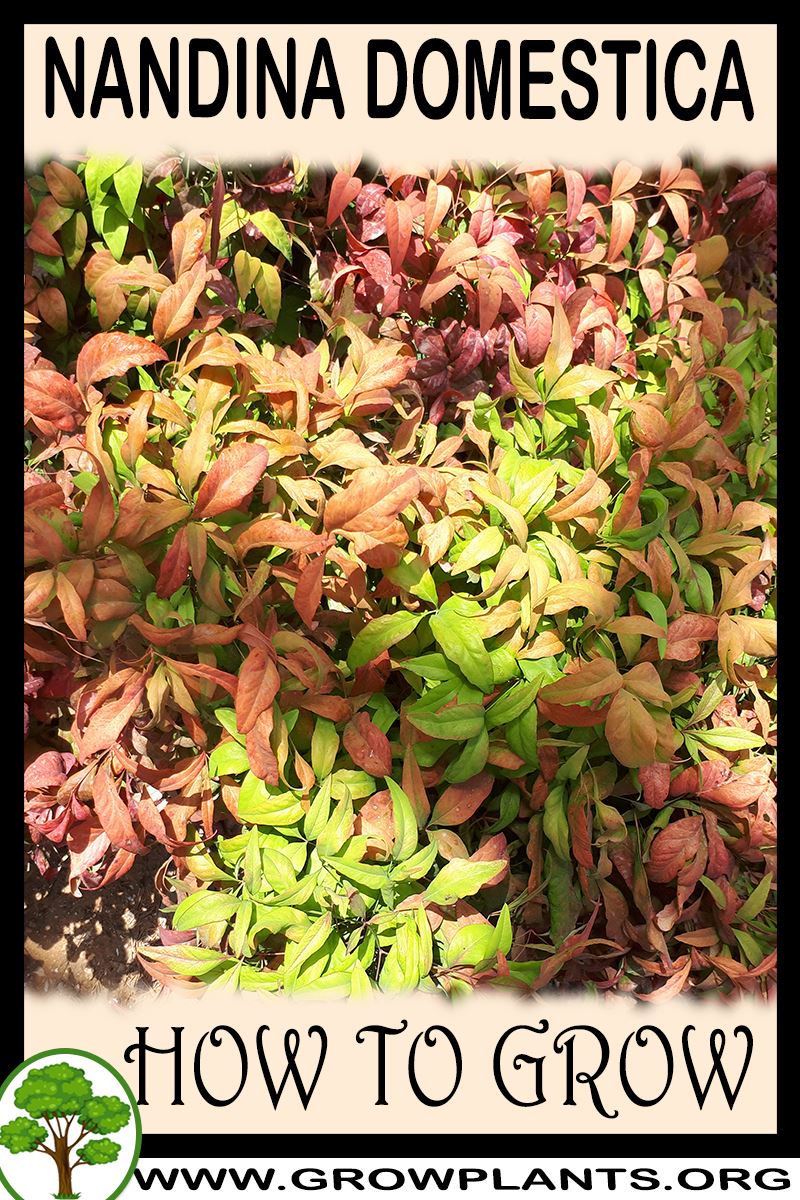
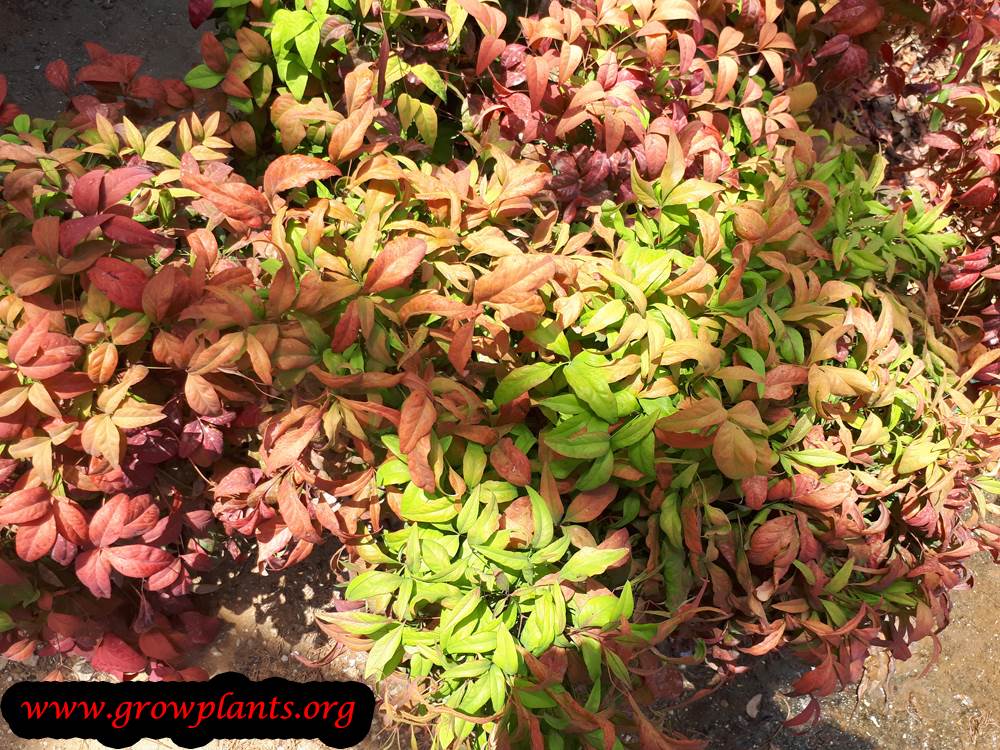
- Leaves & Foliage: Compound, lacy foliage that shifts through green, red, pink and yellow – often several colours on one plant at once.
- Flower Characteristics: Small white, yellow-centred star-shaped flowers borne in clusters in summer.
- Fruit Profile: Bright red berries follow the flowers (ornamental but toxic).
Primary Uses & Landscape Value
- Functional & Ornamental Roles: Ornamental foliage shrub for hedging, screening, borders and containers; grown for its colourful leaves and winter berries.
Care Guide: Planting, Soil & Watering
Overview: Nandina, or heavenly bamboo, is an adaptable evergreen shrub for full sun to full shade. It grows best in moist, well-drained soil enriched with organic matter and mulch, and needs steady, moderate moisture.
Quick Care Requirements
| Requirement | Ideal Condition |
|---|---|
| Planting Season | In spring, summer or autumn during mild weather |
| Growth Rate | Moderate to fast |
| Soil Type | Moist, well-drained, enriched with organic matter |
| Water Need | Moderate – keep evenly moist, especially while establishing |
Planting & Establishment
- Best Planting Season: Plant in the milder parts of the year – spring, summer or autumn – giving roots time to settle before heat or hard frost.
- How to Plant:
- Hole Preparation: Dig a hole about twice the width of the root ball and the same depth so roots spread readily.
- Soil Amendments: Work compost or other organic matter into the backfill and mulch the surface to retain moisture.
- Planting Depth: Set the root collar level with the soil surface and firm gently; keep the stem base unburied.
- Growth Speed & Expectations: Growth is moderate to fast, forming an upright, cane-like shrub with colourful foliage.
Soil, Watering & Drainage Care
- Soil Mix & Drainage Needs: Though adaptable, it does best in moist but well-drained soil; avoid waterlogging, and use a good potting mix with drainage holes in containers.
- Watering Schedule & Technique:
- Young / Newly Planted: Keep newly planted shrubs consistently moist through the first season.
- Established: Water deeply when the top few centimetres dry; established plants tolerate short dry spells but prefer even moisture.
- Seasonal Adjustments: Water more in summer heat and reduce in cool, wet winter weather.
Climate, Light & Hardiness
Nandina domestica is an adaptable evergreen-to-deciduous shrub suited to temperate, Mediterranean, and subtropical climates, and it can also be grown as a houseplant. It tolerates everything from full sun to full shade and is dependably cold-hardy through USDA zone 6.
Quick Climate Specifications
| Climate Zones | Temperate, mediterranean, subtropical; also grown as a houseplant |
|---|---|
| USDA Hardiness Zones | 6–10b |
| Light Conditions | Full sun to full shade |
| Frost Tolerance | Moderate to high for established plants within its hardiness range |
Sunlight & Light Exposure
Optimal Light Setup
Tolerates full sun to full shade, making it one of the more flexible shrubs for varied light situations.
Shade & Heat Management
Leaf coloring is typically most vivid with more sun exposure and cooler temperatures, while shade gives a more uniformly green, softer look; the plant handles heat well within its climate range.
Temperature Extremes & Hardiness
USDA Hardiness & Regional Limits
Hardy from zone 6 to 10b, tolerating winter cold typical of temperate climates while also thriving in warmer subtropical conditions or indoors.
Cold Damage & Winter Protection
In the colder part of its range top growth may be deciduous or semi-deciduous, dropping some leaves in winter; established plants generally need no extra winter protection within zone 6–10b.
Frost Sensitivity
Moderately frost-tolerant once established; young plants benefit from a sheltered position in the coldest end of the hardiness range.
Wind, Humidity & Microclimate
Humidity Preferences
Adapts to a range of humidity levels across its broad climate range, from drier Mediterranean summers to humid subtropical conditions.
Microclimate Recommendations
A container-grown or indoor plant will need protection from hard freezes that an in-ground specimen in zone 6+ would otherwise tolerate.
Growing in Pots, Balconies & Indoors
Heavenly bamboo is a tough, elegant shrub with fine foliage and red berries, and the grower confirms it grows well as a houseplant and in containers. Its wide light tolerance – from full sun to full shade – makes it easy to place, indoors or out.
Quick Details
- Container Size: A medium to large pot, potting on as it grows
- Indoor Suitability: A confirmed houseplant; also thrives in outdoor containers in sun or shade
- Best Spot: Bright, indirect light indoors; anything from full sun to full shade outdoors
- Soil & Drainage: Aerated, organic-rich mix (peat or coir with perlite or vermiculite); must drain freely
- Watering in Pots: Average water – keep evenly moist but never waterlogged
Indoors & On the Windowsill
- A confirmed houseplant: The grower keeps it indoors – give it bright, indirect light, though it tolerates shadier corners than most shrubs.
- Care indoors: Keep the mix evenly moist, feed in growth, and it stays neat with only light trimming.
- Safety: The grower flags this plant as poisonous – the berries in particular are toxic to people, pets, and birds, so keep it out of reach of children and animals and clear up fallen berries.
On a Balcony or Patio
- Light & wind: Very adaptable – full sun to deep shade; foliage colours best in brighter light. It shrugs off wind and reflected heat.
- Practicalities: An easy, undemanding container plant; a pot also helps confine it, as the grower notes it can be invasive in open ground.
Choosing the Pot, Soil & Long-Term Care
- Pot & drainage: A pot with strong drainage holes and no standing-water saucer; terracotta breathes, glazed or plastic holds moisture longer.
- Potting mix: A well-aerated, organic-rich mix – peat or coir with perlite or vermiculite.
- Feeding: Feed through the growing season, as potted shrubs leach nutrients quickly.
- Repotting: Pot on every couple of years, refreshing the mix and trimming the root ball lightly.
Fertilizing & Feeding
As a low-maintenance landscape shrub, Nandina domestica needs only light, balanced feeding – heavy nitrogen mutes its signature red, pink, and yellow foliage tones rather than improving the display.
Quick Fertilizing Specs
| Feeding Level | light |
|---|---|
| Main Nutrient Priority | Balanced feeding that avoids pushing excess green growth over the plant’s colorful foliage |
| Best Feeding Period | Spring through summer active growth |
| Reduce/Stop Feeding | Stop feeding for winter dormancy or slowdown |
| Soil pH | Tolerates a wide range in moist, well-drained, mulched soil |
| Organic Options | Compost and mulch at planting and through the season |
Feeding by Growth Stage
Establishment after planting
Help a newly planted shrub establish its roots and canopy.
| Nutrient direction | Light, balanced feeding to support establishment without overwhelming a young root system. |
|---|---|
| Timing | The first growing season after planting. |
| Frequency | A light feeding at planting, then modest regular feeding as roots establish. |
| Fertilizer types | A balanced, complete shrub fertilizer, Compost or aged organic matter with mulch at planting |
| Precautions | Keep fertilizer away from stems and water thoroughly after feeding; all plant parts are toxic if ingested, so keep berries and clippings away from pets and children. |
Active growth and foliage color development
Support steady growth and the best display of colorful red, pink, and yellow foliage tones alongside summer bloom clusters.
| Nutrient direction | A balanced, complete fertilizer supports steady growth without pushing all-green, overly lush foliage that mutes the plant’s colorful leaf tones. |
|---|---|
| Timing | Spring through the summer growing season. |
| Frequency | Feed lightly through the growing season; ease off as growth slows toward autumn. |
| Fertilizer types | A balanced, complete fertilizer for flowering and foliage shrubs |
| Precautions | Avoid heavy nitrogen, which can produce excess green growth at the expense of the plant’s colorful leaf tones; keep all parts away from pets and children since the plant is toxic if ingested. |
Winter dormancy or slowdown
Let growth rest through the cold season, whether the plant holds its evergreen leaves or drops them where deciduous.
| Nutrient direction | None – withhold fertilizer while growth is dormant or slowed for winter. |
|---|---|
| Timing | Winter in cooler hardiness zones. |
| Frequency | No feeding at this stage. |
| Fertilizer types | No feeding at this stage; do not fertilize during winter dormancy or slowdown. |
| Precautions | Do not fertilize in winter; a light feeding can resume as new spring growth begins. |
Nutrient Deficiency Signs & Corrections
Overall pale or yellowish-green foliage color loss and slowed growth.
| Possible causes | Nitrogen deficiency, Poor drainage limiting root uptake, Root competition from nearby plants or heavy mulch buildup |
|---|---|
| Appears first on | Older leaves and overall canopy |
| What to check | Soil fertility, Drainage, Mulch depth around the root zone |
| Possible correction | Apply a balanced, complete fertilizer and check drainage and mulch depth around the root zone. |
New leaves turn yellow with green veins, most visible where new foliage would normally show red tones.
| Possible causes | High soil pH limiting iron availability, Waterlogged soil, Root stress |
|---|---|
| Appears first on | Newest leaves |
| What to check | Soil pH, Drainage |
| Possible correction | Correct soil pH and drainage; apply a chelated iron product per its label if chlorosis persists. |
Foliage stays mostly green rather than developing red, pink, or yellow tones.
| Possible causes | Excess nitrogen fertilizer, Too much shade, A naturally green-leaved cultivar rather than a nutrient problem |
|---|---|
| Appears first on | New foliage |
| What to check | Recent feeding, Light exposure, Cultivar identity |
| Possible correction | Reduce nitrogen feeding and increase sun exposure where possible, and confirm the cultivar is a colored-leaf type. |
Pruning, Training & Seasonal Maintenance
Nandina domestica is a cane-forming evergreen/semi-evergreen shrub grown for its colourful, ever-changing foliage and its summer flower clusters followed by berries. Unlike most shrubs it doesn’t branch freely from a heading cut, so its pruning logic is built around selective, staggered-height cane removal rather than shearing. It tolerates cuts at any time of year, as the source confirms, though a structural pass is best timed for late winter.
Quick Pruning & Maintenance Specs
| Pruning Tolerance | High for cane renewal; low tolerance for shearing/heading, which ruins its form |
| Primary Pruning Window | Late winter, just before spring growth, for structural cane renewal |
| Secondary Maintenance Window | Any time of year for dead leaf/cane removal, per source |
| Typical Frequency | Annual selective cane thinning, plus as-needed sanitary cleanup |
| Main Objective | Keep a full, naturally layered look and good foliage colour via a mix of cane ages |
| Young Plant Priority | Let new canes establish; remove only dead/damaged growth |
| Mature Plant Priority | Selectively remove the oldest, tallest canes at varying heights each year |
| Best Tool Type | Bypass secateurs and loppers for individual canes – never hedge shears |
| Avoid Heavy Pruning During | Just before the summer bloom/berry set, if that year’s berry display is wanted |
Pruning by Plant Age & Size
Newly Established
Minimal – remove only dead or damaged leaves and stems, per the source’s own guidance, and let the clump fill in.
Young / Formative
No central-leader or vase training applies – Nandina is multi-caned from the base with little branching response to heading cuts. The only formative task is removing weak or overcrowded young canes early.
Mature / Established
Each year remove some of the oldest, tallest canes right at ground level, and cut a portion of the remaining canes back to different heights rather than one uniform level – this keeps the shrub full top to bottom instead of bare-legged.
Seasonal Pruning Schedule
| Stage | Objective | Remove | Do Not Remove | Response |
| Pre-Growth / Late Winter | Renewal | Oldest canes at the base; stagger-cut some remaining canes to varying heights | All canes at one uniform height | Vigorous new cane production from the base |
| Ongoing Sanitary | Tidiness | Dead leaves and dead/broken canes, any time of year | – | Cleaner appearance year-round |
Flowering & Fruiting Wood
Flowers and the following berries form on new growth each summer, not on old wood, so routine cane-renewal pruning doesn’t sacrifice next season’s bloom or berry display. Only avoid removing the current season’s new growth right before the summer bloom if that year’s berry display matters – and note the berries are documented as poisonous, so trimmings carrying berries should be kept away from pets and grazing animals when disposed of.
Structural Pruning & Training
No true framework-training; the relevant task is height and density control through staggered cane cuts, which opens the base to light and prevents the bare-bottom look that comes from letting all canes reach full height untouched.
Special Growth to Remove
- Dead leaves and dead canes – explicitly named in the source.
- Very thin, weak young canes that won’t add to the shrub’s structure.
Container & Small-Space Pruning
Tolerated (source confirms both indoor-houseplant potential and container growing). In a pot, the same staggered cane-renewal approach keeps the plant compact and full rather than tall and sparse, which matters more in a container’s confined space.
Tools
- Bypass secateurs for younger, pencil-thick canes.
- Loppers for older, thicker canes cut at ground level.
Do not use hedge shears – shearing Nandina removes only the outer tips, leaves the interior bare, and destroys the natural cascading form this species is valued for.
Tool Hygiene & Disease Risk
Routine – no disease risk is documented for this species; standard clean, sharp tools are sufficient.
Cut Placement & Technique
Cut old canes flush at, or just above, ground level, not partway up. Stagger the height of remaining cane cuts across the clump rather than cutting to one uniform line.
Heavy Pruning & Rejuvenation
Tolerated well through cane renewal spread across a couple of seasons – removing roughly a third of the oldest canes to the ground each year rejuvenates the whole shrub without total defoliation shock. It can also be cut hard to the ground in one go if seriously overgrown, and it will regrow from the base.
Post-Pruning Care
No special feeding needed after a renewal cut; watch the newly exposed lower canopy for an adjustment period to more direct light if the shrub was previously dense.
Common Pruning Mistakes
- Shearing into a ball or hedge shape – the single most damaging mistake for this species, ruining its natural form and reducing the colourful new-growth display it’s grown for.
- Cutting all canes to one uniform height instead of staggering them.
- Leaving berry-laden trimmings where pets or grazing wildlife can reach them, given the documented toxicity.
When NOT to Prune
Avoid a full hard cutback right before the summer bloom if that year’s berry display matters, since it removes the wood the flowers will form on.
Recommended Tools (by task)
- bypass_secateurs – cutting young-to-medium canes and dead/damaged stems.
- loppers – removing older, thicker canes flush at ground level for renewal.
Pruning Troubleshooting
| Problem | Possible Cause | What to Check | Corrective Action |
| Bare, leggy lower stems | Canes sheared/topped at one uniform height instead of staggered | Whether previous pruning cut all canes level | Switch to staggered cane-renewal cuts at varying heights |
| Sparse foliage colour | Over-shearing removing the colourful new growth | Check for a hedge-sheared outline | Stop shearing; resume selective cane cuts to let full flushes develop |
| Few or no berries | Canes cut hard right before summer bloom | Timing of last major cut relative to bloom season | Shift renewal pruning to late winter instead |
| Overcrowded, congested clump | Old canes never removed at the base | Age/density of canes at ground level | Remove the oldest third of canes annually at ground level |
Propagation Guide
Nandina can be grown from seed, but the site confirms that vegetative propagation is necessary to keep a specific leaf/berry color, since this shrub’s many colorful-foliage selections don’t come true from seed. In practice, stem cuttings or division of an established clump are the best ways to reproduce a particular plant exactly, while seed is fine for growing the species generally. Overall difficulty: Moderate.
Quick Propagation Specs
| Best Propagation Method | Semi-hardwood stem cuttings, or division of established clumps |
| Alternative Methods | Seed (species only – not for reproducing a specific color form) |
| Propagation Difficulty | Moderate |
| Seed True-to-Type | Cultivar-dependent – species seed is generally true, but named color selections do not come true from seed |
| Vegetative True-to-Type | Yes |
| Best Propagation Season | Mid-to-late summer for semi-hardwood cuttings; cooler months for division |
| Seed Germination Time | Often slow and irregular, sometimes taking several months |
| Cutting Rooting Time | Several weeks to a couple of months |
| Germination Temperature | 18–24°C (64–75°F) |
| Seed Sowing Depth | Shallow – lightly covered |
Growing from Seed
Seed Handling & Viability
Nandina berries are poisonous, so wash hands after handling; clean the pulp from the berries before sowing, which is a common step for fleshy-fruited seed like this.
Dormancy & Pre-Sowing Treatment
Seed may benefit from a period of cold, moist stratification (such as sowing outdoors in autumn) to improve and even out germination.
Sowing Season
Autumn, using fresh-cleaned seed, or stratified seed sown in spring.
Sowing Depth & Orientation
Sow shallowly, just covering the seed.
Germination Conditions
Warm, moist, and lightly shaded.
Germination Time
Often slow and irregular, sometimes taking several months.
Seedling Care
Seedlings raised from a colorful-leaved selection will not necessarily show the same foliage color as the parent – only vegetative propagation guarantees that.
Stem Cuttings
Cutting Type
Semi-hardwood tip cuttings.
Best Timing
Mid-to-late summer.
Cutting Preparation
Take a cutting with a few leaf nodes and remove the lower leaves.
Rooting Setup
A well-drained rooting mix kept warm and humid (misting or a humidity cover helps).
Rooting Hormone
Often beneficial for this woody shrub – can improve rooting success, though it’s not strictly required.
Rooting Time
Several weeks to a couple of months.
Division, Offsets, Pups & Suckers
Nandina forms a spreading, clumping base with basal canes (part of why it’s noted as capable of being invasive). Established clumps can be divided in cooler months – each division needs its own roots and at least a few canes attached. This is also the surest way to guarantee an exact match to a specific color form. Keep divisions well watered until re-established.
Bloom & Flower Guide
Quick Details
- Bloom Season: Summer
- Flower Appearance: Small white star-shaped flowers with a yellow centre, carried in large, airy clusters above the foliage
- Edibility: Not edible – all parts of Nandina, flowers included, contain cyanogenic compounds and are toxic
Detailed Blooming Overview
In summer, heavenly bamboo lifts loose, conical sprays of tiny white flowers above its fine, colourful foliage. The bloom is delicate and frothy, a quiet contrast to the plant’s better-known leaf and berry colour.
Flower Characteristics
- Star-shaped white flowers with a yellow eye, grouped in clusters, as the grower notes.
- Held in open panicles that rise clear of the leaves.
Bloom Care & Thinning
- Safety: All parts are toxic if eaten – the berries that follow are especially poisonous to birds and pets, so site it away from children and animals.
- Site: Flowers most freely in full sun to light shade.
- Pruning: Thin out the oldest canes at the base to keep the plant open and flowering well.
Pests, Diseases & Troubleshooting
Overview: Nandina domestica is one of the more trouble-free landscape shrubs, rarely bothered by insects. When problems appear they are usually minor sap-feeders, a cosmetic virus, or root rot in soggy ground – all easily managed with good siting and light organic care.
Quick Troubleshooting Overview
| Issue / Pest | Main Symptom | Primary Solution |
|---|---|---|
| Scale insects | Brown/white bumps on stems, sticky honeydew | Horticultural oil; prune heavy wood |
| Aphids | Curled new shoots, sticky leaves | Water jet, soap, encourage predators |
| Whiteflies | Clouds of tiny white flies when disturbed | Yellow sticky traps; insecticidal soap |
| Nandina mosaic virus | Yellow mottling/mosaic on leaves | Cosmetic; remove badly affected plants |
| Root rot | Yellowing, wilting in wet soil | Improve drainage; reduce watering |
Common Pests & Management
- Scale insects (Coccoidea):
- Symptoms: Small brown or white limpet-like bumps on stems and leaf undersides, with honeydew and sooty mold.
- Prevention & Control: Prune out heavily encrusted wood, encourage parasitic wasps and ladybirds, and coat remaining scale with horticultural oil, repeating as crawlers hatch.
- Aphids (Aphis spp.):
- Symptoms: Clusters on tender new shoots, curling leaves and leaving sticky honeydew.
- Prevention & Control: Dislodge with a water jet, support natural predators, and spot-treat with insecticidal soap only if needed.
- Whiteflies (Aleyrodidae):
- Symptoms: Tiny white flies rising in a cloud when foliage is disturbed; sticky, sooty leaves.
- Prevention & Control: Hang yellow sticky traps, keep plants uncrowded, and apply insecticidal soap or neem to leaf undersides in the evening.
- Mealybugs (Pseudococcus spp.):
- Symptoms: White cottony tufts in leaf axils, usually only on stressed or sheltered plants.
- Prevention & Control: Wipe off with alcohol on a cotton bud and treat wider outbreaks with soap or neem.
Diseases & Fungal Issues
- Nandina mosaic virus (Nandina mosaic virus):
- Symptoms: Yellow mosaic or mottling and faint vein-banding on leaves; growth is usually not badly harmed.
- Treatment & Management: There is no cure. Tolerate mild cases for their cosmetic value or remove and destroy badly affected plants; use clean tools and control sap-feeding vectors.
- Root & crown rot (Phytophthora / Pythium spp.):
- Symptoms: Yellowing, wilting and dieback on plants in heavy, waterlogged soil.
- Treatment & Management: Plant in well-drained soil, avoid overwatering and deep mulch against the crown, and remove plants that collapse.
- Anthracnose / leaf spot (Colletotrichum / Cercospora spp.):
- Symptoms: Occasional reddish-brown spots or blotches on leaves in wet seasons.
- Treatment & Management: Rarely serious – rake up fallen leaves, improve airflow, and a copper fungicide is only needed in persistent wet weather.
Growing Difficulties & Abiotic Problems
- Winter leaf reddening/bronzing:
- Cause & Symptoms: Cold and bright light turn foliage red – a normal, often desirable response, not damage.
- Correction Strategy: No action needed; it greens up again in the growing season.
- Chlorosis:
- Cause & Symptoms: Alkaline or poor soil can yellow leaves between green veins.
- Correction Strategy: Feed with a balanced fertilizer and correct iron/manganese availability with chelates on high-pH soils.
- Note on toxicity:
- Cause & Symptoms: All parts, especially the bright berries, contain cyanogenic compounds toxic to birds and pets if eaten in quantity.
- Correction Strategy: Site away from where children or pets graze, and consider low-berry or sterile cultivars.
What Helps – Products & Tools
This shrub needs very little: horticultural oil for scale, insecticidal soap or neem for aphids and whitefly, yellow sticky traps for monitoring, and above all good drainage to prevent root rot.