

Plant Profile & Key Characteristics
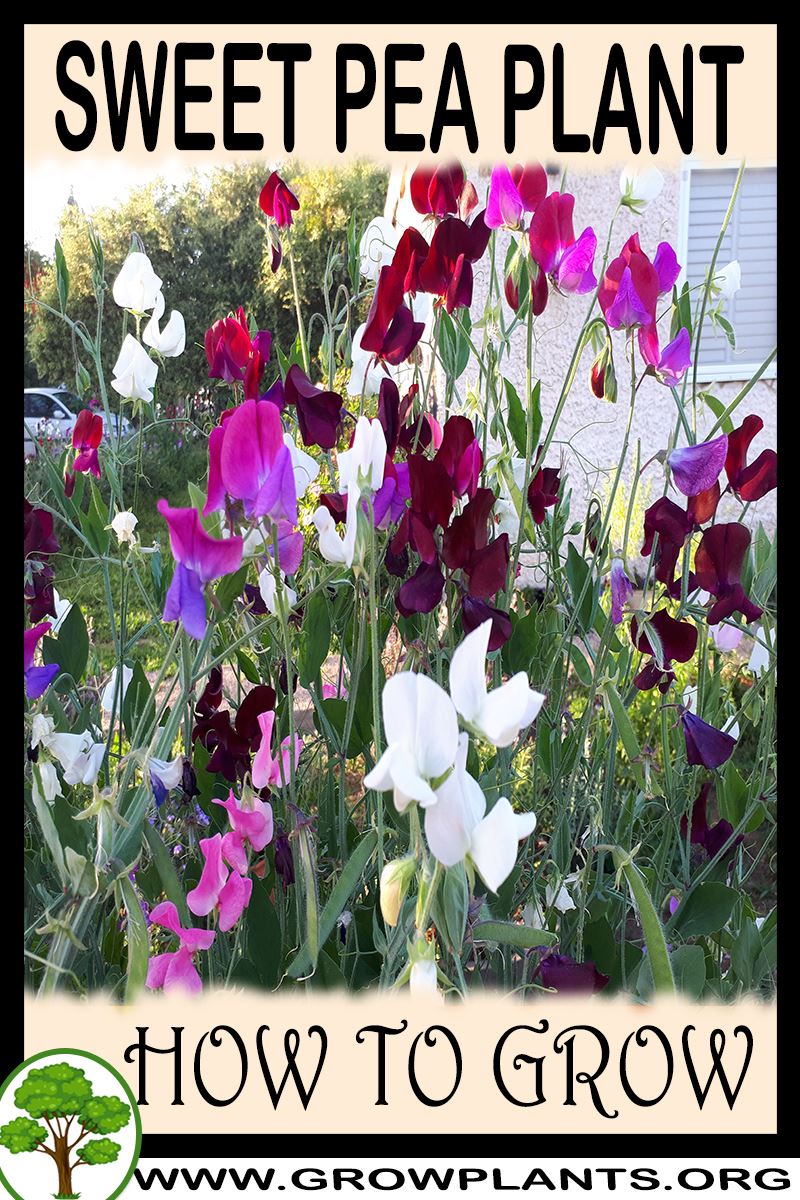
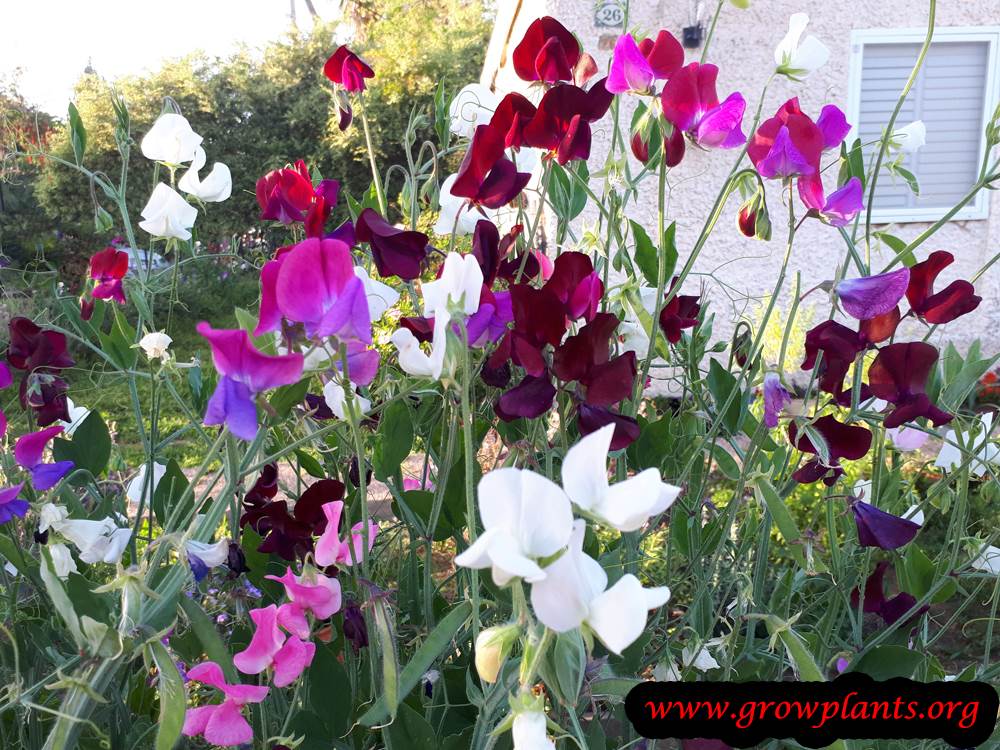
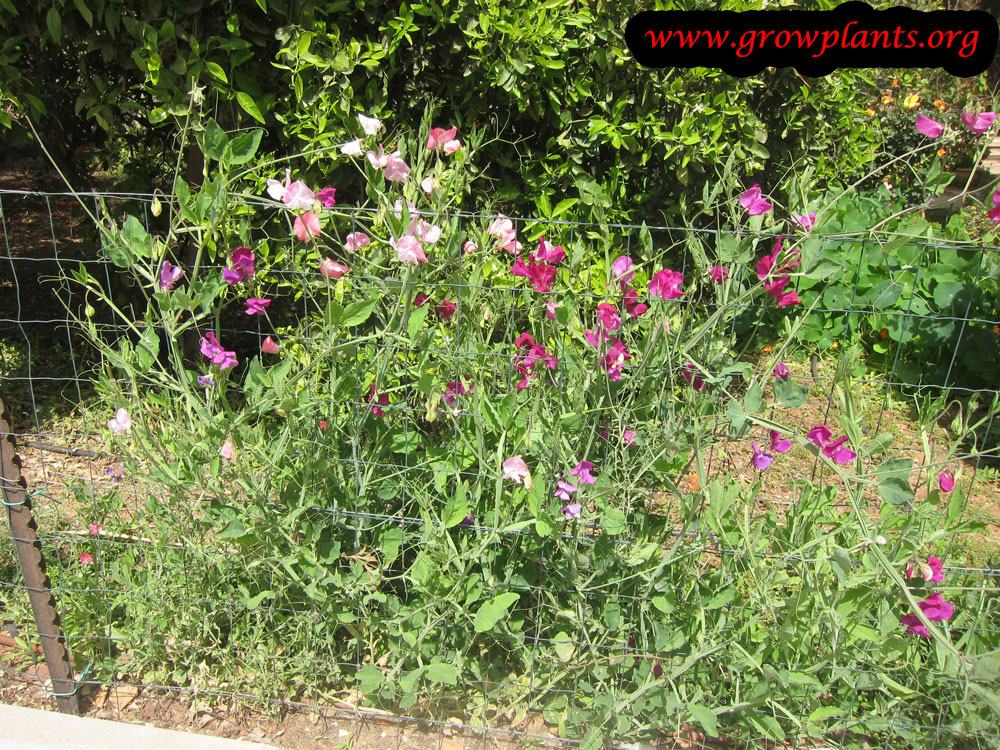
Overview: Sweet pea is a fast-growing annual climbing vine reaching 1-2 m, grown as an ornamental for its intensely fragrant, butterfly-shaped flowers. It climbs by tendrils and is a favourite cottage-garden and cut-flower plant – but its seeds and pods are poisonous.
Quick Specifications
| Specification | Attribute |
|---|---|
| Plant Type / Life Cycle | Annual |
| Mature Size | 1-2 m (3-6 ft) climbing |
| Growth Rate | Moderate to fast |
| Root System | Taproot with nitrogen-fixing root nodules (legume) |
| Toxicity | Seeds and pods are toxic (contain a neurotoxin – lathyrism); not edible despite the pea-like pods |
| Hardiness | USDA zones 2-11 (season-dependent) |
Growth Form & Structure
- Height & Spread: climbs 1-2 m (3-6 ft) on supports; suited to containers with a trellis.
- Growth Habit & Form: slender annual vine that climbs by leaf tendrils.
- Lifespan & Maturity: fast-growing annual that flowers within a single season.
Anatomy & Physical Features
- Leaves & Foliage: green leaves in elliptic, obtuse or linear shapes, with clinging tendrils.
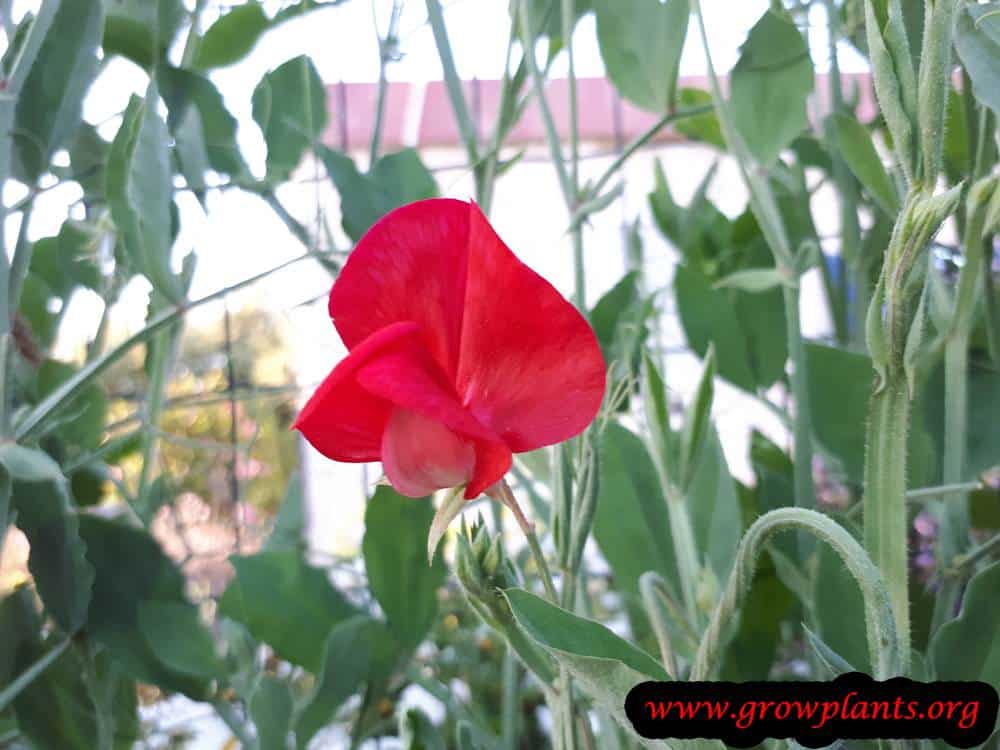
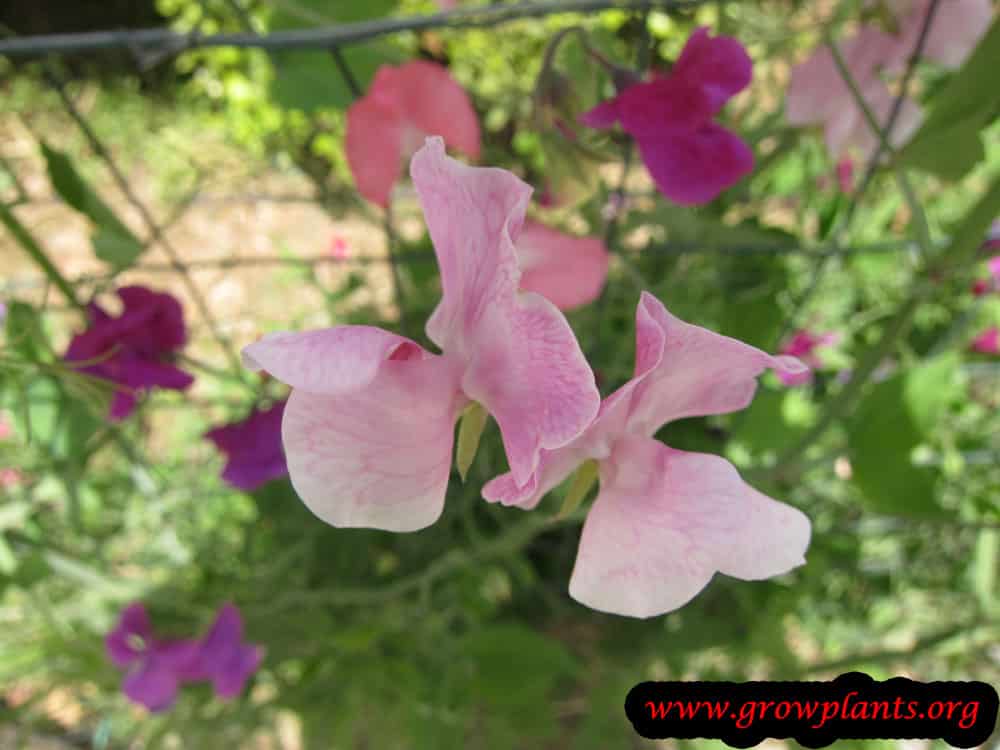
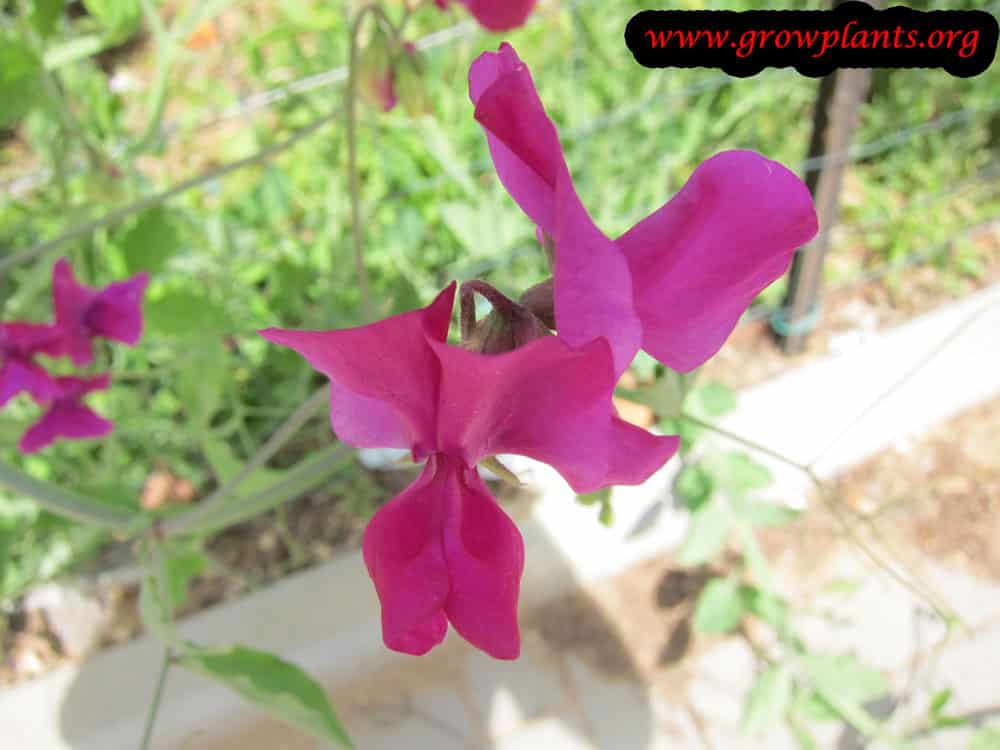
- Flower Characteristics: highly fragrant, butterfly-shaped (papilionaceous) flowers in red, purple, white, yellow or pink.
- Fruit Profile: seed pods – not edible (toxic).
Primary Uses & Landscape Value
- Functional & Ornamental Roles: fragrant ornamental climber, cut flower, trellis/screen and pollinator plant.
Care Guide: Planting, Soil & Watering
Overview: Sweet pea is a fast-growing annual climber grown for its fragrant flowers, thriving in full sun to part shade in cool-to-mild conditions. It does best in rich, fertile, well-draining soil kept consistently moist, with a cool root run.
Quick Care Requirements
| Requirement | Ideal Condition |
|---|---|
| Planting Season | In late winter to early spring, or in autumn in mild-winter climates |
| Growth Rate | Moderate to Fast |
| Soil Type | Rich, fertile, well-draining soil |
| Water Need | Moderate to High – keep evenly moist |
Planting & Establishment
- Best Planting Season: Plant from late winter into early spring for a spring-summer display, or in autumn in mild-winter climates for cool-season flowering; set young plants out once hard frost has passed but while the weather is still cool.
- How to Plant:
- Hole Preparation: Dig a hole a little wider than the root ball; sweet peas appreciate a deep, loosened root run, so work the soil well below the planting hole.
- Soil Amendments: Enrich the soil with plenty of compost or well-rotted organic matter to feed these hungry, fast-growing vines.
- Planting Depth: Set the seedling at the depth it grew in its pot, keeping the stem base at soil level.
- Growth Speed & Expectations: A fast climber that quickly reaches 1-2 m; give it a trellis or support to scramble up from the start.
Soil, Watering & Drainage Care
- Soil Mix & Drainage Needs: Give it rich, moisture-retentive but free-draining soil; a mulch keeps the roots cool and moist, which sweet peas particularly like.
- Watering Schedule & Technique:
- Young / Newly Planted: Keep the soil evenly moist while young plants establish and begin to climb.
- Established: Water regularly and deeply to keep the soil consistently moist, never letting it dry out during flowering.
- Seasonal Adjustments: Water more generously in warm, dry weather and through the flowering season; letting plants dry out shortens flowering.
Climate, Light & Hardiness
Sweet pea is a cool-season annual climber for Mediterranean, desert, subtropical and temperate gardens, grown in full sun to half shade. The dataset gives zones 2–10a for spring sowing and 10b–11 for autumn sowing; seedlings take light frost, and heat rather than cold ends the display.
Quick Climate Specifications
| Climate Zones | Mediterranean, desert, subtropical, temperate (cool-season) |
|---|---|
| USDA Hardiness Zones | Approximately 2–10a spring-sown, 10b–11 autumn-sown (per dataset) |
| Optimal Temp Range | Approximately 13–20 °C / 55–68 °F |
| Cold Damage Begins | Hardened seedlings take light frost; open flowers injured by frost below roughly −2 °C / 28 °F |
| Approx. Survival Minimum | Hardened young plants survive brief frost to around −5 °C / 23 °F; varies with conditions |
| Frost Tolerance | Low–Moderate (seedlings hardier) |
| Light Conditions | Full sun to half shade |
| Wind Tolerance | Moderate (needs a trellis) |
Sunlight & Light Exposure
Optimal Light Setup
Full sun gives strong stems and the best-scented flowers; in hot regions a little afternoon shade prolongs bloom by keeping the plant cooler.
Shade & Heat Management
Half shade helps in warm climates, where heat, not shade, cuts the flowering season short.
Temperature Extremes & Hardiness
USDA Hardiness & Regional Limits
Grown as an annual, but its cool-season habit sets the timing: cold-winter zones (about 2–10a) sow in late winter to spring, while mild and frost-free zones (10b–11) sow in autumn for winter-to-spring bloom. Cold defines the sowing window rather than barring the plant.
Cold Damage & Frost Sensitivity
Young hardened plants tolerate light frost, which allows autumn sowing in mild areas, but the flowers are more tender than the foliage.
Extreme Heat Tolerance
Sustained heat above roughly 24–27 °C / 75–81 °F stops flowering and ends the plant, which is its main climatic limit.
Wind, Humidity & Microclimate
Wind Tolerance
The soft climbing stems need a support and some shelter from strong wind.
Microclimate Recommendations
A sunny, sheltered, well-drained spot worked in the cool season gives the long, mild conditions it loves.
Growing in Pots, Balconies & Indoors
The sweet pea is a fragrant ornamental climber that grows wonderfully in a deep pot with a support on a cool, sunny balcony or patio. It is not a houseplant – and despite the name, its seeds are not edible.
Quick Details
- Container Size: A deep pot, 20-30 L (5-8 gal), with a wigwam or trellis
- Indoor Suitability: Not an indoor plant; a cool-loving climber for a bright balcony or patio
- Best Spot: Full sun to light shade; it appreciates cool roots
- Soil & Drainage: Keep the mix evenly moist – sweet peas dislike drying out at the roots; never waterlogged
- Watering in Pots: Houseplant limits: Not a houseplant – it is a climber that wants full sun, cool air and a support to scramble up. Windowsill growing: A bright, cool sill can start young plants, but they soon need to move outdoors onto a support. SAFETY: Despite the name it is ornamental, not edible – the seeds are toxic. Keep them away from children and pets.
Indoors & On the Windowsill
- Light, heat & wind: Give it the sunniest spot you can. Walls, railings and paving reflect heat, so pots dry quickly – check moisture daily in warm weather, and shelter tall growth from wind. A drip irrigation kit with a timer can take over that watering check automatically.
- Support: On a balcony or patio give it a trellis, netting or a cane wigwam to climb; mind the weight of large filled pots and where drainage water runs off shared balconies.
On a Balcony or Patio
- Pot & drainage: A deep 20-30 L pot with strong drainage holes; skip a standing water saucer to avoid root rot. Terracotta breathes and dries fast; glazed or plastic holds moisture longer.
- Potting mix: Use a well-aerated, organic-rich mix – peat or coir blended with perlite or vermiculite for free drainage.
- Feeding: Potted sweet peas lose nutrients to watering – feed regularly through the season with a balanced or slightly potassium-rich feed for more flowers.
- Annual crop: Grown fresh each season – clear the pot and re-sow rather than repotting.
Choosing the Pot, Soil & Long-Term Care
Growing this plant in a greenhouse
A greenhouse can give sweet pea frost protection, cold protection, a longer growing season and controlled production.
Greenhouse at a glance
| Greenhouse suitability | Excellent - a major practical advantage |
|---|---|
| Main benefits | frost protection, cold protection, a longer growing season, controlled production |
| Season extension | can grow through winter |
| Outdoor protection advisable below | about -2°C |
| Suitable types | unheated greenhouse, polycarbonate greenhouse, lean-to |
| Heating | Heating is optional - useful mainly for winter growing in cold areas. |
Related greenhouse guides
- Greenhouses: How to Choose the Right Greenhouse
- Best Lean-To Greenhouses
- Polycarbonate Greenhouses: What to Look for Before Buying
Fertilizing & Feeding
A light, undemanding feeder: as a legume, Sweet pea fixes some of its own nitrogen and flowers well on modest, balanced feeding rather than heavy nitrogen or high-phosphorus ‘bloom’ products.
Quick Fertilizing Specs
| Feeding Level | Moderate; flowers well on balanced feeding. |
|---|---|
| Main Nutrient Priority | Balanced nutrition; adequate nitrogen and balanced nutrients drive flowering. |
| Best Feeding Period | During active growth and through the bloom season. |
| Organic Options | Compost and other organic matter provide steady, gentle nutrition. |
| Soil pH | Tolerates a wide range; slightly acidic to near-neutral soil is ideal. |
| Reduce/Stop Feeding | Ease off feeding as flowering ends and the plant rests. |
Feeding by Growth Stage
Early growth
Establish Sweet pea and build a healthy framework of stems and leaves ahead of flowering.
| Nutrient direction | Balanced nutrition to build healthy stems and foliage as growth gets going; as a legume it fixes some of its own nitrogen, so keep nitrogen modest. |
|---|---|
| Timing | As new growth begins in the warm growing season. |
| Frequency | A light feeding as growth begins is usually enough. |
| Fertilizer types | A balanced complete fertilizer used lightly, Compost or other organic matter |
| Precautions | Avoid heavy nitrogen, which favors leaves over flowers and can loosen, floppy growth. |
Blooming
Sustain steady, colorful flowering through the bloom season.
| Nutrient direction | Steady, balanced nutrition through the bloom season; adequate nitrogen and balanced nutrients drive flowering, so ordinary complete fertilizer is what supports bloom. |
|---|---|
| Timing | Through the flowering season. |
| Frequency | Light feedings spread through the flowering season keep bloom going. |
| Fertilizer types | A balanced complete fertilizer used lightly through bloom |
| Precautions | Skip high-phosphorus ‘bloom booster’ products; excess phosphorus provides no real flowering advantage and can harm soil life. |
End of the annual cycle
As this annual finishes flowering and sets seed, it is winding down and no longer building growth.
| Nutrient direction | None – withhold fertilizer as the plant finishes its cycle. |
|---|---|
| Timing | After the main flush of bloom, as the annual declines and sets seed. |
| Frequency | No feeding at this stage. |
| Fertilizer types | No feeding at this stage – a spent annual is not building new growth. |
| Precautions | Do not fertilize a declining annual; let it finish naturally. |
Nutrient Deficiency Signs & Corrections
Older, lower leaves turn pale and growth becomes thin and slow.
| Possible causes | Low available nitrogen in the soil, Cold or waterlogged roots limiting nutrient uptake, Leaching of nutrients from a light or sandy soil |
|---|---|
| Appears first on | Older, lower leaves. |
| What to check | Soil drainage and how wet the roots stay, Recent feeding history and soil richness, Whether the fading starts on the oldest leaves |
| Possible correction | Improve drainage, and apply a light balanced feeding to restore steady, moderate growth. |
The newest leaves yellow between the veins while the veins stay green.
| Possible causes | High soil pH reducing iron or manganese availability, Waterlogged or cold roots that cannot take micronutrients up, A genuine iron or manganese shortage |
|---|---|
| Appears first on | New, upper leaves. |
| What to check | Soil pH, Drainage and root health, Whether only the newest growth is affected |
| Possible correction | Correct soil pH and drainage; if it persists, apply a chelated iron or manganese product according to its label. |
The plant grows plenty of leaves but produces few flowers.
| Possible causes | Excess nitrogen favoring foliage over flowering, Too little light for good bud formation, Heat or drought stress during the bloom period |
|---|---|
| Appears first on | Flowering shoots and buds. |
| What to check | Recent nitrogen inputs and overall soil richness, How much direct light the plant receives, Watering steadiness through the bloom season |
| Possible correction | Ease off nitrogen, give the plant adequate light, and rely on balanced nutrition rather than high-phosphorus bloom products, which offer no real flowering advantage. |
Pruning, Training & Seasonal Maintenance
Sweet pea (Lathyrus odoratus) is an annual herbaceous climbing legume grown for its fragrant cut flowers, reaching 1–2 m on a trellis or netting. It has no woody parts, so its “pruning” is really three soft-stem tasks: pinching young plants to make them branch, tying the vine to its support, and — the single most important job — deadheading and cutting flowers constantly. As an annual it flowers on current growth; once seed pods form, the plant reads its life-cycle as complete and stops flowering, so removing spent blooms and forming pods keeps it in flower.
Note that the seeds and pods are poisonous, so pod removal is a handled-and-discarded task, not a harvest.
Quick Pruning & Maintenance Specs
| Pruning Tolerance | Moderate (soft annual – responds to pinching, not structural cuts) |
| Primary Pruning Window | Through the flowering season (continual deadheading/picking) |
| Typical Frequency | Every few days while in bloom |
| Main Objective | Prolong flowering by preventing pod set; keep the vine on its support |
| Young Plant Priority | Pinch the growing tip to force strong basal side shoots |
| Mature Plant Priority | Deadhead and cut flowers before pods form; tie in new growth |
| Best Tool Type | Precision snips |
| Avoid Heavy Pruning During | Any time – it needs no cutting back, only picking |
Pruning by Plant Age & Size
Newly Established
When seedlings have two or three leaf pairs, pinch out the growing tip. This one cut redirects energy into multiple strong shoots from the base and produces a fuller, more floriferous plant than a single tall stem.
Young / Formative
There is no framework to build. Guide the tendril-climbing shoots onto netting, twine or a wigwam and tie in loosely; the plant clings by tendrils but appreciates help staying on the support.
Mature / Established
Keep picking. Frequent cutting of flowering stems is both the harvest and the maintenance — it is what keeps new buds coming. Remove any pods that slip past you before their seeds mature.
Seasonal Pruning Schedule
Flowering season (the whole job): objective is to prevent pod set — cut every open flower stem for the vase and snap off any faded blooms and forming pods; keep all healthy leafy growth and tendrils; expect a fresh crop of buds so long as no pods are allowed to mature. End of season: once summer heat (or, in warm climates, the turn of the season) ends the display, the spent annual is simply cleared; there is no over-wintering prune.
Structural Pruning & Training
Training, not structural pruning, is the point: provide tall netting or a wigwam and keep tying and weaving new growth in. On cordon (single-stem) systems used for exhibition, side shoots and tendrils are removed to channel all energy into one flowering stem — an optional refinement, not a requirement for garden plants.
Container & Small-Space Pruning
In pots and troughs, pinch young plants the same way and choose a more compact or bush strain; keep deadheading rigorously, because a small root run makes an unchecked, pod-setting plant fade even faster.
Tools
Every cut is a soft stem, so precision snips (or simply pinching with finger and thumb) are all that is required. Loppers, saws and shears have no role on this plant.
Tool Hygiene & Disease Risk
Increased when disease is present. Sweet peas are prone to aphid-spread viruses; aphids are the main vector, but when you are cutting out mottled, distorted virus-suspect growth you should clean the blades before moving to healthy plants and remove infected material rather than composting it in place. For routine deadheading of healthy plants, clean sharp snips suffice.
Cut Placement & Technique
Cut or pinch flowering stems low, just above a leaf joint, to encourage the next shoot. Pinch the seedling tip above a strong pair of leaves. Snap developing pods off cleanly at the stem. There are no branch collars or heavy cuts to consider.
Heavy Pruning & Rejuvenation
Not applicable. As a soft annual there is no woody base to renew — a plant that has gone to seed and stopped flowering cannot be “cut back to rejuvenate,” it is at the end of its cycle.
Post-Pruning Care
Keep the plant well watered — sweet peas are thirsty — and feed lightly during heavy flowering to sustain the constant bud production that picking encourages. Watch new growth for aphids, the virus vector.
Common Pruning Mistakes
- Letting pods form — the fastest way to stop flowering for the season.
- Not pinching seedlings, resulting in a single lanky stem with few flowering side shoots.
- Treating the poisonous pods as edible peas — they are ornamental only and must be discarded.
When NOT to Prune
There is never a case for cutting the plant back hard; it only needs picking. Do not strip healthy foliage or tendrils, and do not disturb newly transplanted seedlings beyond the single formative tip-pinch.
Recommended Tools (by task)
- precision_snips — for pinching seedling tips and for the constant deadheading and cut-flower harvesting that keep the plant blooming.
- soft_ties_stakes — to tie the soft tendril-climber onto netting or a wigwam as it grows.
Propagation Guide
Sweet peas are grown only from seed, sown in the cool part of the year; dark, hard-coated seeds germinate more evenly if chipped or soaked, while pale seeds can be sown dry. Cultivars are largely self-pollinating and come true. The seeds are poisonous — they are for sowing only, never eating.
Quick Propagation Specs
| Best Propagation Method | Seed |
| Propagation Difficulty | Easy |
| Seed True-to-Type | Yes — largely self-pollinating |
| Best Propagation Season | Autumn, or late winter to early spring |
| Germination Temperature | Cool, roughly 12–18°C (54–64°F) |
| Seed Sowing Depth | About 1–2 cm (0.5–1 in) |
Growing from Seed
Seed Handling & Viability
Seed is toxic — keep it from children and pets, and use it only for sowing.
Dormancy & Pre-Sowing Treatment
Dark, hard-coated seed germinates more evenly if chipped on the side opposite the eye or soaked; pale-coated seed is best sown dry, as over-soaking can rot it.
Sowing Season & Germination
Sow in the cool season — autumn in mild areas, late winter elsewhere — into cool, moist soil; emergence is best when temperatures stay cool.
Bloom & Flower Guide
Quick Details
- Bloom Season: Spring to summer, or autumn to spring in warm climates
- Time to First Bloom: Roughly ten to thirteen weeks from sowing
- Flower Appearance: Fragrant, butterfly-shaped flowers in red, purple, white, yellow and pink
- Edibility: Not edible; sweet pea is an ornamental only and its seeds are poisonous
Detailed Blooming Overview
Sweet pea is grown for one thing above all: its beautifully scented flowers, which come in a painter’s range of colours and make superb cut blooms. As pretty and pea-like as it looks, this is not a plant for the kitchen. Despite the name, the seeds are poisonous, so it belongs firmly among the ornamentals and should not be confused with edible garden peas.
Flower Characteristics
- Butterfly-shaped flowers, strongly fragrant.
- Colours span red, purple, white, yellow and pink.
- Excellent as a cut flower and a good pollinator draw.
Bloom Care & Thinning
- Keep picking: Regular cutting, and removing faded flowers before they set pods, keeps a sweet pea flowering for weeks longer.
- Site for flowering: Full sun, cool roots and a support to climb give the most abundant, best-scented bloom.
- Safety: The seeds and pods are poisonous; keep them away from children and pets, and never eat any part.
Bloom Health & Protection
- Powdery mildew: A white bloom on leaves and stems in warm, dry spells can cut a display short; good spacing and airflow help, with a sulfur-based fungicide if it spreads.
- Aphids on buds and tips: They crowd the soft flowering growth and can spread virus; a jet of water or an insecticidal soap or neem oil manages them.
- Bud drop: Sudden swings in temperature or watering can make buds fall before opening; steady moisture and feeding keep the bloom coming.
Pests, Diseases & Troubleshooting
Overview: The sweet pea is a cool-season annual climber whose tender, sappy growth attracts aphids (which also spread damaging viruses), along with slugs, thrips and pollen beetles. Its main diseases are the powdery and downy mildews and the wilts and root rots of the pea family, plus abiotic bud drop in unsettled weather. Grow it cool, open and unstressed, with clean crop rotation, and control aphids early to keep viruses out.
Quick Troubleshooting Overview
| Issue / Pest | Main Symptom | Primary Solution |
|---|---|---|
| Aphids | Curled sticky shoots; virus spread | Water jet, beneficials, soap; act early |
| Slugs & snails | Seedlings and shoots grazed | Barriers, traps, hand-pick |
| Thrips | Silvered, distorted flowers and leaves | Sticky traps; soap; beneficials |
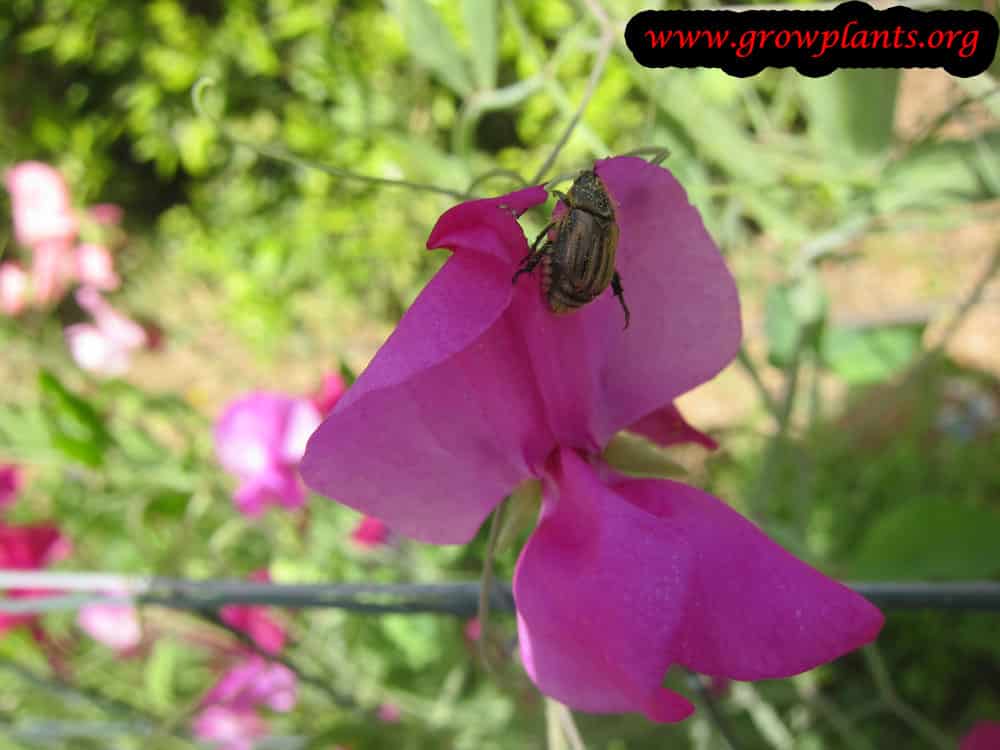
| Pollen beetles | Small beetles inside blooms | Tolerate; shake off cut flowers |
| Powdery / downy mildew | White powder or yellow blotches on leaves | Airflow, dry foliage, resistant strains |
| Bud drop | Buds yellow and fall before opening | Steady moisture & temperature; feed evenly |
Common Pests & Management
- Aphids (Aphidoidea):
- Symptoms: Small soft-bodied green, black or grey insects clustering on new shoots, flower buds and the undersides of young leaves. They suck sap, causing curled, distorted, sticky (honeydew-coated) growth and can transmit viruses. Look for cast white skins and attending ants.
- Prevention & Control: Blast colonies off with a firm jet of water and pinch out badly infested tips. Encourage ladybirds, lacewings and hoverflies with companion flowers; avoid excess high-nitrogen feeding that produces soft, aphid-prone growth. If populations persist, treat with insecticidal soap or a light horticultural/neem oil, coating leaf undersides and spraying in the cool of the evening to protect pollinators.
- Slugs & snails (Gastropoda):
- Symptoms: Irregular ragged holes chewed in young leaves and soft new shoots, worst in damp, shaded conditions, with tell-tale silvery slime trails and seedlings sometimes grazed to the ground overnight.
- Prevention & Control: Clear damp hiding places (boards, debris, dense mulch against stems), water in the morning so the surface dries by night, and hand-pick after dark. Protect vulnerable crowns and seedlings with copper barriers, grit or wool pellets; use beer traps or iron-phosphate slug pellets, which are safe around wildlife, only where pressure is high.
- Thrips (Frankliniella / Thrips spp.):
- Symptoms: Fine silvery streaking and pale flecking on leaves and petals with dark frass specks, and distorted, discoloured flowers; thrips can also transmit viruses.
- Prevention & Control: Monitor with blue or yellow sticky traps, keep plants unstressed, and encourage predatory mites and lacewings. Insecticidal soap or spinosad checks heavy infestations, applied in the evening to protect pollinators; remove badly affected blooms.
- Pollen beetles (Meligethes spp.):
- Symptoms: Small shiny black beetles clustering inside the flowers seeking pollen, disfiguring blooms and being a nuisance in cut flowers rather than a real threat to the plant.
- Prevention & Control: Tolerate them where possible, as they cause little true damage; for cut flowers, stand stems in a shaded spot so beetles fly off toward the light before bringing blooms indoors. Avoid insecticides that would harm the pollinators sweet peas depend on.
- Spider mites (Tetranychus urticae):
- Symptoms: Fine pale stippling or a bronzed, dusty look on leaves, with delicate webbing in leaf axils during hot, dry conditions. Leaves dry, yellow and drop; a shaken leaf over white paper reveals tiny moving specks.
- Prevention & Control: Mites thrive in hot, dry, dusty air, so raise humidity, hose down foliage and avoid drought stress. Preserve predatory mites and other beneficials by avoiding broad-spectrum sprays. For outbreaks, apply insecticidal soap or horticultural oil to leaf undersides, repeating every 5-7 days to catch newly hatched mites.
Diseases & Fungal Issues
- Powdery mildew (Erysiphales):
- Symptoms: A white to grey powdery coating on upper leaf surfaces, shoots and buds, worst where air is still and humid but roots are dry. Affected leaves may yellow, distort and drop early.
- Treatment & Management: Improve airflow by correct spacing and thinning, site plants in good light, and avoid drought stress and overhead watering late in the day. Remove affected leaves. Organic sprays such as potassium bicarbonate, diluted milk, sulfur or neem oil check its spread; choose mildew-resistant varieties where available.
- Downy mildew (Peronosporaceae):
- Symptoms: Pale yellow or angular blotches on the upper leaf surface with a matching greyish-purple furry growth on the undersides, developing in cool, wet, humid weather. Leaves brown and collapse.
- Treatment & Management: Space and thin plants for airflow, water at the base to keep foliage dry, and remove and destroy infected leaves and debris. Rotate crops and choose resistant cultivars. Copper-based fungicides give preventive protection under persistent damp conditions.
- Fusarium & root rot / wilt (Fusarium / Pythium / Aphanomyces spp.):
- Symptoms: Yellowing, wilting and collapse of plants with browning at the stem base and rotted or discoloured roots, worst in cold, wet or compacted soil and where sweet peas have grown before.
- Treatment & Management: Rotate onto fresh ground each year (avoid soil that recently grew sweet peas or peas), improve drainage and soil structure, and sow into warm, well-aerated soil. Remove and destroy collapsed plants; there is no cure, so prevention through rotation and drainage is essential.
- Grey mould (Botrytis cinerea):
- Symptoms: Fuzzy grey mould rotting buds, flowers and soft growth in cool damp, crowded conditions, with tan collapsing tissue.
- Treatment & Management: Space and support plants for airflow, deadhead spent flowers, avoid wetting foliage late in the day, and remove infected material promptly. Good ventilation prevents most infection; fungicide is only for prolonged wet spells.
- Viruses (mosaic / enation) (Bean yellow mosaic / Pea enation mosaic virus):
- Symptoms: Mottled, streaked, distorted leaves and flowers, colour-breaking in blooms, and stunting, spread mainly by aphids.
- Treatment & Management: Control aphids promptly and remove and destroy infected plants, as there is no cure. Buy healthy seed/plants, keep down weed reservoirs, and avoid handling healthy plants after touching infected ones.
Growing Difficulties & Abiotic Problems
- Bud drop (abiotic / environment):
- Cause & Symptoms: Flower buds yellow and drop before opening, triggered by sudden swings in temperature, cold nights, dry roots or a check to steady growth, especially early in the season.
- Correction Strategy: Keep soil moisture even with mulch and regular watering, feed steadily without surges, and shelter early plants from cold snaps. Bud drop usually stops once the weather and growth settle; consistency is the cure.
- Scorch & heat stress / short season (abiotic):
- Cause & Symptoms: Flowering fades fast, colours bleach and plants exhaust as heat arrives, since sweet peas are cool-season plants that decline in summer heat.
- Correction Strategy: Sow early for a long cool-season display, provide the roots with cool, deep, moisture-retentive soil and light afternoon shade in warm areas, and pick flowers regularly (and remove seed pods) to prolong blooming before heat ends the season.
- Poor germination & leggy seedlings (abiotic):
- Cause & Symptoms: Erratic germination from the hard seed coat, or drawn, weak seedlings raised too warm and dark.
- Correction Strategy: Aid germination of hard-coated seed by soaking or nicking before sowing, sow into a cool moist medium, and grow seedlings cool and bright, pinching the tips to encourage sturdy, well-branched climbers.
What Helps — Products & Tools
Sweet peas respond to cultural care: insecticidal soap for aphids (control early to keep viruses out), slug barriers or iron-phosphate pellets for seedlings, and sticky traps for thrips. For disease, rotation, airflow and resistant strains do most of the work, with sulfur or potassium bicarbonate for mildew. Support netting and even watering prevent much of the abiotic bud drop.