Plant Profile & Key Characteristics
Overview: An evergreen succulent vine reaching 1-2 m (3-6 ft), grown as an ornamental (and houseplant) for its curious parachute-shaped flowers. It is a shade-loving perennial for tropical, Mediterranean and subtropical settings.
Quick Specifications
| Specification | Attribute |
|---|---|
| Plant Type / Life Cycle | Perennial (evergreen succulent vine) |
| Foliage Type | Evergreen (succulent) |
| Mature Size | 1-2 m (3-6 ft) long |
| Growth Rate | Moderate to slow |
| Hardiness | USDA zone 10b+ |
Growth Form & Structure
- Height & Spread: Trailing/climbing stems 1-2 m (3-6 ft) long; ideal for hanging baskets and containers with trellising.
- Growth Habit & Form: Twining succulent vine that climbs or trails.
- Lifespan & Maturity: Moderate-to-slow perennial grown year-round indoors or in frost-free gardens.
Anatomy & Physical Features
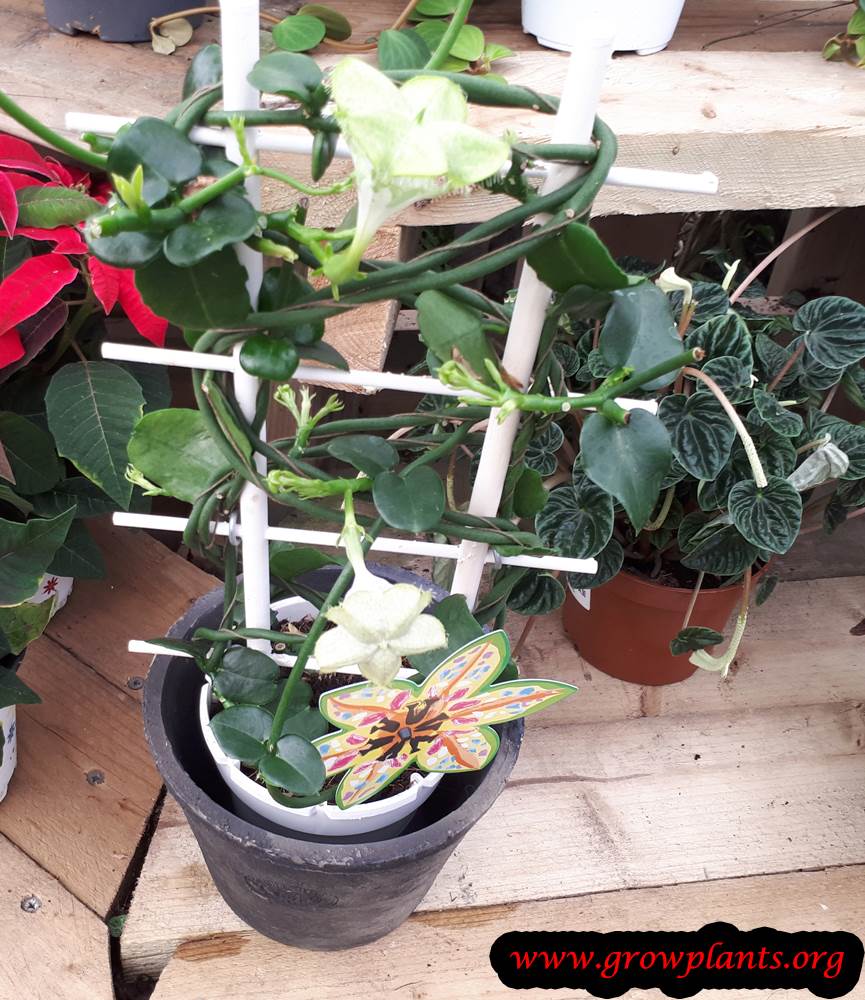
- Leaves & Foliage: Green, fleshy leaves in ovate to heart shape.
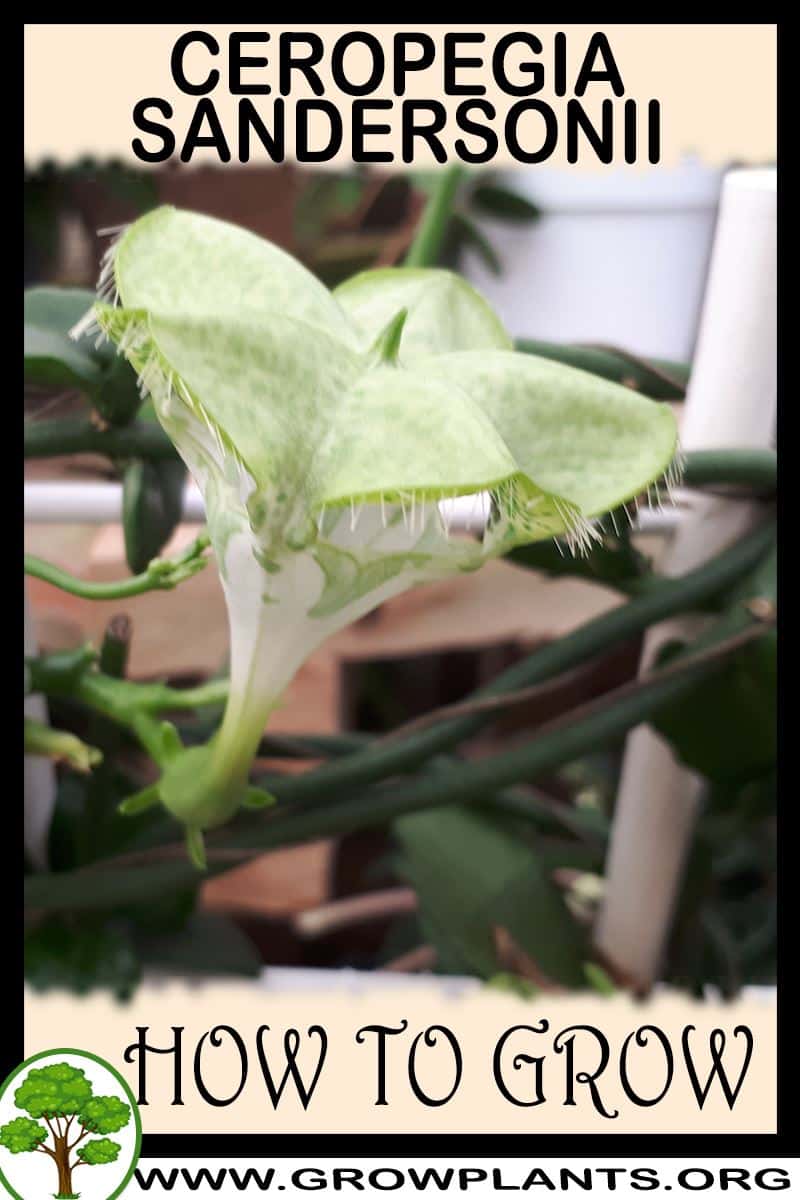
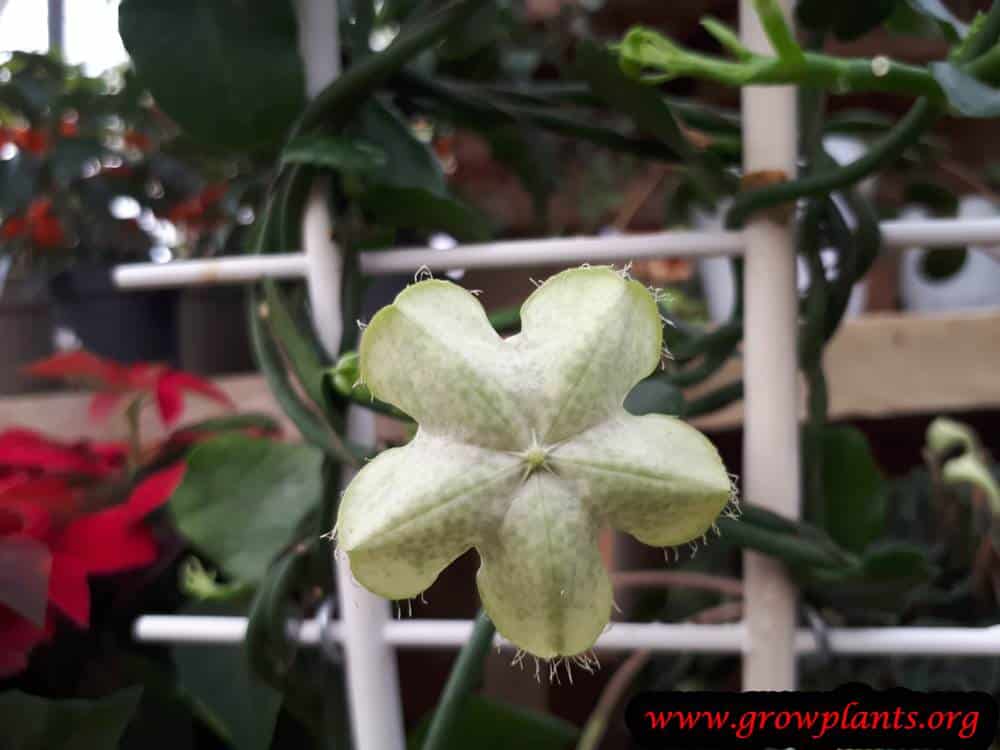
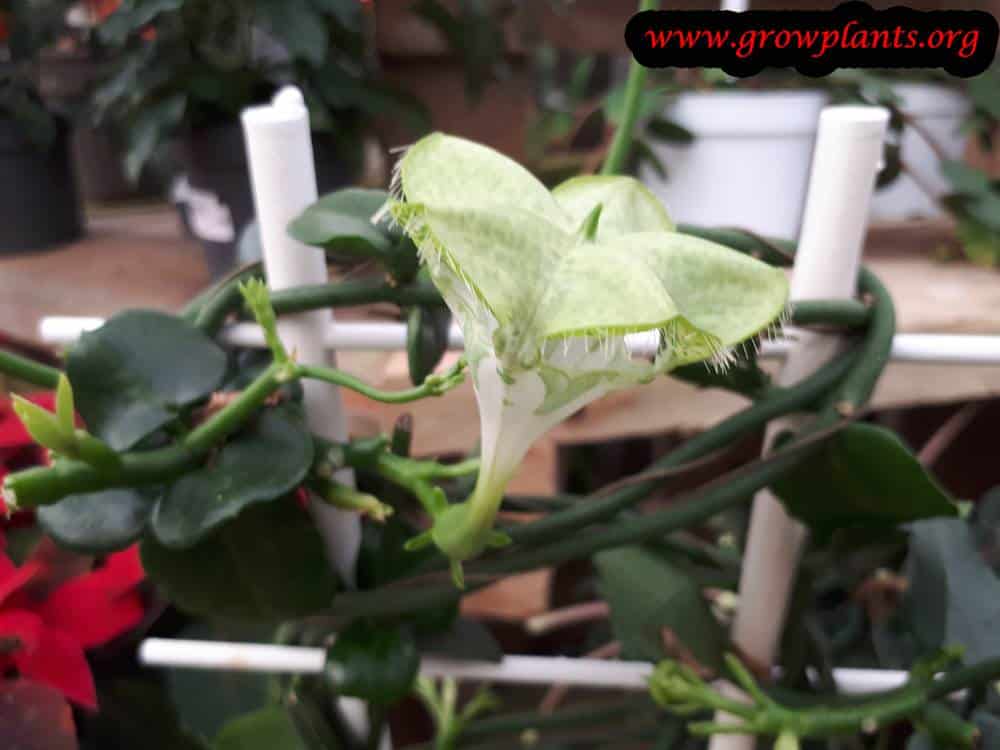
- Flower Characteristics: Green-and-yellow, dotted parachute-shaped flowers that trap flies for pollination (full detail in the Bloom section).
Primary Uses & Landscape Value
- Functional & Ornamental Roles: Novelty ornamental and trailing houseplant for hanging baskets.
Care Guide: Planting, Soil & Watering
Overview: This trailing succulent vine likes bright, warm conditions with good air movement and something to climb. It grows in airy, well-drained yet moisture-retentive soil and enjoys a moderate to generous supply of water with higher humidity.
Quick Care Requirements
| Requirement | Ideal Condition |
|---|---|
| Planting Season | Year-round in the tropics; spring to summer in cooler areas |
| Growth Rate | Slow to moderate |
| Soil Type | Airy, well-ventilated, well-draining but moisture-retentive |
| Water Need | Moderate to high – keep lightly moist with good humidity, never waterlogged |
Planting & Establishment
- Best Planting Season: Year-round in tropical climates, or from spring to summer where conditions are cooler.
- How to Plant:
- Hole Preparation: Dig a hole about twice the width of the root ball and just as deep, loosening the sides so young roots spread easily.
- Soil Amendments: Blend compost with plenty of perlite or grit so the mix stays open and airy while still holding some moisture.
- Planting Depth: Set the plant so the root collar sits level with the surrounding soil; never bury the stem or trunk base.
- Growth Speed & Expectations: A slow to moderate grower whose trailing stems reach 1-2 m; provide a trellis or support to climb.
Soil, Watering & Drainage Care
- Soil Mix & Drainage Needs: Use a loose, well-aerated mix that drains freely but does not dry to dust – potting soil with added perlite works well. Good drainage and airflow prevent rot, while ambient humidity keeps the fleshy stems happy. It grows equally well in pots or hanging containers.
- Watering Schedule & Technique:
- Young / Newly Planted: Water generously and keep the soil consistently moist while the plant roots in; do not let it dry out.
- Established: Maintain steady moisture with regular deep watering, easing off just enough to avoid waterlogging.
- Seasonal Adjustments: Water frequently through warm, active growth and reduce in winter, keeping the soil only just moist.
Climate, Light & Hardiness
Ceropegia sandersonii is a succulent vine from warm tropical and subtropical regions that, despite being a succulent, prefers full shade rather than strong direct sun, and it appreciates humidity. It is reliably hardy outdoors only from about USDA zone 10b upward, elsewhere best grown as a houseplant.
Quick Climate Specifications
| Climate Zones | Tropic, Mediterranean, subtropical, or grown as a houseplant |
|---|---|
| USDA Hardiness Zones | Approximately 10b and warmer |
| Frost Tolerance | Very low |
| Light Conditions | Full shade |
Sunlight & Light Exposure
Optimal Light Setup
Prefers full shade with bright ambient light rather than direct sun, unusual for a succulent but consistent with its understory-vine habit.
Shade & Heat Management
Direct sun is best avoided, as it can scorch the fleshy leaves; bright, filtered conditions suit it better.
Temperature Extremes & Hardiness
USDA Hardiness & Regional Limits
Reliable outdoors only from about USDA zone 10b upward; in cooler climates it should be grown as a houseplant.
Cold Damage & Winter Protection
Cold, especially combined with damp soil, causes stem and root rot; keep warm and on the drier side whenever temperatures drop.
Frost Sensitivity
Highly frost-sensitive.
Wind, Humidity & Microclimate
Humidity Preferences
Appreciates humidity, and benefits from a trellis or support with airflow around the foliage in humid conditions to help prevent fungal issues.
Growing in Pots, Balconies & Indoors
Ceropegia sandersonii, the parachute plant, is a trailing and climbing vine that the grower confirms grows well indoors. Its unusual green parachute-shaped flowers and easy nature make it a lovely houseplant for a hanging pot or a small trellis.
Quick Details
- Container Size: A modest pot – it climbs or trails, so add a small trellis or use a hanging basket
- Indoor Suitability: A good houseplant, happy in bright shade
- Best Spot: Full/bright shade indoors; no harsh direct sun
- Soil & Drainage: Free-draining potting or succulent-type mix
- Watering in Pots: Average to generous in growth, easing off in the cool rest period; keep well drained
Indoors & On the Windowsill
- A good houseplant: The grower grows it indoors – it does well in bright, indirect light and can climb a small support or trail from a shelf or hanging pot.
- Light: It tolerates fairly shady rooms but grows and flowers best in bright, filtered light near a window.
On a Balcony or Patio
- Sheltered shade: On a balcony give it a warm, wind-sheltered spot out of scorching sun, with a trellis or wires to climb; potted vines dry quickly, so check moisture in warm weather.
Choosing the Pot, Soil & Long-Term Care
- Pot & drainage: A modest pot with strong drainage holes and no standing-water saucer; provide a trellis or hang it so the vines can cascade.
- Potting mix: A free-draining mix – potting compost with added perlite, or a gritty succulent blend.
- Potted plants exhaust and leach nutrients faster than those in the ground, so feed more often – a balanced feed through the growing season.
- Refresh the mix and pot on about every two years, lightly root-pruning and top-pruning to keep it vigorous.
Fertilizing & Feeding
A trellised, humidity-loving flowering vine – unlike drier succulent relatives in its family, this species keeps evenly moist soil and benefits from light, steady feeding through its growing and flowering period, tapering off when growth slows.
Quick Fertilizing Specs
| Feeding Level | Light to moderate |
|---|---|
| young_feeding | Very light feeding while a new cutting or young plant is establishing its root system on the trellis or support. |
| mature_feeding | Light, regular feeding through the active growing and flowering season for an established vine. |
| Main Nutrient Priority | A balanced feed that supports steady vine growth and its distinctive parachute-shaped flowers without forcing overly soft stems. |
| Best Feeding Period | The warm growing season into the flowering months. |
| Organic Options | A dilute organic liquid feed pairs well with the plant’s preference for consistently moist, humus-rich soil. |
| Reduce/Stop Feeding | Reduce and stop feeding as growth and flowering slow, especially for plants overwintered indoors in lower light. |
Feeding by Growth Stage
Establishment
Help a new cutting or young vine build roots and begin climbing its support before adding nutrient demands.
| Nutrient direction | Very light, cautious feeding only once new growth confirms the plant has begun rooting in. |
|---|---|
| Timing | The first stretch after planting, potting, or rooting a cutting. |
| Frequency | Feed rarely at this stage – a young, still-rooting vine needs very little beyond consistent moisture and humidity. |
| Fertilizer types | A very dilute balanced liquid fertilizer once new growth appears, applied at a fraction of the normal strength |
| Precautions | Avoid feeding immediately after planting or propagating; wait until new growth confirms roots are active. |
Active Growth and Bloom
Support steady vine extension along its support together with the plant’s characteristic parachute-shaped flowers.
| Nutrient direction | A balanced feed applied lightly and consistently to support both foliage and flowering without pushing weak, overly soft growth. |
|---|---|
| Timing | The warm growing season through the flowering period. |
| Frequency | Feed lightly on a regular basis while the vine is actively growing and blooming. |
| Fertilizer types | A diluted balanced liquid fertilizer worked into a consistently moist, well-ventilated growing medium, A light organic feed as an alternative for plants grown in humus-rich soil |
| Routine trace nutrients | iron, manganese |
| Precautions | Maintain good humidity and airflow alongside feeding, since dense, poorly ventilated conditions can encourage pests and rot even when nutrition is well managed. |
Cool-Season or Low-Light Slowdown
Let the vine rest through periods of reduced light and cooler temperatures without pushing new growth it can’t support well.
| Nutrient direction | None – withhold fertilizer while growth and flowering have clearly slowed. |
|---|---|
| Timing | Cooler months or reduced-light periods, particularly for plants grown indoors away from a tropical climate. |
| Frequency | No feeding at this stage – resume once active vine growth and flowering clearly restart. |
| Fertilizer types | No feeding at this stage – maintenance moisture and humidity only, no fertilizer product needed. |
| Precautions | Do not fertilize during the slowdown; unused nutrients in already-moist soil can build up and stress the roots. |
Nutrient Deficiency Signs & Corrections
New vine growth looks thin, pale, or weak instead of putting on steady, healthy extension.
| Possible causes | Insufficient nitrogen from an overly sparse feeding routine, Low light limiting the plant’s overall growth energy, Inconsistent soil moisture stressing the root system |
|---|---|
| Appears first on | The newest growth at the vine tips |
| What to check | Check light levels and consistency of soil moisture before assuming a nutrient cause, Check how long it has been since the last feeding during the active season |
| Possible correction | Correct light and moisture consistency first, then resume light, regular balanced feeding during the growing season. |
The vine grows well but produces few or no of its characteristic parachute-shaped flowers.
| Possible causes | Insufficient light, since flowering depends more on light exposure than on extra fertilizer, An overly nitrogen-heavy feeding routine encouraging foliage growth at the expense of flowers, A young or recently repotted plant that has not yet matured enough to bloom |
|---|---|
| Appears first on | Absence of flowers along otherwise healthy vine growth |
| What to check | Check light exposure, since this species needs adequate light to flower well, Check whether feeding has leaned heavily toward nitrogen-rich products |
| Possible correction | Improve light conditions and switch to a balanced rather than nitrogen-heavy feed if flowering stays sparse. |
Pruning, Training & Seasonal Maintenance
Ceropegia sandersonii is a soft-stemmed, twining succulent vine with no woody framework, so pruning is essentially trimming and pinching to manage length and encourage branching rather than shaping a structure. It tolerates cutting well and can be trimmed at any time of year; because its parachute-shaped flowers form along current growth rather than on older wood, tidy trimming does not sacrifice a coming bloom cycle. The main decisions are how much trailing length to allow and whether to train the vine onto a support or let it cascade.
Quick Pruning & Maintenance Specs
| Pruning Tolerance | Moderate to High (tolerates cutting back for length and bushiness) |
| Primary Pruning Window | Any time of year, as growth dictates |
| Typical Frequency | Light, ongoing pinching and trimming rather than a scheduled prune |
| Main Objective | Control trailing length, encourage branching, remove leggy or bare stems |
| Young Plant Priority | Pinch growing tips early to build a bushier base before it lengthens |
| Mature Plant Priority | Trim back overlong or bare-based runners; tidy tangled growth |
| Best Tool Type | Precision snips |
| Avoid Heavy Pruning During | No strict restriction, though light trimming is easiest to judge while in active growth |
Pruning by Plant Age & Size
Newly Established
Avoid cutting a newly rooted plant; once it is actively producing new trailing growth, an early pinch or two of the growing tip encourages branching from the base rather than a single long runner.
Young / Formative
Pinching is the only training this species needs — regularly nip growing tips to multiply the number of trailing stems, and decide early whether to let it cascade freely or train it up a small trellis or support.
Mature / Established
On an established plant, trim back runners that have gone bare at the base or grown far past the display area, and thin out overly tangled sections so light reaches the interior stems.
Special Growth to Remove
- Leggy, bare-based runners: cut back to a point with healthy leaves to encourage fresh branching.
- Spent flower stalks: trim once faded; flowering is not seasonally wood-dependent, so this is purely tidying.
- Tangled or dead vine sections: remove to keep the display open and to supply clean material for propagation cuttings.
Container & Small-Space Pruning
Because this species is almost always grown in a hanging container or small pot, length control is the central task rather than canopy management — trim trailing stems back to the container’s rim or trellis top as needed, and pinch regularly to keep growth compact rather than a single sparse runner.
Tools
- Precision snips: for pinching tips and trimming the soft, thin vine stems.
- Soft ties or stakes: for guiding stems onto a small trellis if trained upright rather than left to trail.
Tool Hygiene & Disease Risk
Routine hygiene – a clean blade is sufficient. No significant transmissible disease risk is noted for this species, so no special disinfection routine is required beyond general cleanliness.
Cut Placement & Technique
Pinch or snip just above a leaf node so the plant branches from that point, and cut trailing stems back to just above a healthy leaf pair rather than into completely bare stem.
Heavy Pruning & Rejuvenation
Tolerates a hard cut-back well: an overgrown, sparse plant can be cut back by half or more to force fresh branching from the base, and the trimmed sections readily propagate as cuttings to fill in or start new plants.
Post-Pruning Care
After a hard trim, keep humidity and watering close to normal (this species likes consistent moisture rather than a dry recovery period) and expect new shoots from remaining leaf nodes within a few weeks.
Common Pruning Mistakes
- Letting runners go bare at the base for too long before pinching, resulting in a sparse-looking plant.
- Cutting into fully bare stem with no leaf node to regrow from.
- Discarding healthy trimmed sections instead of using them as propagation cuttings.
When NOT to Prune
Hold off on hard cutting immediately after repotting or a location change, until the plant shows it has settled back into active growth.
Recommended Tools (by task)
- precision_snips: the right scale for pinching tips and trimming this thin-stemmed vine.
- soft_ties_stakes: for training stems onto a trellis rather than leaving them to trail.
Propagation Guide
Ceropegia sandersonii is easiest to grow from stem cuttings, as the site notes, since vegetative propagation isn’t strictly required but reliably outperforms seed. Seed is generally true to the species when it can be obtained, but this Easy-to-root vine is best propagated from cuttings.
Quick Propagation Specs
| Best Propagation Method | Stem (vine) cuttings |
| Alternative Methods | Seed (less reliable to obtain and slower) |
| Propagation Difficulty | Easy |
| Seed True-to-Type | Usually true-to-type |
| Vegetative True-to-Type | Yes |
| Best Propagation Season | All year in the tropics; spring to summer in colder climates |
| Cutting Rooting Time | Typically a few weeks under warm, humid conditions |
Growing from Seed
This species’ parachute-shaped flowers work as temporary fly traps to achieve pollination, which lines up with the site’s own note that the flowers attract flies — so seed set in cultivation can be limited without visiting flies or hand pollination. When seed is available it is generally true to the species; sow it in a warm, humid, well-drained mix, though germination timing is not well documented for this species.
Stem Cuttings
Cutting Type
A length of vine stem, ideally including at least one leaf node.
Best Timing
During the warm growing season — year-round in tropical climates, spring to summer where it’s colder.
Cutting Preparation
Take a cutting with a node and let the cut end dry briefly before inserting it, as is typical for succulent-stemmed vines, to reduce the risk of rot.
Rooting Setup
Root in a well-ventilated, well-drained, lightly moist mix with good humidity; provide a trellis or support once the cutting is growing on.
Rooting Hormone
Optional — cuttings of this vine generally root without it.
Rooting Time
Typically a few weeks under warm, humid conditions.
Bloom & Flower Guide
Quick Details
- Bloom Season: Summer into autumn
- Flower Appearance: Green-and-yellow parachute- or lantern-shaped flowers patterned with fine dots
- Edibility: Not eaten – grown as an ornamental curiosity
Detailed Blooming Overview
Ceropegia sandersonii (parachute plant or fountain flower) is an evergreen succulent vine grown for its extraordinary flowers. They open in summer and autumn in tropical, Mediterranean and subtropical settings, or as a houseplant, in roughly zone 10b and warmer.
Flower Characteristics
- Intricate flowers shaped like a little parachute or fountain, green marked with yellow and fine speckling.
- The petal tips join at the top to form a delicate canopy over the flower’s mouth.
- They briefly trap small flies inside to carry pollen, then release them unharmed – a clever lure, not a carnivorous plant.
Bloom Care & Thinning
- Position: Bright, indirect light and a support to climb bring on the best flowering.
- Watering: Ease off water in the cooler months to keep the tuberous roots healthy.
Pests, Diseases & Troubleshooting
Overview: The parachute plant is a succulent-stemmed trailing vine (a relative of string-of-hearts and the hoyas) whose main danger is rot from overwatering; insect problems are the usual soft-bodied succulent pests. Keep it warm, bright and on the dry side and it is easy and long-lived.
Quick Troubleshooting Overview
| Issue / Pest | Main Symptom | Primary Solution |
|---|---|---|
| Overwatering / stem rot | Mushy blackening stems, collapse | Cut to firm tissue; dry; sharp drainage |
| Mealybugs | White fluff at nodes and leaf axils | Alcohol swab; oil/soap |
| Root mealybugs | Failure to thrive; white on roots | Bare-root, wash, repot |
| Aphids | Clusters on flower stalks/new growth | Water jet; soap |
| Scale | Brown bumps on stems | Scrape; horticultural oil |
| Spider mites | Fine webbing, stippling in dry heat | Rinse; humidity; oil |
Common Pests & Management
- Mealybugs (Pseudococcus / Planococcus spp.):
- Symptoms: White cottony tufts in growth tips, leaf joints and along stems; sticky honeydew and sooty mould follow. On succulents/cacti check the root zone too, where root mealybugs coat roots in white powder.
- Prevention & Control: Wipe or dab colonies with a cotton swab dipped in dilute alcohol; rinse plants and encourage predators (ladybirds, lacewings). For root mealybug, bare-root, wash the roots and repot in fresh mix. Follow up with horticultural oil or insecticidal soap.
- Root mealybugs (Rhizoecus spp.):
- Symptoms: A plant that sulks and won’t grow; tipped out, the roots show white waxy powder and insects.
- Prevention & Control: Bare-root, wash roots, discard old soil and repot in fresh gritty mix; drench with horticultural oil or a systemic and quarantine new stock.
- Aphids (Aphidoidea):
- Symptoms: Clusters of small green, black or grey soft-bodied insects on new shoots, buds and leaf undersides; curled distorted growth, honeydew and sooty mould.
- Prevention & Control: Blast off with a strong jet of water and squash colonies early. Encourage ladybirds, lacewings and hoverflies; avoid excess nitrogen that fuels soft growth. Use insecticidal soap or neem for stubborn outbreaks, sprayed in the evening to spare pollinators.
- Scale insects (Coccidae / Diaspididae):
- Symptoms: Immobile brown, tan or white bumps on stems and leaf undersides; sticky honeydew and blackish sooty mould on soft scale. Growth slows and leaves yellow.
- Prevention & Control: Scrape off light infestations by hand and prune heavily-encrusted stems. Smother the rest with horticultural or neem oil, covering undersides; repeat to catch mobile crawlers. Conserve parasitic wasps and ladybirds.
- Spider mites (Tetranychus urticae):
- Symptoms: Fine pale stippling on leaves, a dull bronzed look, and fine webbing on undersides in hot, dry conditions. Leaves dry and drop as numbers build.
- Prevention & Control: Raise humidity and hose down foliage to break the cycle; mites thrive on dry, dusty plants. Release predatory mites where practical, and treat with insecticidal soap or horticultural oil, coating leaf undersides over repeat applications.
Diseases & Fungal Issues
- Stem & root rot (Fungal / bacterial (overwatering)):
- Symptoms: Soft, blackening, mushy stems or a collapsing base, spreading quickly from soggy soil or cold-wet conditions; the classic and usually fatal problem if not caught early.
- Treatment & Management: Cut back to firm, healthy tissue with a clean blade and let cuttings/wounds callus; take insurance cuttings from healthy growth. Prevent by using gritty free-draining mix, watering only when dry, and keeping the plant warm.
- Fungal leaf spot (Fungal (minor)):
- Symptoms: Occasional dark spots where water sits on leaves in humid, still air.
- Treatment & Management: Improve airflow, keep foliage dry and remove affected leaves; rarely needs more.
Growing Difficulties & Abiotic Problems
- Overwatering (the main killer):
- Cause & Symptoms: Yellowing, soft stems and rot when the succulent roots stay wet, especially in low light or winter.
- Correction Strategy: Water only when the mix dries out, cut back sharply in winter, and always use a pot with drainage and a gritty medium.
- Underwatering / shrivelling:
- Cause & Symptoms: Thin, wrinkled, shrivelled stems and tuber when kept bone-dry for too long.
- Correction Strategy: Give a thorough soak when the mix is fully dry; the plant plumps up again quickly.
- Etiolation in low light:
- Cause & Symptoms: Long, sparse, pale growth with weak or no flowering in dim conditions.
- Correction Strategy: Provide bright, indirect light (some gentle direct sun) for compact stems and the curious lantern flowers.
What Helps – Products & Tools
The essentials are a gritty succulent mix, a well-drained pot and a light hand with water. For pests, use isopropyl alcohol on a swab, insecticidal soap and neem/horticultural oil; take backup cuttings as insurance against rot.