

Plant Profile & Key Characteristics
Overview: Cuckoo pint (Arum maculatum) is a deciduous woodland perennial reaching 30-50 cm, grown for its arrow-shaped leaves and hooded spring flower. All parts are poisonous, especially the bright berries.
Quick Specifications
| Specification | Attribute |
|---|---|
| Plant Type / Life Cycle | Perennial (tuberous geophyte) |
| Foliage Type | Deciduous |
| Mature Size | 30-50 cm (12-20 in) tall |
| Growth Rate | Slow to Moderate |
| Root System | Tuberous rhizome |
| Toxicity | Highly toxic – all parts, especially the berries (calcium oxalate) |
| Hardiness | USDA zones 8-11 |
Growth Form & Structure
- Height & Spread: 30-50 cm (12-20 in) tall; best in the open ground, as container growing is not recommended.
- Growth Habit & Form: Low woodland tuberous perennial with a basal clump of arrow/heart-shaped leaves.
- Lifespan & Maturity: Perennial tuber that is dormant for part of the year; flowers in spring.
Anatomy & Physical Features
- Leaves & Foliage: Green, heart to arrow-shaped leaves, sometimes marked with white or dark spots.
- Flower Characteristics: A spadix (‘ice-pop’) wrapped in a whitish, yellowish, purple or green spathe/bract – a distinctive hooded spring bloom.
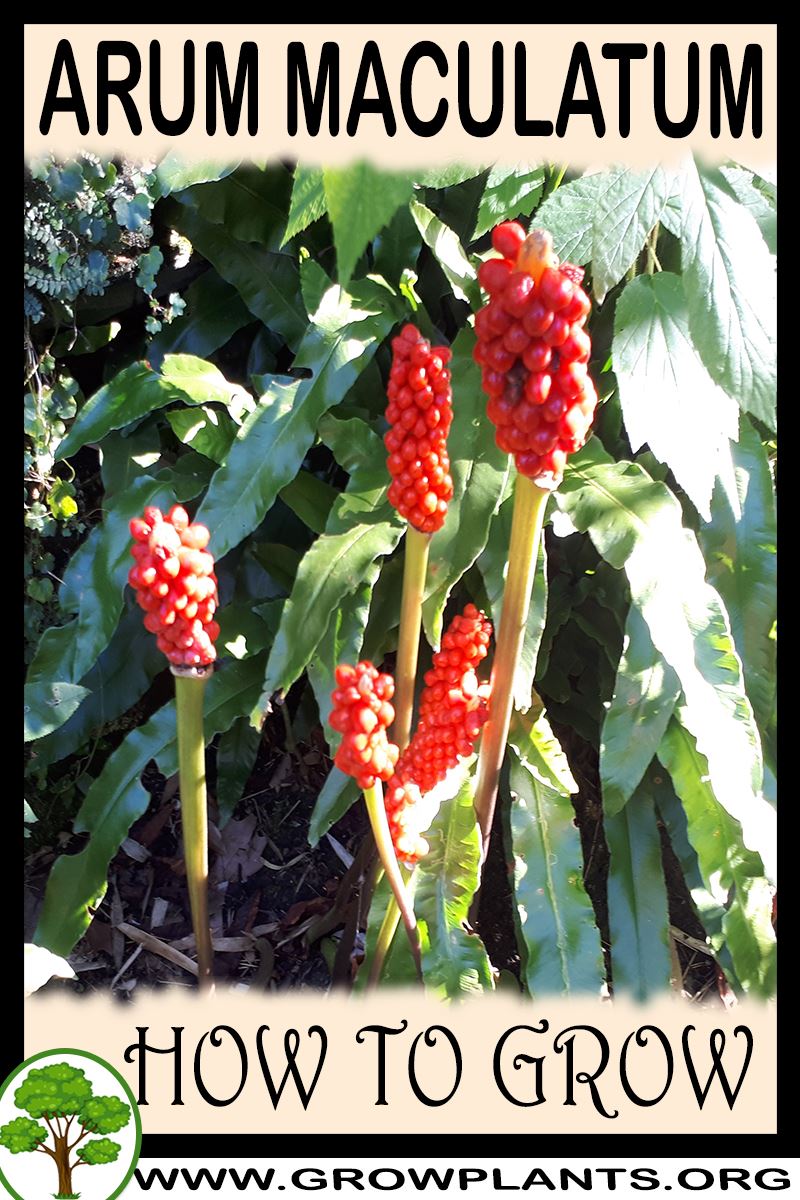
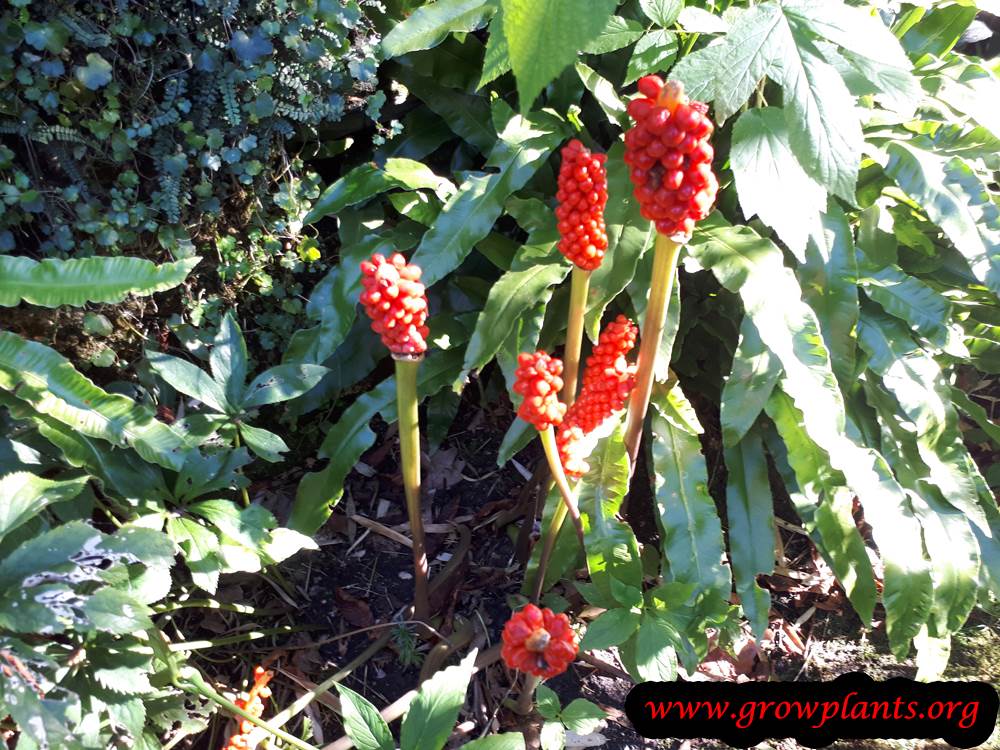
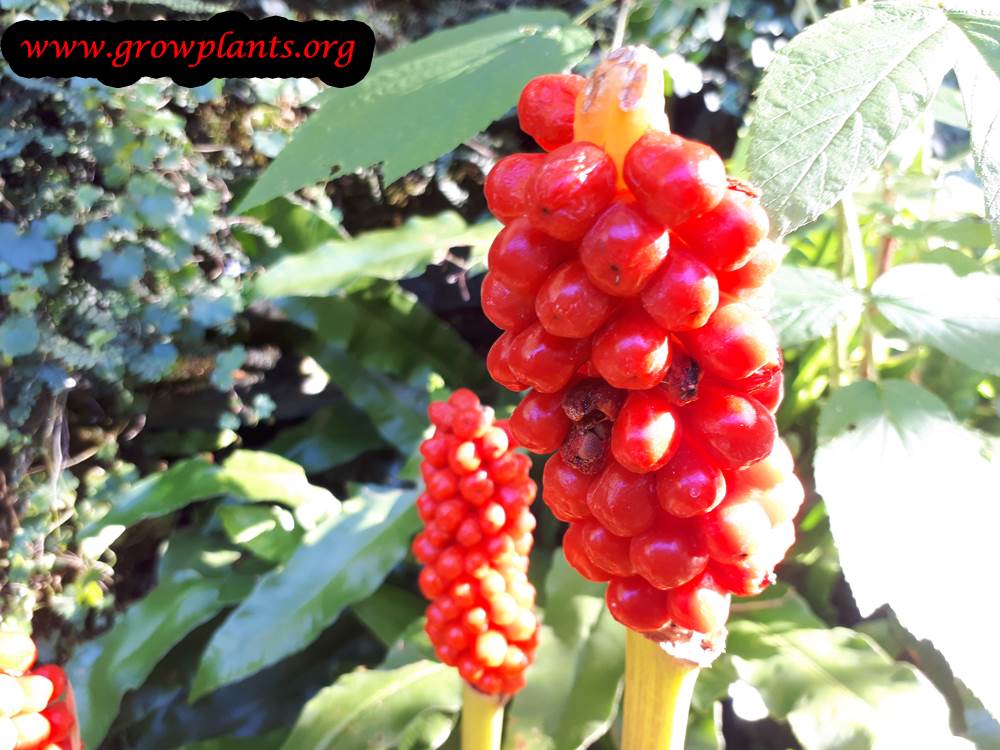
- Fruit Profile: A dense spike of bright orange-red berries in late season – very poisonous, do not ingest.
Primary Uses & Landscape Value
- Functional & Ornamental Roles: Shade and woodland ornamental and shade groundcover; keep away from children and pets.
Care Guide: Planting, Soil & Watering
Overview: Cuckoo pint is a woodland rhizomatous perennial that grows best in half to full shade in moist but well-drained, humus-rich soil. It is drought-tolerant when dormant in summer, and all parts — especially the berries — are poisonous.
Quick Care Requirements
| Requirement | Ideal Condition |
|---|---|
| Planting Season | In spring (or autumn in mild zones 10–11) |
| Growth Rate | Slow to Moderate |
| Soil Type | Moist, humus-rich but well-drained woodland soil |
| Water Need | Low to Moderate — lightly moist in growth, drier when dormant |
Planting & Establishment
- Best Planting Season: Plant the rhizomes in spring; in mild climates (zones 10–11) autumn planting also works.
- How to Plant:
- Hole Preparation: Dig a hole to seat the rhizome a few centimetres deep in loose, leafy soil.
- Soil Amendments: Enrich the backfill with leaf mould or compost to mimic its woodland floor.
- Planting Depth: Plant the rhizome a few centimetres below the surface; firm and water in.
- Growth Speed & Expectations: Slow to moderate, forming clumps 30–50 cm tall that emerge in cooler months and die back over summer.
Soil, Watering & Drainage Care
- Soil Mix & Drainage Needs: Moist, humus-rich but well-drained soil is ideal; the plant tolerates summer dryness during dormancy but rots in waterlogged ground.
- Watering Schedule & Technique:
- Young / Newly Planted: Keep the soil lightly moist as the rhizome establishes.
- Established: Water moderately during leafy growth; allow it to dry as the foliage dies back into summer dormancy.
- Seasonal Adjustments: More moisture in cool active growth; keep drier through summer dormancy.
Climate, Light & Hardiness
Arum maculatum grows naturally in cool, damp woodland-type climates and is a deciduous plant that dies back and goes dormant through the hot or cold season depending on where it is grown. It prefers half to full shade and is broadly hardy across USDA zone 8–11, tolerating cooler winters far better than a typical tropical plant thanks to its dormant rhizome.
Quick Climate Specifications
| Climate Zones | Mediterranean, subtropical, temperate, or grown as a houseplant |
|---|---|
| USDA Hardiness Zones | Approximately 8–11 |
| Frost Tolerance | Moderate for the dormant rhizome; foliage present outside dormancy is more frost-sensitive |
| Light Conditions | Half shade to full shade |
Sunlight & Light Exposure
Optimal Light Setup
Best in dappled woodland-type shade that mimics its native hedgerow and forest-floor habitat.
Shade & Heat Management
Tolerates full shade well; in warmer climates, shade also helps keep the soil cooler and moist during the plant's active growth period.
Best Exposure / Orientation
A shaded, sheltered spot, such as under trees or shrubs, suits it best.
Temperature Extremes & Hardiness
USDA Hardiness & Regional Limits
The dormant rhizome allows this species to be grown across a wide range from USDA zone 8 through 11; where winters are cold, the plant simply dies back to the rhizome and re-emerges once conditions warm.
Cold Damage & Winter Protection
Foliage and flowers are damaged by hard frost, but this is of limited consequence once the plant has entered winter dormancy; a protective mulch over the rhizome is worthwhile in the coldest part of its range.
Frost Sensitivity
Active growth and flowers are frost-sensitive; the below-ground rhizome is considerably more resilient.
Growing in Pots, Balconies & Indoors
Lords-and-ladies (Arum maculatum) is a shade-loving woodland tuber the grower lists as growable indoors, though he does not recommend it for outdoor planters. It is a modest foliage plant for a cool, shaded pot – but every part is poisonous and the bright berries are especially dangerous, so think carefully before keeping it where children or pets can reach it.
Quick Details
- Container Size: A deep pot to suit the tuber; a modest plant overall
- Indoor Suitability: Can be grown indoors in a cool, shaded spot – but see the safety note
- Best Spot: Half to full shade – cool, indirect light
- Soil & Drainage: Moisture-retentive but free-draining woodland-type mix
- Watering in Pots: Small to average while in leaf; keep drier during its dormant rest
Indoors & On the Windowsill
- Safety first: Every part is poisonous and the red berries are highly toxic – keep it well away from children and pets, wash hands after handling, and never eat any part.
- Houseplant: If grown indoors, give it a cool, shaded spot; it dies back to the tuber for a dormant rest each year, when it needs little water.
- Windowsill note: It does not want a bright, sunny sill – shade and cool suit it far better.
On a Balcony or Patio
- Not for planters: The grower does not recommend it for outdoor planters; if potted at all, keep it in deep, cool shade with steady moisture.
- Practicalities: Keep the toxic berries out of reach of children and pets at all times.
Choosing the Pot, Soil & Long-Term Care
- Pot & drainage: A deep pot with good drainage holes and no standing water around the tuber.
- Potting mix: A humus-rich, moisture-retentive but free-draining woodland-type mix.
- Feeding: Feed lightly while in leaf; stop once it dies back.
- Repotting: Repot the tuber during its dormant rest, handling it with gloves.
Fertilizing & Feeding
A light feeder overall; a balanced fertilizer during active leaf growth supports the rhizome without pushing excess soft growth, but every part of this plant, especially the berries, is toxic.
Quick Fertilizing Specs
| Feeding Level | Light – a modest feeder during its active growth phase. |
|---|---|
| young_feeding | A light balanced feed as new growth establishes. |
| mature_feeding | Occasional light feeding through leaf growth and bloom. |
| Main Nutrient Priority | Balanced nutrition to support foliage and flowering. |
| Best Feeding Period | During active leaf growth in the growing season. |
| Organic Options | Compost or well-rotted organic matter. |
| Soil pH | Tolerates a range of soil pH; near neutral is fine. |
| Reduce/Stop Feeding | Stop feeding once foliage dies back and the rhizome goes dormant. |
| Micronutrients | Rarely needed; correct only if a deficiency shows. |
Feeding by Growth Stage
Active leaf growth and flowering
Support leaf growth and the flowering spike while the plant is actively growing from its rhizome.
| Nutrient direction | A balanced, modest feed to support foliage and flowering without pushing soft growth. |
|---|---|
| Timing | During active leaf growth in spring, and again in autumn where the plant re-emerges. |
| Frequency | A few light feedings spaced through the active growing period is enough. |
| Fertilizer types | Balanced complete fertilizer, Compost or well-rotted organic matter worked into the soil |
| Precautions | All parts of the plant, especially the berries, are toxic if ingested – keep away from children and pets and wash hands after handling. |
Dieback and dormancy
Let the rhizome rest once the foliage dies back.
| Nutrient direction | None – withhold fertilizer while the rhizome is dormant below ground. |
|---|---|
| Timing | After flowering and fruiting, once the foliage yellows and dies back. |
| Frequency | No feeding at this stage. |
| Fertilizer types | No feeding at this stage – the rhizome is resting underground until growth resumes. |
| Precautions | Do not fertilize dormant rhizomes; wait until new leaf growth resumes before feeding again. |
Nutrient Deficiency Signs & Corrections
Pale, yellow-green leaves with weak, thin growth during the active growing period.
| Possible causes | Low soil nitrogen, Deep shade limiting growth, Compacted or waterlogged soil restricting roots |
|---|---|
| Appears first on | Older leaves first. |
| What to check | Recent feeding history, Light levels, Soil drainage and compaction |
| Possible correction | Apply a balanced fertilizer during active leaf growth and improve soil drainage where needed. |
Yellowing between the veins on the newest leaves while the veins remain green.
| Possible causes | High or alkaline soil pH locking up iron or manganese, Waterlogged soil reducing micronutrient uptake, Low available iron or manganese in the soil |
|---|---|
| Appears first on | Newest emerging leaves. |
| What to check | Soil pH, Drainage, Whether symptoms follow wet, poorly drained spells |
| Possible correction | Correct soil pH toward the plant’s preferred range, improve drainage, and if it persists apply a chelated iron or manganese product per its label. |
Wilting, a soft rhizome, or foliage collapse despite moist soil.
| Possible causes | Waterlogged, poorly drained soil causing rhizome or root rot, Fungal pathogens favored by overly wet conditions, Excess fertilizer salts stressing an already weak root system |
|---|---|
| Appears first on | Base of the plant and lower leaves. |
| What to check | Soil drainage and moisture, Rhizome firmness when checked, Recent fertilizer or watering amounts |
| Possible correction | Improve drainage, let the soil dry appropriately between waterings, and avoid feeding a stressed or rotting plant. |
Pruning, Training & Seasonal Maintenance
Arum maculatum is a deciduous woodland tuber that goes summer-dormant after flowering, so its pruning needs are entirely tied to that seasonal die-back rather than to any structural growth. It flowers in spring on a distinctive spadix, then the berry-bearing stalk persists into summer even as the leaves yellow and die, and the recorded task – removing dead leaves and bloom stems – is simply the seasonal tidy-up as the plant goes dormant. Because the whole plant, and the berries especially, are toxic, and the sap is an irritant typical of the arum family, any hands-on cleanup calls for gloves.
Quick Pruning & Maintenance Specs
| Pruning Tolerance | Low – seasonal cleanup only, no shaping |
| Primary Pruning Window | Summer, as foliage dies back naturally after flowering |
| Secondary Maintenance Window | None |
| Typical Frequency | Once a year |
| Main Objective | Remove spent foliage and, optionally, the bloom/berry stalk once its display finishes |
| Young Plant Priority | None – let the tuber establish undisturbed |
| Mature Plant Priority | Clear yellowed, dying leaves and finished flower/berry stalks |
| Best Tool Type | Precision snips, plus gloves for the toxic sap and berries |
| Avoid Heavy Pruning During | While foliage is still green in spring and actively feeding the tuber |
Pruning by Plant Age & Size
Newly Established
No pruning; allow the tuber to establish undisturbed.
Young / Formative
None – this herbaceous geophyte has no structural training to apply.
Mature / Established
Annual removal of dead leaves and spent flower/berry stalks as the plant enters summer dormancy.
Seasonal Pruning Schedule
Summer Die-Back
- Objective: tidy the planting as it goes dormant
- Remove: yellowed or dead leaves, and the flower stalk once its berry display has finished
- Do not remove: any leaf tissue still green, since it is still feeding the tuber for next year’s growth
- Expected response: clean dormancy, with the tuber resprouting the following spring
- Flowering impact: none – next year’s spathe and flowers come fresh from the dormant tuber
Special Growth to Remove
- Dead, yellowing leaves as the plant goes summer-dormant
- The flower/berry stalk, which can be left standing for its ornamental orange-red berry display or removed once it finishes – always handled with gloves given the plant’s recorded toxicity, and best cut off before berries drop and self-seed if that spread is unwanted, or where children or pets have access, since the berries are poisonous
Container & Small-Space Pruning
Where grown in a container or as an indoor/protected specimen, the same dormancy-driven cleanup applies: remove dead top growth once it yellows and keep the dormant tuber on the dry side until new growth resumes.
Tools
- Precision snips for the soft leaves and flower stalk
- Gloves, essential given the plant’s toxic sap and berries
Tool Hygiene & Disease Risk
Routine – no significant pruning-transmissible disease is documented. The real risk from this plant is toxicity to people and pets handling it, not tool-borne disease.
Cut Placement & Technique
Cut dead leaves and the spent flower/berry stalk at the base, at soil level, without disturbing the shallow-planted tuber; always handle cuttings and debris with gloves and keep them away from children and pets.
Heavy Pruning & Rejuvenation
Not applicable – there is no woody growth to rejuvenate; the plant renews itself naturally from the tuber each year regardless of how the previous season’s dead growth is tidied.
Post-Pruning Care
No extra watering or feeding is needed after the summer die-back cleanup; keep the area on the drier side through dormancy, as is natural for this species.
Common Pruning Mistakes
- Cutting back green, still-functional foliage before it has naturally yellowed, reducing the tuber’s stored energy for next year
- Handling the berries or sap without gloves
When Not to Prune
Avoid removing any leaf tissue while it is still green in spring; if the ornamental berry display is wanted, do not remove the flower stalk until it has finished displaying.
Recommended Tools (by task)
- precision_snips – the only cutting tool this plant needs, for the soft dead foliage and flower stalk
Propagation Guide
Arum maculatum is most reliably increased by dividing the offsets that form around the mature rhizome/tuber during its summer dormancy, which gives flowering-size plants identical to the parent; seed is also viable and true to the species but germinates slowly and takes longer to reach flowering size. Overall difficulty is Easy by division, Moderate by seed.
Quick Propagation Specs
| Best Propagation Method | Division of rhizome/tuber offsets |
| Alternative Methods | Seed (from the ripe berries) |
| Propagation Difficulty | Easy (division) / Moderate (seed) |
| Seed True-to-Type | Yes (species) |
| Vegetative True-to-Type | Yes |
| Best Propagation Season | Division in summer dormancy; fresh seed sown in autumn |
| Seed Germination Time | Often slow and staggered, sometimes not until the following spring |
Growing from Seed
Seed Handling & Viability
Seed comes from the orange-red berries on the fruiting spike, which are poisonous – wear gloves when handling and cleaning the pulp from the seed. Sow fresh where possible, as extracted seed does not store well long-term.
Sowing Season
Sow fresh seed in autumn, in step with this plant’s natural spring/autumn growth cycle.
Sowing Depth & Orientation
Sow shallow, just covering the seed with soil or a gritty seed-sowing mix.
Germination Conditions
Keep in a cool, shaded, consistently moist but well-drained position; no supplemental heat is needed.
Germination Time
Germination is typically slow and irregular for woodland aroids of this kind; seedlings may not appear until the following growing season, and it can take several years to reach flowering size.
Division, Offsets, Pups & Suckers
The rhizome/tuber naturally produces offset daughter growths. Lift and divide during the summer dormant period, when the foliage has died back (matching this plant’s summer pruning of dead leaves and bloom stems), rather than while in active spring/autumn growth. Each division should keep its own growth point; replant promptly in well-drained, moist soil at the same depth as the parent. Handle with gloves, as all parts are partly poisonous.
Bloom & Flower Guide
Quick Details
- Bloom Season: Spring
- Flower Appearance: A club-like flower spike (spadix) wrapped in a hood-like leaf (spathe); the spathe may be white, yellowish, purple-white or green
- Edibility: Not edible – the whole plant is poisonous
Detailed Blooming Overview
Arum maculatum (cuckoo pint or lords-and-ladies) is a woodland rhizome that produces its curious inflorescence in spring. It grows in Mediterranean, subtropical and temperate settings, or as a house plant, across roughly zones 8-11. What looks like a single flower is really a spike of tiny true flowers sheltered inside the surrounding hood.
Flower Characteristics
- An upright, ice-pop-shaped spadix in shades of white-yellow, purple or near-black.
- Surrounded by a leaf-like spathe in white, yellowish, purple-white or green.
- The tiny true flowers sit hidden at the base of the spike.
Bloom Care & Thinning
- Pollination: The bloom gives off a faint scent that briefly lures small flies down into the hood, where they transfer pollen before being released – a natural trap mechanism, not a carnivorous one.
- Safety: Every part of this plant is poisonous, and the sap can irritate skin – wear gloves when handling, and keep it well away from children and pets. Never treat any part as edible.
Pests, Diseases & Troubleshooting
Overview: Arum maculatum is a tough woodland tuberous perennial whose acrid, irritant sap (rich in calcium oxalate) makes it largely unpalatable, so it is remarkably pest- and disease-free. Its real issues are cultural: tuber rot in waterlogged soil, leaf scorch if grown in sun, and an alarming but entirely natural summer die-back after the leaves have done their work. Grow it in cool, moist, shaded, humus-rich soil and it looks after itself.
Quick Troubleshooting Overview
| Issue / Pest | Main Symptom | Primary Solution |
|---|---|---|
| Tuber rot | Tubers rot in wet soil; leaves fail to emerge | Free-draining humus-rich soil; avoid waterlogging |
| Slugs & snails | Seedlings and soft new growth grazed | Iron-phosphate bait (usually only on seedlings) |
| Aphids | Occasional soft insects on flowering spike | Rinse off; rarely needs treatment |
| Leaf spot | Brown spots on leaves in damp, crowded shade | Improve airflow; remove affected leaves |
| Leaf scorch | Bleached, browned leaves if grown in sun | Grow in shade; keep soil cool and moist |
| Summer die-back | Leaves yellow and vanish by mid-season (natural) | None; the plant is dormant, not diseased |
Common Pests & Management
- Aphids (Aphidoidea):
- Symptoms: Occasionally a few soft aphids gather on the flowering spathe/spadix or the tender petioles, with a little honeydew; the acrid leaves are largely left alone.
- Prevention & Control: Simply rinse them off with water; the plant’s toughness and natural predators mean intervention is rarely needed.
- Whitefly (Aleyrodidae):
- Symptoms: Under glass or in very sheltered conditions, tiny white flies may gather on the leaf undersides with light honeydew; outdoors this is uncommon.
- Prevention & Control: Use yellow sticky traps and insecticidal soap on leaf undersides if numbers build under cover; outdoors it seldom warrants action.
- Slugs & snails (Gastropoda):
- Symptoms: Soft seedlings and the freshest emerging growth can be grazed in damp shade, though the mature, acrid foliage is not a favourite.
- Prevention & Control: Protect seedlings and fresh spring growth with iron-phosphate pellets or traps if grazing occurs; established plants shrug off minor damage.
Diseases & Fungal Issues
- Tuber rot (Pythium / Phytophthora / soft-rot bacteria):
- Symptoms: In heavy, waterlogged soil the dormant tubers turn soft, brown and rotten and fail to reshoot; this is the main way the plant is lost.
- Treatment & Management: Grow in humus-rich but free-draining woodland soil, improve drainage on heavy ground, and avoid waterlogging, especially over the summer-dormant and winter periods. Discard soft, rotted tubers.
- Leaf spot (Cercospora / fungal spp.):
- Symptoms: Brown to grey spots, sometimes ringed, appear on the leaves in damp, crowded, still shade and can merge in bad cases.
- Treatment & Management: Improve airflow, avoid overhead watering, and remove badly spotted leaves; the plant readily replaces foliage. Fungicide is rarely warranted.
- Rust (Puccinia spp.):
- Symptoms: Rarely, yellow spots with orange-brown pustules on the leaf undersides appear in damp conditions; it is uncommon and minor.
- Treatment & Management: Remove affected leaves and improve airflow; no chemical control is normally needed on this robust plant.
Growing Difficulties & Abiotic Problems
- Leaf scorch in sun:
- Cause & Symptoms: Grown in too much sun or dry soil, the broad thin leaves bleach and brown at the margins – it is a shade plant.
- Correction Strategy: Grow in partial to full shade in cool, moisture-retentive, humus-rich soil, and mulch to keep the roots cool and moist.
- Natural summer dormancy:
- Cause & Symptoms: The leaves naturally yellow and die back by mid-season after fruiting, leaving a spike of orange-red berries; this alarms growers but is normal, not disease.
- Correction Strategy: No action is needed – allow the foliage to die down and mark the spot; the tuber rests and re-emerges in its season. (Note: all parts are poisonous and the berries are toxic.)
- Tuber rot from waterlogging:
- Cause & Symptoms: Wet, airless soil during dormancy suffocates and rots the tubers.
- Correction Strategy: Ensure the planting site drains freely, especially where the tuber rests over summer and winter; raise beds or add grit on heavy ground.
What Helps – Products & Tools
Arum needs almost nothing – occasional iron-phosphate slug bait for seedlings and a simple water rinse for the rare aphid. Its health is a matter of siting (cool, moist shade with free drainage) rather than any spray; handle it with gloves, as the sap is a skin and mucous-membrane irritant and all parts are toxic if eaten.