Plant Profile & Key Characteristics
Overview: Pelargonium × hortorum (zonal geranium) is a bushy flowering sub-shrub, 0.3–1.2 m tall, grown as one of the most popular bedding and container plants for its rounded flower clusters. It is grown as an evergreen perennial in mild climates (USDA zone 9+) and as a summer annual in colder regions (zone 3+).
Quick Specifications
| Specification | Attribute |
|---|---|
| Plant Type / Life Cycle | Perennial in mild climates; grown as an annual where winters are cold |
| Foliage Type | Evergreen (where perennial) |
| Mature Size | 0.3–1.2 m tall (1–4 ft) |
| Growth Rate | Moderate to fast |
| Toxicity | Pelargonium species are listed as toxic to cats, dogs and horses |
| Hardiness | USDA zone 9+ as a perennial; zone 3+ as an annual |
Growth Form & Structure
- Height & Spread: A rounded bushy sub-shrub 0.3–1.2 m tall; a classic container, window-box and bedding plant.
- Growth Habit & Form: Upright, branching sub-shrub; kept tidy by removing spent leaves and light shaping through the year.
Anatomy & Physical Features
- Leaves & Foliage: Rounded, heart-shaped or lobed leaves, green often marked with a purple or white zone.
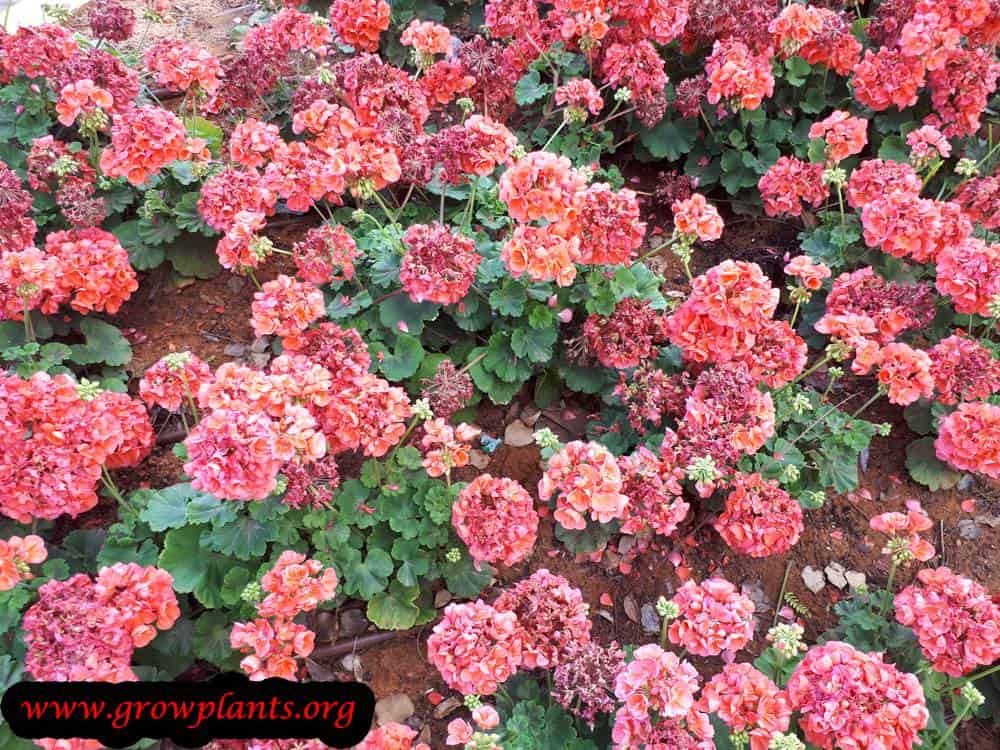
- Flower Characteristics: Five-petalled flowers in rounded umbel-like clusters, in red, white, purple, peach or pink (often bi-coloured) (full detail in the Bloom guide).
Primary Uses & Landscape Value
- Functional & Ornamental Roles: Popular ornamental for containers, window boxes, hanging baskets and summer bedding.
Care Guide: Planting, Soil & Watering
Overview: Zonal Pelargonium grows best in full sun to light shade in a warm spot (hardiness zone 9 and up, or as an annual in colder zones), in well-draining soil. It needs a moderate amount of water and dislikes soggy ground.
Quick Care Requirements
| Requirement | Ideal Condition |
|---|---|
| Planting Season | The warm season, from spring through autumn |
| Growth Rate | Fast to Moderate |
| Soil Type | Well-draining soil |
| Water Need | Moderate – keep evenly moist, letting the surface dry slightly between waterings |
Planting & Establishment
- Best Planting Season: Plant in the warm season, from spring through autumn once frost has passed; in cold zones grow it as a warm-season annual.
- How to Plant:
- Hole Preparation: Dig a hole about twice the width of the root ball and the same depth, loosening the surrounding soil.
- Soil Amendments: Work in compost or well-rotted organic matter, adding coarse material to improve drainage where needed.
- Planting Depth: Set the root collar level with the soil surface and keep the stem base above the soil line.
- Growth Speed & Expectations: Fast to moderate; it establishes and bulks up quickly through the warm months.
Soil, Watering & Drainage Care
- Soil Mix & Drainage Needs: Well-draining soil is essential; in pots use a free-draining potting mix and ensure good drainage, as this sensitive plant is prone to rot in wet soil.
- Watering Schedule & Technique:
- Young / Newly Planted: Water regularly to keep the soil lightly moist while roots establish.
- Established: Water deeply but let the top few centimetres dry before watering again; avoid wetting the foliage in strong sun.
- Seasonal Adjustments: Water more in heat and much less in cool weather and winter.
Climate, Light & Hardiness
Pelargonium hortorum (zonal geranium) grows as a true perennial in warm, frost-free climates and as a warm-season annual almost everywhere else, doing best in subtropical, mediterranean, tropical, or temperate climates in full sun (with some shade where summers are hot). Its cold tolerance depends on whether it is being grown as a perennial or an annual: perennial from about zone 9 upward, but plantable as an annual from zone 3 up.
Quick Climate Specifications
| Climate Zones | Subtropics, mediterranean, tropics, temperate |
|---|---|
| USDA Hardiness Zones | 9+ as a perennial; 3+ grown as an annual |
| Frost Tolerance | Very Low |
| Light Conditions | Full Sun (can scorch in intense heat) to Half Shade |
Sunlight & Light Exposure
Optimal Light Setup
Full sun gives the strongest flowering, though foliage can burn in intense, hot-climate sun, where half shade is preferable.
Shade & Heat Management
In hot-summer climates, some afternoon shade prevents leaf scorch while still allowing good bloom.
Temperature Extremes & Hardiness
USDA Hardiness & Regional Limits
Persists outdoors year-round as a genuine perennial only from about zone 9 upward. In colder zones (down to about zone 3), it is grown as a warm-season annual instead - freezing winters kill the plant, so cold is what limits year-round survival even though it thrives through a single warm season almost anywhere.
Frost Sensitivity
Very frost-tender; even light freezes kill the top growth, which is why gardeners outside its perennial range plant it fresh each year after the last frost.
Wind, Humidity & Microclimate
Microclimate Recommendations
A warm, sheltered, sunny site with good air movement suits it well and helps reduce fungal problems in humid climates.
Growing in Pots, Balconies & Indoors
Zonal geranium is a classic container and balcony plant (0.3-1.2 m). The grower rates it as not a deep-room houseplant, but it flowers happily on a sunny windowsill and is easily overwintered indoors in cold climates.
Quick Details
- Container Size: Small to medium pot, trough or window box
- Indoor Suitability: Not a deep-indoor plant; flowers on a sunny sill and overwinters indoors
- Best Spot: Full sun (some shade in fierce heat)
- Soil & Drainage: Free-draining mix
- Watering in Pots: Let the top dry between waterings – it dislikes being soggy
Indoors & On the Windowsill
- Windowsill: On a bright, sunny sill it keeps flowering; in a dim room it grows pale and leggy.
- Overwintering: In cold climates this tender plant is easily brought indoors to a cool, bright spot to survive the winter, then put back out when it warms – a key reason to grow it in a pot.
- Safety: Geraniums are toxic to pets – keep them out of reach of cats and dogs.
On a Balcony or Patio
- Sunniest spot: Give it the sunniest place on the balcony or patio and deadhead often for continuous flowers.
- Light & heat: Walls, railings and paving reflect heat and wind dries pots fast, so check moisture often and water more in hot spells.
Choosing the Pot, Soil & Long-Term Care
- Pot & drainage: A pot with good drainage holes; let the top of the mix dry between waterings.
- Potting mix: A light, free-draining mix – a good potting mix, or peat/coir blended with perlite or vermiculite.
- Feeding: Feed regularly for continuous flowering, as nutrients leach from pots.
- Long term: Refresh the mix each season or two; cut the plant back before bringing it in for winter.
Fertilizing & Feeding
A moderate feeder, especially in containers: steady balanced feeding through its long spring-to-autumn bloom keeps flowering going, with feeding scaled back for container growth and stopped through cooler dormant weather.
Quick Fertilizing Specs
| Feeding Level | Moderate feeder |
|---|---|
| Main Nutrient Priority | Balanced feeding with adequate nitrogen to sustain repeat bloom |
| Best Feeding Period | Through the long spring-through-autumn growth and bloom cycle |
| Organic Options | Compost worked into well-drained garden soil or potting mix |
| Reduce/Stop Feeding | Reduce feeding as flowering slows in cooler weather and stop while the plant rests through winter |
| Micronutrients | Usually met by a complete fertilizer; correct only diagnosed issues |
| Soil pH | Tolerates a wide range in well-drained soil |
Feeding by Growth Stage
Spring growth flush
Build a full, well-branched plant as growth resumes ahead of the main bloom season.
| Nutrient direction | A balanced fertilizer with adequate nitrogen supports vigorous new growth and branching. |
|---|---|
| Timing | As new growth resumes in spring. |
| Frequency | Regular light feeding supports this growth flush. |
| Fertilizer types | A balanced complete fertilizer, Compost worked into the soil or potting mix |
| Precautions | Avoid pushing overly soft, lush growth with excess nitrogen, which can make the plant more prone to disease. |
Repeat flowering through summer and autumn
Sustain the plant’s long cycle of repeat flowering across the warm season.
| Nutrient direction | Continued balanced feeding, rather than a high-phosphorus bloom product, keeps the repeat-flowering cycle going strong. |
|---|---|
| Timing | Through the extended summer-into-autumn bloom period. |
| Frequency | Regular light feedings sustain repeat bloom, with container plants needing feeding more often than those in garden beds. |
| Fertilizer types | A balanced complete fertilizer, A container-formulated feed for potted plants |
| Precautions | There is no need for a specialty high-phosphorus bloom fertilizer; balanced feeding with adequate nitrogen is what drives continued flowering. |
Cool-season rest
Let the plant coast through cooler weather or winter dormancy without pushing new growth.
| Nutrient direction | None – withhold fertilizer while the plant is not in active growth. |
|---|---|
| Timing | During cool weather or winter dormancy, including overwintering indoors. |
| Frequency | No feeding during this rest; resume only when active growth returns in spring. |
| Fertilizer types | No feeding at this stage; hold off fertilizing until active growth resumes. |
| Precautions | Withhold fertilizer now; feeding a dormant or slow-growing plant wastes nutrients and risks salt buildup. |
Nutrient Deficiency Signs & Corrections
Older leaves fade to pale green or yellow and flowering noticeably slows.
| Possible causes | low available soil or potting-mix nitrogen, nutrient leaching from frequent watering, especially in containers, an extended period without feeding |
|---|---|
| Appears first on | older, lower leaves |
| What to check | recent feeding history, whether the plant is in a container versus garden soil, watering frequency |
| Possible correction | Apply a balanced complete fertilizer, using a container-formulated feed for potted plants. |
New leaves show yellowing between the veins while veins remain green.
| Possible causes | alkaline soil or potting-mix pH limiting iron availability, waterlogged or compacted soil restricting root uptake, true low soil iron |
|---|---|
| Appears first on | newest leaves |
| What to check | soil or potting-mix pH, drainage and watering habits, container versus garden growing conditions |
| Possible correction | Correct overly alkaline soil conditions and apply a chelated iron product per its label if it persists. |
Leaf margins brown or scorch, especially on container-grown plants, despite regular watering.
| Possible causes | fertilizer salt buildup, particularly in containers with limited leaching, overfeeding beyond what the plant needs, under-watering that concentrates salts |
|---|---|
| Appears first on | leaf margins and tips |
| What to check | recent fertilizer amounts and frequency, container drainage and watering consistency, signs of white crust on soil or pot surfaces |
| Possible correction | Ease off feeding, water thoroughly to flush accumulated salts, and resume with lighter feeding. |
Pruning, Training & Seasonal Maintenance
Pelargonium x hortorum is a soft-wooded, fast-to-medium-growing shrubby plant that tolerates moderate-to-high pruning and responds well to shaping. Grooming (deadheading and dead-leaf removal) is done year-round, while the main shaping/design cuts and any harder cutback of leggy growth are best timed for early in the growing season, before the flush of spring/summer bloom, so the plant fills back out with fresh flowering stems rather than losing a season’s display.
Quick Pruning & Maintenance Specs
| Pruning Tolerance | Moderate–High |
| Primary Pruning Window | Early in the growing season (or after overwintering) for shaping/cutback |
| Secondary Maintenance Window | Ongoing year-round deadheading and dead-leaf removal |
| Typical Frequency | Continuous light grooming plus an occasional harder shaping cut |
| Main Objective | Maintain a bushy, floriferous habit; remove decline; renew leggy growth |
| Young Plant Priority | Pinch tips to build branching before it flowers heavily |
| Mature Plant Priority | Deadhead continuously; cut back leggy stems to renew compact form |
| Best Tool Type | Precision snips / bypass secateurs |
| Avoid Heavy Pruning During | Peak bloom, if flower display is the priority that season |
Pruning by Plant Age & Size
Newly Established
Pinch growing tips early to encourage branching before the plant is allowed to flower heavily – unpinched young plants tend toward a single leggy stem.
Young / Formative
No formal leader/framework training; continue pinching to build a dense, multi-stemmed mound.
Mature / Established
Deadhead spent flower trusses continuously (‘for design’, per source) to keep the display tidy and encourage repeat bloom; cut back stems that have become leggy or bare at the base to renew compact growth.
Structural Pruning & Training
No formal framework is needed; the main structural task is periodically cutting back overly long, sparse stems to a strong lower node so the plant rebranches into a fuller shape rather than sprawling.
Special Growth to Remove
- Dead leaves (per source guidance).
- Spent flower trusses/umbels – deadhead regularly to prolong bloom and keep the plant tidy.
- Leggy, thin stems that have outgrown the plant’s compact form.
Container & Small-Space Pruning
This species is one of the most common container/bedding subjects; in pots, more frequent light pinching and deadheading is worthwhile to keep the display compact, and a harder cutback partway through a long growing season can rejuvenate a plant that has become sparse or leggy in its pot.
Tools
- Precision snips – deadheading and pinching soft tip growth.
- Bypass secateurs – cutting back thicker, semi-woody leggy stems.
Tool Hygiene & Disease Risk
High-risk: zonal Pelargonium is notably susceptible to bacterial blight (Xanthomonas), which spreads systemically through the plant and readily transmits on pruning tools from an infected plant to a healthy one. Disinfect blades between plants, especially when working across multiple pots or a bedding block, and remove and discard (do not compost) any plant showing blackened stems, wilting, or leaf spotting.
Cut Placement & Technique
Deadhead by snapping or cutting the entire flower stalk back to its point of origin, not just the spent flower head. When cutting back leggy stems, cut just above a healthy leaf node to encourage branching from that point.
Heavy Pruning & Rejuvenation
Tolerated well, particularly on plants being overwintered or kept as long-term perennial stock: a hard cutback of overgrown, woody-based stems by up to half will sacrifice bloom for a few weeks but produces a fuller, more floriferous plant afterward.
Post-Pruning Care
Keep foliage as dry as practical after cutting to limit bacterial spread; watch for aphids and whiteflies on the flush of new growth, as noted for this species.
Common Pruning Mistakes
- Reusing unsanitized tools across plants, risking spread of bacterial blight.
- Never pinching young plants, leading to a single leggy stem with little branching.
- Deadheading only the flower and leaving the bare stalk, which looks untidy and can rot.
When NOT to Prune
Avoid a hard structural cutback right at peak bloom if flower display that season matters, and avoid pruning wet foliage given the bacterial disease risk.
Recommended Tools (by task)
- precision_snips – deadheading and pinching young growth.
- bypass_secateurs – cutting back thicker leggy stems.
- blade_disinfectant – essential between plants given this species’ known susceptibility to systemic bacterial blight.
Propagation Guide
Pelargonium hortorum is usually grown from stem cuttings, which the site notes is necessary if you want the new plant to match the parent cultivar exactly, since seedlings from named cultivars and hybrid seed strains do not come true. Seed is used mainly for growing the species or F1 seed-strain bedding types from scratch; overall propagation is easy.
Quick Propagation Specs
| Best Propagation Method | Stem cuttings |
| Alternative Methods | Seed |
| Propagation Difficulty | Easy |
| Seed True-to-Type | Cultivar-dependent (named cultivars and hybrids do not come true from seed) |
| Vegetative True-to-Type | Yes |
| Best Propagation Season | Spring, summer or autumn |
| Cutting Rooting Time | Typically a few weeks |
| Germination Temperature | Around 18–24°C (64–75°F) |
| Seed Sowing Depth | Very shallow, just covered |
Growing from Seed
Sowing Season
Sow in spring, summer or autumn, matching the plant’s general planting window.
Sowing Depth & Orientation
Sow very shallowly, just covered with a light growing medium.
Germination Conditions
Keep the medium moist but not waterlogged, in a warm, bright spot; temperatures around 18–24°C (64–75°F) suit germination.
Germination Time
Typically one to a few weeks.
Seedling Care
Grow seedlings on in full sun to half shade, watering moderately, since the species can be sensitive to both overwatering and leaf scorch in very hot climates.
Stem Cuttings
Cutting Type
Semi-succulent stem tip cuttings, the standard way to preserve a specific cultivar’s flower color and habit.
Best Timing
Spring, summer or autumn.
Cutting Preparation
Take a short non-flowering shoot tip, remove lower leaves, and let the cut end callus (dry slightly) for a few hours before inserting, since the somewhat succulent stem is prone to rot if inserted while too fresh/wet.
Rooting Setup
Insert into a well-drained, only lightly moist medium; avoid excess humidity or overly wet conditions given the plant’s sensitivity.
Rooting Hormone
Optional – can help but is not required for this generally easy-rooting plant.
Rooting Time
Typically a few weeks.
Bloom & Edible Flower Guide
Quick Details
- Bloom Season: Spring, summer and autumn — and nearly year-round in frost-free conditions
- Time to First Bloom: Fast — plants from cuttings or seed usually flower within a few months and bloom in their first season
- Flower Appearance: Rounded clusters (umbels) of five-petalled flowers in peach, red, white, purple or pink, often bicoloured
- Edibility: Edible — the petals are edible for people; note that the plant is mildly toxic to cats, dogs and horses
Detailed Blooming Overview
Pelargonium x hortorum, the zonal pelargonium (widely sold as bedding geranium), is one of the longest-flowering plants you can grow. It carries dense, ball-like heads of bloom almost continuously in warm weather and, kept frost-free, will flower through much of the year. Deadheading is the single biggest thing you can do to keep it going.
Flower Characteristics
- Five-petalled flowers packed into rounded, umbrella-like clusters held on stiff stalks above the leaves.
- A broad colour range — peach, red, white, purple and pink — often with more than one colour per flower.
- Free-blooming over a very long season.
Bloom Care & Thinning
- Deadheading: Snap off whole spent flower heads at the base of their stalk; this is the key to continuous bloom.
- Feed and light: Full sun and regular feeding keep the flower heads coming.
- Using the flowers: The petals are edible for people, but keep the plant away from pets, which it can upset if chewed.
Pests, Diseases & Troubleshooting
Overview: Zonal and regal-type pelargoniums are among the more pest- and disease-prone bedding plants: soft, sappy growth draws aphids, whitefly and caterpillars, while cool damp air and overhead watering invite Botrytis grey mould, Pelargonium rust and bacterial blight. Physiological edema is a classic complaint. Management leans on airflow, dry foliage, restrained watering, sanitation of dead flowers and leaves, and clean cutting stock.
Quick Troubleshooting Overview
| Issue / Pest | Main Symptom | Primary Solution |
|---|---|---|
| Aphids | Curled soft tips, honeydew, sooty mould | Water jet, insecticidal soap, conserve ladybirds |
| Whitefly | White flies rising in clouds, honeydew | Yellow sticky traps, Encarsia wasps, horticultural oil |
| Geranium budworm (caterpillar) | Holes bored in buds and new leaves | Hand-pick, Bt, remove damaged buds |
| Botrytis grey mould | Fuzzy grey rot on leaves/flowers/stems | Improve airflow, remove dead tissue, keep foliage dry |
| Pelargonium rust | Brown pustules in rings on leaf undersides | Remove infected leaves, airflow, fungicide if severe |
| Edema | Corky blisters/warts on leaf undersides | Reduce watering/humidity, improve light and airflow |
Common Pests & Management
- Aphids (Aphis / Myzus spp.):
- Symptoms: Green, black or peach colonies on tender shoot tips, buds and leaf undersides, causing curling, stunting, sticky honeydew and sooty mould; aphids can also vector geranium viruses.
- Prevention & Control: Dislodge with a firm water jet; pinch out infested tips; conserve ladybirds, lacewings and hoverflies; avoid heavy nitrogen. Insecticidal soap or a light horticultural oil for persistent colonies, sprayed in the cool of evening to protect bees.
- Whitefly (Trialeurodes vaporariorum / Bemisia tabaci):
- Symptoms: Tiny white moth-like insects on leaf undersides that fly up in clouds when disturbed; honeydew, sooty mould and yellowing, especially under glass or on regal types.
- Prevention & Control: Hang yellow sticky traps to monitor and thin adults; introduce Encarsia formosa parasitoid wasps under cover; keep plants unstressed; treat with insecticidal soap or horticultural oil on leaf undersides, repeating to catch emerging adults.
- Geranium budworm / tobacco budworm (Chloridea (Helicoverpa) virescens):
- Symptoms: Small caterpillars that bore neat holes into flower buds and chew ragged holes in new leaves; buds fail to open or are hollowed, with tell-tale frass. The hallmark caterpillar of geraniums and petunias.
- Prevention & Control: Inspect buds and pick off caterpillars by hand (they are most active at dusk); remove and destroy damaged buds where eggs hide; encourage birds and parasitic wasps; apply Bacillus thuringiensis (Bt) to young larvae, which spares pollinators.
- Two-spotted spider mite (Tetranychus urticae):
- Symptoms: Fine pale stippling, dulling and bronzing of leaves with faint webbing beneath in hot, dry conditions, especially under cover.
- Prevention & Control: Raise humidity and hose foliage; avoid drought and dust stress; conserve or release predatory mites; horticultural oil or insecticidal soap with thorough undersurface coverage.
- Mealybugs (Pseudococcus / Planococcus spp.):
- Symptoms: Cottony white masses in leaf axils and on stems, with honeydew and slow loss of vigour, mostly on plants kept indoors or overwintered.
- Prevention & Control: Wipe off or dab with an alcohol-tipped swab; prune out heavy infestations; conserve natural enemies; horticultural oil, repeated to catch crawlers.
Diseases & Fungal Issues
- Botrytis grey mould (Botrytis cinerea):
- Symptoms: Fuzzy grey-brown mould on faded flowers, leaves and stems in cool, damp, still air; soft rotting patches spread from dead tissue into healthy growth. The commonest disease of geraniums, especially over winter and under cover.
- Treatment & Management: Improve air circulation and spacing; water in the morning at the base and keep foliage dry; promptly remove spent flowers, yellow leaves and any mouldy tissue; reduce humidity and avoid overcrowding; a fungicide is a last resort where cultural steps fail.
- Pelargonium rust (Puccinia pelargonii-zonalis):
- Symptoms: Concentric rings of powdery, cinnamon-brown pustules on leaf undersides with matching yellow spots on the upper surface; heavy infection yellows and drops leaves. Mainly a problem of zonal (P. x hortorum) types.
- Treatment & Management: Remove and destroy infected leaves at first sign; avoid wetting foliage and improve airflow; space plants and dispose of debris; use rust-tolerant cultivars and clean cuttings; a suitable fungicide only where the disease is established and severe.
- Bacterial blight / wilt (Xanthomonas hortorum pv. pelargonii):
- Symptoms: V-shaped yellow wedges from leaf margins, wilting of leaves and shoots, blackened water-conducting tissue and stem collapse; systemic and not curable – a serious problem spread on cuttings and tools.
- Treatment & Management: Buy certified clean stock; never take cuttings from suspect plants; rogue out and destroy infected plants immediately; disinfect tools and hands between plants; avoid overhead watering and splashing.
- Black leg / stem & root rot (Pythium spp. / Rhizoctonia):
- Symptoms: Blackening, softening and rot at the stem base of cuttings and young plants (black leg), or wilting with decayed roots, in cold, wet, overwatered mixes.
- Treatment & Management: Use fresh, sterile, free-draining media and clean containers; water sparingly and never let mix stay saturated; provide warmth and airflow for cuttings; discard affected plants and improve drainage.
- Leaf spots (Alternaria / Cercospora spp.):
- Symptoms: Small brown, sometimes sunken or target-like spots on leaves in warm humid weather, occasionally with a yellow halo.
- Treatment & Management: Remove affected leaves and debris; avoid overhead watering; improve airflow; copper fungicide only where recurrent and severe.
Growing Difficulties & Abiotic Problems
- Edema (oedema):
- Cause & Symptoms: A physiological disorder, not a pest: roots take up more water than leaves can transpire in cool, damp, low-light conditions, bursting cells to form corky blisters and warts on leaf undersides. Common on zonal geraniums.
- Correction Strategy: Reduce watering, especially in cool dull weather; increase light, warmth and air movement; space plants and avoid high humidity; damaged leaves will not recover but new growth will be clean once conditions balance.
- Leaf yellowing / lower-leaf drop:
- Cause & Symptoms: Overwatering and poor drainage, or nitrogen/magnesium shortage, yellow the lower leaves; waterlogged roots are the usual culprit.
- Correction Strategy: Let the mix dry between waterings and ensure free drainage; feed lightly and evenly; apply magnesium (Epsom salts) for interveinal yellowing on older leaves.
- Leggy, sparse growth & few flowers:
- Cause & Symptoms: Too little light and lack of pinching produce stretched, bare stems with sparse bloom.
- Correction Strategy: Grow in full sun (or bright light); pinch young plants to force branching; feed for flowering (moderate nitrogen, adequate potassium); deadhead regularly.
- Sunburn / heat & cold stress:
- Cause & Symptoms: Sudden strong sun bleaches leaves; frost blackens and kills soft top-growth of these tender perennials.
- Correction Strategy: Acclimatise plants to full sun gradually; protect from frost and overwinter tender plants under cover; keep evenly watered in extreme heat.
What Helps – Products & Tools
Geranium care leans on cultural fixes first: airflow, dry foliage and restrained watering stop most Botrytis, rust and rot. For insects, use a water jet or insecticidal soap on aphids, yellow sticky traps and Encarsia wasps for whitefly, Bacillus thuringiensis (Bt) for budworm caterpillars, and horticultural (neem) oil for mites and mealybugs. Where fungal disease is entrenched, a copper fungicide (leaf spot) or a rust-appropriate fungicide can back up sanitation. Apply oils and soaps in the evening to protect pollinators.