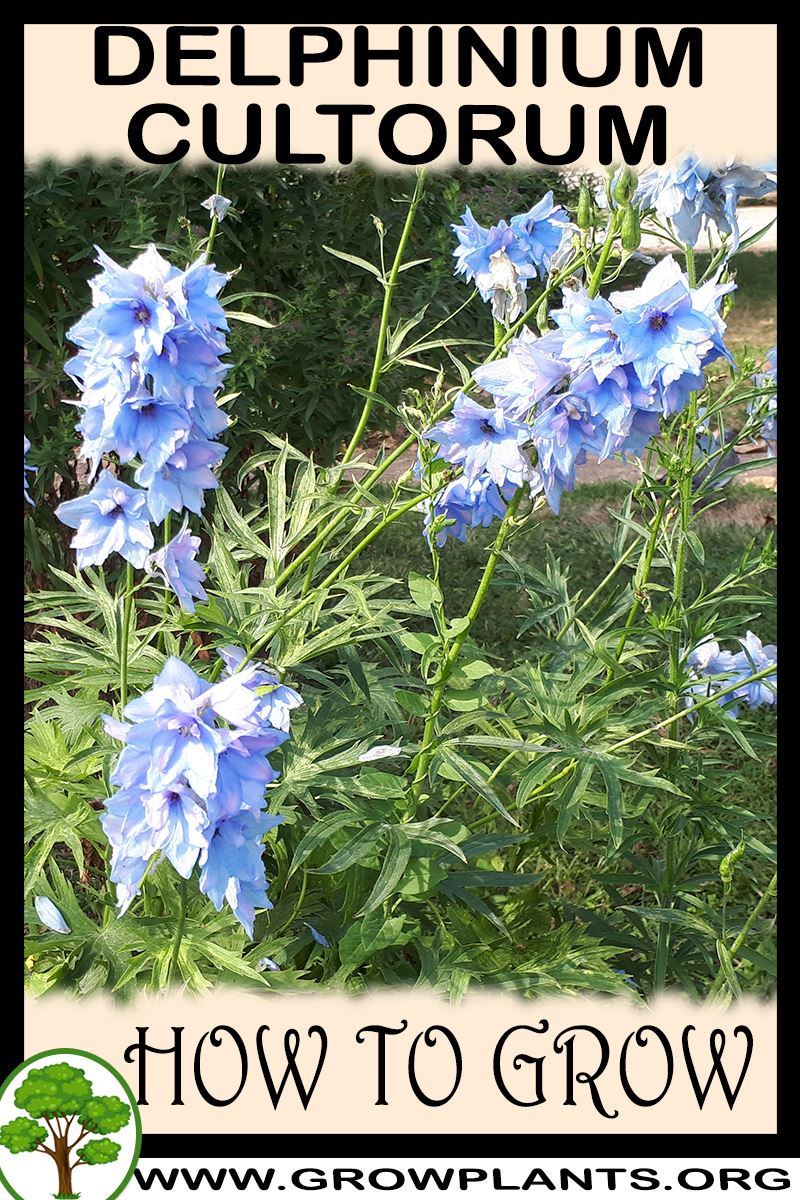
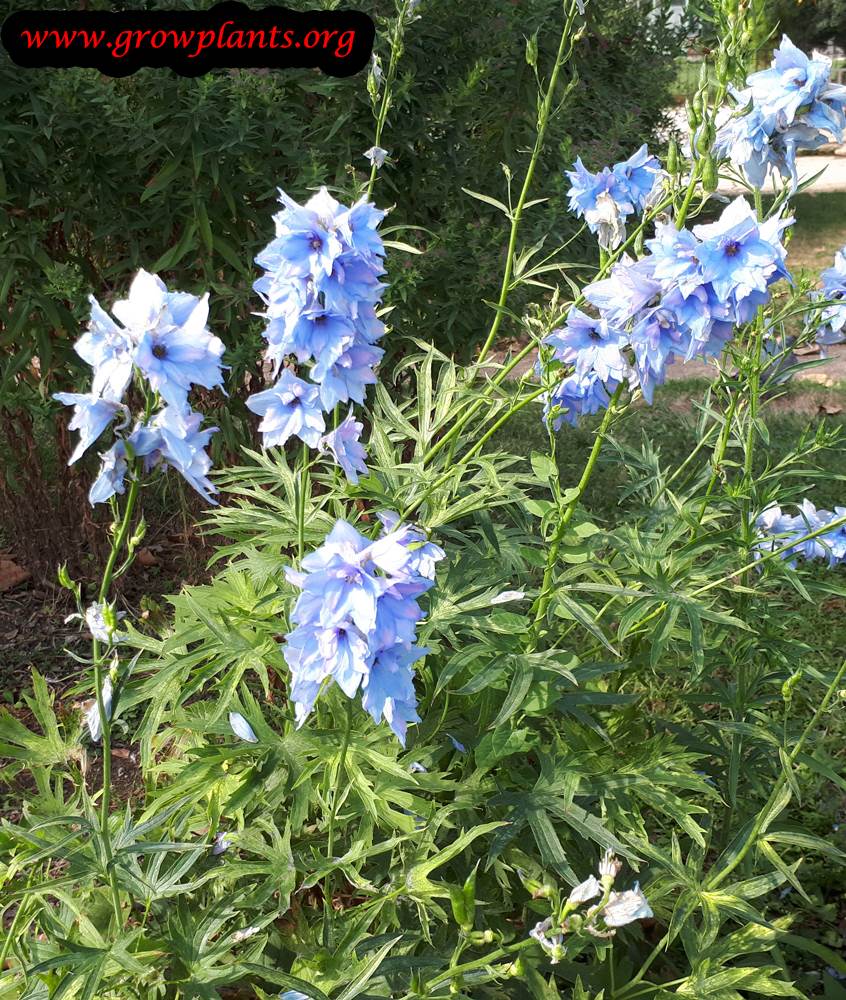
Plant Profile & Key Characteristics
Overview: Delphinium cultorum (Larkspur) is a tall herbaceous plant 0.7-2 m high, grown for its dramatic flower spikes and as a cut flower. It is a short-lived perennial (often grown as an annual) that attracts bees and butterflies.
Quick Specifications
| Specification | Attribute |
|---|---|
| Plant Type / Life Cycle | Perennial (often grown as an annual) |
| Foliage Type | Herbaceous, evergreen or deciduous |
| Mature Size | Height 0.7-2 m (2-6 ft) |
| Growth Rate | Moderate to fast |
| Toxicity | Toxic / poisonous – all parts (contains alkaloids) |
| Hardiness | USDA zones 3-10 |
Growth Form & Structure
- Height & Spread: Sends up tall flower spikes 0.7-2 m (2-6 ft) high from a basal clump; can be grown in a container.
- Growth Habit & Form: Upright, clump-forming herbaceous plant with towering vertical flower spikes.
- Lifespan & Maturity: Short-lived perennial, frequently grown as an annual or biennial; fast to reach flowering height.
Anatomy & Physical Features
- Leaves & Foliage: Green, palmately lobed leaves (3-7 lobes) with serrated edges.
- Flower Characteristics: Tall spikes of blue to purple flowers; a classic cut flower (full detail in the Bloom guide).
Primary Uses & Landscape Value
- Functional & Ornamental Roles: Ornamental border backbone, pollinator plant (bees and butterflies) and premium cut flower.
Care Guide: Planting, Soil & Watering
Overview: Delphiniums are tall perennials that grow best in full sun with rich, well-drained soil and steady moisture. They favour neutral to slightly alkaline soil and need consistent watering to support their fast, upright growth.
Quick Care Requirements
| Requirement | Ideal Condition |
|---|---|
| Planting Season | In spring to summer (or autumn in hot climates) |
| Growth Rate | Moderate to Fast |
| Soil Type | Rich, well-draining soil |
| Soil pH | Neutral to slightly alkaline |
| Water Need | Moderate to High – keep evenly moist |
Planting & Establishment
- Best Planting Season: Plant in spring to summer, or in autumn in hot climates.
- How to Plant:
- Hole Preparation: Dig a hole a little wider than the root ball on fertile, well-drained ground.
- Soil Amendments: Mix in compost or organic matter; a little garden lime suits its preference for slightly alkaline soil.
- Planting Depth: Set the crown at soil level – do not bury it, which can cause crown rot.
- Growth Speed & Expectations: Fast, sending up tall flower spikes that often need staking.
Soil, Watering & Drainage Care
- Soil Mix & Drainage Needs: Rich but free-draining soil; avoid waterlogging around the crown.
- Watering Schedule & Technique:
- Young / Newly Planted: Keep consistently moist while establishing.
- Established: Water regularly and deeply, especially during growth and flowering; do not let it dry out.
- Seasonal Adjustments: More in summer heat; less in winter dormancy.
Climate, Light & Hardiness
Delphinium cultorum (Larkspur) is a cold-hardy herbaceous perennial suited to temperate, Mediterranean, desert, and subtropical climates, grown as an evergreen, deciduous, or annual plant depending on conditions. It performs best in full sun to half shade and tolerates winter cold across a wide zone range.
Quick Climate Specifications
| Climate Zones | Temperate, Mediterranean, desert, and subtropical climates |
|---|---|
| USDA Hardiness Zones | Approximately zone 3–10 |
| Optimal Temp Range | Cool to mild growing-season temperatures |
| Cold Damage Begins | Foliage dies back with hard freezes in colder parts of its range |
| Approx. Survival Minimum | The root system of established plants tolerates the severe winter cold typical of zone 3 |
| Frost Tolerance | High |
| Light Conditions | Full Sun to Half Shade |
Sunlight & Light Exposure
Optimal Light Setup
Full sun to half shade suits this plant well; some afternoon shade helps in hot desert or subtropical climates.
Direct Sun Requirement
Several hours of direct sun daily support the strongest flower spikes.
Best Exposure / Orientation
An open bed in full sun works well in cooler zones; light afternoon shade is preferable in the hottest parts of its range.
Temperature Extremes & Hardiness
USDA Hardiness & Regional Limits
Site data places this plant across a broad zone 3–10 range, reflecting strong winter cold tolerance; at the warm end of its range (desert, subtropical), summer heat rather than cold becomes the main limiting factor, and the plant may behave as a shorter-lived or annual planting.
Cold Damage & Winter Protection
In the coldest zones, the plant dies back to the ground in winter and regrows from the root in spring; a layer of mulch can help protect the crown.
Frost Sensitivity
Foliage is frost sensitive and dies back with hard freezes, but the root system is very cold hardy across most of its range.
Extreme Heat Tolerance
Heat and drought stress are more limiting than cold in the warmer, desert, and subtropical parts of its range.
Wind, Humidity & Microclimate
Microclimate Recommendations
A site with good air circulation and well-drained soil helps this tall-spiked plant handle both winter cold and summer heat without rot or lodging.
Growing in Pots, Balconies & Indoors
Delphiniums are tall, sun-loving border perennials, not houseplants – the grower confirms they will not grow indoors. They can, however, be grown in a large, deep container on a sunny patio or balcony, where their flower spikes make a fine display before they are cut back for the season.
Quick Details
- Container Size: Large and deep – these grow 0.7-2 m (2-6 ft) tall and need root room and stability
- Indoor Suitability: Not a houseplant; grow outdoors
- Best Spot: Full sun to light shade, sheltered from wind
- Soil & Drainage: Rich, moisture-retentive but free-draining mix
- Watering in Pots: Keep evenly moist through the growing season – tall growth is thirsty and pots dry fast
Indoors & On the Windowsill
- Not for indoors: The grower marks it as unsuitable as a houseplant – it needs full outdoor sun, cool air, and a winter chill to perform, none of which a room provides.
- Overwintering: As a hardy perennial it is best left outdoors; in pots it dies back and re-sprouts, so simply protect the pot from waterlogging over winter.
On a Balcony or Patio
- Light & wind: Give it the sunniest spot, but stake the tall spikes and shelter from wind, which snaps them easily. Walls and paving reflect heat, so check pot moisture often.
- Weight & drainage: A big, filled pot is heavy and prone to blowing over when top-heavy – use a sturdy, wide-based container and let excess water drain away freely.
Choosing the Pot, Soil & Long-Term Care
- Pot & drainage: Choose a pot a size or two larger than the root ball, with strong drainage holes; skip a standing water saucer to avoid root rot. Terracotta breathes and dries faster, while glazed or plastic pots hold moisture longer.
- Potting mix: A well-aerated, organic-rich mix – a quality potting mix, or peat/coir blended with perlite or vermiculite.
- Feeding: Potted plants need feeding more often than those in open ground, as frequent watering leaches nutrients away – feed lightly through the growing season.
- Repotting: Refresh the mix or pot up about every two years; for perennials, lightly trim the root ball and top growth at the same time.
Fertilizing & Feeding
A moderate feeder – this garden larkspur wants consistent, balanced nutrition while it builds foliage and flower spikes, then a clean rest once the bloom cycle is finished.
Quick Fertilizing Specs
| Feeding Level | Moderate feeder |
|---|---|
| young_feeding | Start new transplants or seedlings with a light, balanced feed as growth begins |
| mature_feeding | Balanced feeding from spring growth through bud formation, tapering off as bloom finishes |
| Main Nutrient Priority | Balanced overall nutrition; a heavy phosphorus bloom booster is not needed |
| Best Feeding Period | Spring growth through bud set |
| Organic Options | Aged compost worked into the bed at the start of the growing season can stand in for part of a synthetic feeding routine |
| Soil pH | Prefers alkaline, well-drained soil |
| Reduce/Stop Feeding | Stop feeding once flowering ends and spent stalks are cut back |
Feeding by Growth Stage
Spring Growth
Establish vigorous basal foliage and thick flower stalks as the crown breaks dormancy
| Nutrient direction | A balanced feed that favors sturdy, upright growth over soft, oversized leaves |
|---|---|
| Timing | Early spring as new shoots appear from the crown |
| Frequency | A light, steady feeding routine through early growth is typically all that’s needed |
| Fertilizer types | A balanced granular or liquid garden fertilizer applied around, not directly on, the crown |
| Precautions | Water fertilizer in thoroughly and keep it away from direct contact with the crown to prevent burn |
Bud Set and Bloom
Carry the tall flower spikes through bud formation and full bloom for cutting or garden display
| Nutrient direction | Keep feeding balanced rather than phosphorus-heavy – steady overall nutrition, not a bloom-booster ratio, is what sustains the flower spikes |
|---|---|
| Timing | As buds form and spikes come into bloom |
| Frequency | A single balanced feeding as buds begin forming is generally enough to carry the plant through bloom |
| Fertilizer types | A balanced garden fertilizer; skip high-phosphorus bloom formulas |
| Precautions | Avoid pushing extra feeding once spikes are tall, since it can weaken stems and increase the risk of flopping |
Post-Bloom Rest
Allow the crown to recover after cutting back spent flower stalks without prompting tender new growth in cold weather
| Nutrient direction | None – withhold fertilizer once the bloom cycle ends and stalks are cut back |
|---|---|
| Timing | From the end of bloom through autumn and winter |
| Frequency | No feeding at this stage |
| Fertilizer types | No feeding at this stage – resume balanced feeding only once new growth returns in spring |
| Precautions | Do not fertilize the resting crown; new growth pushed by feeding now is vulnerable to cold damage |
Nutrient Deficiency Signs & Corrections
Older, lower leaves fade from green to pale yellow while newer growth looks normal
| Possible causes | nitrogen deficiency from lean soil or an inconsistent feeding routine, waterlogged or compacted soil limiting root uptake, normal senescence of the oldest leaves as the plant matures |
|---|---|
| Appears first on | older, lower leaves |
| What to check | how recently the bed was fed, soil drainage and compaction, whether only the oldest leaves are affected |
| Possible correction | Work a balanced fertilizer or compost into the soil at the start of spring growth and address any drainage issues |
New leaves come in yellow with distinctly green veins
| Possible causes | iron chlorosis brought on by the alkaline soil this plant tolerates well, poor drainage stressing the root system, manganese shortage producing a similar interveinal yellowing |
|---|---|
| Appears first on | newest leaves |
| What to check | soil pH tendency, drainage around the root zone, whether the yellowing is truly interveinal |
| Possible correction | If soil pH has drifted too alkaline, apply a chelated iron product per its label and improve drainage |
Tall flower stalks grow thin and bend or collapse around bloom time
| Possible causes | excess nitrogen encouraging soft, leafy growth instead of sturdy stems, low light causing stretched, weak stem growth, lack of staking for a naturally tall, top-heavy plant |
|---|---|
| Appears first on | flower stalks and upper foliage |
| What to check | recent nitrogen-heavy feeding, how much direct light the bed receives, whether stalks are staked or supported |
| Possible correction | Switch to a balanced rather than nitrogen-heavy feed and stake tall spikes for support |
Pruning, Training & Seasonal Maintenance
Delphinium cultorum, the cultivated larkspur hybrid group, is an herbaceous perennial (sometimes grown as an annual) valued for its tall flower spikes, so pruning is limited to seasonal deadheading and an end-of-season cutback rather than any woody shaping. It resprouts readily from its basal crown, so cutting back hard once flowering is done is safe and beneficial; the main goal is removing spent spikes to tidy growth, curb self-seeding, and ready the crown for autumn–winter dormancy. The whole plant is toxic, so handling cut material safely matters as much as the cut itself.
Quick Pruning & Maintenance Specs
| Pruning Tolerance | Moderate–High (regrows from basal crown) |
| Primary Pruning Window | Autumn–winter, once flowering and foliage decline |
| Secondary Maintenance Window | Spring–summer deadheading as each spike fades |
| Typical Frequency | 1–2 times per growing season |
| Main Objective | Deadhead spent spikes; full cutback for dormancy |
| Young Plant Priority | Remove only damaged or frost-hit growth while the crown establishes |
| Mature Plant Priority | Deadhead to extend bloom; cut back once flowering ends |
| Best Tool Type | Bypass secateurs (spike bases are thick and fibrous) |
| Avoid Heavy Pruning During | Active spring–summer flowering |
Pruning by Plant Age & Size
Newly Established
Leave first-season plants uncut except for removing damaged or frost-nipped leaves, allowing the crown to build the reserves needed for a strong flowering display the following year.
Young / Formative
No structural training applies – this hybrid group forms no woody framework. With spikes reaching up to about 2m, staking supports tall stems instead of shortening them early.
Mature / Established
On established clumps, deadhead the primary spike as its lower florets fade (often prompting a smaller secondary spike) and cut the whole flowering stem back once the display is finished.
Seasonal Pruning Schedule
| Post-Flowering (spring–summer) | Objective: prolong bloom and reduce seed set. Remove: the spent spike, cutting to the topmost healthy leaf or side-shoot. Do not remove: healthy basal foliage. Expected response: a secondary, smaller bloom spike in many cases. Flowering impact: redirects energy from seed production into rebloom. |
| Dormant / Autumn–Winter | Objective: clear dead top growth before dormancy and limit rot/disease carryover. Remove: the finished flowering stem down to the basal rosette. Do not remove: the living crown. Expected response: fresh basal growth and a new spike the following spring. Flowering impact: none negative. |
Special Growth to Remove
- Spent flower spikes (the "old spike" is the primary cut – left on, it sets seed, promotes volunteer seedlings, and can rot in wet conditions).
- Dead or yellowing leaves as they appear.
Container & Small-Space Pruning
Suited to large planters; deadhead promptly in containers so the restricted root volume isn’t spent on seed production, and cut the whole plant back once flowering ends so tall spent spikes don’t rock the root ball in wind.
Tools
- Bypass secateurs for the fibrous flower-spike stems.
- Precision snips for deadheading individual faded florets.
Tool Hygiene & Disease Risk
Routine – clean, sharp tools are sufficient between plants; no specific transmissible pathogen demands disinfecting between cuts. Wear gloves handling cut material given the plant’s toxicity, and wash tools afterward.
Cut Placement & Technique
Deadhead just above a healthy leaf or side-shoot; make the autumn–winter cutback close to the basal rosette. Cut cleanly through the hollow stem rather than tearing it, to avoid inviting rot.
Heavy Pruning & Rejuvenation
The seasonal autumn–winter cutback of spent flowering stems is the plant’s normal renewal – it regrows vigorously from the crown in spring. No harder rejuvenation technique is needed.
Post-Pruning Care
Keep the cut-back crown from sitting wet over winter to limit rot, and watch spring regrowth for aphids, snails and slugs, its documented pests.
Common Pruning Mistakes
- Letting spent spikes stand too long, driving excess self-seeding.
- Cutting a spike while it is still actively flowering, losing potential secondary bloom.
- Handling cuttings bare-handed despite the plant’s toxicity.
When NOT to Prune
Do not cut back a spike while it is still in active bloom – wait for flowers to fade so side-shoots have a chance to develop.
Recommended Tools (by task)
- bypass_secateurs – for the thick flower-spike base at deadheading and the autumn–winter cutback.
- precision_snips – for light deadheading of individual florets along the spike.
Propagation Guide
Delphinium cultorum, the cultivated garden Larkspur group, is most easily grown from seed, which the site notes is not required to be started vegetatively; because it is a long-cultivated seed strain, seedlings are usually similar to the parent but named color selections can vary slightly, so basal cuttings or division are used when an exact color match matters. Propagation is moderate in difficulty, mainly because germination is cool-temperature dependent and can be slow.
Quick Propagation Specs
| Best Propagation Method | Seed |
| Alternative Methods | Basal (crown) cuttings; division of established clumps |
| Propagation Difficulty | Moderate |
| Seed True-to-Type | Mostly uniform for a given seed strain, though named color selections may vary slightly |
| Vegetative True-to-Type | Yes |
| Best Propagation Season | Seed: late winter to spring; basal cuttings and division: spring |
| Seed Germination Time | Typically 2–4 weeks, can be slower or irregular |
| Cutting Rooting Time | A few weeks under cool, humid conditions |
| Germination Temperature | 10–18°C (50–65°F); Delphinium seed generally germinates better cool than warm |
Growing from Seed
Seed Handling & Viability
Seed loses viability relatively quickly; sow it as fresh as possible or keep it cool and dry (refrigerated) if it must be stored.
Dormancy & Pre-Sowing Treatment
Germination can benefit from a short period of cold stratification (a couple of weeks refrigerated) before sowing, though seed will often germinate without it, just less evenly.
Sowing Season
Sow in late winter to early spring indoors, or direct-sow outdoors in spring; the site lists spring through summer (and autumn in hot climates) as the general planting window.
Germination Conditions
Cool temperatures favor germination – warm conditions can inhibit it. Keep the sowing medium evenly moist.
Germination Time
Usually a few weeks, but can be slow and uneven, especially without cool stratification.
Seedling Care
Grow on in cool, bright conditions and transplant once true leaves appear; handle with care as the site notes this plant is toxic.
Stem Cuttings
Cutting Type
Basal cuttings taken from young shoots emerging at the base of an established crown in spring.
Best Timing
Spring, when new basal growth is a few inches tall but still solid.
Cutting Preparation
Remove a young shoot close to its point of origin on the crown, ideally with a sliver of the firmer basal tissue attached, since Delphinium stems are often pithy or hollow higher up and prone to rot if cut there.
Rooting Setup
Insert into a free-draining, gritty propagating mix and keep humidity moderate to high without waterlogging the cutting.
Rooting Hormone
Not essential, but can improve success given the pithy stem tissue.
Rooting Time
Typically a few weeks in cool, humid conditions.
Division, Offsets, Pups & Suckers
Established perennial clumps that have formed multiple crowns can be lifted and divided in spring or autumn. Each division should include healthy roots and at least one growth bud; discard old, woody, or hollow central portions in favor of vigorous outer sections.
Bloom & Flower Guide
Quick Details
- Bloom Season: Spring to summer
- Flower Appearance: Blue to purple flowers carried on tall upright spikes
- Edibility: Toxic – all parts, the flowers included, are poisonous if eaten; not edible
Detailed Blooming Overview
Delphinium cultorum (Larkspur) is a herbaceous perennial (sometimes grown as an annual) whose tall flower spikes are a classic cut flower. From spring into summer it sends up dense spires of blue to purple blooms that draw in butterflies and bees. Handle it with respect, though: every part of the plant, flowers and sap included, contains toxic diterpene alkaloids.
Flower Characteristics
- Blue to purple flowers
- Massed on tall, upright spikes
- Long-lasting and excellent for cutting
Bloom Care & Thinning
- Deadheading: Remove faded spikes to tidy the plant and sometimes coax a second, lighter flush.
- Support: The tall spikes may need staking in exposed or windy spots.
- Pollination: Freely visited by bees and butterflies while in flower.
- Safety: Wear gloves when handling, and keep cut stems and flowers away from children and pets.
Bloom Health & Protection
- Powdery mildew: A white bloom on stems and foliage in warm, humid, crowded conditions; better spacing and airflow help, as can a sulfur-based or potassium-bicarbonate fungicide.
- Slugs and snails: They target soft new shoots as flower spikes rise; hand-picking or a barrier around the crown protects the emerging bloom.
Pests, Diseases & Troubleshooting
Delphinium (larkspur) is a tall, soft-tissued Ranunculaceae perennial whose lush spring growth is a magnet for slugs and snails – its number-one enemy – along with cyclamen mite, aphids and leaf-miner larvae, while powdery mildew, bacterial black blotch and crown rot are the key diseases. All parts are toxic, so handle with care. Slug vigilance from the first shoots, good airflow and sharp winter drainage are the heart of successful culture.
Quick Troubleshooting Overview
| Issue / Pest | Main Symptom | Primary Solution |
|---|---|---|
| Slugs & snails | Emerging shoots shredded overnight; slime trails | Early night patrol, barriers, iron-phosphate bait |
| Cyclamen mite | Distorted, blackened, stunted new growth and buds | Remove affected shoots; hot-water/miticide, isolate |
| Aphids | Sticky curled tips; spreads virus | Rinse off, beneficials, insecticidal soap |
| Larvae / leaf miners | Blotchy mined leaves, chewed foliage | Pick affected leaves, encourage wasps |
| Powdery mildew | White film on leaves and stems | Airflow, avoid overhead water, sulphur |
| Black blotch (bacterial) | Shiny black blotches on leaves/stems | Remove/destroy, avoid wetting, sanitation |
Common Pests & Management
- Slugs & snails (Deroceras / Helix / Arion spp.):
- Symptoms: The number-one pest: emerging spring shoots and tender leaves are rasped and shredded overnight, often destroying young crowns before they can grow away; slime trails confirm the culprit.
- Prevention & Control: Start patrols the moment shoots appear; hand-collect at dusk after rain; ring crowns with sharp grit, crushed shell or copper; use iron-phosphate pellets, which are safer around pets and wildlife; clear nearby debris where slugs shelter.
- Cyclamen mite (Phytonemus pallidus):
- Symptoms: Microscopic mites deep in the growing tips cause distorted, brittle, blackened and stunted new leaves and deformed flower buds; damage is often mistaken for disease.
- Prevention & Control: Cut out and destroy affected shoots; isolate infested plants and avoid spreading mites on hands and tools; encourage predatory mites; badly affected clumps may need disposal, as these mites are hard to reach with sprays.
- Aphids (Myzus persicae / Aphis spp.):
- Symptoms: Soft green or black insects cluster on shoot tips, flower stems and leaf undersides; growth curls, honeydew makes leaves sticky, and aphids spread larkspur viruses.
- Prevention & Control: Dislodge with a water jet, support ladybirds, lacewings and hoverflies, pinch out badly infested tips, and treat persistent colonies with insecticidal soap in the evening. Wear gloves – the plant is toxic.
- Delphinium leaf miner / larvae (Phytomyza / caterpillar larvae):
- Symptoms: Larvae mine blotches inside the leaves or chew the foliage, leaving pale blotchy patches and ragged holes that mar the plant.
- Prevention & Control: Pick off and destroy mined and chewed leaves, keep the area weeded, encourage parasitic wasps and birds, and use Bt for caterpillars where needed; tolerate minor cosmetic damage.
- Two-spotted spider mite (Tetranychus urticae):
- Symptoms: In hot, dry spells leaves show fine stippling and bronzing, with fine webbing on undersides.
- Prevention & Control: Raise humidity and hose down foliage, keep plants watered and unstressed, encourage predatory mites, and use horticultural oil or insecticidal soap if it persists.
Diseases & Fungal Issues
- Powdery mildew (Erysiphe / Golovinomyces):
- Symptoms: A white, dusty coating spreads over leaves and stems, mainly in crowded plantings and late in the season; leaves yellow and dry and flowering suffers.
- Treatment & Management: Space and stake plants for airflow, thin overcrowded stems, and avoid overhead watering late in the day; remove affected foliage; spray sulphur or potassium bicarbonate at first signs, repeating as needed.
- Bacterial black blotch (Pseudomonas delphinii (syn. P. syringae pv. delphinii)):
- Symptoms: Irregular, shiny, tar-black blotches appear on leaves, stems and buds, starting on lower leaves in wet weather and spreading upward; distinctive and disfiguring.
- Treatment & Management: There is no cure: remove and destroy affected leaves and, if severe, whole plants; avoid overhead watering and working plants when wet; clear debris, sanitise tools, and improve airflow to slow spread.
- Crown and root rot (Sclerotium / Pythium / Phytophthora / Rhizoctonia):
- Symptoms: The crown and roots rot in wet, heavy or poorly drained soil, causing sudden wilting, blackening at the base and collapse, often in warm, waterlogged conditions.
- Treatment & Management: Plant in free-draining soil with the crown at the right depth, avoid winter waterlogging and heavy mulch piled on the crown, and improve drainage; remove and destroy rotted plants and do not replant delphiniums in the same infected spot.
- Fungal leaf spot (Various fungi):
- Symptoms: Brown or dark spots with defined margins scatter over the leaves in wet, humid seasons.
- Treatment & Management: Remove spotted leaves, clear debris, and improve air movement; rarely needs a fungicide if airflow and sanitation are good.
Growing Difficulties & Abiotic Problems
- Toxicity (grower safety):
- Cause & Symptoms: All parts, especially seeds and young growth, are poisonous if eaten and the sap can irritate skin.
- Correction Strategy: Wear gloves when handling, cutting or dividing, wash hands afterwards, and keep the plant and its seed away from children, pets and grazing animals.
- Wind and stem collapse:
- Cause & Symptoms: Tall, hollow, brittle flower spikes snap or flop in wind and rain, especially the large hybrid types.
- Correction Strategy: Stake early with canes or ring supports as the spikes rise, site out of strong wind, and cut spent spikes to encourage a sturdier second flush.
- Winter wet / short-lived crowns:
- Cause & Symptoms: Crowns rot and clumps dwindle in cold, wet, heavy soil, and hybrid delphiniums are often short-lived.
- Correction Strategy: Improve drainage and add grit to heavy soil, keep the crown from sitting wet in winter, divide clumps regularly, and mulch away from the crown itself.
- Poor flowering / weak spikes:
- Cause & Symptoms: Shade, poor soil, drought or overcrowding give thin, sparse spikes.
- Correction Strategy: Grow in full sun to light shade in rich, well-drained soil, feed and water through the growing season, thin weak shoots for fewer strong spikes, and divide congested clumps.
What Helps – Products & Tools
For delphiniums, slug control comes first: iron-phosphate bait and grit or copper barriers protect the emerging spikes. Insecticidal soap and horticultural oil handle aphids and mites, sulphur or potassium-bicarbonate fungicide covers powdery mildew, and rigorous sanitation is the answer to bacterial black blotch. Sharp drainage guards the crowns, and good staking prevents storm damage. Wear gloves – the plant is toxic.