
Care Guide: Planting, Soil & Watering
Overview: A warm-loving, fast-growing pepper best in full sun, rich fertile soil and steady moisture. It likes warmth and even watering, dislikes waterlogged ground, and is frost-sensitive.
Quick Care Requirements
| Requirement | Ideal Condition |
|---|---|
| Planting Season | In spring after the last frost in cooler zones; spring–summer in zone 10b–11a; spring–autumn in 11b; year-round in zone 12+ |
| Growth Rate | Fast to moderate |
| Soil Type | Rich, fertile and well-draining |
| Soil pH | Slightly acidic to neutral (about 6.0–6.8) |
| Water Need | Moderate to high – keep evenly moist but never waterlogged |
Planting & Establishment
- Best Planting Season: Warm-season crop – plant out only after all danger of frost has passed and the soil has warmed; in frost-free zones plant across the warm season or year-round.
- How to Plant:
- Hole Preparation: Dig a hole 50–100% wider than the root ball to give the roots loose, easy soil.
- Soil Amendments: Mix compost, humus and dead leaves into the backfill for fertility and moisture.
- Planting Depth: Set the plant at the same depth it grew in the pot, or very slightly deeper; firm gently.
- Growth Speed & Expectations: Fast to moderate in warm weather; if growth stalls, add fertiliser and organic matter to push it along.
Soil, Watering & Drainage Care
- Soil Mix & Drainage Needs: Fertile, well-aerated, free-draining soil; in containers use a 10–30 L pot with good drainage holes and mulch to hold moisture.
- Watering Schedule & Technique:
- Young / Newly Planted: Water twice on planting day, then daily for the first two weeks while the plant settles in.
- Established: Water regularly and deeply to keep the soil evenly moist; mulch in summer to steady moisture.
- Seasonal Adjustments: More in heat, wind and full fruiting; less in cool weather and over winter.
Climate, Light & Hardiness
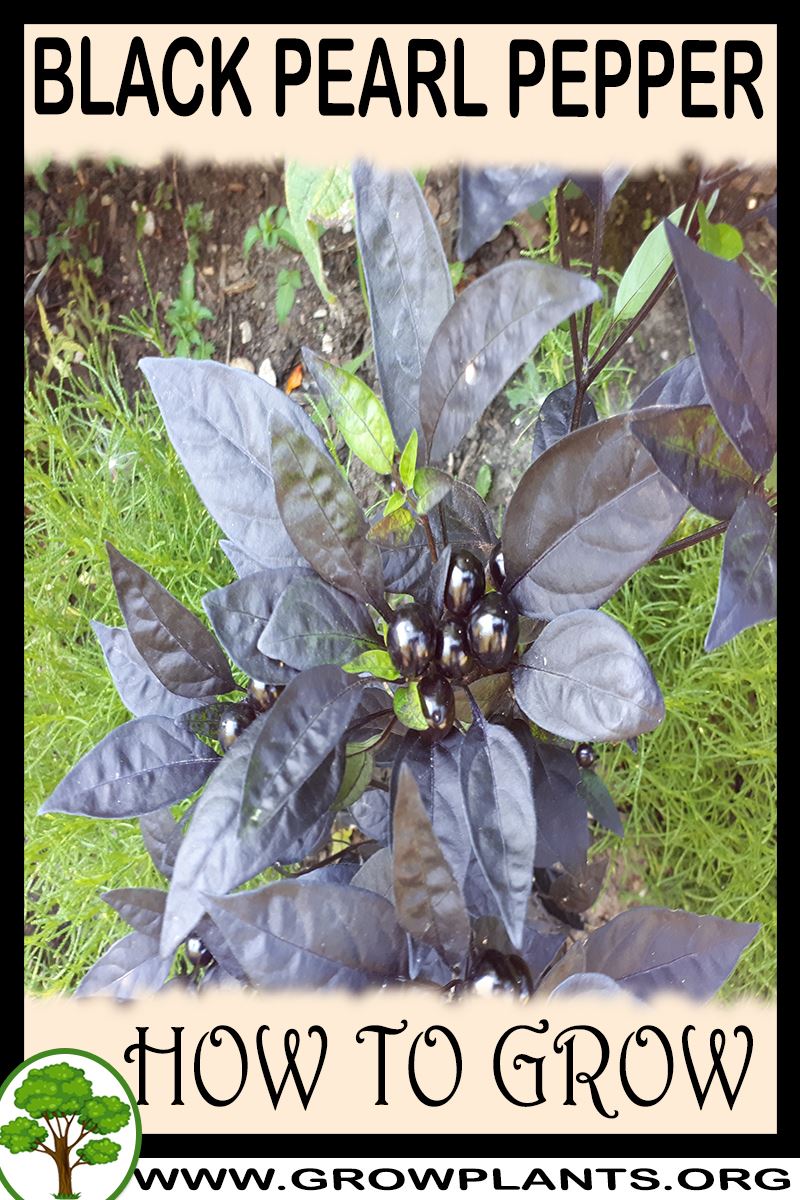
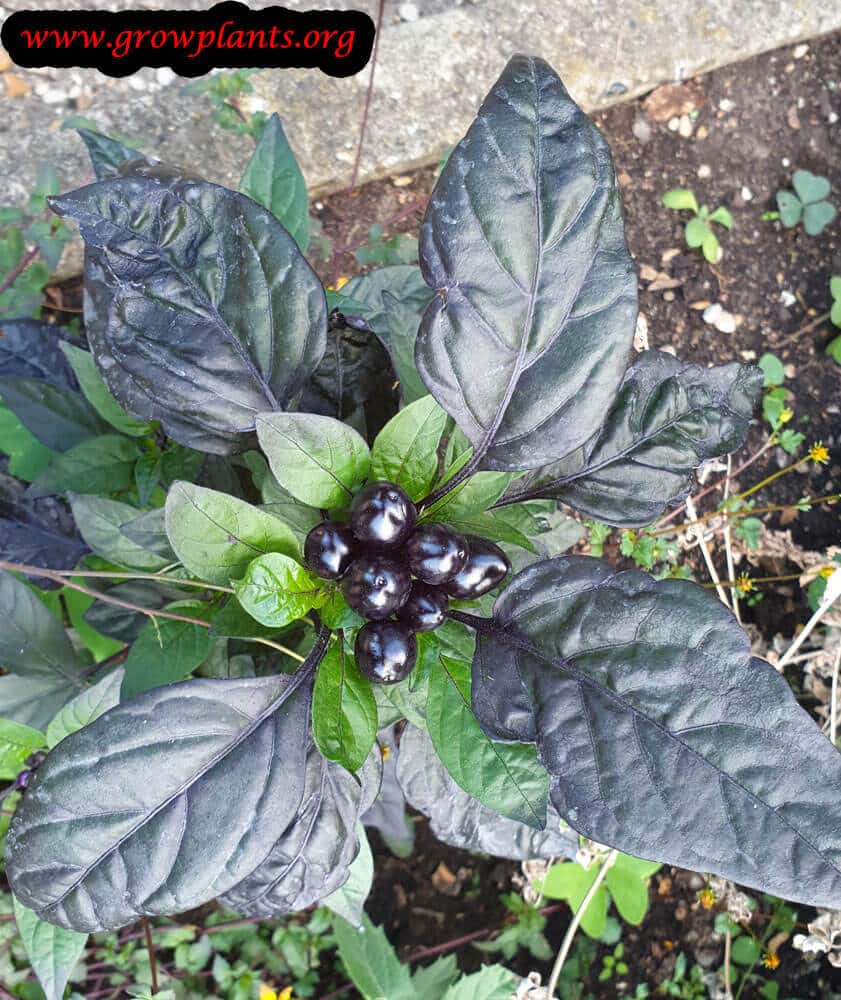
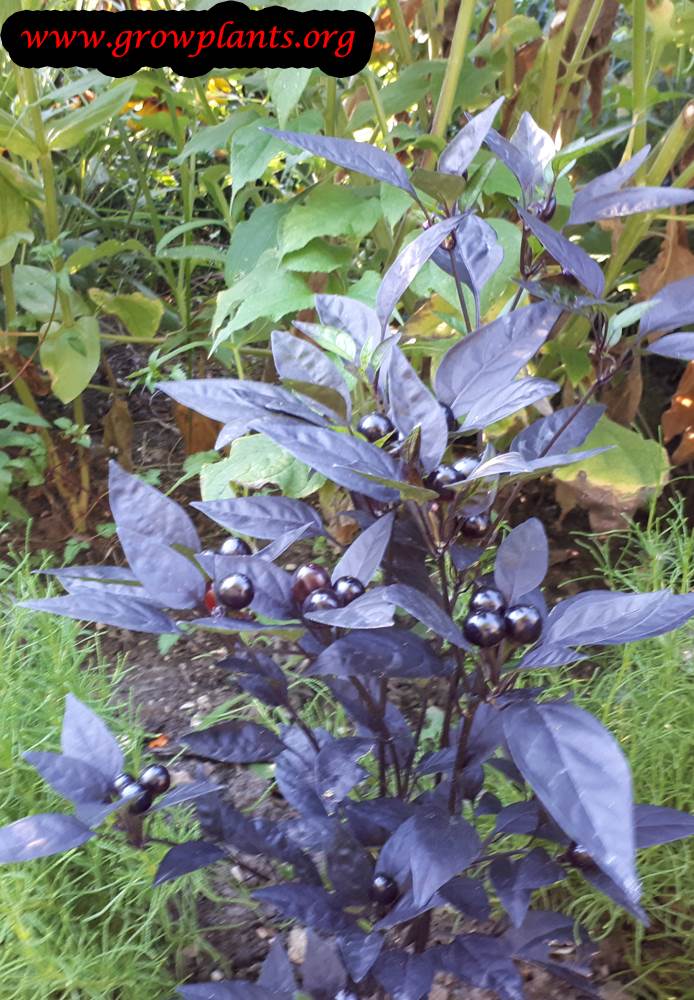
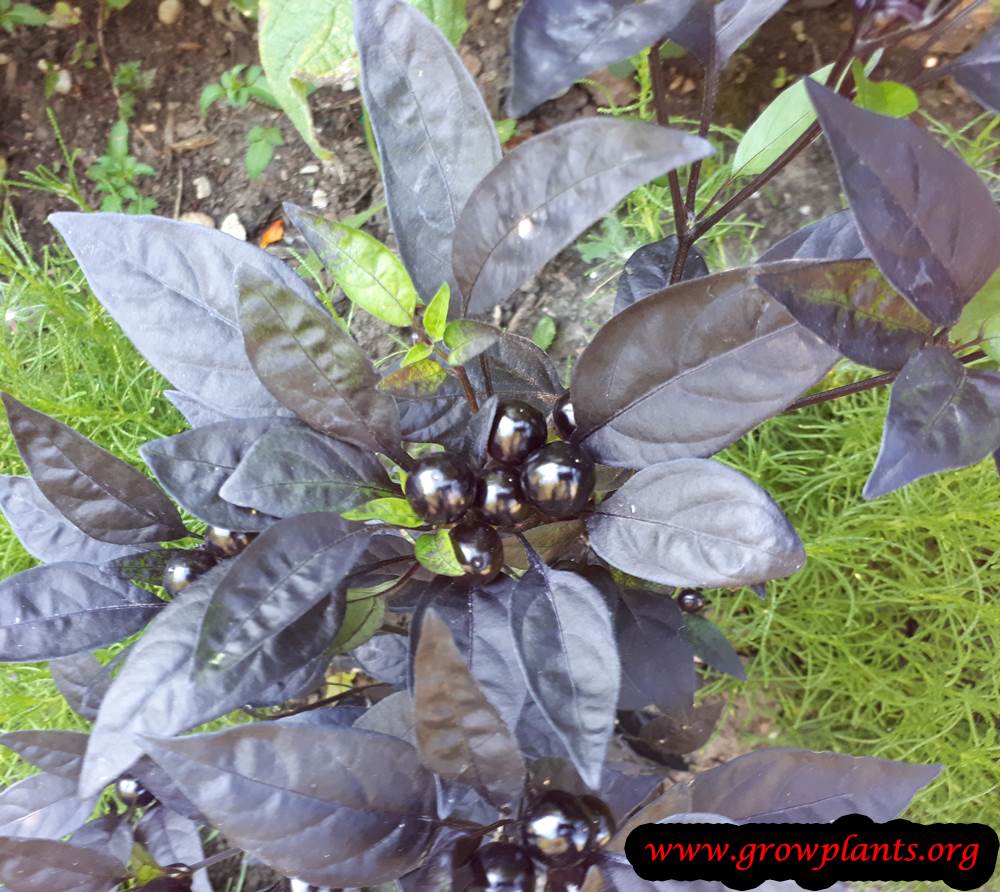
Black Pearl pepper (an ornamental Capsicum annuum cultivar) grows in tropical, subtropical, Mediterranean, temperate, and desert climates, needing full sun for its best colored foliage and fruit exposure. It is frost sensitive, so its USDA hardiness differs sharply depending on whether it is grown as a short-lived perennial or as an annual.
Quick Climate Specifications
| Climate Zones | Tropic, subtropical, Mediterranean, temperate, desert |
|---|---|
| USDA Hardiness Zones | 10b+ as a perennial; 2+ when grown as an annual (or by overwintering cuttings indoors) |
| Frost Tolerance | None |
| Light Conditions | Full sun (almost full sun in hot climates); half shade possible only when grown as a perennial, with reduced fruiting |
Sunlight & Light Exposure
Optimal Light Setup
Full sun gives the best fruiting and foliage color; in very hot, desert climates almost-full sun helps avoid leaf and fruit burn.
Shade & Heat Management
Half shade is tolerable only for perennial specimens and results in less fruit; in intense desert sun the fruits and leaves can scorch, so slight shading may help there.
Temperature Extremes & Hardiness
USDA Hardiness & Regional Limits
As a perennial it survives winters only in USDA zone 10b and warmer, truly frost-free climates. Where winters bring frost, it is grown as an annual (effectively hardy to zone 2+ on that basis), or its cuttings/stems can be kept indoors over winter and replanted after the last frost to grow it as a de facto perennial as far north as zone 2–10.
Cold Damage & Winter Protection
Frost sensitive; in zone 10b, plants grown as perennials commonly suffer or die from winter cold, though some more cold-tolerant varieties can survive and even fruit through a mild winter.
Extreme Heat Tolerance
Foliage and fruit can suffer sunburn above roughly 44°C (111°F) in full sun, so extreme desert heat may call for light afternoon shade.
Wind, Humidity & Microclimate
Microclimate Recommendations
An open, sunny, wind-sheltered bed with mulch to buffer soil temperature swings suits this plant; container growing simplifies bringing it indoors over winter in marginal climates.
Growing in Pots, Balconies & Indoors
Black Pearl pepper (Capsicum annuum) is a compact ornamental pepper that shines in containers. The grower says it is not a deep-room houseplant, but kept small on a bright windowsill it gets enough sun to fruit well, and it is excellent in pots on a sunny balcony or patio.
Quick Details
- Container Size: 10-30 L (2-6 gal), depending on whether it is grown as an annual or a perennial (grower’s guidance)
- Indoor Suitability: Not a deep-room houseplant, but fruits well kept small on a bright, sunny windowsill
- Best Spot: Full sun; in very hot, desert climates give a little shade so fruit and leaves do not scorch
- Soil & Drainage: Well-ventilated, free-draining mix rich in organic matter – potting mix or peat with perlite/vermiculite
- Watering in Pots: Average to plenty – keep evenly moist with mulch; make enough holes so excess drains away
Indoors & On the Windowsill
- Houseplant limits: The grower does not rate it as a deep-room houseplant – the light is too weak away from a window.
- On the windowsill: Keep the plant small on a bright, sunny sill and it gets enough sun for both plant and fruit; watch that it does not get too cold in winter.
- Overwintering: Grown as a short-lived perennial, it can be kept on a warm, bright sill over winter; it is frost tender.
- Safety: The glossy black fruits are intensely hot and this is an ornamental form – keep it away from small children and pets, and do not treat the fruit as a salad pepper.
On a Balcony or Patio
- Light & warmth: Give it the sunniest spot; walls and paving reflect heat, so the compact plant colours up well – but pots dry fast, so check moisture in hot spells.
- Practicalities: Mulch the surface to hold moisture and make sure water drains freely from the base.
Choosing the Pot, Soil & Long-Term Care
- Pot & drainage: A 10-30 L pot with strong drainage holes; mulch the top to keep the mix moist.
- Potting mix: Well-ventilated and free-draining, rich in organic matter – potting mix or peat soil with perlite or vermiculite.
- Feeding: Feed potted plants at least once a year (more through fruiting), as nutrients leach from the pot.
- As a perennial: Every few years switch part of the soil and prune some of the roots and top growth to keep it vigorous.
Grower’s Container Tip
- Gradual fill: Start the pot with only about 10% soil; as the roots fill it, keep topping up the soil until the container is full.
Fertilizing & Feeding
Grown mainly as an ornamental for its dark purple-to-black foliage and colorful fruit rather than for eating, this warm-season plant is a moderate feeder; keeping nitrogen modest rather than heavy is generally favored so the plant sets its colorful fruit display promptly instead of channeling energy into extra leafy growth.
Quick Fertilizing Specs
| Feeding Level | Moderate feeder |
|---|---|
| Main Nutrient Priority | Balanced feeding with only modest nitrogen, since a heavier nitrogen-forward fertilizer tends to favor leafy growth and stems over the plant’s colorful flower and fruit display |
| Best Feeding Period | From planting in warm weather through active foliage and fruit-color development |
| Organic Options | Compost or other organic matter worked into the planting hole and used as mulch |
| Reduce/Stop Feeding | Ease off as the season ends for plants grown as annuals, or as growth slows for plants overwintered indoors |
| Micronutrients | Usually met by a complete fertilizer and organic-rich soil; correct only a diagnosed problem |
| Soil pH | Grows well in ordinary, well-drained garden or container soil without needing a particular pH |
Feeding by Growth Stage
Establishment after transplanting
Help a young transplant root in and begin steady growth once the weather has warmed.
| Nutrient direction | A balanced, complete starter fertilizer along with organic matter supports strong root establishment. |
|---|---|
| Timing | At transplanting in warm weather, after the last frost. |
| Frequency | A starter feeding at planting, followed by regular watering-in, is usually enough to launch establishment. |
| Fertilizer types | A balanced, complete starter fertilizer, Organic matter or compost mixed into the planting hole |
| Precautions | Wait until the weather is reliably warm and frost risk has passed; this plant establishes poorly in cold, wet soil. |
Foliage and fruit-color development
Support the plant’s signature dark, colorful foliage along with its small flowers and round-to-teardrop fruit as they develop and change color.
| Nutrient direction | Balanced feeding with modest, not heavy, nitrogen tends to favor the flower and fruit-color display rather than pushing excess leafy stem growth. |
|---|---|
| Timing | Through the main warm-season growth period as foliage color deepens and fruit forms and colors up. |
| Frequency | Regular but moderate feeding through this period supports the display without overdriving leafy growth. |
| Fertilizer types | A balanced, complete fertilizer with moderate rather than high nitrogen content, Organic matter renewed as a top-dressing or mulch |
| Precautions | Avoid a heavily nitrogen-forward fertilizer, which tends to favor stems and leaves at the expense of the flower and fruit-color display this plant is grown for. |
Season’s end or overwinter rest
Let the planting wind down naturally at season’s end, whether that means the end of its life as an annual or a rest period for stems kept indoors to overwinter in cooler climates.
| Nutrient direction | None – withhold fertilizer as the plant finishes its cycle or rests indoors over winter. |
|---|---|
| Timing | As cooler weather ends the outdoor growing season, and through any indoor overwintering period. |
| Frequency | No feeding at this stage. |
| Fertilizer types | No feeding at this stage; the plant is winding down or resting rather than in active growth |
| Precautions | Do not fertilize a planting that is no longer in active growth; it cannot make use of the nutrients at this point in its cycle. |
Nutrient Deficiency Signs & Corrections
Older, lower leaves fade to pale green or yellow and overall growth and fruit color development slow.
| Possible causes | low available soil or container nutrients, nutrients leaching from frequent container watering, root crowding in an undersized container |
|---|---|
| Appears first on | older, lower leaves |
| What to check | recent feeding history, container size and drainage, watering frequency |
| Possible correction | Apply a balanced, moderate-nitrogen complete fertilizer and check that the container or bed has adequate root room. |
Plant grows lush and leafy but foliage stays greener than expected and fruit color develops slowly.
| Possible causes | overfeeding with a nitrogen-heavy fertilizer that favors leafy growth over color development, too much shade for a plant that colors up best in full sun, inconsistent light exposure through the season |
|---|---|
| Appears first on | whole-plant effect rather than a single stem |
| What to check | recent fertilizer type and amount, sun exposure, overall plant vigor |
| Possible correction | Ease off to a lighter, more balanced feeding and move the plant to fuller sun where possible. |
Leaf margins brown or scorch, especially on container-grown plants, despite adequate watering.
| Possible causes | fertilizer salt buildup in container soil, under-watering that concentrates salts, excessive or too-frequent feeding in a container |
|---|---|
| Appears first on | leaf margins and tips |
| What to check | recent fertilizer amounts, container drainage, watering consistency |
| Possible correction | Ease off feeding, water thoroughly to flush accumulated salts through the drainage holes, then return to lighter, moderate feeding. |
Pruning, Training & Seasonal Maintenance
Black Pearl pepper tolerates light, ongoing pruning well — as a fast-to-medium-growing shrub it recovers quickly from cuts, and pruning is used mainly to remove problem growth and to expose the fruit clusters (which tend to hide inside the dark foliage) to more light, not to build a formal framework. In frost-free zones it can flower and fruit almost year-round, so the safest cutting window is simply whenever damaged, crossing, or pest-affected growth appears, with a heavier cleanup after a fruiting flush or before bringing plants indoors for winter in marginal zones.
Quick Pruning & Maintenance Specs
| Pruning Tolerance | Moderate–High (fast regrowth) |
| Primary Pruning Window | Ongoing as needed; after a fruiting flush in warm-zone perennials |
| Secondary Maintenance Window | Pre-frost cutback/cleanup before bringing tender perennials indoors |
| Typical Frequency | Light, frequent spot-pruning rather than one seasonal event |
| Main Objective | Remove dead/infected/crossing growth; open the canopy so fruit gets sun |
| Young Plant Priority | Pinch to build a bushy, multi-branched framework |
| Mature Plant Priority | Sanitary cuts and light fruit-exposure thinning |
| Best Tool Type | Precision snips / bypass secateurs |
| Avoid Heavy Pruning During | Peak fruit set and extreme heat (above 44°C/111°F) when foliage suddenly removed can expose fruit to sunburn |
Pruning by Plant Age & Size
Newly Established
Remove only damaged or weak stems noted at transplant; the source guidance specifically flags pruning out weak branches at planting time. Avoid hard cutback on a young plant that hasn’t built enough foliage to shade its own fruit yet.
Young / Formative
No formal training system is used — this is a soft-wooded shrub, not a tree. Light pinching of stem tips encourages a fuller, multi-branched habit; stake or provide simple support early since fruit-laden branches can later sag and touch the soil.
Mature / Established
Focus on sanitary removal (dead, infected, aphid-colonized branches) and selectively cutting back stems that shade developing fruit, rather than reshaping the whole plant.
Flowering & Fruiting Wood
Black Pearl pepper flowers and fruits on current-season growth, and can do so almost continuously in frost-free climates. Because new flowers and fruit form on new growth, routine tip-pinching does not sacrifice a coming crop the way it would on a plant that fruits on old wood — the plant simply reflushes new flowering shoots. Hard cutback will, however, remove flowers/fruit already set and delay the next flush while the plant regrows foliage.
Structural Pruning & Training
- Remove branches that cross or rub against each other.
- Selectively thin stems and leaves that bury developing fruit deep in the canopy so pods color and ripen properly — but avoid stripping leaves wholesale, since foliage also shields fruit and stems from sunburn.
- Provide light staking/trellis support for branches carrying a heavy fruit load so they don’t sag to the ground and rot.
Special Growth to Remove
- Dead or disease-infected branches.
- Branches showing aphid colonies, especially lower branches in shaded, still air — cut these out and dispose of them rather than leaving the infestation to spread.
- Non-flowering stems can be selectively removed and used as cuttings for propagation rather than discarded.
Container & Small-Space Pruning
Container plants (10–30 L pots) benefit from more attentive tip-pinching to keep a compact, self-supporting shape, since pot-grown plants have a smaller root volume to draw on. When repotting perennial specimens every few years, prune back part of the root mass along with a proportional trim of top growth to keep the plant in balance with its container.
Tools
- Precision snips: for tip-pinching, deadheading, and cutting soft new stems — the great majority of the cuts this plant needs.
- Bypass secateurs: for slightly thicker, semi-woody older branches on mature perennial specimens.
Tool Hygiene & Disease Risk
Increased risk: this cultivar’s pest/disease list includes mosaic virus, a pathogen that spreads readily on contaminated tools between plants, alongside fungal issues and powdery mildew. Wipe blades with alcohol between plants (not necessarily between every single cut), and always cut out and discard aphid- or fungus-affected material rather than composting it on-site.
Cut Placement & Technique
Use clean pinching or snipping cuts just above a leaf node to encourage branching from that point. When removing whole branches, cut back to the main stem rather than leaving a stub.
Heavy Pruning & Rejuvenation
Tolerated in a limited way: stems kept over winter indoors can be cut back hard in spring after the last frost and will regrow and re-flower, which is how this cultivar is carried as a perennial outside its reliably frost-free range. Separately, if the base of a mature plant begins to rot — a known failure point for this species — the recommended rescue is not a pruning cut but a soil-mounding/layering technique: lay the stem down, bury a few centimeters of the healthy lower stem in moist soil and mulch to raise new roots above the rotten section, effectively renewing the plant without removing top growth.
Post-Pruning Care
After any significant leaf removal that exposes fruit or bark to more direct sun, watch for sunburn, especially in hot, full-sun locations. Keep soil evenly moist after cutback, and inspect regrowth for aphids, which are drawn to the flush of tender new shoots.
Common Pruning Mistakes
- Stripping leaves to "expose" fruit to sun — the source guidance explicitly cautions this is usually unnecessary and better avoided, since it removes the fruit’s own light shielding.
- Letting aphid-colonized lower branches remain instead of cutting them out promptly.
- Failing to support fruit-heavy branches, letting them sag onto the soil where pods rot.
When NOT to Prune
Avoid heavy leaf removal during extreme heat (above roughly 44°C/111°F), when suddenly exposed fruit and bark can burn. Avoid hard cutback while the plant is carrying a full fruit set you intend to harvest, since it interrupts that flush.
Recommended Tools (by task)
- precision_snips – for pinching young growth and deadheading on this soft-stemmed shrub.
- bypass_secateurs – for cutting thicker semi-woody stems on mature perennial specimens.
- soft_ties_stakes – to support fruit-laden branches that would otherwise sag and touch the soil.
Pruning Troubleshooting
| Problem | Possible Cause | What to Check | Corrective Action |
| Fruit sunburned/scorched | Too much foliage removed at once in hot weather | Recent pruning history vs. current temperatures | Prune more conservatively in summer; leave some shading foliage |
| Aphid buildup on lower branches | Shaded, still air and dense lower growth | Underside of lower leaves and stems | Cut out and discard colonized branches; improve airflow |
| Branches sagging or fruit touching soil | No support for a heavy fruit load | Branch angle and fruit weight | Add stakes/ties rather than pruning off productive branches |
| Base of stem softening/rotting | Age-related base decline | Stem tissue at soil line | Layer/bury a healthy section of stem to raise new roots rather than cutting the plant back hard |
Propagation Guide
Black Pearl pepper grows readily from seed, but the site notes that stem cuttings are just as easy and are the only way to guarantee the same fruit quality, since seed-grown plants don’t always reproduce the parent’s characteristics. Both methods are Easy for a home grower, and cuttings are especially useful for keeping this normally short-lived plant going as a perennial from year to year.
Quick Propagation Specs
| Best Propagation Method | Stem cutting (rooted in water or soil) |
| Alternative Methods | Seed; bending a low branch and covering it with soil (layering) |
| Propagation Difficulty | Easy |
| Seed True-to-Type | Cultivar-dependent – not always guaranteed to match the parent’s fruit |
| Vegetative True-to-Type | Yes – ensures fruit quality |
| Best Propagation Season | Cuttings: spring/autumn in warm climates, possible all year; seed: end of winter indoors into early spring as an annual |
| Seed Germination Time | 5–20 days, sometimes longer |
| Cutting Rooting Time | 2–3 weeks, sometimes less |
| Germination Temperature | Best 21–26°C (70–79°F), tolerable range 10–32°C (50–90°F) |
| Seed Sowing Depth | 5–10 mm (0.25–0.5 inch) |
The plant can also be overwintered from seed, fed a nitrogen-forward fertilizer to suppress flowering and push stem growth, then used to take several cuttings — a way to raise multiple plants from a single seed.
Growing from Seed
Seed Handling & Viability
Seeds are brown-yellowish; wash off any remaining fruit/organic material and dry fully before storage, and confirm seed is fully ripe before saving, since unripe seed may not be viable. Keep saved seed somewhere dark and dry, and refrigerate it if storing for more than a year.
Sowing Season
Sow at the end of winter indoors, moving to the start of spring for outdoor sowing as an annual (hardiness zone 2-10a, after the last frost); in hardiness zone 10b-11a, spring sowing is better, and as a perennial in warm climates sowing is possible year-round depending on temperature.
Sowing Depth & Orientation
Sow 5–10 mm (0.25–0.5 inch) deep.
Sowing / Transplant Spacing
Space seedlings roughly 20 x 40 cm (8 x 16 inches) apart depending on cultivar; for early transplanting, start at 2 x 3 cm (1 x 1 inch) spacing, ideally 4 x 5 cm (1.8 x 2 inches), and transplant seedlings on once they have about 5 true leaves.
Germination Conditions
Full sun, moist soil, and high humidity, with a best temperature range of 21–26°C (70–79°F); water an average amount and increase watering as temperatures rise so the soil stays consistently moist.
Germination Time
5–20 days, though it can take longer depending on conditions.
Seedling Care
Give seedlings full sun and keep temperatures above 10°C (50°F); young sprouts are very attractive to pests and need protection early on. Keep the soil moderately moist and transplant once seedlings have about 5 true leaves.
Stem Cuttings
Cutting Type
Stem cuttings; stems left over from pruning (branches without flowers) can be used directly for this.
Best Timing
Spring or autumn in warm climates, though cuttings can be taken year-round where conditions allow.
Rooting Setup
Root the cutting either in water or directly in soil/ground.
Rooting Hormone
Not indicated as necessary by the site – cuttings are described as rooting easily without special treatment.
Rooting Time
2–3 weeks, sometimes less.
Establishment & Perennial Strategy
Because this pepper is frost-sensitive but can be grown as a perennial in cooler zones (2-10) by taking cuttings before winter and keeping the rooted stems indoors, then setting them back out in spring after the last frost. The site also notes that a seed-grown plant can itself be overwintered from seed and then used to generate multiple additional plants by taking several cuttings from it.
Air & Ground Layering
A low branch can be bent over and covered with soil to root at the buried section before being separated as a new plant. Separately, if the base of a mature plant begins to rot, the site describes a rescue technique that doubles as a rooting method: lay the plant down, bury roughly 10 cm (4 inches) of the stem (up to but not necessarily past the lowest green leaves) in moist, mulched soil, which encourages new roots to form along the buried section and helps the plant survive with a renewed root system.
Bloom & Flower Guide
Quick Details
- Bloom Season: In warm, frost-free climates it can flower year-round; in cooler climates it flowers in spring and summer
- Time to First Bloom: About 45 to 70 days from sowing, once the young plant has settled in
- Flower Appearance: Small flowers, white to cream and often flushed purple to match the dark foliage, borne in little clusters of two or three
- Edibility: Grown as an ornamental for its dark leaves; the flowers are not eaten
Detailed Blooming Overview
Black Pearl pepper is grown above all for its glossy near-black foliage, but the flowering stage is charming in its own right. Small, star-shaped flowers open in little clusters of two or three, creamy-white and often washed with purple so they sit neatly against the dark leaves. In warm conditions flowering can continue almost continuously, each bloom starting the plant’s next round of ornament.
Flower Characteristics
- Small flowers, white to cream and frequently purple-tinted, borne in clusters of two to three.
- Neat and star-like, held against the dark, near-black foliage.
Bloom Care & Thinning
- Thinning the bloom: On a young plant that is not yet fully grown, thinning some of the early flowers helps it build size and strength before it carries a heavy set.
- Steady conditions: Very high heat or erratic watering can make the early flowers drop; even moisture and a little shade in extreme heat keep the bloom holding.
- Pollination: The flowers are self-fertile and are also worked by bees and other pollinators.
Fruit & Uses
Black Pearl pepper is grown mainly as a colorful ornamental, but its round-to-drop-shaped fruits are genuinely edible: they ripen from purple through red and are used as a hot chili pepper in cooking. The fruit can be eaten raw or cooked, and is typically used fresh, dried, or preserved rather than needing any special processing.
Quick Edible Specs
| Edible Parts | Fruit (ripe pods) |
|---|---|
| Main Use(s) | Culinary hot pepper/spice – salads, cooking, spreads, pickling, dried spice |
| Eaten Raw or Cooked | Both – raw for heat/garnish, cooked into dishes, or preserved |
| Preparation Required | None to eat; deseed/remove the white pith (placenta) to reduce heat if desired |
| Harvest Season | Through the warm growing season as fruit ripens – nearly year-round in frost-free/subtropical climates, mainly summer into autumn in temperate climates |
| Time to First Harvest | A few months after planting out (see Propagation/Sowing for exact timing) |
| Storage | Best fresh short-term; extend storage by drying, pickling, or freezing |
| Safety/Toxicity Caveat | Very hot – rated about 10,000–30,000 Scoville heat units (similar to cayenne); handle with care and wash hands after cutting. Confirm seed source, as some ornamental pepper plants are sold for display only and are not intended for eating |
Fruit
The fruit is small, round to teardrop-shaped, held upright above the foliage, and ripens from deep purple to red. It is ready to pick once fully colored red (or left longer for a darker, riper flavor) and firm. Fruit is harvested by hand or with snips as it ripens, and picking regularly encourages the plant to keep producing. With its Scoville rating of roughly 10,000–30,000 units, it is a genuinely hot chili, so taste in small amounts first. In the kitchen it is used fresh in salads, cooked into sauces and other dishes, chopped as a spice/herb, blended into spreads, or preserved whole or sliced as pickles.
Harvesting
Because Black Pearl pepper flowers and fruits over an extended period, harvest is ongoing rather than a single event – pick ripe pods continually through the warm season as they color up. In frost-free climates fruiting can continue almost year-round; in cooler temperate climates it is concentrated in summer and autumn. Leaving fruit exposed to light rather than buried under foliage helps it ripen and color well; see Pruning for guidance on opening up the canopy.
Preparation, Uses & Safety
Ripe pods need no special preparation to eat – they can be used straight off the plant in salads and cooking, or processed into pickles, spreads, and dried spice for longer storage. Because the fruit is quite hot, wear gloves or wash hands thoroughly after cutting it, and keep hands away from eyes; supervise around children and pets. As with a number of ornamental Capsicum cultivars, verify that plants/seed came from a food-safe source before eating fruit in quantity, since some ornamental pepper plants are bred and treated purely for display.
Pests, Diseases & Troubleshooting
Overview: The ornamental ‘Black Pearl’ (Capsicum annuum) is grown for its glossy near-black foliage and shiny fruit, but it gets exactly the same pests and diseases as edible peppers — aphids, thrips, whiteflies, mites, plus bacterial leaf spot, anthracnose and Phytophthora. Its dark leaves can mask early pest colonies, so inspect undersides closely; even watering, airflow and sanitation keep it healthy.
Quick Troubleshooting Overview
| Issue / Pest | Main Symptom | Primary Solution |
|---|---|---|
| Aphids / whitefly / thrips | Curled tips, sticky honeydew, silvery stippling; virus spread | Water spray, beneficials, insecticidal soap or neem; sticky traps |
| Pepper weevil | Bud and fruit drop, misshapen pods with internal damage | Remove fallen buds/fruit, sanitation, pheromone traps |
| Spider mites | Stippling, bronzing and webbing in hot dry spells | Raise humidity, hose foliage, horticultural oil |
| Bacterial leaf spot / anthracnose | Spots on leaves, scabby or sunken fruit lesions in wet weather | Resistant seed, no overhead water, copper sprays |
| Phytophthora blight | Wilt, stem-base and root rot, fruit rot in wet soil | Raised beds, drainage, rotation, remove sick plants |
| Blossom-end rot | Sunken black patch at fruit tip | Even deep watering, mulch, correct calcium/pH |
Common Pests & Management
- Aphids (Myzus persicae / Aphis gossypii):
- Symptoms: Small green, yellow or black soft-bodied insects clustered on growing tips and leaf undersides; curled, distorted new growth, sticky honeydew and sooty mold. The most important concern is their role as vectors of mosaic and other viruses.
- Prevention & Control: Blast colonies off with a firm water spray; encourage ladybirds, lacewings and parasitic wasps; use reflective mulch to deter landing; remove badly infested tips. If needed, treat with insecticidal soap or neem oil, spraying leaf undersides thoroughly.
- Western flower thrips (Frankliniella occidentalis):
- Symptoms: Slender, fast-moving insects; silvery stippling and speckling on leaves, deformed new growth and scarred fruit. Critically, thrips transmit Tomato spotted wilt virus (TSWV), so even low numbers matter.
- Prevention & Control: Use blue sticky traps to monitor; keep the area weed-free (weeds harbour thrips and TSWV); introduce predatory mites (Amblyseius) and minute pirate bugs. Treat hotspots with spinosad or insecticidal soap, rotating modes of action.
- Whiteflies (Bemisia tabaci / Trialeurodes vaporariorum):
- Symptoms: Tiny white moth-like insects that fly up in clouds when foliage is disturbed; yellowing, honeydew and sooty mold. They also vector viruses and weaken plants under protection.
- Prevention & Control: Hang yellow sticky traps; release Encarsia parasitic wasps in greenhouses; remove heavily infested lower leaves. Apply insecticidal soap or horticultural oil to leaf undersides, repeating to catch newly hatched nymphs.
- Pepper weevil (Anthonomus eugenii):
- Symptoms: Small dark snout beetle; adults feed on buds and foliage while larvae develop inside buds and young fruit, causing bud and fruit drop and misshapen, discolored pods with internal frass.
- Prevention & Control: Remove and destroy all fallen buds and fruit promptly to break the life cycle; monitor with pheromone/yellow traps; keep nightshade weeds down. In hot climates where it is established, targeted insecticides may be needed, but sanitation is the backbone of control.
- Two-spotted spider mite (Tetranychus urticae):
- Symptoms: Fine pale stippling, bronzing and faint webbing on leaf undersides in hot, dry, dusty conditions; leaves dull, then dry and drop.
- Prevention & Control: Raise humidity and hose down foliage; avoid dusty, drought-stressed plants; introduce predatory mites (Phytoseiulus). Treat with horticultural oil or insecticidal soap, targeting undersides and repeating every 5-7 days.
- Tomato/tobacco hornworm (Manduca quinquemaculata / Manduca sexta):
- Symptoms: Large green caterpillars with a tail horn that strip foliage rapidly and gouge fruit, leaving dark droppings; damage often appears overnight.
- Prevention & Control: Hand-pick at dawn or dusk (a UV torch makes them glow); encourage parasitic braconid wasps (leave caterpillars carrying white cocoons). For heavy pressure, use a Bacillus thuringiensis (Bt) spray while larvae are small.
Diseases & Fungal Issues
- Bacterial leaf spot (Xanthomonas euvesicatoria):
- Symptoms: Small water-soaked spots that turn brown with yellow halos on leaves, and raised scabby lesions on fruit; leaves yellow and drop, worst in warm, wet, splashy conditions.
- Treatment & Management: Use certified disease-free seed and resistant varieties; avoid overhead watering and handling plants when wet; rotate away from peppers/tomatoes for 2-3 seasons; remove infected debris. Copper-based sprays give suppression, not a cure.
- Phytophthora blight (Phytophthora capsici):
- Symptoms: Sudden wilting and plant collapse, dark lesions at the stem base and crown, root rot, and firm brown rot on fruit; devastating in waterlogged soil.
- Treatment & Management: Plant on raised, well-drained beds; never let water pool around stems; avoid overwatering and improve drainage; rotate crops and remove infected plants entirely. Resistant rootstocks/varieties and phosphonate or mefenoxam products help where the disease is established.
- Anthracnose (Colletotrichum spp.):
- Symptoms: Sunken, circular, water-soaked lesions on ripening fruit with concentric rings of pink-to-black spore masses; mostly a problem in warm, humid, rainy weather.
- Treatment & Management: Use clean seed and resistant lines; mulch to reduce soil splash; harvest ripe fruit promptly and remove infected pods; improve airflow. Preventive copper or approved fungicides help during prolonged wet spells.
- Tomato spotted wilt virus (TSWV):
- Symptoms: Bronzing, ring spots and necrotic streaks on leaves and stems, stunted growth, and mottled, deformed fruit with concentric ring patterns; spread by thrips, not by contact alone.
- Treatment & Management: There is no cure: rogue out infected plants immediately. Control thrips rigorously, manage weeds that host the virus, and choose TSWV-resistant varieties where available.
- Powdery mildew (Leveillula taurica):
- Symptoms: Patchy white powdery growth, often first on leaf undersides, with yellow blotches on the upper surface and leaf drop; unusual in that it can infect from within the leaf.
- Treatment & Management: Space plants for airflow and avoid heavy nitrogen; remove affected leaves. Sulfur, potassium bicarbonate or horticultural oil sprays check its spread; apply sulfur only in mild temperatures to avoid burn.
Growing Difficulties & Abiotic Problems
- Blossom-end rot:
- Cause & Symptoms: A sunken, leathery brown-black patch at the blossom (bottom) end of the fruit, caused by calcium not reaching the fruit tip — usually from uneven watering, drought stress or excess nitrogen rather than a true soil calcium shortage.
- Correction Strategy: Water deeply and evenly and mulch to buffer soil moisture; avoid letting plants dry out and rewet; do not over-fertilize with high-nitrogen feeds. Correct soil pH so calcium is available; the first affected fruit can be removed to redirect energy.
- Sunscald:
- Cause & Symptoms: Pale, papery, blistered patches on fruit shoulders exposed to intense sun, which later collapse or rot; worst on plants that have lost canopy to pests, disease or heavy pruning.
- Correction Strategy: Maintain healthy leaf cover to shade fruit; avoid over-pruning; use light shade cloth during extreme heat waves. Keep plants vigorous so foliage protects developing pods.
- Blossom drop:
- Cause & Symptoms: Flowers dry and fall without setting fruit, typically when day temperatures exceed roughly 32°C or nights stay very warm, or under drought, low humidity or excess nitrogen.
- Correction Strategy: Provide afternoon shade and consistent moisture during heat; avoid heavy nitrogen feeding while flowering; be patient — set usually resumes as temperatures moderate.
- Leaf curl and edema:
- Cause & Symptoms: Upward or downward leaf curling from heat, wind or watering swings; and corky blisters on undersides (edema) when roots take up water faster than leaves release it in cool, humid, wet conditions.
- Correction Strategy: Even watering, good drainage and shelter from drying wind reduce curl; improve airflow and avoid overwatering in cool, humid spells to prevent edema.
What Helps — Products & Tools
For this crop, keep a core kit of insecticidal soap and neem or horticultural oil (for aphids, mites, whitefly and thrips), spinosad or Bt (for thrips and hornworms), plus yellow and blue sticky traps for monitoring. On the disease side, copper fungicide addresses bacterial leaf spot and anthracnose, sulfur or potassium bicarbonate handles powdery mildew, and phosphonate products support against Phytophthora. Reflective mulch and even, deep watering prevent both virus spread and blossom-end rot.