Plant Profile & Key Characteristics
Overview: Tropical milkweed (Asclepias curassavica) is an evergreen subshrub to shrub of 30-60 cm (12-24 in), grown as an ornamental and key pollinator plant. It is a fast-growing milkweed with toxic milky latex and can be invasive in warm climates.
Quick Specifications
| Specification | Attribute |
|---|---|
| Plant Type / Life Cycle | Perennial (subshrub / shrub) |
| Foliage Type | Evergreen |
| Mature Size | 30-60 cm tall (12-24 in) |
| Growth Rate | Moderate to fast |
| Toxicity | Toxic (milky latex contains cardiac glycosides) |
| Hardiness | USDA zone 8+ |
Growth Form & Structure
- Height & Spread: Reaches 30-60 cm (12-24 in) in the ground and grows well in containers.
- Growth Habit & Form: Upright, softly woody subshrub with slender leafy stems.
- Lifespan & Maturity: Short-lived but fast-growing perennial that self-seeds readily.
Anatomy & Physical Features
- Leaves & Foliage: Lance-shaped green leaves; broken stems exude milky white latex.
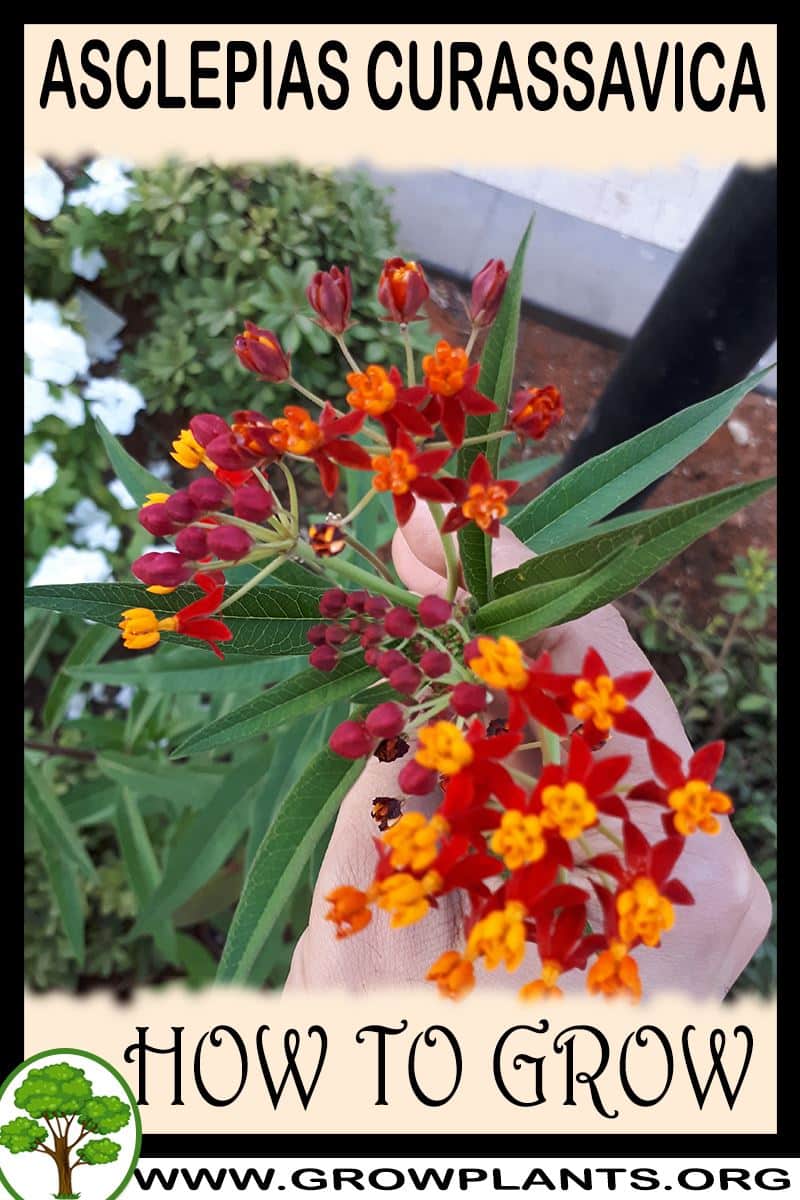
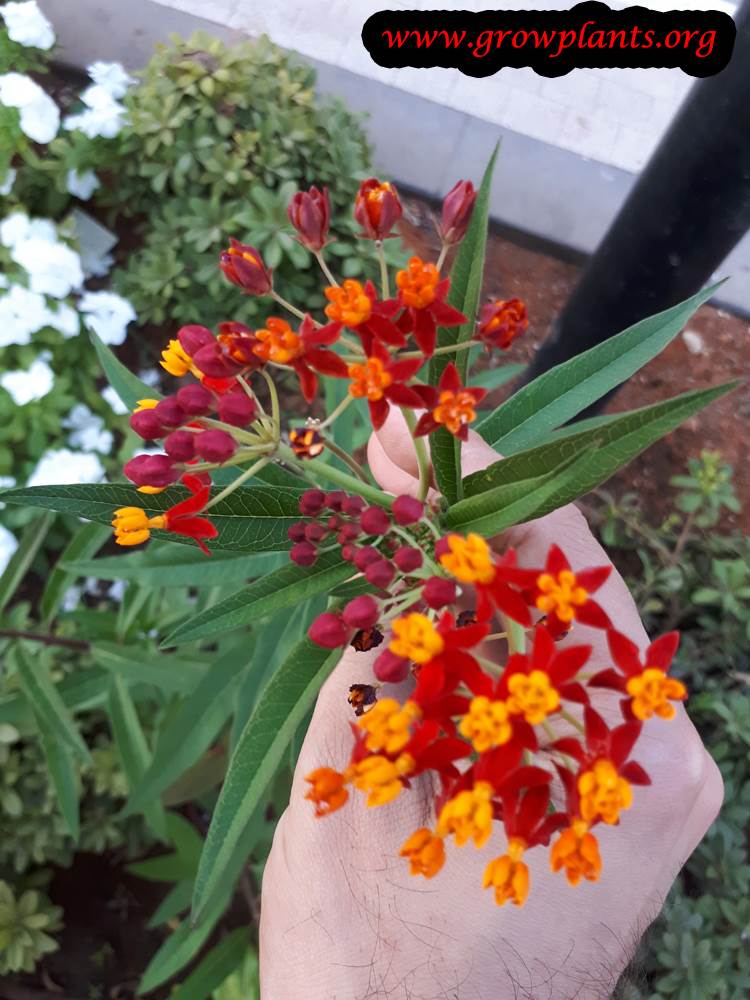
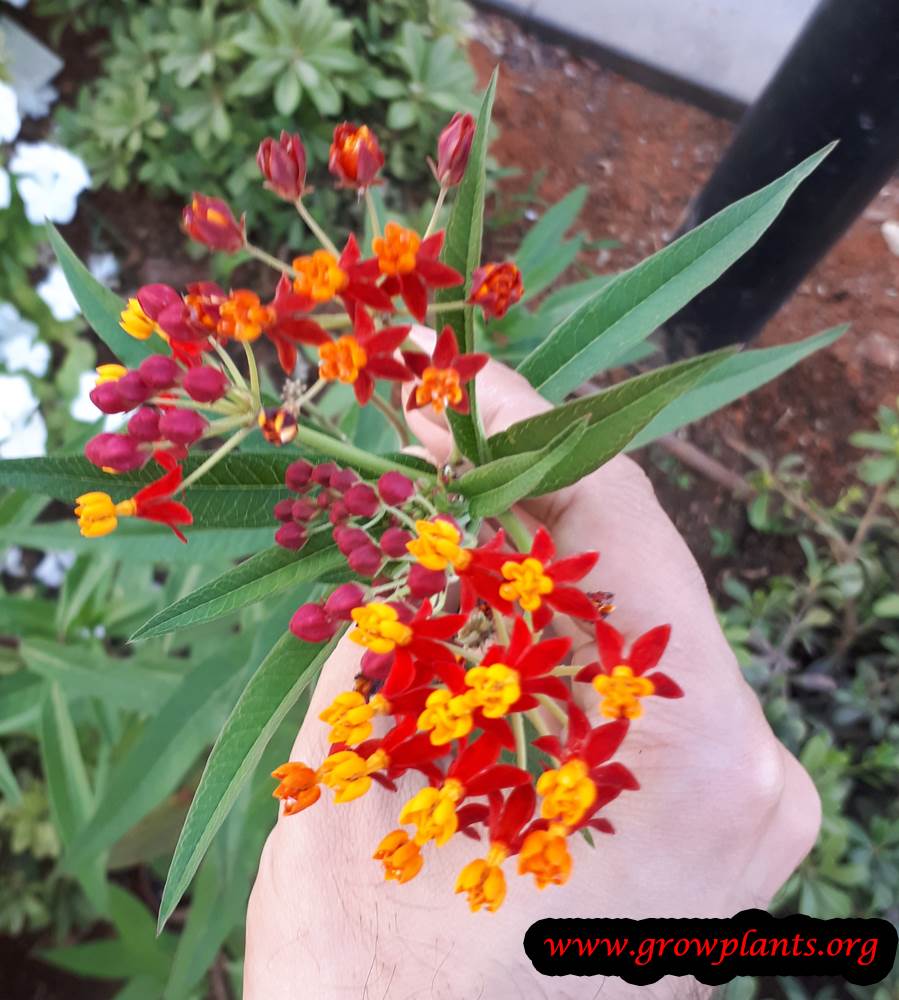
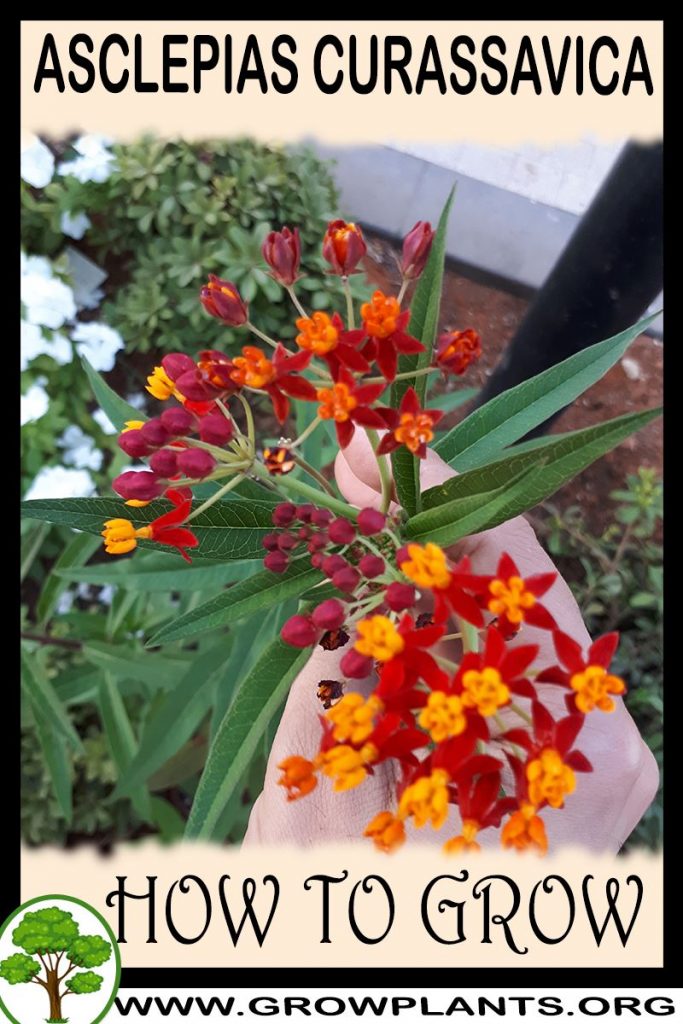
- Flower Characteristics: Clusters of star-shaped orange, yellow or red flowers, a major nectar and larval source for butterflies.
Primary Uses & Landscape Value
- Functional & Ornamental Roles: Ornamental and pollinator/butterfly plant; site with care because of its invasive tendency.
Care Guide: Planting, Soil & Watering
Overview: Tropical milkweed is a fast-growing evergreen perennial that grows in full sun to part shade and prefers consistently moist soil. Unlike its drought-tolerant cousins it likes steady, moderate watering.
Quick Care Requirements
| Requirement | Ideal Condition |
|---|---|
| Planting Season | Spring to summer, in the warm season |
| Growth Rate | Moderate to Fast |
| Soil Type | Moist, well-drained soil |
| Water Need | Moderate – keep evenly moist |
Planting & Establishment
- Best Planting Season: Plant in spring or summer in its frost-free range (zone 8+).
- How to Plant:
- Hole Preparation: Dig a hole about the width of the root ball, loosening the surrounding soil.
- Soil Amendments: Work in organic matter to help hold moisture while still draining.
- Planting Depth: Set at the original soil level with the crown at the surface.
- Growth Speed & Expectations: A moderate-to-fast grower reaching 30-60 cm and blooming spring through autumn.
Soil, Watering & Drainage Care
- Soil Mix & Drainage Needs: Wants moisture-retentive soil that still drains; grows well in containers with regular watering.
- Watering Schedule & Technique:
- Young / Newly Planted: Keep the soil evenly moist while establishing.
- Established: Water regularly to keep the soil moist; it is not drought-tolerant like other milkweeds.
- Seasonal Adjustments: More in heat, a little less in cool weather.
Climate, Light & Hardiness
Tropical milkweed is a fast-growing, warm-climate perennial for tropical, subtropical, Mediterranean and mild temperate gardens, flowering freely in full sun to half shade on moist soil. It is frost sensitive and is often grown as a die-back perennial or annual where winters freeze.
Quick Climate Specifications
| Climate Zones | Tropical, subtropical, Mediterranean, mild temperate |
|---|---|
| USDA Hardiness Zones | 8+ (site data) |
| Optimal Temp Range | Approx. 20–32°C (68–90°F) |
| Cold Damage Begins | Foliage around light frost near 0°C (32°F) |
| Approx. Survival Minimum | Roots may survive light frost in mild parts of its range; hard freezes kill it |
| Frost Tolerance | Low |
| Light Conditions | Full sun to half shade |
Sunlight & Light Exposure
Optimal Light Setup
Full sun gives the strongest stems and most abundant flowers.
Direct Sun Requirement
Direct sun is preferred; light shade is tolerated but reduces bloom.
Shade & Heat Management
Handles heat well with steady soil moisture; no protection needed.
Best Exposure / Orientation
A warm, open, sunny site keeps it flowering over a long season.
Temperature Extremes & Hardiness
USDA Hardiness & Regional Limits
Site data lists it for zone 8 and warmer. Where winters freeze it is commonly grown as a die-back perennial or replanted annual, but it persists and can flower year-round in frost-free climates.
Cold Damage & Winter Protection
Frost blackens foliage near 0°C (32°F); in milder parts of its range the crown may resprout, while a hard freeze kills the plant. A winter mulch helps at the cold margin.
Frost Sensitivity
Low frost tolerance - more tender than the perennial butterfly weed.
Extreme Heat Tolerance
Excellent in tropical and subtropical heat given adequate moisture.
Wind, Humidity & Microclimate
Humidity Preferences
Tolerates moderate to high humidity typical of warm climates.
Dry-Air Tolerance
Moderate; keeps looking best with even soil moisture.
Wind Tolerance
Moderate; the soft stems benefit from some shelter.
Microclimate Recommendations
A warm, sunny, sheltered bed extends flowering and improves overwintering at the cold edge of its range.
Growing in Pots, Balconies & Indoors
Tropical milkweed is not a true houseplant – it wants full sun – but it is a fine container and balcony plant and a magnet for butterflies. In a sunny pot it flowers freely; indoors it only manages on the brightest, sunniest sill.
Quick Details
- Container Size: A 5-10 L pot suits its 30-60 cm (12-24 in) size
- Indoor Suitability: Not a deep-room houseplant – only a very sunny windowsill
- Best Spot: Full sun to half shade – the sunniest balcony or patio
- Soil & Drainage: Aerated, organic-rich mix that drains freely
- Watering in Pots: Average – let the top dry; pots dry fast
Indoors & On the Windowsill
- Houseplant limits: Not a room plant – it needs strong direct sun to bloom and turns leggy in weak light.
- Windowsill growing: The brightest, sunniest sill can work – give it as much direct sun as possible.
- Overwintering: In cold climates it is tender; a potted plant can be moved to a bright, frost-free spot to carry it over, though it is often grown as an annual.
On a Balcony or Patio
- Light & wind: Give it the sunniest corner; walls and railings reflect heat and pots dry fast, so check moisture often. A butterfly favourite on a balcony.
- Safety: The milky sap is toxic and irritant – site it out of reach of children and pets and wash your hands after pruning.
Choosing the Pot, Soil & Long-Term Care
- Pot & drainage: A pot with strong drainage holes; skip a standing-water saucer to avoid root rot. Terracotta breathes and dries faster, glazed or plastic holds moisture longer.
- Potting mix: Well-aerated, organic-rich mix – peat or coir with perlite or vermiculite.
- Feeding: Potted plants exhaust their soil faster as nutrients leach with each watering – feed a little more often than plants in the ground, at reduced strength.
- Repotting: Refresh the mix or pot up about every two years.
Growing this plant in a greenhouse
A greenhouse can give asclepias curassavica frost protection, cold protection, humidity control and extra warmth. In the right climate it may also be kept growing through winter, depending on how much warmth and light are provided.
Greenhouse at a glance
| Greenhouse suitability | Conditional - depends on your climate |
|---|---|
| Main benefits | frost protection, cold protection, humidity control, extra warmth |
| Season extension | earlier spring & later autumn |
| Outdoor protection advisable below | about 5°C |
| Maintain greenhouse minimum | around 5°C for active growth |
| Suitable types | unheated greenhouse, polycarbonate greenhouse, lean-to |
| Heating | Heating is optional - useful mainly for winter growing in cold areas. |
Related greenhouse guides
- Greenhouses: How to Choose the Right Greenhouse
- Best Lean-To Greenhouses
- Polycarbonate Greenhouses: What to Look for Before Buying
Fertilizing & Feeding
A light feeder: an occasional balanced feeding through the warm blooming season plus organic matter is plenty, with high-phosphorus bloom products avoided and feeding held off in winter dormancy.
Quick Fertilizing Specs
| Feeding Level | Light feeder |
|---|---|
| Main Nutrient Priority | Balanced feeding with adequate nitrogen; avoid pushing high phosphorus for bloom |
| Best Feeding Period | Spring through the long warm blooming season |
| Organic Options | Compost and organic matter worked into the bed |
| Reduce/Stop Feeding | Hold off feeding through winter dormancy after cutting back |
| Micronutrients | Usually met by a complete fertilizer and organic matter; correct only diagnosed issues |
| Soil pH | Slightly acidic to near neutral, in well-drained soil |
Feeding by Growth Stage
Spring flush of growth
Support fresh stems and foliage as growth resumes in warm weather.
| Nutrient direction | A balanced complete fertilizer with adequate nitrogen to build the flowering framework. |
|---|---|
| Timing | As growth resumes in spring. |
| Frequency | A light feeding at the start of active growth. |
| Fertilizer types | A balanced complete fertilizer, Compost worked into the bed |
| Precautions | Keep feeding light; this is a tough, low-demand plant and rich feeding gives soft growth and fewer flowers. |
Long warm-season bloom
Sustain steady flowering that feeds pollinators across the warm months.
| Nutrient direction | A balanced complete fertilizer supplies steady flowering; high-phosphorus ‘bloom boosters’ are not needed. |
|---|---|
| Timing | Through the extended spring-to-autumn flowering period. |
| Frequency | Occasional light feeding while in active bloom. |
| Fertilizer types | A balanced complete fertilizer, Compost as a top-dressing |
| Precautions | Avoid high-phosphorus bloom products and heavy nitrogen; balanced feeding with adequate nitrogen drives bloom. |
Winter dormancy after cut-back
Let the plant rest through winter after it is cut back.
| Nutrient direction | None – withhold fertilizer while the plant is not in active growth. |
|---|---|
| Timing | During winter dormancy once stems are cut back. |
| Frequency | No feeding at this stage; resume only when active growth returns. |
| Fertilizer types | No feeding at this stage; hold off fertilizing until active growth resumes. |
| Precautions | Withhold fertilizer now; feeding a plant that is not actively growing wastes nutrients and risks salt buildup in the root zone. |
Nutrient Deficiency Signs & Corrections
Older, lower leaves fade to pale green or uniform yellow and overall growth slows.
| Possible causes | low available soil nitrogen, nitrogen leaching from heavy watering or rain, thin, low-organic-matter soil |
|---|---|
| Appears first on | older, lower leaves |
| What to check | recent feeding history, soil organic matter, watering and drainage |
| Possible correction | Apply a nitrogen-containing complete fertilizer and build soil organic matter, then water evenly. |
Leaf margins and tips brown or scorch and growth stalls despite adequate watering.
| Possible causes | fertilizer salt buildup in the root zone, under-watering that concentrates salts, excessive or too-frequent feeding |
|---|---|
| Appears first on | leaf margins and tips |
| What to check | recent fertilizer amounts, watering consistency, drainage and watering consistency |
| Possible correction | Ease off feeding, water thoroughly to flush accumulated salts from the root zone, then return to lighter feeding. |
Lush leafy growth with sparse flowering after heavy or high-phosphorus feeding.
| Possible causes | excess nitrogen favoring leaves over flowers, belief that high phosphorus forces bloom, overfeeding a naturally low-demand plant |
|---|---|
| Appears first on | whole plant, most visible at bloom time |
| What to check | recent fertilizer type and amount, light exposure, overall feeding frequency |
| Possible correction | Return to light balanced feeding and full sun; do not add high-phosphorus products to force flowering. |
Pruning, Training & Seasonal Maintenance
Tropical milkweed is a soft-stemmed subshrub that blooms on new growth from spring through autumn, so it responds to cutting back by pushing fresh flowering shoots rather than by resenting it. The main jobs are deadheading to prolong bloom and limit its aggressive self-seeding, and — in frost-free areas where it stays evergreen — a hard winter cut-back that renews the plant and helps break the buildup of the monarch parasite Ophryocystis elektroscirrha. It tolerates being cut low and regrows quickly from the base.
Quick Pruning & Maintenance Specs
| Pruning Tolerance | High (regrows readily from the base) |
| Primary Pruning Window | Late winter / early spring in warm zones; or after last frost in colder zones |
| Secondary Maintenance Window | Continuous deadheading, spring–autumn |
| Typical Frequency | Ongoing deadheading plus one annual cut-back |
| Main Objective | Prolong bloom, keep bushy, limit self-seeding, renew foliage |
| Young Plant Priority | Pinch tips for branching |
| Mature Plant Priority | Deadhead and annual renewal cut-back |
| Best Tool Type | Precision snips / light bypass secateurs |
| Avoid Heavy Pruning During | Active monarch caterpillar feeding; hard frost periods |
Pruning by Plant Age & Size
Newly Established
Minimal. Remove only broken or aphid-fouled stems. Let the seedling build a full root system before any hard cutting.
Young / Formative
No structural framework is needed on a 30–60 cm subshrub. Simply pinch the growing tips once or twice to force side branches and a bushier, more floriferous habit.
Mature / Established
Deadhead spent flower clusters through the season, and cut the whole plant back hard once a year to refresh it. Because bloom comes on new wood, this cutting drives the next flush rather than sacrificing it.
Seasonal Pruning Schedule
Late Winter / Early Spring — Renewal cut-back
Objective: reset an evergreen plant and force clean new growth. Cut all stems down to about 10–15 cm. In monarch regions this winter cut is specifically recommended to strip OE-contaminated foliage and discourage monarchs from breeding on out-of-season leaves. Expected response: vigorous basal regrowth and stronger flowering.
Spring–Autumn — Ongoing deadheading
Objective: keep new flowers coming and stop unwanted seedlings. Remove faded umbels just above the next leaf pair before the slender pods split. Do NOT strip healthy foliage that caterpillars may be using.
Flowering & Fruiting Wood
Flowers form on current-season shoots, so any cutting that stimulates new growth ultimately increases bloom. Deadheading before the follicles (pods) mature both extends flowering and curbs the plant’s self-sowing, which is important because it is classed as invasive in warm climates. There is no persistent flowering wood to protect — cut with the season, not against it.
Structural Pruning & Training
Treat this as a herbaceous renewal plant, not a woody framework. Thin out weak or leggy stems at the base and rely on the annual hard cut-back rather than selective canopy shaping.
Special Growth to Remove
Remove spent flower stems and developing seed pods to control reseeding, and rogue out excess self-sown seedlings around the plant. There are no suckers or watersprouts to manage.
Container & Small-Space Pruning
In pots, pinch early and often for a compact, self-supporting mound, and deadhead diligently — confined roots plus free seeding can quickly crowd a container. The same hard late-winter cut-back keeps a potted plant tidy.
Tools
Everything here is soft-stemmed: precision snips handle deadheading and pinching, while light bypass secateurs are enough for the annual basal cut-back. No saw or loppers are ever required.
Tool Hygiene & Disease Risk
Routine — clean, sharp blades are sufficient; there is no notable transmissible pathogen here. The relevant hazard is the milky latex sap, which is a skin and eye irritant: wear gloves and avoid touching your face. Oleander aphids often coat the stems, so wipe blades if you cut through infested growth.
Cut Placement & Technique
Deadhead just above the next leaf pair or lateral bud so regrowth breaks cleanly. For the renewal cut, take all stems low to a few centimetres of live base. Pinch soft tips with fingers or snips.
Heavy Pruning & Rejuvenation
Fully tolerated. A near-ground cut-back is the standard annual renewal and the plant reflushes within weeks in warm weather. Any temporary flower loss is quickly repaid by fresh blooming shoots.
Post-Pruning Care
Water normally to fuel regrowth; do not force-feed, as the plant rebounds without it. After a hard winter cut in a warm zone, keep an eye out for returning aphids on the tender new shoots.
Common Pruning Mistakes
- Never cutting evergreen plants back, allowing OE parasite loads to build on old foliage.
- Letting pods ripen and split, seeding the plant everywhere.
- Stripping foliage that monarch caterpillars are actively feeding on.
When NOT to Prune
Avoid hard cutting while caterpillars are feeding, and hold off on the renewal cut until frost danger has passed in colder zones (fresh regrowth is frost-tender).
Recommended Tools (by task)
- precision_snips — deadheading and tip-pinching on soft stems.
- bypass_secateurs — the once-a-year low renewal cut-back.
Pruning Troubleshooting
| Problem | Possible Cause | What to Check | Corrective Action |
| Leggy, sparse plant | Never pinched or cut back | Long bare stems, few branches | Pinch young growth; hard cut-back to force basal branching |
| Short bloom period | Pods left to form | Seed follicles developing | Deadhead promptly above a leaf pair to keep new flowers coming |
| Seedlings everywhere | Pods split and self-sowed | Volunteer plants nearby | Remove pods before they open; rogue out unwanted seedlings |
Propagation Guide
Tropical milkweed germinates easily from fresh seed without any cold treatment and also roots quickly from soft stem cuttings, so both are simple options. Seed comes fairly true to the species, and the plant self-sows freely — enough to be invasive in warm climates — so deadhead if you want to limit it.
Quick Propagation Specs
| Best Propagation Method | Seed |
| Alternative Methods | Softwood stem cuttings |
| Propagation Difficulty | Easy |
| Seed True-to-Type | Mostly uniform (species) |
| Vegetative True-to-Type | Yes |
| Best Propagation Season | Spring–summer, in warmth |
| Germination Temperature | Warm, about 21–27°C (70–81°F) |
| Cutting Rooting Time | A few weeks in warm, humid conditions |
| Seed Sowing Depth | Barely covered |
Growing from Seed
Seed Handling & Viability
Sow the plumed seed fresh from the pods for best results; unlike its hardy relatives it needs no cold stratification.
Sowing Season
Spring into summer, when warm.
Sowing Depth & Orientation
Barely cover the seed.
Germination Conditions
Warm, around 21–27°C (70–81°F), and moist; germination is usually prompt.
Stem Cuttings
Cutting Type
Soft, non-woody shoots — this species has a fibrous root system rather than a taproot, so cuttings root well.
Cutting Preparation
Let the milky sap dry at the cut before inserting.
Rooting Setup
Warm, humid, in a moist free-draining medium.
Rooting Time
A few weeks under warmth.
Bloom & Flower Guide
Quick Details
- Bloom Season: Spring through autumn (nearly year-round in frost-free areas)
- Flower Appearance: Star-shaped flowers in clusters, in orange, yellow or red – often bicolored red-and-yellow
- Edibility: Not edible – toxic (cardiac glycosides)
Detailed Blooming Overview
A tender evergreen milkweed that flowers over a very long season, drawing monarchs and other butterflies. In warm climates it can bloom almost continuously.
Flower Characteristics
- Star-shaped flowers in rounded clusters.
- Colors range through orange, yellow and red, frequently two-toned.
Bloom Care & Thinning
- Managing the bloom: Deadhead for repeat flushes. In frost-free areas, cutting tropical milkweed back periodically is wise – year-round growth can build up a parasite that harms monarchs.
- Pollination: By butterflies and bees.
- Safety: Sap is toxic if eaten; handle with care.
Bloom Health & Protection
- Oleander (milkweed) aphids: Yellow aphids that mass on buds and flower stalks; a strong spray of water or an insecticidal soap or neem oil helps.
Pests, Diseases & Troubleshooting
Overview: Tropical / scarlet milkweed (Asclepias curassavica) is a milkweed (Apocynaceae) grown to feed pollinators and monarchs, so pest ‘management’ is deliberately hands-off: the ever-present oleander aphid, milkweed bugs, tussock and monarch caterpillars are largely tolerated as part of its ecology. Its real cultural risk is crown/root rot in wet soil. Monarch caterpillars (Danaus plexippus) will defoliate the plant – but this is the whole point of growing milkweed and is beneficial, not a pest problem; plants regrow.
Quick Troubleshooting Overview
| Issue / Pest | Main Symptom | Primary Solution |
|---|---|---|
| Oleander aphid | Yellow aphid clusters on shoots and pods | Tolerate/hose off; light soap only if essential |
| Milkweed / tussock / monarch caterpillars | Chewed or stripped leaves | Tolerate – this is the plant’s purpose; never spray |
| Spider mites / whitefly | Stippling or whitefly clouds (mostly indoors) | Hose foliage, sticky traps, light oil off flowers |
| Leaf spot / rust / mildew | Spots, pustules or powder on leaves | Airflow, base watering, remove affected leaves |
| Crown / root rot | Wilt and blackening at base in wet soil | Sharp drainage, full sun, water sparingly |
| OE parasite / evergreen | Year-round growth harms migrating monarchs | Cut back hard in autumn; prefer natives |
Common Pests & Management
- Oleander / Milkweed Aphid (Aphis nerii):
- Symptoms: Dense clusters of bright yellow-orange aphids with black legs blanketing new shoots, buds and seed pods; honeydew and sooty mould. The classic milkweed pest.
- Prevention & Control: Blast off with water and, importantly, tolerate them where possible – they feed lady beetles, lacewings and parasitic wasps that also support the milkweed’s insect life. If needed, wipe off or use a light insecticidal soap spot-spray, avoiding open flowers and monarch caterpillars.
- Milkweed Bugs (Oncopeltus fasciatus, Lygaeus kalmii):
- Symptoms: Orange-and-black bugs, adults and clustered nymphs, sucking developing seed in the pods; mostly cosmetic and part of the milkweed food web.
- Prevention & Control: Generally tolerate as beneficial biodiversity; if seed-saving, hand-pick or bag pods. Chemical control is rarely appropriate on a pollinator plant.
- Milkweed Tussock Moth (Euchaetes egle):
- Symptoms: Groups of hairy orange, black and white caterpillars that skeletonise older leaves late in the season, sometimes stripping stems.
- Prevention & Control: Tolerate on established plants (they are native specialists); if defoliation is heavy on a young plant, relocate or hand-pick. Avoid sprays that would also kill monarchs.
- Spider Mites, Whiteflies & Mealybugs (Tetranychus, Bemisia, Pseudococcus spp.):
- Symptoms: Stippled bronzed leaves with webbing (mites), or clouds of whitefly and cottony mealybugs with honeydew – most often on greenhouse or indoor-grown plants.
- Prevention & Control: Raise humidity and hose foliage for mites, use yellow sticky traps for whitefly, and spot-treat mealybugs; a light horticultural oil or insecticidal soap where needed, kept off flowers and caterpillars.
- Monarch Caterpillars (beneficial) (Danaus plexippus):
- Symptoms: Bold black-, white- and yellow-banded caterpillars chew leaves, sometimes stripping the plant.
- Prevention & Control: This is a feature, not a fault: milkweed is the sole monarch host. Grow enough plants to share, never spray them, and let the plants regrow – they do so readily.
Diseases & Fungal Issues
- Fungal Leaf Spot (Cercospora, Alternaria, Septoria spp.):
- Symptoms: Brown or purplish rounded spots on leaves in warm, humid, wet-leaf weather; heavy spotting yellows and drops the lower foliage.
- Treatment & Management: Improve airflow, water at the base, and remove spotted and fallen leaves; a copper fungicide only under persistent pressure. Vigorous plants shrug off light spotting.
- Rust & Powdery Mildew (Puccinia asclepiadis / Erysiphales):
- Symptoms: Rusty pustules on leaf undersides (rust) or white powdery patches (mildew) in humid, crowded, late-season conditions.
- Treatment & Management: Space plants for airflow, remove affected leaves, and cut back tired growth; sulfur or potassium bicarbonate for mildew if needed.
- Crown & Root Rot (Phytophthora, Rhizoctonia):
- Symptoms: Wilting, blackening and collapse at the base, especially of the deep-tap-rooted species in heavy, wet soil.
- Treatment & Management: Plant in sharply drained soil and avoid overwatering – avoid waterlogging. Improve drainage and do not disturb the taproot.
- Monarch Parasite (OE) (Ophryocystis elektroscirrha):
- Symptoms: Not a plant disease but a monarch protozoan parasite that builds up on evergreen tropical milkweed kept growing year-round, harming migrating butterflies.
- Treatment & Management: In warm climates, cut tropical milkweed back hard in autumn/winter so it does not stay evergreen; this removes spore build-up and cues natural migration. Consider native milkweeds instead.
Growing Difficulties & Abiotic Problems
- Root Rot from Wet Soil:
- Cause & Symptoms: Milkweed resents heavy, wet or poorly drained soil and rots at the crown/taproot.
- Correction Strategy: Plant in full sun in gritty, free-draining soil, water sparingly once established, and never leave it waterlogged; site it where it can stay on the dry side.
- Slow Spring Emergence:
- Cause & Symptoms: Tropical / scarlet milkweed is late to break dormancy in spring, so bare soil can look empty for weeks and the crown is easily hoed or dug by mistake.
- Correction Strategy: Mark the crown, be patient, and avoid cultivating over it; it reliably reshoots once the soil warms.
- Transplant Shock (taproot):
- Cause & Symptoms: The long taproot resents disturbance, so moved or pot-bound plants sulk or fail.
- Correction Strategy: Plant young and site permanently, sow in place or transplant while small, and avoid root disturbance thereafter.
- Stays Evergreen in Mild Climates:
- Cause & Symptoms: In frost-free areas tropical milkweed keeps growing all winter, which disrupts monarch migration and lets the OE parasite accumulate.
- Correction Strategy: Cut it back hard in autumn/winter to force a rest, or replace with locally native milkweed species.
What Helps – Products & Tools
Because this is a pollinator plant, the lightest touch wins: a water jet and, only if truly needed, insecticidal soap spot-applied away from flowers and caterpillars for aphids; yellow sticky traps for whitefly; and a copper or sulfur fungicide for stubborn leaf spot, rust or mildew. Sharp drainage matters more than any product. For tropical milkweed, secateurs to cut it back in autumn are the key ‘tool’ for monarch health.