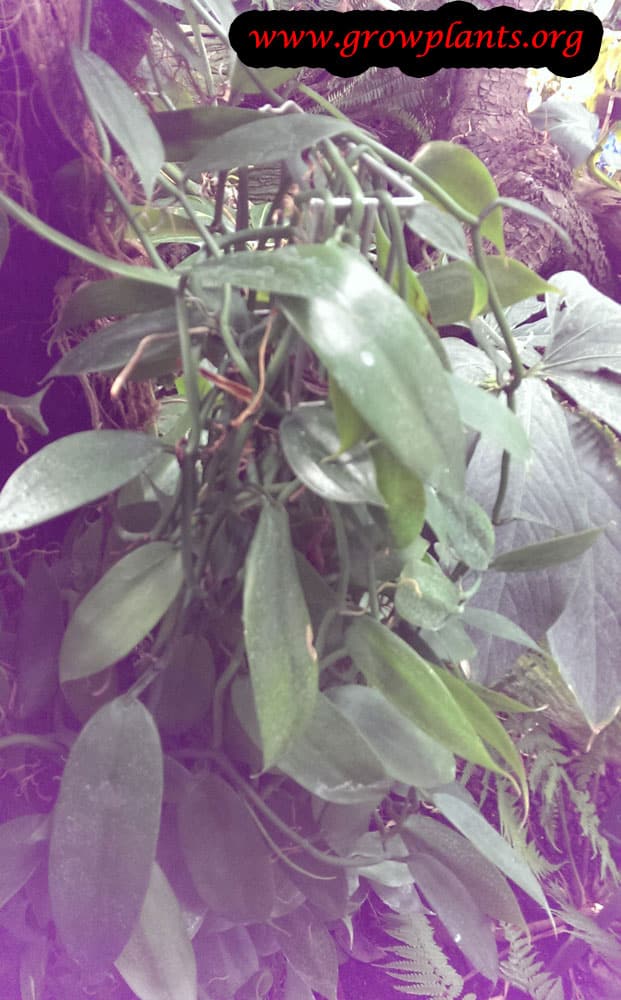
Plant Profile & Key Characteristics
Overview: Vanilla ramosa is a vigorous evergreen climbing orchid vine that can reach 3-20 m (10-60 ft) depending on support, grown ornamentally for its fragrant yellow flowers. It is a strictly tropical perennial (USDA zone 13+) needing high humidity and a sturdy trellis.
Quick Specifications
| Specification | Attribute |
|---|---|
| Plant Type / Life Cycle | Perennial (evergreen orchid vine) |
| Foliage Type | Evergreen |
| Mature Size | 3-20 m (10-60 ft) long, depending on support |
| Growth Rate | Fast to moderate |
| Hardiness | USDA zone 13+ (tropical only) |
Growth Form & Structure
- Height & Spread: 3-20 m (10-60 ft) of climbing length; needs sturdy trellising and can be container-grown in bright light.
- Growth Habit & Form: Climbing, fleshy-stemmed orchid vine that clings by aerial roots.
- Lifespan & Maturity: Long-lived perennial vine.
Anatomy & Physical Features
- Leaves & Foliage: Green, oval, waxy fleshy leaves.
- Flower Characteristics: Fragrant yellow trumpet-like flowers with five tepals, each lasting only briefly.
Primary Uses & Landscape Value
- Functional & Ornamental Roles: Ornamental tropical climber for greenhouses and warm, humid gardens.
Care Guide: Planting, Soil & Watering
Overview: Vanilla ramosa is a tropical climbing vanilla orchid (zone 13+) that needs constant warmth, high humidity and a support to climb. It grows in a loose, moisture-retentive but airy medium and likes generous, steady watering.
Quick Care Requirements
| Requirement | Ideal Condition |
|---|---|
| Planting Season | Year-round in a warm, humid tropical setting |
| Growth Rate | Moderate to Fast |
| Soil Type | Moist, humus-rich and free-draining, with a trellis/support |
| Water Need | High |
Planting & Establishment
- Best Planting Season: Plant at any time of year where it stays warm and humid; give it a trellis, tree or post to climb from the start.
- How to Plant:
- Hole Preparation: Set the base into loose, organic, free-draining ground or medium at the foot of its support.
- Soil Amendments: Blend in plenty of coarse organic matter such as leaf mould or bark so the mix stays moist yet airy around the roots.
- Planting Depth: Plant shallowly and guide the lower stem toward the support; keep the growing tip and stem from being buried.
- Growth Speed & Expectations: A moderate-to-fast climber that can reach 3-20 m (10-60 ft) depending on how it is trained.
Soil, Watering & Drainage Care
- Soil Mix & Drainage Needs: The medium must hold moisture but drain and breathe freely; the fleshy roots rot in soggy, airless soil.
- Watering Schedule & Technique:
- Young / Newly Planted: Keep evenly moist and mist to maintain humidity while it establishes and climbs.
- Established: Water generously and often so the medium stays consistently damp.
- Seasonal Adjustments: Keep up steady moisture year-round in warmth; ease off only in cooler, duller spells.
Climate, Light & Hardiness
Vanilla ramosa is a true tropical vine that needs consistent warmth, high humidity, and moist soil to climb and grow well, typically trained onto a trellis or support. It has no meaningful frost tolerance and is only suited to outdoor culture in consistently warm, frost-free climates.
Quick Climate Specifications
| Factor | Detail |
|---|---|
| Climate Zones | Tropical |
| USDA Hardiness Zones | 13+ |
| Frost Tolerance | None |
| Light Conditions | Full sun |
Sunlight & Light Exposure
Optimal Light Setup
Full sun is preferred, supporting strong vine growth and flowering.
Best Exposure/Orientation
An open, sunny position with a sturdy trellis or support suits it outdoors in warm climates; indoors, the site notes it needs a window or spot with a lot of sun.
Temperature Extremes & Hardiness
USDA Hardiness & Regional Limits
Site data places this species in hardiness zone 13 and warmer, indicating a need for consistently warm, essentially frost-free, truly tropical conditions for outdoor growth; the source data does not give a specific numeric cold-damage or survival-minimum temperature, but a tropical vine of this hardiness range should be assumed to have little to no cold tolerance.
Cold Damage & Winter Protection
No specific threshold is established in the site data; as a precaution, growth should be expected to suffer well before temperatures approach freezing, and the vine should be kept warm and, where grown outside the tropics, indoors or in a heated greenhouse over winter.
Frost Sensitivity
Frost sensitive; any frost exposure should be treated as damaging to fatal.
Wind, Humidity & Microclimate
Humidity Preferences
High humidity is important for healthy growth, consistent with its tropical origin.
Dry-Air Tolerance
Low; dry air should be offset with misting or by growing in a naturally humid environment.
Wind Tolerance
Low; as a climbing vine on a trellis, it benefits from a sheltered position out of strong wind, which can damage new growth and flowers.
Rainfall & Seasonal Moisture
Needs consistently moist soil and humid air rather than a pronounced dry season, in keeping with its tropical rainforest origin.
Microclimate Recommendations
A warm, humid, sunny spot with a trellis for support and shelter from strong wind – a tropical greenhouse or sheltered sunny courtyard – suits Vanilla ramosa well outside its native climate.
Growing in Pots, Balconies & Indoors
Vanilla ramosa is the vanilla orchid – a long tropical climbing vine. The grower says it can be grown indoors, but only at a window or a place with a lot of sun, and it will need a support to climb. In a pot it can be kept and trained, though it wants warmth, humidity and bright light to do well.
Quick Details
- Container Size: A vigorous vine (can reach 3-20 m / 10-60 ft depending on how you train it) – a sturdy pot with a climbing support
- Indoor Suitability: Only at a bright, sunny window with strong light and a support to climb
- Best Spot: Full sun / very bright light; warm and humid
- Soil & Drainage: Open, free-draining orchid/coarse mix; never waterlogged
- Watering in Pots: Big amount of water with high humidity; let the surface dry a little between waterings
Indoors & On the Windowsill
- Bright window only: The grower says indoors works only right at a window or a very sunny spot – Vanilla ramosa needs strong light and will sulk in a dim room.
- Give it a climb: Provide a moss pole, trellis or stake; the vine climbs and can be trained and pruned to keep it in bounds in a container.
- Warmth & humidity: Keep it warm and humid – mist regularly or stand it in a humid spot. Not frost-hardy, so it lives indoors over winter in cold climates.
On a Balcony or Patio
- Light & shelter: Outdoors in warm weather give it bright light with some protection from the fiercest midday sun, plus a support to climb. Pots against warm walls dry fast – water and mist often.
- Bring it in: Move it indoors well before cold nights; it is strictly tropical.
Choosing the Pot, Soil & Long-Term Care
- Pot & support: A sturdy, stable pot with strong drainage holes and a tall support for the vine to climb; never leave it standing in water.
- Potting mix: A loose, free-draining orchid-style mix (bark and coir with perlite) that holds some moisture but drains fast.
- Feeding: Feed regularly with a dilute orchid or balanced fertiliser through the growing season – a fast vine in a pot uses nutrients quickly.
- Repotting: Pot on or refresh the mix every couple of years and retie the growing stems to their support.
Fertilizing & Feeding
A light feeder for a fast-growing tropical vine: it roots and climbs vigorously in humid, evenly moist conditions, but its thick, fleshy roots are easily burned by concentrated fertilizer, so light, steady feeding through active growth works better than a strong dose.
Quick Fertilizing Specs
| Feeding Level | Light feeder |
|---|---|
| Main Nutrient Priority | A weak, balanced fertilizer that supports steady vine and leaf growth without pushing soft, rot-prone growth |
| Best Feeding Period | Through the warm, actively growing months when the vine is putting out new leaves and climbing |
| Organic Options | Compost or well-rotted organic matter worked into the growing medium, plus a diluted organic liquid feed for container plantings |
| Micronutrients | Usually supplied by a complete, weak fertilizer intended for container or epiphytic plants |
| Soil pH | Grown in a moist, well-drained, humus-rich medium; near neutral to slightly acidic conditions suit it best |
| Reduce/Stop Feeding | Ease off feeding when grown indoors through the darkest, coolest part of the year as growth slows |
Feeding by Growth Stage
Newly planted vine
Help a newly planted or freshly rooted cutting establish itself on its support and begin climbing.
| Nutrient direction | A weak, balanced fertilizer kept light, alongside organic matter worked into the moist growing medium. |
|---|---|
| Timing | At planting and through the first weeks of rooting in. |
| Frequency | Light, infrequent feeding while the vine is settling in. |
| Fertilizer types | A weak, balanced complete fertilizer, Compost or organic matter mixed into the growing medium |
| Precautions | Keep fertilizer weak while roots are still establishing; overfeeding a newly planted vine risks root and stem rot in its constantly moist growing medium. |
Active climbing growth
Support vigorous vine growth, waxy oval leaves, and trellis climbing through the warm growing season.
| Nutrient direction | A weak, balanced fertilizer applied regularly rather than as a single strong dose. |
|---|---|
| Timing | Through the warm months whenever the vine is actively producing new growth. |
| Frequency | Regular light feedings support steady climbing growth better than occasional heavy applications. |
| Fertilizer types | A weak, balanced complete fertilizer diluted for container or trellis plantings, A fertilizer suited to humus-rich, constantly moist growing media |
| Routine trace nutrients | iron, manganese |
| Precautions | Avoid concentrated fertilizer on this vine’s thick, fleshy roots, and keep the growing medium well drained even though it should stay evenly moist. |
Indoor winter slowdown
Let growth ease during the darkest, coolest part of the year for vines grown indoors outside their tropical range.
| Nutrient direction | None – withhold fertilizer while growth has slowed. |
|---|---|
| Timing | The lowest-light, coolest months for indoor or greenhouse plantings. |
| Frequency | No feeding at this stage. |
| Fertilizer types | No feeding at this stage; resume light feeding once active growth picks up again. |
| Precautions | Do not fertilize while growth is slow; keep humidity up and avoid letting the medium dry out completely. |
Nutrient Deficiency Signs & Corrections
Older leaves fade toward pale green and new vine growth slows and comes in smaller than expected.
| Possible causes | long stretches without feeding during active growth, poor or leached growing medium, root stress from overly wet or poorly drained conditions limiting uptake |
|---|---|
| Appears first on | older leaves |
| What to check | recent feeding history, medium drainage and condition, root health |
| Possible correction | Resume light, regular balanced feeding through the growing season. |
New leaves emerge pale yellow-green while the veins stay noticeably darker green.
| Possible causes | waterlogged or poorly aerated growing medium limiting root function, a growing medium or water source outside the range this vine prefers, an extended period without micronutrient feeding |
|---|---|
| Appears first on | newest leaves |
| What to check | medium drainage and aeration, water quality, recent feeding history |
| Possible correction | Improve drainage first, then apply a chelated iron product per its label if chlorosis persists. |
Leaf tips or margins brown and scorch on container-grown vines despite regular watering.
| Possible causes | fertilizer salt buildup in a container or bed, under-watering that concentrates salts in the medium, too-frequent or overly concentrated feeding |
|---|---|
| Appears first on | leaf margins and tips |
| What to check | recent fertilizer strength and frequency, watering consistency, drainage |
| Possible correction | Ease off feeding and flush the growing medium thoroughly with water, then return to lighter feeding. |
Pruning, Training & Seasonal Maintenance
Vanilla ramosa is a climbing hemi-epiphytic vine that can run anywhere from 3 to 20 m depending purely on how it is trained, so pruning here is primarily about controlling that size against a trellis rather than shaping a woody framework. Its own guidance keeps this simple: trim dead leaves as they occur, which can be done any time of year since the plant has no fixed dormant season. Flowers form along lateral growth off the climbing vine rather than on old persistent wood, so training the vine’s direction and length has more influence on flowering position than any specific pruning date does.
Quick Pruning & Maintenance Specs
| Pruning Tolerance | Moderate – tolerates trimming and tip control; avoid removing large sections of actively climbing vine |
| Primary Pruning Window | Any time (no fixed seasonal window) |
| Secondary Maintenance Window | Ongoing, for dead leaves |
| Typical Frequency | Light, continual grooming as the vine extends |
| Main Objective | Keep the vine trained to its support and at a manageable size |
| Young Plant Priority | Establish the vine onto its trellis/support early |
| Mature Plant Priority | Pinch or loop growing tips to control length; remove dead leaf tissue |
| Best Tool Type | Precision snips or bypass secateurs |
| Avoid Heavy Pruning During | While a section is actively flowering |
Pruning by Plant Age & Size
Newly Established
Tie the young vine loosely to its trellis or support and remove only damaged leaf tissue; let the plant put its energy into climbing roots first.
Young / Formative
Train the vine along its support (staking/trellising), guiding its direction rather than heading it back – this is a training system by direction, not a leader/vase framework.
Mature / Established
Pinch or cut back an actively extending growing tip once the vine has covered its support space, which encourages lateral branching lower down rather than letting all growth run to one long unbranched length.
Seasonal Pruning Schedule
Ongoing Sanitary
Objective: keep the vine’s leaves and support clean year-round, since there is no single dormant or pruning season. Remove: dead or yellowed leaves. Do not remove: healthy climbing aerial roots along the vine, which anchor it to its support and take up moisture/nutrients. Expected response: continued vine extension along the trellis. Flowering impact: minimal from leaf trimming; cutting the growing tip redirects growth into laterals, which is where new flowers will form.
Structural Pruning & Training
Training the vine’s route along a trellis or support is the main structural task; tip-pinching an over-extended leader encourages branching and keeps the plant from running its full 20 m potential length unchecked in a garden setting.
Special Growth to Remove
Dead or damaged leaves; any vine section that has died back from the tip.
Container & Small-Space Pruning
In a container or smaller garden space, keep the vine compact by pinching growing tips regularly and looping lateral growth back onto the support rather than letting it climb unchecked to its full potential length – the plant’s own facts note its size is design-dependent.
Tools
Precision snips for tip-pinching and leaf trims; bypass secateurs for firmer, older vine sections if length reduction is needed.
Tool Hygiene & Disease Risk
Increased – this plant’s own facts note fungal disease susceptibility, so use clean tools and avoid working on wet foliage to limit spreading fungal pathogens between cuts.
Cut Placement & Technique
Pinch or cut just above a leaf node so a lateral shoot can develop from that point; avoid cutting through the aerial roots that anchor the vine to its support.
Heavy Pruning & Rejuvenation
Not typically needed – this vine is usually managed by ongoing tip control rather than periodic hard rejuvenation; a severely overgrown, tangled vine can be cut back to a framework of main stems on the support, but expect a slow recovery given the plant’s moderate growth rate.
Post-Pruning Care
Maintain the moist soil and high humidity this species needs after any cutting; watch cut tips for fungal issues given the plant’s noted fungal susceptibility.
Common Pruning Mistakes
Cutting through climbing aerial roots instead of around them; letting the vine run unchecked until it outgrows its support; pruning while a section is in active flower.
When NOT to Prune
Avoid cutting back sections that are actively flowering; avoid heavy pruning in prolonged wet conditions given the fungal disease risk noted for this plant.
Recommended Tools (by task)
- precision_snips – tip-pinching and leaf trims on soft new growth.
- bypass_secateurs – firmer, older vine sections when length reduction is needed.
- soft_ties_stakes – training the climbing vine to its trellis/support.
Propagation Guide
Vanilla ramosa is propagated vegetatively from vine cuttings, matching the site’s own confirmation that vegetative reproduction is necessary; seed is not a practical option since, like other orchids, Vanilla seed requires specialist sterile-culture germination and is essentially never used by growers. Cuttings root readily under warm, humid conditions, making vegetative propagation the easy and standard method for this vining orchid.
Quick Propagation Specs
| Best Propagation Method | Vine (stem) cuttings |
| Propagation Difficulty | Easy to Moderate |
| Vegetative True-to-Type | Yes |
| Best Propagation Season | All year, matching the plant’s year-round planting season |
Stem Cuttings
Take cuttings from healthy sections of vine carrying several nodes, and lay or train them along a support in moist, humid conditions similar to those needed by the mature plant, but kept a little more consistently moist while roots form. Roots typically emerge from the nodes within a few weeks under warm, humid conditions; exact timing varies with temperature and cutting freshness.
Bloom & Flower Guide
Quick Details
- Bloom Season: Year-round in the tropics; spring to summer in cooler areas
- Flower Appearance: Fragrant yellow flowers with five tepals and a trumpet-like throat
- Edibility: Ornamental – the flower itself is not eaten
Detailed Blooming Overview
This climbing vanilla orchid produces fragrant yellow flowers whose inner segments roll into a trumpet-like throat. The blooms are famously fleeting – each opens for less than a day – so where pods are wanted the flowers are usually pollinated by hand, or by the specialised Melipona bees that visit them in the tropics.
Flower Characteristics
- Yellow flowers, fragrant, with five tepals and a trumpet-shaped centre.
- Very short-lived – open only briefly.
- Borne along the climbing vine.
Bloom Care & Thinning
- Pollination: Because the flowers open for less than a day, hand-pollinate in the morning if you want pods to set; otherwise Melipona bees do the work.
- Support & warmth: Give the vine a support to climb and steady tropical warmth to encourage flowering.
Pests, Diseases & Troubleshooting
Overview: This wild African vanilla vine shares the genus profile: the soil-borne Fusarium and Phytophthora rots are the main threats, with anthracnose, scale, mealybug and snails secondary. As with all vanilla, sharp drainage, clean cuttings, airflow and dappled shade prevent most trouble.
Quick Troubleshooting Overview
| Issue / Pest | Main Symptom | Primary Solution |
|---|---|---|
| Scale & mealybug | Bumps/cottony tufts, sooty mould | Wipe off; horticultural oil |
| Snails/slugs | Chewed tips, roots and pods | Sanitation; hand-pick; iron-phosphate bait |
| Fusarium root/stem rot | Vine yellows, wilts, blackens at base | Sterile media; drainage; rogue plants |
| Phytophthora rot | Water-soaked black stem/pod lesions | Airflow; drier; copper; remove tissue |
| Anthracnose | Sunken dark spots on stems/pods | Sanitation; airflow; copper if needed |
Common Pests & Management
- Scale insects (Coccoidea):
- Symptoms: Immobile brown, tan or waxy-white bumps along stems and leaf veins; yellowing, weak growth, honeydew and sooty mould with soft (unarmoured) scales. Hard scales sit tight and do not wipe off easily.
- Prevention & Control: Rub off light infestations by hand or with a soft brush; prune out heavily encrusted stems. Conserve parasitic wasps and predatory beetles that keep scale in check. For active crawlers, apply horticultural oil to smother them, repeating as new crawlers emerge; oils give the best organic control against the protective waxy shell.
- Mealybugs (Pseudococcidae):
- Symptoms: White, cottony, waxy tufts tucked into leaf axils, stem joints and along veins; sticky honeydew, sooty mould and slow, distorted growth. Heavy infestations weaken the plant.
- Prevention & Control: Isolate affected plants; dab visible colonies with a cotton bud dipped in horticultural oil or diluted alcohol; wash off honeydew. Support natural enemies such as ladybirds and lacewings, and the mealybug destroyer beetle under cover. Persistent cases respond to repeated horticultural oil or insecticidal soap, reaching hidden crevices where the females shelter.
- Snails and slugs (Gastropoda):
- Symptoms: Chewed tender growing tips, aerial roots and young pods, plus notched leaves and slime trails; damage mainly at soil level and on low vines in damp shade.
- Prevention & Control: Keep the base clean, hand-pick after dark, and trap with cut fruit or beer traps; raise vines off the wet ground. Iron-phosphate bait is the wildlife-safer option where numbers are high.
- Stem weevils / beetles (Curculionidae):
- Symptoms: Small holes and gouges bored into the fleshy stems and pods, sometimes with oozing and entry points that invite rot; chewed young shoots.
- Prevention & Control: Inspect regularly and hand-pick beetles, keep the planting tidy, and protect wounds. Because stem injuries open the door to Fusarium and Phytophthora, prompt sanitation and avoiding damage matter more than spraying; use neem as a deterrent if pressure is high.
Diseases & Fungal Issues
- Fusarium root and stem rot (Fusarium oxysporum f. sp. vanillae):
- Symptoms: The most serious vanilla disease: roots and the stem base brown and rot, vines yellow, shrivel and wilt from the ground up, and whole plants collapse; worst in wet, compacted, poorly drained media.
- Treatment & Management: Prevention is everything: plant in loose, sharply drained, high-organic media on a raised base, avoid waterlogging and stem wounds, and use clean, disease-free cuttings and sterile tools. Remove and destroy affected vines; Trichoderma bio-fungicides and good drainage protect healthy roots — there is no cure once established.
- Phytophthora stem and pod rot (Phytophthora spp.):
- Symptoms: Water-soaked, dark brown to black lesions on stems, leaves and developing pods that spread and shed the pods; splashing rain and high humidity drive it.
- Treatment & Management: Improve airflow and reduce leaf wetness, prune and trellis for an open canopy, and avoid overhead watering. Remove infected tissue and fallen pods. A copper fungicide applied preventively in wet spells checks spread; keep the crown and base on the dry side.
- Anthracnose (Colletotrichum spp.):
- Symptoms: Sunken dark brown spots with yellow halos on leaves, stems and pods, sometimes with pinkish spore masses; spots enlarge and can girdle stems in warm, humid weather.
- Treatment & Management: Prune for airflow, remove infected plant parts, and avoid wetting foliage and overhead irrigation. Keep vines vigorous but not soft. Copper-based fungicides give protection under high humidity; sanitation of pruning tools limits spread.
- Mosaic viruses (CymMV / potyviruses):
- Symptoms: Chlorotic mosaic, mottling and streaking on leaves, distortion and reduced vigour; symptoms persist and cannot be cured.
- Treatment & Management: Use virus-tested planting stock, rogue out symptomatic vines, and sterilise cutting tools between plants; control the aphids and other sap-suckers that spread these viruses.
Growing Difficulties & Abiotic Problems
- Sunburn and light stress:
- Cause & Symptoms: Bleached then brown scorched patches on leaves exposed to direct, intense sun; vanilla is an understorey vine needing dappled shade (about 50% light).
- Correction Strategy: Grow under filtered light or shade cloth and acclimatise gradually to any increase in light; too little light, though, gives weak, non-flowering vines, so aim for bright dappled shade.
- Poor rooting / dieback of cuttings:
- Cause & Symptoms: New cuttings fail to root, blacken at the base or die back, often from cold, sodden or infected media.
- Correction Strategy: Root in warm, humid, airy conditions in loose, well-drained media, keep it barely moist rather than wet, and use clean cuttings and tools; provide the warmth and humidity the tropical vine needs.
- Nutrient and salt issues:
- Cause & Symptoms: Tip scorch or pale, weak growth from over-feeding, salt build-up or, conversely, starvation in poor media.
- Correction Strategy: Feed lightly and regularly with a balanced feed and mulch with organic matter, flushing occasionally with plain water; maintain the airy, humus-rich root run vanilla prefers.
What Helps — Products & Tools
Vanilla is managed mostly by culture and sanitation: sterile tools and clean cuttings, sharp drainage and Trichoderma against the killer Fusarium and Phytophthora rots, copper fungicide for anthracnose and Phytophthora in wet spells, and horticultural oil/insecticidal soap for scale and mealybug, with iron-phosphate bait for snails. There is no cure for virus — rogue and sterilise.